AI Receptionist for Plumbers: Never Miss a Call Again
An AI receptionist for plumbers answers burst-pipe calls at 2am, qualifies emergencies, and routes jobs to your on-call tech — no night-shift hire needed.

TL;DR: A pipe bursts at 11pm and the homeowner starts calling plumbers down the search results page — the first one to answer gets the $2,500 job. Home service businesses miss 27% of inbound calls, and 85% of callers who hit voicemail never call back (Invoca). An AI receptionist for plumbers is the front-desk function that never sleeps: it answers on your website, WhatsApp, and social DMs, asks the qualifying questions a dispatcher would ask (burst pipe or slow drain? water shut off? address?), and routes true emergencies to your on-call tech in seconds. It is chat-first, not a phone system — voice is on Hyperleap's roadmap — so it works alongside your existing phone answering setup, not instead of it. Plans start at $40/month, a fraction of a full-time or after-hours receptionist.
AI Receptionist for Plumbers: Never Miss a Call Again
It's 11:47pm. A homeowner's water heater has just let go, and there's an inch of water spreading across the laundry room floor. They don't scroll past page one. They call the first plumber that shows up, then the second, then the third — whichever one answers first gets the job. Two out of three plumbers on that list will hit voicemail. According to Invoca, home service businesses miss 27% of their inbound calls, and 85% of callers who reach voicemail never call back. That is not a small leak in your pipeline. That is the job walking straight to your competitor.
This is the exact scenario an AI receptionist exists to fix — not by replacing your dispatcher, but by covering the gap between "the phone rings" and "someone answers," 24 hours a day, every day of the week. This guide covers how a chat-based AI receptionist works specifically for plumbing businesses: what it does with an overflow call, how it handles after-hours coverage, what qualifying questions it should ask to separate a true emergency from a routine job, and how it routes work to the right technician without you staffing a night shift. For the full picture of how AI agents for plumbing companies handle everything from quote requests to review generation, that pillar page covers the broader deployment; this article zeroes in on the receptionist function specifically.
We'll also be straight with you about what it doesn't do today: Hyperleap's AI receptionist is chat-first — website, WhatsApp, Instagram DM, and Facebook Messenger — not a phone answering system. If most of your emergency calls genuinely come in by phone, you'll want to pair it with a phone answering setup or a dedicated call-handling product. More on that trade-off below.
What Is an AI Receptionist for Plumbers?
An AI receptionist for plumbers is a chat-based system that performs the front-desk job your dispatcher does during business hours — answering inquiries, asking qualifying questions, and getting the right information to the right person — but running continuously, including nights, weekends, and the 2am moments when a pipe actually bursts. It is not a phone system. It operates on the channels a plumbing business already gets inbound demand through outside of the phone line: the "Contact Us" chat widget on your website, WhatsApp, Instagram DMs, and Facebook Messenger.
For a plumbing business specifically, that front-desk function needs to do four things well:
- Answer immediately, any hour. No hold music, no "we're closed, please call back."
- Separate emergency work from planned work. A burst pipe and a dripping faucet are not the same call.
- Ask the questions a human dispatcher would ask. Water shut off? Address? Type of fixture? Access to the property?
- Get the details to a person who can act. Route true emergencies to an on-call tech immediately; queue planned work for the morning schedule.
This differs from a generic chatbot in one important way: a generic FAQ bot answers "what are your hours?" and stops there. An AI receptionist is built around capturing and qualifying a lead, not just answering a question — closer to what a $40,000/year dispatcher does than what a website widget does. If you want the deeper technical walkthrough of how the chatbot itself handles plumbing-specific conversations (drain snaking, water heater troubleshooting, quote requests), we've covered that in our guide to AI chatbots for plumbing businesses — this article focuses specifically on the receptionist function: call overflow, after-hours coverage, and dispatch routing.
Chat-first, not phone-first — read this before you build a plan around it
Hyperleap's AI receptionist works on your website chat widget, WhatsApp, Instagram DM, and Facebook Messenger. It does not answer phone calls — voice is on the roadmap, not shipped today. If the bulk of your emergency inquiries genuinely arrive as phone calls, an AI receptionist works best paired with your existing phone answering service, not as its replacement. See our AI receptionist vs. answering service comparison for how the two fit together.
Why Plumbers Lose Jobs to Slower Competitors
The call overflow reality
Plumbing businesses are structurally bad at answering every call, and it isn't a staffing failure — it's math. A two-truck operation with one dispatcher can't take a second call while handling the first, can't answer while driving to a job site, and can't answer at all after the office closes. Invoca's research puts the industry-wide missed-call rate at 27% across home service businesses. For a plumbing company running $45–$95 in Google Ads spend per lead, a missed call isn't just a lost job — it's a paid-for lead thrown away.
The after-hours gap
Plumbing emergencies don't respect business hours — water damage doesn't wait for 8am. Industry data on home service call patterns shows a meaningful share of inbound demand lands nights and weekends, exactly when a small plumbing business has the least staffing coverage. Our guide to home service businesses losing jobs to slow response documents this pattern across HVAC, electrical, and plumbing: research shows 78% of customers hire the first contractor who responds, and the average lead response time across the industry exceeds 42 hours — a gap that After-hours emergencies make far worse, not better.
The voicemail dead end
When a call is missed, most plumbing businesses route to voicemail. That's the point where the lead actually dies. Invoca found that 85% of callers who reach voicemail never call back — they hang up and dial the next name on the search results page. A homeowner standing in an inch of water is not going to leave a message and wait for a callback; they're going to keep calling until someone picks up.
The response-speed math
Speed compounds. InsideSales research (widely cited alongside Convoso's analysis) found leads contacted within 5 minutes are 100x more likely to convert than those reached after 30 minutes. For a plumbing business, that gap is even sharper on emergency work — the customer isn't comparison shopping over days, they're deciding in the next 10 minutes who gets the job. Our detailed breakdown of this dynamic across home service categories lives in Capture Emergency Service Calls 24/7, which walks through seven concrete tactics for closing the response gap without adding overnight payroll.
The math on one missed emergency call
A single missed water-heater or burst-pipe emergency runs $1,500–$4,000+ in typical plumbing service tickets. If your business misses even 3-4 after-hours emergencies a month to voicemail, that's a meaningful multiple of a $40/month AI receptionist plan — before you even count the planned-work leads lost to slow response during business hours. Treat these as illustrative figures based on typical plumbing service pricing, not a guaranteed outcome for your business.
7 Ways an AI Receptionist Handles the Plumbing Front Desk
1. Answers instantly on every channel, all hours
What this looks like in practice: A homeowner messages your website chat widget at 1am because their toilet is overflowing. Instead of a "we're closed" message, the AI receptionist responds immediately, confirms it's an emergency, and starts collecting details.
Real-world impact: Every after-hours inquiry that would have hit voicemail — and the 85% abandonment that follows (Invoca) — instead gets a live conversation and a captured lead.
Why it works: The AI doesn't need sleep, breaks, or a second line. It handles simultaneous conversations across web, WhatsApp, Instagram DM, and Facebook Messenger without any of them going to voicemail.
Key features:
- Coverage across Website, WhatsApp, Instagram DM, and Facebook Messenger
- Responds in seconds, not after a callback window
- Runs identically nights, weekends, and holidays
2. Separates true emergencies from planned work
What this looks like in practice: The AI receptionist is configured with plumbing-specific triage questions — is water actively flowing? Is the water shut off? Is this a backup, a leak, or no hot water? — so it can distinguish "call the on-call tech now" from "schedule for tomorrow morning."
Real-world impact: Your on-call technician isn't woken up for a slow drain, and a burst pipe doesn't sit in a general inbox until 8am.
Why it works: Document-grounded conversation flows mean the bot asks the same qualifying sequence a trained dispatcher would, consistently, every time — not a generic "how can I help you today?"
Key features:
- Configurable qualification questions by job type
- Urgency flagging (emergency vs. standard job)
- Consistent triage logic regardless of time of day
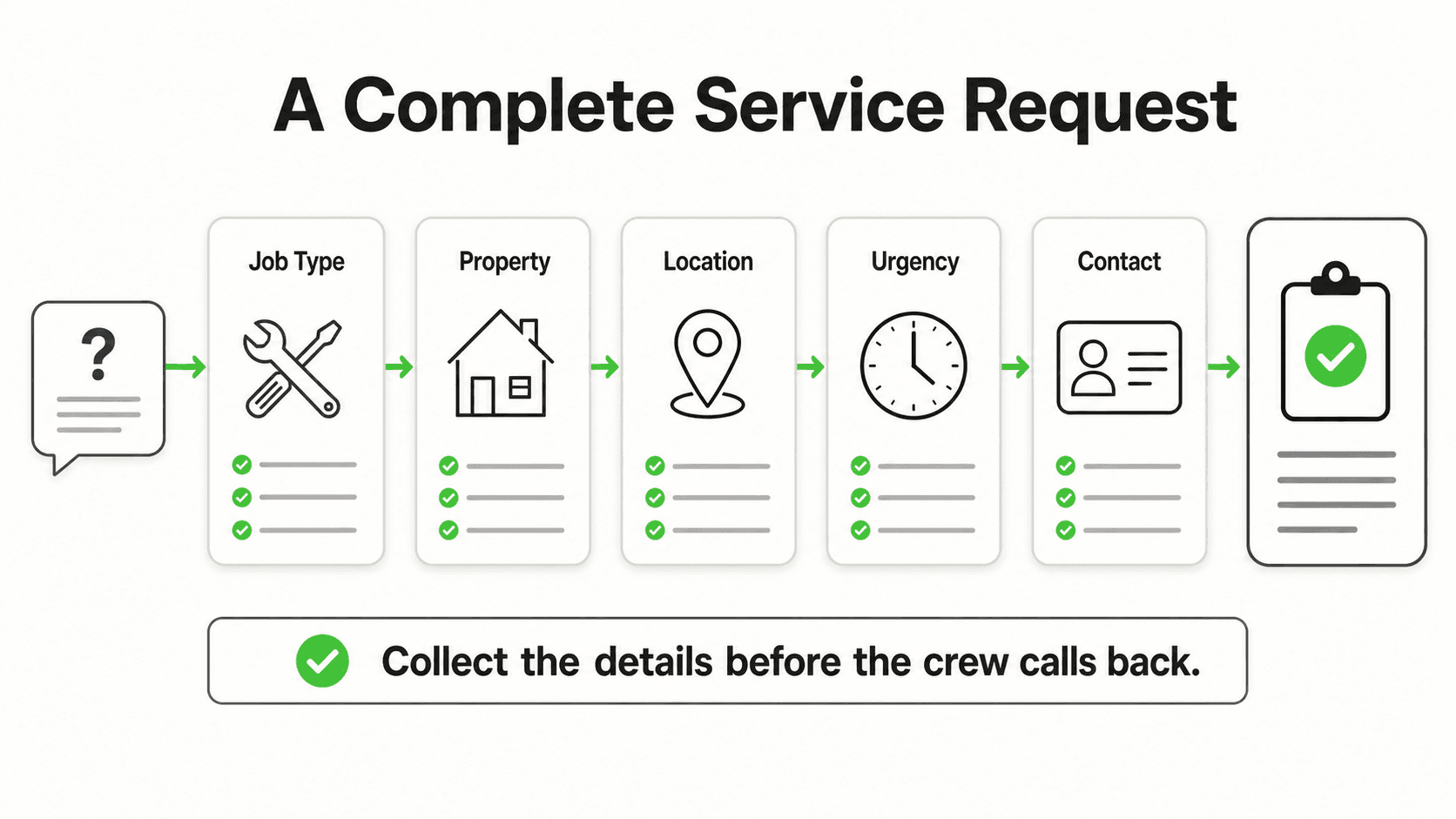
3. Collects the details a dispatcher actually needs
What this looks like in practice: Before a human ever sees the lead, the AI has already gathered address, fixture or system affected, whether water is shut off, and access instructions (gate code, parking notes, pets).
Real-world impact: Your on-call tech shows up with the information needed to bring the right parts on the first trip, instead of calling the homeowner from the truck to ask basic questions.
Why it works: A lead capture form gates the conversation — contact details are collected up front, before the qualifying conversation continues — so every emergency lead includes a callback number even if the chat gets interrupted.
Key features:
- Structured intake fields (address, issue type, urgency)
- Contact details captured before the detailed conversation
- No-forms-vs-chat trade-off avoided: the form is short and precedes, not replaces, the conversation
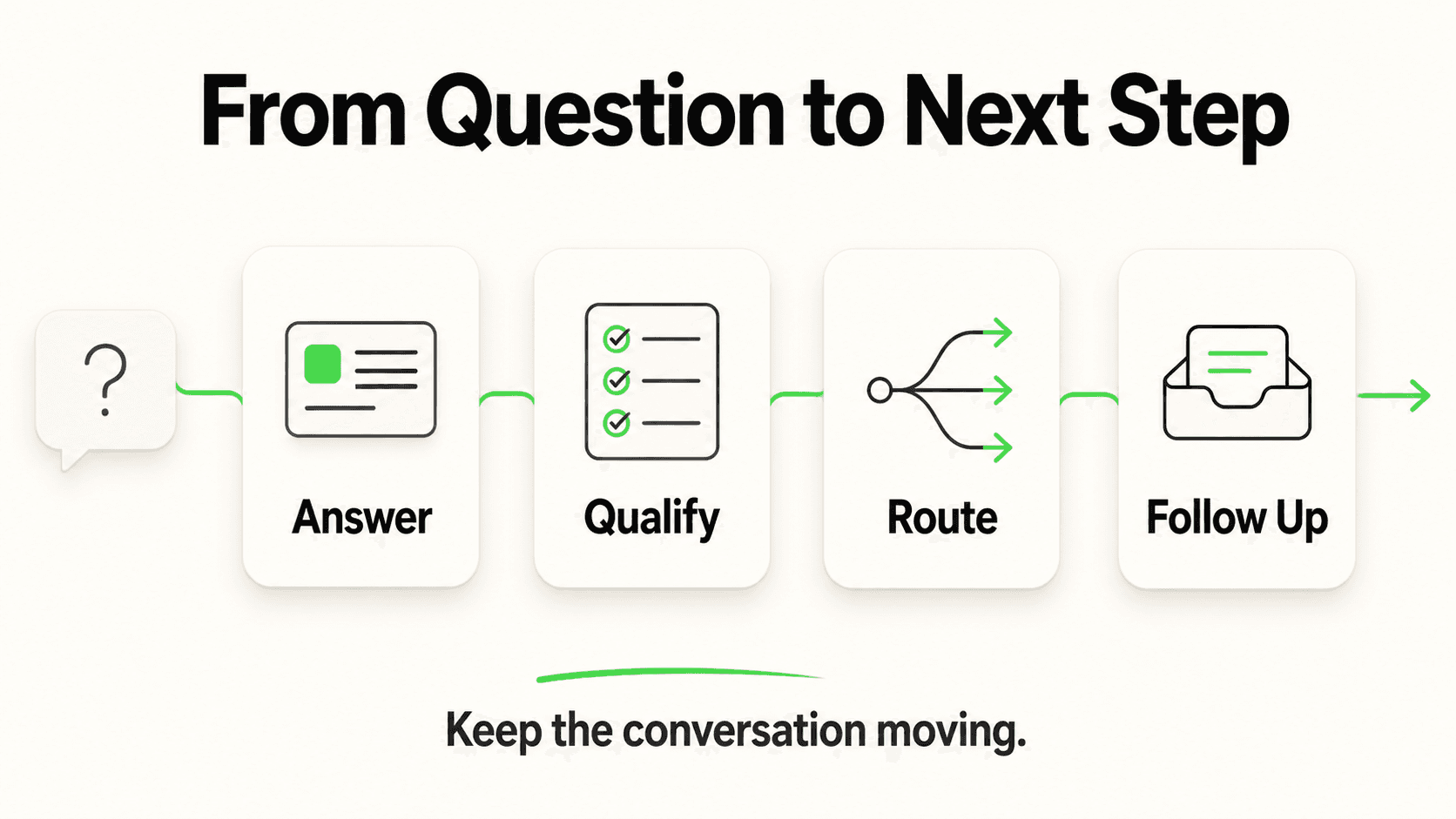
4. Routes emergencies to your on-call tech in seconds
What this looks like in practice: Once a conversation is flagged as an emergency, the system fires a notification — via the dashboard, email, or your CRM through webhooks — so your on-call technician sees it immediately instead of finding it in a shared inbox the next morning.
Real-world impact: The lead-to-dispatch gap shrinks from "whenever someone checks messages" to seconds, closing the exact response-time gap InsideSales found drives a 100x difference in conversion.
Why it works: Automated routing removes the manual step where leads sit unassigned. CRM connectivity works via REST API and webhooks — so the emergency lead can land in whatever system your dispatcher already watches.
Key features:
- Instant notification on qualified emergency leads
- REST API and webhooks for CRM connectivity
- One-click export of captured leads for follow-up
5. Handles the routine questions that eat dispatcher time
What this looks like in practice: Not every conversation is an emergency. "Do you service my zip code?" "What's your rate for a water heater install?" "Are you licensed and insured?" — the AI answers these from your documented business knowledge without pulling a human off the phone.
Real-world impact: Your dispatcher spends time on scheduling and true emergencies instead of repeating the same five answers to every caller.
Why it works: Document-grounded responses mean the bot answers from your actual service area, pricing structure, and licensing information — not a generic script.
Key features:
- Answers FAQs from uploaded business documents
- Consistent pricing and service-area information
- Escalates anything outside its knowledge to a human
6. Absorbs seasonal and weather-driven surges
What this looks like in practice: A cold snap hits and frozen pipes start bursting across a service area simultaneously. Call volume spikes 3-5x in a single day — the exact moment a small dispatch team gets overwhelmed.
Real-world impact: Instead of every fourth or fifth caller hitting a busy signal or voicemail during a surge, the AI receptionist handles the volume spike without adding temporary staff.
Why it works: A chat-based system doesn't have a "line" that gets busy the way a phone system does — it can hold many simultaneous conversations, which matters most exactly when call volume is least predictable.
Key features:
- No capacity ceiling tied to phone lines
- Consistent triage quality regardless of volume
- Works identically during predictable surges (winter freeze, storm season) and quiet weeks
7. Books planned work in the chat instead of playing phone tag
What this looks like in practice: For planned work — a scheduled water heater replacement, a fixture install — the AI receptionist offers real open times from your Calendly or Cal.com calendar and books the slot directly in the conversation, without a callback.
Real-world impact: Non-emergency leads get scheduled without adding to your dispatcher's callback list, freeing that time for the emergencies that need a human judgment call.
Why it works: The booking lands in the Calendly or Cal.com calendar you already use and the homeowner gets the invite by email, which keeps your actual scheduling system as the source of truth. (In-chat booking needs Calendly Standard or higher; with any other tool, the AI shares your booking link.)
Key features:
- Books planned/non-emergency work in the chat, or shares your booking link
- Keeps emergency triage and scheduling logic separate
- No double-booking risk since your calendar tool stays authoritative
See how it handles a burst-pipe call at 2am
Set up an AI receptionist that answers, qualifies, and routes emergency plumbing calls across web, WhatsApp, and social DMs — starting at $40/month.
Start Free TrialReal Results: What Plumbing Businesses Are Achieving
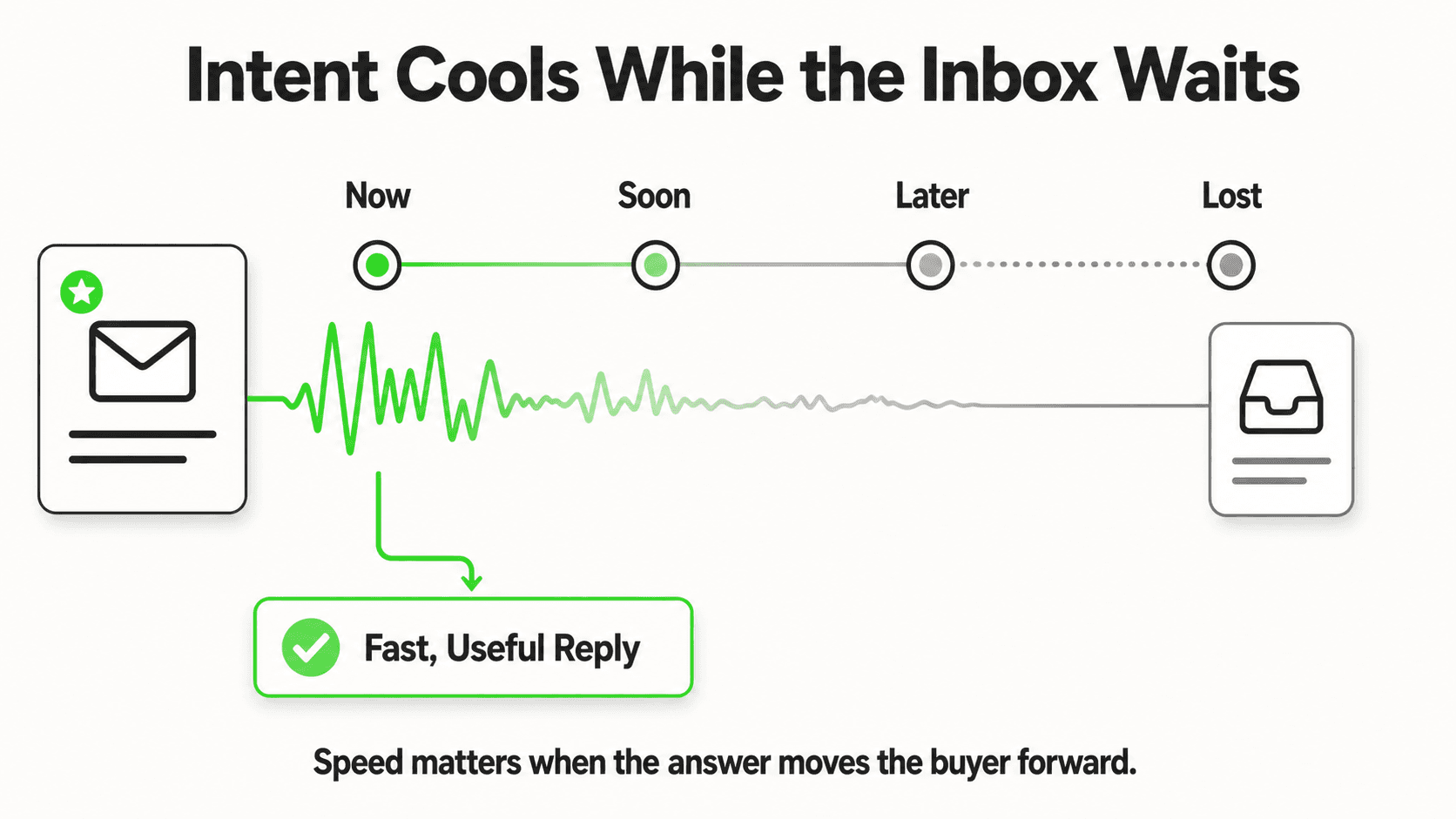
Fewer emergency jobs lost to voicemail
- Every after-hours conversation captured is a conversation that would otherwise have hit the 85% voicemail-abandonment wall documented by Invoca
- Emergency leads arrive with address and problem details already collected, cutting the time between "lead captured" and "tech dispatched"
- Consistent triage means fewer non-emergencies waking up an on-call technician unnecessarily
Dispatcher time reclaimed
- Routine FAQ volume (service area, pricing, licensing) is answered without a human touch
- Planned-work scheduling moves to in-chat booking instead of phone tag
- Dispatchers spend their attention on the calls that actually require judgment
Lower cost than a night-shift hire
- A dedicated after-hours receptionist or answering-service seat runs well beyond $40/month in comparable staffing or service costs
- AI Agents plans start at $40/month (Plus), with a 7-day free trial (credit card required)
- No incremental cost per conversation the way per-minute answering services bill
Consistent coverage regardless of season
- Winter freeze events and storm-driven surges get the same response quality as a slow Tuesday afternoon
- No temporary staffing needed to absorb predictable seasonal spikes
- Coverage doesn't degrade on holidays, weekends, or when your dispatcher is out sick
Illustrative example, not a guarantee
These are structural advantages an always-on chat receptionist provides, not promised outcomes. Actual results depend on your call volume, service area, and how the AI receptionist is configured. Where we cite a number, it's sourced — Invoca and InsideSales research above — or clearly labeled as illustrative.
Implementation Roadmap for Plumbing Businesses
Getting an AI receptionist live for a plumbing business is a matter of days, not months. Here's a realistic path:
Days 1-2: Upload your business knowledge. Service area, pricing structure (or ranges), licensing/insurance info, common FAQs, and your emergency triage questions. If you can write a one-page dispatcher cheat sheet, you can train this.
Days 3-4: Configure emergency qualification logic. Define what counts as an emergency for your business (active water flow, no heat in winter, sewage backup) versus planned work (fixture upgrade, routine maintenance). This is the single most important setup step — it's what separates a real AI receptionist from a generic FAQ bot.
Day 5: Connect notification routing. Point emergency-flagged leads to wherever your on-call tech actually checks — email, dashboard, or your CRM via webhook — so the alert reaches a person fast.
Days 6-7: Deploy across channels and test. Add the chat widget to your website, connect WhatsApp Business, Instagram, and Facebook Messenger, and run a handful of test conversations simulating a real emergency to confirm the triage questions and routing work as expected.
Week 2 onward: Review and refine. Check captured conversations weekly for the first month. Adjust the FAQ knowledge base and triage questions based on what real customers actually ask — plumbing conversations rarely match the script perfectly on day one.
Common mistake: treating this as a phone replacement
The single most common setup mistake is expecting the AI receptionist to absorb inbound phone calls. It doesn't — it's chat-first. If phone is your dominant emergency channel today, plan to run it alongside your phone answering setup (live service or IVR), not instead of it, and drive more of your emergency traffic toward chat and WhatsApp over time where you control the experience end-to-end.
Frequently Asked Questions
Does an AI receptionist for plumbers answer phone calls?
No. Hyperleap's AI receptionist is chat-first — it operates on your website chat widget, WhatsApp, Instagram DM, and Facebook Messenger. It does not currently answer inbound phone calls; voice support is on the roadmap but not shipped. If most of your emergency demand arrives by phone, pair it with a phone answering service rather than replacing your phone line with it.
How is this different from a traditional answering service?
A traditional answering service uses live human operators (or IVR) to answer phone calls, typically priced $50-$450/month for small-business plans or $0.75-$2.00+ per minute on usage-based plans. An AI receptionist answers chat-based channels instantly at a flat monthly rate starting at $40/month and never puts a customer on hold. See our full AI receptionist vs. answering service comparison for a side-by-side breakdown.
Can it tell the difference between a real plumbing emergency and a routine question?
Yes, when configured with your emergency criteria. You define what counts as urgent for your business — active water flow, no heat, sewage backup — and the AI asks qualifying questions to sort emergency leads from planned-work inquiries before routing either to your team.
Will it replace my dispatcher?
No. It handles the volume and the after-hours gap your dispatcher can't cover alone — it doesn't replace the judgment, relationship, and scheduling decisions a human dispatcher makes. Think of it as covering the front desk when no one's there, so your dispatcher spends business hours on higher-value work instead of repeating FAQs.
How much does an AI receptionist for plumbers cost?
Hyperleap AI Agents plans start at $40/month (Plus), which includes one chatbot across four channels with 3,000 AI responses per month. Higher tiers (Pro at $100/month, Max at $200/month) add more chatbots, channels, and response volume. All plans include a 7-day free trial; a credit card is required to start. For a broader look at how AI receptionist pricing compares across the market, see our AI receptionist cost guide.
How long does setup take?
Most plumbing businesses can have a functional AI receptionist live within a week: uploading business knowledge, configuring emergency triage questions, and connecting channels are the main steps. Refinement based on real conversations continues in the following weeks.
Does it integrate with my dispatch software or CRM?
It connects via REST API and webhooks, so captured leads and emergency alerts can flow into whatever system your dispatcher already uses. It does not offer native, pre-built integrations with specific dispatch or field-service platforms today — treat any dispatch-software connection as something to evaluate against your specific tool via the API, not an out-of-the-box integration.
Can it schedule appointments directly on my calendar?
Connect Calendly or Cal.com and it offers live open times and books planned work within the conversation (Calendly needs the Standard plan or higher for in-chat booking); with any other tool, it shares your booking link. It does not sync directly with Google Calendar or Outlook — your existing booking tool remains the source of truth for the calendar itself.
The Plumbing Front Desk That Never Closes
The plumber who answers first still wins the job — that hasn't changed. What's changed is that "answering first" no longer requires a night-shift hire, a per-minute answering service, or accepting that a chunk of after-hours calls will simply go to voicemail. An AI receptionist for plumbers covers the gap between when a pipe bursts and when your team can physically respond: it answers instantly across web, WhatsApp, and social DMs, asks the same triage questions a good dispatcher would, and gets emergency leads to your on-call tech in seconds instead of hours.
It's not a phone system, and it's honest about that — pair it with your existing phone setup if calls are still your primary channel, and let it own the after-hours and overflow coverage where a live line can't keep up. For a two-truck operation losing even a handful of emergency jobs a month to voicemail, that gap is worth closing.
Stop losing burst-pipe calls to voicemail
Give your plumbing business 24/7 coverage across website, WhatsApp, and social DMs — qualifying and routing emergencies while you sleep.
Get Started FreeIndustry Solutions
See how AI chatbots work for these industries:
Related Articles
AI Receptionist for Home Services: The Complete Guide
An AI receptionist for home services answers overflow inquiries in chat, qualifies emergencies by trade, and routes jobs 24/7 across every service line.
AI Receptionist for Veterinary Clinics: A Guide
An AI receptionist for veterinary clinics answers intake and pricing questions, routes emergencies to your team, and shares your booking link 24/7.

AI Chatbot for Plumbers: Stop Losing Emergency Jobs
Plumbing emergencies don't wait for business hours. An AI chatbot captures and qualifies burst pipe calls, drain backups, and water heater failures 24/7.
AI Receptionist for Landscaping Businesses
An AI receptionist for landscaping businesses answers quote and service questions 24/7, qualifies property details, and shares your booking link.