AI Receptionist for Home Services: The Complete Guide
An AI receptionist for home services answers overflow inquiries in chat, qualifies emergencies by trade, and routes jobs 24/7 across every service line.
TL;DR: Every field-service trade has the same structural problem — the people who could answer the phone are on a roof, under a sink, or in a crawlspace. Home service businesses miss 27% of inbound calls, and 85% of callers who reach voicemail never call back (Invoca). Research shows 78% of customers hire the first contractor who responds, while the average industry lead response time exceeds 42 hours (Convoso; cited in Hyperleap's home service response-time research). An AI receptionist for home services is a chat-first front desk — website, WhatsApp, Instagram DM, Facebook Messenger — that answers instantly, asks trade-specific triage questions, and routes emergencies to whoever's on call, whether you run one truck or five trades under one roof. It's not a phone system; voice is on Hyperleap's roadmap. Plans start at $40/month.
AI Receptionist for Home Services: The Complete Guide
A landscaping crew, an electrician, and an HVAC tech all have the exact same problem at 6:45pm on a Tuesday: the office is closed, the field techs are driving home, and the phone is ringing. Multiply that across five trades in a multi-service operation, or across the after-hours hours every single-trade shop can't staff, and the pattern is identical everywhere — field crews can't answer while they're working, and office hours don't match demand hours. A water heater doesn't fail on a schedule. Neither does a tripped breaker, a clogged drain, or a dead HVAC compressor in July.
This is the umbrella guide to how an AI receptionist solves that gap across every home service trade — plumbing, HVAC, electrical, roofing, cleaning, landscaping, and beyond. If you run a single trade, we've written deep-dive guides for plumbers and HVAC companies that cover trade-specific triage logic in detail. If you run a multi-trade operation, or you're comparing an AI receptionist against a traditional answering service before committing to either, this article is built for you: it covers the cross-trade case for why one receptionist setup can serve an entire home service business, how routing differs by trade, and where each specific trade's deeper resources live.
We'll also be upfront about the boundary: Hyperleap's AI receptionist is chat-first — website, WhatsApp, Instagram DM, and Facebook Messenger — not a phone answering system. If your business still takes most emergency calls by phone, pair it with your existing phone setup rather than replacing it. Our AI receptionist vs. answering service comparison walks through exactly how the two fit together.
What Is an AI Receptionist for Home Services?
An AI receptionist for home services is a chat-based system that performs the front-desk job a dispatcher does during business hours — answering inquiries, asking qualifying questions, and routing the right lead to the right person — but running continuously across every trade a business operates in. It is not a phone system. It works on the channels home service demand already flows through outside the phone line: the website chat widget, WhatsApp, Instagram DM, and Facebook Messenger.
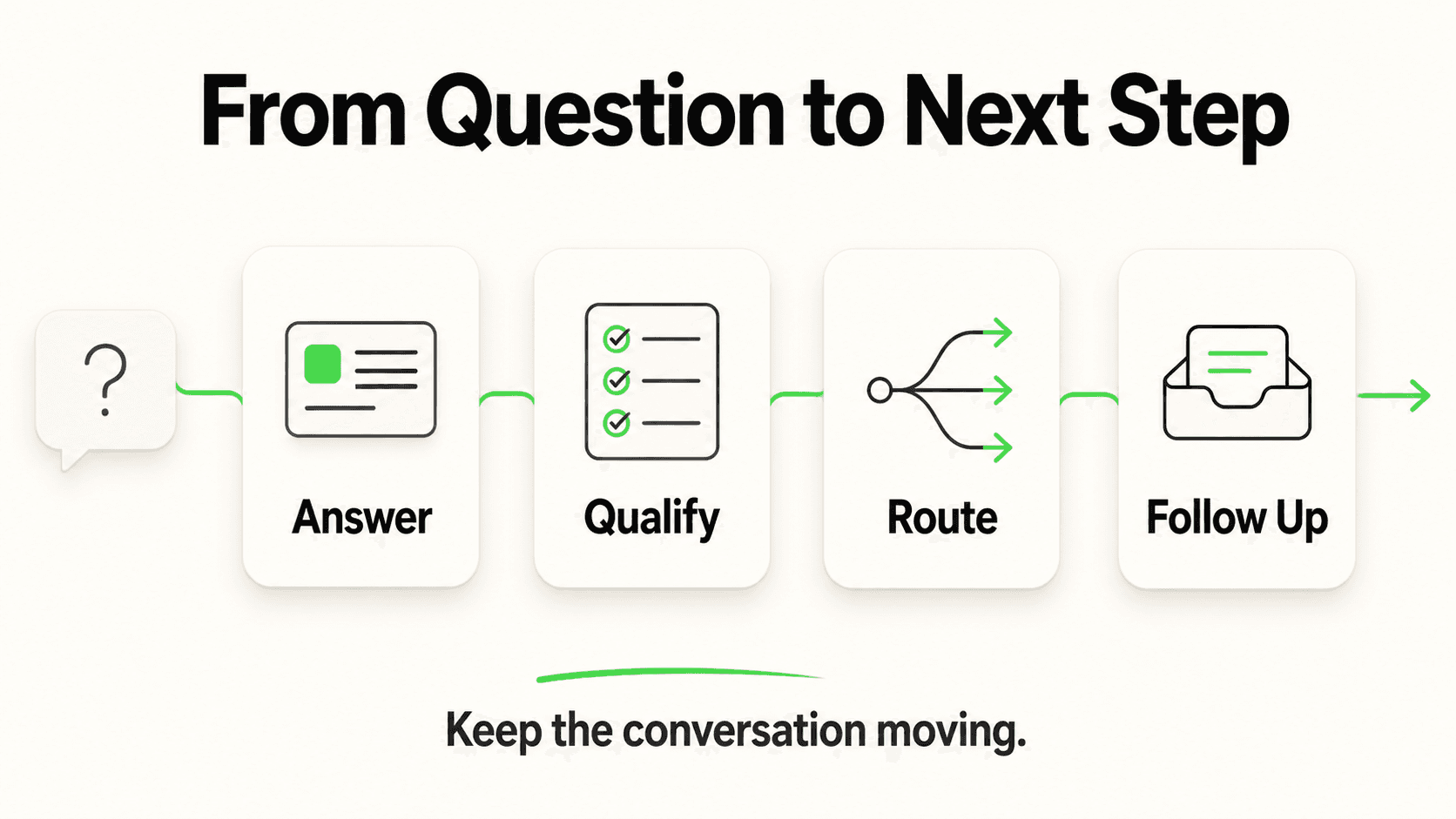
For a home service business, especially one running multiple trades, the front-desk function has to do five things well:
- Answer immediately, any hour, on every channel. No hold music, no "we're closed."
- Identify which trade the inquiry belongs to. A cracked pipe and a dead breaker need different questions and different technicians.
- Ask the qualifying questions a human dispatcher would ask for that specific trade. Emergency triage looks different for plumbing than it does for roofing.
- Route to the right on-call person. A multi-trade operation might have three different on-call technicians for three different service lines.
- Handle the routine questions that eat office time — service area, pricing ranges, licensing — the same way regardless of which trade the customer needs.
This is what separates an AI receptionist from a generic FAQ chatbot: a generic bot answers "what are your hours?" and stops. An AI receptionist is built around capturing and qualifying a lead — closer to what a trained dispatcher does than what a static widget does. One Hyperleap chatbot, configured with knowledge and triage logic for each trade you operate, can act as the single front desk for a multi-trade business, rather than requiring a separate system per service line.
Chat-first, not phone-first — read this before you build a plan around it
Hyperleap's AI receptionist works on your website chat widget, WhatsApp, Instagram DM, and Facebook Messenger. It does not answer phone calls — voice is on the roadmap, not shipped today. If the bulk of your emergency inquiries genuinely arrive as phone calls, an AI receptionist works best paired with your existing phone answering service, not as its replacement. See our AI receptionist vs. answering service comparison for the full breakdown.
For the deployment-level view of how AI agents for home service businesses handle everything from quote requests to review generation across a whole operation, that pillar page covers the broader picture. This article focuses specifically on the receptionist function — call overflow, after-hours coverage, and trade-by-trade routing.
Why Home Service Businesses Lose Jobs to Slower Competitors
The field-crew reality is the same in every trade
Every home service trade shares one structural fact: the people qualified to answer a technical question are the same people out doing the work. A plumber snaking a drain can't take a second call. A roofer on a ladder can't check messages. A landscaping crew running mowers can't hear a phone ring at all. This isn't a staffing failure specific to any one trade — it's the nature of field service work, and it's why home service businesses lose jobs to slow response across the board, not just in one vertical.
Office hours don't match demand hours
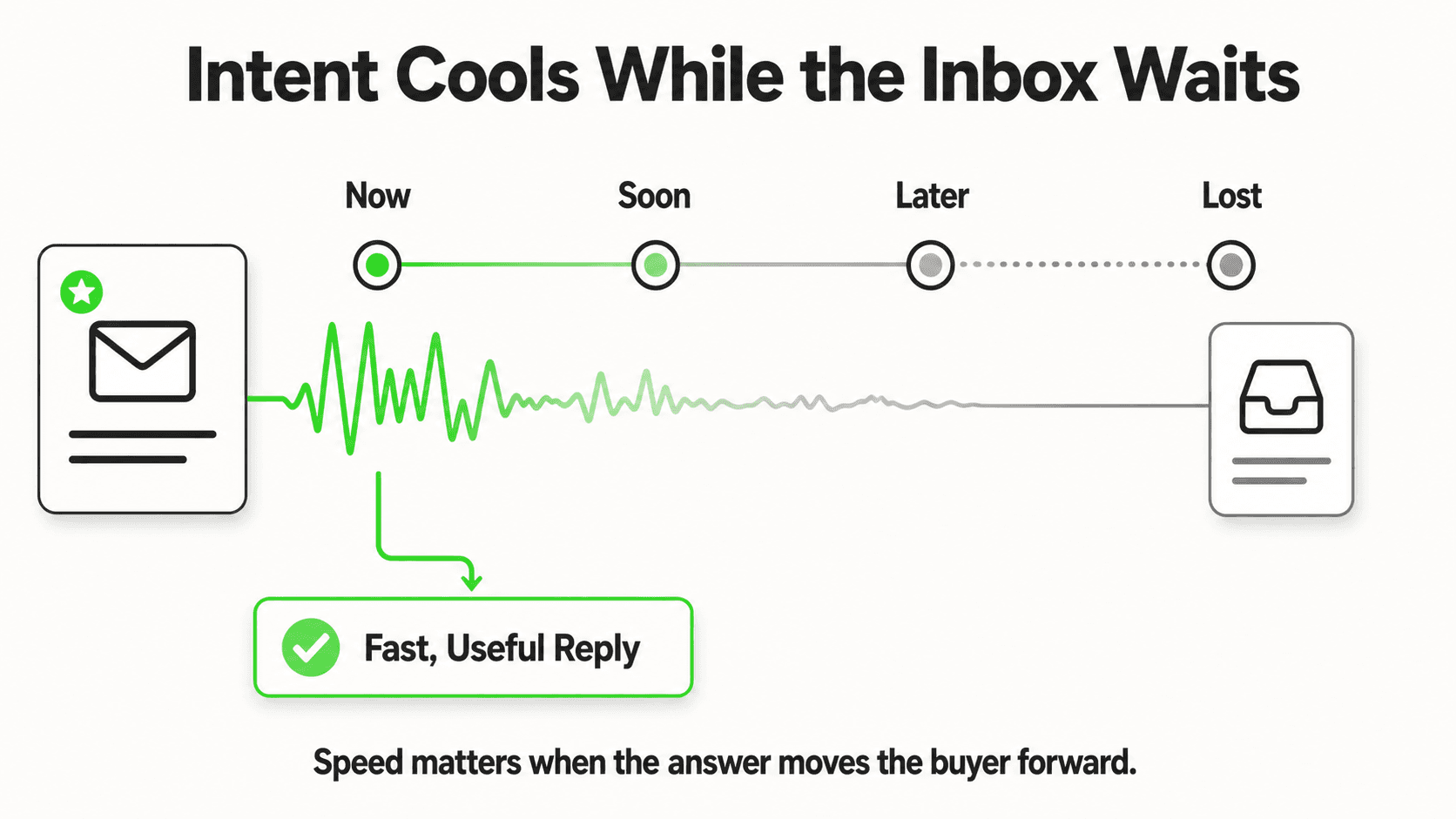
A dead HVAC compressor doesn't wait for 8am, and neither does a burst pipe, an electrical short, or a security light that stops working the night before a break-in. Emergency demand across home service trades skews toward evenings, weekends, and exactly the hours when a small business has the least staffing coverage. Research shows 78% of customers hire the first contractor who responds (Convoso), and this dynamic gets sharper, not softer, after hours — the customer isn't comparison shopping over days; they're deciding in the next few minutes who gets the call back.
The missed-call math compounds across trades
Invoca's research puts the industry-wide missed-call rate at 27% across home service businesses, and 85% of callers who reach voicemail never call back — they call the next name on the list. For a business running a single trade at $45–$95 in paid lead cost, that's an expensive leak. For a multi-trade operation running paid campaigns across plumbing, HVAC, electrical, and more simultaneously, that same 27% miss rate applies to every service line at once — the losses stack.
Response speed is the deciding factor, not price
InsideSales research (widely cited alongside Convoso's analysis) found leads contacted within 5 minutes are 100x more likely to convert than those reached after 30 minutes. The average lead response time across the home service industry exceeds 42 hours — a gap most homeowners never wait out. They hire whoever answered first, at any price point, because the job needs to get done.
The math on one missed emergency call
A single missed emergency call — a burst pipe, a dead AC unit in a heat wave, an electrical hazard — runs into the thousands in typical home service ticket value. If a multi-trade business misses even a handful of after-hours emergencies a month across its service lines, that's a meaningful multiple of a $40/month AI receptionist plan. Treat this as an illustrative comparison based on typical home service ticket sizes, not a guaranteed outcome for your business.
One Receptionist Setup, Every Trade: How Cross-Trade Routing Works
This is the core value for a multi-trade or multi-crew home service business: instead of running separate answering systems, separate voicemail boxes, or separate staff per service line, one AI receptionist can serve the entire operation — identifying which trade an inquiry belongs to and applying that trade's specific triage logic automatically.
What this looks like in practice: A homeowner messages your website chat widget mentioning "no hot water and the breaker keeps tripping." The AI receptionist recognizes this touches both plumbing and electrical, asks the qualifying questions relevant to each (is the water heater electric or gas, is the breaker tripping immediately or after a delay), and routes to whichever on-call technician handles the more urgent issue first — typically the electrical hazard.
Why it works: The receptionist is document-grounded on each trade's specific triage criteria. A plumbing emergency (active water flow, sewage backup) looks different from an electrical emergency (sparking, burning smell, exposed wiring) or an HVAC emergency (no heat in freezing temperatures, no AC during a heat advisory). Configuring trade-specific knowledge means the same chatbot asks the right questions regardless of which service the customer needs — it doesn't force every inquiry through one generic script.
Key advantages of a single cross-trade setup:
- One knowledge base covers service area, licensing, and company-wide policies once, instead of duplicating that information per trade
- Trade-specific triage questions and routing rules layer on top, configured per service line
- A single dashboard shows every inbound lead across every trade, instead of monitoring separate inboxes
- Notification routing can point different trades to different on-call technicians via webhooks, while sharing the same underlying system
Trade-by-Trade: How Routing and Triage Differ
Plumbing
Plumbing triage centers on water. Is water actively flowing? Is the shutoff valve accessible? Is this a backup, a leak, or a no-hot-water call? These questions separate a burst-pipe emergency that needs an on-call tech in minutes from a slow drain that can wait for tomorrow's schedule. For the full breakdown of plumbing-specific triage logic, qualification flows, and setup steps, see our dedicated guide: AI Receptionist for Plumbers.
HVAC
HVAC triage is driven by weather and season more than any other trade — a single heat wave or cold snap can spike call volume 3-5x in a day, all at once, across an entire service area. The qualifying questions focus on whether a system is completely down versus underperforming, and whether the customer has a maintenance plan that changes priority. Our full guide covers seasonal surge handling in detail: AI Receptionist for HVAC Companies.
Electrical
Electrical triage is safety-first. The AI receptionist's job is to identify hazard indicators — sparking, burning smell, exposed wiring, a breaker that won't reset — and flag those as immediate emergencies distinct from planned work like a panel upgrade or new outlet installation. Given the safety stakes, electrical routing should escalate any ambiguous hazard signal to a human immediately rather than attempting to resolve uncertainty in chat. For the broader picture of how AI agents support electrical businesses end-to-end, see AI Agents for Electrical Companies.
Roofing
Roofing inquiries split cleanly into two categories: active leaks (which need same-day attention, especially during or after a storm) and inspection or replacement quotes (which are planned work with no urgency). A roofing-specific AI receptionist asks whether water is actively entering the property before anything else, since that single answer determines whether the lead goes to an on-call crew or into the standard estimate queue. See AI Agents for Roofing Companies for the full deployment picture.
Cleaning services
Cleaning has fewer true emergencies and more scheduling volume — the receptionist's main job is capturing recurring-service inquiries, one-time cleaning requests, and move-in/move-out jobs quickly enough that the lead doesn't go to a faster-responding competitor, then sharing a booking link to lock in the appointment. See AI Agents for Cleaning Businesses for how this plays out across a cleaning operation.
Landscaping
Landscaping demand is seasonal and quote-heavy: spring cleanup surges, storm damage cleanup after severe weather, and ongoing maintenance contract inquiries all arrive in bursts. An AI receptionist here focuses on capturing property details (size, current condition, service frequency desired) so a crew can quote accurately without a site visit for routine requests. See AI Agents for Landscaping Businesses for the complete setup.
Don't have a trade listed here?
The trade-specific pattern above generalizes to any home service business: identify what counts as a true emergency for your specific work, define the qualifying questions a trained dispatcher would ask, and configure routing to whoever handles that category. If you run a trade not listed here, the same setup approach applies — the home services pillar page covers the general deployment pattern.
7 Ways an AI Receptionist Handles the Home Service Front Desk
1. Answers instantly on every channel, all hours, across every trade
What this looks like in practice: A homeowner messages at 9pm about a service issue — regardless of trade — and instead of a "we're closed" message or a ring-to-voicemail, the AI receptionist responds immediately and begins qualifying.
Real-world impact: Every after-hours inquiry that would have hit the 85% voicemail-abandonment wall (Invoca) instead becomes a captured, qualified lead.
Why it works: The AI doesn't need sleep or a second line — it handles simultaneous conversations across web, WhatsApp, Instagram DM, and Facebook Messenger without any of them going unanswered.
2. Identifies the trade and applies the right triage logic
What this looks like in practice: The receptionist recognizes whether an inquiry is plumbing, HVAC, electrical, or another service line based on the details shared, and applies that trade's specific qualifying questions rather than a generic script.
Real-world impact: A multi-trade business gets accurate triage across every service line from one system, instead of needing separate tools or staff per trade.
Why it works: Document-grounded conversation flows mean each trade's emergency criteria are configured explicitly, so the bot asks consistent, trade-appropriate questions every time.
3. Separates true emergencies from planned work, trade by trade
What this looks like in practice: Whether it's active water flow, a tripped breaker that won't reset, or no heat during a cold snap, the receptionist is configured to recognize what counts as urgent for each specific trade.
Real-world impact: On-call technicians aren't woken up for non-emergencies, and true emergencies don't sit in a general inbox until morning.
Why it works: Consistent triage logic — applied per trade — removes the guesswork a generic FAQ bot can't handle.
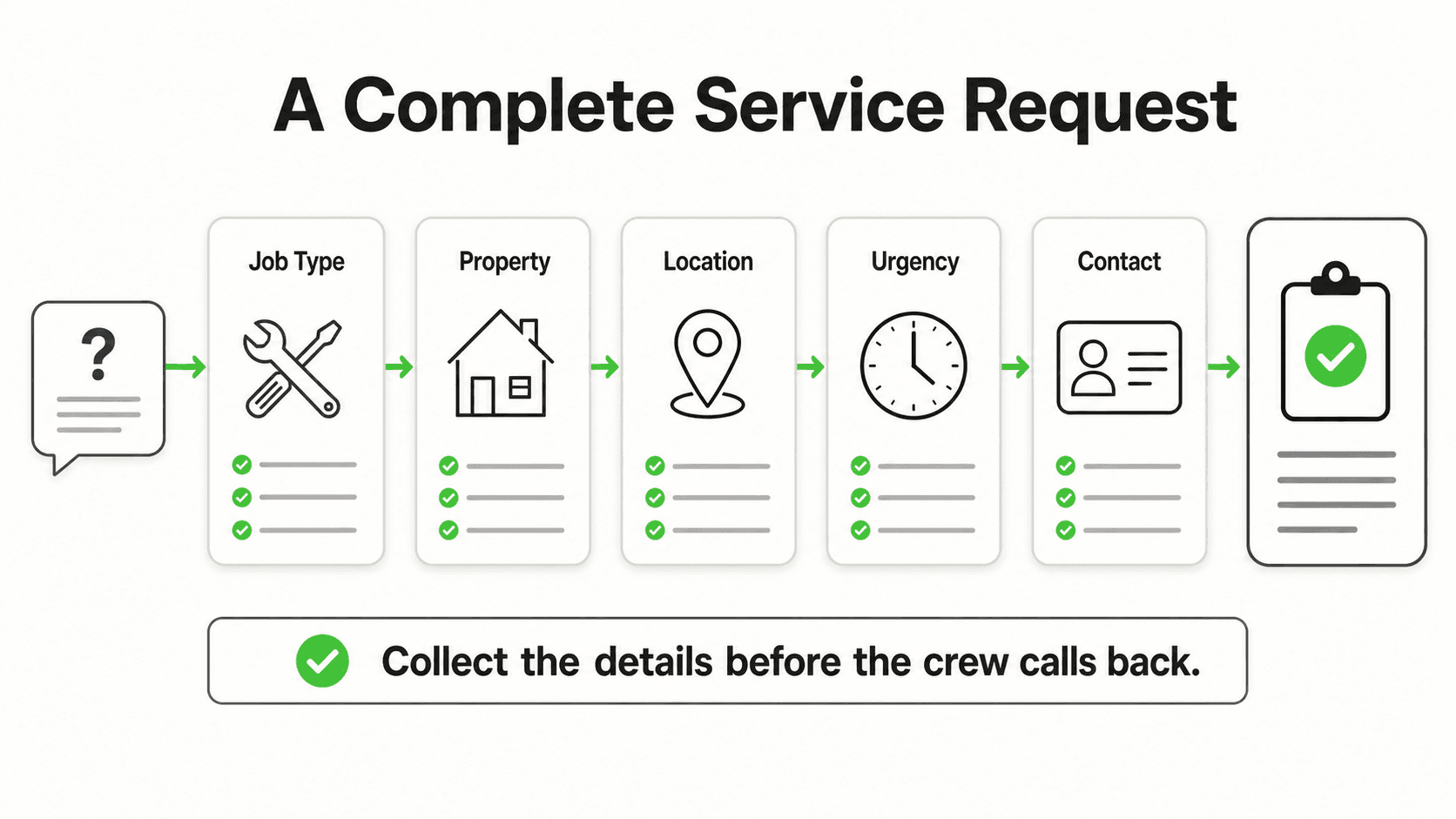
4. Collects the details a dispatcher actually needs
What this looks like in practice: Before a human ever sees the lead, the AI has gathered address, issue details, and access instructions relevant to that trade.
Real-world impact: The technician arrives with the right information and parts on the first trip, instead of calling from the truck to ask basic questions.
Why it works: A lead capture form gates the conversation — contact details are collected up front, before the qualifying conversation continues — so every lead includes a callback number even if the chat is interrupted.
5. Routes to the right on-call person per service line
What this looks like in practice: Once flagged as an emergency, the system fires a notification to whoever handles that specific trade — plumbing emergencies to the plumbing on-call tech, electrical hazards to the electrician — via the dashboard, email, or CRM through webhooks.
Real-world impact: The lead-to-dispatch gap shrinks from "whenever someone checks messages" to seconds, closing the exact response-time gap InsideSales found drives a 100x difference in conversion.
Why it works: CRM connectivity works via REST API and webhooks, so each trade's emergency lead can land in whatever system that team already watches.
6. Absorbs surges regardless of which trade triggers them
What this looks like in practice: A heat wave spikes HVAC calls, a storm spikes roofing and electrical calls, a cold snap spikes plumbing calls — call volume can surge 3-5x in a single day for any one trade, and a multi-trade business can face several surges at once.
Real-world impact: Instead of every fourth or fifth caller hitting voicemail during a surge, the AI receptionist handles the volume spike without adding temporary staff, regardless of which trade is driving it.
Why it works: A chat-based system doesn't have a "line" that gets busy the way a phone system does — it can hold many simultaneous conversations across every trade at once.
7. Books planned work in the chat instead of playing phone tag
What this looks like in practice: For planned work across any trade — a scheduled install, a routine maintenance visit, a quote appointment — the AI receptionist checks your connected Calendly or Cal.com calendar, offers real open times, and books the visit directly in the conversation.
Real-world impact: Non-emergency leads across every service line get scheduled without adding to office callback lists, freeing that time for the emergencies that need a human judgment call.
Why it works: Bookings land in the Calendly or Cal.com calendar you already use, and the customer gets the invite by email, so your real scheduling system stays the source of truth. (In-chat booking needs Calendly Standard or higher; with any other scheduling tool, the AI shares your booking link.)
Stop losing jobs to voicemail — across every trade you run
Give your home service business 24/7 coverage across website, WhatsApp, and social DMs, with trade-specific triage and routing built in.
Get Started FreeReal Results: What Multi-Trade Home Service Businesses Are Achieving
Fewer emergency jobs lost to voicemail, across every trade
- Every after-hours conversation captured is one that would otherwise have hit the 85% voicemail-abandonment wall (Invoca)
- Emergency leads arrive pre-qualified with the details each trade's technician needs
- Consistent trade-specific triage means fewer non-emergencies escalating unnecessarily
Office time reclaimed across the whole operation
- Routine FAQ volume (service area, pricing ranges, licensing) is answered from one knowledge base regardless of which trade a customer needs
- Planned-work scheduling across every service line moves to in-chat booking instead of phone tag
- Office staff spend attention on judgment calls and scheduling instead of repeating the same answers per trade
Lower cost than staffing multiple front desks
- A dedicated after-hours receptionist or answering-service seat runs well beyond $40/month in comparable staffing or service costs — and a multi-trade business would otherwise need that coverage duplicated per service line
- AI Agents plans start at $40/month (Plus), with a 7-day free trial (credit card required)
- One receptionist setup covers every trade instead of paying per service line
Consistent coverage regardless of season or which trade surges
- Winter freeze events, summer heat waves, and storm-driven roofing surges all get the same response quality as a slow Tuesday
- No temporary staffing needed to absorb predictable seasonal spikes in any single trade
- Coverage doesn't degrade on holidays, weekends, or when office staff are out
Illustrative example, not a guarantee
These are structural advantages an always-on, multi-trade chat receptionist provides, not promised outcomes. Actual results depend on your call volume, trade mix, and configuration. Where we cite a number, it's sourced — Invoca, InsideSales, and Convoso research above — or clearly labeled as illustrative.
Implementation Roadmap for Multi-Trade Home Service Businesses
Getting a cross-trade AI receptionist live is a matter of days, not months, even for an operation running several service lines.
Days 1-2: Upload company-wide business knowledge. Service areas, general policies, licensing and insurance information — the details that apply regardless of which trade a customer needs.
Days 3-5: Configure trade-specific triage per service line. For each trade you operate, define what counts as an emergency (active water flow for plumbing, a hazard indicator for electrical, no cooling during a heat advisory for HVAC, an active leak for roofing) versus planned work. This is the step that makes routing accurate — a single generic triage script won't work across multiple trades.
Day 6: Connect notification routing per trade. Point each trade's emergency-flagged leads to the correct on-call technician — email, dashboard, or CRM via webhook — so alerts reach the right person, not a shared inbox someone has to sort manually.
Days 7-8: Deploy across channels and test each trade. Add the chat widget to your website, connect WhatsApp Business, Instagram, and Facebook Messenger, then run test conversations simulating an emergency for each trade you operate to confirm triage and routing work correctly.
Week 2 onward: Review and refine per trade. Check captured conversations weekly for the first month, broken out by service line. Real customer language rarely matches the script perfectly on day one, and refinement needs happen independently per trade.
Common mistake: one generic script for every trade
The most common setup mistake for multi-trade businesses is reusing one generic set of triage questions across every service line. A plumbing emergency and an electrical emergency have different hazard signals, and treating them identically means either over-escalating routine plumbing calls or under-escalating genuine electrical hazards. Configure triage per trade, even when they share one underlying receptionist.
Trade-specific versions of this pattern: roofing companies and landscaping businesses.
Frequently Asked Questions
Does an AI receptionist for home services answer phone calls?
No. Hyperleap's AI receptionist is chat-first — it operates on your website chat widget, WhatsApp, Instagram DM, and Facebook Messenger. It does not currently answer inbound phone calls; voice support is on the roadmap but not shipped. If most of your emergency demand arrives by phone, pair it with a phone answering service rather than replacing your phone line with it. See our AI receptionist vs. answering service comparison for how the two work together.
Can one AI receptionist really cover multiple trades?
Yes, when configured with trade-specific knowledge and triage questions for each service line you operate. One chatbot can hold company-wide information (service area, licensing) while applying different emergency criteria and routing rules per trade — plumbing leads to your plumbing on-call, electrical hazards to your electrician, and so on.
How is this different from a traditional answering service?
A traditional answering service uses live human operators or IVR to answer phone calls, typically priced $50-$450/month for small-business plans or $0.75-$2.00+ per minute on usage-based plans. An AI receptionist answers chat-based channels instantly at a flat monthly rate starting at $40/month and never puts a customer on hold. See our full AI receptionist vs. answering service comparison for a side-by-side breakdown.
Will it replace my office staff or dispatcher?
No. It covers the volume and after-hours gap your team can't staff alone — it doesn't replace the judgment, relationship management, and complex scheduling decisions a human dispatcher makes. Think of it as a front desk that's always staffed, so your team spends business hours on higher-value work instead of repeating the same answers across every trade.
How much does an AI receptionist for home services cost?
Hyperleap AI Agents plans start at $40/month (Plus), which includes one chatbot across four channels with 3,000 AI responses per month. Higher tiers (Pro at $100/month, Max at $200/month) add more chatbots, channels, and response volume — useful if you want separate chatbots per brand or location rather than one shared setup. All plans include a 7-day free trial; a credit card is required to start. For a broader look at how AI receptionist pricing compares across the market, see our AI receptionist cost guide.
Does it work for a single-trade business too, or only multi-trade operations?
It works for both. A single-trade plumbing, HVAC, electrical, roofing, cleaning, or landscaping business gets the same 24/7 coverage and trade-specific triage — the multi-trade case simply layers additional service lines onto the same underlying system rather than requiring separate tools.
Does it integrate with the dispatch software or CRM we already use?
It connects via REST API and webhooks, so captured leads and emergency alerts can flow into whatever system your office already uses. It does not offer native, pre-built integrations with specific dispatch or field-service platforms today — treat any dispatch-software connection as something to evaluate against your specific tool via the API, not an out-of-the-box integration.
How long does setup take for a multi-trade business?
Most home service businesses can have a functional AI receptionist live within one to two weeks: uploading company-wide knowledge, configuring trade-specific triage questions for each service line, and connecting channels are the main steps. A single-trade business typically finishes closer to the one-week mark; multi-trade setups take a bit longer because each trade's triage logic needs its own configuration.
The Home Service Front Desk That Never Closes
The contractor who answers first still wins the job, regardless of trade — that fact hasn't changed. What's changed is that answering first no longer requires a night-shift hire, a separate answering system per service line, or accepting that a share of after-hours calls will simply go to voicemail. An AI receptionist for home services covers the gap between when a job comes in and when your team can physically respond, whether that's a burst pipe, a dead AC unit, a tripped breaker, or a storm-damaged roof — one setup, trade-specific triage, routed to the right person in seconds.
It's not a phone system, and it's honest about that boundary: pair it with your existing phone setup if calls remain your primary channel, and let it own the after-hours and overflow coverage where a live line can't keep up. For a business running one trade or five, losing even a handful of emergency jobs a month to voicemail is worth closing.
Give every trade you run a 24/7 front desk
One AI receptionist, configured per trade, covering website, WhatsApp, Instagram DM, and Facebook Messenger — starting at $40/month.
Start Free TrialIndustry Solutions
See how AI chatbots work for these industries:
Put this into practice
Related Articles

AI Receptionist for Plumbers: Never Miss a Call Again
An AI receptionist for plumbers answers burst-pipe calls at 2am, qualifies emergencies, and routes jobs to your on-call tech — no night-shift hire needed.
AI Receptionist for Veterinary Clinics: A Guide
An AI receptionist for veterinary clinics answers intake and pricing questions, routes emergencies to your team, and shares your booking link 24/7.
AI Receptionist for Landscaping Businesses
An AI receptionist for landscaping businesses answers quote and service questions 24/7, qualifies property details, and shares your booking link.
AI Receptionist for Roofing Companies: Never Miss a Lead
An AI receptionist for roofing companies answers storm-damage and estimate questions 24/7, qualifies homeowners, and routes leads to your team.