Service-Area Answers: Scripts for Local Businesses
Give clear service-area answers with location questions, boundary scripts and a practical handoff record for local service enquiries.

“Do you cover my area?” looks like a simple question until the customer names a neighborhood on the edge of your territory. Your team may serve part of that neighborhood, offer only certain services there, or need to check travel arrangements. A confident yes can become an awkward correction. A vague answer sends the customer back to the phone and interrupts someone already working.
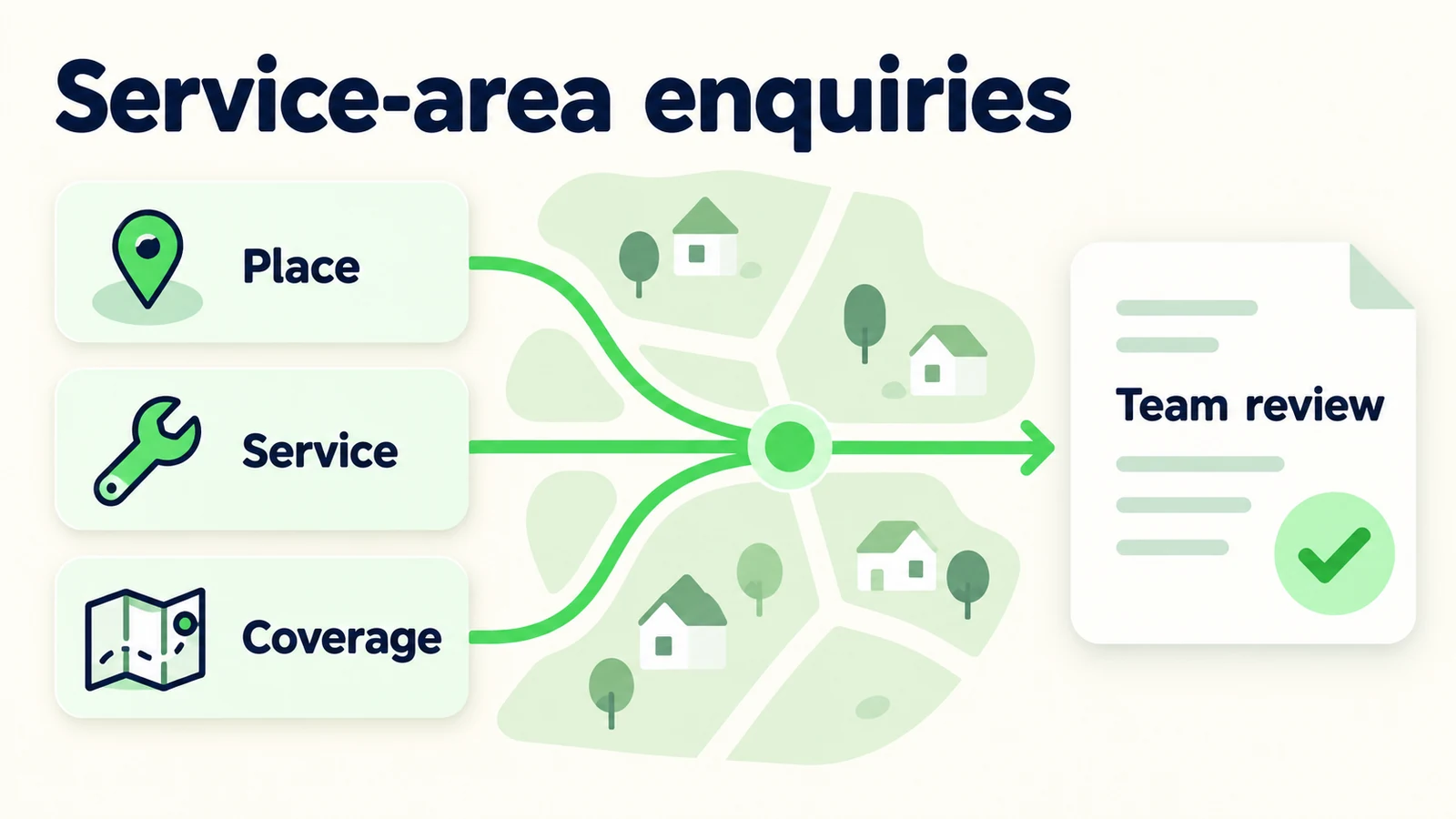
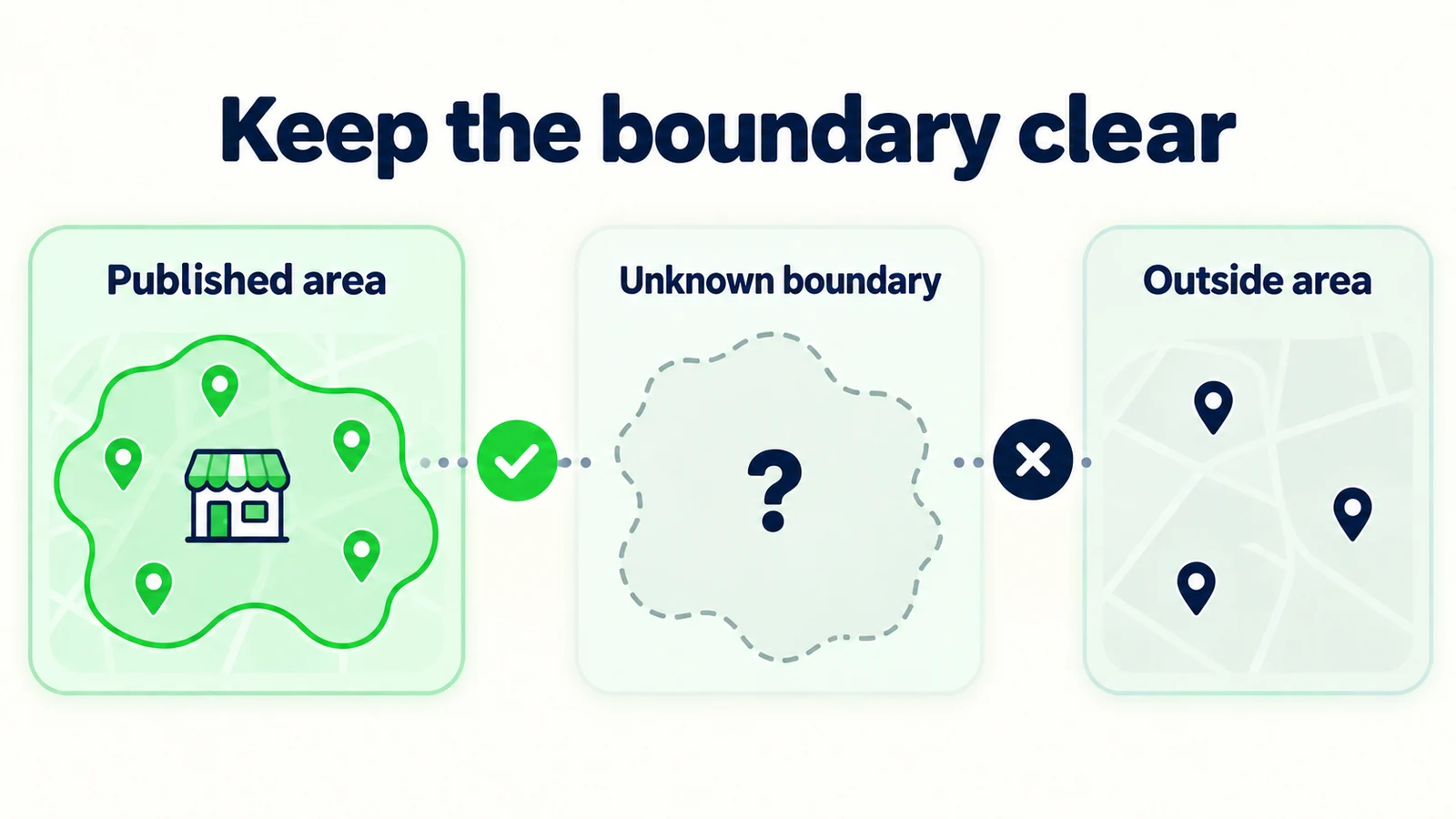
Useful service-area chatbot responses separate three things: the location the customer gives, the coverage your business has actually approved, and anything a person still needs to decide. The AI front desk can explain published coverage and collect a useful enquiry. It should not pretend to locate an address, calculate a route, dispatch a technician or promise an appointment.
This guide provides a location-question tree, boundary replies and a team review record. The examples use fictional place names and business rules. They are writing models, not coverage recommendations for a real business. Replace them with your approved territory information, and keep an explicit route for addresses that your source does not resolve.
What Makes a Service-Area Answer Useful?
A useful service-area answer tells the customer whether the available information covers their request and what happens next. That is narrower than saying whether the business can complete the job. Geography is one condition; the service, job scope and appointment process may introduce others.
For example, a fictional company might publish that it provides routine plumbing in Northbridge and appliance installation in Eastbank. “We serve Northbridge and Eastbank” is technically incomplete if a customer in Eastbank wants a plumbing repair. The relevant unit is the place-and-service combination, not a list of towns copied into a greeting.
Start with an approved source sheet containing named areas, any service-specific exclusions and the person responsible for uncertain enquiries. If a postcode range is genuinely how your business defines coverage, record the exact range and its limitations. Do not create a geographic rule simply because a map looks convenient. A neighborhood name, postal district and municipal boundary may represent different things in your own operating documents.
For a plumbing AI front desk, the immediate job is usually to answer a coverage question or collect the minimum context for a team check. It is not to determine the severity of a fault or decide which technician should attend. Keep urgent-contact wording separate from coverage qualification so a customer is not led through a sales questionnaire when they are seeking urgent assistance.
The broader AI answering guide for plumbing companies discusses the complete enquiry flow. This article concentrates on a smaller artifact: an answer pack your owner, office coordinator and field team can all agree is accurate before it reaches customers.
Coverage is not an appointment
A location being inside your published service area does not establish technician availability, a quoted price, a dispatch decision or a confirmed visit. These scripts explain approved coverage and preserve any decision your team still needs to make.
Why Local Coverage Replies Go Wrong
A familiar place name hides an unfamiliar boundary
Customers use local names that may not match your website. A visitor might describe a district by a shopping center or neighboring town. Asking for one useful clarification is better than guessing which place they mean. Your source should include approved alternate names only when the business has checked that they refer to the same coverage area.
A general territory statement overrides a service exception
The homepage may describe the company's broad region while a specialist service page lists a smaller territory. If those sources conflict, the AI cannot decide which commercial rule the owner intended. Resolve the source set first. The knowledge-base maintenance guide is useful for assigning ownership and removing obsolete instructions.
The script asks for too much personal information
A town or partial postcode may be enough to explain a published boundary. Requiring a full address, name and phone number before giving that explanation can make a straightforward question feel like a sales trap. Request more precise information only when it serves the next step, and explain that purpose.
“Probably” becomes a promise in the handoff
An uncertain answer sometimes becomes “in area” when someone summarizes the conversation. Preserve uncertainty explicitly. “Customer says the property is near Eastbank; exact coverage needs office review” is a usable record. “Eastbank customer confirmed eligible” adds a decision that nobody made.
These problems require different repairs. Better phrasing can fix an overconfident acknowledgement, but it cannot resolve conflicting boundaries. A source change can clarify coverage, but it cannot create staff availability. Keep those operating decisions visible rather than expecting one prompt to substitute for all of them.
7 Scripts for Clear Service-Area Conversations
1. Ask for the smallest useful location detail
Begin by acknowledging the question and requesting the detail your source actually needs. If the coverage sheet lists towns, start with the town. If it lists postal districts, ask for that district. Avoid collecting a complete address merely because it might be useful later.
Illustrative reply:
“I can help you check our published service areas. Which town or postal district is the property in, and which service are you looking for?”
If the customer has already supplied the service, do not ask again. “For that repair, which town is the property in?” is easier to answer and shows that the conversation is being followed. If the location is already clear but the service is not, reverse the question.
Record the customer's wording rather than silently standardizing it into another place. “Near Northbridge station” is not the same as “Northbridge.” The team may understand the local reference, but the record should preserve what was actually said.
This is a practical application of lead qualification: ask because the answer changes the next action. A useful field has a reason. If neither the response nor the handoff changes when a field is filled, consider removing that question from the opening exchange.
2. Give an in-area answer with the right limitation
When the approved source clearly covers the place and service, answer directly. Do not bury the useful yes under a long disclaimer. Follow it with the next supported action and a concise distinction between coverage and a visit.
Illustrative reply:
“Northbridge is included in our published routine plumbing service area. I can collect a repair enquiry for the team or share our approved booking page. The team or booking process will confirm the visit arrangements.”
That answer is more helpful than “It depends” when coverage itself is known. It is also more accurate than “We can send someone today” when no such availability has been checked. The boundary belongs to the unknown action, not to every sentence.
If published coverage has a condition, include the condition near the answer. For example, a business may accept a certain service only for a defined property type. Use that rule only if it exists in approved information; do not infer it from past jobs or neighboring services.
Review the final acknowledgement too. An accurate first reply can be undone by a later “You're all booked.” If the interaction only collected a request, its ending must still describe a request. Test the whole conversation, not just the sentence that mentions the town.
3. Explain an outside-area answer without inventing exceptions
A clear no can still be helpful. Say which published boundary governs, then offer an approved alternative if one exists. Do not promise a special trip, a surcharge option or a partner referral unless your business has explicitly approved that path.
Illustrative reply:
“Westmere is outside our published routine service area. I can't confirm an exception here. If you would like the office to review your request, I can collect the service needed and your preferred contact method.”
Only include that review offer if the office actually accepts exception enquiries. Otherwise give a polite final answer and any genuinely approved public resource. Inventing a review route merely transfers disappointment to someone else.
A customer may ask whether paying more changes the answer. The script should distinguish a published travel-fee policy from a negotiation. “The office would need to assess that request” is suitable when an exception process exists. Calculating a fee from distance is not suitable when the agent has neither an approved rule nor reliable distance information.
The operating aim is consistency, not relentless lead capture. If the business has a firm boundary, an honest outside-area response can be a successful outcome. Evaluate whether the customer understood the answer, rather than treating every conversation without a captured lead as a failure.
4. Preserve uncertainty near a boundary
An uncertain location deserves a specific explanation of what is missing. “I don't know” is honest but incomplete; “You seem close enough” is helpful-sounding guesswork. Name the gap and explain how the team can resolve it.
Illustrative reply:
“Our published information does not make that boundary clear. I can pass the location and service request to the office for a coverage check. Please share only the location detail needed for that review; the office can ask for a full address if necessary.”
The business must decide what “needed” means in its own process. A public chat should not become an unrestricted document collection channel. Avoid asking customers to upload ownership records or identification to prove where they live merely for a general coverage question.
In your internal record, use an explicit result such as “coverage unresolved” rather than leaving the field blank. A blank can be mistaken for an overlooked administrative task. A deliberate unresolved state tells the next person what decision remains.
If the customer corrects the location, reassess the answer against that corrected information. Do not continue using the original town because it appeared earlier in the conversation. The correction should also be visible in the handoff so staff do not reopen the wrong enquiry.
5. Keep service-specific exceptions attached to the place
The same address may be eligible for one service and outside the scope of another. An answer pack should make that distinction easy to find. A compact matrix is often clearer than several paragraphs scattered across the website.
Fictional source example:
| Area | Service | Approved public answer | Human review needed |
|---|---|---|---|
| Northbridge | Routine plumbing | Included in the published area | Appointment arrangements |
| Eastbank | Appliance installation | Included in the published area | Job scope and arrangements |
| Eastbank | Routine plumbing | Not included in this example | Only if the office accepts exceptions |
| Boundary location | Any service | Coverage unresolved | Office coverage decision |
This table is a format example, not a recommended territory policy. Your real version should identify its owner and source date. If a service is not listed, the response should not borrow eligibility from another column.
Illustrative reply:
“Our published Eastbank coverage applies to appliance installation. It does not list routine plumbing there. Would you like the approved contact route for a service-area question?”
This distinction is especially useful for a multi-trade home-services front desk. A shared reception experience should not flatten the separate rules that make each trade operationally workable.
6. Route urgent-contact requests without assessing the situation
Your service-area script should not determine whether a reported problem is safe, urgent or minor. Use the business's approved urgent-contact wording when relevant, and keep it distinct from the normal quote or appointment flow.
Illustrative response pattern:
“For an urgent issue, please use the urgent-contact route listed by the business. This chat cannot assess the situation or arrange emergency attendance. I can also explain our published service area, but that does not confirm an urgent visit.”
Replace the generic contact phrase with a verified destination before deployment. Do not publish a placeholder number, invent a local emergency contact or imply that a staff member is currently monitoring a channel unless that is operationally true.
If the visitor describes immediate danger, your owner-approved safety wording should direct them to appropriate emergency help rather than continue ordinary qualification. The answer pack is not a safety protocol, and the AI should not give repair instructions or decide whether waiting is acceptable.
The human-handoff guide explains how to preserve context for a person. For this case, preserve the customer's own words without translating them into a technical diagnosis. “Customer reports water near the appliance” is different from “confirmed appliance leak.”
7. Close with a reviewable coverage record
A good ending states what happened and what remains open. If an enquiry was collected, describe it as an enquiry. If only a public page was shared, do not imply that a team member received a request.
Illustrative acknowledgement:
“Your enquiry describes appliance installation near Eastbank station. Coverage at that location still needs an office check. Your preferred reply method is email. A visit has not been arranged.”
Use that wording only after confirming what the configured workflow actually captured or delivered. An acknowledgement of receipt is not evidence that a person has accepted the next action.
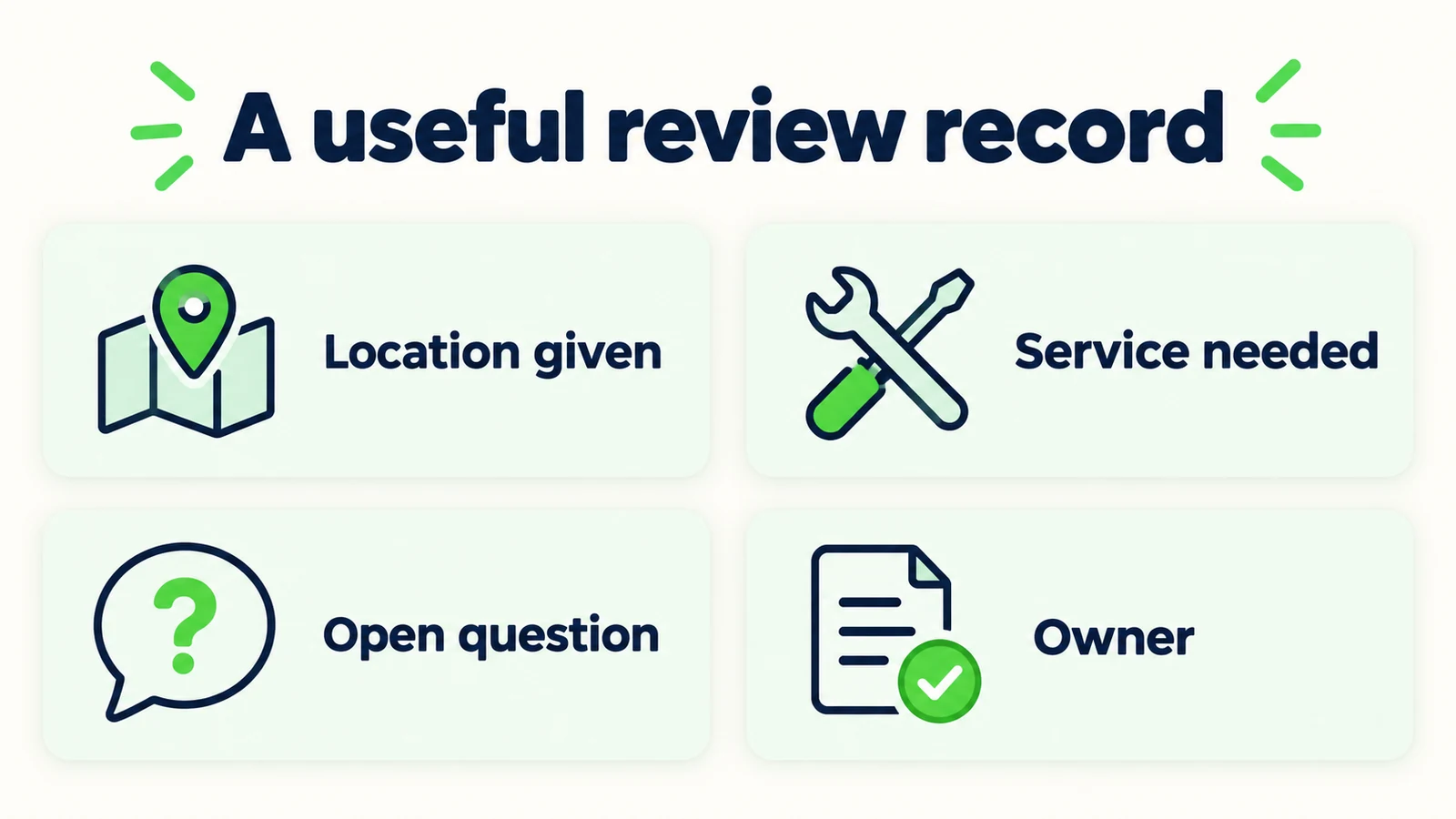
The review record can remain small: customer location wording, requested service, governing source, coverage result, unresolved question, chosen contact method and next-action owner. These are proposed team worksheet fields, not a claim that Hyperleap provides a dedicated coverage-management module.
For a clean operational handoff, compare the record with the original conversation. If a detail was inferred, mark it as an inference or remove it. If a contact field is missing, say so. The next person should know whether they need to answer a coverage question, request a missing location or explain a firm boundary.
Make local enquiries easier to handle
Use approved coverage information to answer routine questions and prepare clearer requests for your team.
Start for freeWhat a Better Coverage Conversation Looks Like
Review progress through observable behavior rather than an assumed revenue lift. Can customers receive a clear answer without submitting unnecessary contact details? Does the team get the place and service together? Are uncertain boundary requests visibly different from confirmed published coverage?
Compare two fictional records. The first says, “New customer in Eastbank needs help.” The second says, “Customer requests routine plumbing near Eastbank station; published source lists appliance installation only; office coverage decision needed; customer chose email follow-up.” The second record does not promise more. It simply preserves the information needed for a responsible next step.
Track corrections as well as completed enquiries. If staff repeatedly change “in area” to “needs review,” investigate the source or response rule that creates that error. If customers repeatedly refuse a full-address request, check whether that precision is needed at the opening stage. These observations support specific changes without claiming that every improvement creates a sale.
Time savings should be measured in your own workflow. Ask staff whether they can act on the enquiry without repeating the location and service questions, and record where they still have to ask again. Do not convert a cleaner conversation into a financial forecast without actual follow-up evidence.
Build and Test Your Coverage Answer Pack
Begin with the business owner or operations coordinator, not the map. Ask which written source determines coverage, who may approve an exception and whether different services have different territories. Resolve disagreements before making the source available to the AI front desk.
Create a review sheet with the following fields:
| Field | What to record |
|---|---|
| Approved place wording | Town, district or other boundary the business actually uses |
| Service scope | Which service the rule applies to |
| Public response | The clear answer customers may receive |
| Missing-detail question | The minimum clarification needed |
| Exception route | Named team process, or no exception path |
| Source owner | Person responsible for reviewing changes |
Then test ordinary, outside-area and ambiguous examples. Include a corrected location, a different service at the same place and a customer who declines to provide more detail. Have someone unfamiliar with the setup judge whether each response would create a false expectation of attendance.
Hyperleap AI can use approved sources for answers, collect lead information and provide conversation context to your team. Its quick-start path can be live in under five minutes; this territory review is additional tuning for your business. The software does not replace your geographic policy or dispatch process. Review the available plans against your needs, then start with the coverage question that currently causes the most avoidable interruption.
Frequently Asked Questions
Can the AI front desk check an exact address automatically?
Do not assume an address lookup exists. These scripts compare customer-provided information with your approved sources and route unclear cases to your team. Exact geocoding, distance calculation or address validation would require separately verified functionality and an appropriate operating process.
Should every visitor provide a complete address?
No. Ask for the smallest location detail needed to answer the coverage question. A town or postal district may be sufficient for general information. Explain why more detail is needed when an office review genuinely requires it, and avoid gathering unrelated personal information.
What should happen when two coverage pages disagree?
A responsible person should resolve the conflict and update the approved source set. The agent should not choose whichever page sounds more detailed. Until the rule is clear, route the affected question for review and avoid presenting an uncertain boundary as an established fact.
Does an in-area answer confirm a visit?
No. Coverage, appointment availability, price and dispatch are separate decisions. The reply should explain the supported booking or enquiry step without claiming that a slot has been held or a technician assigned. Your authorized booking process confirms actual arrangements.
Can customers outside the area still send an enquiry?
Only offer that route when your business actually accepts exception requests. Explain that a review is not approval. If there is no exception process, give the published boundary honestly rather than collecting contact details for a follow-up your team does not intend to provide.
How should a small team review these scripts?
Test them against the approved coverage sheet and representative fictional enquiries. Review the customer-facing answer and the record received by staff. Keep unclear cases separate, assign someone to resolve source changes and retest any answer affected by an updated territory or service rule.
A Clear Boundary Is Better Than a Confident Guess
The strongest service-area answer is not always yes. It is the answer your business can stand behind: clear published coverage, an honest outside-area response or a well-prepared request for human review. Customers should understand the next step without confusing an enquiry with an appointment.
Start by choosing one service and its approved territory. Write the ordinary reply, the boundary reply and the outside-area reply, then test them with someone who does not know your internal shorthand. Once those paths work, extend the same discipline to other services. An AI front desk is useful when it removes repetitive explanation while keeping commercial decisions with the people authorized to make them.
Give every coverage question a clear next step
Build an AI front desk around your approved business information and a practical handoff to your team.
Start for freeIndustry Solutions
See how AI chatbots work for these industries:
Related Articles

Quote or Estimate? AI Front Desk Reply Templates
Use clear quote-versus-estimate replies, scope questions and approval checks so your AI front desk does not promise a price your team has not agreed.

HVAC Repair or Replacement: Enquiry Questions
Use HVAC enquiry questions to capture the customer's concern, property context and contact preference while leaving diagnosis and quotes to technicians.

Real Estate Lead Handoff: The Agent-Ready Checklist
Use a real estate lead handoff checklist to preserve buyer intent, property context, unanswered questions and the next action without inventing certainty.

Wedding Venue Tour Enquiries: A Question Pack
Prepare better wedding venue tours with questions on date flexibility, guest range, event shape and priorities, plus a copy-ready host handoff.