Quote or Estimate? AI Front Desk Reply Templates
Use clear quote-versus-estimate replies, scope questions and approval checks so your AI front desk does not promise a price your team has not agreed.

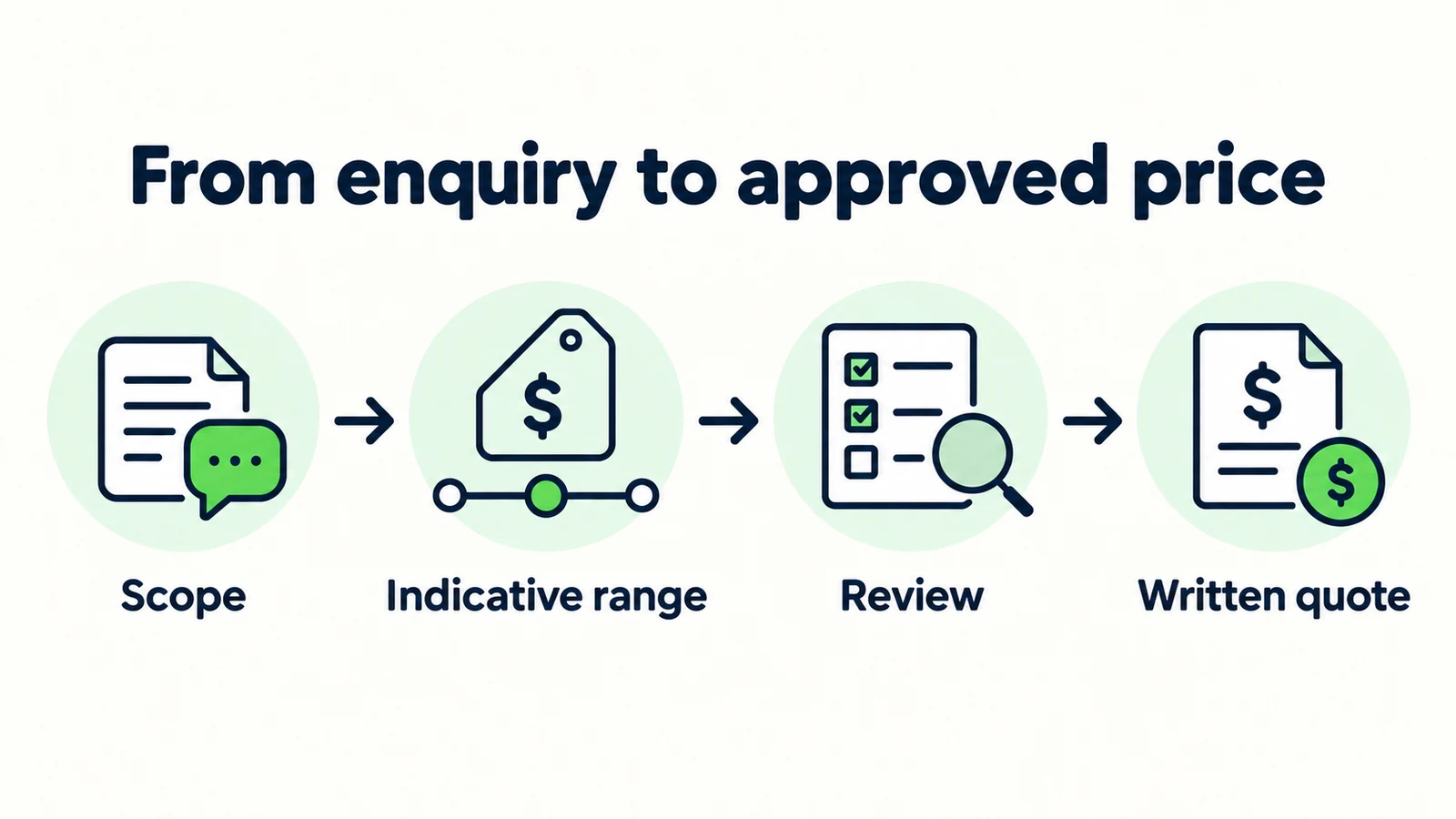
“How much will it cost?” sounds like a simple question until the answer becomes a commitment your team never made. A customer may be asking for a rough guide, comparing a published package or requesting a formal quotation. The front desk needs to distinguish those intentions before it attaches certainty to a price.
Good quote-versus-estimate customer replies make the next step clear. They explain what is known, what depends on the job and who must review the scope. They do not hide behind vague disclaimers, and they do not turn an example price into a promise just because the customer asks twice.
This guide offers a language ladder, copy-ready examples and an approval worksheet for service businesses. It is an operational writing guide, not legal advice about the meaning or enforceability of a quotation in your jurisdiction. Use your business's approved terminology and terms. All scenarios are illustrative, and no sample figure is needed to show how the boundary works.
A Practical Language Ladder for Price Enquiries
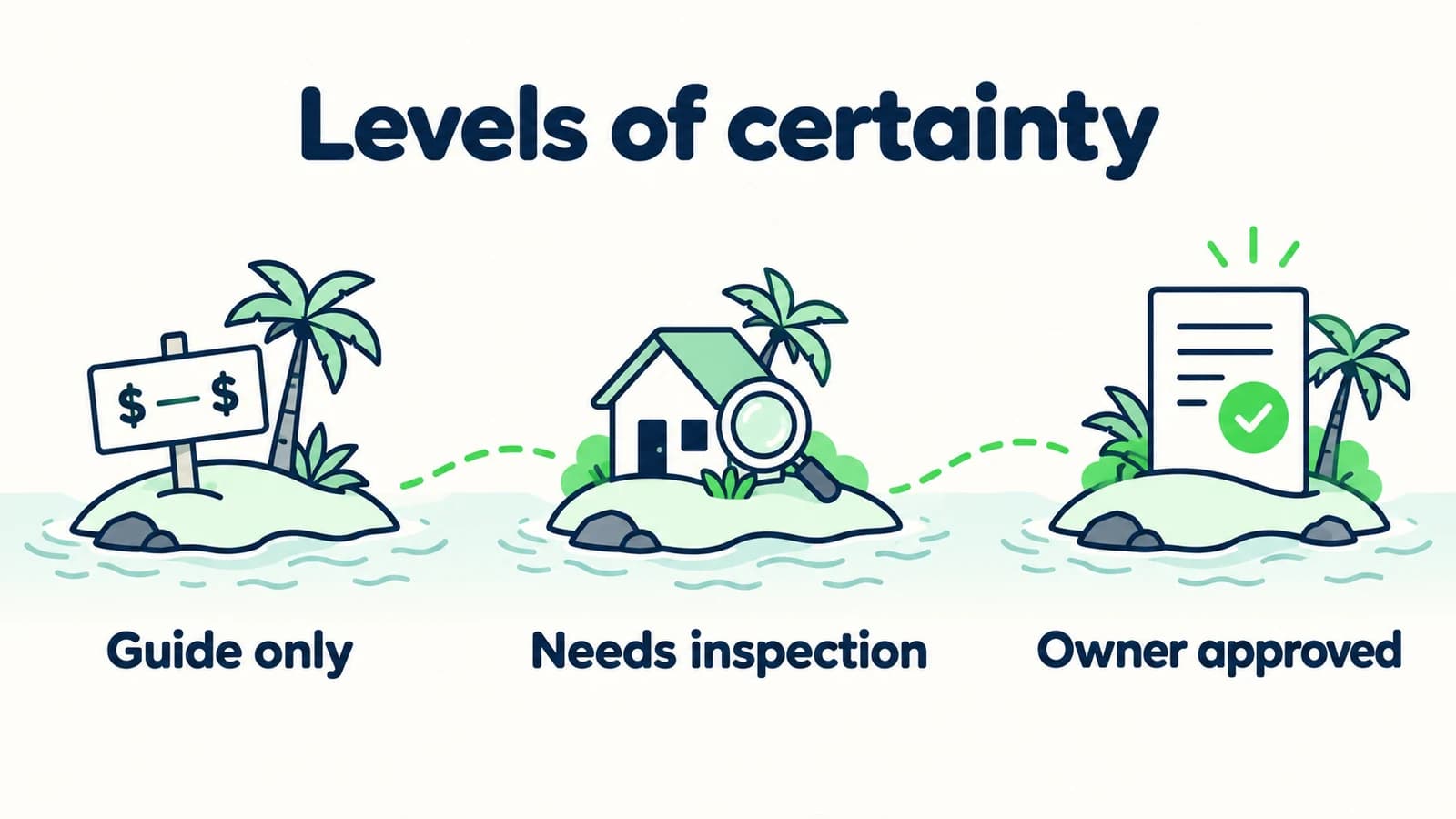
Use different wording for different levels of certainty: published information, indicative guidance, a scope review and an approved quotation. The important distinction is the action the business has actually taken, not which label sounds more persuasive.
Published information describes an approved offer and its conditions. Indicative guidance helps a customer understand what affects price, but it should not be presented as a job-specific commitment. A scope review gathers the details needed for a person to assess the request. An approved quotation is a document or communication issued through your authorized business process.
Your AI front desk can answer from approved material, ask relevant questions and pass the enquiry to the team. Those capabilities do not mean it has inspected a property, measured a move, checked a technician's diary or authorized an exception. A useful answer makes that distinction visible without forcing the customer to read an essay.
| Level | What the customer needs | Appropriate wording |
|---|---|---|
| Published offer | Understand an existing package | “The published package includes…” |
| Indicative guidance | Understand likely cost drivers | “The final price depends on…” |
| Scope review | Find out what the team needs | “To prepare your request, may I ask…” |
| Approved quotation | Review an authorized offer | “Please use the quotation provided by the team…” |
Do not treat this table as a universal legal definition of “quote” and “estimate.” Businesses and jurisdictions use those terms differently. Its purpose is to stop the front desk from crossing an operational boundary unnoticed. If your terms attach specific consequences to a price communication, have the appropriate professional approve the wording.
For a home-services business, the practical question is whether the answer sets the right expectation before a person reviews the job. A customer who understands the next step is better served than one who receives a confident number that later needs to be withdrawn.
Use approved price language, not improvised disclaimers
Ask the business owner to approve the words that describe published prices, preliminary guidance and formal offers. This worksheet does not establish contract terms or replace professional review of your own documents.
Why Price Conversations Drift Into Promises
A starting price loses its conditions
A source may say “starting price for a standard visit,” while the reply shortens that to “your visit costs…” The missing words change the meaning. Keep the scope and qualifiers near the price in the source itself. Do not rely on a distant disclaimer to repair an answer that presents an individual total.
The customer supplies an assumption as a fact
“It is only a small job” expresses the customer's view. It does not prove that access, materials or required work are straightforward. The response should acknowledge the description and ask for the detail that changes the next step. It should not repeat “small job” as an assessed scope.
Reassurance becomes authorization
Friendly phrases such as “that should be fine” can imply acceptance. When the customer asks whether an extra is included, the front desk should cite the approved package or ask the team to confirm. A conversational tone does not justify a broader promise than the source supports.
A quote request sounds like a quote issued
“Your quote is ready” and “your quote request is ready for review” describe different events. Choose verbs that reflect the actual state. This matters even if no number is shown: a customer may plan around a claimed confirmation. The lead-qualification guide helps define what belongs in an enquiry before that review.
7 Reply Patterns That Keep Pricing Clear
1. Answer the price question before requesting contact details
If there is approved public information, answer it directly. Do not make the customer submit a phone number merely to discover whether you publish prices. If prices depend on scope, explain that in the opening sentence and name the next useful detail.
Customer: “What do you charge for this?”
Front desk: “The price depends on the work required. I can help prepare a request for the team. Are you asking about a standard service visit or a specific problem?”
This response does not invent a range or pretend every job needs the same process. It also avoids the unhelpful “contact us for pricing” dead end by offering a concrete choice. Adapt the categories to your actual services; do not force a customer into a category that does not fit.
Where a fixed package is genuinely published, describe its approved inclusions and link to the relevant information. Ask for contact details when there is a purpose, such as returning a quotation request. State that purpose. A person who only wants general information should not be treated as if they have agreed to a sales follow-up.
2. Preserve the difference between a guide and a job-specific figure
If your business uses indicative ranges, the source must explain when they apply and who approved them. Do not create a range by combining unrelated prices from several documents. Do not calculate a personalized total unless the actual workflow is designed, authorized and verified to do that.
Customer: “Can you give me a rough idea?”
Front desk: “I can explain the published pricing guide and what affects the final figure. The team still needs to review your specific request before providing an offer.”
The reply should then supply only the approved guide, if one exists. If none exists, say so plainly and ask the most useful scope question. Being transparent about a missing guide is better than manufacturing a plausible answer.
Write down the prohibited shortcut: “A guide must not be repeated as this customer's confirmed price.” Include a test where the customer says, “Great, so that is what I will pay?” The expected response should restate the boundary respectfully. It should not agree simply because the customer has summarized an earlier message confidently.
3. Ask for scope without pretending to inspect the job
The front desk can collect a description. It cannot turn that description into a physical assessment. Ask for ordinary details that help a person decide what to do next: service type, approximate size where relevant, broad location and the customer's main concern.
For a cleaning enquiry, distinguish a routine clean from a move-out or specialist request. For a moving enquiry, distinguish origin and destination areas, approximate property size and relevant access constraints. The cleaning-service overview and moving-company guide cover those broader workflows; the purpose here is to keep the price wording aligned with the information actually collected.
Customer: “It is a small apartment, so can you confirm the standard price?”
Front desk: “I can note that it is a small apartment. The team still needs to confirm the requested work and any access or special requirements. Is this a routine clean or a move-out clean?”
Do not ask customers to make technical judgments they cannot reasonably make. If a detail needs inspection, label it as unknown and route it. An honest blank in the enquiry is more useful than a guessed answer that looks complete.
4. Keep inclusions and exclusions next to the offer
Customers often ask about price because they are trying to understand scope. “Does that include the windows?” may be more important than the headline figure. Answer from the approved package description, and avoid treating silence as inclusion.
Customer: “Does the standard clean include the inside of the oven?”
Front desk: “I can check the published scope. If that item is not listed, the team needs to confirm whether it can be added and how it affects the quotation.”
In your real configuration, replace the generic wording with the specific approved inclusion or exclusion. A source should not require the agent to infer policy from a photograph, a marketing adjective or another customer's request.
Use a scope table in the business source:
| Element | Source instruction |
|---|---|
| Included work | State the approved tasks clearly |
| Optional work | Describe it as requiring confirmation |
| Excluded work | Explain the relevant limit in plain language |
| Unknown condition | Ask the team to review rather than assume |
Retest questions that combine an included item with an optional one. The answer should not apply the package's certainty to the entire combined request. This is a common place for a neat summary to become misleading.
5. Explain when a visit or specialist review is needed
If the business requires an inspection before quoting, say why in practical language. Avoid making the customer feel that you are refusing to help. The front desk can explain what the review establishes and how to request it, using the owner's approved process.
Customer: “Why can't you just tell me the total?”
Front desk: “The team needs to confirm the scope before giving a job-specific price. I can pass along what you need and share the approved next step for arranging that review.”
Do not imply that the review is booked when you have only shared a link or collected a preference. “Here is the booking page” is different from “your inspection is scheduled.” If no live calendar is available to the front desk, it should not name a slot as available.
Keep urgency separate from authorization. A customer saying they need work immediately does not authorize the agent to skip your review process or promise a surcharge. Record the stated urgency accurately and let the responsible person decide whether the business can meet it. Your handoff process should make that unresolved decision visible.
6. Handle challenges without negotiating on the owner's behalf
Customers may ask for a discount, refer to an older offer or say a competitor quoted less. Those are reasonable enquiries, but the front desk should not invent commercial discretion. Acknowledge the request and explain who can decide it.
Customer: “Your old brochure gives a lower price. Will you honor that?”
Front desk: “The team needs to review that request against the current offer. I can note which brochure you mean and pass along your question. I cannot confirm an exception here.”
Do not ask for unnecessary personal documents to support a routine price question. A public brochure name or general description may be enough to identify the source conflict. If a private quotation needs review, direct the customer to the business's approved contact process instead of asking them to paste it into a general chat.
Test repeated pressure: “Just say yes,” “Your colleague already agreed” or “I need you to confirm now.” The desired behavior is not a scolding refusal. It is a calm restatement of the limit and the available next step. Friendly persistence should preserve the boundary, not erode it.
7. End with the exact next action and a usable brief
The closing message should say what happened, what remains unresolved and what the customer can do next. If a request was collected, describe it as a request. If a link was shared, say that the booking or enquiry process continues there.
Front desk: “Your request is for a move-out clean, with kitchen appliances to be reviewed as an additional item. The team needs to confirm the scope and price. Would you like to provide a contact method for that follow-up?”
Only claim that a request was delivered or a team member was notified after the corresponding action is verified in your workflow. A conversational acknowledgement is not delivery evidence. The lead-summary guide shows how to distinguish the customer's stated needs from the next action your team must take.
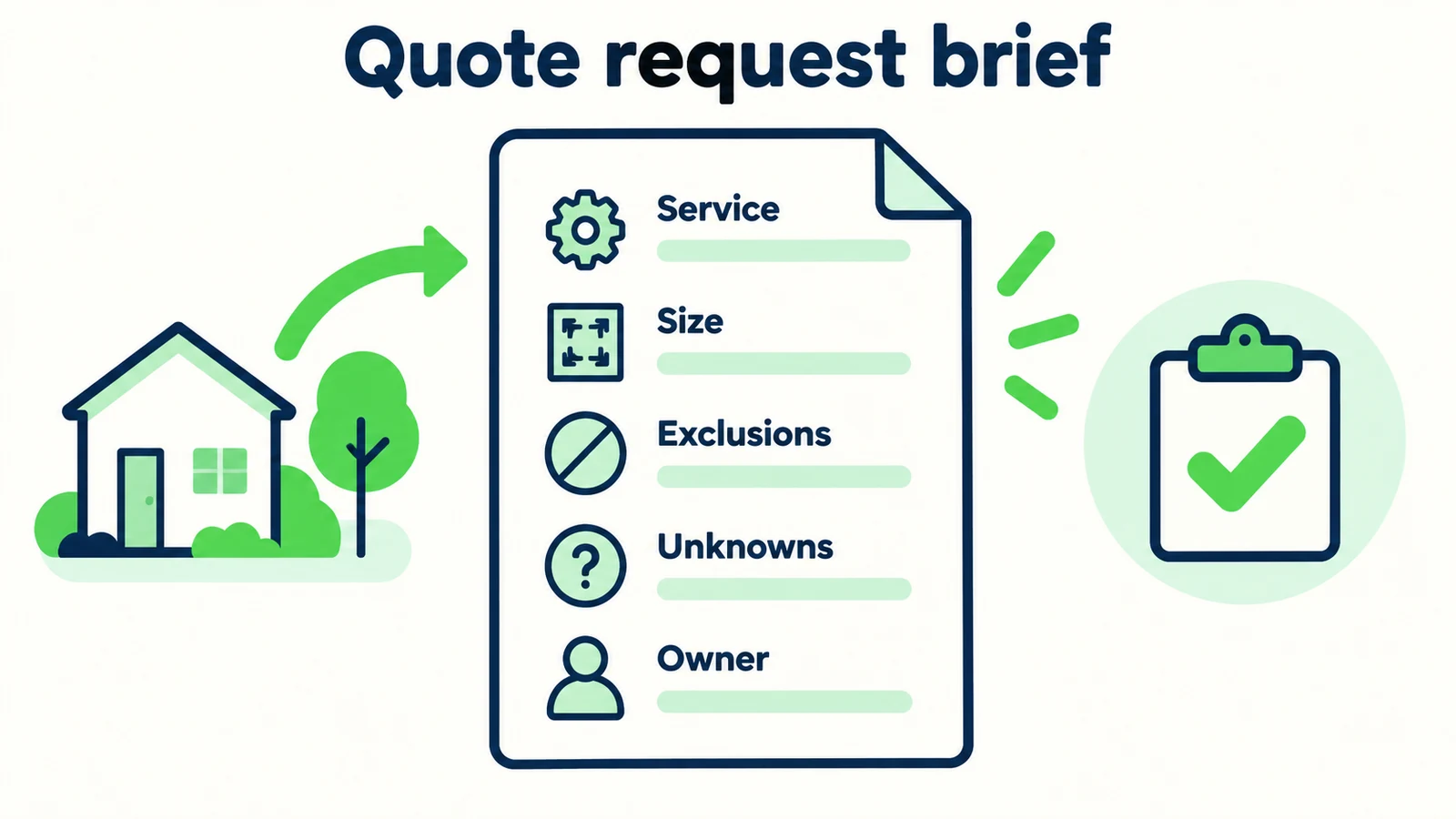
Use the same discipline in the internal brief. Write “customer requests a fixed quotation” rather than “fixed quotation agreed.” Include uncertainties rather than smoothing them away. The receiving person should be able to see why review is needed without reading the full exchange first, while retaining access to the conversation when detail matters.
Make price enquiries easier to review
Use Hyperleap AI to explain approved offers, collect useful scope and give your team a clearer starting point.
Start for freeThe Owner-Approval Worksheet
Before publishing a pricing reply, ask the owner to approve both the positive statement and the prohibited inference. This keeps review focused on meaning, not whether the sentence sounds polished.
| Review item | Owner decision |
|---|---|
| Published price source | Which page or document governs? |
| Price label | What terms does the business use? |
| Applicable scope | Which service and conditions are covered? |
| Exclusions | What needs separate review? |
| Authority | Who can issue a job-specific quotation? |
| Exception path | Who decides discounts or disputed offers? |
| Customer next step | Link, contact route or review request? |
| Forbidden claim | What must the front desk never imply? |
Now compare two fictional summaries. The weak version says, “Customer needs a standard clean at the usual price.” It conceals the unanswered oven question and implies a price decision. The stronger version says, “Customer requests a routine apartment clean and asks whether oven cleaning is included. Scope and quotation require team review.”
The second version is not longer because it is bureaucratic. It carries the uncertainty that the person preparing the quotation needs. It prevents the team from having to correct an expectation before discussing the actual work.
Track your own price corrections, repeated scope questions and cases where a customer believed an enquiry was an accepted offer. Review the underlying conversations rather than treating a low number of questions as proof of success. A visitor who stopped responding may have received enough information, become confused or simply changed their plans. Do not assign a revenue result without evidence.
Put the Templates Into a Small, Testable Workflow
Start with the service that causes the most price-related interruptions. Collect its current public offer, approved exclusions and review process. Resolve contradictory pages before attaching them as sources. Do not ask the front desk to choose between an old brochure and a new policy that the owner has not reconciled.
Write a short instruction explaining the language ladder. Describe which information can be answered directly, which details should be collected and which decisions need a person. Include examples of both acceptable replies and the specific promises to avoid. Avoid enormous scripts that repeat the same warning in every sentence.
Run realistic tests using fictional details. Include a straightforward package question, a request with missing scope, an exception request, a disputed old price and a customer who insists a rough guide is final. Review the visible reply and the receiving team's summary. If the summary upgrades uncertainty into certainty, the workflow still needs correction.
Check the destination links on a phone. A correct explanation followed by the wrong booking page is not a good handoff. Where Hyperleap AI shares a booking link, the customer continues in that separate system. Verify the full journey without treating the chat itself as confirmation that a reservation or appointment exists.
Keep a named owner for changes. If the business updates its offer, update the source and rerun the relevant price questions. A template that was appropriate for the old package may be misleading when the service becomes scope-based.
Hyperleap AI's plans and trial terms describe the product purchase separately from the prices your business quotes customers. Keep those two commercial contexts distinct in configuration and testing. The front desk's job is to help your customer understand your service, not to improvise either set of terms.
Frequently Asked Questions
Should an AI front desk give a quote or an estimate?
It should use the price language and authority your business has approved. It can explain published information and prepare an enquiry for review. Do not let it describe a preliminary guide as a job-specific commitment. The legal meaning of commercial terms varies, so this operational guide does not replace review of your own terms.
What if we do not publish prices at all?
Say that the team needs to review the request and ask a useful scope question. Explain what information helps the team respond. Do not create a plausible range to satisfy the visitor. A clear path to a quotation is more useful than a number your business cannot support.
Can the front desk calculate a final price from customer answers?
Do not assume that collecting answers authorizes or verifies a price calculation. A final-pricing workflow requires approved rules and a system designed for that responsibility. The examples here use information collection and human review; they do not claim that Hyperleap AI inspects jobs or independently issues authorized quotations.
How should it respond to a request for a discount?
It should acknowledge the request and explain the approved review path. It should not grant an exception unless the business has explicitly authorized and verified that workflow. Preserve the customer's reason in the handoff so a person can consider it without asking the same question again.
Does sharing an inspection link mean the inspection is booked?
No. Sharing a link directs the customer to the next step. Availability, slot selection and confirmation belong to the booking process being used. The front desk should describe the action it actually took and avoid saying that an appointment exists merely because the customer expressed a preferred time.
How can we tell whether our reply wording is working?
Review whether customers understand the scope, whether the team receives the relevant details and whether price expectations need correcting. Use actual conversation evidence and record unresolved questions. Do not judge success only by how quickly a conversation ends or by an assumed conversion improvement.
Give Customers Clarity Before Certainty
A helpful price reply does not always contain a number. It may explain an approved package, identify a missing scope detail or tell the customer who needs to review an exception. What matters is that the wording matches the decision the business has actually made.
Choose one recurring price enquiry and build its language ladder. Name the source, the scope, the approver and the next step. Test the customer who accepts the explanation and the customer who pushes it beyond its boundary. Make sure the internal summary preserves the same level of certainty as the visible reply.
That discipline lets your AI front desk handle ordinary questions without leaving staff to unwind accidental commitments. The team can begin the next conversation with a useful brief, and the customer can understand what happens before a formal offer is ready.
Build a clearer first conversation
Create a Hyperleap AI front desk that answers from approved information and prepares scope questions for your team.
Start for freeIndustry Solutions
See how AI chatbots work for these industries:
Related Articles

Service-Area Answers: Scripts for Local Businesses
Give clear service-area answers with location questions, boundary scripts and a practical handoff record for local service enquiries.

Ask for Contact Details Without Blocking the Answer
Use practical contact-request scripts that explain the purpose, respect customer choice and keep useful answers separate from lead capture.

HVAC Repair or Replacement: Enquiry Questions
Use HVAC enquiry questions to capture the customer's concern, property context and contact preference while leaving diagnosis and quotes to technicians.

Real Estate Lead Handoff: The Agent-Ready Checklist
Use a real estate lead handoff checklist to preserve buyer intent, property context, unanswered questions and the next action without inventing certainty.