Guide
Moving Enquiries: The Access-Detail Checklist
Prepare a clearer moving enquiry with access questions for both addresses, uncertainty labels and a practical review record for your team.

Gopi Krishna Lakkepuram · Founder & CEO
· 17 min read
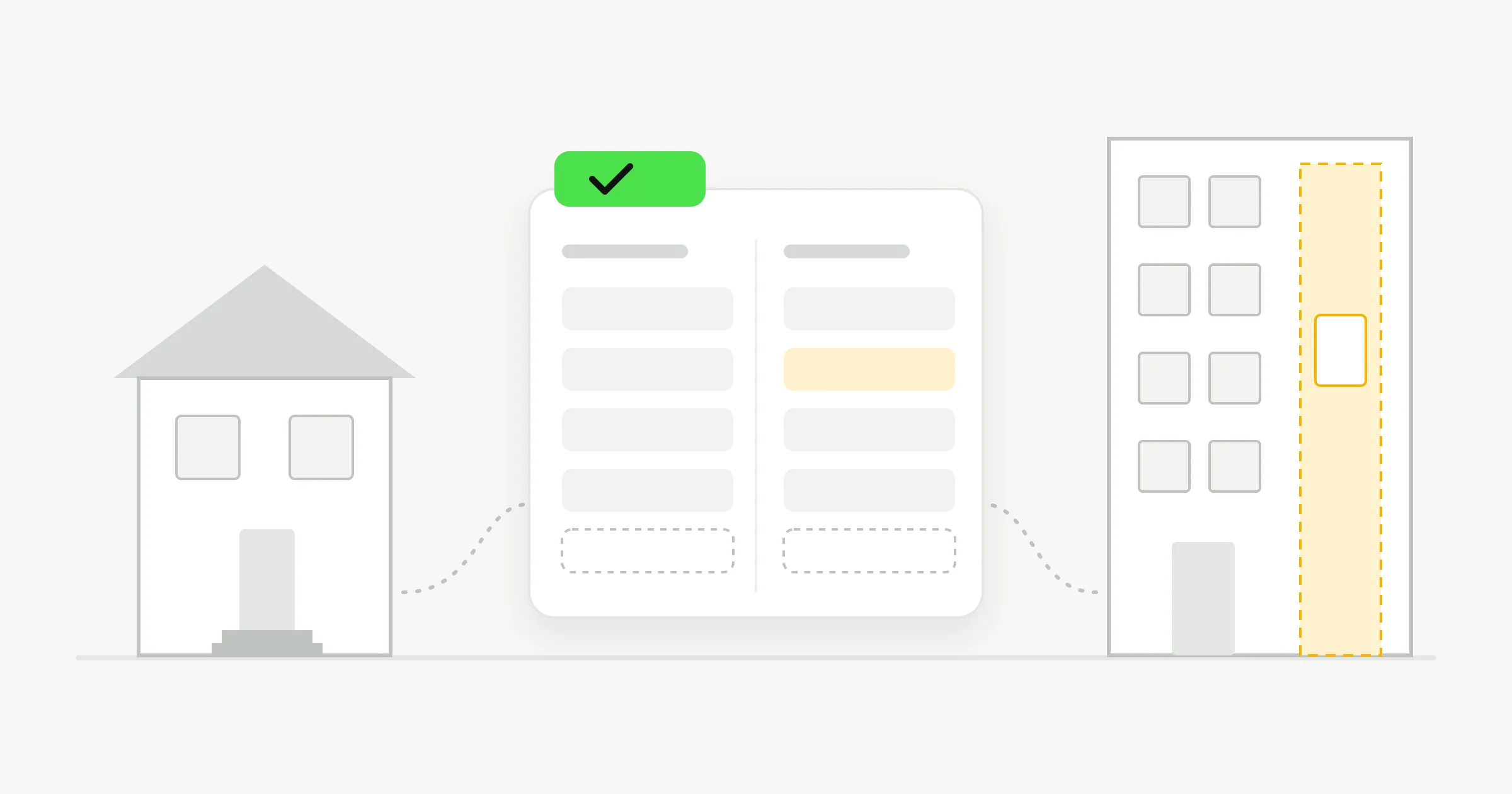
A moving enquiry can include a date, addresses and a list of rooms while still missing the details the team needs to understand access. Is there a lift at the destination? Does the customer know whether it can be used for moving? Where might loading take place? A vague “easy access” answer can conceal several questions that staff must ask again.
A moving quote access checklist collects the customer's description without pretending to inspect the property. An AI front desk can ask useful questions, preserve uncertainty and prepare a note for the moving team. It should not validate an inventory, judge whether an item will fit, approve parking or calculate a firm estimate from unverified details.
This guide provides an original access-detail attachment for an initial moving enquiry. The examples are fictional and concern information gathering, not lifting instructions, route planning or safety advice. Replace the questions with those your moving team actually uses. The goal is to make the next human conversation better prepared, while keeping site assessment, quotation and operational decisions with authorized staff.
What Is an Access-Detail Attachment?
An access-detail attachment is a short record of how the customer describes entry and loading at the origin and destination. It sits alongside the main move enquiry rather than replacing it. The main enquiry may explain what the customer wants to move and when; the attachment makes location-specific access questions easier to review.
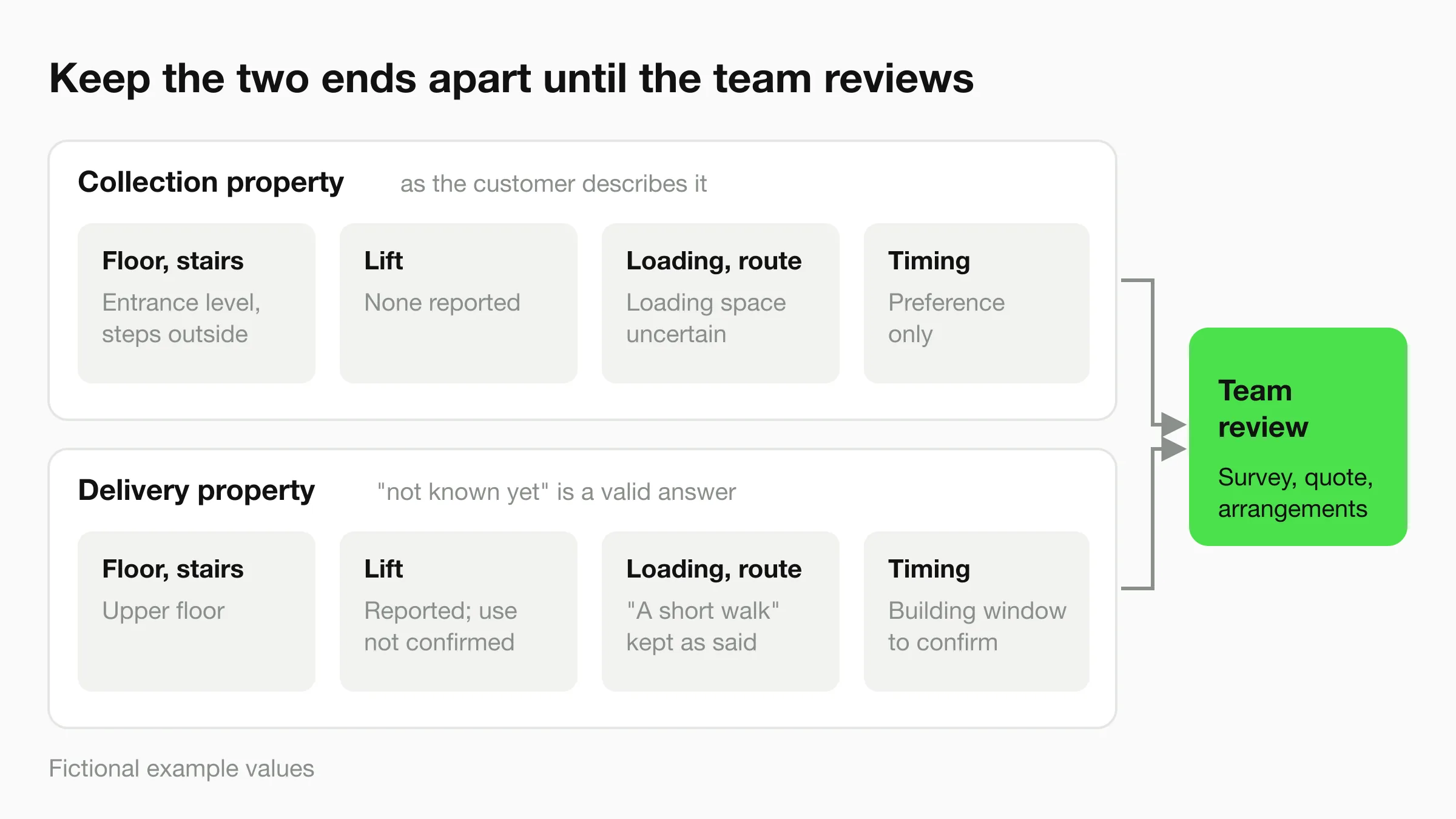
The most important design choice is to keep the two ends separate. “There are stairs” is incomplete if staff cannot tell whether the customer means the collection property, the delivery property or both. Use consistent fields for each location and preserve “unknown” when the customer has not yet visited the destination.
For a home-services AI front desk, the useful role is bounded enquiry collection. The agent can explain approved business information, ask for relevant context and share the team's approved quote-request route. It does not acquire the authority of a surveyor or moving coordinator merely because it has collected a detailed form.
The broader moving-company AI guide covers customer enquiries across the business. This article is narrower: a practical question pack for stairs, lifts, loading, walking distance and timing restrictions. It should help staff identify what to ask next, not imply that a quotation can be finalized without the company's normal review.
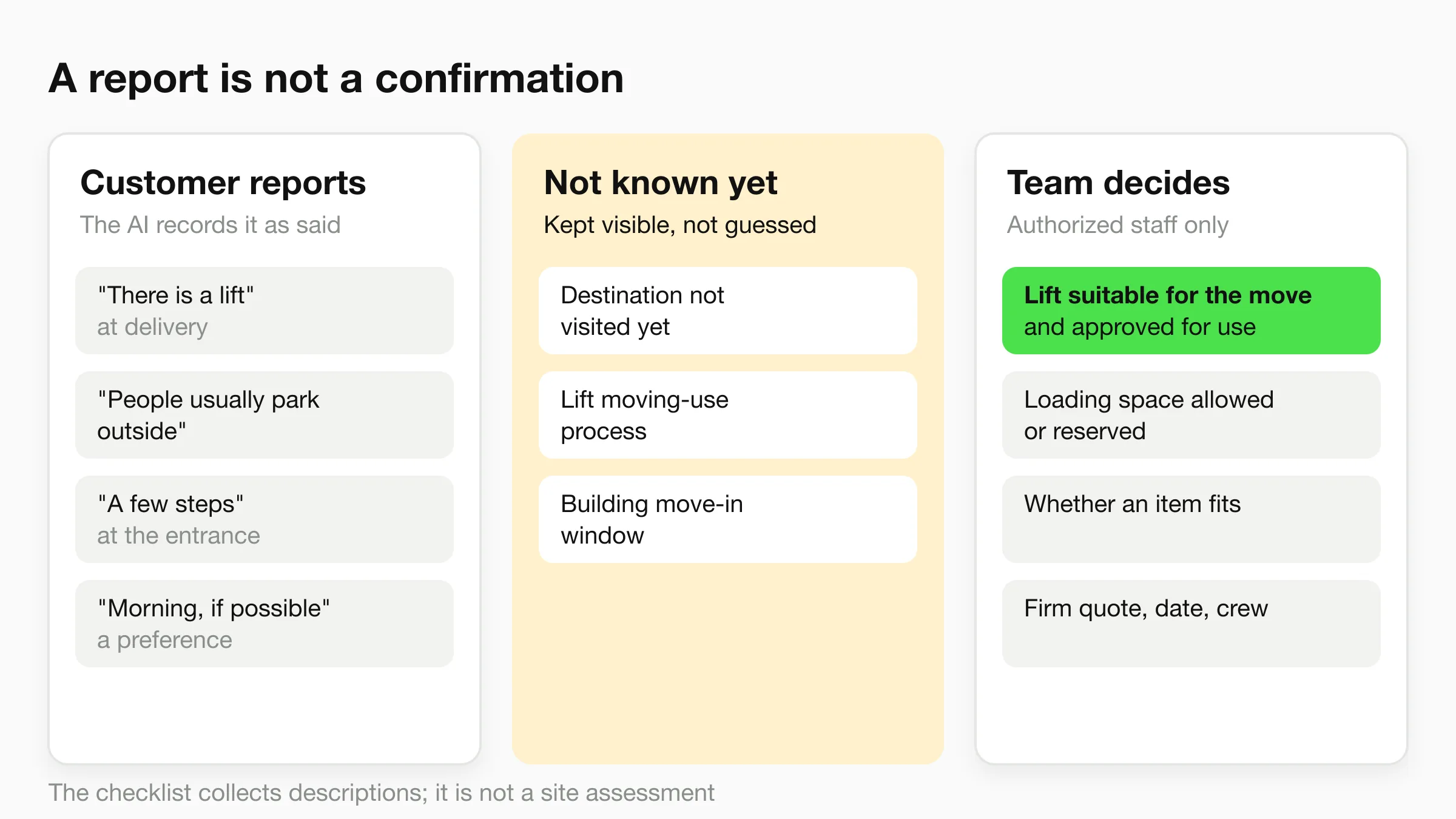
Describe every access detail by its evidence level. “Customer reports a lift” is not “lift confirmed suitable.” “Parking is usually available nearby” is not “loading space reserved.” The attachment is strongest when it carries those distinctions into the handoff instead of polishing uncertainty into a firm operational fact.
Customer descriptions are not a site assessment
This checklist gathers reported access information. It does not confirm that an item fits, a lift is suitable, a vehicle can park, a route is safe or a move can be completed at a quoted price. Your moving team must review those decisions through its authorized process.
Why Access Details Get Lost in Moving Enquiries
The two addresses collapse into one description
A customer may mention stairs at the old home and a lift at the new one in the same sentence. A summary that says “stairs and lift” removes the relationship that makes the information useful. Label each detail by origin or destination before passing it to staff.
Everyday language is treated as a technical measurement
“A few steps,” “small lift” and “close parking” are useful descriptions, but they are not measured dimensions or confirmed permissions. Ask an appropriate clarification when it changes the next step. Do not convert vague phrases into exact distances or equipment requirements.
Unknown destination details look like missing form work
A customer may not have access to the new property yet. Forcing an answer can encourage guessing. A deliberate “not known yet” value tells the moving coordinator where later confirmation is required. It is more useful than a confident response entered just to finish the form.
A detailed enquiry sounds like an accepted moving plan
The more questions the assistant asks, the easier it is for the customer to assume the business has assessed the job. The acknowledgement should say that information was collected for review and that timing, pricing and arrangements remain subject to the authorized process.
The lead-summary guide explains how to preserve useful context. For moving enquiries, the specific discipline is attribution: which property, who reported the detail and what remains unconfirmed. Without those labels, a longer summary can actually be less reliable than a short one.
7 Access Questions to Add to the Enquiry
1. Separate origin and destination before asking about obstacles
Start by naming the two locations in a way the customer understands. Depending on the business's approved process, a general area or property reference may be enough for an initial conversation. Do not request more precise location information than the team needs at that stage.
Illustrative opening:
“I can help collect access details for the moving team's review. Let's keep the collection property and delivery property separate. Which one would you like to describe first?”
If the customer already provided both addresses through an appropriate process, acknowledge the two ends without unnecessarily repeating full personal addresses in every reply. Use “collection property” and “delivery property” as stable labels in the working note.
Ask whether the customer knows the destination details. “I have not been inside yet” is a valid answer. Record it and let staff decide what later review is needed. Do not fill the gap from a public photograph or assume that similar buildings have identical access.
The lead qualification guide supports this question-by-purpose approach. The first goal is not to complete a long form; it is to ensure every later detail has the correct location attached. That makes all subsequent questions easier to interpret.
2. Ask about floors and stairs in plain language
Ask which floor is involved and whether the customer expects stairs along the route. Avoid asking the customer to assess safe lifting conditions or tell staff how to move an item. Their role is to describe what they know.
Illustrative prompt:
“At the collection property, which floor are the items on, and are there stairs you know about between that area and the usual entrance? If you are unsure of a detail, I can mark it for the team to clarify.”
If the customer says “first floor,” clarify the physical description when regional terminology could cause confusion. For example, ask whether they mean the entrance level or a level above it. Do not silently impose your own floor-number convention on a global customer.
Separate indoor stairs from steps outside the entrance when the customer can describe them. A single “stairs: yes” field can hide that difference. Keep the question proportionate; if detailed dimensions are needed, let the team's authorized survey process request them appropriately.
Do not instruct the customer to lift, move or dismantle anything to answer the question. The intake should not create a task that carries its own risk. A description of what is visible or already known is enough for an initial handoff.
3. Record lift information without declaring suitability
A lift may exist but still require booking, building approval or staff review for a move. The assistant should collect what the customer knows and keep those questions open. It should not decide that a particular item or load can use the lift.
Illustrative prompt:
“Is there a lift at this property, and do you know whether the building has a moving-use process or booking requirement? I can record your information for the team, but lift suitability still needs review.”
If the customer only knows that a lift is present, record exactly that. Do not convert “lift available” into “lift approved for move.” If they say the building manager must approve use, include that as an unresolved coordination step rather than assuming approval will be routine.
Avoid asking for photographs or documents containing unrelated resident information. If the business later needs a building guide or dimensions, use its approved collection process and explain the purpose. The public enquiry does not need every document associated with the property.
A useful handoff phrase is “customer reports a lift; moving-use permission not yet confirmed.” It communicates both the potentially helpful fact and the decision that remains. That is more actionable than either a blank field or an overconfident suitability statement.
4. Ask about loading and parking as reported conditions
Customers can describe where vehicles usually stop, but they may not know local restrictions or whether a space can be reserved. The AI front desk should not interpret parking rules, promise access or calculate a route from informal descriptions.
Illustrative prompt:
“What do you know about the usual loading area or nearby parking at this property? Please mention any building instructions or restrictions you have been told about. The moving team will need to review the arrangements.”
Keep reported observations distinct from permission. “There is a driveway” does not prove that a moving vehicle can use it. “People usually park outside” does not prove that loading there is permitted on the requested date. Record the statement without endorsing the conclusion.
If the customer is unsure, the next action may be a staff question or a check with the authorized building contact. Do not tell the customer to place objects in a road, reserve space informally or undertake another action outside the approved moving process.
For local service-area questions, geography itself may still need review. Keep that separate from loading detail. Being inside the company's service territory does not establish that a vehicle can reach or use a particular entrance.
5. Capture the route description without inventing measurements
Ask the customer to describe the route between the usual entrance and the place where items are located. Useful context may include a courtyard, a long corridor or a separate building. Keep this as a description unless the customer provides measurements through an appropriate process.
Illustrative prompt:
“Is there anything about the route from the entrance to the items that the team should know, such as a courtyard, separate building or long corridor? A plain description is fine; please do not estimate a precise distance unless you know it.”
If they say “a short walk,” preserve that phrase rather than turning it into a distance. The moving team can decide whether more detail or a survey is needed. The assistant should not use an invented measurement to produce labor, equipment or price estimates.
Separate the route description at each property. A clear collection route does not resolve the delivery route. If the customer knows one end well and the other poorly, the record should show that asymmetry rather than making the destination look complete.
This question is especially useful when the standard address conceals the actual entrance. Do not collect private access codes to make the description more detailed. The initial brief can say that entry arrangements require later coordination through the business's authorized process.
6. Record timing restrictions as questions to confirm
Buildings may have move-in windows or procedures, and customers may have a preferred date. Collect their report without promising that the moving team or property has accepted the schedule. A preference and a permitted window are different kinds of information.
Illustrative prompt:
“Have you been told about any building move-in or loading windows? Please separate those from your preferred moving time, and tell us if either still needs confirmation.”
If the customer gives a document or message as the source, the team can review it through the approved process. The assistant should not interpret a complex building rule or claim that it has permission to override it. The first brief needs to expose the coordination requirement.
Use the relevant local date and time context. “Morning” may be enough as a preference, but it is not a precise access window. Do not convert it into a confirmed start time or tell the customer that a crew is assigned.
When the two properties have different restrictions, retain both. A move can be difficult to plan even if each individual window seems straightforward. That is a staff scheduling problem, not something the AI should resolve by choosing a time that sounds convenient in the chat.
7. Close with a two-location review record
Summarize the access details by location and identify what remains unknown. The acknowledgement should help the customer spot a misunderstanding without sounding like a completed site assessment or quotation.
Illustrative summary:
“For collection, you described an entrance-level property with steps outside and uncertain loading space. For delivery, you reported an upper-floor apartment with a lift, but moving-use arrangements are not confirmed. The team needs to review those details before confirming the moving plan or quotation.”
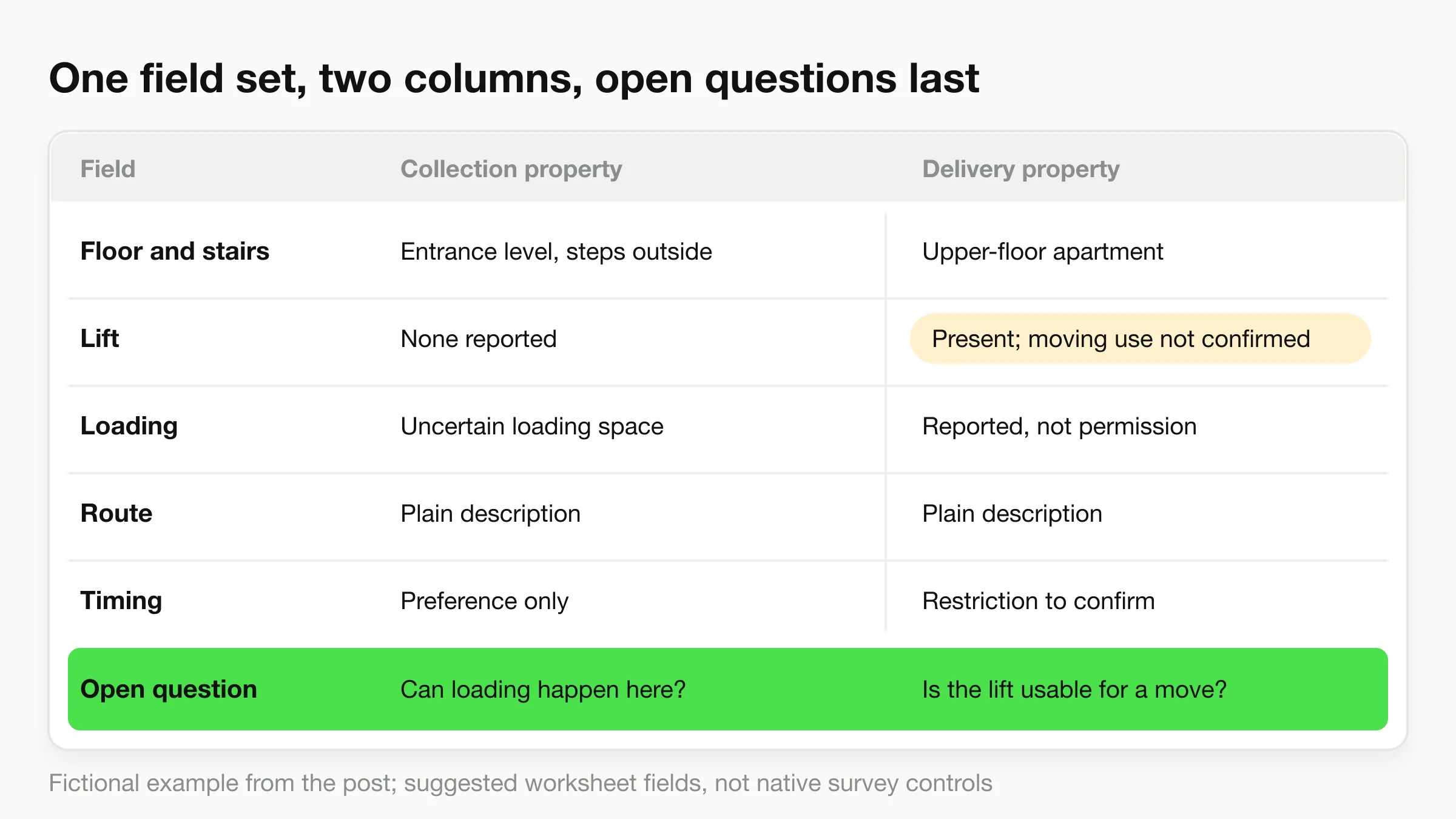
Use a simple attachment:
| Field | Collection property | Delivery property |
|---|---|---|
| Floor and stairs | Customer description | Customer description |
| Lift | Present, absent or unknown; approval separate | Present, absent or unknown; approval separate |
| Loading | Reported condition, not permission | Reported condition, not permission |
| Route | Plain description | Plain description |
| Timing | Reported restriction or preference | Reported restriction or preference |
| Open question | What staff must clarify | What staff must clarify |
These are suggested worksheet fields, not claims of native survey or dispatch controls. Verify the configured receiving process and give the team the handoff context it needs. Do not tell the customer that a quote or moving date is confirmed simply because the attachment is complete.
Collect more useful moving enquiries
Answer approved questions and help your team receive clearer access context before its review.
Start for freeJudge the Checklist by the Questions It Resolves
A useful access attachment reduces ambiguity without creating false certainty. Staff should be able to tell which property a detail belongs to, whether the customer actually knows it and what needs a later check. That is the first quality bar to evaluate.
Compare a fictional note saying “stairs, lift, parking nearby” with a record that separates collection steps from a delivery lift and labels parking as unconfirmed. The second record does not promise an easier move or a lower price. It simply prevents the coordinator from treating unrelated fragments as a complete operational picture.
Ask the receiving team which details they still have to request again. If they routinely ask whether a restriction applies at collection or delivery, strengthen the location labels. If customers keep guessing dimensions, revise the prompt so “unknown” is an accepted answer. If the final message sounds like a quote approval, correct the acknowledgement.
Keep any claimed time savings or commercial results tied to your own measured process. A longer record is not necessarily better, and a submitted enquiry is not a completed move. Review usefulness and correction rates qualitatively first, then choose a measurement approach that reflects the real staff task you want to improve.
Add the Checklist to Your Existing Enquiry Process
Start with the moving coordinator's current questions. Identify which access details matter in the initial conversation and which belong in a later survey. Remove questions that the team does not use or that encourage customers to undertake measurements or inspections outside the approved process.
Prepare an approved source explaining how quote requests are reviewed, which public information can be shared and where the customer should provide additional material if needed. Use the knowledge-base maintenance guide to assign an owner and keep obsolete instructions out of the answer set.
Test fictional enquiries with different levels of knowledge: a customer who knows both properties, one who has not visited the destination, one who changes the date and one who asks for a firm price after supplying incomplete access details. The correct response should preserve uncertainty and explain the staff review step rather than filling gaps to satisfy the request.
Hyperleap AI can answer approved questions, collect enquiry information and support a clearer staff handoff. It does not validate moving inventories, inspect buildings or issue a firm quotation through this checklist. Its quick-start path can be live in under five minutes, with this business-specific review as additional tuning. Check the current plans and begin with the access question that most often causes avoidable back-and-forth in your own team.
Frequently Asked Questions
Can an AI front desk calculate a moving quote from these answers?
This checklist does not establish that capability. It collects customer-reported access context for the moving team. A firm quotation may depend on inventory, survey findings and other business decisions. Do not turn incomplete or unverified descriptions into a confirmed price.
Should the customer measure doorways and lifts during chat?
Not as an improvised task prompted by this template. Ask for information the customer already knows and mark uncertainty clearly. If measurements are needed, the moving team should request them through its approved process and decide how suitability will be assessed.
Is a lift's presence enough to mark access as suitable?
No. Presence, moving-use permission and suitability are different questions. Record what the customer reports and leave unresolved items visible. The assistant should not conclude that an item fits or that the building has approved use simply because a lift exists.
What if the customer does not know the destination details?
Record that explicitly rather than forcing an answer. A destination the customer has not visited is a valid reason for missing information. The moving coordinator can decide what follow-up or survey is appropriate before confirming arrangements.
Can the assistant approve parking or loading arrangements?
No approval is implied here. The assistant can collect the customer's description and any reported building instructions. Permission, restrictions and practical access need review through the moving company's authorized process. Nearby parking is not the same as an approved loading space.
How should the enquiry be acknowledged?
Summarize the two locations separately, preserve unknowns and state that the information is for team review. Do not describe the move, crew, date or quotation as confirmed unless the authorized process has actually made that decision. A completed checklist is not a completed moving plan.
Better Access Context, Fewer Assumptions
The value of an access checklist is not that it makes an AI front desk sound like a moving surveyor. It helps a customer describe what they know and helps the team see what still needs attention. Keep origin and destination separate, treat uncertainty as useful information and finish with a truthful review step.
Start with a small set of questions your coordinator already trusts. Test the resulting attachment against real operating needs using fictional enquiries, then adjust the wording where people misunderstand it. That gives your team a more useful first conversation without replacing the judgment that makes a moving plan workable.
Give your moving team a clearer starting point
Build an AI front desk that captures useful enquiry context and keeps operational decisions with your team.
Start for freeIndustry Solutions
See how AI chatbots work for these industries:
Related Articles
View all
Guide18 min read
Quote or Estimate? AI Front Desk Reply Templates
Use clear quote-versus-estimate replies, scope questions and approval checks so your AI front desk does not promise a price your team has not agreed.
Guide17 min read
Service-Area Answers: Scripts for Local Businesses
Give clear service-area answers with location questions, boundary scripts and a practical handoff record for local service enquiries.
Guide17 min read
Hotel Event-Space Enquiries: Build a Useful Brief
Collect useful hotel meeting-space enquiries with layout, attendance, equipment and catering prompts, without implying a venue reservation.
Guide17 min read
Cleaning Enquiries: Scope Questions Before a Quote
Collect clearer cleaning quote enquiries with residential and commercial scope questions, exclusions, access notes and a practical team-review worksheet.