Cleaning Enquiries: Scope Questions Before a Quote
Collect clearer cleaning quote enquiries with residential and commercial scope questions, exclusions, access notes and a practical team-review worksheet.

“How much for a clean?” is not enough information to prepare a useful quotation. The customer may mean a routine home visit, a move-out clean, a workplace schedule or a specialist task your business does not provide. If the first reply jumps to a price, your team may spend the next conversation correcting the scope.
Good cleaning quote enquiry questions identify the work before discussing an offer. They separate residential and commercial needs, ask about the areas and frequency involved, and make exclusions visible. They also leave room for a person to review anything the chat cannot establish.
This guide provides illustrative scripts and a scope worksheet for an AI front desk. It does not describe automatic price calculation, a site inspection or a confirmed booking. The goal is simpler: give the customer a clear next step and give your team a request it can review without beginning again.
What a Cleaning Scope Enquiry Should Establish
A cleaning scope enquiry records what the customer wants done, where the work is broadly located and which conditions still need review. It should distinguish a requested task from an included task. A customer asking for oven cleaning has expressed a need; the business has not necessarily accepted that work.
Use the first conversation to identify the service lane. Residential and commercial cleaning can involve different questions, but neither needs an exhaustive survey in chat. Ask the detail that changes the next step, then stop when the team has enough context to respond.
| Scope dimension | Residential example | Commercial example |
|---|---|---|
| Purpose | Routine, move-in or move-out | Regular workplace service or one-off request |
| Areas | Rooms or broad home size | Work areas and approximate site description |
| Frequency | One visit or recurring interest | Desired service pattern |
| Special items | Appliance or interior-window request | Shared spaces or specialist areas |
| Access | General arrival constraints | Occupancy and approved access process |
| Review need | Unclear condition or extra work | Site-specific requirements |
The cleaning-service overview covers the broader business use case. This question pack concentrates on scope quality. It does not claim that collecting a room count makes an instant quotation appropriate or that a description replaces a site review.
For a home-services AI front desk, the useful boundary is clear: answer approved service questions, gather a relevant request and explain who confirms the work. Do not accept hazardous or specialist work by inference. If the request falls outside the business's published scope, provide the approved review or contact route.
Keep access secrets out of the enquiry
Ask about general access constraints, not alarm codes, key locations or door credentials. Any necessary private access arrangements belong in the business's approved later process, not an open-ended first-contact chat.
Where Cleaning Enquiries Lose Important Detail
“Standard” means different things to different people
A customer may include appliances, internal windows or laundry in their idea of a standard clean. Your business may not. Ask about the requested work and show approved inclusions and exclusions. Avoid using a package name as if it explains itself.
Size is collected without purpose
A room count can help, but it may not describe the task. A small property with a specialist request is not necessarily a routine visit. Explain why you ask for approximate size and keep condition or scope questions separate rather than making the number do all the work.
Residential questions are reused for a workplace
A workplace enquiry may require a broad description of shared areas, occupancy and desired frequency. Asking how many bedrooms it has signals that the conversation is following a rigid template. Establish the service lane first, then use the relevant questions.
A preferred date becomes a booking
The customer may need the clean before an event or move. Record the timing, but do not confirm staff availability or acceptance. A quote request and a booking are different steps. The qualification guide helps keep the next action tied to the information collected rather than a premature completion message.
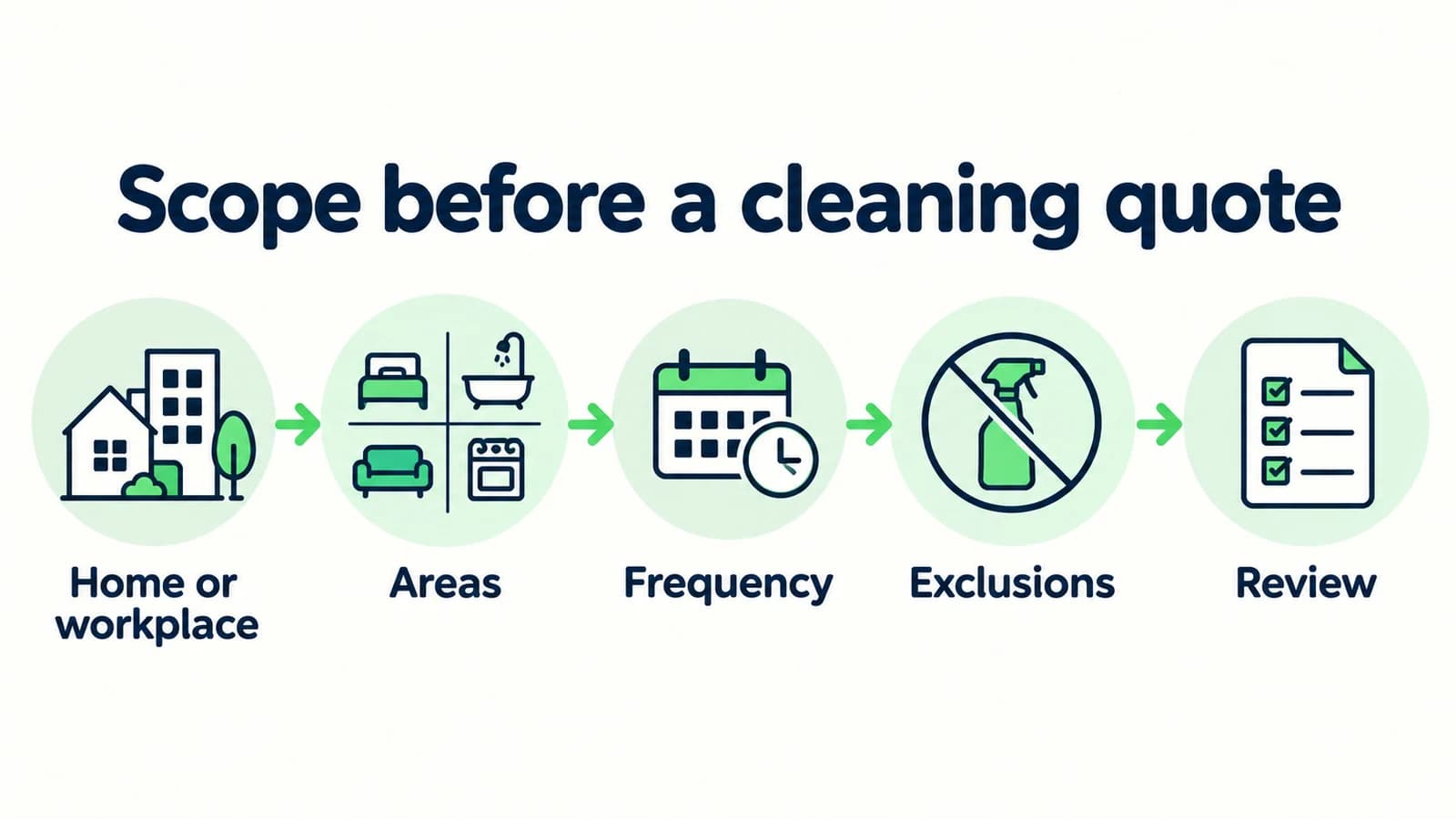
7 Question Groups for a Reviewable Cleaning Request
1. Identify the setting and purpose
Ask whether the request concerns a home or a workplace, unless the customer has already said so. Then clarify the purpose using the business's actual service categories. Do not invent a specialist offering because it sounds adjacent to cleaning.
Customer: “I need a cleaning quote.”
Front desk: “Is this for a home or a workplace? I can then ask the relevant scope questions for the team.”
For a home, the next distinction might be routine cleaning versus a move-out request. For a workplace, it might be regular service versus a one-off visit. Keep the choices understandable and allow a free description when none fits.
If the customer says “deep clean,” ask what work they want included. Different people use that phrase differently. An approved package description can help, but it should not overwrite the customer's stated needs.
The internal note should say “customer requests move-out cleaning” rather than “move-out package accepted.” The first is intake; the second is a commercial decision. This distinction matters before any quotation is prepared and remains important when the team later changes the scope after review.
2. Ask which areas need attention
Collect the areas relevant to the service, using approximate descriptions where appropriate. A home enquiry may mention rooms and bathrooms. A workplace enquiry may identify offices, shared facilities and public-facing areas. Do not ask customers to produce a technical site specification in the first chat.
Front desk: “Which areas would you like included? A broad description is enough for the initial enquiry; the team can confirm the detailed scope.”
If the customer already listed areas, summarize them and ask only about a meaningful gap. Repeating the question can make the front desk appear inattentive and may produce conflicting answers in the record.
For commercial spaces, avoid assuming that every area in a building is included. A customer may only be responsible for part of a site. Record the requested scope and leave access or responsibility questions for the appropriate review where needed.
Do not convert approximate descriptions into measured facts. “Customer describes a small office” is accurate. “Site measured and suitable for standard service” is not. The front desk has collected a description, not inspected the premises or verified the work involved.
3. Separate frequency from availability
Ask whether the customer wants a one-off service or is exploring recurring cleaning. Frequency helps the team understand the request, but it does not mean the business has capacity for that pattern.
Customer: “Could someone come every Friday?”
Front desk: “I can note Friday as your preferred recurring day. The team needs to confirm availability and the service scope. Is there a particular start period you have in mind?”
If the business has approved public information about service frequency, explain it accurately. Do not imply that a recurring request automatically creates a schedule or payment arrangement. The team's quotation and booking process still applies.
For a workplace, ask whether service must occur during or outside ordinary occupancy if that distinction affects the next review. Do not request detailed staff schedules or security arrangements. A broad constraint is usually enough to flag the issue for a person.
Record timing in a way the reviewer can interpret: “prefers weekly service; weekday flexible” or “one-off request before move-out; date needs confirmation.” Avoid a bare calendar entry that looks like a confirmed appointment. The customer should understand the same distinction in the visible reply.
4. Surface extras and exclusions before the quotation
Ask whether there are particular tasks the customer wants included beyond the core service description. Use the approved list to explain what is included, excluded or subject to review. Silence in the source is not permission to promise an extra.
Customer: “Can you include the oven and inside windows?”
Front desk: “I can include those as requested items in the enquiry. The team needs to confirm whether they are available for your service and how they affect the scope.”
If a task is explicitly included in the relevant approved package, say so with the applicable conditions. If it is explicitly outside the business's services, explain that directly and offer the supported next step. Do not keep collecting details for work the business has already ruled out.
Avoid instructions about handling hazardous substances, unsafe conditions or specialist cleaning situations. The front desk should not assess risk or advise a customer how to prepare a potentially dangerous area. Route the request according to the business's approved boundaries.
The scope note should distinguish “requested extras” from “approved inclusions.” That small separation helps the person preparing the quotation see what still needs a decision rather than discovering it after the customer believes the offer is settled.
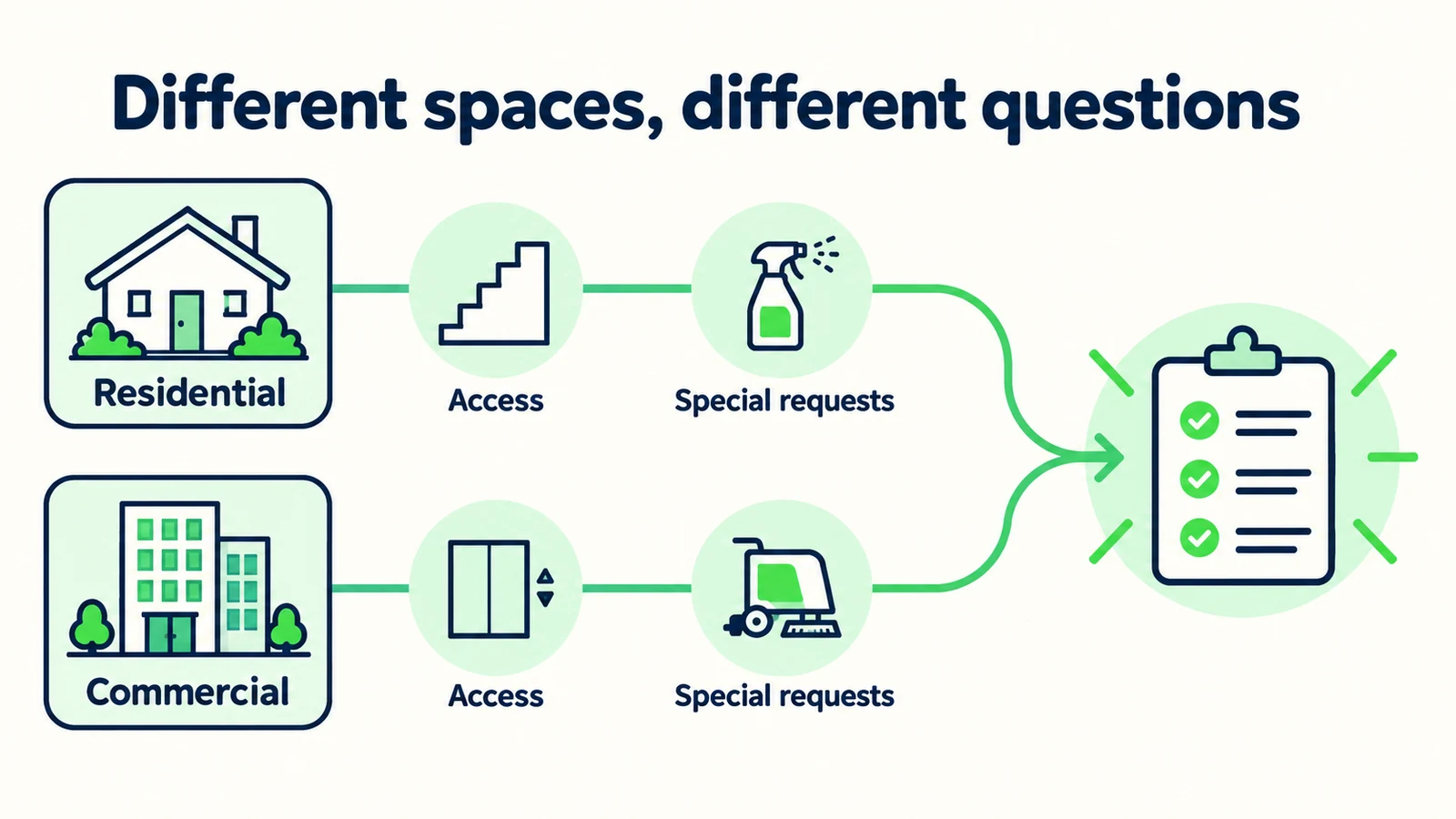
5. Ask about access constraints without collecting secrets
Access can affect whether a visit needs further discussion. Ask about general constraints such as parking restrictions, stairs, building access procedures or whether the site will be occupied. Keep the question practical and avoid asking for credentials.
Front desk: “Are there any general access constraints the team should know about, such as restricted parking or building entry arrangements? Please do not share codes or key locations here.”
Do not repeat sensitive details if the customer volunteers them. Use the business's approved handling process and redirect future arrangements to the appropriate private channel. A first-contact transcript should not become a storage place for access secrets.
For a home, a simple note that access needs discussion may be enough. For a workplace, the team may need to coordinate with an authorized site contact later. The front desk should not infer permission to enter from the fact that someone asked for a quote.
Keep access separate from availability. Knowing a building has an entry process does not prove that the cleaning team can attend at the requested time. Record each unresolved item clearly so the reviewer can address it in the correct order.
6. Explain the quotation or site-review path
Once the scope is clear enough, explain how the business prepares an offer. If the team reviews enquiries manually, say that. If a site visit may be needed, describe it as a review requirement rather than a booked appointment.
Front desk: “The team will need to review the areas, requested extras and access constraints before confirming the scope and price. I can help prepare that enquiry and share the approved next step.”
Use the actual business process in the final configuration. Do not claim delivery or a response deadline unless it is verified and authorized. A customer should not be told a quotation has been issued when the chat has only gathered information.
If a booking link is available for a consultation or site review, the front desk may share it. The separate booking process handles its own selection and confirmation. The chat should not promise that a specific slot is available or that the visit exists merely because the customer requested it.
The human-handoff guide can help define the receiving team's responsibility. The purpose is to avoid a dead end: the customer knows how the request will be reviewed, and the team knows which questions still need an answer.
7. Confirm the scope in the customer's language
Summarize the setting, purpose, areas, frequency and unresolved extras. Invite a correction before the conversation ends. Do not replace the customer's words with jargon that makes the scope sound more settled than it is.
Front desk: “You are requesting a one-off move-out clean for the areas you described, with oven cleaning and interior windows to be reviewed as additional items. The preferred timing is before your move, and access arrangements still need discussion. Have I missed anything important?”
This summary is useful because it includes uncertainty. It does not claim that all requested work is included, that a price is approved or that a date is booked. If the customer corrects it, update the brief rather than appending a contradictory note without explanation.
Use the lead-summary guide to design the receiving record. A concise summary should show customer statements, approved information shared and decisions pending. Keep the full conversation available for the person who needs more context.
Do not collect a contact method until its purpose is clear. If the customer wants the team to follow up, ask which supported route they prefer. If they only wanted general service information, respect that and leave a clear option to return later.
Turn cleaning enquiries into useful scope briefs
Use Hyperleap AI to explain approved services and collect the details your team needs before reviewing a quotation.
Start for freeA Residential-and-Commercial Scope Worksheet
Use this worksheet as a team review artifact, not as a mandatory customer form. It can guide the conversation without requiring every field in every enquiry.
| Field | Residential prompt | Commercial prompt |
|---|---|---|
| Purpose | Routine, move-in, move-out or another request? | Regular service or one-off request? |
| Areas | Which rooms or broad areas? | Which site areas are in scope? |
| Size | Approximate description, if useful | Approximate site description, if useful |
| Frequency | One-off or recurring interest? | Desired pattern and start period? |
| Special items | Any specific tasks to review? | Any areas requiring separate discussion? |
| Access | General constraints only | Occupancy and approved entry process |
| Exclusions | What is outside the published scope? | What needs specialist or owner review? |
| Next step | Quotation review or approved booking route | Quotation review or site discussion |
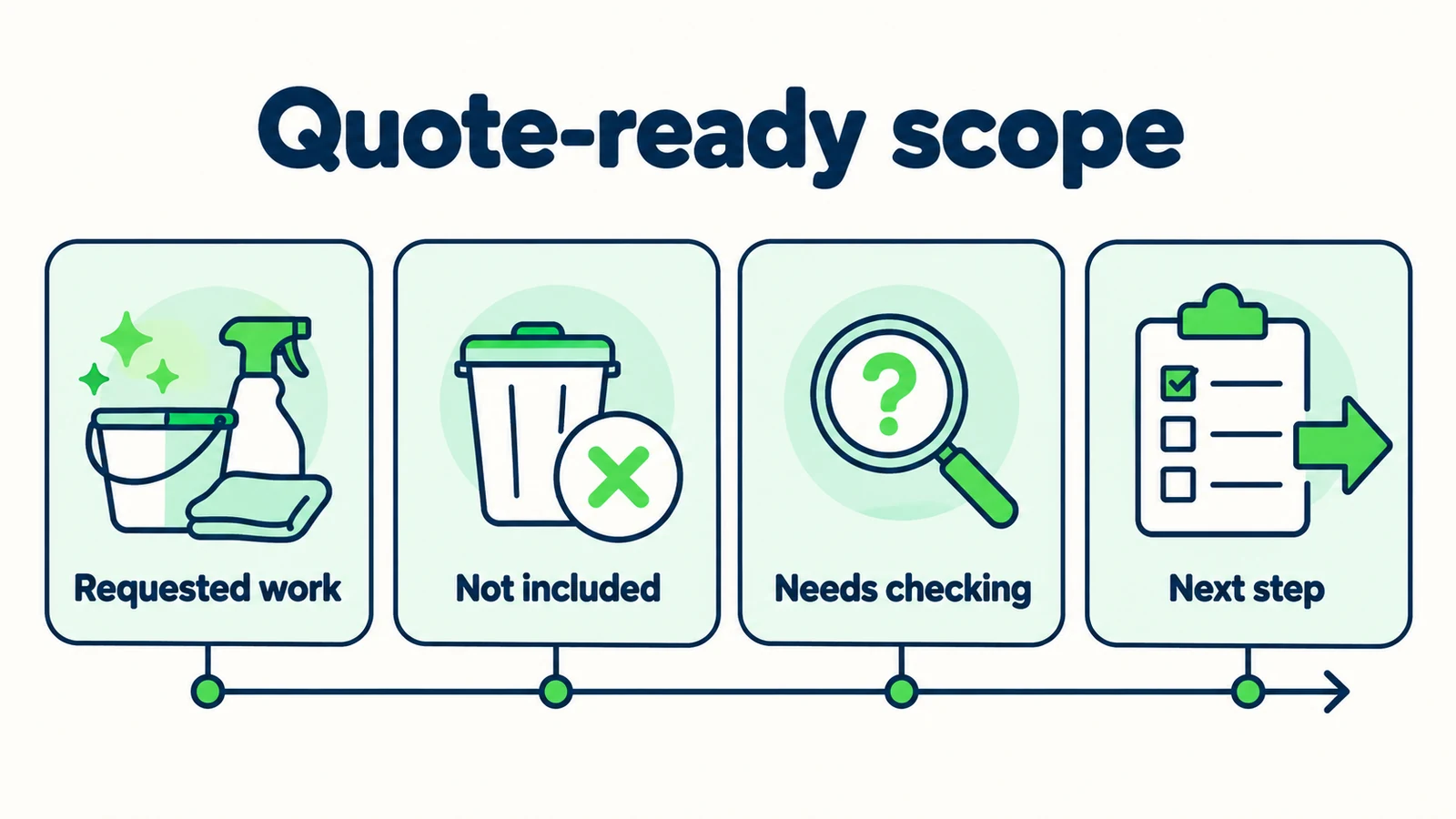
Add three short sections to the internal brief: requested work, not included under the published scope, and needs checking. This is more useful than a single paragraph that blends all three.
For example, a fictional workplace request might include shared offices and washrooms, exclude a specialist production area and leave access timing for review. The front desk should preserve those distinctions. It should not summarize the enquiry as “whole-building clean” because that phrase is shorter.
Review whether the quotation team can identify missing information from the brief without asking the customer to start over. Track corrections to scope and misunderstandings about included tasks. Those are observable signs of intake quality. Do not infer a revenue result or a staffing reduction merely because more fields are filled in.
Launch the Question Pack With a Real Scope Review
Begin with the services the business actually offers. Gather current descriptions, exclusions, service areas and the approved quotation process. Ask the operations owner to resolve ambiguous package terms before using them as AI sources.
Create separate residential and commercial question paths where the distinction matters. Keep them short and responsive. If a customer has already supplied the relevant information, the front desk should use it rather than ask the same questions in a fixed order.
Test routine requests and edge cases. Include an unclear “deep clean,” an extra that is not in the source, a workplace with access constraints, a request outside the service area and a customer who asks for a confirmed price immediately. Use fictional details and do not paste actual access codes or customer records into testing.
Check the receiving summary. Does it preserve approximate size? Does it mark extras as requested rather than included? Does it separate a preferred day from an appointment? These meaning checks matter more than whether the conversation sounds enthusiastic.
Hyperleap AI can answer from approved documents and website information, collect lead details and support team follow-up. Your business still owns quotations, site review and acceptance of the work. Native scheduling or automatic price approval is not established by a successful intake conversation.
Use the knowledge-base maintenance guide when service descriptions change. Keep the current product plans separate from the cleaning prices your business quotes customers. The front desk should be tested against your service facts, not a generic template's assumptions.
After launch, ask the people preparing quotations which questions helped and which produced irrelevant detail. Remove questions that do not change their next action. A useful pack should reduce the need to reconstruct scope, not create a larger pile of information to read.
Frequently Asked Questions
What should a cleaning quote enquiry ask first?
Identify the setting and purpose if the customer has not already done so. A home, workplace, routine visit and move-out request can need different follow-up questions. Answer any direct public-information question first, then collect only the scope details that help the team review the request.
Can the AI provide an instant final cleaning price?
This workflow does not calculate or approve a final price. It collects scope and explains approved published information. Your business decides how quotations are prepared and whether a site review is needed. Do not let a customer description become an unauthorized pricing decision.
Should customers send photos or access codes in chat?
Do not request access codes, key locations or other secrets in a first-contact conversation. Follow the business's approved process for any later materials it genuinely needs. Keep the initial enquiry focused on a broad description and practical constraints, and avoid collecting unnecessary personal or sensitive information.
How should the front desk handle a specialist cleaning request?
Use the business's approved service boundaries. If the request is outside the published scope or needs specialist review, say so and offer the correct contact route. Do not assess hazards, provide handling instructions or assume the team can accept the work because it relates generally to cleaning.
Does a preferred recurring day mean the service is scheduled?
No. It is a customer preference until the business's actual booking process confirms an arrangement. The front desk should preserve the preference and explain the next step without claiming staff availability, acceptance or a recurring schedule that has not been established.
How can we tell whether the scope worksheet is helping?
Ask the quotation team whether it can understand the request, identify open decisions and avoid repeating introductory questions. Review corrections to inclusions, exclusions and timing. These observations can show better preparation; they do not by themselves prove increased revenue or a particular time-saving percentage.
Get the Work Clear Before Getting the Price Specific
The strongest cleaning enquiry is not the longest one. It tells the team what the customer wants, where the scope is uncertain and what needs review before an offer is made.
Separate home and workplace questions, ask about areas and frequency, and keep extras and exclusions visible. Collect general access constraints without secrets. Finish with a summary that describes a request, not an approved quotation or booking.
An AI front desk can make that first conversation easier for both sides. The customer gets a useful next step, and the team receives the information it needs to discuss the work accurately.
Build a clearer cleaning enquiry flow
Create a Hyperleap AI front desk using your approved service information, scope questions and team-review route.
Start for freeIndustry Solutions
See how AI chatbots work for these industries:
Related Articles

HVAC Repair or Replacement: Enquiry Questions
Use HVAC enquiry questions to capture the customer's concern, property context and contact preference while leaving diagnosis and quotes to technicians.

Quote or Estimate? AI Front Desk Reply Templates
Use clear quote-versus-estimate replies, scope questions and approval checks so your AI front desk does not promise a price your team has not agreed.

Service-Area Answers: Scripts for Local Businesses
Give clear service-area answers with location questions, boundary scripts and a practical handoff record for local service enquiries.

Mobile AI Front Desk QA: A Practical Review Sheet
Review your mobile AI front desk from opening to follow-up, with practical checks for reading, keyboard obstruction, links, forms and close controls.