AI Chatbot for Cleaning Services: Quotes & Bookings 24/7
See how an AI chatbot for cleaning services delivers instant quotes, books recurring cleanings, and captures after-hours leads your team would otherwise miss.
TL;DR: Homeowners and office managers requesting cleaning quotes typically contact several companies at once, and research from InsideSales.com shows leads contacted within 5 minutes convert up to 100 times better than those contacted after 30 minutes. Most residential and commercial cleaning companies can't staff a phone line around the clock, so evening and weekend inquiries — when a large share of quote requests actually arrive — go unanswered until the next business day. An AI chatbot for cleaning services collects the details needed for an instant estimate, offers open time slots for recurring service, and routes every lead through a contact-detail form before the conversation starts, so your team gets a qualified, reachable lead instead of a missed call. Pricing starts at $40/month with a 7-day trial (card required).
Why Cleaning Companies Lose Jobs to Faster Competitors
A cleaning company's biggest revenue leak usually isn't marketing spend — it's the gap between when a prospect asks for a quote and when someone finally answers. Direct answer: cleaning businesses lose jobs primarily because quote requests and booking questions arrive when no one is available to respond, and by the time a callback happens, the prospect has already booked with a competitor.
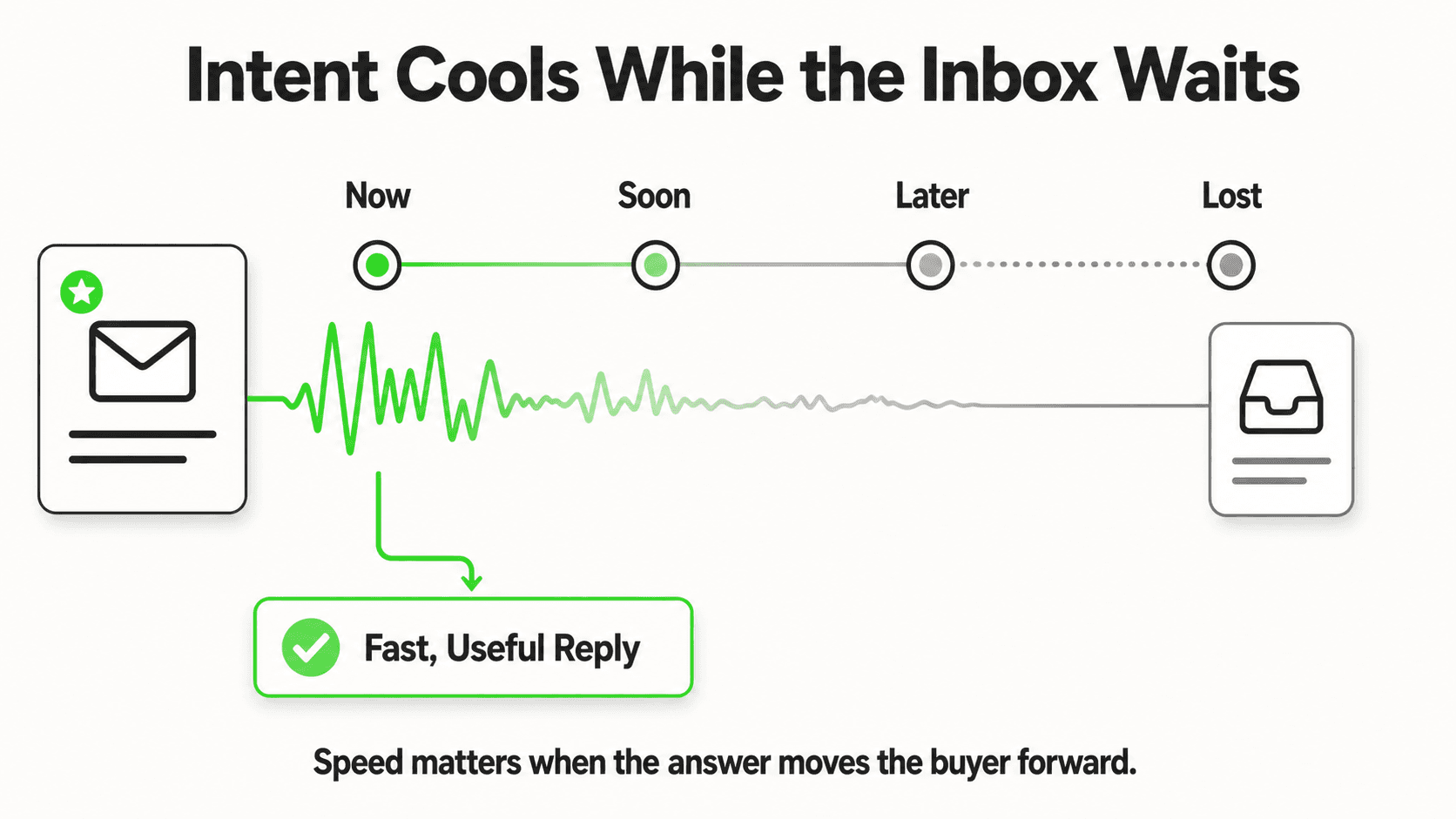
Think about how someone actually shops for a cleaning service. They don't call one company and wait. A homeowner moving into a new place, a property manager prepping a turnover, or an office manager comparing move-out cleaning services will typically message three or four companies within the same 20-minute window — often at night, after they've finally sat down to handle the errand they'd been putting off. InsideSales.com's widely cited response-time research found that leads contacted within 5 minutes are up to 100 times more likely to convert than leads contacted after 30 minutes, and the odds of even making contact fall sharply once you cross the 5-minute mark. In a market where four companies are all quoting the same job, that math determines who gets it.
Cleaning is also a business built on recurring relationships — weekly, biweekly, or monthly visits — which means the cost of a slow first response compounds. A prospect who quietly books elsewhere isn't just one missed job; it's the entire lifetime value of a recurring client, gone to a competitor who happened to text back first.
What This Article Covers
This guide is written for owners and operators of residential and commercial cleaning companies — from solo maid services to multi-crew franchises — who are evaluating an AI chatbot to handle quote requests, recurring scheduling, and after-hours inquiries. It explains what the technology does, where it fits into your existing booking process, and how to roll it out without disrupting your crews.
What Is an AI Chatbot for Cleaning Services?
An AI chatbot for cleaning services is a document-grounded conversational assistant that lives on your website, WhatsApp, Instagram, and Facebook Messenger, answering quote and scheduling questions using your actual pricing structure, service area, and availability — not a generic script. It is trained on your specific price list, add-on menu, and service radius, so a prospect gets an answer that reflects your business, not a canned FAQ.
Unlike a static "request a quote" form that a prospect fills in and then waits days for a callback, a chatbot for cleaning services has a two-way conversation: it asks the follow-up questions a front-desk employee would ask (square footage, number of bedrooms and bathrooms, cleaning frequency, special requests like pet hair or move-out deep cleaning) and can surface a same-visit ballpark estimate. Because the underlying platform gates access to the conversation behind a lead-capture form — collecting name, phone, and service address before the chat begins — every conversation your team reviews comes with contact details already attached, not an anonymous session you have to chase down.
What a cleaning-industry AI agent typically handles:
- Ballpark and itemized quote requests based on home/office size and service type
- New booking requests, including preferred date and time windows
- Recurring service setup (weekly, biweekly, monthly) and frequency changes
- Service area verification by zip code before a quote is issued
- Add-on upsells (deep cleaning, carpet cleaning, window washing, move-in/move-out packages)
- After-hours and weekend lead capture, routed to your team the next business day
- FAQ handling: supplies provided vs. BYO, insurance/bonding, pet policies, cancellation windows
How this differs from a traditional intake process:
A phone-only intake process forces every quote request through business hours and through however many staff you have answering calls — which for most independent and small-team cleaning companies means missed calls during a job, during drive time, or after 6pm. A chatbot doesn't replace your booking coordinator; it captures the lead the moment the prospect is ready to buy, then hands a qualified, reachable contact to your team to confirm and schedule.
Why Cleaning Businesses Struggle to Keep Up With Inquiry Volume
The After-Hours Quote Gap
Most residential cleaning inquiries happen outside a typical 9-to-5 window — evenings after work, Sunday afternoons when someone is finally tackling their to-do list, or late at night after a stressful day prompts a "I need to hire a cleaner" search. Industry response-time research broadly suggests a substantial share of service-business inquiries — commonly cited in the 40–60% range and varying by category — arrive outside standard business hours. If your booking line only rings during the day, that inquiry sits until morning, and by morning the prospect has often already booked with whoever answered first.
The Repetitive-Question Bottleneck
Every new caller asks a version of the same five questions: "How much do you charge for a 3-bedroom house?" "Do you bring your own supplies?" "Can you do a one-time deep clean before I list my house?" "Are you insured?" Answering these one at a time, by phone, between jobs, eats into hours your crew leads or office manager could spend on scheduling, invoicing, or actually running the business. A chatbot handles this repetitive first-tier questioning instantly and consistently, escalating anything unusual to a human.
The Recurring-Schedule Juggle
Recurring cleaning clients frequently need to shift a date, skip a week for travel, or change frequency — small requests that, multiplied across dozens of recurring accounts, become a steady stream of scheduling admin. Left to phone tag, these requests slow down and frustrate clients who expect a quick text-like exchange, not a voicemail loop.
The Price-Shopping Reality
Cleaning is a commoditized-feeling service to most consumers until they've experienced your quality firsthand — which means the company that responds fastest with a clear, professional quote has a real edge before quality even enters the conversation. If a prospect can't get an estimate from you quickly, they'll get one from a competitor and may never come back to compare.
Common Mistake
Many cleaning companies route every online inquiry to a generic contact form with no auto-response. The prospect submits the form and hears nothing for hours (or longer) — by which point they've usually already texted a competitor back. A chatbot that responds instantly, even just to confirm receipt and gather scheduling details, keeps the prospect engaged instead of moving on.
7 Ways an AI Chatbot for Cleaning Services Wins More Jobs
1. Instant Quote Estimation
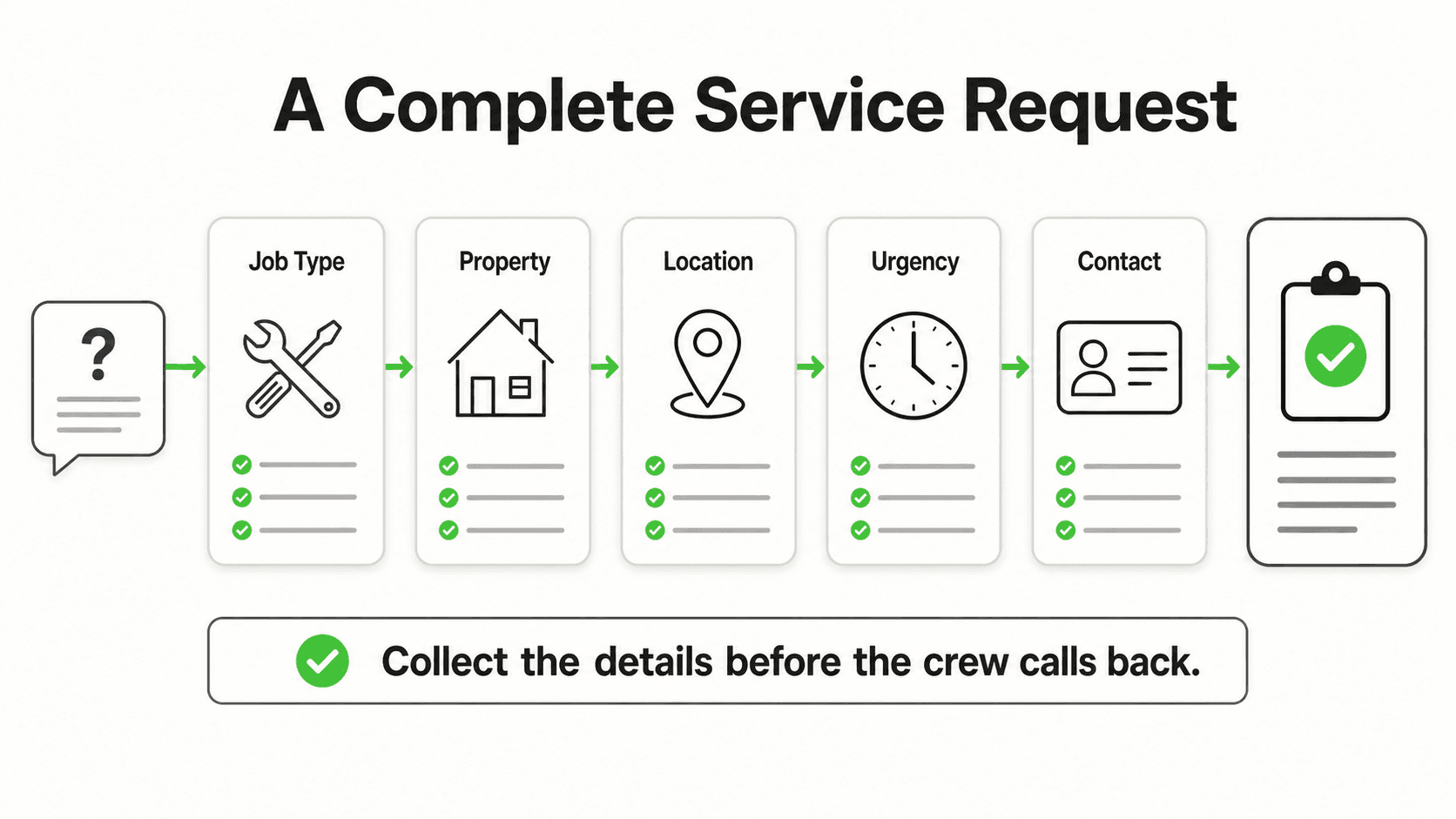
What this looks like in practice: A prospect visiting your website at 9 PM types "how much to clean a 3-bed, 2-bath house?" The chatbot asks a few clarifying questions — square footage, cleaning frequency, any special requests — and returns a ballpark range based on your actual pricing tiers, not a generic estimate.
Real-world impact: Instead of waiting until the next business day for a callback, the prospect gets a same-minute answer and can decide to book while they're still motivated to solve the problem.
Why it works: Quote-shopping prospects are comparing multiple companies in the same session. The company that answers the pricing question first — accurately — keeps the conversation, and the competitor who takes a day to call back loses it.
Key features:
- Trained on your actual price list and add-on menu
- Asks the same clarifying questions your intake staff would ask
- Works identically on your website, WhatsApp, Instagram DM, and Facebook Messenger
2. Recurring Cleaning Schedule Setup
What this looks like in practice: A prospect who wants ongoing biweekly service is walked through choosing a frequency, preferred day of the week, and any recurring special instructions (garage access code, pet on-site, preferred products).
Real-world impact: Recurring clients are the backbone of most cleaning businesses' revenue. Making it effortless to sign up for a recurring plan — instead of requiring a phone call during business hours — removes friction at exactly the moment a prospect is deciding between "one-time" and "ongoing" service.
Why it works: Recurring service has a materially higher lifetime value than one-off jobs. Reducing the setup friction increases the share of new customers who opt into a plan rather than a single visit.
Key features:
- Weekly, biweekly, and monthly frequency options
- Preferred day/time capture for your scheduling team to confirm
- Add-on selection built into the same conversation
3. Service Area Verification
What this looks like in practice: Before collecting further details, the chatbot asks for a zip code and checks it against your defined service area, so you're not spending time quoting jobs you can't actually service.
Real-world impact: Filters out-of-area leads automatically, so your team's follow-up time goes toward prospects you can actually book.
Why it works: Cleaning companies typically operate within a defined driving radius. Confirming service area upfront avoids the awkward and time-wasting scenario of quoting a job, scheduling it, and then discovering it's 40 minutes outside your coverage zone.
Key features:
- Zip-code or address-based service area check
- Graceful "outside our service area" messaging with a referral option if you choose
- Prevents wasted quote and scheduling time
4. After-Hours and Weekend Lead Capture
What this looks like in practice: A prospect messages your Facebook page at 11 PM on a Sunday asking about move-out cleaning before a Tuesday lease inspection. The chatbot gathers the job details, timeline, and contact information, and your team sees a fully qualified lead first thing Monday morning — ready to confirm, not chase.
Real-world impact: In Hyperleap's own Jungle Lodges hospitality deployment, 35% of all inquiries arrived after standard business hours — a pattern consistent with how service businesses generally experience demand outside the 9-to-5 window. Cleaning inquiries follow a similar rhythm: evenings, weekends, and last-minute "before the guests arrive" requests.
Why it works: Capturing the lead the moment it happens — rather than losing it to voicemail — means your team starts the next business day with confirmed leads instead of a stack of missed-call notifications.
Key features:
- 24/7 availability across all channels
- Lead details routed to your team via instant notification
- No staffing cost for night or weekend coverage
5. Add-On and Upsell Suggestions
What this looks like in practice: During a standard house-cleaning quote conversation, the chatbot naturally surfaces relevant add-ons — carpet cleaning, interior window washing, oven/fridge deep clean, move-in/move-out packages — based on what the prospect describes.
Real-world impact: Increases average job value without requiring your staff to remember to pitch every add-on on every call.
Why it works: Prospects often don't know what add-ons are available until they're offered. Surfacing them contextually, at the point of quote, captures incremental revenue that a rushed phone call might skip.
Key features:
- Configurable add-on menu tied to your actual services
- Context-aware suggestions (e.g., move-out cleaning triggers a deep-clean upsell)
- No pressure-selling — presented as options, not upsell scripts
6. Multi-Channel Consistency
What this looks like in practice: Whether a prospect messages you through your website chat widget, WhatsApp, Instagram DM, or Facebook Messenger, they get the same accurate pricing, availability, and service-area answers — no channel-specific gaps.
Real-world impact: Cleaning businesses increasingly get inquiries through social channels, not just their website. A prospect who DMs your Instagram business page after seeing a before/after photo shouldn't get a worse experience than one who visits your website.
Why it works: Consistency across channels means no lead falls through the cracks because it arrived on the "wrong" platform. Rich cards and swipeable carousels (service packages, before/after highlights) render with the same functionality across all four channels.
Key features:
- Website chat widget, WhatsApp Business API, Instagram DM, Facebook Messenger
- Same knowledge base and pricing logic across every channel
- Card and carousel support for showcasing service packages
7. Qualified Lead Handoff to Your Team via OTP-Verified Capture
Cleaning companies that add OTP-verified lead capture (a paid add-on on Pro and Max plans) can confirm a prospect's phone number in real time before a lead reaches the team, cutting down on fake numbers and no-show estimate appointments.
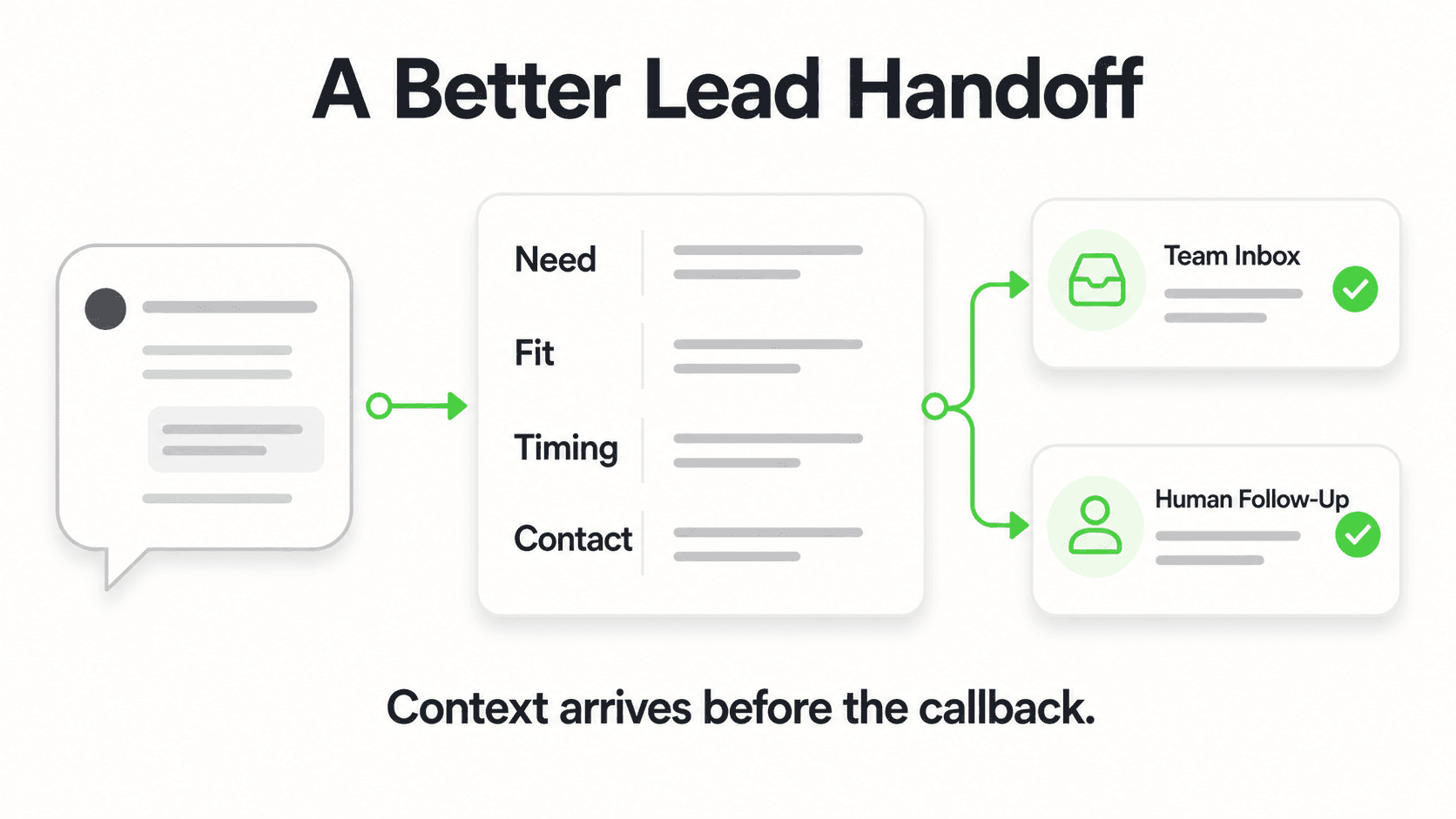
What this looks like in practice: Before the chat conversation even starts, the AI presents a short contact-detail form — name, phone number, service address — that the prospect fills in. Only after that gate is the conversation unlocked. Every completed conversation your team reviews is tied to a real, reachable contact, not an anonymous chat log.
Real-world impact: Your booking coordinator opens qualified leads with name, contact info, job details, and preferred timing already attached — ready to confirm and schedule, not chase down basic information.
Why it works: A lead-capture form gating the conversation means you're not relying on a prospect voluntarily typing their phone number mid-chat. It's collected upfront, consistently, every time.
Key features:
- Contact-detail form gates access to the chat (name, phone, address collected before conversation)
- Instant team notification when a new lead completes the flow
- One-click CSV export for follow-up campaigns or CRM upload
Booking in the chat
When a prospect is ready to lock in a time, connect Calendly or Cal.com and the AI offers real open slots from your live availability and books the one they choose in the conversation — the booking lands in your existing calendar, and the customer gets the invite by email. (In-chat booking needs Calendly Standard or higher; with any other booking tool, the AI shares your booking link.)
See how it captures quote requests while your crews are on the job
Deploy an AI chatbot trained on your cleaning company's pricing, service area, and availability — across web, WhatsApp, Instagram, and Facebook.
Start Free TrialReal Results: What Cleaning Companies Can Expect
Faster Response, More Booked Jobs
- Instant response to quote requests instead of next-business-day callbacks
- Consistent answers to pricing and service-area questions, day or night
- Fewer leads lost to competitors who simply answered first
Time Saved for Owners and Office Staff
- Fewer interruptions during active jobs to answer repetitive quote calls
- Recurring schedule changes handled without back-and-forth phone tag
- Add-on upsells surfaced automatically instead of relying on staff to remember
Better Lead Quality for Follow-Up
- Every lead arrives with name, phone number, and job details already collected
- Out-of-area inquiries filtered out before they reach your scheduling team
- One-click CSV export makes it easy to load leads into your existing CRM or spreadsheet workflow
24/7
Quote & Booking Availability
4
Channels: Web, WhatsApp, IG, FB
35%
After-Hours Inquiries (Jungle Lodges case study)
$40/mo
Starting Price, 7-Day Trial
Illustrative example, not a guarantee
The figures above reflect a documented hospitality deployment and general industry patterns cited earlier in this article. Results vary by market, service area, and how quickly your team follows up on qualified leads — treat any ROI estimate as a starting point for your own math, not a promised outcome.
A Simple ROI Framework for Cleaning Companies
If your business currently misses even a handful of quote requests per week after hours, the math is straightforward to run yourself:
Missed after-hours inquiries per week × average job value × estimated close rate = weekly revenue at risk
For example, a company that misses 5 after-hours inquiries a week, with an average first-clean value of $150 and a conservative 20% close rate on inquiries that do get a fast response, is leaving roughly $150/week — about $650/month — on the table before even counting the lifetime value of a recurring client. Weighed against a $40/month starting plan, the question quickly becomes less "can we afford this" and more "can we afford to keep missing these."
Implementation Roadmap for Cleaning Companies
Rolling out an AI chatbot doesn't require a technical team or weeks of setup. Here's a practical path:
Days 1–3: Load your knowledge base Upload your pricing sheet, service area zip codes, add-on menu, cancellation policy, and answers to your most common FAQs (supplies provided, insurance/bonding, pet policy). The more specific your source documents, the more accurate the chatbot's answers.
Days 4–5: Configure the lead-capture form and channels Set up the contact-detail form fields you want collected before a chat begins (name, phone, service address is typical for cleaning), then connect your website chat widget and any of WhatsApp, Instagram DM, or Facebook Messenger you actively use for customer inquiries.
Days 6–7: Test the conversation flow Run through common scenarios yourself — a one-time deep clean request, a recurring biweekly setup, an out-of-area zip code — to confirm the chatbot's answers match how your business actually operates before sending it live traffic.
Week 2 and beyond: Monitor and refine Review the first batch of captured leads with your booking team. Add any FAQ gaps you notice back into the knowledge base, and adjust the add-on prompts based on which upsells are actually converting.
Must-have features checklist for cleaning-industry chatbots:
- Instant, accurate quote estimation tied to your real pricing
- Recurring schedule setup (frequency, day/time preference)
- Service area verification before quoting
- Lead-capture form gating the conversation (contact details collected upfront)
- Multi-channel deployment (website, WhatsApp, Instagram, Facebook)
- In-chat booking (Calendly or Cal.com) or booking-link sharing for other schedulers
- CSV export or REST API/webhook access for your existing CRM or spreadsheet workflow
For businesses juggling recurring appointments across a broader service menu, the same lead-capture and scheduling logic extends well beyond cleaning — see how home service businesses generally lose jobs to faster-responding rivals for the wider pattern, or explore the dedicated home services AI agent page if you offer adjacent services like landscaping or pest control alongside cleaning. If you're weighing WhatsApp specifically as a booking channel, this WhatsApp pricing calculator breaks down the costs, and this explainer on after-hours lead capture covers the underlying concept in more depth.
Frequently Asked Questions
Will an AI chatbot replace my booking coordinator or front-desk staff?
No. The chatbot handles the repetitive first-tier work — quote estimates, service area checks, and initial scheduling questions — and hands off a qualified, contact-ready lead to your team. Your staff still confirms bookings, manages crew logistics, and handles the relationship; the AI just makes sure no inquiry sits unanswered until someone is available.
How much does an AI chatbot for a cleaning business cost?
Hyperleap AI's plans start at $40/month (Plus plan), with a Pro plan at $100/month and a Max plan at $200/month for higher-volume businesses. Every plan includes a 7-day free trial (a credit card is required to start the trial). There is no free plan, and add-ons like OTP-verified lead capture or Multi-variant (locations, courses, etc) are priced separately.
Can the chatbot provide an exact price, or just a ballpark estimate?
It depends on how your pricing is structured. If your pricing is based on clear inputs like square footage or bedroom/bathroom count, the chatbot can return a fairly precise range. If your pricing depends on an in-person walkthrough (common for heavily soiled or unusual spaces), the chatbot will collect the details and set expectations that a final quote requires a quick follow-up.
Does the chatbot integrate with my scheduling or field-service software?
Hyperleap AI connects via REST API and webhooks (lead created, new message, conversation started), which lets you route captured leads into whatever scheduling or CRM system you use today. If you use Calendly or Cal.com, the AI connects natively: it reads live availability and books new appointments in the conversation. With any other booking tool, it shares your booking link. If you use dedicated field-service software, treat that connection as an integration requirement to evaluate against your specific platform's API rather than assuming out-of-the-box support.
How long does it take to set up an AI chatbot for a cleaning company?
Most cleaning businesses can have a working chatbot live within a week: loading your pricing and FAQ documents takes a day or two, configuring the lead-capture form and channels takes another day, and testing common scenarios rounds out the first week. No coding or technical team is required — if you can write down your pricing and FAQ answers, you can train the AI.
Will the chatbot give customers wrong pricing information?
The AI is trained on documents you provide — your actual price list, service menu, and policies — and is designed to answer from that grounded knowledge rather than guessing. For anything outside its knowledge base or ambiguous (an unusually large property, a hoarding situation, a commercial contract negotiation), it's designed to escalate to your team rather than invent an answer.
Can the chatbot handle both residential and commercial cleaning inquiries?
Yes. You can train the AI on separate pricing structures and FAQs for residential and commercial services, and it will route the conversation based on what the prospect describes — a homeowner asking about a 3-bedroom house gets residential pricing logic, while an office manager asking about nightly commercial cleaning gets a different set of questions and answers.
What channels does the chatbot work on?
Hyperleap AI's chatbot deploys on your website chat widget, WhatsApp Business API, Instagram DM, and Facebook Messenger, with the same knowledge base and pricing logic across all four. SMS, voice, and email channels are on the product roadmap but not currently supported.
Never Miss Another Quote Request
Cleaning businesses don't lose jobs because their work isn't good enough — they lose jobs because the prospect never got a fast enough answer to book in the first place. An AI chatbot for cleaning services closes that gap: instant quotes based on your real pricing, recurring schedule setup without phone tag, and a contact-detail form that gates every conversation so your team never has to chase an anonymous chat log for a phone number.
The tools that used to be reserved for national franchise chains — 24/7 coverage, instant response, consistent pricing answers — are now available to a two-person cleaning crew for $40/month. Compare that against a single missed recurring client, and the math tends to answer itself. See how the full pricing breakdown works on the Hyperleap AI pricing page, or explore what an AI agent looks like for your specific service mix on the cleaning services AI agent page.
Ready to stop losing jobs to faster competitors?
Get an AI chatbot trained on your cleaning company's pricing, service area, and availability — live across web, WhatsApp, Instagram, and Facebook in about a week.
Get StartedIndustry Solutions
See how AI chatbots work for these industries:
Put this into practice
Related Articles
AI Receptionist for Landscaping Businesses
An AI receptionist for landscaping businesses answers quote and service questions 24/7, qualifies property details, and shares your booking link.
AI Receptionist for Roofing Companies: Never Miss a Lead
An AI receptionist for roofing companies answers storm-damage and estimate questions 24/7, qualifies homeowners, and routes leads to your team.

AI Chatbot for Moving Companies: Win the Quote Race
A chatbot for moving companies qualifies quote requests instantly — origin, destination, home size, date — so you respond before rival estimates land.
AI Receptionist for Home Services: The Complete Guide
An AI receptionist for home services answers overflow inquiries in chat, qualifies emergencies by trade, and routes jobs 24/7 across every service line.