Pro Chat Bot Responses: A Guide to Leads & Bookings
Learn to write chat bot responses that capture leads & book appointments for your SMB. Our step-by-step guide covers templates, testing, and optimization.
Your website is getting traffic, the inbox is full, and yet the hottest leads still slip away when nobody answers fast enough. A visitor asks about pricing at 9:40 p.m., a booking question comes in during lunch rush, or a prospect wants a quote and leaves before a slow email reply lands. Small businesses run into this all the time, especially when one person is handling calls, messages, and the rest of the day's work.
That is why chat bot responses matter so much. They are not just canned support text, they are the first sales conversation your business can have at any hour. A good response does more than answer a question, it moves the visitor toward a qualified lead, an appointment, or a useful next step.
The shift is already mainstream, and customer expectations have changed with it. Businesses are using conversational AI in core workflows, and many customers now expect fast help from a chatbot instead of waiting on email or voicemail. For a practical small-business setup, build a chatbot with AI so the first reply can qualify intent, collect contact details, and route people toward booking without adding extra work for your team.
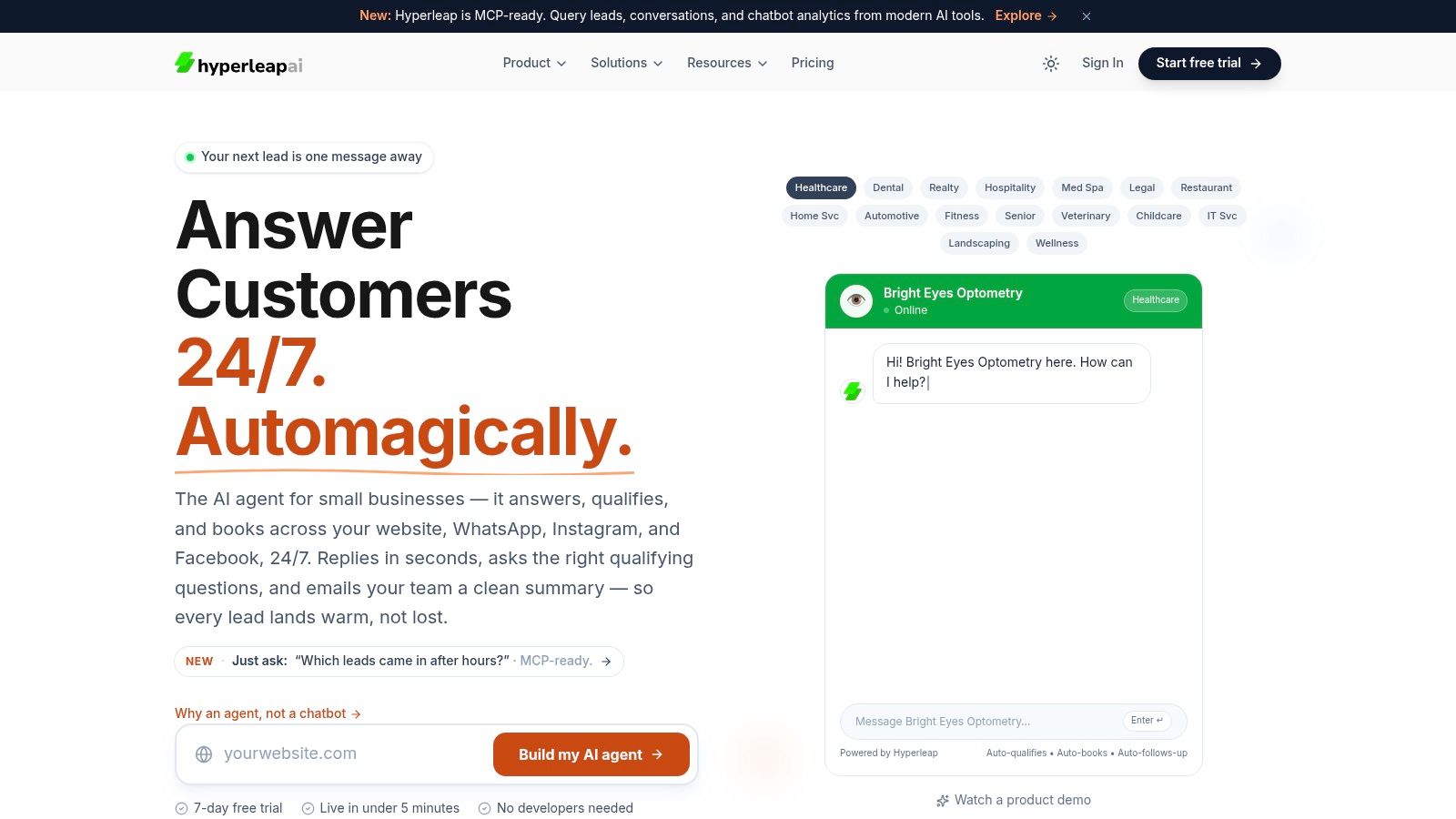
If you want a practical benchmark for a home services setup, the same logic applies to service companies that need to turn quick questions into booked jobs. A platform like Hyperleap AI's small business chatbot guide shows how these workflows fit into real operations, especially when the goal is to capture leads, answer common questions, and keep appointment requests from falling through the cracks.
Table of Contents
- Why Your Chat Bot Responses Are a 24/7 Sales Engine
- Laying the Foundation for Effective Responses
- Crafting Responses That Capture and Convert
- Defining Your Bot Persona and Tone of Voice
- Handling Errors Fallbacks and Multilingual Users
- Measuring and Optimizing Your Response Performance
- Your Path to Smarter Customer Conversations
Why Your Chat Bot Responses Are a 24/7 Sales Engine
A lot of SMB owners still treat a chatbot like an FAQ widget. That leaves money on the table. Every message is a chance to qualify a visitor, filter out low-fit requests, and move a real buyer toward contact capture or booking.
The business case is straightforward. Chatbots are now part of normal customer operations, and people are already used to getting support this way, as noted earlier. If visitors are willing to start that conversation, the key question is whether your responses are doing sales work or just clearing clicks.
A useful way to look at it is simple. Your bot acts like a front desk, intake rep, and appointment setter in one place. If a response says, “How can I help?” and then stops, it wastes the moment. If it asks the right follow-up, confirms the need, and pushes the visitor toward a calendar or contact form, it becomes a steady revenue channel.
Practical rule: a chatbot response should either answer, qualify, or advance the conversation. If it does none of those three, rewrite it.
For SMBs, the value is concrete. You miss fewer leads after hours, lose fewer prospects who leave before filling out a form, and free your team from typing the same basic reply all day. Good responses cut friction without making the experience feel stiff or robotic.
That is the mindset shift. A response should help you capture demand before the visitor disappears, and a well-built flow from Hyperleap AI's chatbot for small business can do that without turning every exchange into manual work. For home-service companies, the same logic applies, especially when a visitor needs quick qualification before a booking. An AI chatbot for home services can screen intent, collect the right details, and hand off stronger leads to the team.
Laying the Foundation for Effective Responses
Strong replies start long before the first greeting. If you don't define the job of the bot, the writing turns into a pile of disconnected answers that sound fine but don't move anyone forward. The first decision is the primary objective, and for most SMBs that means lead capture, appointment booking, or first-line support with a handoff when needed.
Start with one business outcome
A bot that tries to do everything usually does nothing well. If bookings matter most, then every path should make the next step obvious. If lead capture matters most, then the bot should ask for the smallest useful set of details and pass the visitor to sales without dragging things out.
A system like Hyperleap AI's chatbot builder fits naturally, because the flow can be planned around one goal instead of patched together after launch. A service business may want qualification first, while an e-commerce store may want product guidance and email capture. The point is to choose the business outcome before writing scripts.
Map what users actually want
Visitors don't arrive with the same urgency. Some want pricing, some want availability, some want a human, and some just want to know if you serve their area. Your responses need to match that intent quickly, or the conversation starts to feel like a maze.
A useful tactic is to list the top questions people ask before they convert. Then separate them by urgency and complexity. A simple question can get a direct answer, while a high-intent request, like “Can I book this week?”, should move straight to the next action.
Design the journey before the copy
Write the conversation path like a short customer journey. Greeting, clarification, answer, proof, next step. That order matters because it keeps the bot from sounding random or overly verbose.
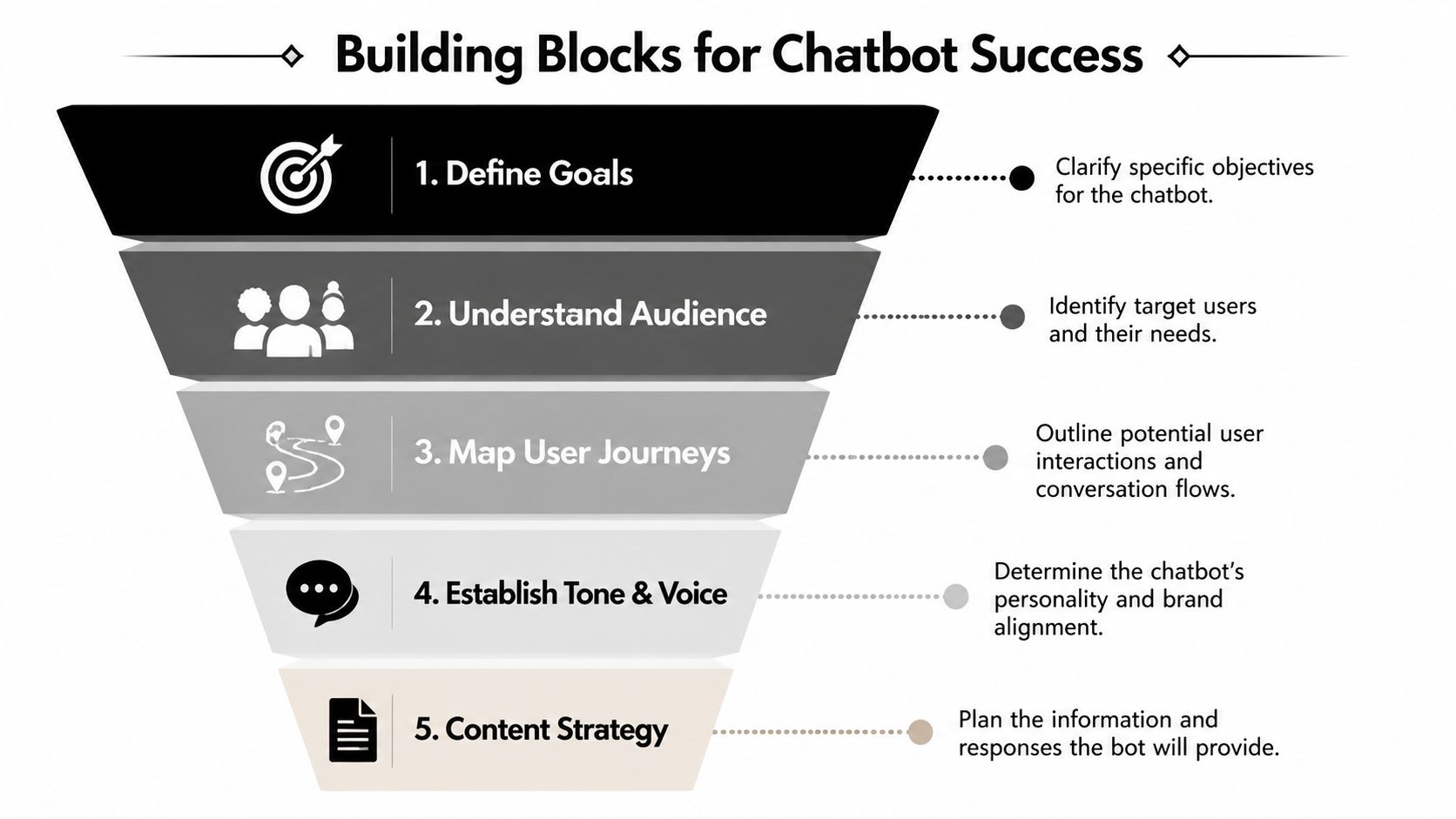
If you skip the journey mapping, the bot may still sound polite, but it won't reliably produce leads. A planned conversation makes it easier to keep responses short, purposeful, and tied to one concrete action.
Crafting Responses That Capture and Convert
The best chat bot responses feel like a smart receptionist, not a script reading machine. They're short, direct, and they ask for the next piece of information only when it matters. That balance matters because user-experience research points out that response quality needs to separate relevant from efficiently helpful answers, not just warm language (Springer research on response quality).
Use copy that leads somewhere
A welcome message should do more than greet. It should set expectations and offer two or three clear paths. “Hi, I can help you book an appointment, answer service questions, or connect you with the right person. What do you need?” is better than “How can I help today?”
Qualifying questions should stay simple. Ask only what you need to move the conversation forward. For example, “What service do you need?” is better than stacking three questions at once.
Good chat copy asks one useful thing at a time. If you ask five things in the first reply, you're not qualifying, you're discouraging.
Handle objections without getting wordy
When a visitor hesitates, answer the concern and return to the next step. If they ask about pricing, acknowledge it, give the available range if your business allows that, then invite them to book or request a quote. If they ask whether you cover their area, answer clearly and then ask for the address or zip code if needed.
Here's a useful pattern.
- Bad: “We offer several options depending on your needs, and someone will get back to you soon.”
- Better: “We can help with that. Tell me the service you need, and I'll connect you to the right booking option.”
Keep the booking path visible
A chatbot should never hide the calendar step behind extra chatter. If the goal is appointments, the user should see that path early. A clear button, a scheduling prompt, or a concise handoff to a booking link works better than long back-and-forth.
A good rule is to end each useful exchange with a visible action. Collect the contact detail, send to booking, or confirm the request and escalate. Anything else is just conversation for conversation's sake.
Use verification where fake leads are a problem
If your team gets junk submissions, OTP verification can help you separate real contacts from bad data before the lead reaches sales. That's especially useful when chat volume is high or when a single booking mistake creates real operational cost. The chatbot should protect the sales team's time, not add cleanup work.
Defining Your Bot Persona and Tone of Voice
A bot without a clear voice feels unstable. One reply sounds formal, the next sounds cheerful, and the third sounds like a different system entirely. That kind of inconsistency weakens trust, especially when a visitor is deciding whether to book or share contact information.
The right persona depends on your brand, but the rule is always the same. Be consistent enough that the user feels continuity, and specific enough that the bot doesn't sound generic. If your business is a dental clinic, a calm and efficient tone usually beats playful banter. If you run a creative agency, you may have more room for personality, but the answers still need to stay precise.
The best way to think about persona is that it should support action. A helpful voice reduces hesitation. A sloppy voice creates it.
Here's a simple tone guide you can adapt.
| Chatbot Tone of Voice Guidelines | |
|---|---|
| Instead of This, Robotic & Vague | Try This, Human & Specific |
| “Please provide your inquiry.” | “What do you need help with today?” |
| “Your request has been received.” | “Thanks, I've got that request.” |
| “Kindly wait for further assistance.” | “I'm checking the next step for you now.” |
| “We will respond soon.” | “I can connect you with the right person or booking option.” |
A practical way to keep the voice grounded is to limit it to the same content you'd trust in a real customer conversation. That's where a system built around your own documents helps, and Hyperleap AI's personality-focused chatbot guidance is relevant if you're trying to align tone with brand voice without drifting into fluff.
The bot should sound like your business on its best day, not like a marketing template.
The same applies when the bot answers complex questions. A calm, specific response builds more confidence than a long, friendly one that never lands the point. If the tone helps the user act faster, it's doing its job.
Handling Errors Fallbacks and Multilingual Users
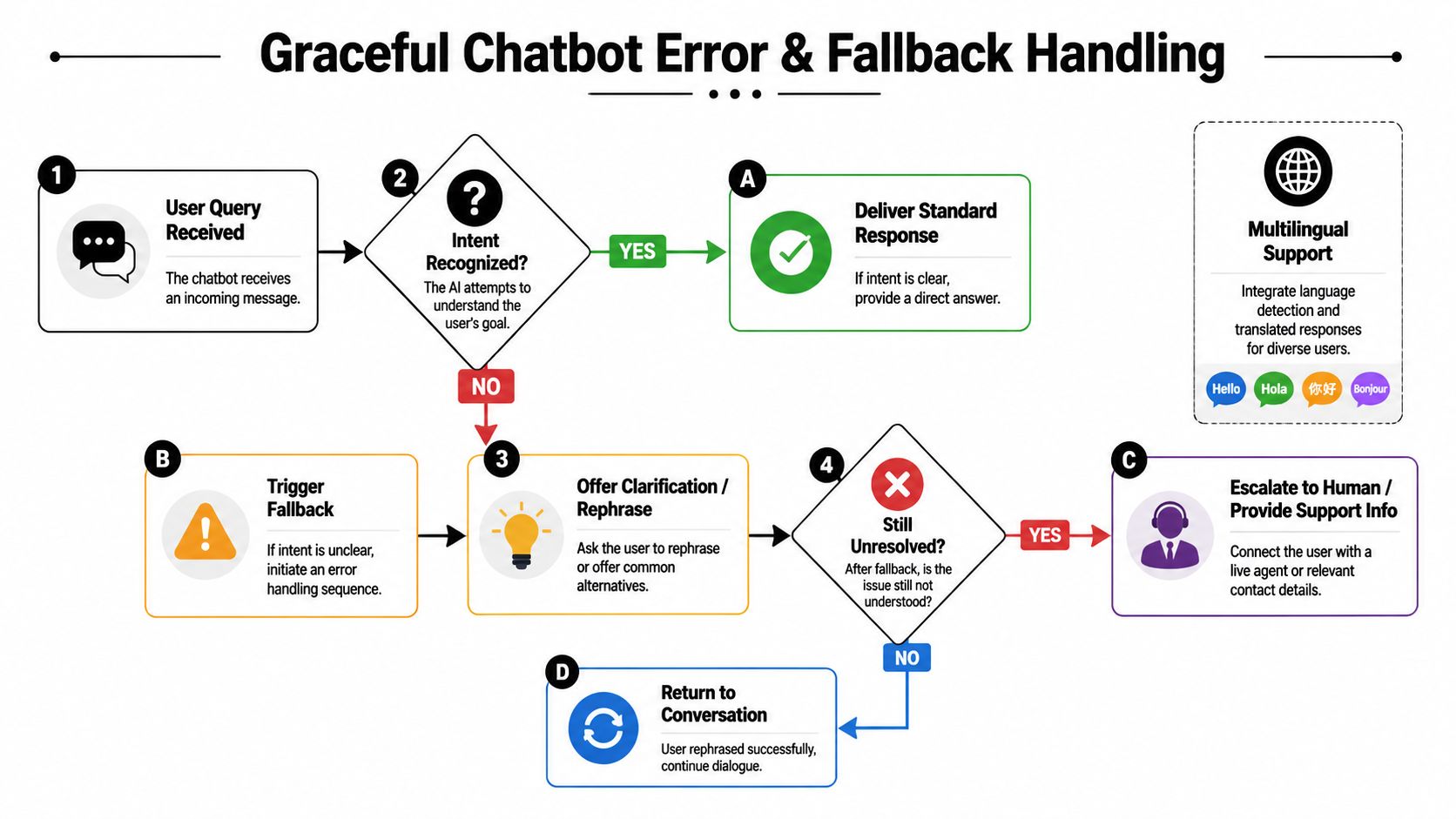
A bot never gets every request right on the first pass. People type quickly, ask vague questions, switch topics halfway through, or phrase the same request in a way your flow did not expect. The goal is not perfect coverage. The goal is to make every miss useful for lead capture, appointment booking, or a clean handoff.
Build a fallback that keeps the conversation alive
A weak fallback says, “I didn't understand.” Then it stops. A better fallback gives the user a path forward by offering a rephrase, showing a few common options, and making escalation easy if the request is still unclear.
“Please rephrase your question” is not enough. A better response sounds like this, “I can help with bookings, pricing, and service questions. Could you rephrase your request, or choose one of those options?” That keeps the user moving instead of forcing them to start over. If the bot still cannot resolve the issue, it should hand off to a person or give the correct support contact without making the visitor repeat everything from scratch.
Know when to escalate
Escalation is the right move when the bot cannot answer with confidence, or when the user is clearly outside the scope you set for automation. A clean transfer is better than a confident wrong answer, especially if the chat is close to a booking or lead opportunity. The user should feel that the system recognized its limit and passed them along with context intact.
Multilingual support belongs in the same planning stage. Chatbots are already used at global scale, according to global chatbot statistics, so if your customer base includes more than one language group, your bot should be ready for that from day one.
Plan for language diversity early
A multilingual bot should detect language smoothly and reply in the user's language without making them search for a toggle. That matters for local businesses that serve mixed communities, because it keeps support natural and lowers the chance of losing someone who is ready to buy but not willing to struggle through an English-only flow.
For businesses that need a broader setup, Hyperleap AI can respond in more than 100 languages and keep answers grounded in uploaded knowledge. That is useful when the same booking flow or lead capture path has to work across markets. The technical detail matters less than the result, fewer dropped conversations and a clearer route to the next step.
Don't let fallback text become a dead end. It should act like a handrail.
The businesses that handle this well do not sound perfect, they sound prepared. They make it easy to recover, easy to escalate, and easy to continue in the customer's language.
Measuring and Optimizing Your Response Performance
A bot that's never reviewed becomes stale fast. New services launch, policies change, and the questions people ask drift over time. If you don't measure response quality, you end up guessing about what's working.
The most useful review process is simple and repeatable. Sample 30–100 real chats per week and score them against a rubric, then tag the intent before judging the answer, as recommended in the practical evaluation workflow from BizAILast (chatbot accuracy and evaluation). That gives you a manageable window into what the bot is doing, not just what the dashboard says.
Focus on revenue-linked metrics
For SMBs, the best metrics are the ones tied to action. Conversation-to-lead conversion tells you whether the bot is helping create opportunities. Appointment booking rate tells you whether the flow is closing the loop. Grounded answer rate tells you whether the reply stays true to your own information. Containment rate shows how often the bot solves the issue without human help.
A good review session asks a few blunt questions.
- Did this conversation create a lead?
- Did it book an appointment or move the user closer to booking?
- Was the answer grounded in the business content?
- Did the bot fail to escalate when it should have?
Compare answers to human labels
Don't rely only on summary numbers. Compare each response to a human-reviewed label, then inspect the error clusters by intent. A single high-volume issue, like scheduling or pricing, can distort the whole picture if you don't isolate it.
That's also where broader user experience metrics become useful as a reference point, because performance is not just about speed or polish. The core question is whether the conversation moves a customer toward the right action without friction.
Keep the system fresh
Every time your services change, your pricing shifts, or your booking process updates, the bot needs a check. Automated regression tests against the labeled set are useful after content or model updates, but the human review is what catches nuance. That mix is what keeps response quality from slipping imperceptibly.
A bot that books more appointments this month than last month is doing useful work. A bot that looks active but doesn't move anyone closer to a sale is just busy.
Your Path to Smarter Customer Conversations
A customer asks about pricing at 9 p.m., then follows up about booking a consultation before breakfast. Strong chat bot responses turn that exchange into a lead or an appointment instead of a dead end. They start with a clear business goal, follow a planned journey, sound like one consistent brand, recover cleanly when they miss, and get reviewed often enough to stay useful. That is how a chatbot becomes part of your sales process instead of only a support shortcut.
For SMBs, the trade-offs are practical. Better replies improve lead quality, make appointment booking smoother, and cut down on wasted time from poor-fit inquiries. They also force you to stay disciplined about what the bot should handle and when it should hand off to a person. If you want your bot to earn its place on your site, treat it like a revenue tool and keep refining the conversation. Hyperleap AI fits into that approach by giving you a way to build, test, and improve responses around the outcomes that matter most.
A CTA for Hyperleap AI.