Generative AI vs Agentic AI: Strategic Choices for 2026
Explore generative AI vs agentic AI for your business in 2026. Understand key differences, applications, and choose the best AI strategy for success.
Your inbox is full. Your website chat keeps blinking. Customers send the same questions through WhatsApp, Instagram, and Facebook, then disappear if nobody replies fast enough. Meanwhile, your team is trying to answer routine questions, qualify leads, and book appointments without letting actual work pile up.
That's where most small businesses run into the same decision. They hear about Generative AI and Agentic AI, but the difference sounds more theoretical than useful. For a business owner, the core question is simpler: which one helps you answer customers faster, capture better leads, and reduce manual work without creating a new technical mess?
The cleanest way to think about it is this. Generative AI is a strong communicator. Agentic AI is an operator. One produces responses. The other can pursue an outcome.
For SMBs, that distinction matters because customer support and lead handling rarely stop at “answer the question.” A prospect asks about a service, wants a brochure, needs pricing details, then asks for a booking link. If your AI can only talk, staff still has to finish the job. If your AI can act, the handoff gets much shorter.
Table of Contents
- The AI Crossroads Every Business Faces
- What Is Generative AI The Creative Content Engine
- What Is Agentic AI The Autonomous Problem-Solver
- Generative vs Agentic AI A Head-to-Head Comparison
- Real-World Use Cases for SMB Customer Support
- How to Choose and Implement the Right AI
- The Future Is Both Conversational and Action-Oriented
The AI Crossroads Every Business Faces
A growing business usually sees the same pattern. More customer questions come in, which is good news. But those questions arrive across too many channels, often outside business hours, and they're repetitive enough to waste staff time while still being important enough to affect sales.
That pressure creates a fork in the road. One path leads to an AI assistant that can generate strong answers from your business information. The other leads to an AI system that can move a conversation toward a concrete result, like collecting a lead or booking an appointment.
Two kinds of digital help
Generative AI works like a highly capable front-desk assistant. Ask it a question, and it drafts an answer. Give it documents, FAQs, pricing notes, or service policies, and it can turn that knowledge into natural responses for customers.
Agentic AI behaves more like an operations coordinator. You give it a goal, and it can work through steps to reach it. That might include checking a system, choosing the next action, collecting details, and pushing the conversation toward completion.
For a small business, the difference isn't academic. It affects staffing, response quality, and conversion flow.
A business doesn't need “more AI.” It needs the right level of AI for the job in front of it.
Where owners usually get stuck
Most SMBs don't need a research lab. They need something they can launch quickly and trust with customer-facing work. That means asking practical questions:
- If support volume is the problem: Do you mainly need accurate answers available around the clock?
- If lead quality is the problem: Do you need the system to verify, qualify, and route prospects?
- If admin work is the problem: Do you need the system to trigger actions in tools like booking software or calendars?
The reason the generative AI vs agentic AI debate matters is that each solves a different bottleneck. One reduces the burden of answering. The other reduces the burden of doing.
What usually works in practice
Businesses often get the quickest wins by starting with a narrow customer-facing workflow. Support questions are ideal because the knowledge already exists. It's in your website, brochures, PDFs, service pages, and staff inboxes.
From there, the next step is usually action. Once the AI can answer reliably, owners want it to collect contact details, send assets, and move qualified people to scheduling.
That's the practical lens for the rest of this article. Not AI as a buzzword. AI as a working part of customer support, lead generation, and everyday efficiency.
What Is Generative AI The Creative Content Engine
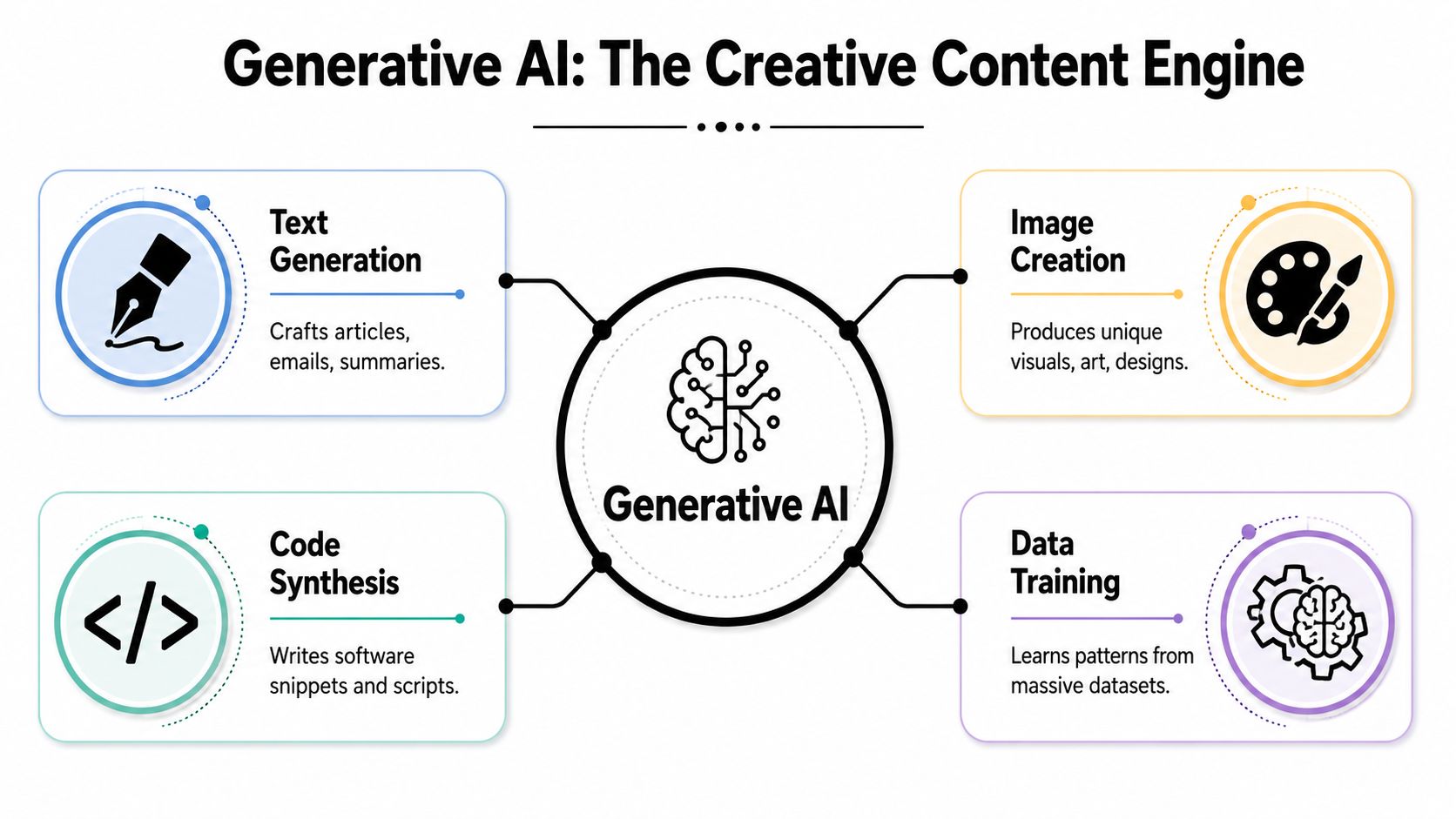
Generative AI is best understood as a content engine. It takes an input, such as a question, prompt, document, or instruction, and produces a fresh output in response. That output might be a customer reply, a summary, a draft email, an image, or a block of code.
For SMBs, the most useful form is usually text generation tied to business knowledge. A customer asks, “Do you offer weekend appointments?” or “What's included in this package?” The system reads the available context and writes a clear answer in real time.
What it does well
Generative AI shines when the task is to explain, summarize, rewrite, or draft.
It can turn a messy internal document into a customer-friendly answer. It can summarize a long policy. It can adapt tone, shorten a reply, or turn product information into a conversational response. If you've read Prometheus Agency's generative AI guide, that framing will sound familiar. The technology is strongest when the work starts with language and ends with language.
Why it fits customer support
In support settings, generative AI becomes much more useful when it's grounded in your business content instead of left to answer from general training alone. That means feeding it your service details, pricing notes, knowledge base articles, operating hours, and policy documents so it responds from your material.
That's the difference between a novelty chatbot and a practical support assistant. A grounded model can answer based on what your business offers, not what sounds plausible.
A useful example is a customer-service setup where the assistant is trained on internal FAQs and site content, then deployed across your public channels. In such scenarios, no-code implementations are compelling, especially for teams that need to go live quickly. For a practical look at that customer-support use case, see this guide to generative AI for customer service.
Where it falls short
Generative AI usually needs a prompt for each task. It doesn't naturally own the broader workflow. It can answer, but it won't reliably complete a chain of business actions unless other logic surrounds it.
That matters because customer conversations often continue past the answer:
- A prospect asks for details
- Then wants a brochure
- Then needs qualification
- Then asks to book
Generative AI handles the words in that exchange very well. It doesn't automatically manage the process behind it.
Practical rule: Use generative AI when the main bottleneck is communication, not orchestration.
If your business needs a polished, informed, always-on responder, generative AI is often the right starting point. It helps when your team keeps repeating the same explanations and customers mostly need accurate information fast.
What Is Agentic AI The Autonomous Problem-Solver
A prospect lands on your site at 9:40 p.m., asks whether you handle their type of project, wants pricing, and asks for a call next week. A basic AI assistant can answer those questions. An agentic system can keep the interaction moving by collecting the right details, checking the calendar, and pushing the lead into the right follow-up path.
That is the practical shift.
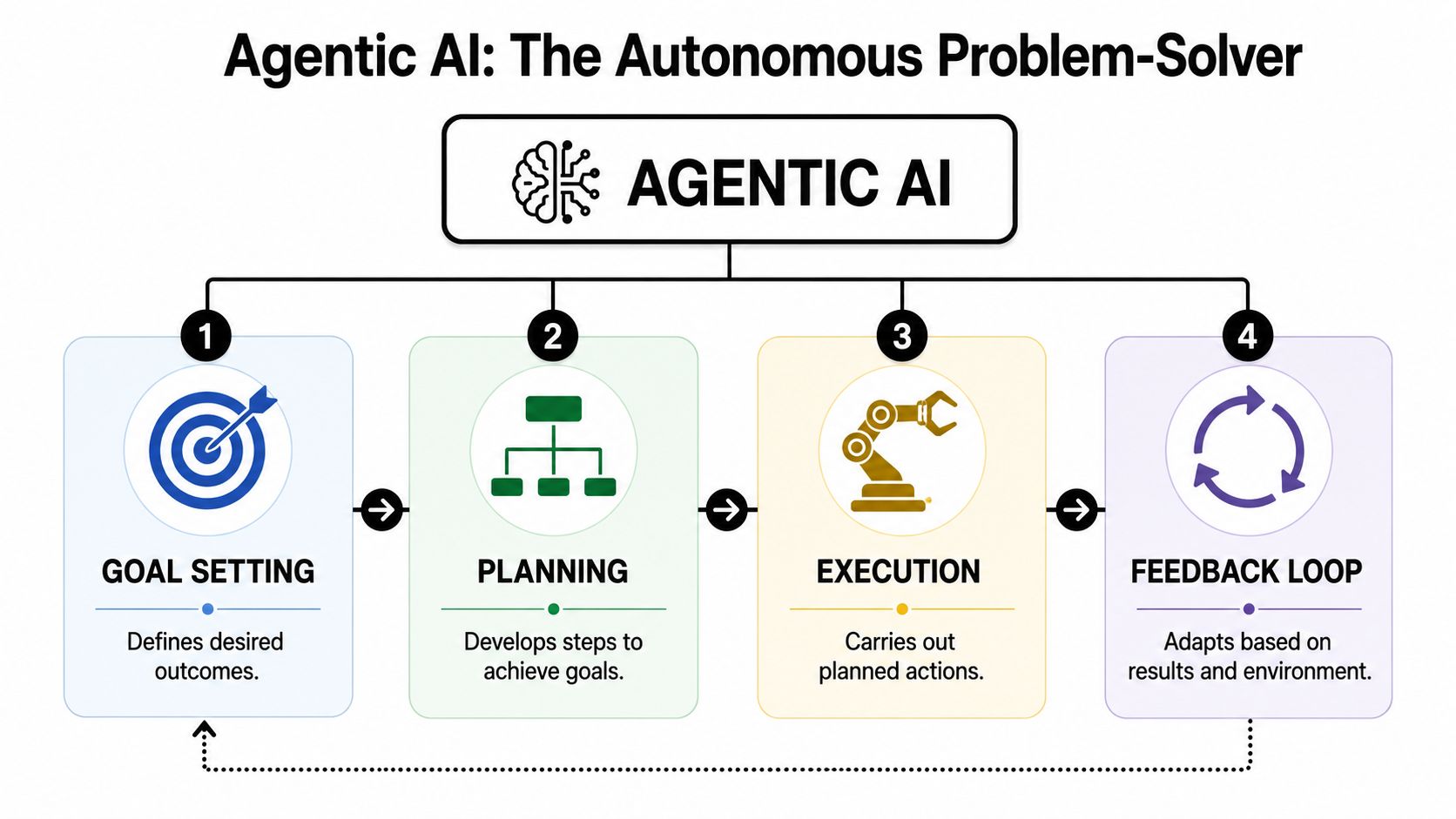
Agentic AI is built to pursue an outcome through a series of actions. It does not stop at generating a reply. It can evaluate the next step, use connected tools, and continue until it reaches a defined endpoint or hits a rule that requires human review.
For an SMB, that usually means less manual handoff work. Instead of having staff copy details from chat into a CRM, send a booking link, and sort the inquiry later, the system can handle those steps inside one workflow.
What makes it different
An agentic setup usually combines a language model with planning logic, memory, and access to business tools. The model handles interpretation and decision support. The surrounding system handles execution, such as checking availability, updating records, triggering emails, or routing a request to the right team.
That difference matters because many business conversations are really small processes in disguise. A customer is not only asking a question. They are trying to complete something.
Instead of replying to “Can I book a consultation?”, the system can ask qualifying questions, identify the right service, check schedule options, and move the person to a confirmed booking or a human fallback.
Why small businesses should care
The value is not theoretical. Small teams feel process friction faster than large ones because the same people are handling sales, support, and operations.
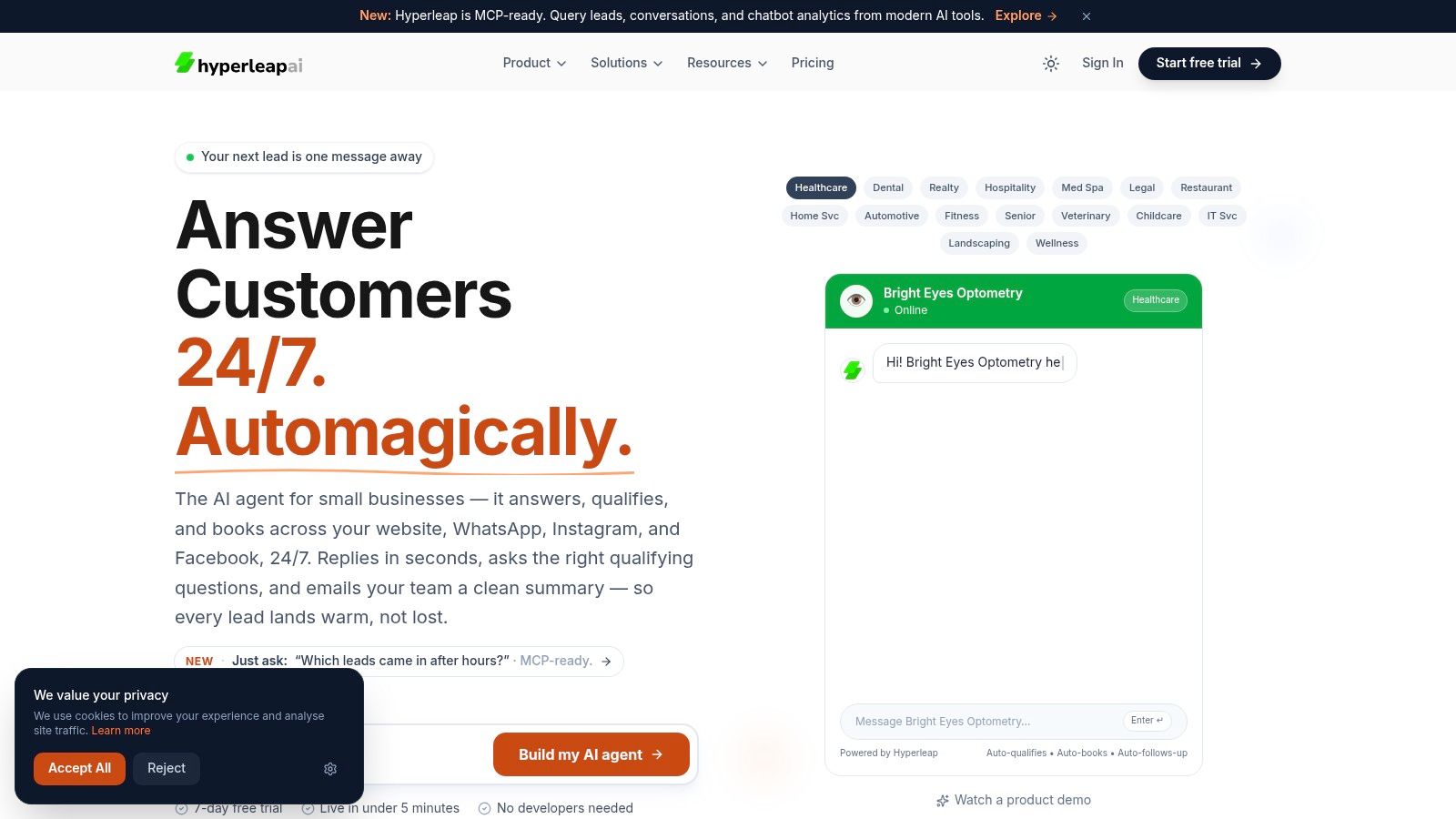
In practice, agentic AI helps most when work follows a repeatable path. Lead intake, appointment booking, support triage, and follow-up routing are good examples. These are the kinds of jobs where no-code platforms such as Hyperleap AI can be useful today, because the business owner can define the steps without waiting on a custom engineering project.
That makes agentic AI more approachable than many articles suggest. A local service business does not need an enterprise automation program to benefit. It needs a clear workflow, tool connections, and rules for when the AI should act versus when it should hand off.
For a thoughtful example of how people are using agents as part of a broader knowledge and execution system, Iwo Szapar's AI second brain approach is worth reading.
Where agentic systems help most
Agentic AI works best when the process has defined steps, known systems, and a measurable finish line. Common examples include:
- Lead qualification: collect contact details, ask screening questions, and push qualified leads into your CRM or sales queue
- Booking support: identify the right service, answer common objections, and trigger the scheduling flow
- Operational routing: send requests to the correct team, branch, or inbox based on urgency, location, or service type
If you're evaluating implementation paths, this walkthrough on how to get started with AI agents for real business workflows shows the setup decisions that matter early.
Agentic AI creates value when the business outcome matters more than the wording.
The trade-off you need to manage
More autonomy creates more risk if the setup is loose. An agent that can write an answer is one thing. An agent that can update records, trigger messages, or move leads between systems needs clear limits.
Set permissions carefully. Define which tools it can use, what counts as a successful completion, and which cases must stop for human approval. I usually advise businesses to start with workflows that are repetitive, low-risk, and easy to audit. That is how you get efficiency without creating cleanup work later.
Agentic AI is a strong fit when your process is stable enough to automate and valuable enough to justify guardrails.
Generative vs Agentic AI A Head-to-Head Comparison
The fastest way to understand generative AI vs agentic AI is to compare what each one is built to deliver. One produces content in response to a prompt. The other works toward an outcome through a sequence of actions.
Here's the short version.
| Characteristic | Generative AI | Agentic AI |
|---|---|---|
| Core purpose | Create content and responses | Achieve goals through actions |
| Autonomy level | Instruction-driven | Goal-driven |
| Task style | Single-turn or narrow tasks | Multi-step workflows |
| Interaction model | Reactive | Proactive within defined boundaries |
| Architecture | Usually centered on an LLM | LLM plus planning, memory, and tool use |
| Primary output | Text, images, summaries, drafts | Completed steps, actions, and business outcomes |
| Best SMB fit | FAQs, support answers, content drafts | Booking flows, lead qualification, workflow automation |
| Main risk | Wrong or vague answers | Wrong actions if guardrails are weak |
Generative AI vs. Agentic AI at a Glance
If your team keeps asking, “Can the AI answer this well?” you're usually looking at a generative use case.
If your team keeps asking, “Can the AI finish this process?” you're usually looking at an agentic use case.
Autonomy changes the management model
Generative AI still expects a human or a surrounding app to initiate the task. Someone asks a question. The model responds. That pattern is predictable and easier to review.
Agentic AI reduces the need for step-by-step supervision. You set the objective, define constraints, and let the system work through the sequence.
Generative AI helps staff do the work. Agentic AI can take ownership of parts of the work.
That difference affects staffing. A support team using generative AI still owns the workflow. A support team using agentic AI starts shifting from direct handling to oversight.
Complexity is the real dividing line
A surprising number of businesses overbuy on autonomy. They hear “agentic” and assume it's automatically better. It isn't.
If your main customer interactions are simple, such as hours, pricing, locations, eligibility, product details, or service policies, generative AI is often enough. It solves the repetitive communication problem with less operational risk.
Agentic AI starts earning its keep when the request naturally branches into several actions. That's common in service businesses, healthcare intake, hospitality, real estate, and multi-location operations where routing matters.
Architecture affects reliability
With generative AI, most of the value sits in the model and the quality of the content you provide. Reliability depends heavily on how well the system is grounded in your actual knowledge.
With agentic AI, reliability also depends on workflow design. The model may reason well, but the process can still fail if tool permissions are sloppy, triggers are poorly defined, or escalation logic is missing.
That's why implementation quality matters more with agentic systems. You're not just shaping responses. You're shaping behavior.
Output determines ROI
A strong answer feels useful. A completed task is useful.
That doesn't mean action always wins. In many SMB environments, the first financial gain comes from reducing response delays and freeing staff from repetitive explanations. That's a generative win. The second gain often comes from moving conversations into lead capture and scheduling without staff involvement. That's where agentic patterns start paying off.
The best choice comes down to where your business loses time today. On words, or on workflow.
Real-World Use Cases for SMB Customer Support
The difference becomes obvious when you watch both systems handle the same customer journey.
A customer lands on your site after business hours. They want information, but they also want progress. If the AI can only answer, the conversation may still stall. If it can answer and move the interaction forward, the business gets more value from the same chat.
Smart FAQ with generative AI
A real estate group is a good example. Buyers and renters ask repetitive but important questions: availability, viewing hours, neighborhood details, pricing context, office location, agent contact information, and required documents.
A generative AI assistant works well here because the business already has the answers. They're spread across listings, website pages, brochures, and internal notes. Once that knowledge is organized and grounded, the assistant can respond in natural language and stay consistent across channels.
That setup turns support into a high-speed information layer:
- Website visitors get immediate answers instead of waiting for office hours
- Social media prospects don't need to jump between pages to find basic details
- Staff stop retyping the same explanations all day
The key limit remains the same. The assistant informs, but it doesn't necessarily complete the next operational step unless extra workflow logic is attached.
Concierge flow with agentic behavior
Now take a med spa or service clinic. A prospect asks about a treatment package. The conversation usually doesn't stop at “What does it include?”
The person may want to know whether the treatment is suitable, ask for a brochure, share contact details, and request a booking option. In these situations, agentic behavior changes the experience.
A stronger flow can do several things in sequence:
- Answer the initial question using approved business knowledge.
- Offer the relevant asset such as a brochure, service sheet, or media.
- Capture lead details in a structured way.
- Verify contact quality before sending the lead into follow-up.
- Route to scheduling when intent is clear.
This is much closer to a digital concierge than a chatbot.
The best support flow doesn't just reduce tickets. It reduces drop-off between interest and action.
Why hybrid setups are winning
Most SMB support environments don't fit neatly into one box. They need reliable answers first, then lightweight automation around the moments that matter most.
That's why the most practical implementation is often a hybrid pattern:
- Generative layer: handles questions, clarifies services, explains policies
- Agent-like layer: captures leads, routes requests, shares assets, supports booking steps
This model is especially useful for local service brands, clinics, property businesses, and multi-location operators. Their customers want conversation, but they also want progress without waiting for a callback.
The business benefit is simple. Staff members spend less time repeating information and more time handling exceptions, high-value prospects, or in-person service.
How to Choose and Implement the Right AI
Most small businesses shouldn't start by asking which AI category sounds more advanced. They should start by asking where the current customer journey breaks.
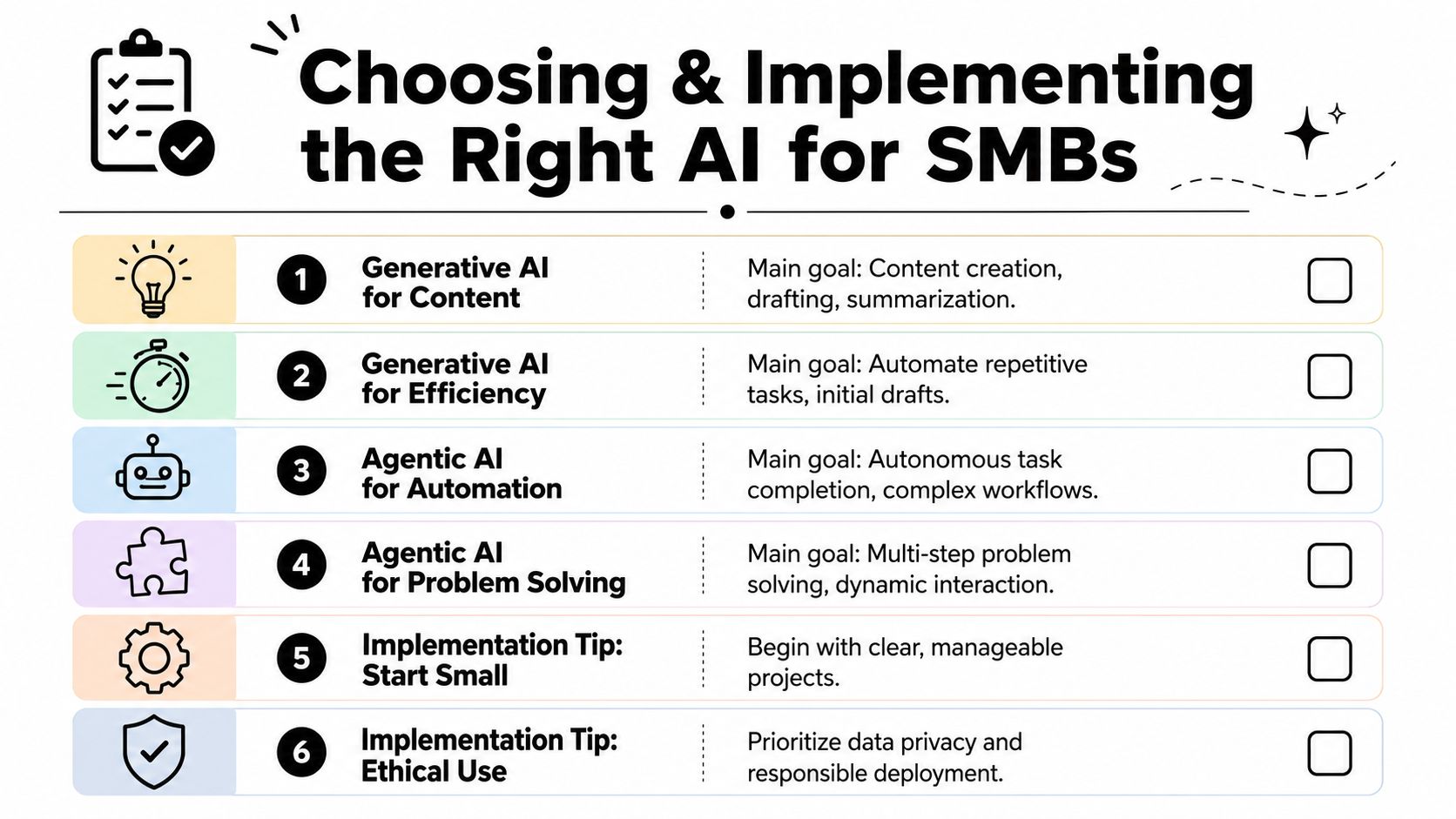
If customers ask the same questions every day and your team keeps rewriting the same answers, begin with generative AI. If the bigger problem is that good conversations still require manual follow-up, add agent-like actions next.
Start with the business bottleneck
Choose based on the friction you already see:
- Heavy question volume: Use generative AI when support is mainly about explaining services, policies, availability, or product details.
- Lead leakage: Add agentic patterns when people show buying intent but staff has to manually collect details and push them toward the next step.
- Operational drag: Use more autonomous workflows when support touches calendars, routing, intake, or repetitive admin actions.
For most SMBs, this isn't an either-or choice. It's a sequence.
A practical rollout path
A good implementation usually looks like this:
Ground the AI in real business content
Upload service pages, FAQs, PDFs, pricing notes, brochures, and policy documents. The first job is accuracy.Define the key customer intents
Don't start with every possible scenario. Start with the repeated ones, such as service questions, package inquiries, location details, and booking intent.Add action at the conversion points
Once the assistant answers well, connect the next step. That might be lead capture, qualification, or booking.Deploy where customers already message you
The best AI setup doesn't force customers into a new channel. It meets them on the website and messaging apps they already use.
A useful walkthrough of that support automation mindset is this guide on how to automate customer support.
Here's a short demo worth watching before you map your own rollout:
What tends to fail
A lot of teams make the same three mistakes.
- They start too broad: trying to automate every workflow at once creates confusion and weak answers.
- They skip content cleanup: if your source material is inconsistent, the AI reflects that inconsistency.
- They automate without guardrails: action-based systems need boundaries, approvals, and a clear fallback path.
Small businesses usually get better results by automating one valuable customer journey well than by launching a sprawling AI setup nobody trusts.
The no-code advantage
Consequently, no-code platforms become vital. Most SMBs don't have an internal engineering team to wire models, prompts, integrations, channel delivery, and lead handling from scratch.
A no-code stack lowers the barrier. You can start with a grounded conversational assistant, then layer in actions like verified lead capture, asset sharing, and appointment routing as the workflow proves itself. That's the practical path for companies that want value now, not a long AI roadmap document.
The Future Is Both Conversational and Action-Oriented
The debate around generative AI vs agentic AI won't stay clean for long because the market is already moving toward combinations of both. Businesses want assistants that can speak naturally and complete useful tasks. Not one or the other.
That future is especially relevant for SMBs. They don't need abstract autonomy. They need systems that can answer service questions, understand intent, gather clean lead data, and help the customer reach the next step without friction.
What that looks like in practice
The next generation of business AI won't stop at polished conversation. It will connect conversation to operations.
A customer asks about a package. The assistant explains it clearly, shares the right asset, identifies buying intent, gathers verified details, and routes the person to booking. That's not a chatbot in the old sense. It's a customer-facing workflow layer.
For businesses thinking beyond search traffic and into AI-native discovery, tools that help you understand visibility in AI environments are becoming more relevant too. Rank on chatgpt is part of that broader shift.
What matters for owners now
You don't need to wait for some future, fully autonomous system. The practical move is to adopt AI where customers already expect speed and clarity.
Start with conversation if your team is buried in repetitive questions. Add action where drop-off happens. Keep the workflows narrow, the knowledge clean, and the handoff points clear.
The businesses that win with AI won't be the ones using the flashiest label. They'll be the ones that remove friction from support and sales first.
If you want to put this into practice without custom development, Hyperleap AI gives small businesses a no-code way to launch grounded AI chat across website, WhatsApp, Instagram, and Facebook, then layer in lead capture, asset sharing, and appointment booking when you're ready.