Natural Language Understanding a Practical SMB Guide
Learn what natural language understanding (NLU) is and how it powers smarter chatbots for your SMB. This guide explains NLU concepts and practical applications.
A customer sends your business a simple message at 9:14 p.m. on Instagram: “Need to move my appt tmrw. still possible?”
Your chatbot replies: “I can help you book a new appointment. Please choose from the following services.”
That's the moment many small business owners realize they don't have a communication problem. They have an understanding problem.
Natural language understanding is the part of AI that helps software figure out what a person means, not just what words they typed. At the kitchen table, it's the difference between hearing your spouse say “We're out of milk” and understanding that they're asking someone to pick it up on the way home. The words matter, but the intent matters more.
For small businesses, this gap shows up everywhere. A prospect asks an incomplete question on WhatsApp. A patient uses shorthand. A customer asks about one location, but the bot answers for another. On paper, chatbots sound simple. In practice, they only help when they can handle messy human language, missing details, and changing business information.
Table of Contents
- The Difference Between a Helpful and a Hopeless Chatbot
- NLU vs NLP vs NLG Unscrambling the AI Soup
- Inside the NLU Brain The Four Core Components
- How NLU Drives Leads and Supports Customers 24/7
- Choosing the Right NLU and Measuring Its Performance
- The Hidden Pitfalls Why Many Chatbots Disappoint
- Putting Smart NLU to Work in Your Business Today
The Difference Between a Helpful and a Hopeless Chatbot
A hopeless chatbot is painfully literal. It waits for perfect wording, exact keywords, and complete sentences. If a customer types “Do you guys have anything open Friday after work for color?” the bot may miss that the person wants a salon appointment, on a specific day, in a likely evening time window.
A helpful chatbot does something more human. It recognizes that “after work” hints at later availability. It understands that “for color” refers to a service. It notices that the customer is trying to book, not browse.
Where business owners feel this most
This problem doesn't stay technical for long. It turns into missed leads, frustrated customers, and staff cleanup the next morning.
Think about a dental clinic, med spa, or home service company. Customers rarely write polished requests. They send fragments:
- Booking requests: “Can I come in Thurs?”
- Changes: “Need to reschedule”
- Pricing questions: “How much for 2 rooms?”
- Urgent support: “Nobody answered. Are you still open?”
If the bot treats each message like a matching game instead of a conversation, customers leave.
Practical rule: A chatbot isn't useful because it replies fast. It's useful because it understands enough to move the conversation forward.
What natural language understanding changes
Natural language understanding gives the bot a working sense of intent, context, and meaning. That's why it matters so much in customer-facing automation. It acts like the “brain” behind the chat, helping the system tell the difference between “I want to book,” “I want to cancel,” and “I'm just asking a question.”
This matters even more in industries where details can shift by location, provider, or service line. If you're exploring practical examples of AI adoption for healthcare solutions, it's easy to see why understanding patient language matters more than recognizing medical keywords.
At the kitchen table, this is common sense. If someone says, “Can we do dinner later?” you understand the plan, the timing issue, and the likely next step. Good chatbot experiences feel like that. Bad ones feel like shouting into a vending machine.
NLU vs NLP vs NLG Unscrambling the AI Soup
These terms confuse people because they sound interchangeable. They aren't.
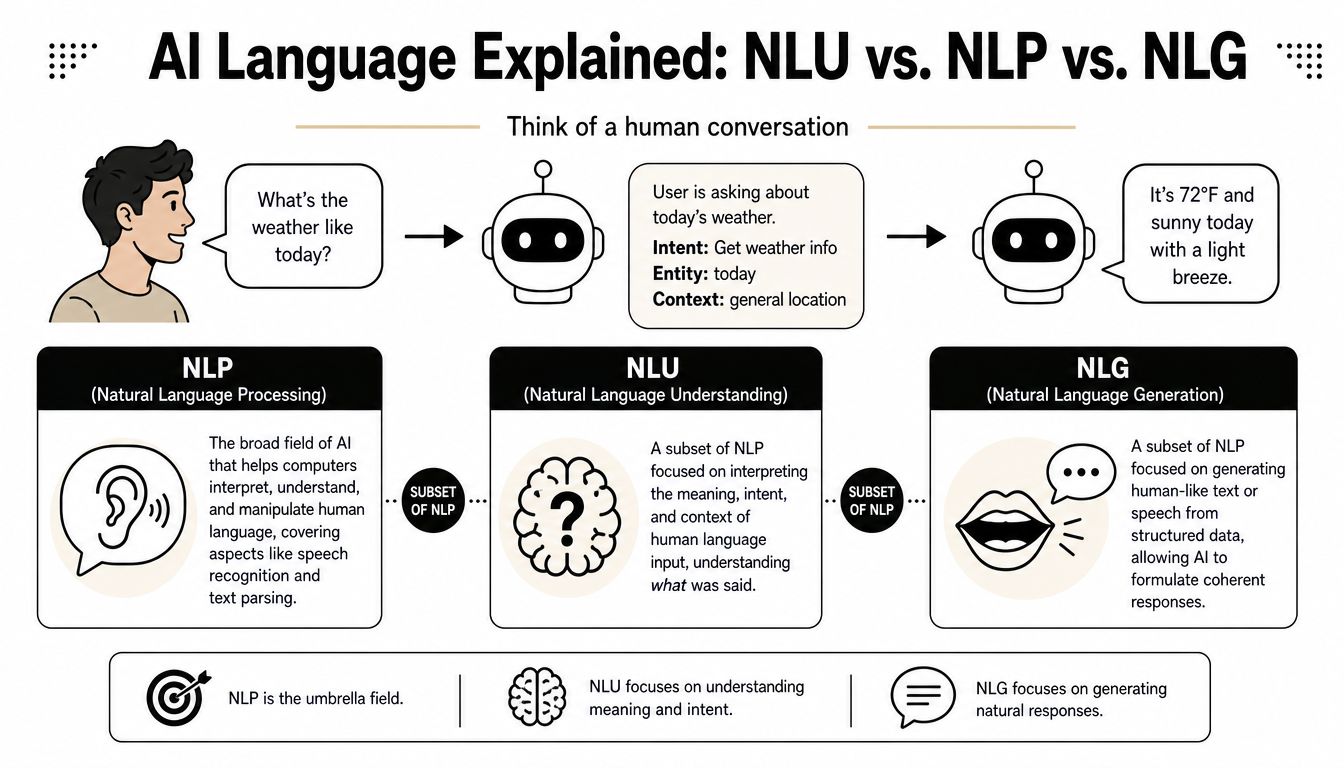
The simplest way to keep them straight is to think about a normal conversation between two people. One person hears words, understands meaning, and then replies. AI language systems follow the same broad pattern.
A kitchen table way to remember it
NLP, or Natural Language Processing, is the big umbrella. It covers the whole job of working with human language.
NLU, or Natural Language Understanding, is the comprehension part. It tries to figure out what the person meant.
NLG, or Natural Language Generation, is the response part. It turns that understanding into a sentence the customer can read.
If you want a broader glossary-style definition of the parent category, this overview of natural language processing is a useful reference point.
NLP vs NLU vs NLG at a Glance
| Term | Analogy | Primary Goal |
|---|---|---|
| NLP | The whole conversation system | Process human language in general |
| NLU | The brain listening for meaning | Understand intent, context, and entities |
| NLG | The mouth forming a reply | Generate a useful response |
A lot of people use “NLP” when they really mean “NLU.” That's understandable because NLU sits inside NLP. But when you're choosing a chatbot or evaluating one, the distinction matters. Plenty of tools can process text. Fewer can understand a messy customer message well enough to act on it.
Why NLU suddenly feels more capable today
The field didn't appear overnight. Natural Language Understanding formally emerged in the 1950s, and its roots trace back to Alan Turing's 1950 work on machine intelligence through language conversation. A major leap came with the 2018 introduction of Transformer architecture, which enabled large language models and improved a machine's ability to grasp connotations, emotion, and intent instead of only literal wording, as described in this account of the evolution of natural language processing from 1950 to 2025.
People don't buy “AI language processing.” They buy faster answers, cleaner lead capture, and fewer dropped conversations.
That's why small business owners should care less about the acronym and more about the middle step. If the system can't understand, it can't help.
Inside the NLU Brain The Four Core Components
When natural language understanding works well, it can feel almost magical. Under the hood, it's more like a good front-desk routine. The system breaks a message down, figures out the request, pulls out key details, and keeps track of where the conversation stands.
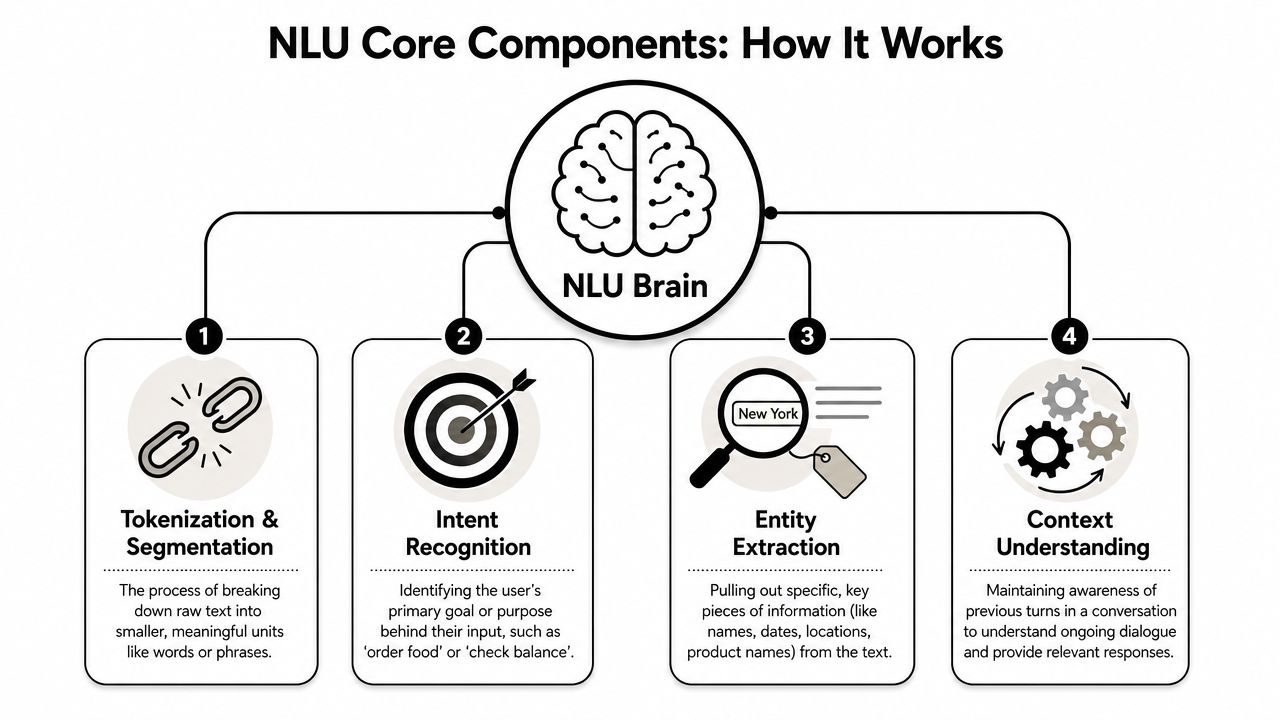
Modern systems commonly work through Tokenization, Semantic Analysis, and Output Generation, with Named Entity Recognition and Intent Recognition playing central roles, as explained in this overview of modern NLU systems and their core mechanisms.
Tokenization and segmentation
Start with the raw message: “Need haircut tmrw 2ish downtown.”
A machine can't do much with that until it splits it into manageable pieces. That splitting step is tokenization. The system breaks the text into smaller units such as words or subwords, then starts identifying patterns.
At the kitchen table, this is like separating ingredients before cooking. You can't make sense of the dish until you know what's on the counter.
Intent recognition
Once the message is broken apart, the bot asks the most important question: What is this person trying to do?
That's intent recognition. In a small business setting, common intents include:
- Book something: An appointment, room, service, or consultation
- Change something: Reschedule, cancel, update, confirm
- Ask something: Hours, pricing, availability, location, policy
- Get support: Track an order, check status, speak to a human
This is the first place readers often get mixed up. They think intent is the same as keywords. It isn't. “Can you fit me in tomorrow?” and “Any slots open tmrw?” use different words, but they point to the same goal.
Entity extraction
Intent tells you the destination. Entity extraction tells you what details the system needs to get there.
If someone writes, “Book a facial for Friday at the Midtown location,” the entities might include:
| Entity type | Example from the message |
|---|---|
| Service | facial |
| Date | Friday |
| Location | Midtown location |
In technical language, this is closely related to Named Entity Recognition, which identifies important objects or labels inside the text.
Context understanding and dialog state
A real conversation unfolds over multiple turns. That's why a good bot has to remember what just happened.
Customer: “Need to move my cleaning.”
Bot: “Sure, which location?”
Customer: “Downtown.”
Bot: “What day works better?”
Customer: “Friday morning.”
The final message only makes sense because the system remembers the earlier ones. That's context understanding.
The bot also needs dialog state tracking, which is a practical way of saying it knows what step comes next. If it already has the service and location, it shouldn't ask for them again. It should ask for the missing piece.
A smart system doesn't just answer questions. It collects the right information in the right order.
For business owners, this is the primary payoff. Natural language understanding stops being a black box once you see these parts. It's a structured process. The better each part works, the more the chatbot behaves like a capable staff member instead of a rigid form.
How NLU Drives Leads and Supports Customers 24/7
A good NLU system earns its keep in ordinary conversations. Not in demos. Not in polished sample prompts. In the nightly stream of half-written messages your customers send from a phone.
Lead capture from messy messages
A prospect rarely arrives saying, “Hello, I would like to become a qualified lead.” They write things like, “Do you cover my area?” or “How much for kitchen + bath?”
Natural language understanding helps the system spot buying intent inside casual language. It can separate a browsing question from a genuine inquiry, ask the next useful question, and gather contact details without making the exchange feel robotic.
For local businesses, that often means the difference between a dead-end FAQ reply and a conversation that moves toward a booking.
Appointment booking without back-and-forth chaos
Booking is where NLU shines when it's done well. The system can identify the requested service, pull out a day or time reference, and ask only for what's missing.
That matters because customers don't talk like scheduling software. They say:
- Loose time windows: “after lunch,” “late afternoon,” “before school”
- Incomplete requests: “Need next week if possible”
- Provider preferences: “Anyone except the same girl as last time”
A bot with decent language understanding can keep the exchange moving. A weak one gets stuck waiting for perfectly formatted input.
If you want to see how this fits into always-on front desk workflows, this guide to an AI receptionist for small business connects the dots well.
Better support across locations and channels
Support gets harder when one business has multiple locations, services, or language needs. A customer asks, “Is the downtown branch open Sunday?” and the bot answers with generic company hours. That's not a language failure alone. It's often a knowledge failure.
One major issue is knowledge drift. 68% of businesses using NLU chatbots report errors after 3 months because models fail to automatically propagate updates like new hours or prices across multiple locations or languages, according to the verified data provided for this article.
That's why the best practical setups combine NLU with a central knowledge base that staff can update easily. The bot still needs to understand the question, but it also needs current facts to answer it correctly.
What this looks like in daily operations
For an SMB, the value tends to show up in a few very concrete ways:
- After-hours coverage: Customers can ask, book, or qualify themselves when staff is offline.
- Cleaner handoff: The team starts the morning with organized conversations instead of a pile of vague messages.
- Less repetition: Staff don't have to answer the same simple questions on every channel.
- Stronger routing: The system can distinguish sales questions from support requests and send each one down the right path.
That's the kitchen table version of AI value. Not novelty. Useful conversations that continue while you sleep.
Choosing the Right NLU and Measuring Its Performance
A lot of chatbot vendors like to talk about accuracy. The problem is that “accuracy” often sounds more reassuring than it is.
If a system is tested on clean, predictable examples, it can look impressive and still struggle in live conversations. Your customers won't type benchmark-quality sentences. They'll use slang, shorthand, incomplete details, and local phrasing.
Why shiny benchmark scores can mislead
Researchers have pointed out that standard NLU benchmarks such as GLUE and BIG-Bench often miss true linguistic versatility because models can score well through superficial pattern matching rather than deeper semantic understanding. They recommend broader evaluation that includes in-domain and out-of-domain generalization, multi-metric testing, and non-English data, as discussed in this review of NLP benchmarking limitations and better evaluation practices.
That sounds academic, but the business takeaway is simple: don't let a vendor hide behind one number.
Ask what happens when the customer writes like a real customer.
Questions worth asking before you buy
Use questions that expose real-world readiness:
- How does it handle messy input? Ask about typos, abbreviations, slang, and incomplete sentences.
- What happens outside the script? A strong system should manage requests that don't match canned examples exactly.
- Can it handle language variation? If you serve multilingual customers, ask how the system is tested beyond neat English examples.
- How do updates get reflected? If your hours, pricing, or service availability changes, ask how fast the bot reflects that change.
Buyer's filter: If a vendor can explain performance only with a single generic score, you still don't know how the bot will behave on WhatsApp at 10 p.m.
What to measure instead
You don't need a machine learning team to evaluate natural language understanding. You need a practical test set.
Take messages from your own inbox. Include rushed phrasing, abbreviations, vague scheduling requests, and common support questions. Then watch for outcomes such as:
| What to test | What success looks like |
|---|---|
| Booking intent | The bot recognizes the request and asks the next relevant question |
| Support intent | The bot gives the right answer or routes correctly |
| Ambiguous phrasing | The bot asks a clarifying question instead of guessing |
| Knowledge updates | The bot reflects current business information |
For ongoing reporting, this overview of AI chatbot KPIs that measure success can help frame the operational side.
The best NLU system usually isn't the one with the fanciest marketing. It's the one that still works when your customer types like a human being in a hurry.
The Hidden Pitfalls Why Many Chatbots Disappoint
The promise sounds simple. Add a chatbot, answer customers faster, capture more leads. Then reality shows up in the form of vague language, typos, and stale business information.
That's why so many chatbot projects feel underwhelming. The issue usually isn't that the bot can't reply. It's that it replies without enough understanding.

The ambiguity problem
Human language is slippery. “Book a table” and “cancel my reservation” are very different actions, but people often leave out the details a system needs. They might write, “Need to change Friday,” assuming the bot understands what Friday refers to.
That's where many off-the-shelf tools struggle. In high-ambiguity, low-context situations, the safest move is often to ask a clarifying question. Weak systems guess. Guesses create bad customer experiences.
The noise problem
Real customer messages are noisy. They contain misspellings, random capitalization, abbreviations, and rushed wording from a mobile keyboard.
NLU accuracy can drop by 30 to 40% when systems encounter linguistic ambiguity or real-world noise like typos, according to the verified data and the related real-world noise benchmarks for natural language understanding.
That's a big deal for small businesses because a lot of high-intent conversations happen in exactly those messy environments, especially on WhatsApp and Instagram.
Common troublemakers include:
- Typos: “appt,” “tmrw,” “availble”
- Fragments: “2 for downtown?”
- Casual phrasing: “you guys open rn”
- Missing context: “same as last time”
The bot that works on polished demo prompts may be the same bot that fails on a real customer's second message.
The knowledge drift problem
Even if the bot understands the question, it can still fail if its information is old. This shows up when businesses change hours, update prices, rotate staff schedules, or manage several locations at once.
Customers don't care whether the failure came from bad language understanding or bad knowledge management. They just know the answer was wrong.
That's one reason teams also need to think about factual reliability and response guardrails. If you want a practical read on that side of the problem, Mava's AI hallucination prevention guide offers useful guidance.
For SMBs, these pitfalls aren't edge cases. They're normal operating conditions. Any serious chatbot decision should start there.
Putting Smart NLU to Work in Your Business Today
Natural language understanding matters because your customers don't write like forms. They write like people. They skip details, use shorthand, change their minds, and ask questions in the middle of doing something else.
That's why the true test of an NLU-powered chatbot isn't whether it sounds polished in a demo. It's whether it can handle ambiguity, tolerate noisy messages, and stay grounded in current business information. If it can't do those three things, it won't help much when real conversations start coming in.
For a small business owner, the practical path is straightforward:
- Choose tools that ask clarifying questions instead of guessing
- Test with real customer messages, not idealized prompts
- Keep business knowledge easy to update across services and locations
- Measure outcomes like bookings, resolved questions, and qualified leads
Natural language understanding doesn't need to feel mysterious. At its best, it acts like a dependable front desk assistant that listens carefully, remembers context, and gives customers the next right step.
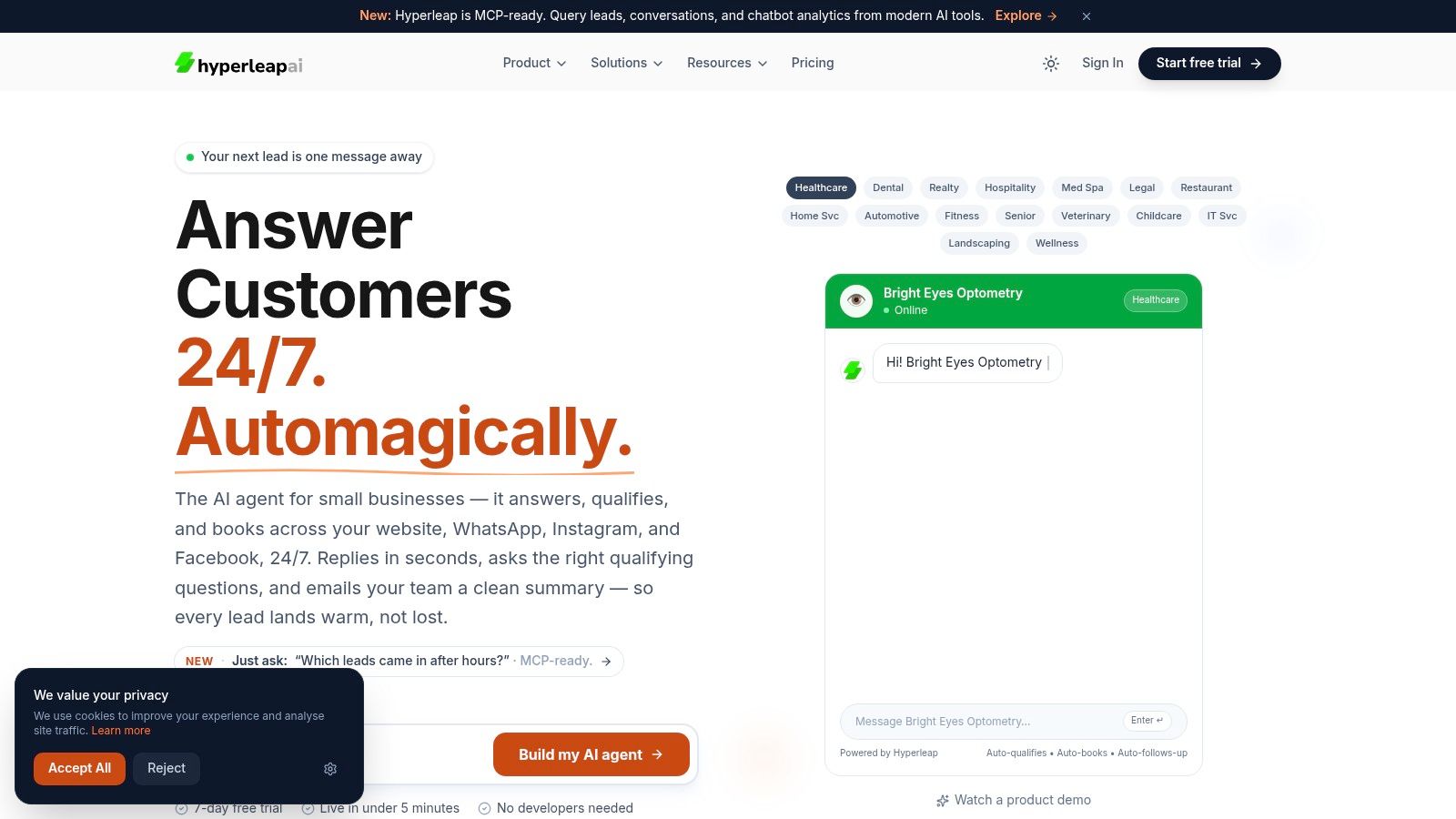
If you want a practical way to put that into action, Hyperleap AI helps small businesses capture leads, answer questions, and book appointments across website, WhatsApp, Instagram, and Facebook with a no-code setup grounded in your own business knowledge.