Qualified Lead Generation: A Complete Guide for 2026
Learn a complete system for qualified lead generation. This guide covers criteria, workflows, channels, and KPIs to attract leads that actually convert.
Your CRM says leads are coming in. Your inbox agrees. The sales team does not.
They're chasing form fills that never reply, demo requests that were never serious, and “interested” contacts who don't fit your service area, budget, or buying timeline. Marketing points to volume. Sales points to wasted hours. Revenue stays flat.
That's precisely the problem qualified lead generation solves. It doesn't start with more campaigns. It starts with a stricter standard for who deserves attention, who needs nurturing, and who should never make it to a rep in the first place.
For most SMBs, the fastest improvement doesn't come from adding another channel. It comes from building a system that captures intent earlier, filters harder, and hands sales fewer but better opportunities. If your current process still depends on generic forms and manual follow-up, it's probably creating busywork more than pipeline. Practical lead capture strategies fix that by turning every inquiry into a structured qualification moment instead of a loose contact record.
Table of Contents
- From Busywork to Business Growth The Power of Qualification
- Defining a Truly Qualified Lead MQL vs SQL
- The Lead Qualification Workflow from First Touch to Sales Handoff
- Top Channels for Attracting High-Quality Leads
- Building Your Lead Scoring and Nurturing Engine
- Qualified Lead Generation in Action for Your Industry
- Measuring Success The KPIs That Actually Matter
- Frequently Asked Questions About Lead Qualification
From Busywork to Business Growth The Power of Qualification
A common SMB scenario looks like this. Marketing reports 200 new leads this month. Sales reviews the list and finds students, competitors, vendors, and people who wanted a free template but have no buying path. The team stayed busy. Revenue did not move.
That gap is why qualified lead generation matters. It is the operating system that decides which inquiries deserve sales time, which ones need nurturing, and which ones should never enter the pipeline at all.
Without that filter, lead generation turns into admin work. Reps chase low-intent contacts, marketing celebrates form fills that never had a chance to close, and reporting gets noisy enough to hide the actual problem. Better qualification fixes that by tying early signals to actual buying potential.
The market keeps pouring money into lead generation, which is exactly why discipline matters. More spend usually creates more names. It does not automatically create more pipeline. If you want better raw input, start with lead capture strategies that collect fit and intent signals early, not just contact details.
Practical rule: If sales keeps saying “these leads aren't ready,” the issue is usually your qualification system, not your campaign volume.
Strong qualification changes what the business optimizes for. The target stops being maximum lead count and becomes a controlled flow of prospects who match your ICP, show real interest, and reach sales with enough context to have a useful conversation. That requires marketing and sales to agree on the definition, the handoff point, and the follow-up standard. It also creates a clear role for automation. AI can score behavior, enrich records, flag fit, and route leads faster, but only after the team defines what “qualified” means in operational terms.
That is how lead generation stops being busywork and starts contributing to predictable growth.
Defining a Truly Qualified Lead MQL vs SQL
A qualified lead is a contact with enough fit, intent, and context to justify the next action.
That sounds simple, but many SMB teams incur losses here. Marketing counts engagement. Sales looks for buying conditions. If those standards are different, the CRM fills up, follow-up gets inconsistent, and no one trusts the numbers.
Launch Leads found that misalignment between sales and marketing contributes to 40% to 50% of failed pipelines in its analysis of why lead generation fails. In practice, that usually means the team never agreed on two things: what marketing is allowed to hand off, and what sales is required to act on.
The practical difference between MQL and SQL
An MQL has earned more attention from marketing. An SQL has earned time from sales.
The difference is not academic. It determines who follows up, how fast they respond, and what information has to be collected before a rep gets involved. Teams that skip this step usually create one of two problems. Sales gets flooded with curious but low-intent contacts, or good opportunities sit in nurture too long because nobody recognized purchase intent early enough.
Here's the working distinction:
| Criteria | Marketing Qualified Lead (MQL) | Sales Qualified Lead (SQL) |
|---|---|---|
| Engagement | Opened emails, clicked content, submitted a form, interacted with chat | Requested a demo, asked buying questions, replied with timing, scope, or decision details |
| Intent | Researching the problem | Actively comparing options and showing a path to purchase |
| Fit | Rough match with target segment | Clear match with ICP, including budget, authority, service area, or relevant use case |
| Next action | Enter nurture sequence | Route to sales for direct follow-up |
| Risk if mishandled | Interest fades before the lead is ready | Purchase momentum drops while competitors respond faster |
A good qualification system does not stop at labels. It turns those labels into operating rules. For example, a pricing-page visit from an owner in your service area should not be treated the same way as a student downloading a checklist. One deserves routing and follow-up. The other belongs in nurture or disqualification.
That is why lead scoring has to combine two filters:
- Intent: pages viewed, questions asked, return visits, reply behavior, form detail, and urgency
- Fit: company type, role, geography, budget range, service need, and buying authority
If a lead has fit without intent, keep nurturing. If a lead has intent without fit, disqualify it or move it to a lower-touch path.
This is also where automation starts paying for itself. Tools can enrich records, apply score thresholds, and trigger chatbot-based lead routing rules the moment a contact crosses from marketing interest into sales readiness. The trade-off is straightforward. Automation speeds up handoff, but only if the team defines the thresholds clearly enough that the system is not guessing.
The goal is not to push more names to sales. The goal is to send fewer, better-timed conversations with enough context to close.
The Lead Qualification Workflow from First Touch to Sales Handoff
A qualified lead doesn't appear at the end of the funnel by accident. It gets shaped by the process.
Organizations generate an average of 1,877 leads per month, but that becomes only 312 sales opportunities, with an average MQL to SQL conversion rate of 16% across industries, according to SalesHandy's lead generation benchmarks. That gap is where workflow matters. Without a real system, most leads sit in limbo.
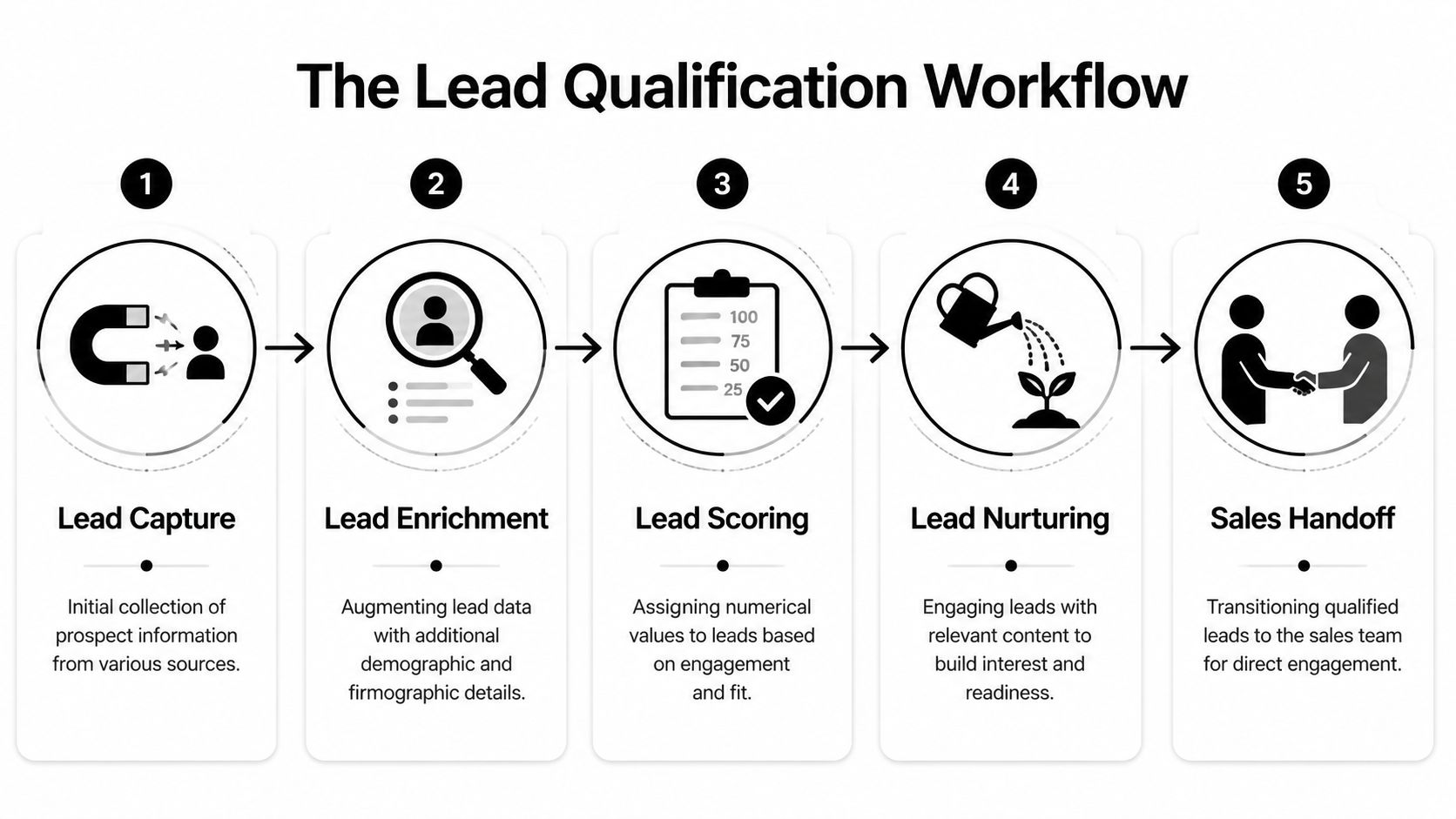
Step 1 through Step 3 capture enrich score
The first job is capture. Leads come in from your website, ads, WhatsApp, Instagram, referrals, and landing pages. If every source dumps into a generic inbox, your qualification process is already broken.
Then comes enrichment. Raw contact details rarely tell sales enough. You need context. For a local service business, that might be service area and urgency. For B2B, it might be company type, role, and use case. Enrichment can come from forms, chat flows, CRM lookups, or manual review.
Third is scoring. Engagement signals and fit signals should combine into one practical view of readiness. A prospect who asks about pricing and timeline should rank above someone who only downloaded a guide. A lead routing workflow should reflect that logic, and AI chatbot lead routing practices are useful when you want conversations to move automatically to the right rep or queue.
Step 4 and Step 5 nurture and handoff
Not every good-fit lead is sales-ready today. That's where nurturing does the heavy lifting. A lead who asks an early-stage question should get education. A lead who compares packages or asks about onboarding should get closer to scheduling.
Use short workflows tied to behavior:
- Early research behavior gets educational emails, FAQs, or use-case content.
- Mid-funnel engagement gets proof, comparisons, and objection handling.
- High-intent behavior triggers direct outreach, scheduling options, or rep alerts.
The final step is handoff. Many teams still fail at this point. Sales should receive more than a name and a phone number. They need context: pages viewed, questions asked, qualification answers, channel source, and any previous conversation history.
The handoff isn't complete when the lead enters the CRM. It's complete when the rep can act without guessing.
That's the operational difference between a lead system and a contact collection system.
Top Channels for Attracting High-Quality Leads
A common failure pattern looks like this: marketing reports strong lead volume, sales says the pipeline is full of weak opportunities, and both teams are technically right. The problem usually starts with channel mix. Lead quality is shaped at the acquisition stage, long before anyone applies a score or books a call.

Organic channels that attract intent not noise
SEO produces better-fit leads when the page strategy mirrors buyer intent. Broad educational traffic can help visibility, but it often creates extra filtering work for small teams. Service pages, comparison pages, and location pages usually bring in visitors who are closer to a buying decision.
The pattern is straightforward.
- Problem-based searches: Searching for a fix often indicates a more advanced stage than reading definitions or general advice.
- Location-led pages: Geography pre-qualifies the lead for any business with service areas, regional sales coverage, or on-site delivery.
- Service comparison content: Buyers comparing options are showing commercial intent, not casual interest.
For firms selling regionally, it helps to review insights for UK service businesses that focus on search intent, service-area targeting, and lead quality rather than raw traffic growth.
Content partnerships, webinars, and referrals can also bring in strong opportunities because trust is already established before the first form fill. The trade-off is scale. These channels tend to produce fewer leads, but the conversion path is often shorter if the audience match is tight.
A generic webinar can build a list. A webinar built around one painful problem, one buyer type, and one clear next step usually gives sales far better conversations.
Paid and conversational channels that qualify in real time
Google Ads works well when the account is built around high-intent keywords and the landing page asks enough questions to separate buyers from researchers. LinkedIn Ads can be effective for narrow B2B targeting, especially when role, industry, and offer are tightly aligned. Both channels get expensive fast when every click is treated as equal.
That is where modern qualification systems matter. Paid traffic should not flow into a single generic form and wait for manual review. High-intent visitors need fast qualification, smart routing, and follow-up that reflects what they asked, which is one reason AI-assisted chat, form logic, and CRM workflows are now part of lead generation operations rather than experimental add-ons.
Use conversational capture on high-intent pages where timing matters most:
- Website chat: Best for pricing, availability, implementation, and service-fit questions.
- WhatsApp and Instagram: Useful for buyers who prefer messaging and want a quick answer before committing to a call.
- Landing page bots: Strong option when the business needs to branch follow-up questions based on budget, timeline, location, or use case.
A short explainer helps if you're evaluating conversational capture in practice:
The main decision is not traffic versus conversion. It is channel role. Some channels are built to generate reach. Others are built to generate sales conversations. SMBs usually need both, but each channel should be judged by the job it is meant to do.
Building Your Lead Scoring and Nurturing Engine
A scoring model only helps if sales uses it every day. I've seen SMB teams spend weeks building detailed point systems, then abandon them because nobody can explain why one lead scored 73 and another scored 61. Keep the model simple enough that marketing, sales, and operations can all defend the logic.
Start with two score groups: fit and intent. Fit answers whether the lead belongs in your pipeline. Intent answers whether the lead is ready for a sales conversation now or needs more time. That split keeps the model practical and makes handoff rules much easier to enforce.
| Score type | What to include | Why it matters |
|---|---|---|
| Fit score | Industry, location, company type, role, budget range, service need | Shows whether this lead belongs in your pipeline |
| Intent score | Form depth, chat answers, repeat visits, pricing questions, reply behavior | Shows how close they are to a sales conversation |
Use the score to trigger action, not just labeling.
- High fit plus high intent: Route to sales fast.
- High fit plus low intent: Put the lead into nurture.
- Low fit plus high intent: Review manually or redirect to a better offer.
- Low fit plus low intent: Keep out of the sales queue.
That last point matters more than teams expect. A weak scoring model does not just create noise in the CRM. It slows response time for strong opportunities because reps waste time chasing contacts who were never a fit.
The strongest systems connect scoring to real conversation data. If a prospect asks about rollout across multiple locations, procurement, or implementation timing, that should carry more weight than a generic content download. A unified inbox and full chat history make those decisions more reliable because the team can review what the buyer asked, how they answered qualification questions, and whether the contact details were verified.
That's one place a tool like Hyperleap AI fits into the operating model. It captures conversations across website and messaging channels, stores the history, and supports OTP-verified lead capture so teams can screen out fake contacts before sales follows up. For multi-unit brands and operators working with a franchise lead generation agency, that kind of verification and routing helps keep territory teams focused on real demand instead of junk form fills.
Nurturing based on readiness not hope
Nurture breaks down when every lead gets the same email sequence.
A better approach uses the signals already collected. A prospect asking, “Can you support multiple locations?” needs proof, case examples, and implementation detail. A prospect asking, “How much does it cost?” needs package clarity, objections handled, and a path to book. A checklist downloader with no commercial questions needs education, not rep outreach.
Build nurture around lead state:
- Education stream for early-stage interest.
- Evaluation stream for leads comparing options.
- Sales-assist stream for high-intent prospects who have not booked yet.
Don't send a sales pitch to a lead who still needs diagnosis. Don't send beginner content to a lead already asking commercial questions.
Review the model on a schedule, not every time one rep complains. Pull transcripts, inspect outcomes, and compare scored leads against closed-won and closed-lost deals. In practice, scoring problems usually come from bad signal selection, weak routing rules, or poor sales follow-up. The math is rarely the core issue.
Qualified Lead Generation in Action for Your Industry
The same framework looks different depending on what you sell. That's why generic lead advice often breaks down in practice.
Healthcare and local services
A healthcare clinic doesn't need “more leads.” It needs people who are suitable for the treatment, located in the right area, and ready to book or proceed to intake. The qualification flow should ask focused questions such as treatment type, availability, and whether the inquiry is new or returning. From there, the system can route appointment-ready patients and hold back general inquiries for staff review.
Local service businesses face a different headache. Fake numbers, low-intent quote requests, and vague “call me” submissions eat time fast. OTP verification is practical here because it reduces junk contacts before anyone on the team follows up. The lead doesn't just submit. They confirm.
A strong local workflow usually includes:
- Service-area filtering: No point sending out-of-area leads to the team.
- Need-based branching: Repair, installation, consultation, or emergency requests should not enter the same path.
- Booking or callback routing: Urgent inquiries need immediate handling. Research-stage contacts need slower nurture.
Real estate agencies and marketing firms
A multi-location real estate group needs answers that change by market. School district, neighborhood inventory, budget range, financing stage, and move timeline all affect whether an inquiry is sales-ready. A central knowledge base with location overlays helps keep answers accurate while still qualifying buyers by market, budget, and timing.
Marketing agencies should apply the same standards to their own inbound pipeline. Too many agencies collect “let's chat” forms with no qualification. A stronger version asks for channel mix, monthly spend range, goals, and decision timeline before a strategist ever joins the conversation. That doesn't make the process colder. It makes the first call more useful.
Franchise businesses add another layer because lead quality has to stay consistent across locations. If that's your model, looking at how a franchise lead generation agency structures acquisition and qualification can help clarify what should happen centrally and what should remain local.
A few practical industry patterns show up again and again:
- Healthcare: readiness and eligibility matter as much as interest.
- Real estate: location, budget, and timeline drive qualification.
- Agencies: fit depends on budget, scope, and decision-maker access.
- Home services: contact verification and urgency matter more than top-of-funnel volume.
The best qualification system doesn't ask every lead the same questions. It asks the few questions that predict whether that lead belongs in your sales process.
That's what makes it operational, not theoretical.
Measuring Success The KPIs That Actually Matter
Teams often track too much of what's easy and too little of what's useful.
Lead volume, click totals, and raw form submissions can help with channel diagnostics, but they don't tell you whether qualified lead generation is improving revenue. If marketing celebrates traffic while sales complains about junk, your KPI set is part of the problem.
What to stop obsessing over
Don't build your reporting around raw lead counts alone. More leads can mean more waste, more follow-up burden, and more false confidence. That's especially risky when the average cost per lead is substantial and the average lead-to-customer timeline is long, as covered earlier in the broader industry benchmarks.
A better question is whether the leads are advancing.
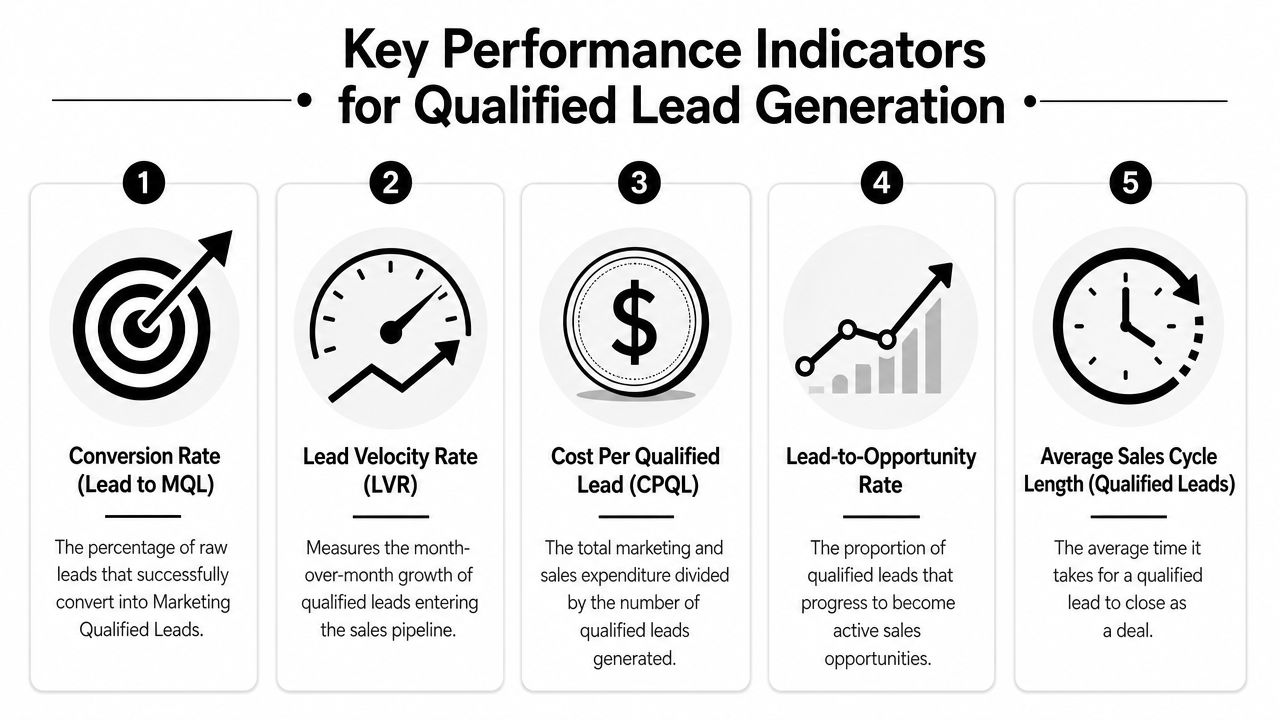
The metrics that connect to revenue
Start with outcome-based metrics:
- MQL to SQL conversion rate: Measures whether marketing is producing leads sales wants.
- Lead-to-opportunity rate: Shows whether qualification and nurturing are moving contacts into real pipeline.
- Average sales cycle length for qualified leads: Tells you whether readiness is improving.
- Lead source quality: Compare sources by downstream outcome, not just cost.
One of the most useful efficiency metrics is Cost per SQO. Experts recommend calculating Cost per Sales Qualified Opportunity by dividing total marketing spend by the number of new SQOs, according to LevelUp Leads on lead generation KPIs. That filters out unqualified noise and tells you what you're really paying for prospects with revenue potential.
If you're building dashboards around chatbot-assisted capture or automated qualification, these AI chatbot KPIs to measure success are a useful reference point because they keep the focus on routing quality, booked outcomes, and conversion progression rather than conversation volume alone.
Track fewer metrics, but choose the ones that force better decisions. If a channel creates lots of names and almost no sales-ready opportunities, you don't have a scaling opportunity. You have a filtering problem upstream.
Frequently Asked Questions About Lead Qualification
How many questions should a qualification form ask
Ask only what helps you decide the next action.
If a field doesn't affect routing, scoring, or follow-up, it probably doesn't belong on the form. Early-stage offers should collect less. High-intent pages can ask more because the buyer expects a more serious exchange.
When should sales step in
Sales should step in when the lead has crossed both thresholds: fit and intent.
That usually means the prospect matches your target customer profile and has taken an action that signals active evaluation, not just passive interest. Don't send every engaged contact to sales. That burns rep time and creates bad habits.
Can small businesses do this without a large tech stack
Yes. Most SMBs don't need enterprise software to run qualified lead generation well.
They need four basics: one place to capture inquiries, one clear qualification standard, one scoring or tagging method, and one handoff process sales follows. Complexity isn't the goal. Consistency is.
What's the biggest mistake teams make
They confuse lead capture with lead qualification.
A name, email, or phone number is not a qualified lead. It's raw material. Qualification happens only when the business can judge fit, intent, and next best action with enough confidence to route the lead correctly.
Should every lead be nurtured
No.
Some leads should be disqualified quickly. If the contact is outside your market, lacks basic fit, or shows no meaningful interest, don't force them through a nurture workflow just to make your funnel look full. Clean pipelines close faster.
If you want a practical way to run qualified lead generation without stitching together multiple tools, Hyperleap AI gives SMBs a way to capture leads across website and messaging channels, ask qualifying questions automatically, verify contacts, and route conversations toward booking or follow-up with full chat context intact.