Automated Real Estate Lead Management: A 2026 Blueprint
Build a powerful, automated real estate lead management system. Our 2026 guide covers capture, scoring, routing, and follow-up to convert more leads.
78% of buyers work with the first agent who responds to their inquiry, yet the average real estate agent takes 917 minutes, or over 15 hours, to respond to a new web lead according to AgentZap's real estate lead statistics roundup. That gap changes how real estate lead management should be viewed. This isn't admin work. It's revenue operations.
Most agencies still treat lead handling as a mix of forms, inboxes, portal notifications, and agent memory. That setup fails at the exact moment a prospect is most valuable. A modern team needs one automated system that captures inquiries across channels, verifies contact details, qualifies intent, routes the lead to the right agent, and keeps follow-up moving until an appointment is booked or the contact is pushed into nurture.
Table of Contents
- Why Your Real Estate Lead Management Is Leaking Commission
- Building Your 24/7 Multi-Channel Capture Engine
- From Contact to Prospect Applying Qualification Logic and Scoring
- Instant and Intelligent Lead Routing and Assignment
- Designing Your Automated Follow-Up and Nurturing Workflow
- Centralizing Data and Measuring What Matters
- Your Implementation Blueprint Using Hyperleap AI
Why Your Real Estate Lead Management Is Leaking Commission
The biggest leak in most agencies isn't ad spend. It's response delay.
According to AgentZap's real estate lead statistics roundup, agents who respond within five minutes are 21 times more likely to qualify a lead than those who wait longer. The same source notes that conversion drops by a factor of 10 after one hour, and that 78% of buyers end up working with the first responding agent. If your team responds like the average agent, which Inman's 2025 technology survey put at 917 minutes, your lead management process is handing opportunity to faster competitors.
Slow response is a systems problem
Teams often blame agents for missed follow-up. Sometimes that's fair. More often, the problem starts earlier.
A lead comes in from a website form at night. Another arrives through Instagram DMs during a showing. A portal inquiry lands in one inbox while a WhatsApp message goes to someone's phone. No one has a unified queue. No backup rule exists. The lead sits.
That delay has a direct commission cost. Based on NAR commission data and a $400,000 median home price, Real Trends calculates that each missed or poorly handled lead can represent $7,500 or more in lost commission income per transaction, as summarized in AgentZap's real estate lead statistics roundup.
Practical rule: If a lead depends on a person noticing a notification, the system is broken.
What top teams do differently
Strong real estate lead management removes human latency from the first few minutes. It doesn't wait for an agent to manually send the first text, decide who should reply, or remember to log the inquiry in the CRM.
The better model looks like this:
- Capture immediately: Website chat, forms, WhatsApp, Instagram, and portal inquiries all feed into one workflow.
- Acknowledge instantly: The prospect gets an immediate response with the next step.
- Route automatically: Assignment happens by geography, property type, language, or availability.
- Escalate fast: If the first assignee doesn't engage, the lead moves.
That's why speed-to-lead should be designed as an operational standard, not a motivational slogan. Agencies that want a sharp breakdown of how slow response kills conversion should read this analysis of why real estate agents lose leads from slow response.
Building Your 24/7 Multi-Channel Capture Engine
A “Contact Us” form isn't a capture engine. It's a mailbox.
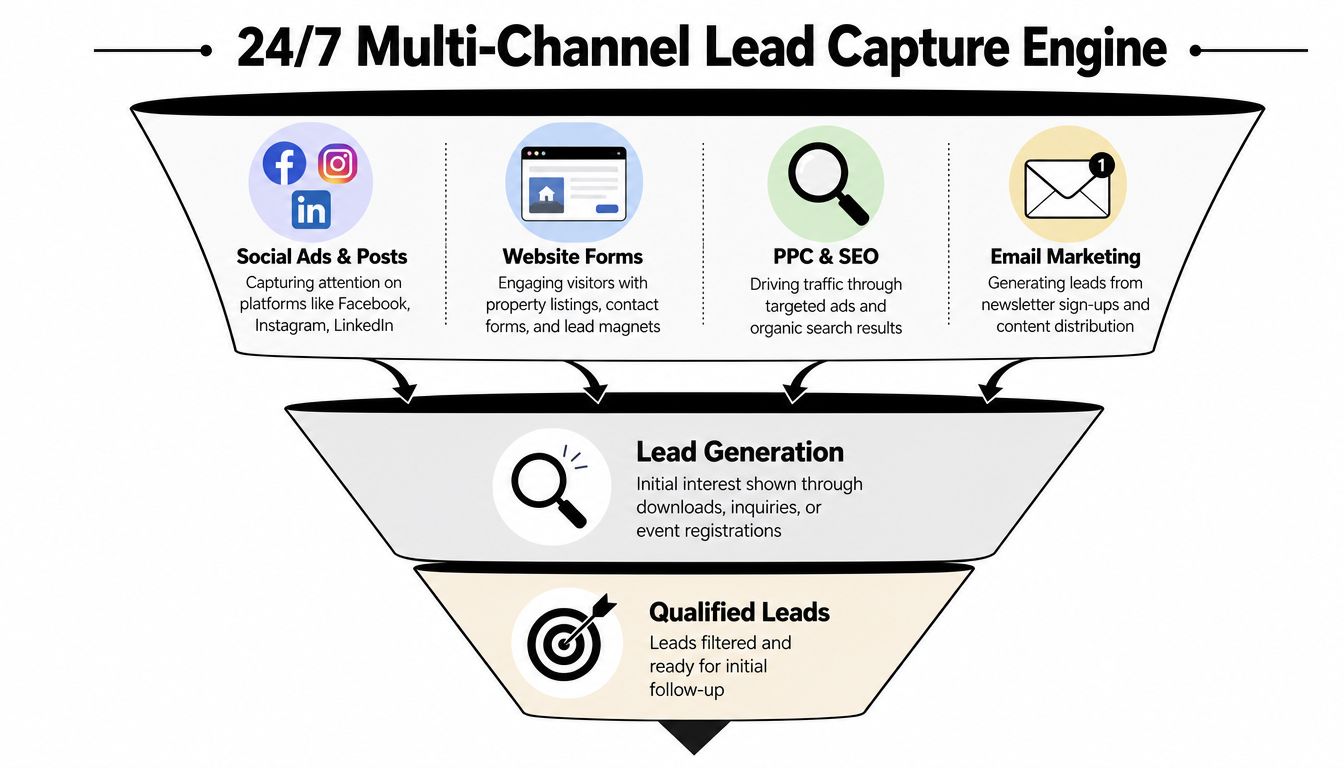
Modern real estate lead management starts earlier, across more channels, and with better data. Your digital front door should work the same way a strong ISA would work. It should greet, ask smart questions, verify contact details, share useful assets, and hand off only when the inquiry is real.
Capture where prospects already are
Most growing agencies need at least three active capture surfaces.
Website chatbot. This is your main conversion layer for listing pages, valuation pages, and neighborhood content. A visitor who's browsing homes at night shouldn't hit a dead form. The bot should ask what they're looking for, where, when, and whether they want listings, a valuation, or to book a call.
WhatsApp. Many prospects prefer quick messaging over phone calls, especially for first contact. A WhatsApp flow is useful for rental inquiries, relocation questions, open house follow-up, and investor conversations that need fast back-and-forth.
Instagram and Facebook messaging. Social inquiries are usually weaker if you treat them like inbox clutter. They become useful when you respond with a structured flow instead of “How can I help?” A bot can qualify the request before an agent steps in.
If you're reworking the top of funnel as well as the capture layer, this guide to real estate lead generation is worth reviewing because it frames the upstream traffic problem separately from the downstream conversion system.
Ask fewer questions, but better ones
The first exchange should gather enough to route and prioritize without turning into an interrogation.
A practical capture sequence usually includes:
- Intent: buying, selling, renting, investing, or valuation
- Area: city, neighborhood, ZIP, or development
- Timeline: immediate, soon, or exploring
- Budget or price band: enough to segment without forcing exact numbers
- Financing readiness: pre-approved, cash, not yet
- Preferred contact method: call, SMS, email, WhatsApp
For listing-specific inquiries, add one more question: “Is this about this property, or are you looking for similar options too?” That single branch often reveals whether the lead is narrow and urgent or broader and nurture-ready.
Verify before you route
Bad contact data poisons everything after capture. It wastes agent time, pollutes CRM reporting, and makes ad channels look worse than they are.
That's where OTP verification matters. A simple one-time password by SMS or email filters out fake submissions, mistyped phone numbers, and low-effort spam before the lead hits your assignment queue. It's one of the cleanest ways to improve data quality without adding friction for serious prospects.
Useful capture bots also share assets in the moment:
- Property brochures for active listing interest
- Videos or virtual tours when someone can't talk yet
- Neighborhood guides for relocation leads
- Seller prep checklists for valuation requests
A lead capture bot should do more than collect contact info. It should move the conversation one step closer to qualification.
Agencies mapping this across channels should think in terms of one conversation layer, not separate tools. This is the right moment to study a multi-channel AI chatbot strategy for customer messaging, especially if website chat, WhatsApp, and social DMs are currently managed in silos.
From Contact to Prospect Applying Qualification Logic and Scoring
Not every new inquiry deserves the same speed, script, or agent.
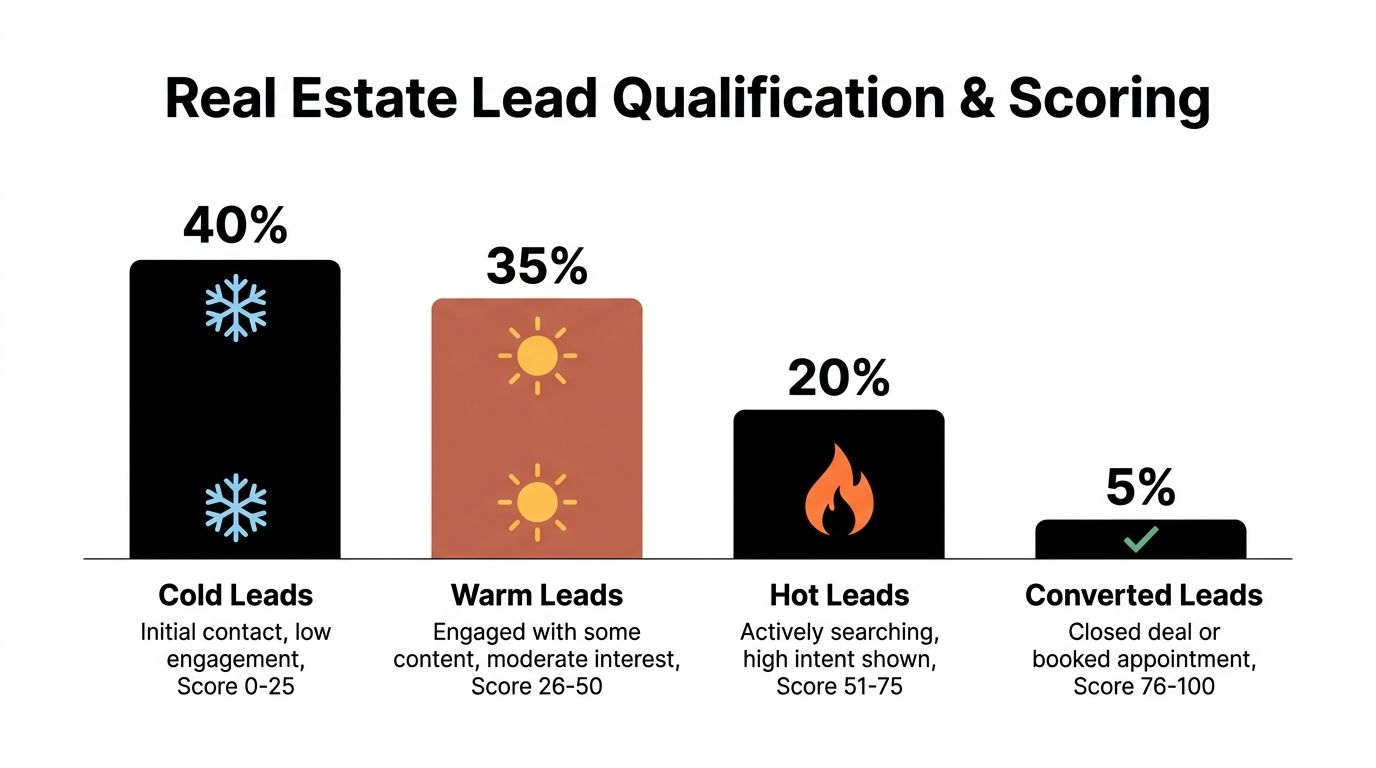
That sounds obvious, but many teams still process leads in the order they arrived. That's one reason average conversion stays weak. Good real estate lead management separates capture from qualification. The first gets names into the system. The second decides who should get immediate human attention.
Source matters more than most teams admit
Lead source should be one of the first inputs in your scoring model because source quality isn't even close.
According to Ylopo's analysis of real estate lead conversion rates, there is a 10–25x conversion gap between referral leads, which convert at 14–30%, and online portal leads, which convert at 0.4–1.2%. The same source notes that top-performing teams push portal leads to 5–9% because they score and prioritize them effectively instead of treating every inquiry the same.
That should change how you route from the first second.
A referral from a past client with a clear buy timeline should trigger direct assignment and immediate human follow-up. A broad portal lead asking about “homes in the area” may still be valuable, but it should go through stronger qualification logic before it consumes prime agent time.
Build a scoring model from explicit and implicit signals
The most useful scoring systems combine what the lead tells you with what their behavior shows.
Here's a practical model.
| Signal type | What to capture | Why it matters |
|---|---|---|
| Source | Referral, portal, website, social, database reactivation | It sets the base expectation for intent and follow-up intensity |
| Declared need | Buy, sell, rent, invest, valuation | It determines workflow and agent specialization |
| Timeline | Immediate, near-term, exploratory | It changes urgency |
| Financial readiness | Pre-approved, cash, still researching | It separates active prospects from future nurture |
| Behavioral activity | Repeated listing views, guide downloads, return visits, mortgage tool use | It reveals intent that forms alone miss |
The behavioral layer is where many agencies fall behind. A lead who revisits one condo listing three times, watches the video, and asks for HOA details is different from someone who fills a broad home search form and disappears. Your system should reflect that difference automatically.
Use scores to decide action, not just labels
A score is only useful if it changes who does what next.
For example:
- High-intent lead: Immediate call task, SMS fallback, senior agent assignment if the property type fits
- Mid-intent lead: Fast response, but with more automated follow-up before agent time expands
- Low-intent lead: Educational nurture, listing alerts, periodic reactivation
Operator's view: Teams don't waste money by buying the wrong leads. They waste money by handling all leads the same way after capture.
The strongest agencies also add “fit” rules alongside “intent” rules. A luxury condo inquiry in a downtown tower should not land with the suburban buyer's agent just because it arrived first. Scoring has to support assignment. Otherwise the system looks organized in the CRM while the prospect experiences a clumsy handoff.
Instant and Intelligent Lead Routing and Assignment
A qualified lead in the wrong hands is still a mishandled lead.
Many teams start with round-robin because it feels fair. Fairness is fine for internal politics. It's not always the best conversion strategy. Real estate lead management works better when routing increases the chance of a useful first conversation.
Why manual assignment fails
Manual assignment breaks in familiar ways. The office admin is away. The team lead forwards the lead to a group chat. Two agents reply. Nobody knows who owns the record. The prospect gets a clumsy experience and loses confidence fast.
Automated routing fixes that by turning assignment into a rules engine. The rules should reflect how your business sells, not how your CRM happens to be set up.
Useful routing inputs include:
- Location: city, neighborhood, building, ZIP, school district
- Property type: residential, commercial, rental, land, luxury
- Price band: starter, mid-market, premium
- Lead source: referral, portal, database reactivation, social
- Language or channel preference: especially important for WhatsApp-led conversations
- Availability: who can engage now, not who looked free an hour ago
Use overlays for multi-location teams
One of the cleanest operating models for a growing group is a single knowledge base with location-specific routing overlays.
Say your brokerage covers two cities and several neighborhoods in each. The website bot can answer general questions from one shared content base, but the moment a lead mentions “downtown condos” in one city, the system should assign that conversation to the agent who knows that micro-market. The same principle applies to waterfront inventory, new developments, suburban family homes, or commercial leases.
That overlay approach avoids two common problems. First, you don't need to build a separate bot stack for every office. Second, you don't force generalists to handle specialist demand.
Match the lead to the likely closer
A few routing examples make the difference clear:
| Scenario | Weak routing choice | Better routing choice |
|---|---|---|
| Inquiry about a luxury penthouse | Next agent in round-robin | Agent who handles luxury urban inventory |
| Seller asks for valuation in a farm area | General buyer rep | Listing agent for that territory |
| Commercial lease message via WhatsApp | Residential inside sales rep | Commercial specialist with fast messaging habits |
| After-hours portal inquiry | Wait until morning | Auto-response now, backup assignment if no engagement |
The trade-off is straightforward. The more intelligent your routing gets, the more setup discipline it needs. You need clean tags, ownership rules, and a clear reassignment policy. But that operational effort pays off because prospects stop bouncing between agents who can't answer their actual questions.
Routing should optimize for relevance first and fairness second.
That's especially true for agencies growing across offices. A lead assignment model built for a five-person team won't survive multiple territories, mixed property types, and always-on messaging.
Designing Your Automated Follow-Up and Nurturing Workflow
A good follow-up system doesn't just move fast. It moves with intent.
The first response should happen immediately, but the true advantage comes from what happens in the next hours and days. Most agencies still rely on one call, one text, and a vague note to “try again later.” Better real estate lead management uses automation to keep momentum without making the outreach feel robotic.
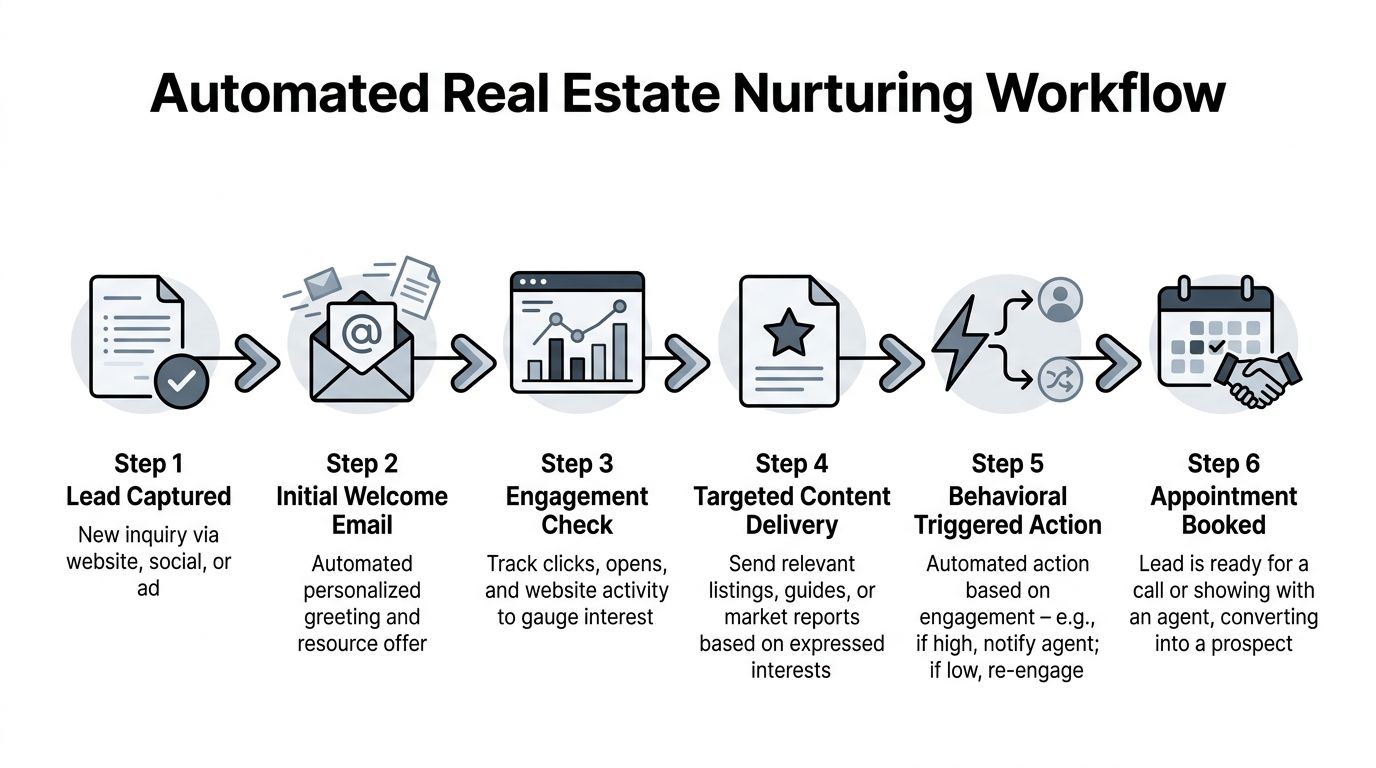
Start with the workflow itself.
The first minutes decide whether the lead lives or dies
According to LeadsBridge's guide to real estate lead management, best practice is a response time of under five minutes, supported by instant automated SMS and email alerts to the assigned agent, plus an escalation to a backup after two minutes of inactivity. The same source notes that top performers use auto-generated daily call lists sorted by activity score and recency so prime hours go to prime prospects.
That's the baseline. Here's what that looks like in an actual operating sequence.
- Lead enters the system. A website chat, form, portal lead, or WhatsApp inquiry creates the record.
- Automated first touch goes out immediately. Usually an SMS or channel-native message that confirms receipt and offers the next step.
- Assigned agent gets an alert. The alert should include source, intent, property reference, location, and preferred contact method.
- Escalation fires if there's no action. After the inactivity window, the lead is reassigned or mirrored to a backup.
- Short nurture begins if live contact fails. Email, SMS, or WhatsApp follows with useful, relevant content.
- Behavior changes priority. If the lead re-engages, returns to listings, or replies, they jump back to the top of the queue.
Here's the video view many teams find helpful when mapping automation and handoff:
Build follow-up around real behaviors
The easiest mistake is writing one fixed drip for every lead. That's lazy automation.
A better workflow reacts to behavior:
- If the lead replies to the first text: pause generic follow-up and assign the conversation to the agent thread.
- If they click listing links but don't answer calls: send a tighter message tied to those listings.
- If they revisit a saved property: raise priority and put them on the next call block.
- If they go quiet: shift from appointment language to lower-pressure educational content.
A simple nurturing stack often uses SMS for urgency, email for substance, and WhatsApp when that's the original channel. The channel mix matters because people don't all respond the same way, but consistency matters more. Agents should never wonder what happens after an unanswered first call. The system should already know.
Human support still matters in the middle of automation
Automation handles speed and consistency. People handle nuance.
That's why some teams blend automation with inside support or admin help for qualification, appointment coordination, and record hygiene. If you're evaluating that model, these CallZent insights on real estate virtual assistants are useful because they show where human support fits without replacing the core workflow design.
Don't automate because you want fewer conversations. Automate because you want faster, cleaner, better-timed conversations.
The best nurturing systems feel persistent from the operator's side and personal from the prospect's side. That's the balance to aim for.
Centralizing Data and Measuring What Matters
A lead system is only as strong as its visibility.
If website chat lives in one dashboard, WhatsApp in another, Instagram messages on someone's phone, and appointment notes in a CRM that only half the team updates, you don't have real estate lead management. You have fragmented activity.
Build one source of truth
The operating standard should be simple. Every inbound conversation, every handoff, and every follow-up attempt should be visible in one place.
That usually means a unified inbox plus CRM sync. The inbox gives your team full conversation history across channels. The CRM holds ownership, stage, notes, and downstream deal activity. Together, they let a manager answer practical questions fast:
- Which leads are waiting for a first response?
- Which agents are missing assignment alerts?
- Which source is creating appointments versus noise?
- Which nurtured leads are showing new intent?
Export matters too. CSV and Excel export sounds boring until finance wants source-level reporting, marketing wants channel quality by campaign, or operations wants to audit duplicate records and bad phone numbers. If your stack can't move cleanly between systems, your reporting will always lag behind your activity.
Track operational KPIs, not vanity metrics
Many teams over-measure the top of funnel and under-measure response quality.
A practical dashboard for real estate lead management should center on four indicators:
| KPI | What it tells you | Why it matters |
|---|---|---|
| Speed-to-lead time | How quickly first contact happens | It reveals whether your workflow is actually functioning |
| Contact rate | How often your team reaches a real person | It shows lead quality and follow-up effectiveness |
| Appointment set rate | How often contact becomes a booked next step | It highlights qualification and scripting quality |
| Conversion rate by source | Which channels create closed business | It drives budget allocation and source strategy |
Those numbers should be viewed by source, by agent, and by time period. Otherwise, good channels get cut for the wrong reasons and weak channels survive because nobody can isolate the issue.
Keep attribution honest
The source that introduced a lead isn't always the source that converted it. In real estate, that matters because reactivation and long nurture often do heavy lifting before the deal is real.
A practical reporting model should at least preserve both first touch and the last meaningful touch before appointment or conversion. That gives marketing and sales a more honest picture of what influenced the outcome.
The dashboard should help you make one decision each week: where should the next hour of agent time and the next dollar of budget go?
If the answer isn't visible, your data structure still needs work.
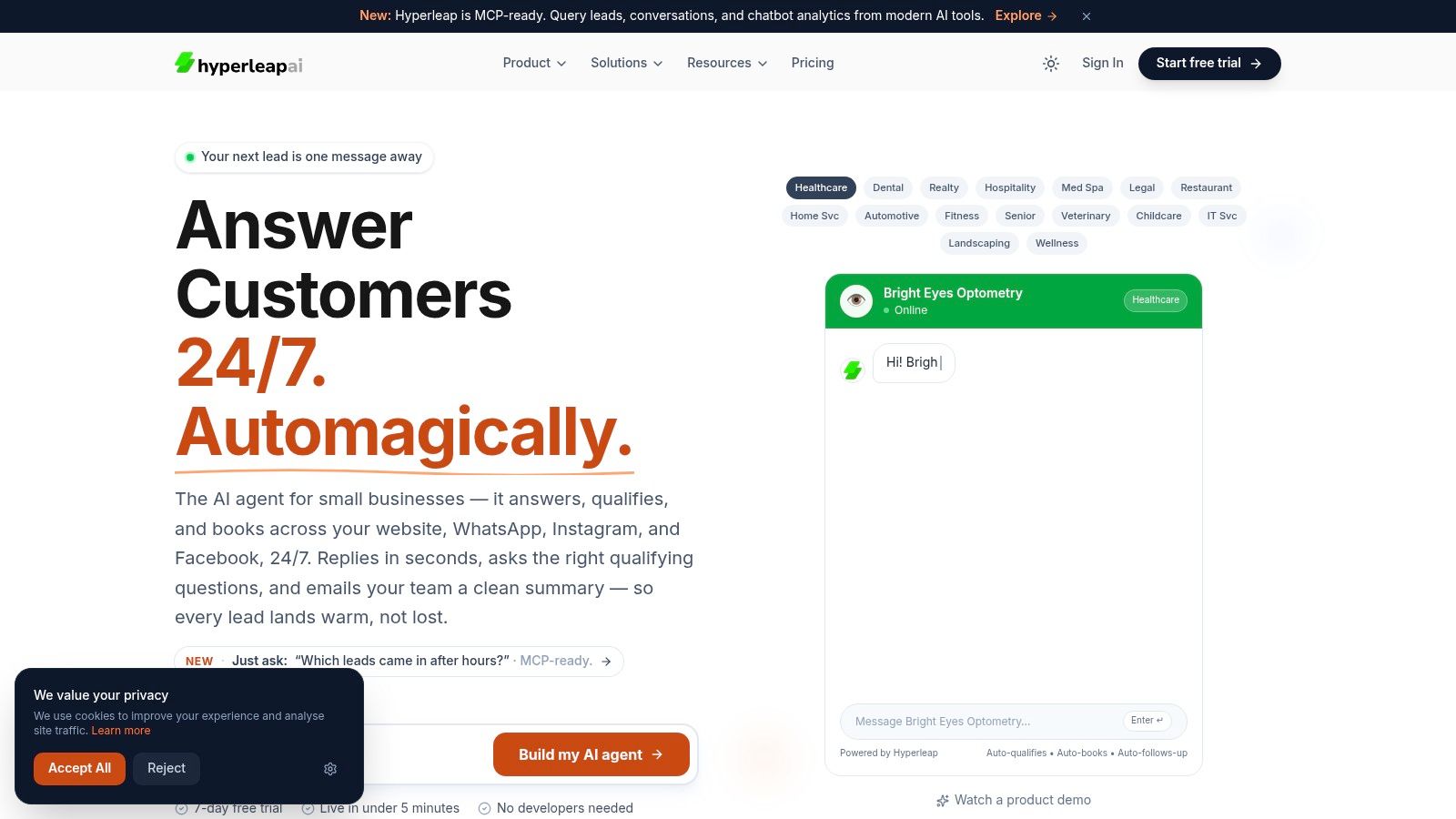
Your Implementation Blueprint Using Hyperleap AI
Many teams don't need a long transformation project. They need a working first version.
The easiest way to implement a modern real estate lead management system is to launch a narrow but complete workflow. Start with one website, one messaging layer, one routing rule set, and one appointment path. Then tighten the logic after you've seen real conversations move through it.
A practical first deployment
A clean rollout looks like this:
Start with a real estate template and train it on your actual content. Use the brokerage website, listing FAQs, buying and selling guides, office details, and neighborhood pages. The point isn't to make the assistant sound clever. It's to make it answer accurately and consistently.
Set up lead capture fields inside the chat flow. Ask only for what you need to qualify and route. Intent, area, timeline, budget range, and financing status are enough for a strong first version. Add OTP verification by SMS or email so fake or low-quality contacts don't enter the queue.
Create simple routing for a two-agent team. One agent handles north-side residential and seller leads. The other handles downtown condos and investor inquiries. Keep the first rules easy to audit. Routing logic becomes more complex later, but it should be clear on day one.
Connect appointment booking. Calendly or Cal.com works well for this step. The assistant shouldn't force every lead into a booking page, but when someone is clearly ready, the handoff should be immediate and friction-free.
Add a short automated follow-up. Start with one SMS-style acknowledgment and one email. The first confirms receipt and offers the next step. The second delivers something useful, such as listings, a brochure, or a valuation resource.
Keep integrations clean from the start
The implementation mistake I see most often is rushing into channel activation without deciding where records live and how ownership syncs.
Before going live, define:
- Primary system of record: where lead ownership and stage live
- Conversation system: where the team sees ongoing messages
- Escalation path: who gets the lead if the first assignee doesn't act
- Export and CRM sync rules: how contacts map across tools
If your CRM is part of the stack, this CRM integration reference for Hyperleap AI is the kind of setup detail worth reviewing before launch, especially for teams that need clean contact sync and operational discipline.
Launch narrow, then expand
Don't begin with every office, every agent, and every channel. Start where response failure is most expensive. For most agencies, that means website inquiries and messaging channels that currently sit outside the CRM.
A first version is successful if it does three things well: captures verified contacts, routes them correctly, and creates visible follow-up. Once that works, expand into additional territories, listing types, and longer nurture logic.
If you want to put this system in place without stitching together separate tools, Hyperleap AI gives small and growing teams a practical way to launch website, WhatsApp, Instagram, and Facebook lead capture with OTP verification, unified inboxes, appointment booking, and multi-location routing in one setup.