What Is A Lexicon: Boost AI Chatbot Success
Discover what is a lexicon and its vital role in AI chatbot success. Learn to create a custom lexicon for your business with no-code tools in 2026.

Your chatbot is live. It answers opening hours, returns, and booking questions well enough. Then a real customer asks something slightly specific, like “Do you do bridal skin prep?” or “Is the deluxe king the one with the balcony?” The bot replies with something vague, off-topic, or flat-out wrong.
That’s usually the moment a business owner realizes the problem isn’t just “AI quality.” It’s missing business language.
A lexicon is the missing layer. In plain English, it’s the organized set of terms, meanings, relationships, and context that tells an AI what words mean inside your business. If you’ve been wondering what is a lexicon, the simplest answer is this: it’s your company’s internal dictionary plus the rules for how your terms connect.
For a small business, that matters because customers rarely speak in neat FAQ language. They use shorthand, nicknames, half-remembered product names, and industry terms. A good chatbot needs to understand all of that without making your team clean up the mess later.
Table of Contents
When Your Chatbot Gets It Wrong
A customer lands on a hotel website late at night and types, “Do you still have the oceanfront family suite for next weekend?” The chatbot answers with a generic room list. It recognizes “suite,” but misses that “oceanfront family suite” is a very specific room type.
A med spa bot can do the same thing in a different way. Someone asks, “Do you offer Botox for jaw slimming?” The chatbot sees “Botox” and returns a general anti-wrinkle answer. The visitor wanted a treatment use case, not a broad description.

Many small businesses often get stuck at this point. They don’t need a bigger chatbot. They need a chatbot that understands their language.
Practical rule: A chatbot usually fails on the words your team takes for granted.
That hidden layer is the lexicon. You can think of it as the chatbot’s secret playbook. It tells the system that “bridal skin prep” relates to a service category, that “balcony king” may be shorthand for a specific room, and that a customer asking about “touch-up pricing” is probably asking about a follow-up treatment rather than a first appointment.
A basic bot matches surface words. A stronger bot uses a business lexicon to interpret intent and context.
If this sounds familiar, many failed deployments break for exactly this reason. The bot launches with generic knowledge, but not the company’s own vocabulary, naming habits, and customer phrasing. That’s one reason so many teams run into the issues discussed in common AI chatbot implementation failures.
Interest in this topic has grown. A summary citing Inbenta’s discussion of AI lexicons and query growth notes a 40% YoY spike in “AI lexicon chatbot” queries in 2025, while also pointing out that most available content still doesn’t give small businesses practical, no-code guidance.
Decoding the Lexicon Beyond a Simple Word List
Hearing “lexicon” often brings to mind a fancy word list. That’s too narrow.
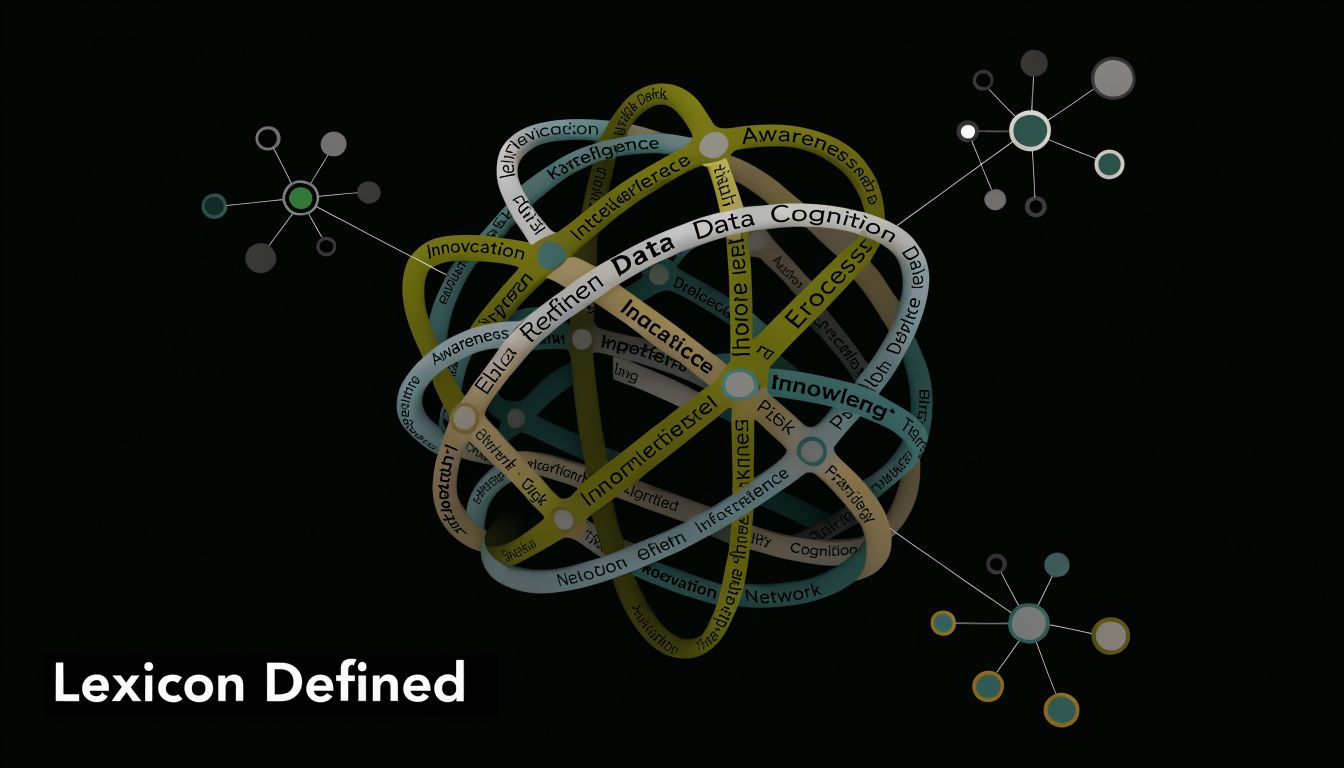
A lexicon is closer to a living map of meaning. It includes the terms your business uses, what those terms mean, what other terms they connect to, and how customers refer to them in real conversations.
Your business already has a lexicon
Even if you’ve never written one down, your company already speaks its own dialect.
A few examples:
Product names: “Premium Plus Plan,” “Signature Facial,” “Oceanview Deluxe”
Shortcuts: “new patient form,” “VIP package,” “standard install”
Synonyms customers use: “quote,” “estimate,” “price,” “cost”
Messy language: misspellings, abbreviations, and partial names
If a customer says “balcony room,” your staff may instantly know they probably mean a certain category. If a chatbot doesn’t have that context, it treats the phrase like random text.
That’s why a lexicon isn’t just a glossary pasted into software. It has structure.
A lexicon connects terms to meaning
A useful business lexicon often includes things like:
Synonyms and near-synonyms: “consultation” and “assessment”
Brand-specific names: the exact names of services, packages, or room types
Category relationships: a “chemical peel” belongs under skincare treatments
Common misspellings: customers won’t always type terms correctly
Context clues: “book a room with a view” may be a booking question, not a support issue
A lexicon helps a system understand not just the word someone typed, but what they likely meant inside a specific domain.
That’s the leap from language to business use. Your team doesn’t just know definitions. They know which terms belong together and what customers are usually asking when they use them.
The word itself has an interesting history
The term lexicon comes from the Greek lexikon, meaning “of or for words,” and it was first recorded in English in its modern linguistic sense between 1955 and 1960, as noted in Wikipedia’s entry on lexicon.
That origin matters because it shows how the idea developed. A lexicon began as a language concept, the full inventory of a language’s lexemes, but today the same idea fits modern AI surprisingly well. Instead of being only a scholar’s word book, a lexicon can function as a company knowledge layer that helps software understand your specific terms.
For a small business owner, the plain-language takeaway is simple. A lexicon is not academic decoration. It’s the organized language your chatbot needs so it can stop guessing.
Lexicon vs Dictionary vs Glossary
These terms get mixed together all the time. They overlap, but they aren’t the same thing.
The easiest way to separate them is to ask one question: what job is this thing doing? A dictionary helps general readers. A glossary helps people decode terms in a document or field. Vocabulary is the set of words a person knows or uses. A lexicon can do more than define terms. It can organize how they relate in a business or language system.
Quick comparison
| Term | Scope | Purpose | Example |
|---|---|---|---|
| Lexicon | Structured set of terms plus meanings and relationships | Help a system or domain understand words in context | A chatbot knows “bridal glow package” relates to facials, prep timelines, and booking questions |
| Dictionary | Broad, general language reference | Define words for common use | A standard English dictionary defines “suite” |
| Glossary | Limited list of terms in a subject or document | Explain specialized terms quickly | A clinic glossary defines “microneedling” |
| Vocabulary | The words a person or group knows or uses | Describe language range or usage | Your front desk team’s everyday service language |
The distinctions matter more once AI enters the picture.
Why a dictionary isn't enough
A general dictionary can define “filler,” but it can’t know what that word means inside your clinic, your policies, your treatment menu, and your customer conversations.
That’s the practical gap. A dictionary answers, “What does this word mean in general English?” A business lexicon answers, “What does this term mean here, and what else is connected to it?”
Modern AI needs that second type of knowledge. As described in Oxford Academic’s overview of lexicography history, the practice of compiling lexicons as dictionaries goes back over 2000 years, with the Erya from the 3rd century BCE often cited as the first known lexicon. But modern AI lexicons go beyond a static word list. They must also map relationships and context. That’s a very different job from Samuel Johnson’s 1755 dictionary, even though his work famously defined 42,773 words.
Why a glossary still falls short
A glossary is useful, but it’s usually thin.
It might say:
“Deluxe King: larger guest room with king bed”
“Dermal filler: injectable treatment used for volume”
That helps a reader. It doesn’t necessarily help a chatbot handle messy customer language like “big room with balcony,” “lip filler touch up,” or “is the king deluxe the one near the pool?”
If you browse a broad business AI terminology glossary, you’ll notice the same pattern. Terms need interpretation inside a use case, not just one-line definitions.
Bottom line: A glossary explains. A lexicon helps interpret.
That difference is exactly why small business chatbots often seem fine in demos and weaker in real conversations. Real customers rarely talk like glossary entries.
Why Your AI Chatbot Needs a Business Lexicon
A chatbot without a business lexicon can sound polished and still be unreliable. It recognizes words, but it misses meaning. For customer service and lead capture, that’s a serious weakness because people don’t ask questions in clean, predictable language.
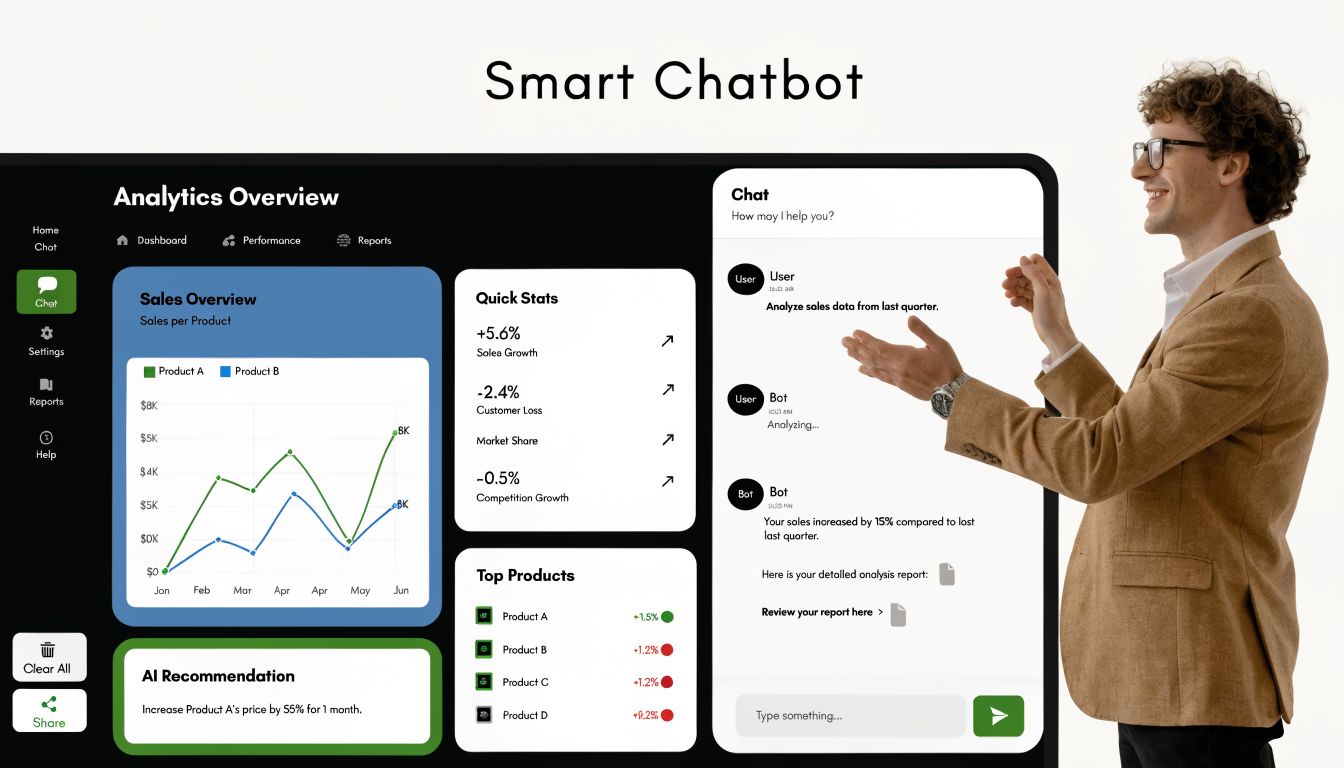
A business lexicon gives the chatbot a grounded understanding of how your customers talk and how your team labels products, services, locations, policies, and next steps. That improves the quality of each conversation in ways that matter directly to revenue and operations.
What the chatbot is really trying to do
When someone messages your business, the bot usually needs to do several jobs at once.
Figure out intent: Is this person trying to book, compare options, ask for pricing, or solve a support issue?
Pull out key details: Names, service type, room type, preferred location, date, or contact info
Stay aligned with your business: Use the right terminology, not generic filler language
Without a lexicon, these jobs get shaky fast.
A hotel guest might ask, “Do you have a family room with sea view near the lift?” A generic bot may latch onto “room” and answer with booking instructions. A stronger bot can recognize room type language, preference language, and the difference between a room feature and a location preference.
A med spa prospect might ask, “What’s the difference between filler and Botox for smile lines?” The bot needs to understand that those are separate treatment categories and that the customer is comparing options, not trying to reschedule an appointment.
What a business lexicon changes
A lexicon improves understanding in several practical ways.
First, it helps with intent recognition. The chatbot stops treating every product mention as the same type of request. “Do you offer Botox?” and “Can I get Botox after a facial?” are related, but they are not the same question.
Second, it helps with entity extraction. The system can better identify the important details hidden inside a message. That means it has a better chance of capturing the right service, location, or product name before handing the lead to your team.
Third, it supports consistency. If your business uses “consultation,” “discovery call,” and “assessment” in different places, a lexicon can help the chatbot understand those terms as related instead of unrelated fragments.
Customers don't grade your chatbot on technical sophistication. They judge whether it understood them.
That’s the business case in one sentence.
A stronger lexicon can also reduce friction in multilingual customer conversations. If your service names, policies, and internal terminology are clearly organized, the AI has a better foundation for staying accurate across different languages rather than drifting into vague translation-like guesses.
This walkthrough gives a concrete look at how AI assistants depend on structured business knowledge:
The key point isn’t that a lexicon makes your chatbot sound smarter. It makes the bot more useful. It can answer with the right product, the right explanation, or the right next step.
For a small business, that means fewer missed leads, fewer repetitive handoffs, and fewer moments where a customer thinks, “I’ll just try another company.”
How to Build Your Lexicon with Hyperleap AI
For most small businesses, the hard part isn’t understanding what is a lexicon anymore. The hard part is turning the idea into something usable without hiring a technical team.
The good news is that your lexicon usually already exists in scattered form across your website, brochures, menus, PDFs, FAQs, onboarding files, and message history. The job is to gather that language, organize it, and make it usable for AI.
Start with the language you already own
Don’t begin by inventing a perfect taxonomy. Start with the words your business already uses every day.
Good source material includes:
Website copy: service pages, pricing pages, booking pages, location pages
Customer-facing documents: brochures, welcome guides, menus, policies, FAQs
Internal naming habits: the shorthand your staff uses for rooms, services, packages, and follow-ups
If you run a hotel, your lexicon might include official room names, common guest phrases like “room with a view,” booking rules, add-ons, and location-specific details.
If you run a clinic, it might include treatment categories, treatment names, eligibility notes, pre-care and aftercare terms, and the language patients use in inquiries.
Turn documents into usable business knowledge
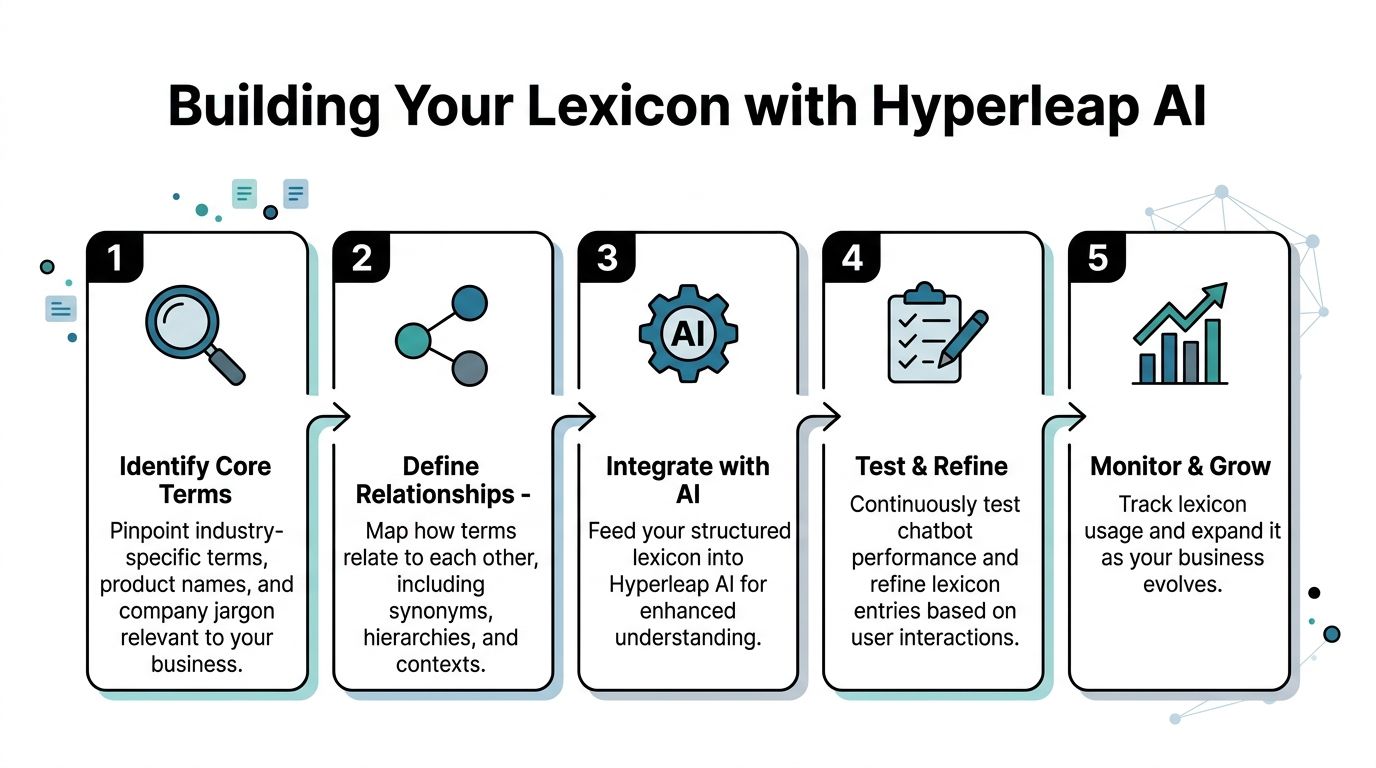
A no-code workflow works best when it follows a simple pattern.
Collect your core materials. Gather the pages and files that reflect how your business explains itself.
Look for recurring terms. Product names, service bundles, policy phrases, common questions, and abbreviations matter most.
Notice relationships. Which services are alternatives, which packages belong to one category, which terms are customer shorthand.
Feed that knowledge into your chatbot setup. The platform should use your material to ground responses in your actual business content.
Test real phrasing. Ask questions the way customers do, not the way your marketing copy does.
Some platforms make this easier by letting you import a website URL and upload business documents rather than define every term by hand. If you want the product-specific workflow, Hyperleap documents the content setup in its guide to the conversation and chat content tab.
Keep the first version practical. Your lexicon does not need every possible term on day one. It needs the terms that drive conversations now.
Refine based on real conversations
Your first lexicon draft won’t be complete. That’s normal.
What matters is how you improve it. Review the chats where the bot hesitates, answers too broadly, or misses the customer’s meaning. Those moments usually reveal one of three gaps:
A missing term
A missing relationship between terms
A phrase customers use that your business never writes down
Small businesses often gain an advantage over larger teams. You and your staff already know the confusing phrases customers use. You know that “bridal package” might mean one thing in your salon and something else in another. You know that one location uses a room label guests ask for constantly, while another doesn’t.
A useful lexicon should also reflect those local differences. Multi-location businesses often need one shared knowledge base plus location-specific language. The same service may exist across branches, but pricing terms, availability wording, or package names can vary.
A business lexicon is never “finished.” It becomes stronger as your company learns from real interactions and keeps tightening the connection between customer language and business meaning.
From Vocabulary to Value in Your Business
A lexicon may sound like a language-school term, but in business it has a very practical role. It captures how your company names things, how your customers ask for them, and how those meanings connect.
That’s why the question what is a lexicon matters far beyond linguistics. For a small business, a lexicon is the layer that helps a chatbot understand more than keywords. It helps the bot interpret context, recognize intent, and respond in language that matches your business.
The shift is simple but important. A weak chatbot stores answers. A stronger chatbot uses organized business language to choose the right answer.
If your bot often misses the point, gives broad replies, or struggles with your service names, package terms, abbreviations, or customer shorthand, the issue may not be the chatbot itself. The issue may be that it doesn’t yet have a real business lexicon.
Own that layer, and you own more of the customer experience. You reduce guesswork. You make automation more trustworthy. You give your team a better first line of response without turning every conversation into a manual task.
In the AI era, your business language is an asset. The companies that organize it well will have chatbots that feel less like scripted widgets and more like informed assistants.
If you're ready to turn your business language into a working AI assistant, Hyperleap AI gives small businesses a no-code way to build grounded chatbots from their website and documents, then deploy them across web and messaging channels with lead capture, booking flows, and multilingual support. It’s a practical place to start building your company’s AI brain.