AI Chatbot for Eco Lodges: Remote Inquiries at Scale
Eco lodges and jungle resorts use AI chatbots to answer sustainability questions, handle remote inquiries, and capture bookings without full-time reception.

TL;DR: Eco lodges and jungle resorts operate with small teams in remote locations, yet their guests ask the most detailed questions of any hospitality segment — sustainability certifications, wildlife sighting expectations, conservation practices, connectivity warnings, packing lists for jungle conditions. AI chatbots trained on a lodge's specific conservation story handle this inquiry depth 24/7 without requiring a full-time reception team, and capture bookings from guests who research at unconventional hours across multiple time zones.
AI Chatbot for Eco Lodges: Handle Remote Inquiries at Scale (2026)
The guest who books an eco-lodge in the Texas Hill Country is not the guest who books a city hotel. They will ask whether the property sources food locally, how the lodge handles waste water, whether their visit funds wildlife corridors, and whether they should expect to see bald eagles or just white-tailed deer. They will ask these questions at 9 PM on a Thursday while simultaneously researching three properties in three different countries — and the lodge that answers with substance will win the booking.
Eco lodges and jungle resorts sit at a fascinating intersection: premium guests with high expectations and detailed questions, served by small teams in remote locations with limited connectivity and no capacity for 24/7 staffing. A lodge in the Costa Rican cloud forest, a tented camp on the Maasai Mara, or a backcountry lodge outside Yellowstone may have two or three staff responsible for all guest communication — across website inquiries, WhatsApp messages, Instagram DMs, and email — while also managing actual operations.
According to The World Tourism Organization's 2025 Sustainable Tourism Report, guests who choose eco-certified properties are among the most research-intensive travelers in any segment, averaging 3.2× more pre-booking inquiries than guests at conventional hotels. They're also willing to pay premium rates — but only to properties that can demonstrate, with specificity, that their sustainability commitments are genuine.
AI chatbots built for eco lodges don't just handle inquiries at scale. They become the first voice of the property's conservation story — telling that story with consistency and depth that a busy operations team simply cannot maintain across every channel and every time zone.
Who This Guide Is For
This guide is written for eco lodge owners, jungle resort operators, wildlife camp managers, and nature-based tourism properties in Costa Rica, Kenya, India, the Amazon, Borneo, and similar destinations. If your property has a meaningful sustainability story and a small team managing a high volume of detailed inquiries, this guide is for you.
What Is an AI Chatbot for Eco Lodges?
An AI chatbot for eco lodges is a conversational AI agent trained on your property's specific sustainability practices, wildlife context, activity offerings, and location details — deployed across website chat, WhatsApp, Instagram DM, and Facebook Messenger to handle the full depth of inquiries that conservation-minded travelers ask.
Unlike generic hospitality AI, an eco lodge chatbot is distinguished by what it knows: the names of the wildlife species your guests might encounter, the conservation programs the lodge supports, the certifications the property holds (Rainforest Alliance, LEED, Green Globe, eco-certification bodies), the sourcing philosophy for food and supplies, the waste management approach, and the honest answer to "how likely are we to see a tiger?"
For eco lodges and jungle resorts specifically, AI chatbots handle:
- Sustainability certification and practice explanations
- Wildlife sighting expectations (realistic, specific, honest)
- Activity details: guided safaris, birding walks, canopy tours, river activities
- Packing list and preparation guidance for remote and jungle conditions
- Connectivity warnings and digital detox communication
- Conservation program participation options
- Safety and medical facility proximity information
- Transfer and access logistics for remote locations
- Dietary accommodation for conservation-conscious guests (many are vegan or vegetarian)
- Multi-lodge itinerary coordination for safari circuit properties
The fundamental value for eco lodges: AI ensures that every inquiry receives a response that reflects the depth of the property's story — even when the lodge manager is in the jungle leading a safari, the chef is managing the evening meal, and there's no one at the front desk.
Why Eco Lodges Face Distinctive Communication Challenges
Small Teams, Remote Locations, Maximum Inquiry Complexity
A 15-room eco-lodge in the Texas Hill Country might employ 8–12 people total — including guides, kitchen staff, housekeeping, and a manager. Communication responsibilities fall to the manager or a dedicated reservations person, who is simultaneously managing incoming guests, vendor relationships, booking systems, and the hundred operational details that a remote property requires every day.
When a prospective guest in London sends a detailed WhatsApp message at 7 PM local time asking about the lodge's wildlife monitoring program, whether the kitchen uses gas or solar, and what the leopard sighting frequency has been this month — that message arrives at 12:30 AM for the lodge. It sits unanswered until morning. By morning, the guest has either found another property that answered, or the inquiry has cooled.
Sustainability Questions Demand Deep, Specific Answers
Eco-tourism guests have developed sophisticated skepticism about "greenwashing." According to Booking.com's 2025 Sustainable Travel Report, 74% of travelers say they would abandon a booking at an eco-property if they discovered the sustainability claims were superficial or unsubstantiated. These guests ask questions that most conventional hotel chatbots cannot answer: "What percentage of your staff is from the local community?" "Does your composting program cover all organic waste?" "Are your safari vehicles electric or petrol?"
Generic answers — "we care about the environment" — destroy credibility with this audience. Property-specific, detailed answers build it. AI trained on the lodge's actual practices and certifications delivers these detailed answers consistently.
International Guest Base Across Multiple Time Zones
A backcountry lodge near Glacier National Park in Montana draws guests from the UK, Germany, Australia, and both US coasts — spread across 5–9 time zones. The peak research window for most international travelers falls in their evening hours, which is overnight or early morning for a Montana property. Without AI, every evening research session by international prospects hits an unanswered inbox.
Jungle Lodges & Resorts — a multi-property hospitality group in Karnataka — captured 3,300+ leads in 90 days after deploying Hyperleap AI, with 35% of those inquiries arriving after regular business hours. For a jungle lodge drawing international guests, that after-hours proportion would be even higher — potentially 45–55% of total inquiry volume arriving outside any reasonable staffing window.
Wildlife Expectation Management is Both Sensitive and Critical
Every eco-lodge guest wants to know: will I see wildlife? This question is simultaneously the most important one to answer well and the most dangerous one to answer badly. Overpromise ("You're almost guaranteed to see grizzlies!") and the guest arrives expecting certainty that wildlife cannot provide; disappoint them and they write a review that damages the property. Underpromise and the guest might choose a competitor who sounds more confident.
The right answer is nuanced: honest about probabilities, specific about season and recent sightings, contextualized with what factors influence sightings. AI trained on the lodge's actual wildlife data and communication standards delivers this nuanced answer every time.
Conservation Storytelling Requires Consistency
The best eco lodges have genuinely compelling conservation stories: the wildlife corridor they're funding, the community school built with tourism revenue, the rhino monitoring program they support, the rewilding initiative on adjacent land. These stories are what premium conservation-minded travelers are paying for — but telling them consistently across every inquiry channel, every time zone, and every day of the year is impossible for a small team.
AI becomes the consistent narrator of the property's conservation story — always ready with the details, always telling it with the specificity that turns a prospect into a committed booking.
Let Your Conservation Story Work Around the Clock
Eco lodges using Hyperleap AI answer sustainability questions, wildlife inquiries, and booking requests 24/7 — without a full-time reception team.
See How It Works7 Essential Capabilities Eco Lodges Need in an AI Chatbot
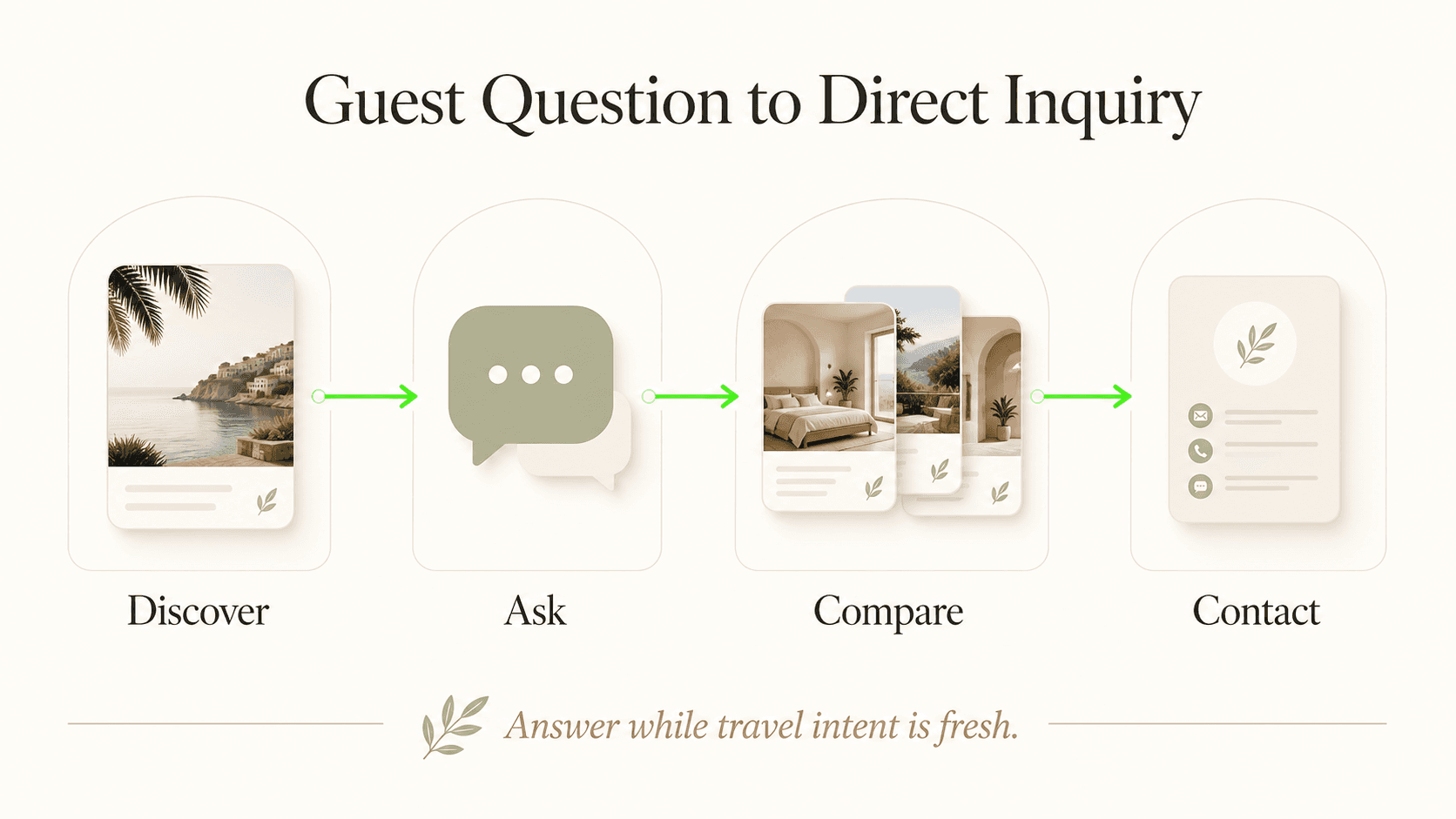
1. Sustainability and Certification Question Handling
What this looks like in practice: A guest inquires via Instagram: "We only stay at genuinely sustainable properties — what certifications does the lodge hold? What's your approach to waste?" The AI responds with specifics: the certification body and certification level, the property's solar energy percentage, the composting program details, water treatment approach, and the community employment figure — all grounded in the lodge's actual practices, not generic claims.
Real-world impact: Specific, substantiated sustainability answers convert eco-conscious guests at meaningfully higher rates than generic sustainability statements. These guests have done their research and can detect the difference between real commitment and marketing language.
Why it works: The AI is trained on the property's actual certifications, practices, and metrics — not on generic eco-hospitality language. Every answer reflects the lodge's real operations.
Key features:
- Certification body and level communication (Rainforest Alliance, LEED, Green Globe, country-specific eco-certifications)
- Energy sourcing details (solar, hydro, generator backup protocols)
- Water management and treatment practices
- Waste management and composting program details
- Community employment percentage and local sourcing practices
- Conservation program financial contribution disclosure
2. Wildlife Sighting Expectation Setting
What this looks like in practice: A prospective guest booking a trip to Yellowstone asks: "What's the chance of seeing a grizzly? We've been to two parks and not seen one — are you confident about sightings here?" The AI provides an honest, season-appropriate answer: current grizzly sighting frequency, best areas, optimal timing within the park for bear visibility, and context about what factors influence sightings — without making guarantees that wildlife cannot honor.
Real-world impact: Proper expectation setting before booking dramatically reduces disappointed reviews. When guests arrive knowing that wildlife sightings are probable but not guaranteed, and understanding what factors affect them, their satisfaction is evaluated against realistic expectations rather than false promises.
Why it works: The AI is trained on your property's actual sighting data, the park's seasonal patterns, and communication guidelines that balance honesty with enthusiasm. It answers the way your best naturalist would.
Key features:
- Species-specific sighting probability by season
- Recent sighting data (updated regularly)
- Factors that affect sighting probability (time of day, season, weather, zone)
- Safari timing and strategy guidance
- Honest communication about variability — wildlife is wild
3. Activity and Guided Experience Clarification
What this looks like in practice: A guest asks: "What activities are included in the package? Are guided walks free or extra? Can we do a night safari?" The AI lists all included activities, explains what's available as an add-on with pricing, describes the guided walk format (naturalist-led, duration, difficulty level), and confirms whether night safaris are available and how they're booked.
Real-world impact: Activity package confusion is a leading source of arrival-day disappointment and checkout billing disputes at eco-lodges. Clear pre-booking communication about inclusions vs. extras prevents both.
Why it works: Eco-lodge guests are often comparing multiple properties with different activity structures. AI that clearly explains what's included — with enough detail that the guest understands the value — helps your property stand out from less transparent competitors.
Key features:
- Included activity list with descriptions
- Add-on activity pricing and booking process
- Activity suitability by age and fitness level
- Seasonal activity availability
- Guide expertise and certification explanation
4. Remote Location, Connectivity, and Logistics Communication
What this looks like in practice: A guest asks: "How do I get to you from Austin? Is there Wi-Fi? What should I pack for a backcountry stay?" The AI provides step-by-step transfer options (distance, road conditions, recommended transport, journey time), confirms the connectivity situation honestly ("limited connectivity; we have Wi-Fi in the main lodge, not in individual tents — this is part of the immersive experience"), and provides a detailed packing list appropriate for backcountry conditions.
Real-world impact: Remote location logistics and connectivity expectations are among the most anxiety-inducing unknowns for first-time jungle travelers. AI that addresses these proactively converts anxious prospects into confident bookings.
Why it works: The AI turns what could be a deterrent (remote location, limited Wi-Fi) into an authentic selling point by contextualizing it correctly: the remoteness is the experience, not a limitation. The packing list is specific to your microclimate and terrain.
Key features:
- Transfer options from major cities/airports with journey times and costs
- Road condition seasonal guidance
- Connectivity honest disclosure (no false promises about Wi-Fi)
- Destination-specific packing list generation
- Medical facility proximity and emergency protocol communication
5. Conservation Program Participation Options
What this looks like in practice: A guest who read about the lodge's wildlife corridor program asks: "Can we participate in the conservation work while we're there? Is there a way to contribute beyond just staying here?" The AI explains the participation options: attending a briefing with the conservation team, joining a camera trap check, contributing to the conservation fund, adopting a tree, or sponsoring a specific program — with pricing and process for each.
Real-world impact: Guests who actively participate in or contribute to conservation programs become advocates — the most valuable marketing asset an eco-lodge has. AI that converts this expressed interest into actual participation deepens guest connection and typically increases ancillary revenue.
Why it works: Conservation participation interest is rarely captured proactively because staff are busy and the inquiry often comes at an inconvenient moment. AI ensures every expressed interest is followed with clear, actionable information about how to get involved.
Key features:
- Conservation participation program descriptions
- Contribution options with pricing and fund allocation transparency
- Briefing and activity scheduling
- Post-stay follow-up options (conservation fund contributions, ongoing program support)
6. Health, Safety, and Medical Preparation Guidance
What this looks like in practice: A guest traveling with elderly parents asks: "Is the terrain suitable for older guests with limited mobility? What vaccinations are recommended? Is there a doctor nearby?" The AI addresses mobility suitability honestly (specific to your terrain and room locations), recommends consulting a travel physician or the destination's vaccination requirements, and confirms the nearest medical facility with distance and emergency transport options.
Real-world impact: Health and safety questions are high-stakes for eco-lodges. Guests who receive incomplete or inaccurate information and arrive unprepared create both guest experience failures and potential liability issues. AI that handles these questions with accuracy and appropriate caution builds trust.
Why it works: The AI is trained to provide factual property and location information while appropriately deferring to medical professionals for health advice. This combination of helpfulness and humility is exactly what anxious guests need.
Key features:
- Terrain and activity difficulty by fitness and mobility level
- Vaccination recommendation (standard destination guidance, not medical advice)
- Medical facility proximity and emergency protocol
- Insect protection and jungle health preparation guidance
- Altitude information for high-elevation properties
7. Multi-Night Itinerary and Multi-Property Coordination
What this looks like in practice: A guest planning a two-week national park circuit asks: "We want to do Yellowstone, Grand Teton, and Glacier — can you help us plan the routing? What's the best order?" The AI provides routing logic based on geography and flight connections, recommends optimal night distribution across properties based on wildlife season, and connects the guest with the lodge's booking contact for multi-property itinerary assistance.
Real-world impact: The Yellowstone–Grand Teton–Glacier circuit, Costa Rica's eco-lodge trail, Kenya's Maasai Mara–Amboseli–Samburu circuit — these multi-property itineraries represent high-value bookings that individual properties often miss because no one has time to do complex itinerary planning by message. AI initiates the conversation and captures the lead.
Why it works: Guests planning multi-property wildlife itineraries are high-value, low-price-sensitivity travelers. They choose properties that are helpful and knowledgeable rather than just cheap. AI that engages substantively with their planning needs signals the kind of expertise they're looking for.
Key features:
- Geographic routing guidance for multi-destination trips
- Seasonal wildlife timing by region
- Lead capture for multi-property booking coordination
- Partner property referral (where applicable)
- Flight and ground transport connection guidance
Real Results: What Eco Lodges Are Achieving
The Jungle Lodges Case Study: 3,300+ Leads in 90 Days
Jungle Lodges & Resorts — a Karnataka-based multi-property wildlife hospitality group operating properties including Kabini River Lodge and K Gudi Wilderness Camp — deployed Hyperleap AI across their guest communication channels. The results from 90 days of live deployment establish the benchmark for this category:
- 3,300+ leads captured across properties in a single quarter
- 35% of all inquiries arriving after regular business hours — a segment that was previously either lost or diverted to OTAs
- Escalation rate well under 10%, meaning the AI resolved the overwhelming majority of inquiries without human intervention
- 24/7 coverage maintained across all properties without overnight staffing addition
The 35% after-hours figure is particularly telling for eco-lodge operators with international guest bases. International travelers researching Indian wildlife properties during their own evenings are contacting Jungle Lodges during Indian overnight hours. Without AI, those inquiries were piling up — and competing properties were receiving the bookings.
The full case study is documented at Jungle Lodges Case Study.
International Conversion Through 24/7 Coverage
Eco lodges with strong international audiences — Costa Rica, Kenya, India, Borneo — consistently report that AI deployment most dramatically improves their ability to convert international prospects. A guest in Germany researching a Kenya safari at 9 PM CET is typically contacting the Kenya camp at 10 PM Nairobi time — outside any reasonable staffing window. AI ensures that guest receives a substantive response to their wildlife and sustainability questions within minutes, not the next morning.
Conservation Story Consistency
Properties that document their sustainability practices, conservation programs, and community initiatives thoroughly in the AI knowledge base report that their conservation story is told more consistently than it was by a human team. Staff enthusiasm and knowledge varies; the AI's knowledge base is the property's best, most complete sustainability narrative told every time.
Inquiry Quality Improvement
Eco-lodge operators report that AI-handled pre-arrival communication results in better-prepared guests who arrive with appropriate expectations about wildlife, connectivity, and terrain. This translates to higher in-stay satisfaction scores because guests' actual experience matches their expectations — which were properly set by the AI before arrival.
Implementation Roadmap for Eco Lodges
Phase 1: Knowledge Base Development (2–3 Weeks)
The most important investment for an eco-lodge AI deployment is the knowledge base. This is where the lodge's story lives. Document:
Sustainability and certification facts:
- All certifications held, certifying body, year certified, renewal status
- Energy sourcing (solar %, grid %, generator protocols)
- Water sourcing, treatment, and conservation approach
- Waste management: composting, recycling, waste-to-landfill reduction
- Sourcing philosophy: local food percentage, supplier community proximity
- Community employment: % local staff, community initiative investments
Wildlife and ecology:
- Species present with seasonal sighting probabilities
- Recent sighting log (update monthly)
- Safari format: vehicle type, guide qualification, zone access
- Activity inventory: what's included vs. add-on, with pricing
- Conservation programs: description, participation options, contribution opportunities
Location and logistics:
- Transfer options from nearest airports and cities
- Road conditions by season
- Connectivity honest disclosure
- Medical facility distance and emergency protocol
- Packing recommendations for your specific terrain and season
Phase 2: Channel Setup and Testing (1 Week)
Connect the AI to WhatsApp Business API and website chat. For eco-lodges with strong Instagram presence, add Instagram DM — many conservation-minded guests discover properties through photography on Instagram and initiate contact there.
Test with your team posing as guests. Pay particular attention to:
- Are sustainability answers specific and substantiated?
- Is wildlife expectation-setting honest and appropriate?
- Does the AI handle connectivity questions without making false promises?
- Is the packing list specific to your location and conditions?
Phase 3: Live Deployment and Monitoring (Weeks 3–8)
Go live and review actual conversations daily for the first two weeks. Eco-lodge guests ask genuinely complex questions that will reveal knowledge base gaps. Common early gaps:
- Specific species questions ("Do you have pangolins?" or "Have you seen wild dogs recently?")
- Seasonal activity availability ("Is the river walk possible in monsoon?")
- Comparison questions ("How do you compare to [competitor lodge in same park]?")
Add responses to each new question category as it appears. By week six, the AI typically handles 85–90% of inquiries without escalation.
A Critical Note on Wildlife Promises
Never configure your AI to guarantee wildlife sightings or make species-specific promises. Wildlife cannot be guaranteed, and guests who arrive expecting certainty and experience variability will write negative reviews that are difficult to overcome. Train your AI to set honest expectations: probabilities, not guarantees.
Frequently Asked Questions
Can AI genuinely convey the authenticity that eco-lodge guests expect?
Yes — when trained on genuinely authentic content. The AI doesn't fabricate sustainability commitments; it articulates the ones that actually exist. Eco-lodge guests' preference for depth and specificity is something AI serves well — it can answer "what percentage of your staff is from local communities?" with the actual number, something a generic chatbot cannot. The authenticity comes from the content you put into the knowledge base, not from the AI technology itself.
How does AI handle inquiries in a jungle where connectivity is unreliable?
The AI runs on your website and messaging channels — it doesn't require in-lodge connectivity. Guest inquiries arrive through WhatsApp or your website from wherever the guest is (typically their home country, before they visit). The AI responds from your hosted platform, not from in-lodge infrastructure. For guests who contact you after arrival (via lodge Wi-Fi), the AI operates the same way. Unreliable in-lodge connectivity doesn't affect pre-arrival communication at all.
What about privacy — eco-lodge guests are often privacy-conscious travelers?
AI chatbots for eco-lodges follow the same data handling standards as any hospitality platform. Guest contact details collected during inquiry are stored securely. For properties with EU guests under GDPR, or any guests with privacy concerns, the platform's data handling practices should be reviewed. Hyperleap AI's terms cover data handling for the regions where it operates.
How should an eco-lodge handle the "will I see bears?" question via AI?
Configure the AI with a response that matches your best naturalist's honest answer: seasonal sighting frequency data ("In late May, our guides typically spot grizzlies on 70–80% of morning drives in the Lamar Valley"), factors that influence sightings (time of day, season, weather), and a genuine acknowledgment that wildlife is wild and sightings cannot be guaranteed. This honest, specific answer builds more trust than either a confident false guarantee or a dismissive "we can't guarantee sightings."
Can the AI help with post-stay conservation engagement?
Yes. Configure the AI to handle post-stay inquiries about conservation fund contributions, returning guest programs, and ongoing conservation updates. Many eco-lodges find that guests want to stay connected after their visit — particularly guests who participated in conservation activities during their stay. AI ensures these post-visit inquiries are responded to promptly even when the lodge team is busy during season.
How long does it take to set up an eco-lodge AI knowledge base?
Most eco-lodge operators spend 6–10 hours building an initial knowledge base — primarily documenting sustainability practices, wildlife information, and logistics in writing that the AI can use. The time investment upfront is significant, but the result is a comprehensive documentation of your property's story that also serves as onboarding material for new staff, a reference document for press inquiries, and a source of structured content for your website.
Your Conservation Story Deserves to Be Heard — All Day, Every Day
The best eco-lodges have earned their positioning through years of genuine commitment: wildlife corridor funding, community employment, composting programs, solar infrastructure, naturalist training. These properties deserve guests who understand and value that commitment — but those guests are doing their research at 10 PM from their home countries, and they need answers tonight, not tomorrow.
AI chatbots trained on a lodge's actual sustainability story tell that story with more consistency, depth, and availability than any small team can. The result isn't just operational efficiency — it's a genuine alignment between what the lodge stands for and what its guests experience from their very first interaction.
For properties like the ones in the Texas Hill Country, the Great Smoky Mountains, Costa Rica, and the Maasai Mara that are building meaningful conservation programs, the question isn't whether AI can represent their story. The question is: can they afford to have that story go untold every time a prospect inquires at midnight?
Explore how Hyperleap AI serves hospitality businesses and read the Jungle Lodges case study for first-party results from a live deployment at a Karnataka wildlife lodge group. See current pricing options or start with a 7-day trial at /start.
Can the chatbot handle bookings and availability questions?
Yes — it answers room and rate questions, captures booking inquiries with check-in / check-out / party-size details, and shares your direct-booking link or routes serious bookers to your reservations team. It does not replace your PMS — it sits in front of it as a 24/7 inquiry desk.
Further Reading
Authoritative external sources used and recommended for further research on this topic:
- Skift hospitality research
- Phocuswright travel and hospitality data
- STR / CoStar hotel performance benchmarks
Ready to Tell Your Conservation Story 24/7?
Eco lodges using Hyperleap AI answer wildlife questions, sustainability inquiries, and booking requests around the clock — even when the team is in the jungle.
Start Free TrialRelated Resources
- AI for Hospitality Businesses — Complete guide for nature-based tourism properties
- Jungle Lodges Case Study — 3,300+ leads in 90 days at a Karnataka wildlife lodge
- Hotels Lose Revenue from After-Hours Inquiries — Quantifying the cost of missed inquiries
- WhatsApp Automation for Hotels and Resorts — WhatsApp strategy for remote properties
- 7 Ways Hotels Use AI to Increase Direct Bookings — Direct booking strategy
- Pricing — Plans starting at $40/month
Glossary
- WhatsApp Business API — Core communication channel for international eco-tourism guests
- What is a Chatbot? — AI chatbot fundamentals
- Multi-variant (locations, courses, etc) — How the chatbot answers for the right lodge when you run several
Related Articles

AI Chatbot for Luxury Hotels: Service at Scale
Luxury city hotels use AI chatbots to deliver personalized concierge experiences at scale, handle VIP inquiries, and maintain white-glove service 24/7.

AI Chatbot for Golf Resorts: Tee Time Guide
Golf resorts use AI chatbots to handle tee time inquiries, membership questions, and high-net-worth guest service without response delays.

AI Chatbot for Serviced Apartments (2026 Guide)
Serviced apartments use AI chatbots to handle extended-stay inquiries, corporate account questions, and self-check-in coordination 24/7.

AI Chatbot for Honeymoon Resorts (2026 Guide)
Honeymoon resorts use AI chatbots to respond to romantic inquiries 24/7, coordinate special requests, and capture couples before they book elsewhere.