AI Legal Receptionist: What It Handles for Your Firm
An AI legal receptionist answers firm FAQs, captures and qualifies client intake, and shares booking links 24/7 — without giving legal advice. Here is what it handles.

TL;DR: An AI legal receptionist is a messaging-based digital front desk that runs 24/7 across your website, WhatsApp, Instagram DM, and Facebook Messenger. It collects intake inquiries through a lead form before the conversation begins, answers general firm FAQs, qualifies prospects by practice area, shares your booking links, and routes warm leads to your team. It never gives legal advice. It ensures that no prospective client disappears into a competitor's intake form because your office was closed at 9 PM on a Tuesday.
Someone visits your website at 11:15 PM. They have just been served divorce papers, or they were rear-ended on the way home from work, or they received a cease-and-desist letter they do not understand. They want to know whether your firm handles their situation, what the process looks like, and how to book a consultation.
They are not going to wait until 9 AM to find out.
According to Clio's Legal Trends Report (2024), 27% of legal searches happen outside standard business hours, and responsiveness is ranked by potential clients as one of the top three factors in choosing a law firm — ahead of price and behind specialization. A separate Clio study found that when law firms were mystery-shopped, 42% never responded to an online inquiry at all.
The prospective client at 11:15 PM is not your client yet. They are in the market right now. The firm that answers them tonight — even if that answer is just "here is what we handle, here is how to book a call, here is what to expect" — has an enormous advantage over the firm whose website shows a phone number and office hours.
An AI legal receptionist is how you show up at 11:15 PM.
What an AI Legal Receptionist Actually Does
Before anything else, let's be precise about what this is and what it is not.
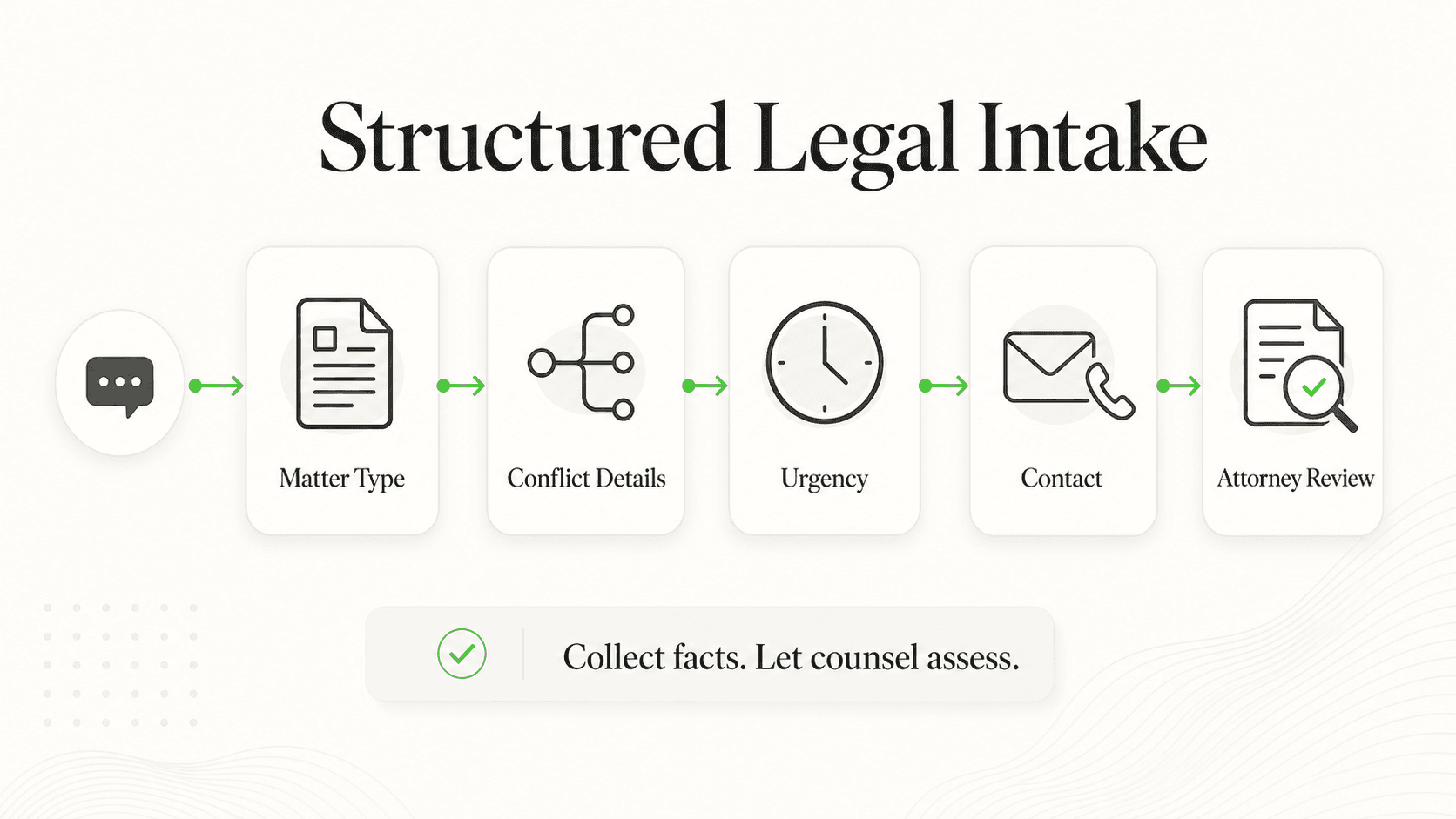
An AI legal receptionist is a messaging-based digital front desk — not a phone system, not a voice assistant, not a virtual paralegal. It operates through chat channels: your website chat widget, WhatsApp Business, Instagram DM, and Facebook Messenger. A prospective client types a question; the AI reads it against your firm's own knowledge base and provides a grounded, document-grounded response.
It is not a lawyer. It does not assess cases, give legal advice, or perform legal triage. What it does is handle the front-of-funnel work that currently either (a) goes unanswered after hours, or (b) consumes your receptionist's or intake coordinator's time on repetitive questions that have the same answer every time.
Here is the job breakdown:
| Job | What the AI handles |
|---|---|
| General FAQ | Practice areas, office hours, location, fee structures (if you publish them), languages spoken, parking |
| Intake capture | Collects name, contact details, and inquiry type via a lead form before the conversation begins |
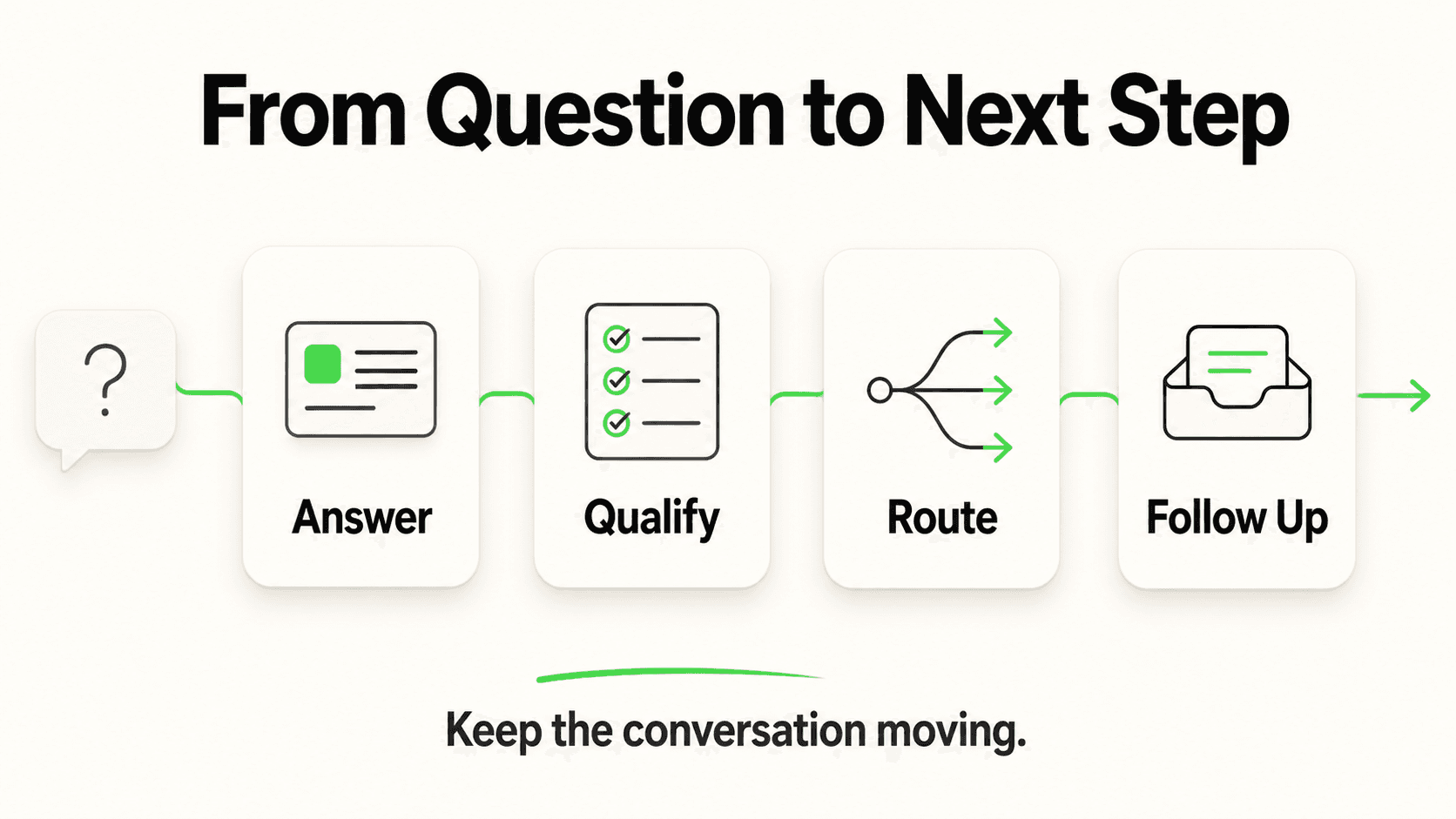
| Qualification | Identifies whether the inquiry fits your firm's practice areas; flags mismatches for routing |
| Booking | Books consultations in the chat through Calendly or Cal.com on Pro and Max, or shares your booking link on Plus or for any other scheduling tool |
| Routing | Forwards a clean lead summary to the right team member by email |
| After-hours triage | Acknowledges the inquiry, sets expectations for response time, collects details so nothing is lost |
| Multilingual support | Responds in 100+ languages without requiring a separate agent or translator |
Notice what is not on that list: legal advice, case strategy, document drafting, and anything that requires a licensed attorney's judgment. The boundary is clear, and we will cover it in detail below.
After-Hours Intake Capture — The First Firm to Respond Wins
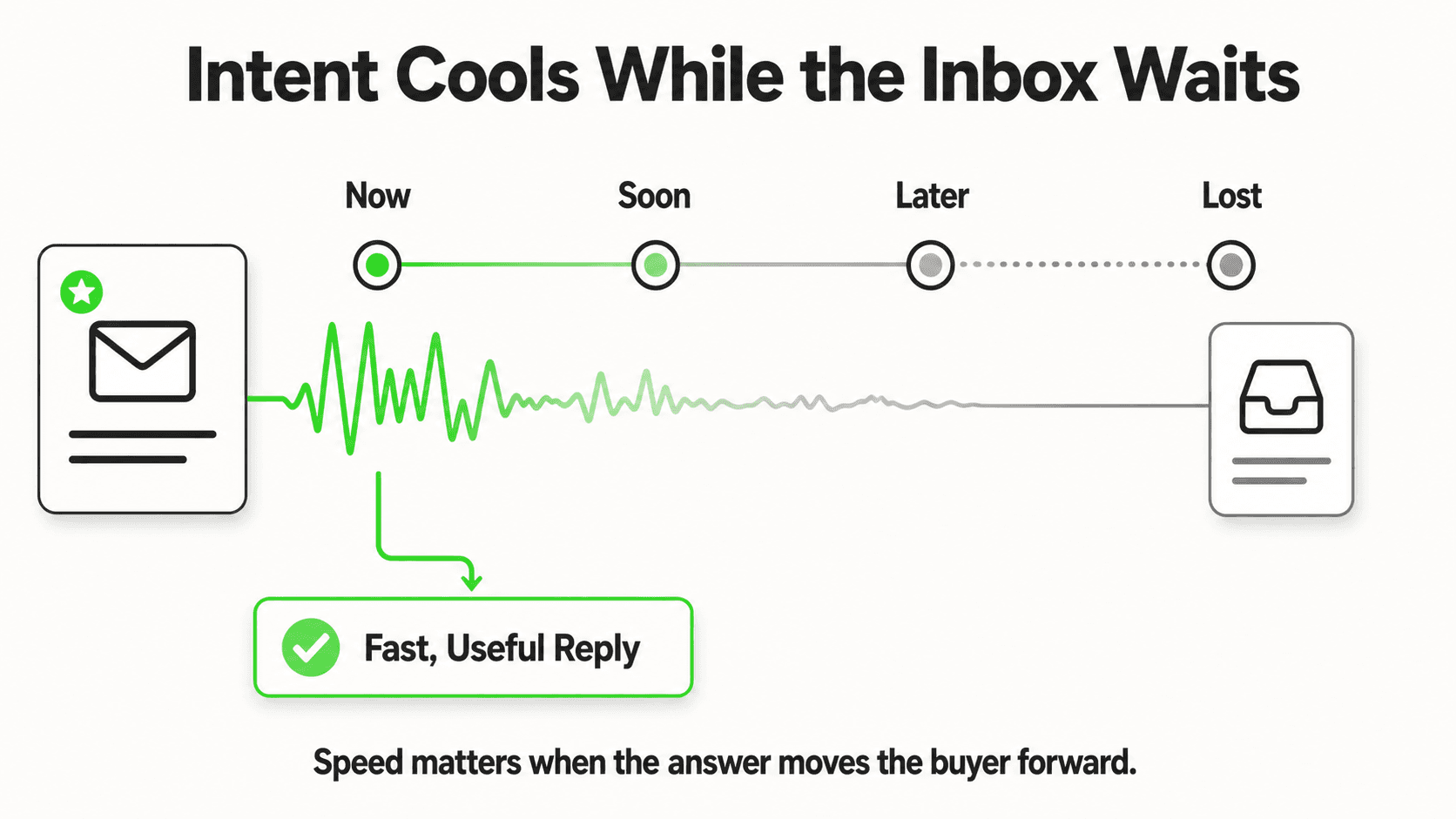
Most law firms lose their most motivated prospects not because they lose on price or reputation, but because they lose on timing.
Here is the scenario that plays out dozens of times a week for a mid-size practice. A person dealing with a legal situation — often an emotionally charged one — searches for help. They visit three or four firm websites. They fill out contact forms or try to call. The firms that call them back the next business day are competing against each other and against the fact that the prospect's urgency has cooled, they have already found someone else, or they have simply given up.
The AI legal receptionist changes this dynamic completely by being available the moment the prospect arrives.
The lead form runs first. Before the conversation begins, Hyperleap's AI agent presents a short intake form — name, phone or email, and a brief description of their situation. This is intentional. Collecting contact details upfront means that even if the conversation ends abruptly or the prospect closes the browser, you have their information and can follow up. There are no "conversations-only" mechanics that skip the form — the form is the foundation of lead capture, not an obstacle to it.
Once the form is submitted, the conversation opens. The AI now has context: who this person is, what they are looking for, and where they came from. It can immediately answer whether your firm handles their type of matter, what the next step looks like, and how to book a consultation.
By the time your intake coordinator arrives at 9 AM, they have a clean summary email in their inbox: prospect name, contact details, inquiry type, practice area flag, and the conversation thread. The lead is warm, qualified, and waiting. Not cold. Not lost.
For a personal injury firm that gets a significant volume of after-hours inquiries from people who were just in accidents, this is not a minor efficiency gain — it is a structural competitive advantage.
See how Hyperleap AI handles after-hours intake for law firms
7-day free trial. No free plan — but Plus starts at $40/month and includes everything your firm needs to capture and qualify inquiries around the clock.
View PricingQualifying Inquiries by Practice Area
Not every inquiry is the right inquiry for your firm. A family law boutique that gets contacted by someone asking about a commercial lease dispute is not a good match — and the fastest possible response to that person is telling them, clearly and kindly, that you are not the right fit and pointing them toward a general referral resource.
This qualification layer is one of the most valuable things an AI legal receptionist does, and it is often overlooked.
When you set up your AI agent, you train it on your firm's knowledge base: which practice areas you cover, which geographic jurisdictions you operate in, and what types of matters you typically decline. A well-configured AI agent can then do the following within the first two or three exchanges:
- Identify the general nature of the inquiry — family law, personal injury, estate planning, employment, criminal defense, immigration, business law, etc.
- Confirm whether it fits your practice — a direct match, a possible fit requiring attorney review, or a clear mismatch
- Set appropriate expectations — if it is a match, describe the intake process; if it is not, acknowledge the situation and suggest seeking appropriate counsel
- Capture the lead either way — even a mismatch prospect might refer someone appropriate later; the intake form captures them regardless
The AI does this without legal analysis. It is not assessing the merits of a case. It is pattern-matching the inquiry against your firm's stated practice scope — the same way a trained receptionist would say "we don't handle commercial litigation, but let me give you our referral list" without giving any legal guidance on whether the commercial litigation claim is strong.
For firms with multiple practice groups, you can configure routing logic: a personal injury inquiry gets flagged for one team, a business formation inquiry gets routed to another. Your intake coordinator sees a pre-sorted queue rather than a raw feed of mixed inquiries.
Answering General Firm FAQs 24/7
The majority of questions prospective clients ask before they ever book a consultation are not legal questions. They are logistics questions. And your team answers the same ones repeatedly, every single week.
- "Do you handle cases in [county/state]?"
- "What are your office hours?"
- "Do you offer free consultations?"
- "Do you work on contingency?"
- "How long does a [matter type] typically take?"
- "Do you have someone who speaks Spanish?"
- "Where are you located? Is parking available?"
- "What do I need to bring to a first meeting?"
These are not questions that require an attorney. They are questions that require the right information delivered quickly and accurately to a prospect who is evaluating whether to proceed. When these questions go unanswered — because it is Saturday morning, or because your receptionist is on another call, or because your contact form sits in a queue — you create friction at the exact moment the prospect is most motivated.
An AI legal receptionist, trained on your firm's FAQs and practice documentation, answers all of these instantly. The answers are document-grounded, drawn from content you have approved. If a question falls outside the scope of what your knowledge base covers, the AI acknowledges that and directs the prospect to reach out to your team directly or book a consultation.
The outcome: less time spent on repetitive inbound calls, more capacity for your intake team to focus on qualified prospects who are ready to move forward, and no prospective client who feels ignored because nobody was available to answer a basic question.
The Hard Boundary — No Legal Advice, Ever
This section exists because it is the most important thing to understand about deploying AI in a law firm context.
The AI Does Not Give Legal Advice
An AI legal receptionist answers general questions about your firm — its practice areas, process, fees if published, and availability. It does not assess the merits of a case, recommend a legal strategy, predict outcomes, or provide any guidance that constitutes legal advice. If a prospective client asks "do I have a strong case?" or "what should I do about this contract?", the AI acknowledges the question and routes them to book a consultation with an attorney. It never attempts an answer that requires professional legal judgment.
This boundary is not a limitation of the technology — it is a deliberate design choice that reflects both ethical responsibility and practical risk management. Bar association rules in virtually every jurisdiction prohibit unauthorized practice of law. An AI agent that tells a prospective client they "probably have a strong negligence claim" or that they "should definitely dispute the contract" would be creating unauthorized-practice-of-law risk for your firm, potential liability for advice given without a proper attorney-client relationship, and serious ethical exposure.
The correct framing for an AI legal receptionist is this: it is a messaging front desk, not a legal analyst. It operates the same way a well-trained human receptionist operates — answering logistics and intake questions, routing substantive inquiries to attorneys, and never holding itself out as capable of providing legal counsel.
In practice, the AI is configured with clear escalation language. When a question edges toward legal analysis — "what are my rights here?" "is this contract enforceable?" "do I have grounds to sue?" — it responds with something like: "That is a great question for one of our attorneys. Let me share our booking link so you can schedule a consultation, or I can let our team know you would like to discuss this."
This is not evasion. It is exactly what a skilled receptionist says.
Multilingual Intake — Serving Clients in Their Language
Law is a field where language barriers carry real consequences. A prospective client who is not fully comfortable in English may struggle to navigate a firm's website, misunderstand a contact form, or simply not call because they are unsure whether anyone can communicate with them.
An AI legal receptionist removes that barrier at scale.
Hyperleap AI agents respond in 100+ languages. The prospect does not need to know your firm has Spanish-speaking or Portuguese-speaking or Mandarin-speaking staff — they simply write in the language they are most comfortable with, and the agent responds in kind. The intake form captures their details regardless of language. The routing email your team receives includes the conversation context so the appropriate team member can respond in the right language.
For immigration law firms, this is particularly valuable — the practice area where language barriers are most acute and where the consequences of a miscommunication are most serious. But it applies broadly: a personal injury firm serving a multilingual urban market, an estate planning practice that serves non-English-speaking family-owned businesses, a criminal defense firm where some clients are not native English speakers.
The multilingual capability is not a separate product add-on. It is built into the AI agent and available across all four channels — website, WhatsApp, Instagram DM, and Facebook Messenger.
Sharing Consultation Booking Links
Once a prospective client has been identified as a potential fit — through the intake form, through the qualification conversation, through their response to the FAQ — the natural next step is to get them on the calendar.
An AI legal receptionist handles this by sharing your consultation booking link directly in the chat conversation. At the right moment — when the prospect has expressed interest in moving forward, or when a question clearly requires attorney input — the AI offers the next step. If you're on Pro or Max and schedule through Calendly or Cal.com, the AI reads your live availability, offers real open times, and books the slot in the conversation, and the prospect gets the calendar invite by email (in-chat booking needs Calendly Standard or higher). On Plus, or with any other scheduling tool, the AI shares your booking link.
This matters more than it sounds. The difference between "I will have someone call you" and "here is a link where you can book a 30-minute call right now, pick any time this week" is the difference between a warm lead that might convert tomorrow and a warm lead that self-schedules tonight and shows up for a consultation already prepared. The motivated prospect at 11:15 PM does not want to wait to be called. They want to take action now.
The AI shares the booking link as a conversational handoff — not as a cold redirect. The conversation continues: if the prospect has more questions before they book, the AI continues to answer them. Booking is offered as an option, not a dead end.
How Hyperleap AI Fits
Hyperleap AI is not a legal software platform. It is an AI agent platform that you configure for your firm's specific practice, knowledge base, and intake workflow. The legal AI agent operates through messaging channels — website chat, WhatsApp, Instagram DM, and Facebook Messenger — and is grounded in the documents and FAQs you provide.
Here is what the setup looks like in practice:
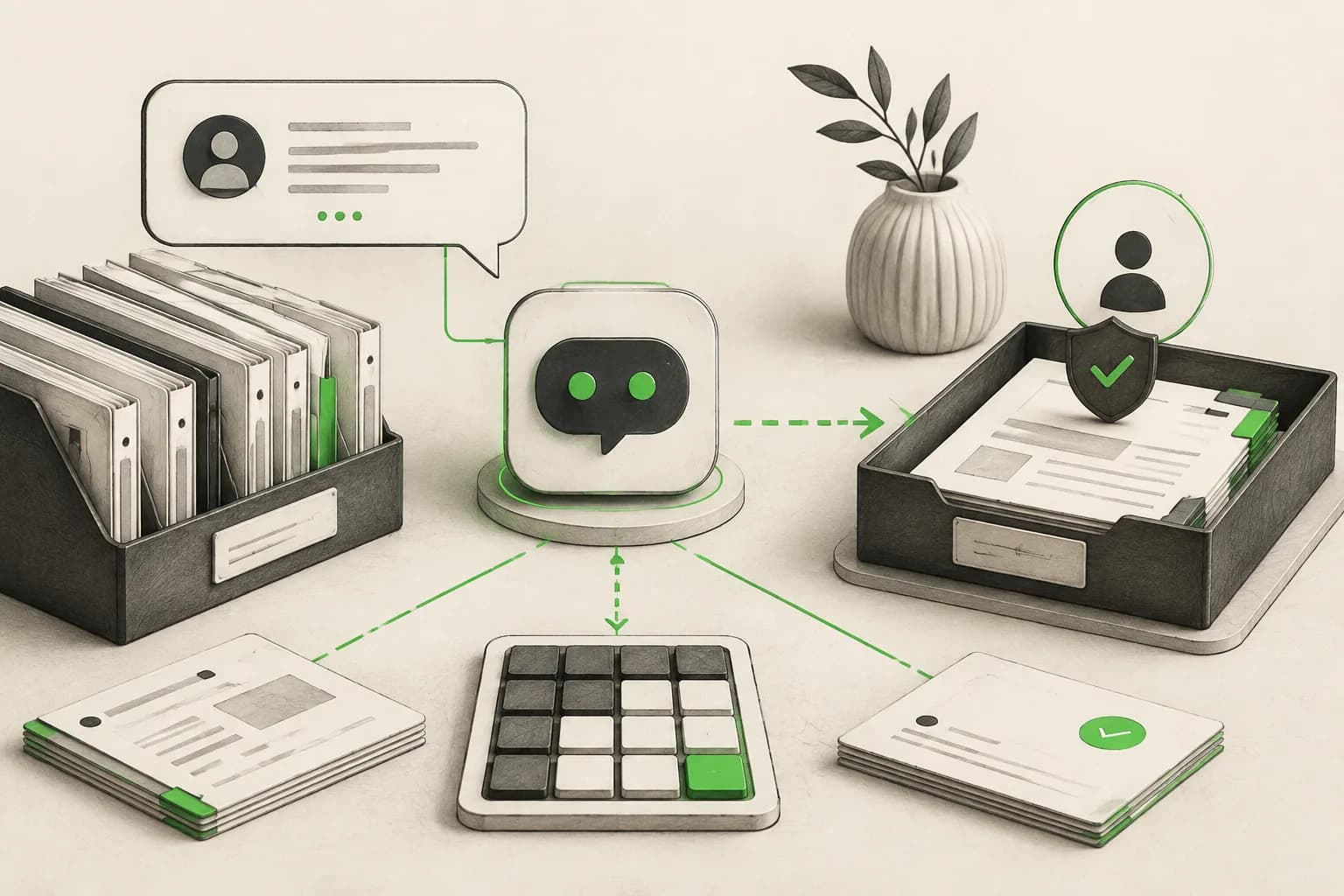
Your firm's knowledge base is the source of truth. You upload your FAQ document, your practice area descriptions, your intake process overview, and any other content you want the AI to draw from. The AI's responses are document-grounded — it answers from what you have provided, not from the internet or general legal databases. If the answer is not in your knowledge base, it says so and routes the prospect appropriately.
The lead form runs before chat. Every prospect fills in their name and contact details before the conversation opens. No anonymous conversations, no lost leads because a chat ended before you got contact information.
Routing and notifications happen automatically. When a prospect completes the intake form and conversation, your designated team member receives an email summary: prospect name, contact details, inquiry type, practice area match flag, and full conversation thread. You do not need to check a dashboard — the lead comes to you.
Channels are wherever your prospects are. Law firm prospects increasingly reach out through WhatsApp and social channels in addition to website chat. Hyperleap deploys the same AI agent across all four channels from a single configuration — you do not build separate bots for each channel.
Pricing is straightforward. Plus ($40/month) handles a single chatbot with up to 3,000 AI responses per month — enough for most solo and small-firm deployments. Pro ($100/month) supports two chatbots, 12,000 responses, and white-label branding. Max ($200/month) supports up to five chatbots and 30,000 responses for larger or multi-location practices. All plans include a 7-day free trial; a credit card is required. There is no free plan. If you want us to build and configure the agent for your firm, Managed Setup is $299 Free.
For firms that want to connect intake data to an existing CRM or case management system, Hyperleap provides a REST API and webhooks. Native integrations with specific legal practice management software are not currently available — the REST API is how you build that connection.
This is not a tool that replaces your intake coordinator. It is a tool that gives your intake coordinator qualified, warm leads to work with instead of a pile of missed calls and unanswered contact forms. Think of it as conversational AI for customer service applied specifically to the law firm front desk — it handles volume and availability so your team handles relationships and judgment calls.
To see how the same receptionist model applies in a different professional services context, the AI receptionist for dental clinics post covers many of the same mechanics for a different vertical.
Put an AI legal receptionist on your firm's website
Start a 7-day free trial. Configure your firm's knowledge base, launch on website and WhatsApp, and capture every after-hours inquiry from day one.
See PlansFrequently Asked Questions
Does an AI legal receptionist give legal advice?
No. An AI legal receptionist answers general questions about your firm — its practice areas, intake process, office hours, fee structures if you publish them, and how to book a consultation. It does not assess cases, evaluate legal claims, or recommend legal strategies. When a prospect asks a question that requires attorney judgment, the AI acknowledges the question and directs them to book a consultation or reach your team directly. This is the same role a well-trained human receptionist fills, and it is the appropriate scope for a messaging-based front desk.
Does it handle phone calls?
No. An AI legal receptionist from Hyperleap operates through messaging channels: your website chat widget, WhatsApp Business, Instagram DM, and Facebook Messenger. It does not intercept, answer, or handle voice calls. If you need phone coverage, that requires a separate voice solution. The messaging-based channels this AI covers are where a growing share of prospective clients first reach out — particularly after hours and on mobile.
What happens with prospective clients who contact the firm after hours?
The AI is available 24/7 across all configured channels. When a prospective client reaches out at 11 PM or on a weekend, the AI immediately presents the intake form, captures their contact details, answers general firm questions, and offers the consultation booking link. Your intake coordinator receives an email summary the following morning with all prospect details and conversation context. No inquiry is lost because the office was closed.
How does the AI know what to say about our practice?
You provide the knowledge base. When you configure Hyperleap for your firm, you upload your FAQ document, practice area descriptions, intake process overview, jurisdiction coverage, and any other content you want the AI to reference. The AI's responses are document-grounded — it draws from what you have uploaded, not from external legal databases or general internet content. If a question falls outside your knowledge base, the AI says it cannot answer that question and routes the prospect to your team.
Can it handle multiple practice areas and route inquiries to different teams?
Yes. You can configure the AI to recognize inquiry types across your practice areas and route the lead summary email to the appropriate team member or group. A personal injury inquiry routes to your PI team; an estate planning question routes to your trusts and estates team. The routing logic is defined during setup and can be adjusted as your firm's needs change. For firms with a large volume of mixed inquiries, this pre-sorting means your intake staff spend less time triaging and more time converting.
What languages does it support?
Hyperleap AI agents respond in 100+ languages. The prospect writes in their preferred language and the AI responds in kind. This applies across all four channels — website, WhatsApp, Instagram DM, and Facebook Messenger. The intake form captures their contact details regardless of language, and the routing email to your team includes the full conversation so the appropriate staff member can follow up in the right language.
The After-Hours Intake Problem Is Solvable
The law firm that responds first does not always win the client. But the law firm that never responds certainly loses them.
An AI legal receptionist is not a replacement for attorney judgment, for intake coordinators who build rapport, or for the human relationship at the center of every representation. It is the infrastructure that makes sure a motivated prospective client at 11 PM is not greeted with a contact form that sits unread until Tuesday.
Every day your firm operates without 24/7 messaging coverage, you are leaving after-hours inquiries for faster-moving competitors to capture. The setup is not complicated, the boundary (no legal advice — ever) is clear, and the value is straightforward: more qualified leads in your intake queue every morning, sourced from the prospects who were motivated enough to reach out when your office was closed.
If you are exploring this for your practice, review Hyperleap's plans — the Plus plan at $40/month covers a single chatbot, up to 3,000 AI responses per month, and all four channels. Most small and mid-size firms find that is enough to start.
Industry Solutions
See how AI chatbots work for these industries:
Related Articles
AI Chatbot for Accounting Firms
How an AI chatbot for accounting firms answers service, fee, and process questions 24/7 — and where every question routes to a CPA instead.
AI Receptionist for Med Spas: What It Actually Handles
An AI receptionist for med spas answers treatment and pricing questions, captures consultation requests on Instagram DM, and routes anything clinical to staff.

AI Receptionist for Pharmacies: The Non-Clinical Front Desk
An AI receptionist for pharmacies answers hours, services, and insurance questions 24/7 — and routes every medication question straight to your pharmacist.

AI Receptionist for Daycares and Preschools
An AI receptionist for daycares answers parent enquiries, shares tour links, captures waitlist leads, and routes sensitive questions to the director.