Multilingual Customer Support: An SMB Implementation Guide
Launch and scale multilingual customer support for your SMB. This guide covers language selection, AI chatbots, KPIs, and compliance for global growth.

Language barriers don't just create awkward support moments. They can cost real revenue. One 2026 analysis estimated that companies worldwide lose about $2.1 trillion annually because language barriers make it harder to understand, serve, and retain customers, and the same analysis says businesses offering multilingual service see roughly 1.5 times higher customer retention than those that don't (multilingual business communication statistics).
For an SMB, that changes the conversation. Multilingual customer support isn't a branding extra. It's a retention system, a conversion lever, and in some industries, a compliance issue. The mistake I see most often is treating it as a translation purchase. Buy a tool, add a language toggle, hope for the best. That approach usually creates new failure points: inconsistent answers, bad routing, unclear ownership, and risky automation in sensitive workflows.
The better approach is narrower and more practical. Start with the few languages that matter most to your pipeline and service load. Use AI where speed and coverage matter. Keep human review where mistakes carry cost. Then measure the program in revenue terms, not just ticket terms.
Table of Contents
- Laying Your Strategic Foundation
- Choosing Your Multilingual Support Channels
- Building Your Multilingual Tech Stack
- Implementing Your Support Workflow
- Measuring ROI and Ensuring Compliance
- Conclusion Your Path to Global Service
Laying Your Strategic Foundation
A multilingual support rollout usually fails long before the first chatbot goes live. It fails when a company chooses languages based on intuition, internal preference, or one loud sales request.
Start with customer behavior, not language ambition
Begin with the systems you already have. Look at website traffic by country and browser language. Pull support tickets by region. Check checkout abandonment, inbound call notes, form submissions, and sales conversations where reps had to switch languages, use a family member as interpreter, or stop the conversation entirely. You're not trying to prove global scale. You're trying to find where language friction is already blocking money or creating avoidable service cost.
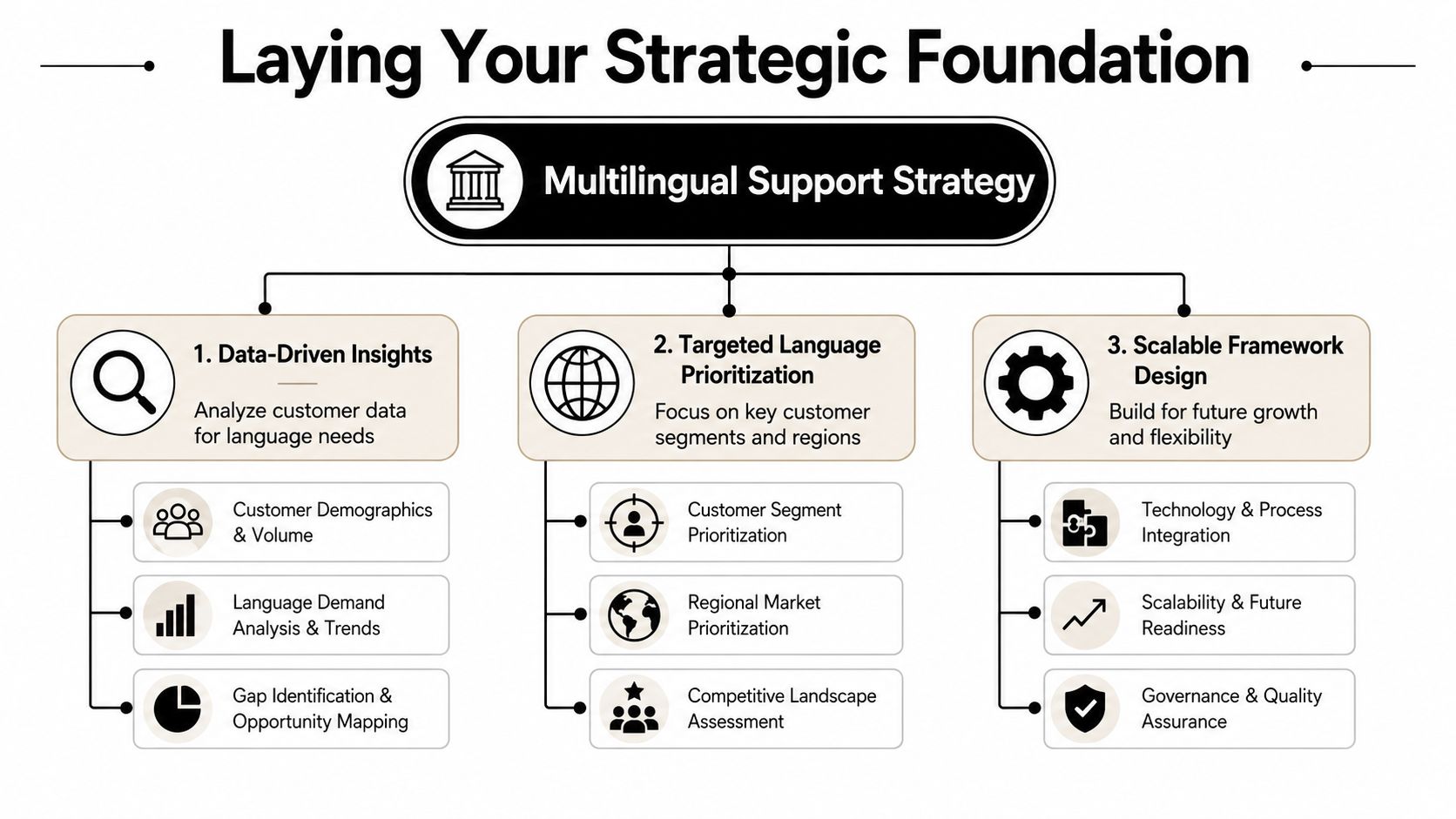
For most SMBs, the right answer isn't “support everything.” It's usually two or three high-value languages tied to clear demand. One language may matter because it represents a large lead segment. Another may matter because those customers ask repetitive pre-sales questions that a bot can handle well. A third may matter because the business is entering a region where local-language service affects trust.
Use a simple prioritization grid:
| Language candidate | Customer demand | Revenue relevance | Support complexity | Compliance sensitivity | Decision |
|---|---|---|---|---|---|
| Existing market language | High | High | Medium | Low | Launch first |
| Expansion market language | Medium | High | Medium | Medium | Pilot |
| Long-tail request language | Low | Unclear | High | Low | Defer |
That table matters because not all language demand deserves the same response. Some languages justify live chat and localized workflows. Others only justify translated self-service and delayed human follow-up.
Practical rule: Don't add a language until you can name the exact customer journey it will improve.
Pick service levels before you pick tools
The next decision is service depth. It protects budgets. You don't need native-speaking agents across every channel on day one. You need a service model that matches the value and risk of the interaction.
A workable support ladder looks like this:
- Self-service first for FAQs, returns, shipping, hours, booking policies, and basic troubleshooting.
- AI chat next for repetitive questions, lead capture, appointment routing, and first-response triage.
- Human follow-up for exceptions, complaints, cancellations, technical issues, billing disputes, or regulated topics.
- Specialist review for legal, clinical, financial, or consent-related conversations.
Set goals that reflect that ladder. Avoid broad promises like “full multilingual support.” Instead, define what success looks like by language and channel.
- For chat: Contain routine pre-sales and service questions without escalating every conversation.
- For email: Maintain acceptable response quality for more nuanced requests.
- For regulated workflows: Limit AI to intake, navigation, and non-advisory responses unless reviewed.
- For managers: Create clear visibility into what the bot answered, what agents edited, and where confusion appeared.
A lot of teams overbuild early. They spend time translating every article, every template, every macro. Then they discover only a small subset drives ticket volume or purchases.
A narrower rollout is usually stronger. Customers care less about whether you support ten languages badly. They care whether you can solve their problem clearly in the language they use.
Choosing Your Multilingual Support Channels
Channel decisions shape cost more than language decisions do. A business can support the same language cheaply in one channel and expensively in another.
A practical channel comparison for SMBs
One customer service analysis found that 41% of consumers prefer live chat as their primary support channel (customer experience trends research). For SMBs, that matters because chat is usually the easiest place to start multilingual coverage without building a large team.
Here's the trade-off:
| Channel | Best use | Strengths | Limitations | Good SMB fit |
|---|---|---|---|---|
| Live chat | Sales questions, simple service, intake | Fast, scalable, AI-friendly | Weak for long explanations or high emotion | Strong starting point |
| Complex follow-up, documentation, non-urgent cases | Flexible, reviewable, easier human editing | Slower, less immediate | Strong secondary channel | |
| Phone | Urgent, sensitive, high-friction issues | Highest trust for some cases | Expensive, hard to scale by language | Selective use |
| Help center | Repetitive questions | Cheap deflection, consistent answers | Requires maintenance | Essential foundation |
Live chat works well because it handles language switching naturally. Customers type in their preferred language. The system detects intent. Your team can route, answer, and escalate without forcing the customer into a long queue. If you're designing an AI-first support model, a good multi-channel AI chatbot strategy keeps the same knowledge and routing logic across website chat, messaging apps, and social inboxes.
What usually works first
For most growing companies, the strongest first mix is:
- Multilingual help center: Keep articles short, task-based, and tied to high-frequency issues.
- AI-powered live chat: Use it for first contact, qualification, and common support questions.
- Email escalation: Move edge cases here when agents need time to investigate or rewrite carefully.
- Phone for exceptions only: Reserve it for urgent complaints, complex troubleshooting, or trust-sensitive scenarios.
If your team can't maintain channel consistency in one language, adding more channels in more languages will multiply the mess.
Phone support is where many SMBs overspend. It sounds customer-friendly, but multilingual phone coverage often creates scheduling problems, uneven quality, and dependency on a few bilingual staff members. Unless your customers require voice, chat plus email usually gives better coverage per dollar.
Self-service deserves more attention than it gets. A strong knowledge base reduces ticket volume, gives AI something reliable to cite, and creates consistency across every language. Without it, every channel becomes improvisation.
Building Your Multilingual Tech Stack
Most multilingual support stacks look larger than they need to be. In practice, the stack should stay compact. One source of truth, one automation layer, one ticketing flow, and a clear handoff to humans.
Your knowledge base is the real product
The most important asset isn't the chatbot. It's the centralized knowledge base behind it. If the source content is unclear, outdated, or contradictory, every translation and every AI response inherits the same weakness.
Start with a small set of documents and articles:
- Policy content: returns, refunds, cancellations, privacy, booking changes
- Service content: pricing logic, timelines, onboarding steps, appointment rules
- Troubleshooting content: common issues, account access, setup errors, delivery questions
- Escalation rules: what the bot can answer, what must go to a human, what must never be answered automatically
Then standardize the writing. Short sentences. One policy per article. Fewer ambiguous phrases. Fewer internal shortcuts. AI performs better when the input is operational, not marketing-driven.
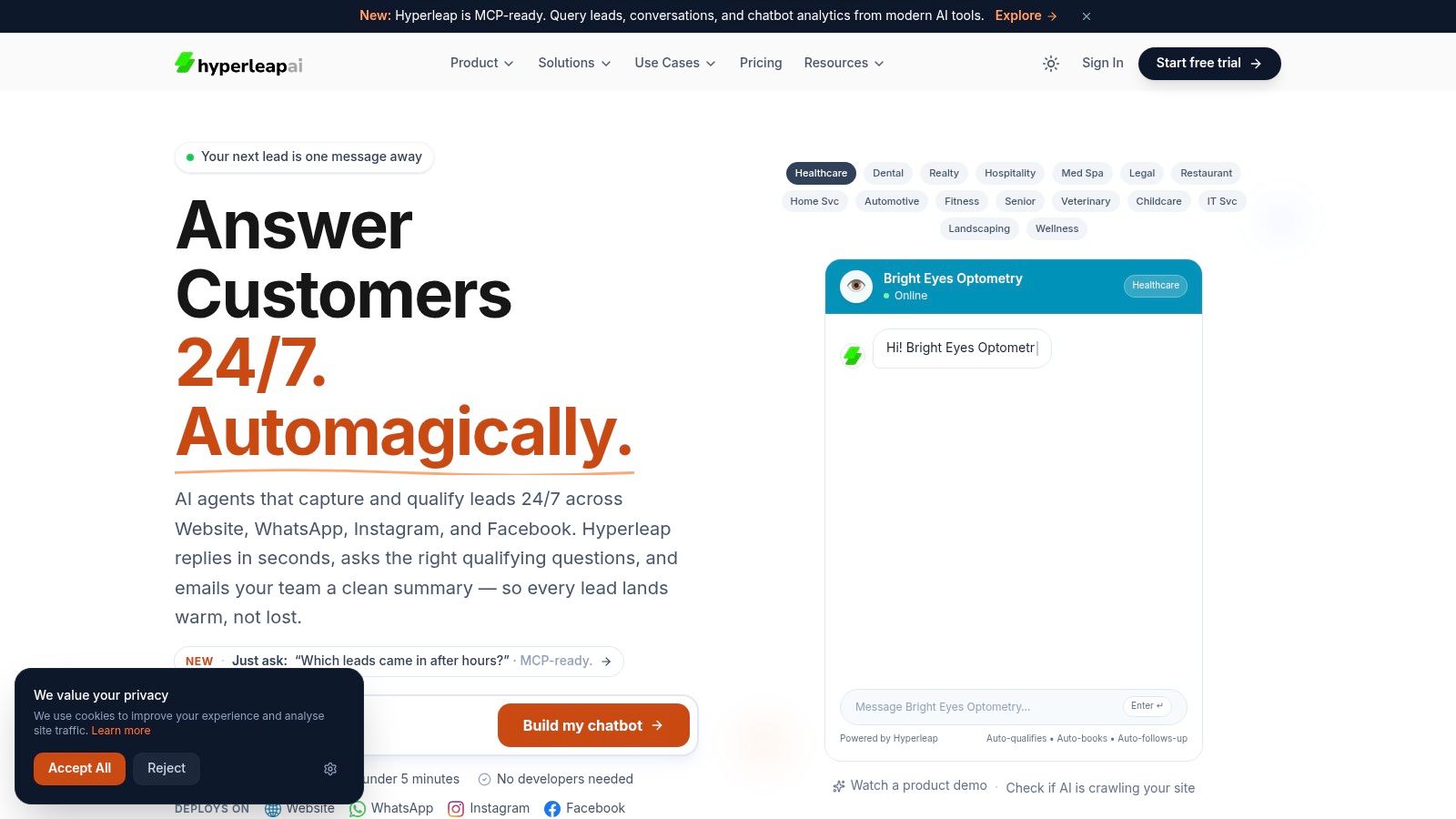
A platform such as Hyperleap AI's multi-language chatbot setup can use uploaded knowledge to answer across website and messaging channels in multiple languages, while keeping responses grounded in the business's own content. That grounded approach matters more than broad language coverage alone.
Translation versus localization
Teams often mix up translation and localization. They're not the same purchase.
Translation is enough when the content is factual, repeatable, and low risk. Think delivery timelines, appointment availability, return windows, opening hours, and basic product specs.
Localization is necessary when wording changes trust, legal meaning, or cultural clarity. Think consent language, payment disputes, health instructions, financial terms, or tone-sensitive complaint handling.
Use this rule of thumb:
| Content type | AI translation only | Human localization needed |
|---|---|---|
| FAQ answers | Usually yes | Sometimes |
| Transactional messages | Usually yes | Sometimes |
| Marketing offers | Sometimes | Often |
| Legal or consent text | Rarely | Usually yes |
| Clinical or financial guidance | Rarely | Usually yes |
Operator's note: Don't ask AI to rescue messy source content. Rewrite the English first, then translate.
What an SMB stack should include
You don't need an enterprise platform maze. A practical stack includes these layers:
Knowledge base Approved answers reside here. Keep ownership clear. Someone updates policy content. Someone approves regulated language. Someone retires old articles.
AI chat layer
This handles detection, first response, triage, and repetitive questions. It should log confidence signals, preserve transcript history, and allow controlled escalation.Translation support
Use machine translation for low-risk coverage. Use human review for high-risk templates and high-impact flows.Inbox or ticketing system
All conversations should land in one queue structure, even if they start on your site, WhatsApp, Instagram, or Facebook.QA and reporting workflow
Managers need a way to review conversations across languages without guessing whether the translated summary preserved the original meaning.
The biggest stack mistake is fragmentation. One chatbot for the website, another for social, a separate inbox for email, scattered documents, and no common escalation logic. That setup creates inconsistent answers fast.
Implementing Your Support Workflow
A multilingual workflow is where strategy gets tested. If routing is sloppy or ownership is vague, the customer feels the gap immediately.
To make this concrete, use one scenario: a Spanish-speaking customer lands on your site and asks whether an appointment can be rescheduled and whether a deposit is refundable.
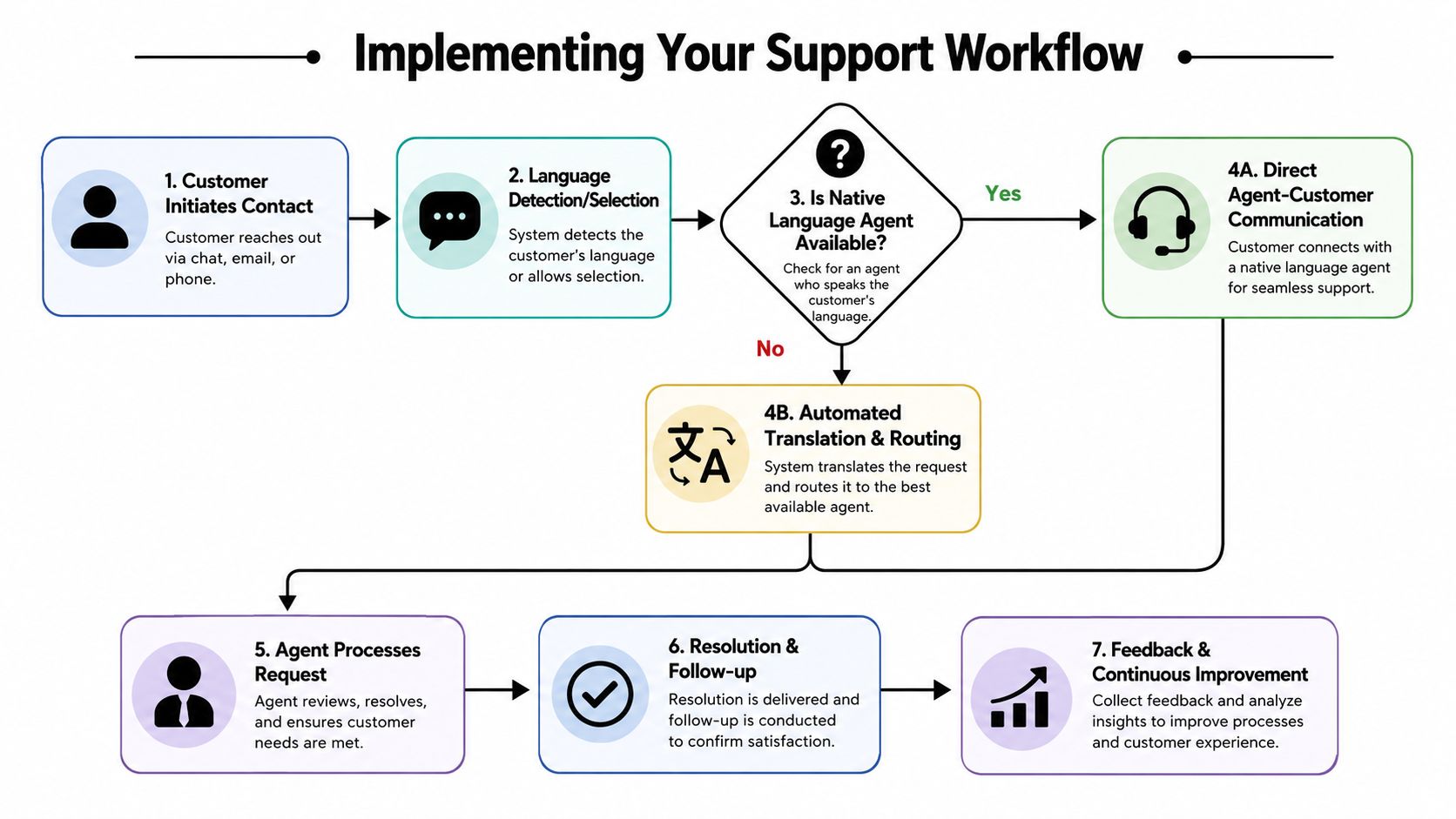
A Spanish ticket from arrival to resolution
The workflow should look like this:
Language detected or selected
The chat widget identifies Spanish from browser settings or the first customer message. If confidence is low, it asks the customer to confirm their preferred language.Intent classified
The system identifies this as a policy and booking question. That matters because policy questions can often be answered from the knowledge base, while booking changes may require account-specific review.AI answers the low-risk portion
The bot provides the approved rescheduling policy in Spanish, using the exact knowledge source tied to booking changes. It avoids improvising around edge cases.Escalation triggered for the account-specific part
Refundability depends on timing, service type, or booking terms. The bot collects booking ID, date, and contact details, then routes the case.Agent receives structured context
The human doesn't get a blank handoff. They get transcript, language tag, customer details, detected intent, and the knowledge source the bot already used.Resolution sent in Spanish, with internal review in English if needed
If the assigned manager doesn't speak Spanish, the system provides a translated internal view while preserving the original text for verification.
That's the operational difference between “we support Spanish” and a real multilingual support workflow. The first is a claim. The second is a controlled process.
A short walkthrough helps visualize the handoff in motion:
Where quality control usually breaks
Most failures happen in one of four places:
- Weak intent routing: The system detects the language but not the business context, so billing questions get handled like generic FAQs.
- Unapproved source content: The bot translates outdated or conflicting policies.
- Agent handoff gaps: The customer has to repeat the issue after escalation.
- Manager blind spots: Supervisors review only translated summaries and miss nuance in the original exchange.
The fix isn't complicated, but it does require discipline.
| Workflow stage | What to check | Who owns it |
|---|---|---|
| Detection | Did the system identify the language correctly | Ops or CX lead |
| Response | Did the bot use approved content only | Knowledge owner |
| Escalation | Was the case routed with full context | Support manager |
| QA | Did translation preserve meaning and tone | QA lead or bilingual reviewer |
A good multilingual workflow reduces effort for both sides. The customer doesn't repeat themselves, and the agent doesn't reconstruct the case from scratch.
Train agents on decision boundaries, not just scripts. They should know when to trust the bot's answer, when to edit it, when to switch channels, and when to stop the conversation until a specialist reviews it. That matters far more than asking every agent to become fluent in every supported language.
Measuring ROI and Ensuring Compliance
A multilingual support program becomes fragile when the only success story is “customers seem happier.” That's not enough to defend budget, and it won't survive scrutiny from finance or compliance.
Measure business impact by language
A 2023 McKinsey CX survey found that only 28% of companies linked language support to revenue outcomes or churn reduction, even though customers using their preferred language were 1.7 times more likely to complete a purchase in reviewed multi-region e-commerce studies (multilingual support ROI discussion). That gap is exactly where SMBs should be more disciplined than larger firms.
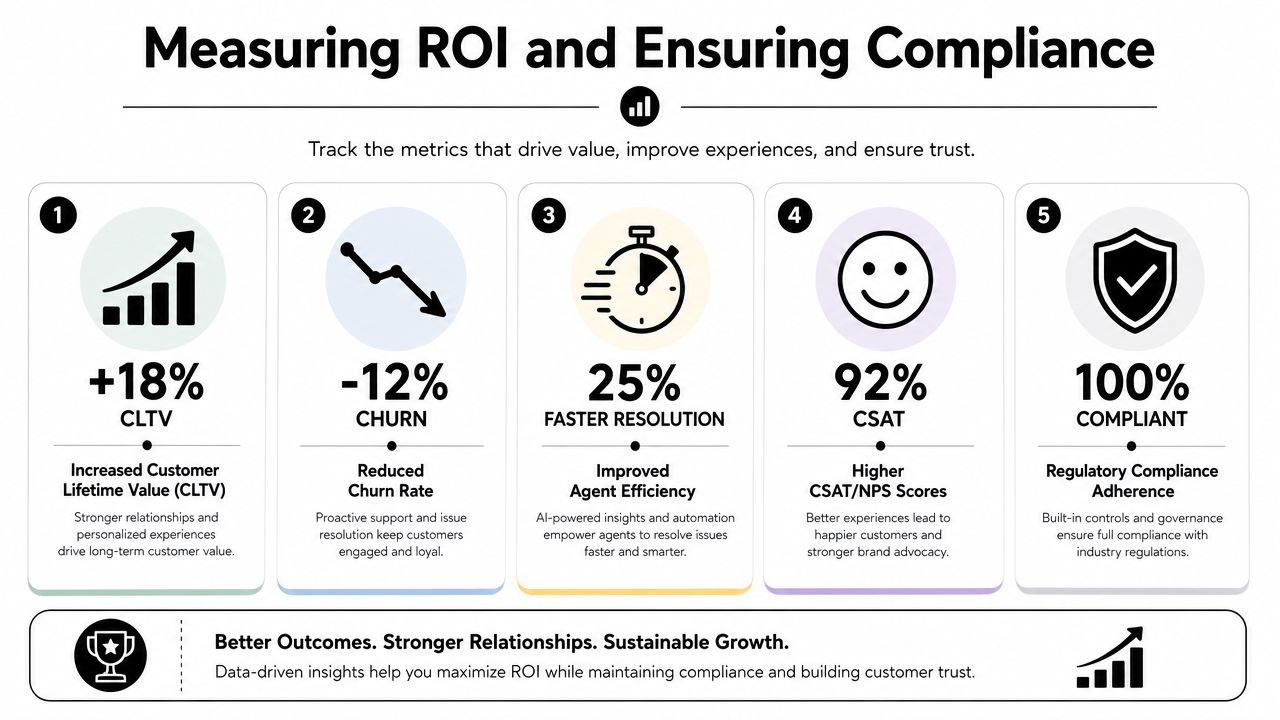
Track multilingual customer support by language cohort, not only by total queue performance. A useful dashboard starts with:
- Conversion by language: Do visitors who interact in Spanish, German, or French complete forms, bookings, or purchases at a higher rate than before?
- Retention by language cohort: Do customers served in their preferred language renew, rebook, or return more consistently?
- Escalation rate by language: Which languages create the most handoffs, rewrites, or manager reviews?
- Containment quality: Which questions can AI resolve safely, and which should move directly to humans?
- Revenue-attributed tickets: Which conversations influenced closed sales, saved accounts, or reduced cancellations?
If your team still reports only response time, resolution time, and CSAT, expand the scorecard. Those metrics matter operationally, but they don't prove the investment. A more useful set of customer service KPIs ties service activity to conversion, retention, and workload economics.
Where AI support creates compliance risk
Many multilingual programs become dangerous. In regulated industries, a translated answer isn't just a customer experience artifact. It can shape consent, disclosure, eligibility, privacy understanding, or professional liability.
The risk is highest when SMBs use AI in:
- Healthcare and dental intake
- Financial product questions
- Insurance or claims support
- Consent collection
- Privacy and data-rights workflows
One industry review summarized in the verified research notes that misleading or culturally insensitive translations in telehealth chatbot contexts can trigger liability or regulatory action, especially in consent and adverse-event disclosure scenarios, and it also warns that multilingual interfaces can become part of the legal notice and consent architecture in GDPR-type regimes (multilingual support and compliance considerations).
That means your workflow should classify conversations by risk level:
| Risk level | Typical example | AI role | Human role |
|---|---|---|---|
| Low | Hours, location, booking status | Answer directly | Review exceptions |
| Medium | Pricing explanation, plan comparisons, refund policy | Triage and draft | Approve edge cases |
| High | Consent, medical guidance, financial suitability | Intake only | Full response and review |
Don't let convenience define policy. If the customer is making a health, legal, or financial decision, human review should sit inside the workflow, not outside it as an afterthought.
Conclusion Your Path to Global Service
Most SMBs don't need a giant multilingual operation. They need a tight system for the right languages, answers repeatable questions well, and escalates risky issues cleanly.
That starts with language prioritization tied to actual demand. Then it moves into a realistic channel mix, usually with self-service and live chat doing most of the heavy lifting. After that, the work becomes operational: one knowledge base, one routing model, one QA process, and clear rules for where human review is required.
The payoff isn't just broader reach. It's fewer dropped conversations, better conversion in language-specific journeys, stronger retention, and less chaos for the team handling support every day. The compliance side matters too. If you operate in a sensitive sector, careful boundaries around AI use are part of the business case, not a separate legal cleanup project.
The companies that do multilingual customer support well don't chase coverage for its own sake. They build control first, then scale. That's why an AI-first model is so useful for growing businesses. It lets you start with practical coverage, keep staffing lean, and expand based on evidence instead of guesswork.
If you want to put this into practice, Hyperleap AI gives SMBs a way to launch multilingual customer support across website chat and messaging channels using a single knowledge base, grounded responses, lead capture, and human handoff workflows without a heavy implementation project.