Run Sales Standups in Claude Desktop with Hyperleap MCP
Replace your Monday pipeline review with a 15-minute Claude Desktop session. 10 natural-language prompts that pull live data from your Hyperleap chatbot.

TL;DR: Open Claude Desktop, type "Show me hot leads from this week," and get a plain-English summary of every high-intent lead your Hyperleap chatbot captured — ranked, labeled, and ready to share with your team. With Hyperleap's MCP server connected, your 9 a.m. pipeline review shrinks from a 30-minute dashboard crawl to a 15-minute conversation. No filters, no exports, no SQL.
The 9 A.M. Problem Every Sales Manager Knows
It is 8:55 on Monday morning. In five minutes, you are running the weekly pipeline review. You need to answer three questions: which leads are hot, which deals stalled, and where are we against the week's target.
Here is what actually happens: you open the Hyperleap dashboard, filter by date, scan the leads list. Then you switch to the conversations tab to check what the bot said to each high-intent prospect. Then you pull up the pipeline view to count how many leads are in each stage. Then you switch back to the leads list because you forgot to check the WhatsApp channel separately. By the time you have a mental picture of the week, it is 9:12 and the standup started without you.
This is not a data problem. You have plenty of data — every lead, conversation, stage change, and chatbot interaction is sitting in Hyperleap. The problem is the interface. Dashboards are built for browsing. Standups need answers.
The Model Context Protocol (MCP) is the bridge. MCP is an open standard that lets Claude Desktop connect directly to external data sources and call tools on your behalf. Hyperleap ships a native MCP server with 9 read-only tools. When you connect it to Claude Desktop, you stop browsing your CRM and start conversing with it.
A sales standup query that used to take four tab switches and three minutes of filtering now takes one sentence and eight seconds.
This guide shows you exactly what that workflow looks like: the shape of the session, the 10 prompts worth bookmarking, and how to turn it into a daily habit that the whole team benefits from.
If you have not yet connected Claude Desktop to Hyperleap, start with the setup tutorial — it takes under five minutes. Come back here once Claude Desktop is connected and your API key is in the config file.
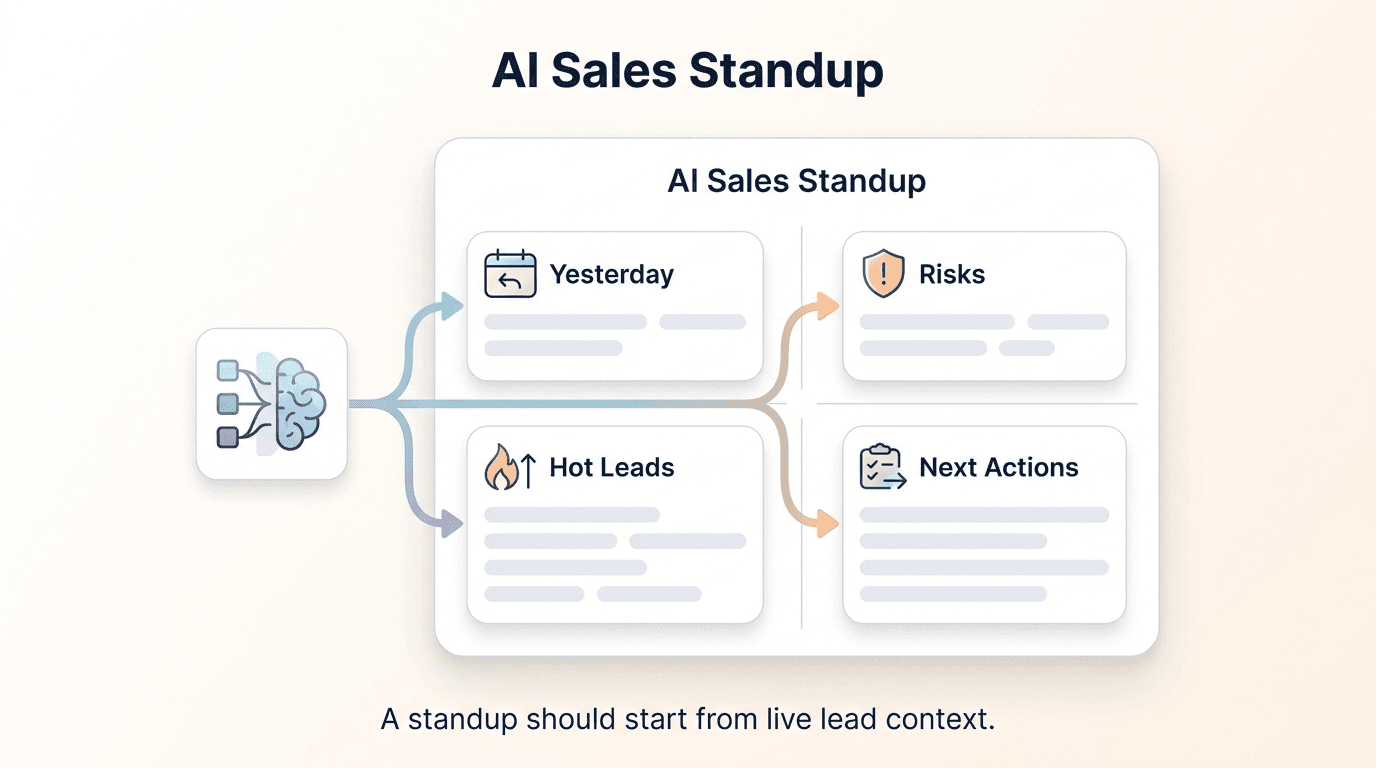
The New Workflow: A 15-Minute Claude Session
Here is the entire standup workflow, from opening Claude Desktop to sharing the digest with your team.
Open one Claude Desktop conversation. Give it a name like "Sales standup — week of May 11" so you can find it later. Everything you ask in this session will have context from previous turns, so Claude can do things like "Now filter that by leads who came through Instagram DM" without you repeating yourself.
Start with the dashboard aggregate. Ask Claude for this week's CRM summary first. This gives you the top-line numbers — total leads, conversions, response rate — before you drill into specifics. Claude calls get_crm_dashboard and returns a plain-English summary of the aggregate metrics for your chosen date range.
Drill into pipeline stages. Ask which stages have the most leads and where things are stuck. Claude calls get_pipeline_stages, returns stage names and counts, and can immediately tell you if one stage has an outsized backlog that signals a bottleneck.
Pull the hot list. Ask for leads with high engagement or strong intent signals from this week. Claude uses list_leads with date and status filters, then optionally calls extract_lead_insights on the top results to surface intent scores and objections without you having to open each lead profile.
Spot the stalls. Ask which leads have gone quiet. Claude filters list_leads by last-activity date, returns leads that have not had a conversation update in several days, and flags which stage each one is stuck in.
Sample 2–3 conversations. For the leads that matter most, ask Claude to pull the conversation transcript. Claude calls get_lead_conversations and returns the actual messages exchanged between the lead and your chatbot — so you can see exactly what the prospect said, not just a status label.
Save or share the digest. Copy Claude's responses into a Slack message, email, or shared doc. That is your standup artifact for the day.
The entire session — dashboard summary, pipeline breakdown, hot list, stall check, two or three conversation samples — takes 12–18 minutes for most managers. You spend that time reading and thinking, not clicking filters.
10 Prompts That Replace Dashboards
For each prompt below, the italicized response sketch describes what Claude actually does under the hood and what the answer looks like. All lead names, company names, and figures in the sketches are illustrative.
1. Pipeline Stage Counts
How many leads are in each pipeline stage right now?
Claude calls get_pipeline_stages, which returns stage names and lead counts. The response looks something like: "New Inquiry: 34 leads. Qualified: 18 leads. Demo Scheduled: 7 leads. Proposal Sent: 5 leads. Closed Won: 3 leads this month." If any stage has a disproportionately large count relative to the others, Claude will flag it as a likely bottleneck.
2. Hot Leads This Week
Show me leads from this week who have high intent or showed strong buying signals.
Claude calls list_leads filtered by the current week's date range and engagement signals, then calls extract_lead_insights on the top results. The response surfaces a ranked list: lead name, channel they came through, a one-sentence intent summary ("Asked about pricing for 50-seat plan; mentioned budget is approved"), and any objections detected. Illustrative example: "Acme Corp (Website, Tuesday) — strong purchase intent, asked about onboarding timeline. Main objection: wants to see a demo before committing."
3. Stalled Leads
Which leads haven't had any activity in the last 5 days?
Claude calls list_leads with a last-activity filter to surface leads that have gone quiet. The response lists each stalled lead with their current pipeline stage, when they last had a chatbot interaction, and which channel they came through. This is your re-engagement queue — the leads most at risk of going cold.
4. Leads by Channel
Break down this week's leads by channel — website, WhatsApp, Instagram, Messenger.
Claude calls get_crm_dashboard or list_leads grouped by channel source. The response gives a count per channel, and Claude can highlight which channel is driving the most volume versus which is converting at the highest rate. Illustrative: "Website: 41 leads. WhatsApp: 28 leads. Instagram DM: 19 leads. Facebook Messenger: 11 leads." Useful for budget allocation conversations.
5. Recent Conversations
Pull the last 3 conversations from leads in the 'Demo Scheduled' stage.
Claude calls get_lead_conversations for leads filtered to the specified stage, then summarizes each transcript. The response gives you the gist of each conversation — what the lead asked about, how the chatbot responded, and any commitments made (like a scheduled call time or a document request). This replaces the three-tab-switch sequence of finding a lead, clicking conversations, and reading the transcript manually.
6. Top Intent Signals
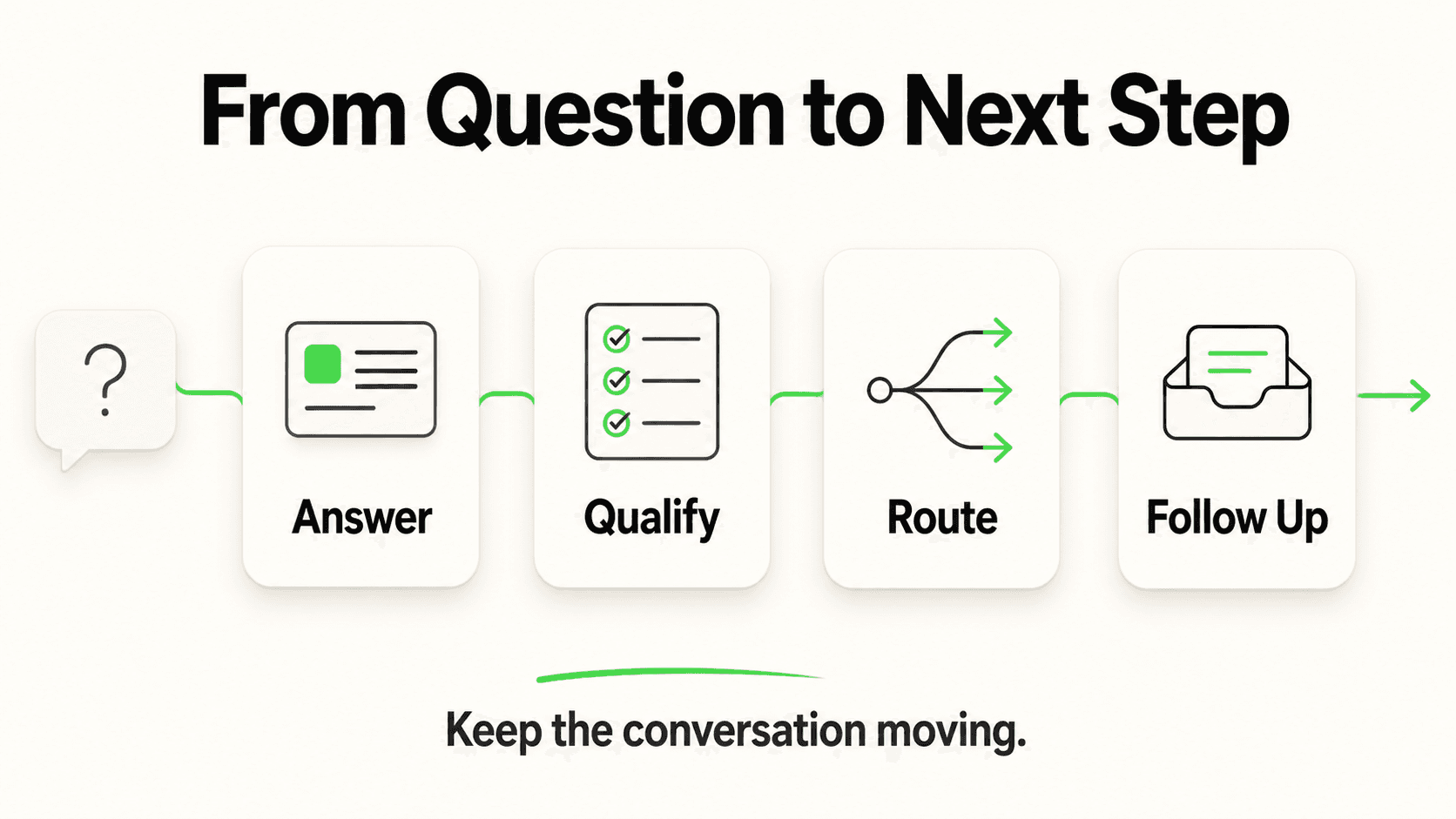
What are the most common buying signals you're seeing across leads this week?
Claude calls extract_lead_insights across a sample of this week's leads and aggregates the intent patterns. The response identifies themes: "Pricing questions appear in 60% of high-intent conversations. Timeline urgency ('we need this by Q3') is the second most common signal. Multiple stakeholders mentioned in 8 conversations — suggest these for enterprise follow-up." This is the kind of meta-analysis that normally requires a separate analytics tool.
7. Objection Mining
What objections are prospects raising most this week?
Claude calls extract_lead_insights across recent leads and clusters the objection patterns. Illustrative response: "Integration concerns (can it connect to our existing tools?) appeared in 14 conversations. Pricing hesitation in 11. 'Not the right time' in 8. Team sign-off required in 6." This output feeds directly into sales coaching — you know exactly what objections your team needs to be equipped to handle.
8. Conversion Rate: This Week vs. Last
Compare this week's lead-to-qualified conversion rate against last week.
Claude calls get_crm_dashboard for both date ranges and computes the comparison. Illustrative: "This week: 23 of 99 new leads reached Qualified stage (23%). Last week: 19 of 87 (22%). Slight improvement. Worth noting: WhatsApp leads converted at 31% this week versus 18% last week — that channel is outperforming." Claude surfaces the most meaningful deltas rather than dumping a raw table.
9. Biggest Deals in Flight
Who are the largest deals in our pipeline right now, and where is each one stuck?
Claude calls list_leads filtered to high-value or enterprise-tagged leads and get_lead_details for the top results. The response lists each deal with current stage, last activity date, and a brief status note. Illustrative: "Riverside Dental Group — Proposal Sent, last activity 3 days ago, no response to bot follow-up. GlobalEdge Solutions — Demo Scheduled for Thursday, confirmed via WhatsApp. Summit Property Management — New Inquiry, high intent detected, no human follow-up yet."
10. Lead Source Mix
Where are our leads coming from this week — what's the source breakdown?
Claude calls get_crm_dashboard or list_leads and groups by lead source tag. The response breaks down leads by acquisition source (organic search, paid campaign, referral, direct, etc.), which channels they engaged through, and which sources are producing the highest-intent leads versus the highest volume. Use this to bridge your marketing attribution conversation with your sales conversion conversation.
Turning It Into a Daily Habit
The prompts above are most valuable when you run them consistently, at the same time, with the same structure. Here is the three-step ritual that works for teams using Claude Desktop for sales standups.
Step 1: Run the session before the standup, not during it. Spend 12–15 minutes in Claude Desktop before your team call. Pull the dashboard summary, the hot list, and the stall list. By the time the meeting starts, you are sharing insights, not hunting for them. Your team gets a manager who knows the pipeline, not a manager who is clicking filters on screen share.
Step 2: Capture the key outputs as text. As Claude generates each response, copy the most useful summaries into a running doc or note. A simple structure: "Hot leads this week," "Stalled leads to re-engage," "Top objection this week," "Biggest deals and current status." This becomes your standup script and your paper trail.
Step 3: Compare against last session. Because Claude Desktop saves conversation history, you can open last Monday's session side by side and ask: "How does this week's pipeline compare to last week?" Claude can synthesize the comparison across both sessions if you paste in the key numbers. Over time, this gives you a weekly trend without building a single spreadsheet.
Sharing the Output with Your Team
Once you have run your Claude session and captured the digest, the simplest distribution path is also the best: plain text.
Paste into Slack. Copy the hot leads summary, the stall list, and the week's top insight into a Slack message to your sales channel. Three to five lines per section is enough. This is your standup artifact — it replaces the "can you pull up the dashboard" moment in the meeting.
Email it to stakeholders. If you are reporting up to leadership or a board observer, a brief weekly pipeline email built from your Claude digest takes about three minutes to write. The Claude summaries are already in plain English, so you are mostly formatting, not drafting.
Screenshot the digest. For visual-preference teams, a screenshot of the Claude conversation window showing the hot list and pipeline summary works well in async standups or Notion wikis. Claude's responses are formatted cleanly enough that a screenshot reads well without additional editing.
Save as a recurring artifact. If your team uses a shared doc for weekly pipeline reviews, create a template with the ten prompt categories as section headers. Each week, paste Claude's outputs into the corresponding section. After four weeks you have a searchable history of pipeline state — without a single manual export.
One important note: Slack mentioned here is your distribution channel for the digest, not a Hyperleap chatbot channel. Hyperleap chatbots operate on Website, WhatsApp, Instagram DM, and Facebook Messenger — not Slack. The Slack message is simply where you share the summary your Claude session produced.
What You Cannot Do Yet (Read-Only Honesty)
The Hyperleap MCP server is intentionally read-only. All 9 tools are observation tools — zero write methods. This is worth being direct about, because it affects how you design your workflow.
What you cannot do via Claude Desktop MCP:
- Update a lead's pipeline stage
- Reassign a lead to a different owner
- Add a note or comment to a lead record
- Change a lead's status from "New" to "Qualified"
- Send a follow-up message or trigger a chatbot flow
- Mark a deal as closed
What this means for your workflow: the standup session in Claude Desktop is a read-and-plan activity. You surface insights, identify which leads need attention, and decide on next actions. The next actions themselves — updating stages, adding notes, reassigning owners — happen in the Hyperleap dashboard or via the Hyperleap API directly.
Think of the read-only constraint as a safety feature, not a limitation. Claude cannot accidentally change a lead's status, reassign an opportunity to the wrong person, or trigger an unintended chatbot flow. It can only look. That makes it safe to run during a live standup, in a shared session, or with a team member looking over your shoulder — no accidental writes.
For teams that want to close the loop on updates after a Claude session, the most practical approach is to have the Hyperleap dashboard open in one window and Claude Desktop in another. Claude surfaces what needs attention; you action it in the dashboard.
The full MCP tools reference documents every tool's parameters if you want to understand exactly what each call returns before you build your standup workflow.
Run Your First Standup Today
The biggest shift from dashboard-based pipeline reviews to natural-language ones is not the technology — it is the thinking pattern. Instead of asking "where do I click to find this?", you ask "what do I want to know?" and type it.
That shift takes about one session to internalize. After the first time you type "show me hot leads from this week" and get a ranked, plain-English summary in under ten seconds, the old way of clicking through filters starts to feel obviously wrong.
Connect Hyperleap to Claude Desktop and run your first standup session. The ten prompts in this article are enough to cover a full pipeline review. Start with prompt 2 (hot leads this week), add prompt 3 (stalled leads), and finish with prompt 6 (top intent signals). That three-prompt sequence alone gives you more signal than most 30-minute dashboard sessions.
If you want to explore every tool the MCP server exposes and how to chain them together, the full MCP tools reference is the next read. And if you are evaluating which chatbot platform gives you the best MCP integration story, the 2026 comparison covers the field.
Ready to connect? Start with the Hyperleap MCP setup.
Frequently Asked Questions
Does the Hyperleap MCP server work with the free Claude plan?
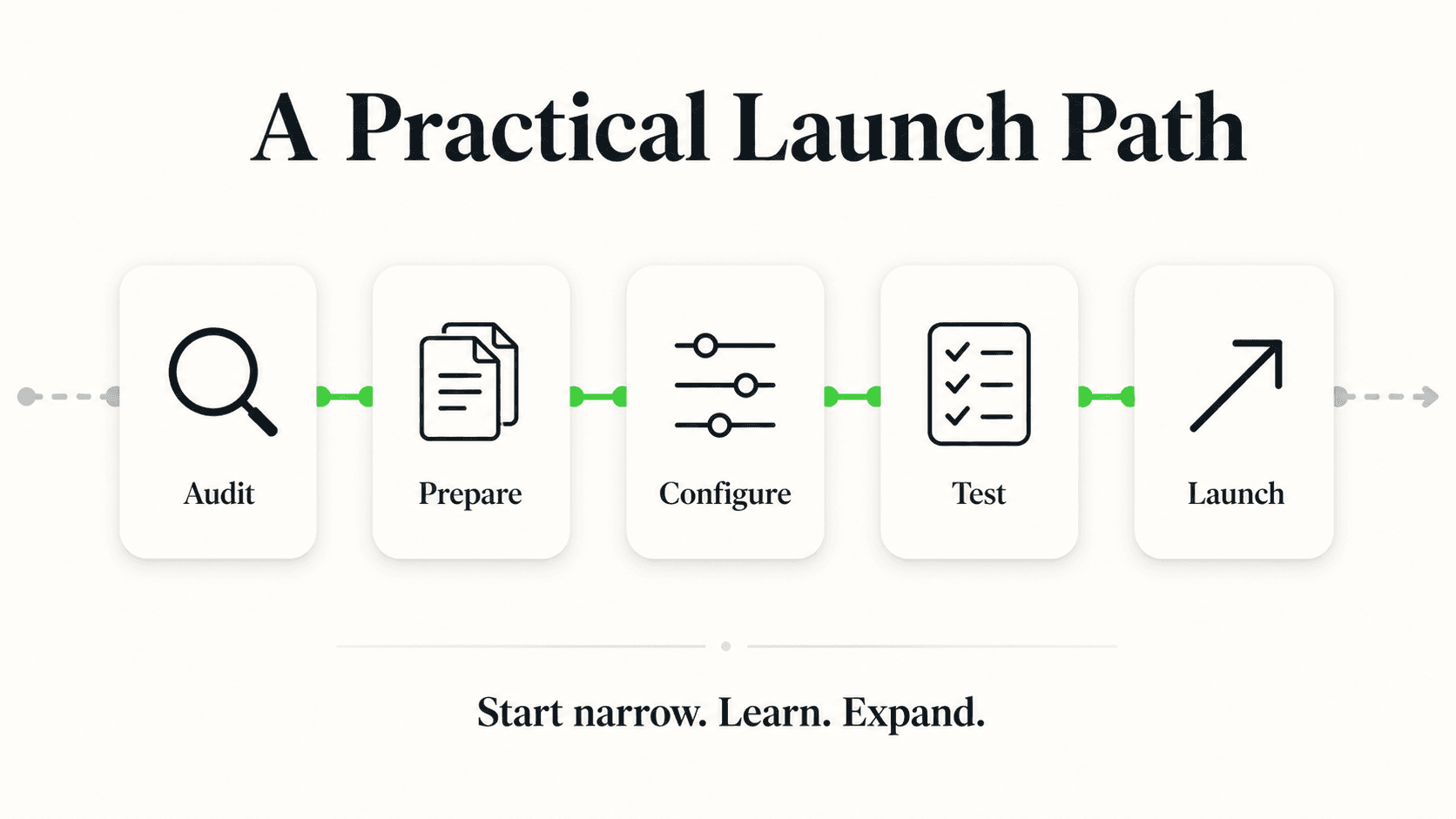
MCP integrations in Claude Desktop require a Claude Desktop installation, which is available on both free and paid Claude plans. The Hyperleap side of the connection requires a paid Hyperleap plan (Plus, Pro, or Max) with API access enabled. Check Settings → Developer in your Hyperleap workspace to confirm API access is active on your plan.
How current is the data Claude returns?
Claude calls the Hyperleap MCP server in real time — there is no cache or pre-pulled snapshot. When you ask "show me leads from this week," Claude calls the list_leads tool at the moment you send the message, and the response reflects your live Hyperleap data. The only lag is the network round-trip time, which is typically under two seconds.
Can I use these prompts in Cursor or another MCP client instead of Claude Desktop?
Yes. Hyperleap's MCP server is client-agnostic — it implements the open MCP standard, so any MCP-compatible client can connect to it. The prompts in this article will work in Cursor, Raycast, Continue.dev, or any other client that supports MCP tool calls. Setup instructions vary by client; the full MCP reference covers the server configuration parameters you will need. The Claude Desktop setup guide walks through the specific JSON config for Claude Desktop.
Can multiple people on my team run these standups simultaneously?
Yes. Each team member connects with their own Claude Desktop and their own Hyperleap API key. If your Hyperleap workspace is shared, everyone is reading from the same underlying data, so the pipeline state will be consistent across sessions. There are no conflicts because all MCP operations are read-only — no two users can accidentally overwrite each other's changes through Claude.
What happens if Claude hallucinates a lead name or number?
Because Claude is calling live Hyperleap data through the MCP tools rather than generating responses from memory, the lead names, counts, and stage data it returns are sourced directly from your CRM. Claude cannot invent a lead that does not exist in your Hyperleap account. That said, Claude's synthesized summaries and trend interpretations involve reasoning, and like any LLM, it can occasionally misread or miframe a pattern. For anything high-stakes — a deal you are about to close or a number you are presenting to leadership — verify the specific data point in the Hyperleap dashboard before acting on it.
How do I coach my sales reps based on what I learn in these sessions?
The objection mining prompt (prompt 7) is the most direct input to rep coaching — it tells you exactly what objections your chatbot-captured leads are raising, which is the same objections reps will face on calls. Once you have a weekly objection pattern, you can run targeted roleplay sessions, update your sales playbook, or improve the chatbot's response scripts. For a deeper look at using chatbot transcripts for coaching, see How to Coach Sales Reps Using AI Chatbot Transcripts.
Can I save my standup prompts so I do not have to retype them each week?
Claude Desktop does not have a native prompt library, but you can keep a simple text file with your ten standup prompts and paste them each session. A faster approach: create a Claude Desktop "Project" called "Sales Standups" and pin it. At the start of each session, paste all ten prompts at once and let Claude process them in sequence. The conversation history in that Project becomes your running weekly log.
Where do I go to connect Hyperleap to Claude Desktop if I have not done it yet?
The step-by-step setup guide is at /blog/connect-hyperleap-claude-desktop-mcp. It covers generating your Hyperleap API key, editing the Claude Desktop config file, and verifying the connection. The setup takes under five minutes and does not require any coding. Once connected, you can run every prompt in this article immediately.
Related Articles

Qualify Leads in Claude Desktop with Hyperleap MCP
Stop scoring leads from gut feel. Connect Claude Desktop to Hyperleap via MCP and qualify every chatbot-captured lead on real intent signals — prompts, a scoring workflow, and how to prioritize who gets called first.

Coach Sales Reps with AI Chatbot Transcripts (via MCP)
Use Claude Desktop to find chatbot conversations matching any coaching theme — objections, discovery, closing — and turn transcript review into a weekly ritual.

Connect Hyperleap to Claude Desktop in 5 Minutes (MCP Setup Tutorial)
Step-by-step guide to connecting Hyperleap AI to Claude Desktop using MCP. Query your chatbot leads, conversations, and pipeline in plain English.

What is MCP (Model Context Protocol)? SMB Guide
MCP lets AI tools like Claude and Cursor query your business data directly. Here is what Model Context Protocol means, why it matters, and how to use it.