One AI front desk for your locations
Answer questions about each branch’s hours, services, and prices. Keep shared company information in one place and add the details for each location.
Quick Answer
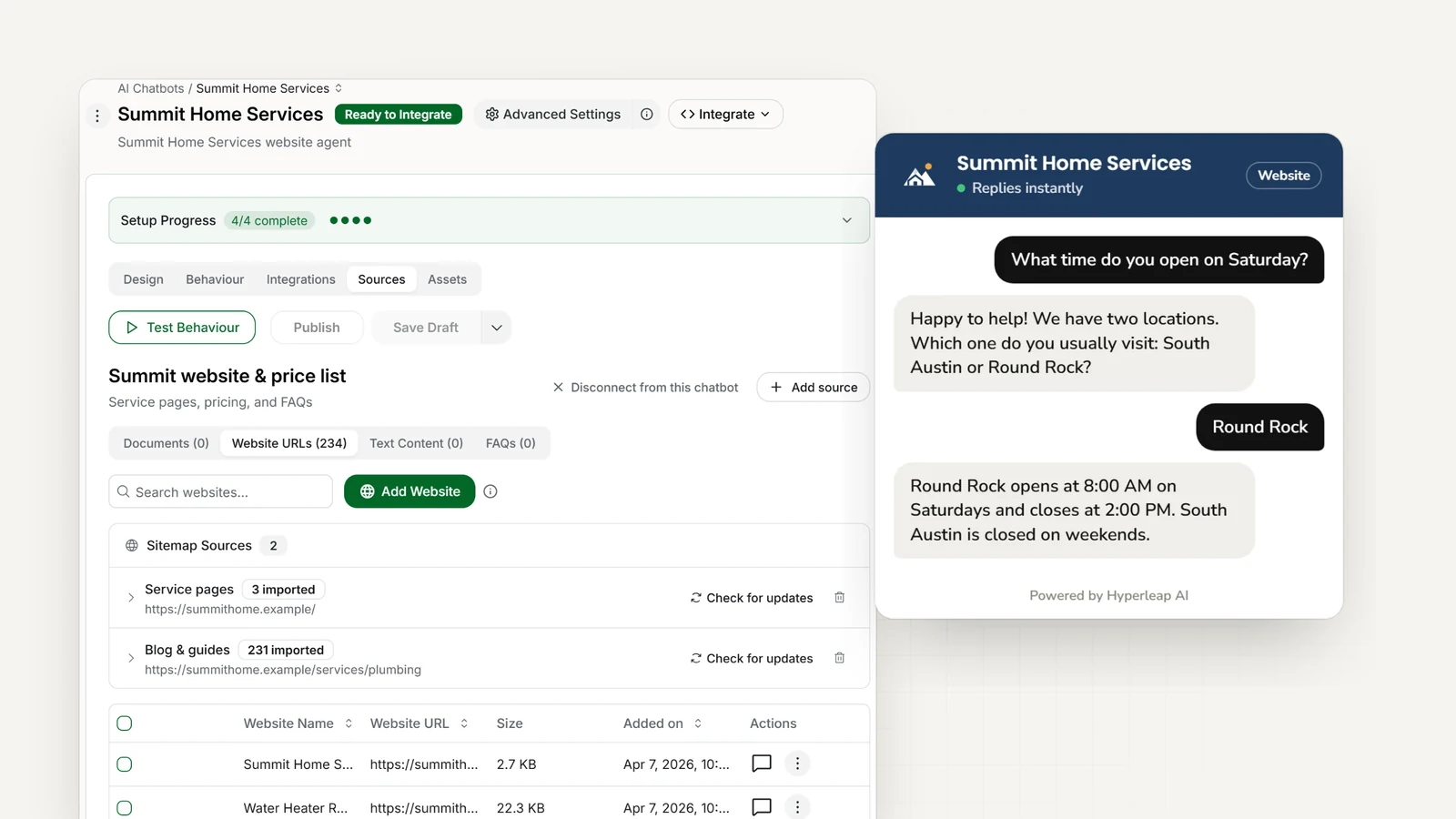
One AI agent can use shared company policies and separate location details. Hyperleap AI’s Multi-variant add-on makes sure each answer comes from the right location and asks which one when unclear. Available on Pro and Max for $40/month plus 2x credits per request.
How it works
Keep each location’s information separate
Branches may have similar services but different hours or prices. Organizing those details by location helps the AI find the information a customer needs.
The Multi-variant add-on first finds the relevant location, then searches its documents for the answer. For questions across locations it reads every one, and when a question doesn’t name a location it asks which one.
Shared company information
Keep company-wide policies, services, and FAQs in one place.
Details for each location
Hours, addresses, amenities, staff, and local pricing sit in location-specific sources.
Find the right location
The Multi-variant add-on answers from the right location, compares across all of them, and asks which one when unclear. Available on Pro and Max.
Update in one place
Each policy or location detail lives in one source, so there are no duplicate copies to keep in sync.
Proof
Proven on a real multi-property chain
Jungle Lodges & Resorts, a Karnataka government tourism enterprise running a portfolio of eco-resort properties, deployed Hyperleap across its properties and captured 3,300+ leads in three months, with 35% of inquiries arriving after hours — traffic that previously went unanswered. One agent, every property, each answered with its own details.
Read the Jungle Lodges case studyWho it fits
Built for businesses like yours
Hotel & resort groups
Per-property amenities, rates context, and directions — one concierge for the whole portfolio.
Dental & medical groups
Each practice’s hours, insurers, and team — with emergencies routed to the right office.
Property management
Tenant and prospect questions answered per building, from one portfolio-wide agent.
Real estate brokerages
Multiple offices and listings behind one agent that qualifies and routes every inquiry.
Gym & studio chains
Class schedules, membership terms, and trainer info that differ by club.
Restaurant groups
Menus, hours, and reservations context per outlet — without per-outlet bots.
Compared
How the alternatives compare
Factual differences that matter when you run more than one location.
| Hyperleap AI | Podium | Chatbase / SiteGPT | |
|---|---|---|---|
| Multi-location knowledge model | Per-location sources; answers from the right one and asks when unclear (Multi-variant, Pro/Max add-on) | Per-location inboxes | Flat document upload; no location model |
| Pricing | Self-serve, from $40/mo | Custom quote via sales team | Self-serve tiers |
| Channels | Website, WhatsApp, Instagram DM, Messenger | SMS/webchat-centric, US-focused | Website-centric |
| Languages | 100+ languages | English-centric | Varies by plan |
Full head-to-head: Hyperleap vs Podium · Chatbase alternatives
FAQ
Frequently asked questions
How does one AI chatbot handle multiple business locations?
Do I need a separate chatbot for each location or franchise?
What happens when information changes at one location?
Which types of multi-location businesses does this work for?
How much does a multi-location AI chatbot cost?
How is Hyperleap different from Podium for multi-location businesses?
Related
Keep exploring
RAG Chatbot
How document-grounded AI keeps answers accurate.
Multi-variant Answers, Explained
How the chatbot picks the right location before it answers.
Chatbot Lead Generation
Capture and qualify leads at every location, 24/7.
Conversational AI for Customer Service
Resolve more conversations across every channel.
Channels
One agent across website, WhatsApp, Instagram, and Facebook.
Case Studies
How real businesses run Hyperleap in production.
Every location answered. One agent to maintain.
Give customers information about the location they need, while managing shared policies in one place.
7-day free trial on all plans. Cancel anytime.