AI Chatbot Security & Data Privacy: A Business Owner's Guide
What business owners need to know about AI chatbot security, data privacy, and compliance before deploying customer-facing AI.

TL;DR: AI chatbot security is broader than encryption — it spans data storage and retention, conversation logging, third-party LLM data policies, identity verification, role-based access, and regulatory compliance (GDPR, HIPAA, CCPA, India's DPDP). The biggest difference from traditional software: chatbots receive unstructured natural-language input, so they routinely capture PII you never asked for — medical details, government IDs, financial data — embedded in normal conversations. Cisco's 2024 Data Privacy Benchmark found 94% of organizations believe customers would not buy from them if data is not properly protected, making privacy a competitive advantage rather than a checkbox. This guide walks business owners through the questions to ask vendors before they deploy, framed in plain language with no technical background required.
Your AI chatbot handles your customers' most sensitive questions — their health concerns, their financial details, their personal contact information. Yet many businesses deploy chatbots without asking a single question about where that data goes. According to Cisco's 2024 Data Privacy Benchmark Study, 94% of organizations said their customers would not buy from them if data were not properly protected. As AI regulation tightens globally and customers grow more privacy-aware, AI chatbot security isn't just a technical checkbox — it's a competitive advantage.
This guide walks you through everything a business owner needs to know about AI chatbot security, data privacy, and compliance before deploying customer-facing AI. Whether you're evaluating your first chatbot platform or auditing an existing deployment, the questions and frameworks here will help you protect both your customers and your business.
Who This Guide Is For
This guide is written for business owners, operations leaders, and decision-makers who are evaluating or have already deployed AI chatbots. You don't need a technical background — we explain every concept in plain language with actionable takeaways.
What Does AI Chatbot Security Actually Mean?
AI chatbot security is the set of practices, policies, and technical controls that protect customer data as it flows through your AI-powered conversations. It goes well beyond a simple "is the data encrypted?" question. When a customer interacts with your chatbot, data moves through multiple layers — from the customer's device to your chatbot platform, often through a third-party AI model provider, and into your storage and analytics systems. Each layer introduces a different set of risks.
A comprehensive AI chatbot security posture covers six key areas:
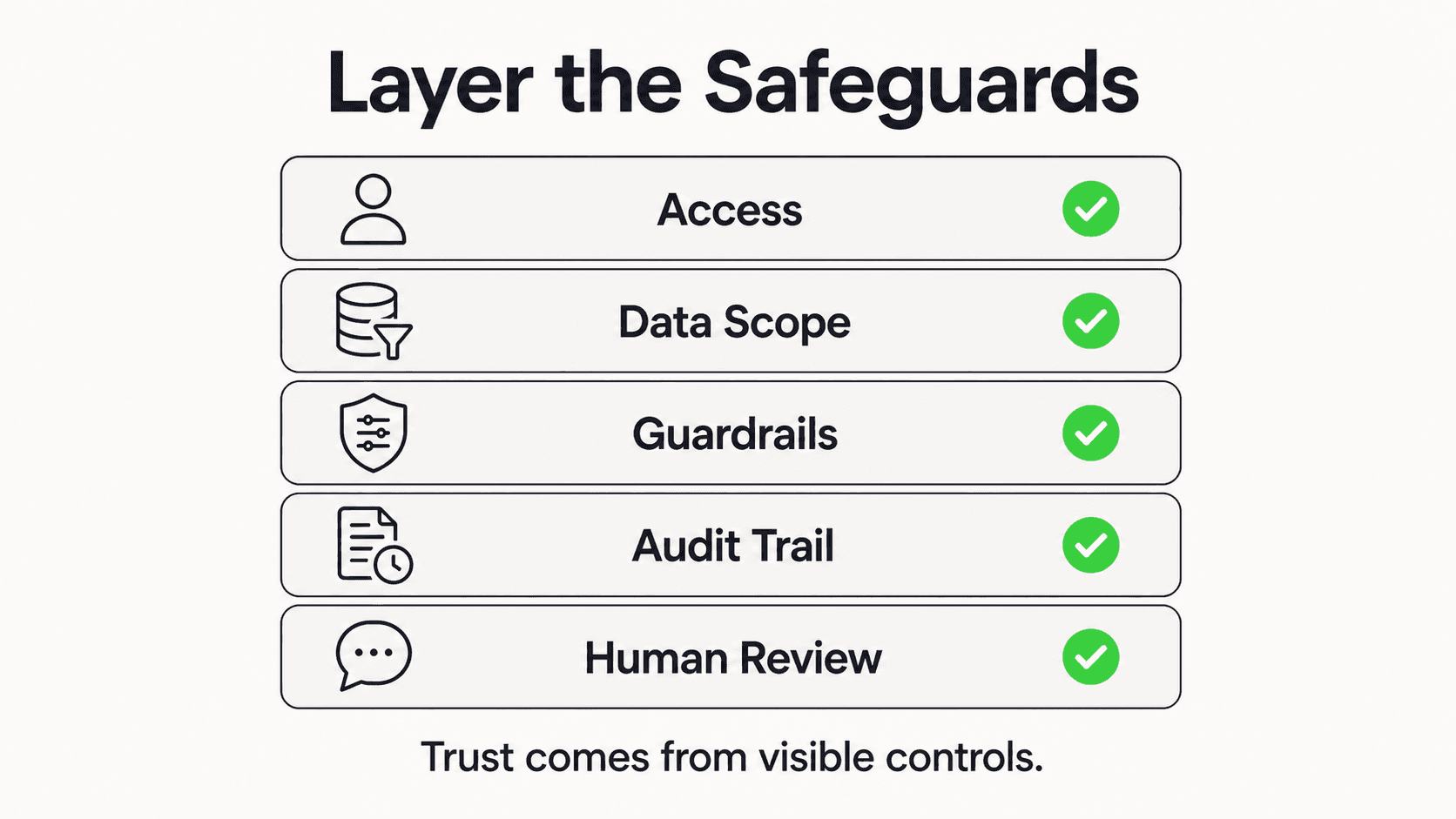
- Data storage and retention: Where are conversation logs kept, for how long, and who controls them?
- Conversation logging and monitoring: What is recorded, who can review it, and how are logs protected?
- Third-party AI model data policies: Does the underlying large language model (LLM) provider use your customer conversations to train or improve their models?
- User authentication and identity verification: How does the chatbot confirm the identity of the person it's talking to, especially for sensitive operations?
- Access controls and team permissions: Who on your team can view, export, or delete conversation data? Are there role-based restrictions?
- Regulatory compliance: Does the platform meet the requirements for your industry and geography — GDPR, HIPAA, CCPA, India's DPDP Act, and others?
Understanding each of these areas is critical because a weakness in any single layer can expose your business to data breaches, regulatory fines, and customer trust erosion. The good news is that asking the right questions during your chatbot platform evaluation can prevent most security risks before they arise.
Why Security and Privacy Matter More for AI Than Traditional Software
AI chatbots introduce security and privacy challenges that traditional web forms and email systems simply don't face. If you've managed customer data before, you might assume the same rules apply. They don't — and here's why.
AI Processes Unstructured Customer Data
Traditional software collects structured data: a name in a name field, an email in an email field. You know exactly what data you're collecting because you designed the form. AI chatbots are fundamentally different. Customers type whatever they want, in natural language. A conversation that starts with "What are your office hours?" can quickly shift to "I need help with my account, my social security number is..." or "My child has been having seizures and I need to see someone urgently."
This unstructured input means your chatbot may inadvertently collect sensitive personal data that you never intended to gather — medical details, financial information, government IDs, or legal matters. Without proper safeguards, this data ends up in your conversation logs alongside routine inquiries.
Conversations Contain Implicit PII
Even when customers don't explicitly share their social security number or credit card, conversations are rich with implicit personally identifiable information (PII). A conversation about a real estate inquiry reveals location preferences, budget ranges, family size, and timeline — a complete buyer profile. A healthcare chatbot interaction reveals symptoms, medication names, and appointment urgency. This implicit PII is often overlooked during security audits because it doesn't match the typical "name, email, phone number" checklist that most data protection frameworks focus on.
Third-Party LLM Providers May Use Data for Training
Most AI chatbot platforms rely on third-party large language models — from providers like OpenAI, Anthropic, Google, or others — to generate responses. The critical question is: what happens to your customer conversations once they reach the model provider? Some LLM providers, depending on the tier of service and the terms of agreement, may use data submitted through their API to improve their models. This means your customers' private conversations could theoretically become part of a training dataset accessible to the model's other users. Enterprise-tier API agreements from major providers typically include data usage exclusions, but the default terms often differ. This is a question you must explicitly ask and get a written answer on from any chatbot vendor.
The Regulatory Landscape Is Evolving Fast
The regulatory environment for AI and data privacy is shifting rapidly across the globe. The EU AI Act, which began phased enforcement in 2025, introduces specific requirements for AI systems that interact with people — including transparency obligations and risk classifications. The GDPR continues to be enforced aggressively, with fines reaching into the hundreds of millions of euros. In the United States, the California Consumer Privacy Act (CCPA) and its successor, the CPRA, establish data rights for consumers that directly apply to chatbot interactions. India's Digital Personal Data Protection (DPDP) Act of 2023 introduces consent-based data processing requirements that affect any business serving Indian customers.
These regulations are not static. They are actively being updated, interpreted, and enforced. A chatbot platform that was compliant in 2024 may not meet the requirements introduced in 2026. This makes it essential to choose a platform that treats compliance as an ongoing commitment rather than a one-time certification.
Evaluating AI Chatbot Platforms?
See how Hyperleap AI approaches data privacy and security for customer-facing AI agents.
Learn More7 Security Questions to Ask Before Deploying Any AI Chatbot
Before you sign a contract with any AI chatbot provider, ask these seven questions. They apply whether you're looking at a well-known platform or a newer entrant, and they'll help you separate vendors who take security seriously from those who treat it as an afterthought.
1. Where Is Conversation Data Stored and for How Long?
Why this matters: The physical location of your data determines which laws apply to it. Data stored in the EU falls under GDPR. Data stored in India is subject to the DPDP Act. If your vendor stores data in a country with weaker privacy protections, your customers' data could be vulnerable to government access requests or less rigorous breach notification standards.
What good looks like: The vendor clearly states which cloud provider and region hosts your data (e.g., AWS eu-west-1 or Azure India Central). They have a documented data retention policy that specifies how long conversations are stored and offer configurable retention periods so you can align with your industry's requirements. They can provide a data processing agreement (DPA) that covers cross-border data transfers.
Red flag to watch for: The vendor cannot tell you where your data is stored, claims it's "in the cloud" without specifics, or has no configurable retention policy. If the sales team defers to "we'll check with engineering," that's a sign security isn't a first-class concern.
2. Does the AI Provider Use Customer Conversations to Train Their Models?
Why this matters: If the LLM provider behind your chatbot uses customer conversations for training, your proprietary business information and your customers' private data could influence model outputs shown to other users. This is a data leakage risk that many businesses overlook because it happens at the model layer, not the application layer.
What good looks like: The vendor has an explicit, written policy stating that customer data is not used for model training. They use enterprise-tier API agreements with their LLM providers that include data usage exclusions. They can share the relevant sections of their LLM provider agreements upon request.
Red flag to watch for: Vague language like "we take privacy seriously" without specifics. Terms of service that include broad data usage rights. Any language like "we may use aggregated data to improve our services" without clearly defining what "aggregated" means and whether conversation content is included.
3. What Encryption Is Used in Transit and at Rest?
Why this matters: Encryption is the baseline security measure. Data in transit (moving between the customer's browser and your chatbot server) should be encrypted to prevent interception. Data at rest (stored in databases and logs) should be encrypted to prevent unauthorized access if the storage infrastructure is compromised.
What good looks like: TLS 1.2 or higher for data in transit. AES-256 encryption for data at rest. The vendor uses encrypted database connections and encrypted backup storage. If you're in a regulated industry, look for end-to-end encryption where the vendor cannot access message content — though this is rare in AI chatbot platforms because the AI model needs to read the message to generate a response.
Red flag to watch for: The vendor cannot specify their encryption standards. They use outdated protocols (TLS 1.0, for example). There's no mention of encryption at rest in their security documentation.
4. Who on My Team Can Access Conversation Logs?
Why this matters: Even within your own organization, not everyone should be able to read customer conversations. A marketing analyst might need aggregate metrics, but they shouldn't have access to individual conversation transcripts that contain health details or financial information. Without role-based access controls (RBAC), you create an internal data exposure risk.
What good looks like: The platform offers role-based access controls where administrators can define who sees what. At minimum, there should be distinct roles for: administrators (full access), agents (access to their assigned conversations), analysts (aggregate data only), and read-only viewers. Audit logs should record who accessed which conversations and when.
Red flag to watch for: Everyone on your team can see all conversations by default with no way to restrict access. No audit trail of who viewed what. The vendor's admin panel has a single "admin" role with no granularity.
Don't Overlook Internal Access Risks
According to the Verizon 2024 Data Breach Investigations Report, 68% of breaches involved a non-malicious human element — mistakes, misconfigurations, or social engineering. Proper access controls within your chatbot platform are just as important as protecting against external threats.
5. How Does the Chatbot Handle Sensitive Information It Shouldn't Collect?
Why this matters: Customers will share sensitive information in chat conversations whether you ask for it or not. Someone might type their credit card number, health condition, or legal situation into a chatbot that was only designed to answer product questions. If your chatbot stores this data without safeguards, you may be collecting and retaining regulated data you're not equipped to protect.
What good looks like: The platform offers PII detection and redaction capabilities that can identify and mask sensitive data patterns (credit card numbers, social security numbers, health identifiers) before they're stored in conversation logs. The chatbot has configurable boundaries — you can instruct it to redirect sensitive conversations to a human agent rather than attempting to handle them. Your knowledge base configuration can include explicit instructions about what information the chatbot should and should not collect.
Red flag to watch for: No PII detection or redaction features. The chatbot stores all conversation text verbatim with no filtering. No mechanism to redirect sensitive conversations to human agents.
6. What Compliance Certifications Does the Provider Hold?
Why this matters: Compliance certifications are independent verification that a vendor follows recognized security practices. While certifications alone don't guarantee security, their absence suggests the vendor hasn't invested in formal security processes. For regulated industries, specific certifications may be legally required.
What good looks like: SOC 2 Type II certification (demonstrates ongoing security controls, not just a point-in-time snapshot). GDPR compliance documentation including a Data Protection Impact Assessment (DPIA) template. For healthcare, a HIPAA Business Associate Agreement (BAA) available upon request. ISO 27001 certification for information security management. The vendor proactively shares their compliance documentation rather than making you ask for it.
Red flag to watch for: The vendor claims to be "GDPR compliant" or "HIPAA ready" but cannot produce documentation. No SOC 2 report is available. Certifications are self-declared rather than independently audited. The vendor has never undergone a third-party security audit.
7. What Happens to My Data If I Cancel the Service?
Why this matters: Vendor lock-in is a real risk with AI chatbot platforms. If you decide to switch providers — or if the vendor goes out of business — you need to know that you can export your data and that the vendor will delete their copy. Data portability isn't just a nice-to-have; under GDPR and several other regulations, it's a legal right.
What good looks like: The vendor provides a data export feature that lets you download all conversations, contact data, and configuration in standard formats (CSV, JSON). They have a documented data deletion policy that specifies how long after cancellation your data is retained and when it is permanently deleted. The deletion process includes all backups and replicas, not just the primary database. They provide written confirmation of deletion upon request.
Red flag to watch for: No data export feature. Vague language about post-cancellation data handling. The vendor retains data indefinitely after cancellation "for analytics purposes." No written commitment to permanent deletion.
Industry-Specific Compliance Considerations
Different industries face different regulatory requirements for AI chatbot deployments. Here's a quick reference for the most commonly affected sectors.
Healthcare — HIPAA
Any chatbot that handles protected health information (PHI) in the United States must comply with the Health Insurance Portability and Accountability Act. This means your chatbot vendor must sign a Business Associate Agreement (BAA), implement access controls for PHI, maintain audit logs, and ensure encrypted storage. The chatbot itself should be configured to avoid collecting PHI unnecessarily and to route clinical conversations to qualified staff rather than attempting to provide medical advice.
Legal — Attorney-Client Privilege
Law firms deploying AI chatbots face a unique challenge: conversations between attorneys and clients are protected by attorney-client privilege. If a chatbot handles initial client intake, the conversation data must be protected to the same standard as any attorney-client communication. This means strict access controls, encrypted storage, and clear policies about which conversations are privileged. Firms should ensure that third-party LLM providers cannot access the content of privileged communications.
Financial Services — PCI-DSS and SOX
Financial institutions must ensure that chatbot conversations never store payment card data in violation of PCI-DSS requirements. If customers share account numbers or financial details in chat, PII redaction becomes critical. The Sarbanes-Oxley Act (SOX) adds requirements for data integrity and audit trails that apply to any customer communication system, including chatbots.
Education — FERPA
Educational institutions in the United States must comply with the Family Educational Rights and Privacy Act when deploying chatbots that interact with students or parents. Student records, grades, and enrollment information are protected, and the chatbot platform must ensure that this data is only accessible to authorized personnel.
EU Businesses — GDPR
The General Data Protection Regulation applies to any business that processes the personal data of EU residents, regardless of where the business is located. For chatbot deployments, this means explicit consent before data collection, the right to access and delete data, mandatory data breach notifications within 72 hours, and data processing agreements with all sub-processors (including the LLM provider).
India — Digital Personal Data Protection Act 2023
India's DPDP Act requires consent-based processing of personal data, purpose limitation (data can only be used for the stated purpose), and the right to erasure. Businesses deploying chatbots for Indian customers must ensure their platform supports granular consent management and can demonstrate purpose limitation for all collected data.
Compliance Is Not One-Time
Regulations evolve. The EU AI Act's phased enforcement continues through 2026, and India's DPDP Act rules are still being finalized. Choose a chatbot provider that treats compliance as an ongoing process with regular updates, not a one-time certification achieved and forgotten.
Building Customer Trust with Transparent AI
Security and compliance protect you legally, but customer trust is earned through transparency. According to Salesforce's 2024 State of the Connected Customer report, 79% of customers say they are more loyal to companies that are transparent about how they use their data. Here's how to communicate your AI chatbot's security posture to your customers in a way that builds, rather than erodes, trust.
Disclose That They're Talking to AI
Transparency starts with honesty about what the customer is interacting with. Many jurisdictions, including the EU under the AI Act, now require that users be informed when they are communicating with an AI system rather than a human. Beyond legal requirements, being upfront about AI builds credibility. A simple introductory message like "I'm an AI assistant for [Your Business Name]. I'm here to help with your questions. For complex matters, I can connect you with our team." sets the right expectation.
Provide a Privacy Disclosure Within the Chat
Don't bury your data handling practices in a Terms of Service page that nobody reads. Include a concise privacy notice accessible directly within the chat interface. This should state what data is collected during the conversation, how long it's retained, and how the customer can request deletion. A well-implemented chat privacy disclosure might look like a small "Privacy Info" link in the chat header that expands to show a brief, plain-language summary.
Make Opt-Out Easy
Customers should be able to end data collection at any point during a conversation. This means providing a clear mechanism to opt out of conversation logging or to request that a specific conversation be deleted. Under GDPR, this is a legal requirement; under most other frameworks, it's a best practice that demonstrates respect for customer autonomy.
Show, Don't Just Tell
If your chatbot platform has strong security credentials, communicate them visibly. Display relevant compliance badges (SOC 2, GDPR-compliant) in your chat widget or on your website's chatbot page. If your AI chatbot implementation uses document-grounded responses to minimize hallucinations, explain that to customers: "My responses are based on [Your Business Name]'s official documentation." This kind of transparency differentiates responsible AI deployments from careless ones.
Create a Public AI Use Policy
Consider publishing a brief, accessible document on your website that explains how your business uses AI in customer interactions. Cover what the AI can and cannot do, what data it collects, how that data is protected, and how customers can escalate to a human. This proactive transparency is increasingly expected by privacy-conscious consumers and can serve as a differentiator in industries where trust is paramount.
Platforms like Hyperleap AI enable businesses to configure AI disclosure messages, set conversation boundaries, and manage knowledge bases to keep responses grounded in verified information. When evaluating any platform, look for these transparency controls as part of the standard feature set rather than as costly add-ons.
Protecting Your Business Starts with the Right Questions
AI chatbot security isn't a one-time setup task — it's an ongoing commitment that protects your customers, your reputation, and your business. The businesses that get this right build a lasting competitive advantage. When customers trust that their data is handled responsibly, they engage more freely, share more useful information, and develop stronger loyalty.
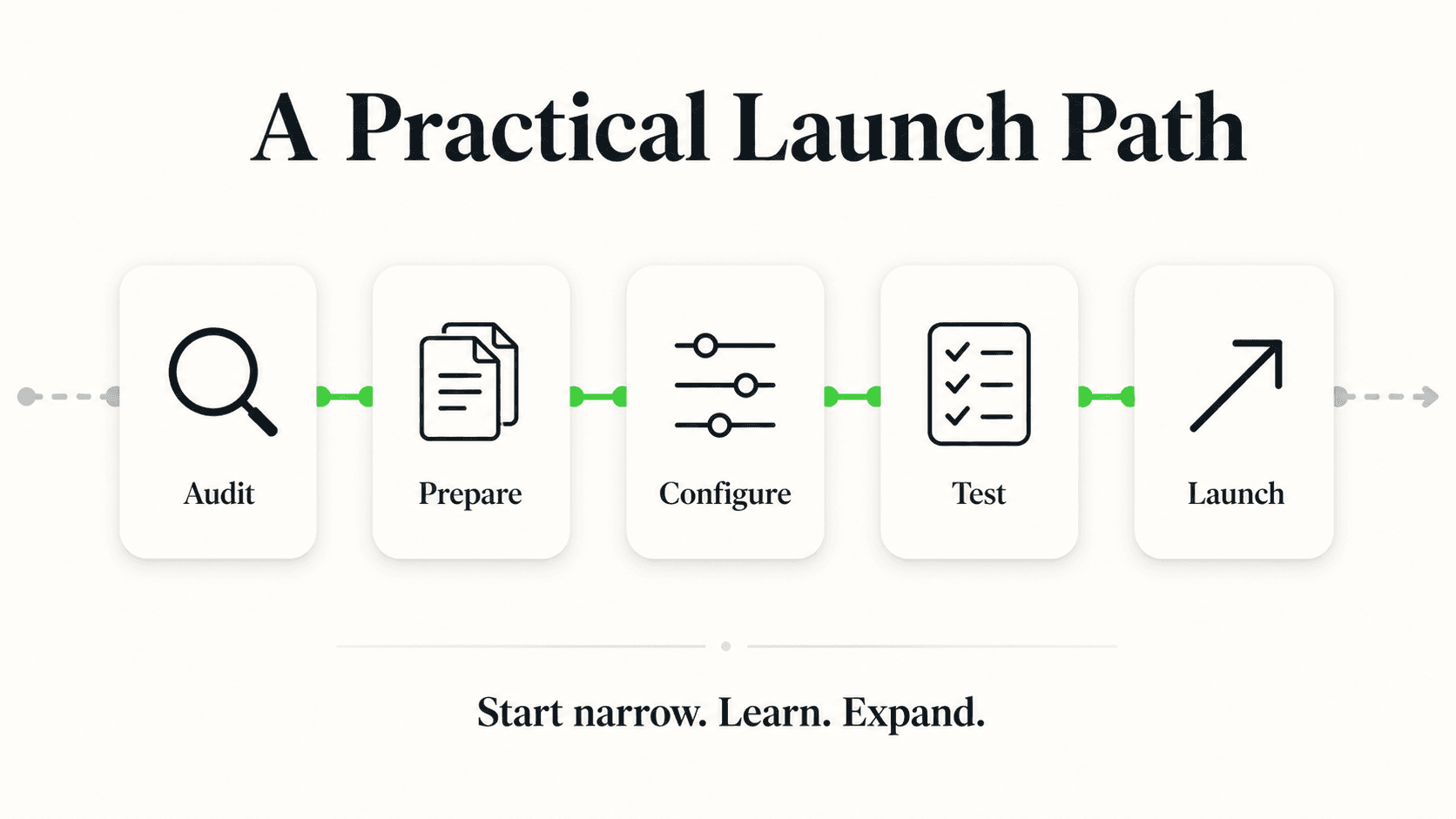
The seven questions in this guide give you a practical framework for evaluating any AI chatbot provider's security posture. Don't accept vague reassurances. Ask for documentation, review data processing agreements, and test data export and deletion capabilities before you commit.
As you evaluate your options, look for platforms that make security and transparency a core part of the product rather than an afterthought. Features like document-grounded AI responses, configurable data retention, role-based access controls, and clear AI disclosure messages should be standard, not premium add-ons.
The regulatory landscape will only grow more complex. The businesses that invest in secure, transparent AI deployments today are the ones that won't be scrambling to retrofit compliance tomorrow.
Further Reading
Authoritative external sources used and recommended for further research on this topic:
Accounting firms have their own version of this confidentiality question — see AI chatbot for accounting firms.
Frequently Asked Questions
Is my customer data safe with AI chatbots?
Customer data safety depends entirely on the platform you choose and how you configure it. A well-implemented AI chatbot with encrypted data storage, role-based access controls, and a clear data retention policy can be as secure as — or more secure than — traditional communication channels like email or phone, where conversations are often unencrypted and access is uncontrolled. The key is to evaluate your provider's security practices using the seven questions outlined in this guide before deployment, not after.
Do AI chatbots comply with GDPR?
AI chatbots can comply with GDPR, but compliance is not automatic. It requires the platform to support explicit consent collection before processing personal data, the right to access and delete data on request, data processing agreements with all sub-processors including the LLM provider, and breach notification capabilities. Ask your vendor for their GDPR compliance documentation and Data Protection Impact Assessment template. If they cannot provide these, they may not meet GDPR requirements.
Can AI chatbots be HIPAA compliant?
AI chatbots can be used in HIPAA-regulated environments, but only if the vendor signs a Business Associate Agreement (BAA), implements the required technical safeguards (encryption, access controls, audit logs), and ensures that protected health information is handled according to HIPAA's minimum necessary standard. Not all chatbot platforms offer HIPAA-compliant configurations, so this must be verified during vendor evaluation. For a deeper look at this topic, see our guide to HIPAA-compliant AI chatbots.
What if a chatbot accidentally collects sensitive data?
This is one of the most common risks with AI chatbots because customers volunteer information unprompted. The best mitigation is a platform that offers PII detection and redaction — automatically identifying sensitive data patterns like credit card numbers, social security numbers, or health identifiers and masking them before they're stored. Additionally, configure your chatbot's knowledge base and system prompts to instruct it to redirect sensitive conversations to a human agent rather than processing them. If sensitive data is collected, have a documented incident response procedure that includes notifying affected customers and regulators as required by your jurisdiction.
How do I audit my chatbot's data practices?
Start with a quarterly review of your chatbot platform's access logs: who accessed conversation data, when, and for what purpose. Review your data retention settings to ensure old conversations are being deleted according to your policy. Test your data export and deletion capabilities to verify they work as documented. Check that your LLM provider's data usage terms haven't changed. If you're in a regulated industry, consider engaging a third-party security firm for an annual audit that covers your chatbot as part of your broader data processing infrastructure.
Should I tell customers they're talking to AI?
Yes. Beyond the ethical argument for transparency, many jurisdictions now legally require it. The EU AI Act mandates that users be informed when they are interacting with an AI system. Even where not legally required, disclosure builds trust — customers who discover they were unknowingly talking to AI feel deceived, while customers who know from the start tend to appreciate the speed and availability. Frame the disclosure positively: "I'm an AI assistant here to help you instantly, 24/7. I can also connect you with our team if you prefer." This positions AI as a benefit, not a compromise.
Ready to Deploy AI with Confidence?
Hyperleap AI gives you document-grounded responses, team access controls, and multi-channel deployment — built with data privacy in mind from day one.
Get StartedRelated Articles

HIPAA Compliant Chatbot Checklist: Free 2026 Tool
Is your chatbot HIPAA compliant? Free 30-question self-assessment covering BAAs, PHI handling, encryption, and audit logging — get a downloadable report.

How Many Languages Does ChatGPT Support?
OpenAI doesn't publish an official language count for ChatGPT. Here's what's known, and why it matters less than you'd think for a business chatbot.

AI Front Desk for Insurance Agencies: Quoting & Compliance
How an AI front desk handles insurance quoting, lead qualification, and multiple lines of business — and exactly where a licensed agent takes over.

How to Add an AI Chatbot to Squarespace (Step by Step)
Step-by-step guide to adding an AI chatbot to Squarespace via Code Injection, plus plan requirements, troubleshooting, and a pre-launch checklist.