Guide
AI Agent Platforms for Small Business: A Buyer's Guide
Compare AI agent platforms for small and multi-location businesses: scoring criteria, privacy checks, rollout steps and how to choose the right fit.

Gopi Krishna Lakkepuram · Founder & CEO
· 15 min read
23% of organizations were scaling an agentic AI system in at least one business function in 2025, and another 39% had begun experimenting with AI agents, according to McKinsey's 2025 global survey of 1,993 respondents. The same survey makes that headline less flattering than it reads. Among organizations scaling agents, most were doing so in only one or two functions, and no single business function had more than 10% of respondents reporting scaled adoption.
Money is arriving faster than working deployments. Omdia's September 2025 analysis projects the enterprise agentic AI software market growing from $1.5 billion to $41.8 billion by 2030, a forecast that assumes buyers keep signing contracts after the first year.
Two things decide whether a purchase works, and neither is on the feature list of most comparisons. The first is whether the agent completes the same task on the fifth attempt as on the first. The second is whether you can see what it did and stop it when it goes wrong. Small businesses carry more risk on both counts than large ones, because there's no platform team to catch a bad action and no security department to read the audit log.
Table of Contents
- Platform Types and Operating Differences
- Criteria Worth Scoring Before You Shortlist
- Privacy, Governance and Compliance Checks
- Which Platform Fits Your Business Situation
- Run a Two-Week Pilot Before You Commit
- Roll Out the Chosen Platform in One to Two Weeks
Platform Types and Operating Differences
A customer messages a dental clinic at 9pm asking for a Saturday appointment. A chatbot replies with opening hours and a link to the contact form. An agent opens the booking calendar, finds two Saturday slots, asks whether the visit is a checkup or a hygienist appointment, collects a name, phone number and date of birth, confirms the slot, sends the confirmation and leaves a summary in the front desk inbox before the practice opens its doors.
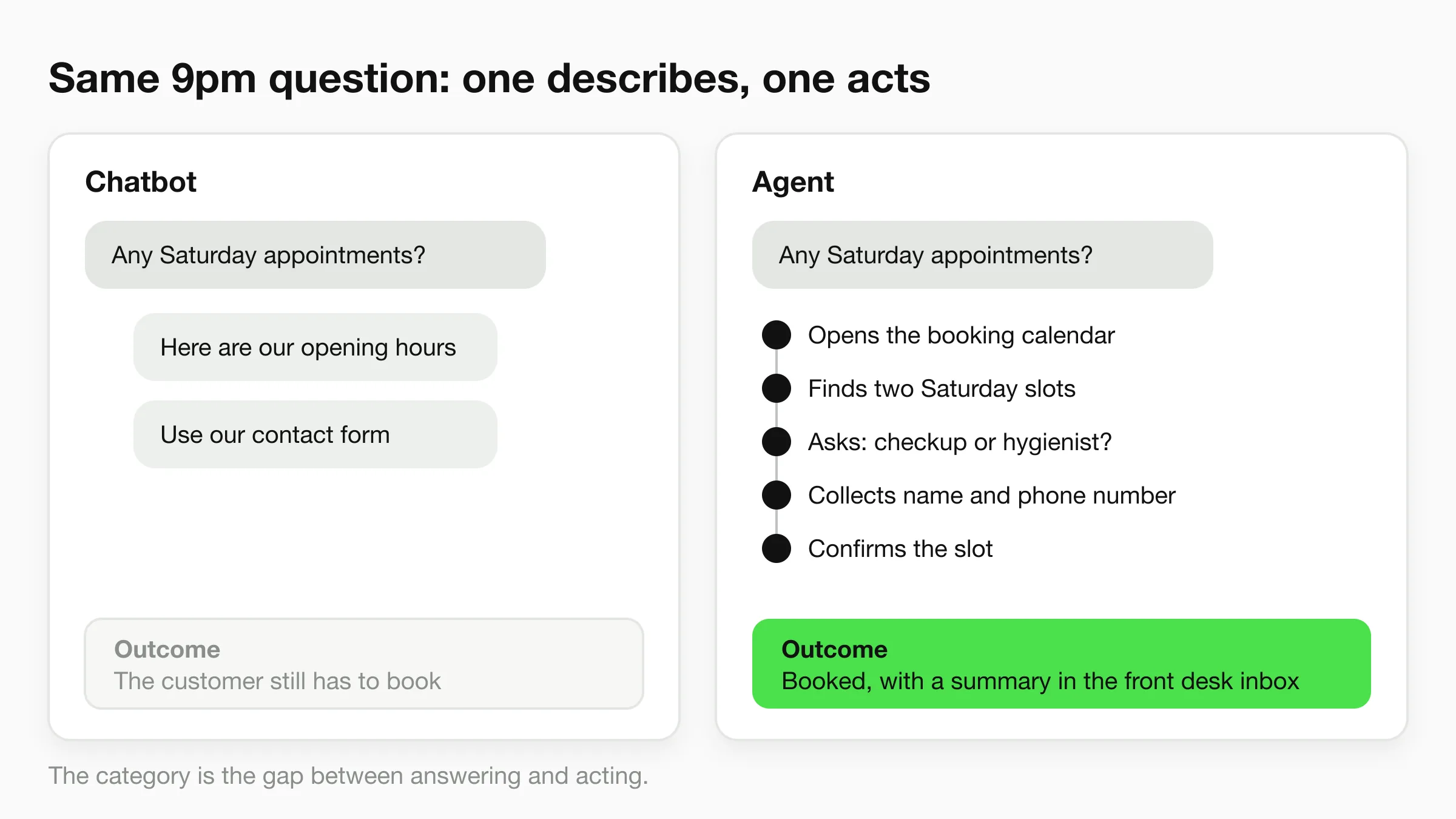
That gap between answering and acting is the category. IBM's history of AI agents traces the term back to the 1955 Dartmouth proposal and points out that today's platforms get evaluated on task completion and system integration rather than response quality. If you're still working out whether you need an agent at all, the practical difference between an AI agent and a chatbot comes down to whether the system can retrieve, decide and act across your systems, or only describe them.
Buyers have already moved. In 2025, 79% of companies surveyed by PwC reported they were adopting AI agents, and 66% of adopters said the agents were delivering measurable productivity value. Adoption isn't the same as fit, though. Four platform types cover most of the market, and each fails in a different way.
The Four Types and What Each Does Best
| Platform type | Main job | Typical buyer | Channels | Multi-location setup | Setup effort |
|---|---|---|---|---|---|
| Customer-facing agents | Answer visitors, qualify leads, book appointments | Small service businesses, clinics, hotels | Website chat plus WhatsApp, Instagram and Messenger | Central knowledge base that answers for the right location | Hours to days |
| Enterprise agent builders | Multi-system workflows across CRM, ticketing and ERP | Mid-size and large IT teams | Set by connectors, usually web and CRM | Possible, needs admin design | Weeks with IT support |
| Developer frameworks | Full control over logic, models and hosting | Engineering teams | Whatever the team builds | Built in code by the team | Weeks to months with engineers |
| Workflow automation with AI steps | Trigger-based tasks across apps and forms | Operations staff and solo founders | Email, forms and app triggers | Set up per workflow, repeated per branch | Days |
Customer-facing agents are the shortest path from a website visitor to a booked appointment. One knowledge base feeds website chat, WhatsApp, Instagram and Messenger, so a clinic answers the same question on four channels without writing four scripts. The weakness is depth: most of these platforms read your content and hand off to a booking link, but they won't reconcile a reservation against room inventory or write into a legacy CRM without connectors.
Enterprise agent builders trade the other way. They carry role-based permissions, approval steps and audit logs because they live inside systems of record, which is what a finance or support operation needs. The price is calendar time: a mid-size company planning a workflow across three systems should budget weeks, and someone has to own the admin design.
Developer frameworks hand you the model, the orchestration and the hosting. Engineering teams pick them when the agent must behave in a way no vendor anticipated, and they pay for the freedom in maintenance: prompts, evaluation sets, retries and monitoring all become your code to keep alive. Langbase's State of AI Agents research, which collected responses from more than 3,400 developers across over 100 countries, reflects how large that build-it-yourself population already is.
Workflow automation with AI steps, in tools like Zapier, Make or n8n, suits the operations manager who wants a form submission to create a ticket and draft a reply. It's cheap to start and predictable when the task is rule-driven. It turns fragile the moment conversation quality matters, because the AI step has no channel memory, no grounding beyond the prompt and no human takeover built in.
Where Multi-Location Setups Break
Hotel groups and real estate brands hit one specific failure mode: every branch keeps its own copy of the knowledge base. Rates drift, parking instructions go stale, and two locations give different answers to the same question in the same week. What you need is one central knowledge base for brand-level facts with clearly separated location details for rates, hours and access, an agent that answers from the right location and asks which one when a question doesn't say, and updates made in one place rather than through a support ticket.
Before you shortlist anything, write down three actions you want automated, say after-hours lead capture, appointment booking and a shipping question. Then check which platform type can perform all three without custom code. If any one of them needs a build, you're not buying a platform, you're buying a project.
Criteria Worth Scoring Before You Shortlist
A demo answers "can it?" Your business needs "how often, how fast, and at what cost?" Those are different questions, and the second set is where most purchases go wrong.
An enterprise-agent evaluation of 300 tasks found that similar precision could involve up to a 50× cost difference, and agents tuned only for accuracy were 4.4 to 10.8× more expensive than cost-aware alternatives with comparable results (CLEAR evaluation framework). Reliability bends the same way. One tested system in that evaluation fell from 60% success on a single run to 25% consistency across eight runs, which is exactly the distance between a demo that impresses and an agent you'd leave running overnight.
The Scorecard to Copy Into a Spreadsheet
| Criterion | Question to ask the vendor | Red flag |
|---|---|---|
| Cost per completed conversation | What does one resolved lead or booking cost, including model usage? | Pricing with no stated usage limits |
| End-to-end latency | What is the p95 response time on each channel? | Only average response times quoted |
| Task success across runs | How often does the same conversation succeed on repeat runs? | Results from a single demo only |
| Escalation and handoff | How does a person take over a chat and hand it back? | No way for staff to take over a chat |
| Knowledge grounding | Does the agent answer only from our uploaded content? | Answers drawn from general web knowledge without a source |
| Security and compliance | Where is data stored, and what processing terms apply? | No data processing terms offered |
| Channel coverage | Which channels run on official business APIs? | Unofficial or scraping-based connections |
The CLEAR framework behind that 300-task study gives the scorecard its spine: Cost, Latency, Efficacy, Assurance and Reliability. Benchmarks built for tool-using agents go further and specify the units worth recording, including wall-clock and p50/p95/p99 step latency, API spend and token counts, HTTP-call counts and peak memory (AgentSLABench methodology). For a buyer, token counts and HTTP calls are diagnostic: a rising call count usually means a brittle integration or an agent looping through orchestration it doesn't need.
Weighting by What You're Automating
If the agent's job is lead capture and booking, weight reliability and latency above raw model capability. A slightly less articulate agent that answers in three seconds and never drops a booking beats a brilliant one that stalls on the tail. For regulated intake, such as a clinic collecting health details, weight assurance higher and treat unclear data processing terms as a disqualification rather than a negotiation point.
The rule that saves the most money: ask every vendor to run the same 20 real conversations from your own inbox, and quote p95 response time, escalation rate and cost per resolved case. A vendor who can only show one polished demo has told you what you need to know.
Privacy, Governance and Compliance Checks
Ask a vendor what their agent is allowed to do without asking a human, and most sales decks change the subject. That silence is measurable. Only 21% of organizations had a mature governance model for agentic AI, even though 74% expected to deploy agents within two years, in Deloitte's global survey of 3,235 business and technology leaders. Approximately 80% lacked mature decision boundaries, real-time monitoring and complete action logs.
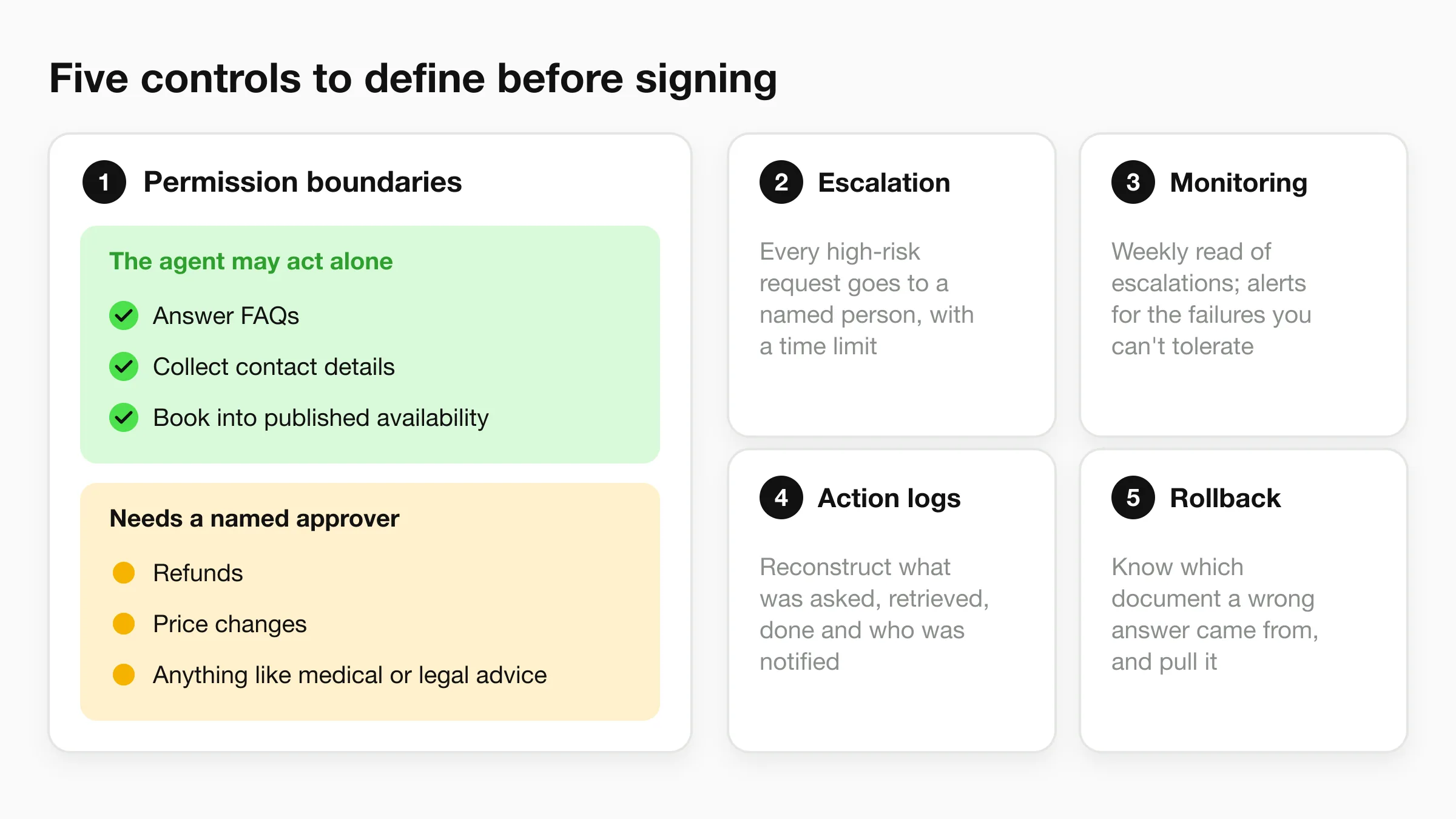
That's a control gap, not a documentation gap. Governance here is an operating model you run every week, and five controls carry most of the weight.
Five Controls to Define Before Signing
- Permission boundaries. Write two lists. Actions the agent may take alone, such as answering FAQs, collecting contact details and booking into published availability. Actions that require approval, such as refunds, price changes and anything that sounds like medical or legal advice. Keep the second list short and name the approver.
- Escalation. Every high-risk request needs a route to a named person and a time limit. "Someone on the team will see it" is how a complaint becomes a review.
- Monitoring. Someone reads escalations and unanswered questions weekly, and real-time alerts fire for the two or three failures you can't tolerate, such as a wrong policy answer or a booking for a service you don't offer.
- Action logs. You should be able to reconstruct every step of a conversation after an incident: what the customer asked, what the agent retrieved, what it did and who was notified.
- Rollback. A wrong price can sit in a knowledge base for weeks. Removing it takes a minute if you know which document it came from and whether the agent cached it.
Privacy Questions That Come Before the Price
Ask where customer data is stored, whether the vendor offers GDPR-aligned processing terms, how long transcripts are retained and whether you can export them. Those four answers determine what you can promise your own customers. If you're still deciding how much conversation data to hand over, this guide to chatbot data privacy and security for businesses covers retention, access and consent questions worth putting in writing.
For WhatsApp, confirm the vendor runs on Meta's official Business APIs rather than unofficial connections, because unofficial links break when a number is flagged and give you no route to template approval. Hyperleap AI is a Meta Technology Provider and Business Partner, and our WhatsApp, Instagram and Messenger channels run on Meta's official Business APIs.
The counterintuitive test: for a 12-person business, the better platform may be the one with the fewest autonomous actions. Constrained autonomy, approvals, logs and recovery are far easier to supervise than raw capability.
Which Platform Fits Your Business Situation
Platform type narrows the field. Business situation picks the winner inside it. Five situations account for most small and mid-size purchases, and each has one check that separates a deployment that holds up from a subscription cancelled in month three.
| Business situation | Priority | Shortlist type | Check before signing |
|---|---|---|---|
| Multi-location hotel or real estate group | One knowledge base with location-specific answers | Customer-facing agent with central knowledge base | Answers come from the right location, and the agent asks which one when it's unclear |
| Dental or med spa clinic | Intake forms and appointment booking | Customer-facing agent with booking integration | Patient data storage and consent capture |
| Marketing agency managing client messaging | Separate accounts across WhatsApp, Instagram and Facebook | Customer-facing agent with multi-channel inbox | Account separation and clean exports |
| Single-site service business | After-hours lead capture | Customer-facing agent with quick-start setup | Lead summaries reach the team the same day |
| Shopify, WordPress or Webflow store | Live order or stock answers | Agent with API actions | Permissions scoped to each API key |
Multi-location hotels and real estate groups live or die on location accuracy. Change one branch's rate in the knowledge base, then ask the same question on a branch-specific channel and once without naming the branch: the agent should answer for the right location or ask which one. If the update needs a ticket or a re-upload, every location will drift within a quarter.
Clinics need intake and booking more than conversation. The deciding question isn't whether the agent can book, it's where the patient's details land and whether consent is captured before the appointment is confirmed. A clinic that stores intake data in a dashboard nobody opens has built a compliance risk, not a front desk.
Agencies should test account separation first. Push two client brands through the same login and check whether knowledge bases, inboxes and exports stay separate. A merged inbox is a client confidentiality incident waiting to happen, and clean CSV exports matter because clients ask for reporting.
A single-site service business mostly wants after-hours capture, and a quick-start agent covers it. The check is unglamorous and decisive: does the lead summary reach the person on call the same evening, on the phone they carry?
Stores on Shopify, WordPress or Webflow asking about order status need API actions, not better prose. Scope each key to read-only order and stock endpoints, and confirm the agent fails politely when the API times out instead of inventing a delivery date.
Hyperleap AI sits in the customer-facing row: no-code setup, one central knowledge base (the Multi-variant add-on, $40/mo plus 2x credits per request on Pro and Max, answers from the right location and asks which one when a question doesn't say), OTP verification (a paid add-on on Pro and Max, website chat only), a unified inbox across website, WhatsApp, Instagram and Messenger, and CSV or Excel export. That fits small and multi-location businesses without an IT team. It's the wrong buy for a team that needs deep ERP workflows or custom model hosting, where an enterprise builder or a developer framework will cost more and fit better.
Run a Two-Week Pilot Before You Commit
Two platforms, one channel, the same 20 questions, three passes on each. That's the whole method, and it beats any demo because it produces numbers you own rather than numbers a vendor selected.
The stakes are easy to underrate. In McKinsey's 2025 State of AI report, only 39% of respondents reported any level of EBIT impact from AI, and most of those said AI contributed less than 5% of EBIT. A pilot that measures cost per resolved lead and records how the agent fails tells you whether your use case sits in the other 61%.
What to Log on Every Run
- p95 response time per channel. Averages hide the slow tail, and the slow tail is what customers abandon.
- Accuracy, question by question. Mark each of the 20 as correct, partially correct or wrong. Partial credit is where vague answers hide.
- Handoff quality. Did the agent recognise the request needed a person, and did the person get the context without asking the customer to repeat themselves?
- Cost per resolved lead. Total platform and model spend divided by leads captured, not conversations started.
- Summary arrival. Confirm the lead summary lands in your inbox and in the right inbox, not just the account owner's.
- Takeover and hand-back. Check whether staff can enter a live conversation and return it to the agent afterwards. On Hyperleap AI, that handover is included on Pro and Max, so test it on the plan you intend to buy rather than a sandbox.
Include two deliberately hard questions in the set, such as an out-of-scope request and a two-part question about pricing and parking, plus one that must reach a human, such as a refund demand. Those three reveal more about a platform than the other 17 combined.
Fix the Decision Rule Before the Clock Starts
Set the decision date two weeks out and write two thresholds per platform before the first run: the p95 response time you'll accept, and the accuracy score below which you walk away. Add a rule for cost per resolved lead, because a platform that wins on quality and loses on unit economics is still a loss at your volume.
Hyperleap AI is one option to test in this format. The agent replies in seconds, asks qualifying questions and emails the team a clean summary, and the Plus, Pro and Max plans include a 7-day trial, which fits inside the two-week window if you start the same week you shortlist.
Roll Out the Chosen Platform in One to Two Weeks
A pilot that ends with a winner and no plan often becomes a second pilot. Book the rollout before you sign, put the dates in the calendar, and give each step an owner who can be named in a message.
The Five Steps, in Order
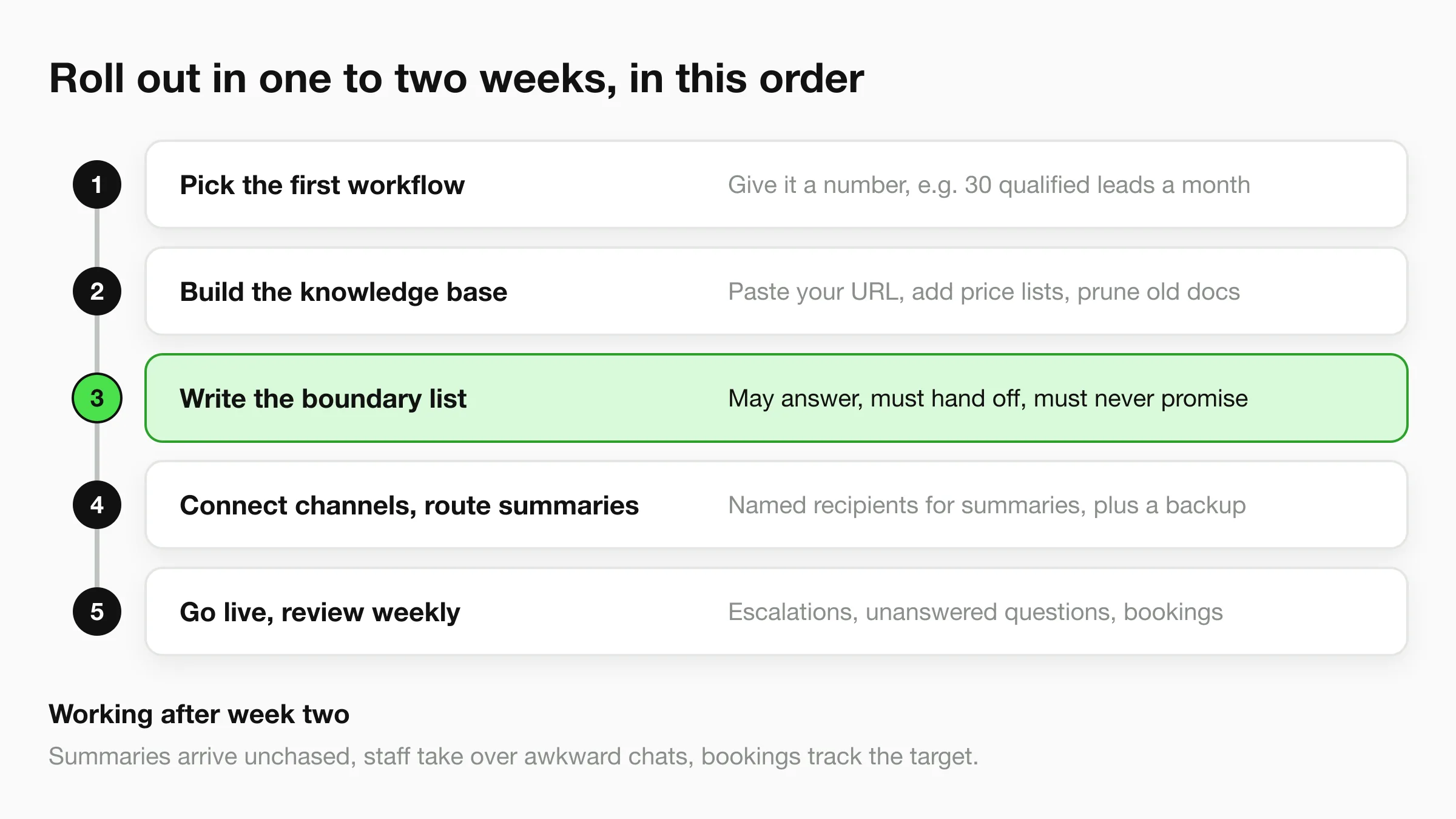
- Pick the first workflow and give it a number. After-hours lead capture, say, with a target of 30 qualified leads a month. Without a number you can't tell a working agent from a present one.
- Build the knowledge base from the source, then prune it. Paste your website URL, upload price lists, policy documents and location details, then delete anything outdated. Grounding is only as good as the worst document you feed it.
- Turn the boundary list into writing. What the agent may answer, what it must hand to a person, what it must never promise, whether that's a delivery date, a discount or clinical advice. This is your governance model compressed to one page, and it's the document you'll reach for when something goes wrong.
- Connect the channels and route the summaries. Website, WhatsApp, Instagram and Messenger, with named recipients for lead summaries and one backup. A captured lead nobody reads is a diary entry.
- Go live and review weekly for the first month. Read escalations, unanswered questions and bookings against the target. Most first-month questions reveal a knowledge gap rather than a model failure, and fixing the document is faster than changing the prompt.
Hyperleap AI's agent goes live in under 5 minutes once the knowledge base is ready, and that's the moment testing starts, not the moment watching stops. If you want the sequence with more detail on each screen, this step-by-step deployment walkthrough follows the same order.
What working looks like after week two: summaries arrive without anyone chasing them, staff take over the awkward conversations without asking for a login, and bookings track the target you set on day one. If any of the three misses, the rollout isn't finished, whatever the launch date said.
Hyperleap AI gives small and multi-location businesses a no-code AI agent that answers questions, qualifies leads and books appointments across the website, WhatsApp, Instagram and Messenger (natively with Calendly or Cal.com on Pro and Max; on Plus it shares your booking link), grounded in a single knowledge base, with Multi-variant and OTP verification available as paid add-ons on Pro and Max. It's built for the kind of two-week rollout described here: paste your URL, set your boundaries, log your 20 conversations, and decide on numbers you collected yourself. Visit Hyperleap AI to start a 7-day trial and run the pilot on your own customers.