Guide
Information Retrieval System Explained: A Practical Guide
Learn how an information retrieval system works: crawling, indexing, BM25, vector search, evaluation metrics, privacy and small business use.

Gopi Krishna Lakkepuram · Founder & CEO
· 16 min read
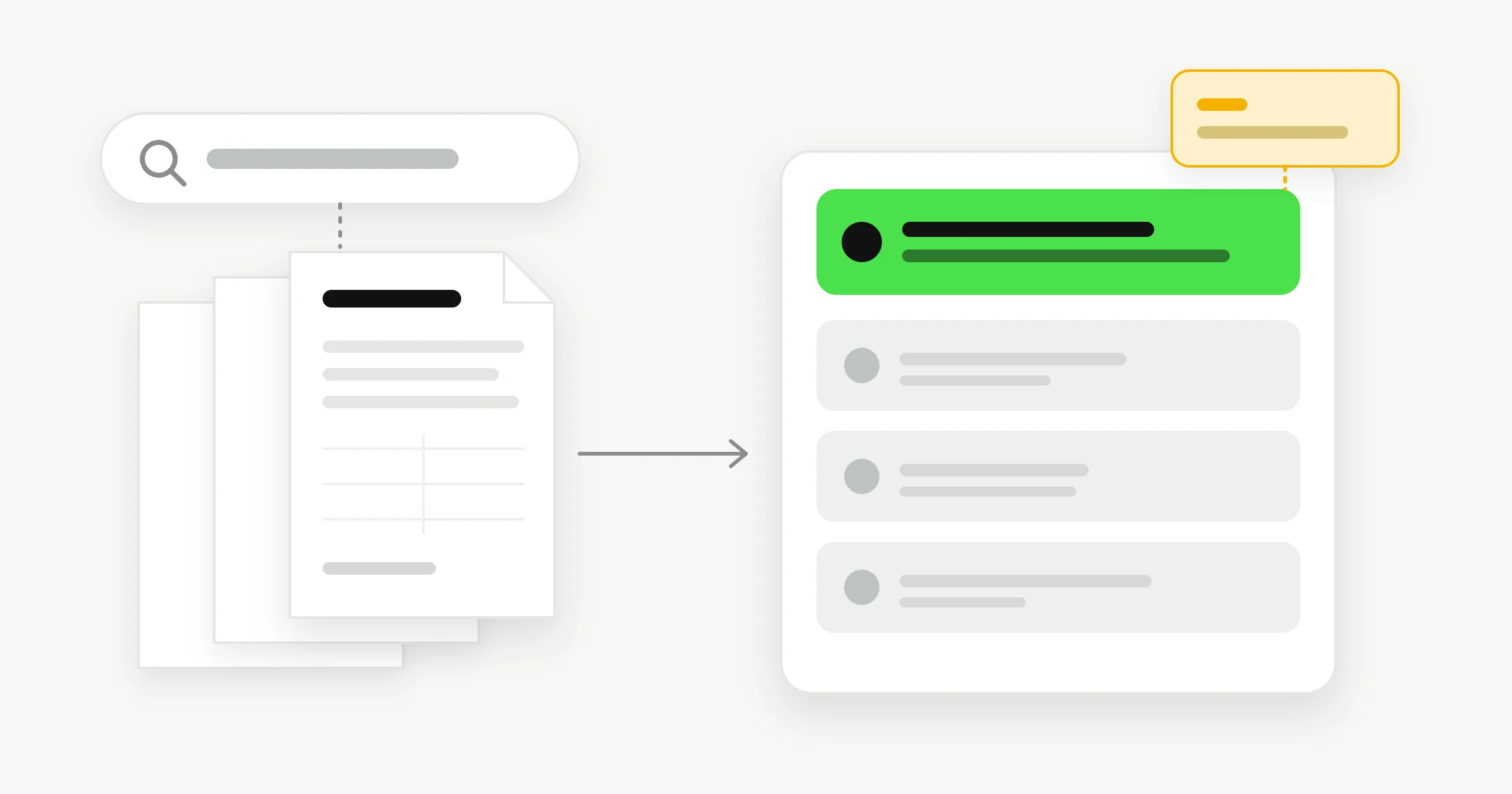
An information retrieval system stores content, matches a person's question to the most relevant items, and returns them in ranked order.
You've probably used one while searching your own website for a cancellation policy or trying to find the document that answers a customer's question. The frustrating part isn't always finding something relevant. It's finding an answer you can safely act on, including the exception buried in another file.
For a business, that distinction matters. A customer who finds a service description but misses its eligibility conditions may leave with the wrong expectation, even when the search worked exactly as designed.
Table of Contents
- What an Information Retrieval System Does
- The Four Stages From Crawling to Ranking
- Boolean, BM25 and Vector Search Compared
- Metrics That Show Whether Results Are Good
- Why Relevant Results Can Still Fail
- Privacy, Governance and Scaling Safely
- How to Build a Knowledge Base in Five Steps
- Pick Your First Retrieval Use Case
What an Information Retrieval System Does
Think of a librarian helping someone find information about starting a business. A helpful librarian doesn't just find books containing the word business. They ask whether the visitor needs registration requirements, bookkeeping guidance, or help choosing a legal structure.
An information retrieval system performs a similar matching task across a collection of content. It uses the person's request to identify useful material, then orders that material according to an estimate of relevance.
The collection and the question
Every retrieval system needs these inputs:
- A collection: Website pages, support articles, contracts, product descriptions, or other searchable material.
- An information need: A question, a phrase, a selected topic, or another expression of what someone wants to know.
Say a hotel guest asks whether they can arrive late with a dog. The useful material might include reception hours, late-arrival instructions, and the pet policy. Finding only a page about check-in would address the topic without satisfying the whole request.
That's different from a conventional database lookup. A precise database query might return the booking associated with a confirmation code. Retrieval handles less structured requests, partial matches, and judgments about which results deserve attention first. Real applications often combine both approaches.
Why evaluation matters
In 1992, NIST, working with the U.S. Department of Defense and DARPA, created the Text REtrieval Conference to compare systems using shared collections, information needs, and human relevance judgments, according to NIST's TREC overview. This made retrieval quality something researchers could test under comparable conditions rather than infer from technical features.
You'll encounter retrieval in website search, enterprise document search, support chatbots, and the evidence-gathering step inside AI assistants. The interface changes, but the underlying question stays practical: did the person receive material that satisfied their need?
Practical rule: Judge a search system by the information people can successfully use, not by the size of its document collection.
A huge index is an inventory. A useful answer is an outcome.
The Four Stages From Crawling to Ranking
A search box hides a chain of preparation and selection. To diagnose a bad result, follow the content through that chain rather than immediately changing the chatbot's instructions.
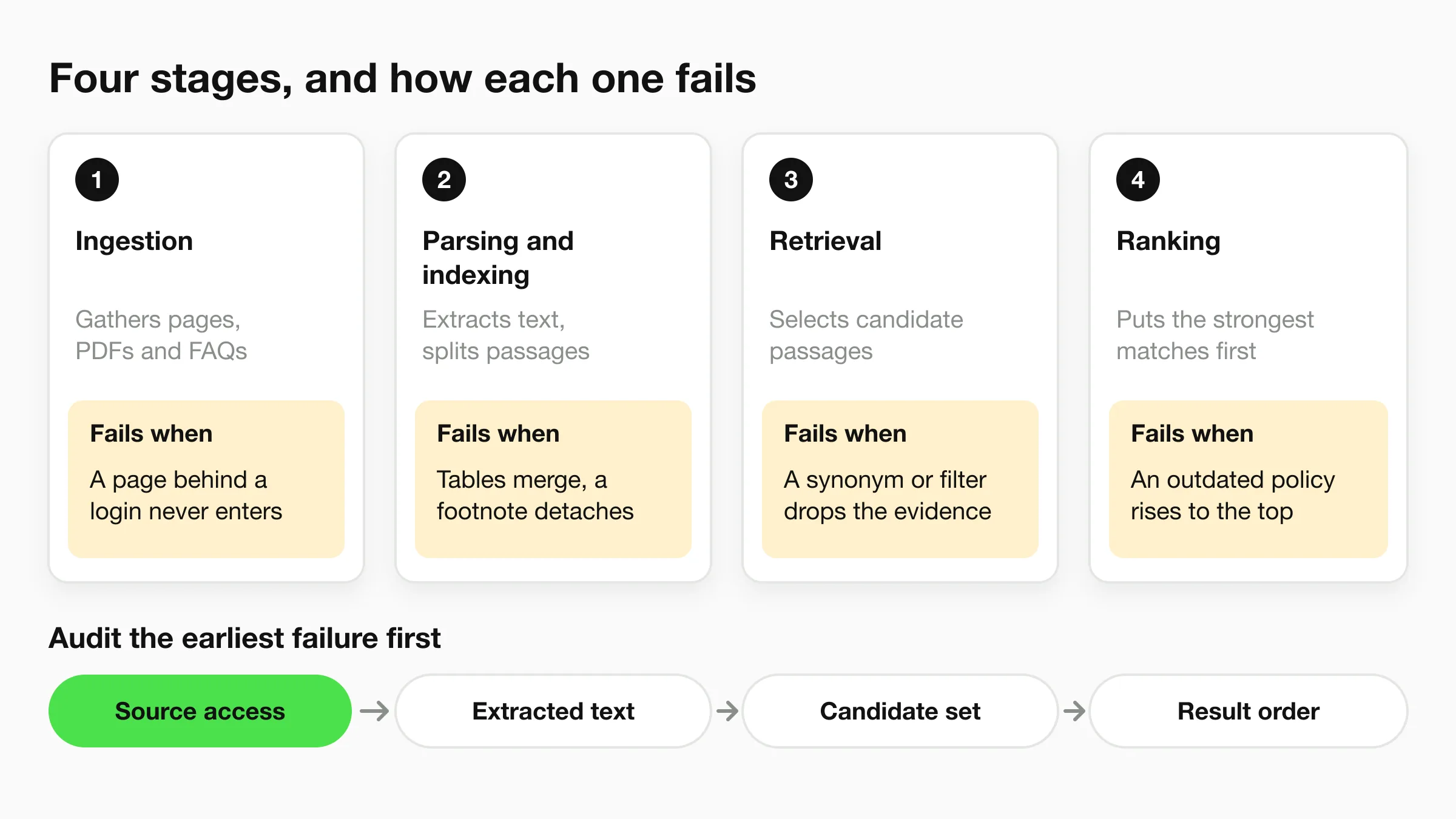
This flow shows where the work happens.
Follow the content through the pipeline
Crawling or ingestion gathers the material. A crawler follows approved website pages, while connectors and uploads bring in PDFs, product sheets, FAQs, and suitable past tickets. Record each source, its owner, access permissions, and update information, because a page behind a login won't become searchable unless an authorized ingestion method can reach it.
Parsing and indexing make the material searchable. Extract text and structure, normalize case and punctuation where appropriate, remove navigation clutter, and split long documents into meaningful passages. An inverted index maps terms to the documents containing them; optional vector embeddings support meaning-based matching, but poor parsing can still merge separate price tables or detach a footnote from the service it qualifies.
Retrieval selects candidates. The system interprets the request and searches its indexes for potentially useful documents or passages. This stage should favor adequate coverage, because a missed synonym, restrictive filter, or incorrectly interpreted location can exclude the evidence before a ranking model ever sees it.
Ranking orders the candidates. A scoring method places the strongest matches first, and a separate re-ranker may refine that order using closer query-document comparison. An outdated policy can still rise to the top if the system rewards textual similarity without applying approval status and effective-date rules.
The boundaries aren't always separate software components. BM25, for example, can both retrieve candidates and score their order. The stages are still useful for understanding which responsibility failed.
Audit the earliest failure first
Suppose a customer asks about a warranty exclusion and receives an incomplete answer. First, check whether the exclusion document entered the collection at all. Then inspect the extracted passage, the candidate results, and the final ordering.
Changing ranking settings won't recover a document that ingestion never collected. Likewise, a fluent answer generator can't reconstruct a table that the parser scrambled without risking an unsupported claim.
Keep a diagnostic record for failed questions: the expected source, the extracted text, whether it entered the candidate set, and where it appeared in the returned results. That record turns vague complaints about bad answers into specific fixes.
The audit path is straightforward: source access, extracted content, candidate coverage, then result order.
Boolean, BM25 and Vector Search Compared
| Model | How it matches | Strength | Weakness | Best fit |
|---|---|---|---|---|
| Boolean | Exact AND, OR and NOT on terms | Precise and auditable | Returns all matches or none, without inherent relevance ranking | Compliance and legal lookups |
| BM25 | Term frequency weighted by rarity and document length | Fast, explainable, strong baseline | Misses synonyms and paraphrases | FAQs and catalogues with exact terms |
| Vector (semantic) | Similarity of text embeddings | Matches meaning and paraphrase | Can miss exact codes; needs embeddings | Free-text and multilingual questions |
| Hybrid (BM25 plus vector) | Combined keyword and meaning scores | Covers exact terms and meaning | More components to tune | Most customer-facing search |
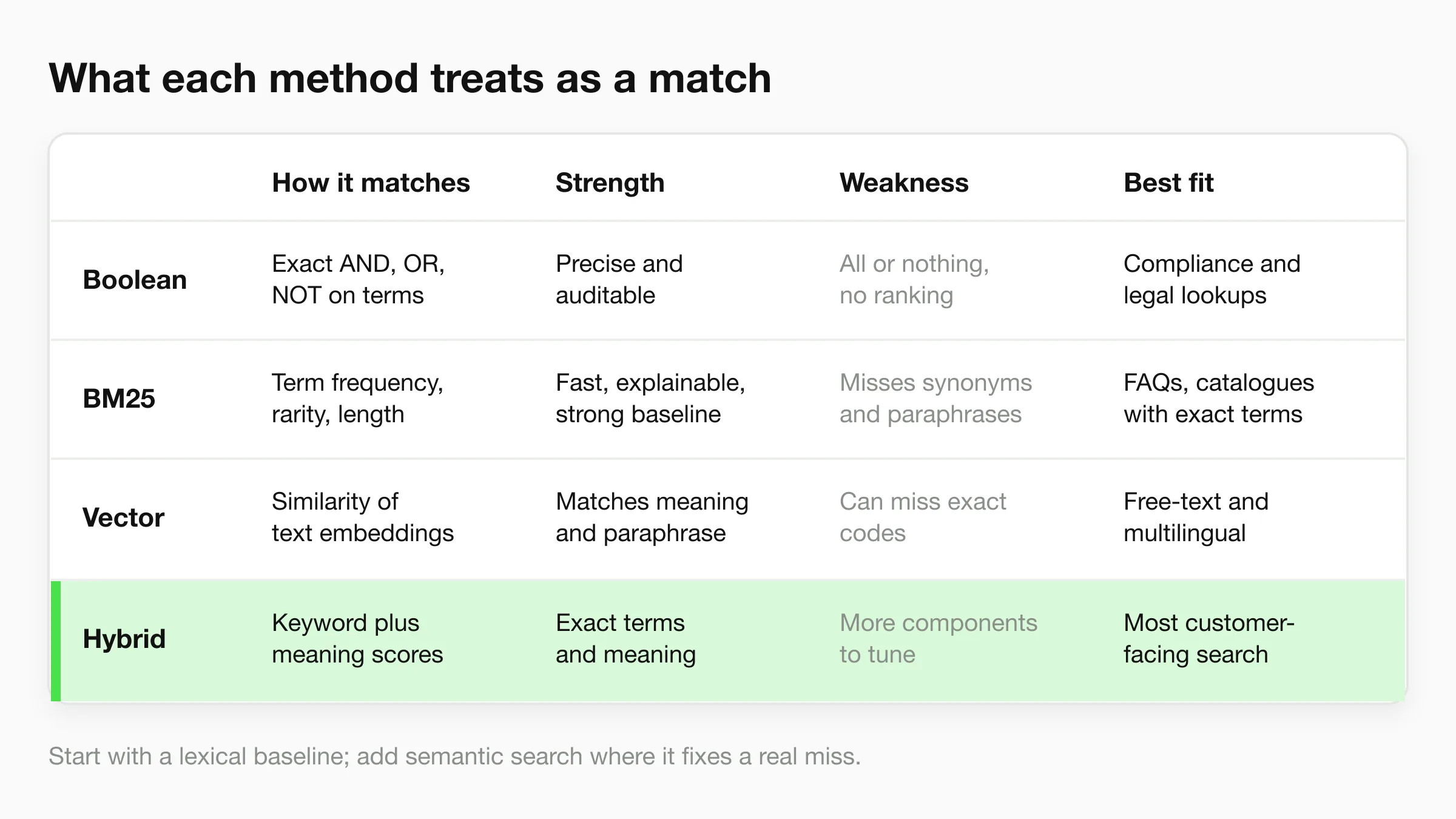
The methods differ mainly in what they treat as a match. This comparison provides a visual reference.
Exact words versus similar meaning
Boolean retrieval uses explicit conditions. A staff member searching for cancellation AND wedding NOT supplier can inspect the logic and understand why documents qualify. Pure Boolean matching doesn't decide which qualifying document is most helpful, although a search application can add ranking afterward.
BM25 gives documents relevance scores based on query terms. It considers how often terms occur, gives more weight to less common terms, and adjusts for document length. For a customer asking about a named replacement part, that direct connection to the words can be useful and explainable.
However, a page that says withdraw your reservation might not match cancel my booking strongly enough through lexical overlap alone. Vector search addresses that problem by representing text as numerical embeddings and comparing their similarity. It can connect paraphrases and support cross-language matching when the embedding model supports the languages involved.
Meaning-based matching introduces a different risk. Similar descriptions can refer to different products, and exact model numbers may matter more than semantic resemblance. Don't assume a nearby embedding means an interchangeable item.
What benchmark results actually tell you
Across 18 publicly available datasets, the BEIR benchmark found that BM25 remained a reliable general-purpose baseline, while late-interaction and re-ranking methods achieved stronger average retrieval quality at substantially greater computational cost. Its evaluation also showed that dense retrievers could struggle to generalize beyond their training distribution.
That's a reason to test against your own questions, not a reason to dismiss semantic search. An approach that works well for conversational travel questions may need adjustment for technical maintenance documents.
Hybrid retrieval combines lexical and semantic candidates or scores. A query containing both a product identifier and a conversational description can benefit from exact-term matching alongside meaning-based matching. The extra coverage comes with more tuning, including how to merge results and avoid duplicates.
A re-ranker then compares the query with selected candidates more closely. That extra work is easier to justify for a small shortlist than for an entire collection.
For customer-facing search, start with a lexical baseline, test where it misses natural language, and add semantic retrieval where it solves a demonstrated problem. Use re-ranking when better final ordering is worth the added processing, rather than treating the most complex architecture as the default.
Metrics That Show Whether Results Are Good
| Metric | What it measures | How to read it | Blind spot |
|---|---|---|---|
| Recall@K | Share of relevant documents found among the top K candidates | Higher means more of the labeled relevant material entered the pool | Says nothing about order |
| MRR@10 | Average reciprocal rank of the first relevant result within the cutoff | Higher means the first relevant result appears nearer the top | Ignores other relevant results |
| nDCG | Graded relevance with a position discount | Rewards putting the most useful results first | Needs graded relevance labels |
| Precision@K | Share of the top K results that are relevant | Lower means more noise is shown to the user | Ignores answers that were never retrieved |
K is the result cutoff you choose to inspect. Measure candidate retrieval and the final displayed order separately, because they answer different operational questions.
Coverage and position are different goals
Recall@K asks whether the relevant material entered the candidate pool. If a customer's question needs both a warranty policy and an exclusion schedule, labeling only the policy as relevant will make the evaluation too forgiving.
MRR@10 focuses on the position of the first relevant passage. It's useful when someone needs a direct answer quickly, but it doesn't establish that all supporting conditions were retrieved.
The MS MARCO passage-ranking evaluation reports approximately 0.165 to 0.167 MRR@10 for a conventional BM25 baseline, compared with about 0.359 to 0.365 for an early BERT large re-ranker. These are benchmark-specific results, not a forecast of what a business website will achieve.
The operational lesson is to separate finding eligible evidence from arranging it well. A re-ranker may improve the first useful result's position while leaving an omitted document undiscovered. Conversely, broad retrieval may collect the necessary evidence but bury it beneath distracting results.
A good position for a relevant passage doesn't prove that the system found every passage needed to answer the question.
Add graded judgments and inspect failures
nDCG, or normalized discounted cumulative gain, helps when usefulness isn't relevant or irrelevant. A generic service page might deserve less credit than a page explaining the exact service, applicable location, and booking restriction.
Precision@K exposes a different problem: clutter. If users must inspect unrelated policies before finding an answer, the result set needs attention even if the relevant source is technically present.
Build a test collection from real customer emails and chats. For each question, label the required sources, their usefulness, and the conditions a complete answer must include.
Track recall and top-result ranking whenever you change content, parsing, filters, or retrieval models. Keep the question set stable enough to compare changes, but add newly discovered failure cases. Review individual failures alongside averages so a good overall score doesn't hide an unsafe answer category.
Why Relevant Results Can Still Fail
Say a dental clinic's chatbot retrieves the cleaning price list and gives the customer the listed price. The answer looks helpful, but the applicable policy says X-rays are excluded and may be needed separately. The retrieved passage is relevant; the customer's understanding is incomplete.
Relevance is not sufficiency. The system must find evidence for the decision the customer is trying to make, not merely evidence about the same topic.
Where incomplete answers come from
A communication-oriented retrieval study found that standard relevance scores explained only about 1% of the variation in human ratings of answer completeness. That finding challenges the assumption that improving relevance scores automatically produces decision-ready answers.
The gaps often take recognizable forms:
- Missing exceptions: A service description is retrieved without the eligibility restriction or exclusion attached to it.
- Location-specific rules: The answer uses a general policy when a particular branch has an approved exception in another document.
- Multilingual differences: The main page lacks a caveat that appears in the Spanish-language version, so translation alone can't supply it.
These aren't solved by making the final response sound more confident. They require better evidence coverage and a way to identify what remains unanswered.
Check the request before composing the answer
Break a compound request into requirements. For a guest asking about late arrival, parking, and an accessible entrance, record those needs separately and check that each has supporting evidence.
If a requirement lacks support, search specifically for the missing part. If the answer changes by location or service type, ask a clarifying question instead of selecting a convenient interpretation.
Abstention means declining to supply an unsupported answer. It needn't end the conversation: the assistant can explain what it can confirm, identify what it can't, and offer the appropriate human handoff.
Grounding generated answers in approved documents helps limit fabricated detail. It doesn't make missing caveats appear, and a citation to a relevant page doesn't prove that every sentence in an answer is supported.
For high-stakes responses, use a completeness checklist:
- Conditions: Who qualifies, and which exceptions apply?
- Location: Does the answer match the relevant branch or property?
- Price qualifier: What's included, excluded, or subject to assessment?
- Currency: Is the source approved and applicable now?
- Unknowns: Does the response explain what remains unresolved and how to get help?
Treat those checks as acceptance criteria, not optional wording added after a ranking test passes.
Privacy, Governance and Scaling Safely
A retrieval system can return a relevant policy and still expose information to the wrong person. Safe operation depends on controlling what enters the collection, who can access it, and what happens when the evidence does not support an answer.
Set access, retention, and fallback rules
- Approve the collection: Identify which documents and folders the system may use. Apply permissions during retrieval, not only when content is added.
- Minimize personal information: Remove unnecessary names, contact details, and sensitive information from reusable examples. Keep transactional customer data separate from general reference content.
- Set retention deliberately: Decide how long transcripts are needed, limit access to authorized roles, and establish deletion procedures.
- Make reviews possible: Let authorized staff inspect what customers were told and retain appropriate audit records.
- Define the fallback: Specify how unanswered questions reach the team and which topics require a qualified person.
Hyperleap AI lets you read past conversations to check what the AI told a customer. You choose the fallback wording and the topics it should avoid. For more guidance, see this guide to chatbot security and data privacy.
A system should also know when to abstain rather than guess. The MTRAGEval benchmark found that only 15 of 28 evaluated models correctly abstained on most tasks involving difficult question types, including unanswerable or underspecified requests. Test this behavior directly; a conversational interface does not guarantee that a system will recognize the limits of its evidence.
Scale without losing document authority
As a collection grows, staff may add competing versions of the same policy. Record approval status, effective dates, and superseded versions so retrieval can favor the currently effective, approved version. The newest upload may describe a policy that has not taken effect.
For multiple locations, keep shared rules centrally and document local exceptions clearly. Check permissions and location filters whenever a branch is added.
Document where information is stored, who can access it, which GDPR deletion procedures apply, and who is responsible for recurring reviews. These controls help keep privacy, document authority, and safe handoff consistent as the collection grows.
How to Build a Knowledge Base in Five Steps
A useful knowledge base starts with editorial decisions, not file uploads. Organize content around the questions customers ask and the evidence staff need to answer them safely.
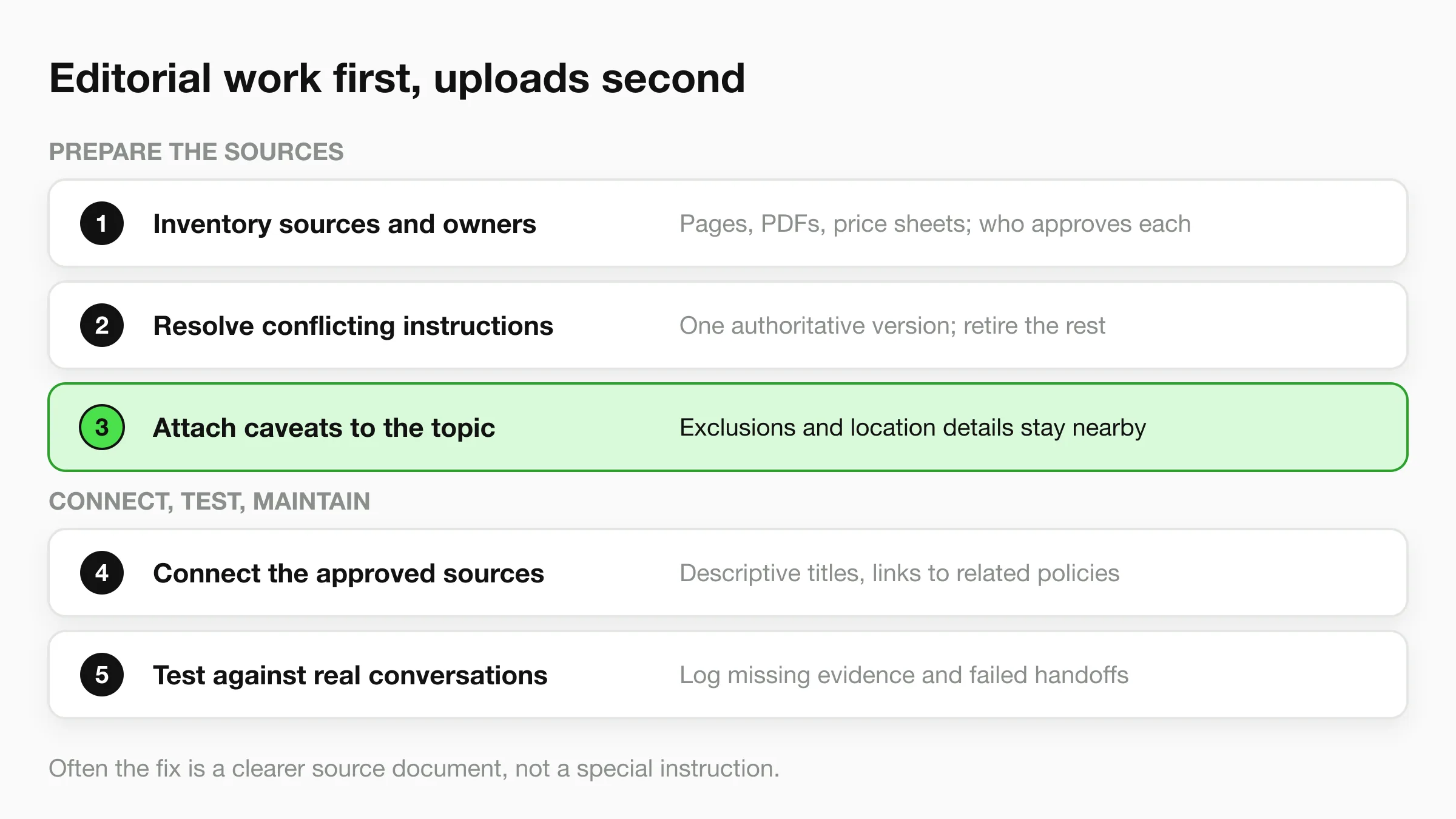
This checklist provides a maintenance-oriented view of the work.
Prepare the sources before connecting them
Inventory the sources and their owners. List the pages, PDFs, price sheets, policies, and procedures staff consult, then record who approves changes and when each item was last reviewed. Group them by customer task, such as eligibility, preparation, booking, or cancellation, rather than relying only on internal department names.
Resolve conflicting instructions. Select the authoritative version of each policy and retire superseded material from the active collection. Don't leave an old brochure searchable merely because its design looks better than the replacement.
Attach the caveats to the answerable topic. Keep exclusions, location details, preparation requirements, and response-time qualifications near the statements they modify. Preserve meaningful headings and table labels so extracted passages remain understandable outside their original page layout.
Before connecting a website, inspect what its pages contain as text and note material that needs editorial cleanup; treat any text-extraction check as an inspection aid, not proof that every crawler will extract identically.
Connect, test, and maintain
Connect the approved sources. Add website pages and documents with descriptive titles, clear headings, a plain statement of which location or service each applies to, and links to related policies. During our setup, you can attach your service catalog, SLA sheet, SOPs, and onboarding checklist so the assistant has the operational context needed to answer in your business's way.
Test against real conversations. Use questions from recent emails and chats, including ambiguous requests, exceptions, and topics the assistant shouldn't answer. Compare each response with its supporting passages, then log missing evidence, incorrect conditions, unsupported wording, and failed handoffs as separate issues.
Don't rewrite every failed answer as a special instruction. Sometimes the right fix is a clearer source document, a document that doesn't say which location it covers, or a corrected table.
Use our knowledge base best practices guide to develop an ongoing editing and review routine. Assign an owner to each topic so corrections don't depend on someone remembering which file they originally uploaded.
A successful test response should identify the applicable evidence, state the condition that affects the customer, and avoid filling a gap with a plausible guess. When the source is silent, the next action should be clear enough that the customer doesn't have to restart their request elsewhere.
Pick Your First Retrieval Use Case
| Use case | Source documents | Questions answered | Escalate when |
|---|---|---|---|
| Dental clinic intake | Treatment list, insurance policy, booking rules | Available treatments, accepted insurance, how to find the next slot | Emergency pain is mentioned or a price isn't covered |
| Multi-location hotel | Per-property policies, room rate sheets | Check-in times, parking, room types by location | The location is missing and changes the answer |
| Real estate group | Live listings, financing FAQ, viewing rules | Viewing availability, property features, required documents | Mortgage or legal advice is requested |
| Local service firm | Service catalogue, SLA sheet, service area map | Coverage, response times, booking windows | A quote requires a site visit or custom assessment |
Start with a repeated question that has an authoritative source, not the department with the largest document folder. Service-area questions or booking preparation rules are easier to evaluate than open-ended advice spanning many exceptions.
Keep reference information separate from live operational facts. A booking policy can explain how appointments work, but current availability requires an up-to-date booking source or a handoff to scheduling. Likewise, a stored room rate sheet shouldn't be presented as a confirmed live quote.
Choose a narrow, testable launch
A suitable first workflow has a clear owner, recognizable customer language, and a defined point where a person takes over. Write down what success means before deployment: which requests can be resolved, which details should be collected, and which claims must never be inferred.
Our industry coverage includes healthcare and wellness, home and field services, professional services, beauty and fitness, hospitality and events, retail and local businesses, and education. The useful starting point within any of them is a bounded task, not unrestricted advice.
Choose a workflow your team can review completely before expanding the assistant's responsibilities.
If you're deciding how to connect business knowledge to an assistant, our guide to RAG, fine-tuning, and prompt engineering explains the architectural choices. Changing business facts generally need an explicit content-maintenance process, whichever interface you choose.
Make the first deployment reviewable
The same approved answer collection can support website chat and messaging channels, but channel-specific instructions still matter. A customer moving between channels shouldn't receive different policy conditions merely because the interface changed.
A no-code platform such as Hyperleap AI offers an alternative to building the retrieval application yourself. Our AI front desk answers from your website and documents across website chat, WhatsApp, Instagram, and Messenger, collects customer details, and sends your team a summary.
Review those summaries alongside the conversation history during the initial rollout. Look for omitted conditions, unnecessary requests for personal information, and conversations that should have reached a person sooner.
Choose the first use case this week, approve its sources, and run a real-question acceptance test. Launch only when high-stakes answers include their applicable conditions and unsupported requests reach the right human.
Turn your approved website pages, prices, and policies into a customer-facing knowledge assistant with Hyperleap AI. Bring a focused use case and representative customer questions, then test how the AI front desk answers, qualifies enquiries, and hands off requests your documents can't resolve (live human handoff is on Pro and Max).