AI Front Desk for Pet Services: Booking Questions
Use an AI front desk for pet services to answer grooming, boarding, and daycare FAQs while routing health and safety concerns to people.

TL;DR: An AI front desk for pet-service businesses should answer documented service and policy questions, collect pet and owner details, share the request link, and route health or behavior concerns to staff. It should not act like an autonomous expert. It must never assess an animal’s health, promise that a pet will be accepted, recommend medication, or confirm a boarding or grooming slot. The practical design is answer, capture, or hand off: answer from approved business content, capture only the context your team needs, and hand off whenever the request requires judgment, live availability, a protected record, or a custom commitment.
A pet owner asks at night whether a nervous large dog can be groomed on Saturday and what vaccination records are required. A useful reply can clarify policy and gather details without pretending to assess the animal.
That first exchange looks small, but it determines whether the visitor becomes a workable inquiry or disappears. The answer does not need to be magical. It needs to be immediate, specific, and honest about what happens next. For a small team, that is exactly what an AI front desk should provide.
This guide shows how groomers, boarders, and pet daycares can automate the repetitive layer without automating professional judgment. It is designed around the category promise of an AI front desk: answer common questions, qualify intent, share the next-step link, route exceptions, and report the conversation. If you are still deciding between the two product categories, start with AI agent versus chatbot; the difference is whether the system only replies or also helps the inquiry move forward.
The operating principle
Automate the question your team answers the same way every time. Route the decision your team must make case by case.
How an AI Front Desk Works in Pet-Service Businesses
An AI front desk for pet-service businesses is a customer-facing conversational agent trained on the business’s approved information. It runs on a website and can cover WhatsApp, Instagram DM, and Facebook Messenger as additional channels. It is not a hidden employee and it is not a replacement for the professional service. Its job is to make the first conversation useful.
In practice, it should answer documented service and policy questions, collect pet and owner details, share the request link, and route health or behavior concerns to staff. Each answer comes from source material you control: service pages, policy documents, preparation instructions, location details, pricing guides, and approved FAQs. When the material does not support an answer, the correct behavior is to say so and route the conversation.
The distinction from live chat is important. Live chat still depends on someone being present. A contact form captures details but does not answer the visitor’s immediate question. A rule-based bot can become a maze of buttons. A document-grounded AI agent can understand free-text questions, retrieve the relevant approved information, ask a contextual follow-up, and produce a structured lead summary.
The distinction from business software is equally important. The agent does not become your booking system, payment processor, professional record, inventory system, or CRM. It can share links to those systems and connect through the REST API and webhooks when you deliberately build that workflow. Start with the smallest useful job before adding integration complexity.
Start With the Customer Journey, Not the Software
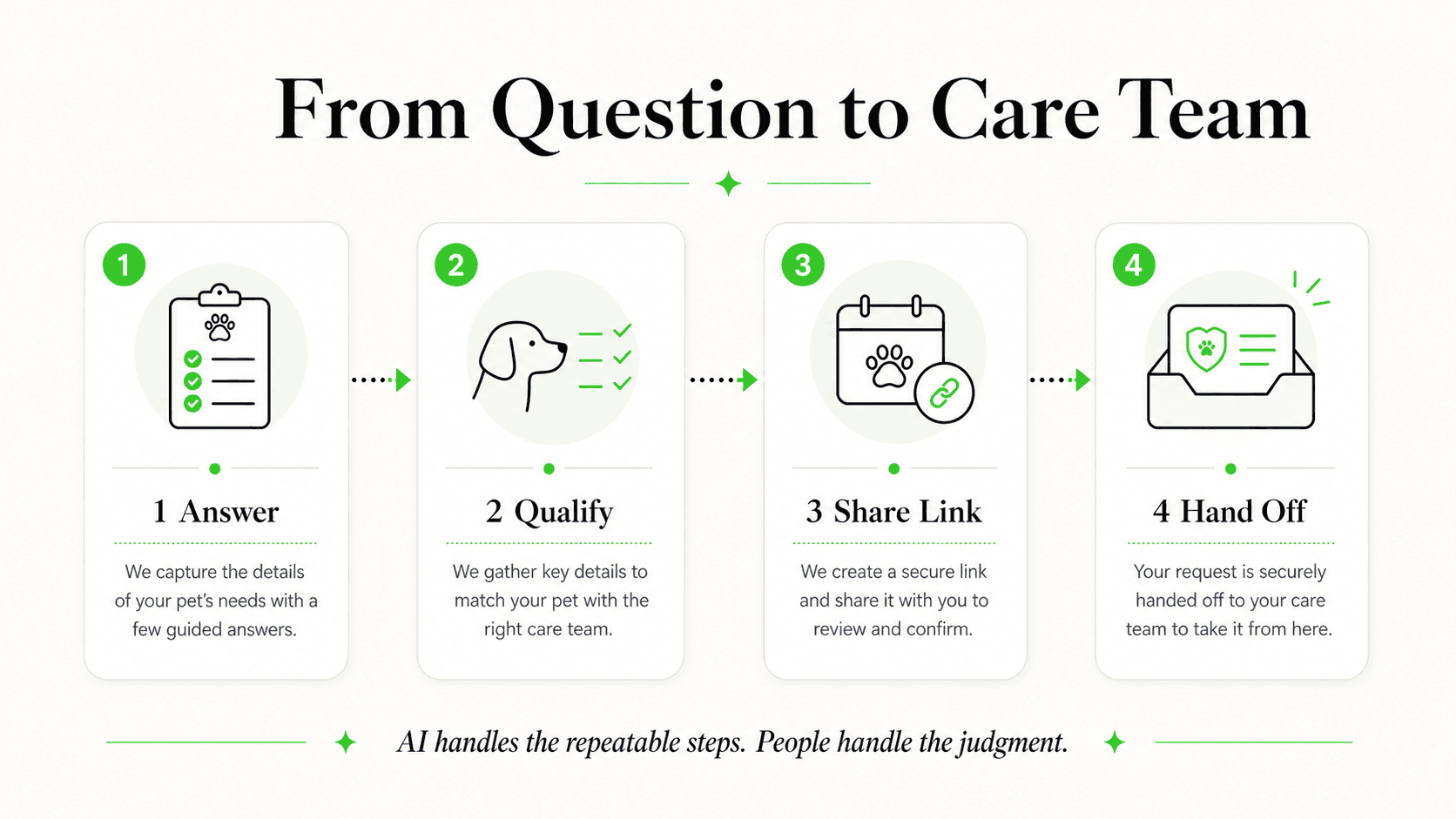
The weak version of inquiry automation starts with a widget and asks, “What should the bot say?” The stronger version starts with the customer journey and asks three questions: what does the visitor need to know now, what does the team need to know later, and where must a person make the decision?
For pet-service businesses, the initial capture sequence should usually include the following fields. Do not ask all of them as a form before answering anything. Answer the visitor’s first question, then collect only the next piece of context that changes the route.
| Step | Context to Capture | Conversation Rule |
|---|---|---|
| 1 | Service requested | Ask early when it shapes the rest of the conversation |
| 2 | Pet species and breed | Ask early when it shapes the rest of the conversation |
| 3 | Approximate size or weight band | Collect only when relevant |
| 4 | Preferred dates | Collect only when relevant |
| 5 | General behavior notes | Collect only when relevant |
| 6 | Owner contact details | Collect only when relevant |
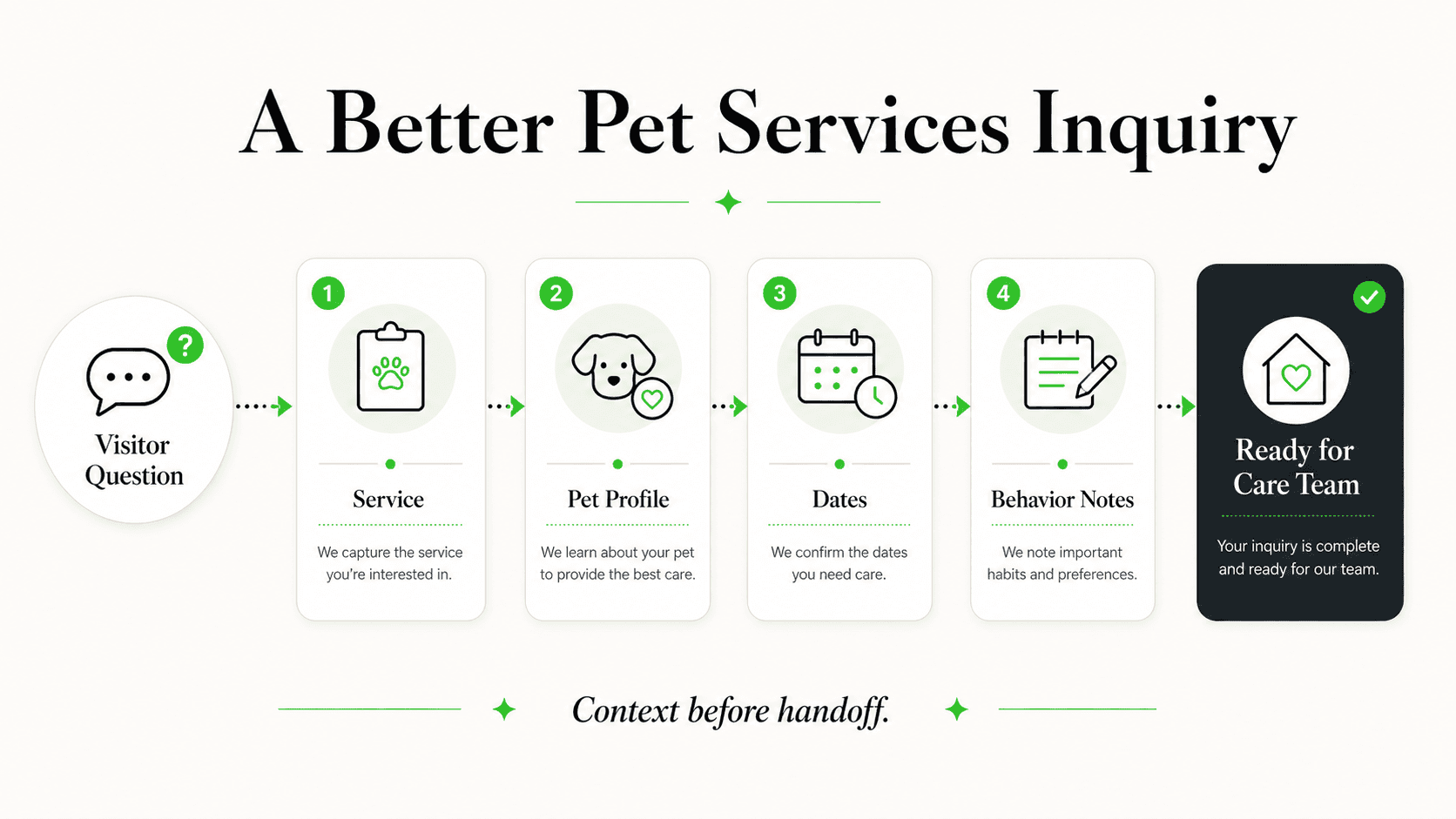
This sequence prevents two common failures. The first is under-qualification: the team receives “please call me” with no useful context and has to restart the conversation. The second is over-collection: the agent asks for sensitive or unnecessary details before earning enough trust to justify the request.
Use progressive disclosure. If a visitor asks a simple hours question, answer it immediately. If they show buying intent, ask for the relevant details. If they ask for professional judgment, live availability, a custom price, or a record lookup, stop expanding the automation and route the request. The small-business implementation checklist gives a broader launch framework; the table above is the industry-specific intake layer.
7 High-Value Jobs Across the Inquiry Journey
These seven jobs cover the highest-value parts of the first conversation. They are intentionally narrower than “automate customer service.” A narrow job has a clear source, a clear completion condition, and a clear handoff. That makes it easier to test and much easier for the team to trust.
1. Explain service choices
The goal is not to make the conversation longer. It is to resolve the part that can be resolved now and leave your team with better context for the part that cannot. A visitor may ask “What is included in a full groom?” The agent should respond from approved material, keep the language plain, and ask only the next question that changes the outcome.
What the AI can do: Published service steps, duration range, and starting price. That gives the visitor an immediate, specific answer instead of a generic promise that someone will respond later. It also keeps the answer consistent across the website, WhatsApp, Instagram DM, and Facebook Messenger.
Where a person takes over: A final price before coat condition is reviewed. The handoff should say why a person is needed, collect the minimum useful context, and set a realistic expectation for follow-up. That is a better experience than either guessing or ending the chat abruptly.
Configuration note: Write one approved answer, one follow-up question, and one escalation sentence for this scenario. Test short messages, detailed messages, misspellings, and a request that falls just outside the documented policy. The agent should remain helpful without crossing the boundary.
2. Collect boarding basics
The goal is not to make the conversation longer. It is to resolve the part that can be resolved now and leave your team with better context for the part that cannot. A visitor may ask “Can my dog stay next weekend?” The agent should respond from approved material, keep the language plain, and ask only the next question that changes the outcome.
What the AI can do: Dates, pet profile, vaccination-policy reminder, and contact details. That gives the visitor an immediate, specific answer instead of a generic promise that someone will respond later. It also keeps the answer consistent across the website, WhatsApp, Instagram DM, and Facebook Messenger.
Where a person takes over: Confirming space or admission. The handoff should say why a person is needed, collect the minimum useful context, and set a realistic expectation for follow-up. That is a better experience than either guessing or ending the chat abruptly.
Configuration note: Write one approved answer, one follow-up question, and one escalation sentence for this scenario. Test short messages, detailed messages, misspellings, and a request that falls just outside the documented policy. The agent should remain helpful without crossing the boundary.
3. Answer policy questions
The goal is not to make the conversation longer. It is to resolve the part that can be resolved now and leave your team with better context for the part that cannot. A visitor may ask “Which records do you require?” The agent should respond from approved material, keep the language plain, and ask only the next question that changes the outcome.
What the AI can do: The business’s written vaccination and intake policy. That gives the visitor an immediate, specific answer instead of a generic promise that someone will respond later. It also keeps the answer consistent across the website, WhatsApp, Instagram DM, and Facebook Messenger.
Where a person takes over: Determining whether a record is medically sufficient. The handoff should say why a person is needed, collect the minimum useful context, and set a realistic expectation for follow-up. That is a better experience than either guessing or ending the chat abruptly.
Configuration note: Write one approved answer, one follow-up question, and one escalation sentence for this scenario. Test short messages, detailed messages, misspellings, and a request that falls just outside the documented policy. The agent should remain helpful without crossing the boundary.
4. Route health concerns
The goal is not to make the conversation longer. It is to resolve the part that can be resolved now and leave your team with better context for the part that cannot. A visitor may ask “My dog is coughing. Can she still attend?” The agent should respond from approved material, keep the language plain, and ask only the next question that changes the outcome.
What the AI can do: A handoff to staff and veterinary guidance under the business’s policy. That gives the visitor an immediate, specific answer instead of a generic promise that someone will respond later. It also keeps the answer consistent across the website, WhatsApp, Instagram DM, and Facebook Messenger.
Where a person takes over: Health assessment or reassurance. The handoff should say why a person is needed, collect the minimum useful context, and set a realistic expectation for follow-up. That is a better experience than either guessing or ending the chat abruptly.
Configuration note: Write one approved answer, one follow-up question, and one escalation sentence for this scenario. Test short messages, detailed messages, misspellings, and a request that falls just outside the documented policy. The agent should remain helpful without crossing the boundary.
5. Handle behavior context
The goal is not to make the conversation longer. It is to resolve the part that can be resolved now and leave your team with better context for the part that cannot. A visitor may ask “He is anxious around other dogs.” The agent should respond from approved material, keep the language plain, and ask only the next question that changes the outcome.
What the AI can do: A neutral note for staff and the approved evaluation process. That gives the visitor an immediate, specific answer instead of a generic promise that someone will respond later. It also keeps the answer consistent across the website, WhatsApp, Instagram DM, and Facebook Messenger.
Where a person takes over: Promising group suitability or safety. The handoff should say why a person is needed, collect the minimum useful context, and set a realistic expectation for follow-up. That is a better experience than either guessing or ending the chat abruptly.
Configuration note: Write one approved answer, one follow-up question, and one escalation sentence for this scenario. Test short messages, detailed messages, misspellings, and a request that falls just outside the documented policy. The agent should remain helpful without crossing the boundary.
6. Share the request path
The goal is not to make the conversation longer. It is to resolve the part that can be resolved now and leave your team with better context for the part that cannot. A visitor may ask “How do I reserve?” The agent should respond from approved material, keep the language plain, and ask only the next question that changes the outcome.
What the AI can do: The existing booking or request link. That gives the visitor an immediate, specific answer instead of a generic promise that someone will respond later. It also keeps the answer consistent across the website, WhatsApp, Instagram DM, and Facebook Messenger.
Where a person takes over: Holding a kennel, table, or daycare place. The handoff should say why a person is needed, collect the minimum useful context, and set a realistic expectation for follow-up. That is a better experience than either guessing or ending the chat abruptly.
Configuration note: Write one approved answer, one follow-up question, and one escalation sentence for this scenario. Test short messages, detailed messages, misspellings, and a request that falls just outside the documented policy. The agent should remain helpful without crossing the boundary.
7. Deliver a complete summary
The goal is not to make the conversation longer. It is to resolve the part that can be resolved now and leave your team with better context for the part that cannot. A visitor may ask “Please call me tomorrow.” The agent should respond from approved material, keep the language plain, and ask only the next question that changes the outcome.
What the AI can do: Pet details, requested service, dates, concerns, and callback preference. That gives the visitor an immediate, specific answer instead of a generic promise that someone will respond later. It also keeps the answer consistent across the website, WhatsApp, Instagram DM, and Facebook Messenger.
Where a person takes over: Replacing staff review of the pet. The handoff should say why a person is needed, collect the minimum useful context, and set a realistic expectation for follow-up. That is a better experience than either guessing or ending the chat abruptly.
Configuration note: Write one approved answer, one follow-up question, and one escalation sentence for this scenario. Test short messages, detailed messages, misspellings, and a request that falls just outside the documented policy. The agent should remain helpful without crossing the boundary.
Turn Repetitive Questions Into Useful Inquiries
Build a front desk that answers from your content, collects the right context, and hands judgment back to your team.
Start Your 7-Day TrialThe Safe Operating Envelope
Every incoming message should land in one of three buckets. Answer when the response exists in approved content and does not depend on a live system or professional judgment. Capture when the team needs structured context before it can respond. Hand off when the message asks for an exception, a commitment, an assessment, a record, or information the source material does not contain.
| Decision | Use It When | Good Outcome |
|---|---|---|
| Answer | The current policy or service document contains the answer | The visitor gets a direct response and can continue independently |
| Capture | The team needs context to prepare a useful follow-up | The lead arrives with intent, constraints, and contact preference |
| Hand off | Judgment, safety, privacy, live availability, or custom terms are involved | The agent explains the boundary and routes the conversation with context |
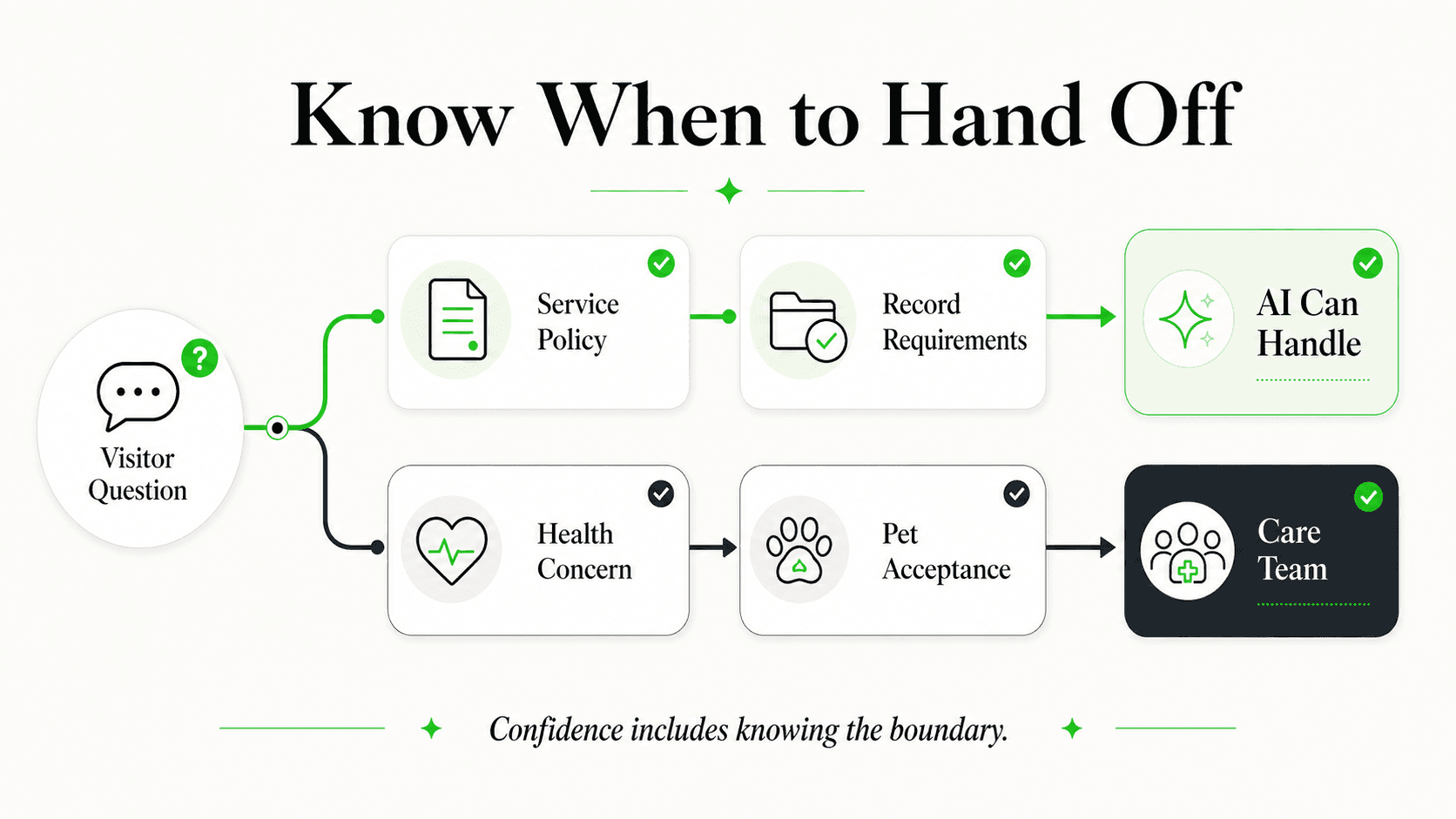
For this industry, the non-negotiable boundary is simple: It must never assess an animal’s health, promise that a pet will be accepted, recommend medication, or confirm a boarding or grooming slot. Put that sentence into the operating policy before you write conversational flourishes. A warm tone cannot rescue an unsafe workflow, but a clear boundary can still feel helpful when it explains what the visitor should do next.
Also decide what the system should forget or avoid collecting. A front desk rarely needs account passwords, payment-card details, government identifiers, full records, or detailed health information. Data minimization improves trust and reduces the amount of sensitive context your team must govern.
The Launch Checklist
Start with source quality. The agent can only be as specific as the material it is allowed to use. Gather the following before launch:
- Service menu. Confirm that it is current, written for customers, and owned by someone who can approve changes.
- Vaccination policy. Confirm that it is current, written for customers, and owned by someone who can approve changes.
- Size and breed policies. Confirm that it is current, written for customers, and owned by someone who can approve changes.
- Starting-price language. Confirm that it is current, written for customers, and owned by someone who can approve changes.
- Booking-request link. Confirm that it is current, written for customers, and owned by someone who can approve changes.
- Health and behavior handoff rules. Confirm that it is current, written for customers, and owned by someone who can approve changes.
Next, write an answer library from real messages. Export or review a representative set of website questions, DMs, and front-desk notes. Group them by intent, then draft one canonical answer for each group. Keep answers short enough for chat and link to a detailed page when the visitor needs depth.
Then write the handoff library. A strong handoff contains four pieces: a direct acknowledgment, the reason a person is needed, the minimum context to collect, and the expected next step. Avoid “I cannot help” dead ends. Prefer: “Our team needs to review that detail. I can collect your preferred contact information and summarize what you need.”
Configure the supported channels only after the website flow works. The website is the durable home base; WhatsApp, Instagram DM, and Facebook Messenger are channels the same front desk can cover. Hyperleap AI is a Meta Technology Provider and Business Partner, and those three messaging channels use Meta’s official Business APIs. Keep the knowledge and boundaries consistent even when the tone varies slightly by channel.
Finally, test the edges rather than only the happy path. Ask an incomplete question, a question with two intents, an out-of-scope request, a request for a custom exception, and a message containing details you do not want stored. A trustworthy agent should remain calm, specific, and conservative at every edge.
Do not confuse a link with an integration
If you schedule through Calendly or Cal.com, the agent can show live availability and book the slot in the conversation (in-chat booking needs Calendly Standard or higher). Native booking is on Pro and Max; on Plus, the agent shares your booking link. With any other booking system, it shares your link and that system confirms the appointment. Either way, it does not hold a slot or process the customer’s payment.
What Good Performance Looks Like
Measure whether the workflow produces useful outcomes, not whether it produces more chats. Start with a short weekly review that an owner or manager can actually maintain.
- Answer usefulness: Did the first response directly address the question from an approved source?
- Capture completeness: Did qualified inquiries arrive with the fields the team truly needed?
- Boundary quality: Did the agent route judgment calls without guessing or sounding dismissive?
- Follow-up readiness: Could a team member continue from the summary without rereading the entire transcript?
- Knowledge gaps: Which repeated questions lacked a current approved answer?
- Channel consistency: Did the same policy produce equivalent answers across the website and connected Meta channels?
Review a small sample of conversations, update the underlying source or rule, and test again. Do not fix recurring gaps by stuffing exceptions into a giant prompt. If the answer changed because the business policy changed, update the policy source. If the route changed because ownership changed, update the routing rule. Keep the operating system legible.
The most valuable metric is often interruption avoided. When the agent answers a routine question correctly, a skilled person stays focused. When it hands off a complete brief, the person starts halfway through the work instead of at the beginning. The broader guide on why slow response costs small businesses explains the commercial side; this scorecard keeps the automation honest.
For pet-service businesses, compare the workflow with the options in this relevant software guide, then review Hyperleap AI pricing against the real inquiry volume and number of channels you plan to cover. Choose based on the job, the boundary controls, and the quality of the handoff—not the length of the feature list.
Veterinary clinics run a stricter version of this same pattern — see AI receptionist for veterinary clinics for the emergency-routing guardrails.
Frequently Asked Questions
Will an AI front desk replace the people in a pet-service businesses business?
No. It handles repetitive first-response work and organizes inquiry context. People still make professional judgments, confirm availability, set custom pricing, manage exceptions, and build the relationship.
What can an AI front desk safely answer for pet-service businesses?
It can answer questions that have a current, approved source: services, general process, hours, locations, policies, and published pricing context. It must never assess an animal’s health, promise that a pet will be accepted, recommend medication, or confirm a boarding or grooming slot.
Does the AI confirm bookings or appointments?
Only through Calendly or Cal.com, on Pro and Max (on Plus, the agent shares your booking link). Connected, the AI offers real open times and books the slot in the chat, and the customer gets a calendar invite by email (in-chat booking needs Calendly Standard or higher). With any other booking system, it shares your booking link and gathers the details your team needs; that system or a person confirms availability. It never holds a slot.
Which channels can use the same front desk?
Hyperleap AI supports the website chat widget, WhatsApp Business API, Instagram DM, and Facebook Messenger. The same approved knowledge and routing rules can serve all four channels from one dashboard.
How quickly can a small team launch?
The quick-start path can go live in under five minutes by reading a website and generating a starting configuration. Treat that as the beginning: add policies, define handoffs, and test real questions before directing meaningful traffic to it.
Do we need a native CRM or scheduling integration?
No. Calendly and Cal.com connect natively for in-chat booking on Pro and Max; with any other scheduler, start by sharing your existing booking link and delivering lead summaries to the team. If you need system connectivity later, evaluate the REST API and webhooks; do not assume a native vertical integration exists.
Build a Front Desk Your Team Can Trust
The best AI front desk does not try to prove how much it can say. It proves that it knows what to answer, what to collect, and when to stop. For pet-service businesses, that means it can answer documented service and policy questions, collect pet and owner details, share the request link, and route health or behavior concerns to staff while leaving judgment and commitments where they belong—with your team.
Start with one channel, a small approved knowledge set, and the seven conversation jobs in this guide. Review real transcripts every week, close the most common knowledge gaps, and add channels only after the core workflow is dependable. That is how automation becomes operational leverage instead of another inbox to supervise.
Explore the dedicated AI agent page for pet-service businesses to see the industry workflow, or use the checklist above to evaluate another platform on the same terms.
Build a Better First Response
Give every visitor a useful answer and give your team a cleaner handoff across all four supported channels.
Get StartedIndustry Solutions
See how AI chatbots work for these industries:
Related Articles
Event Planning AI Front Desk for Lead Qualification
An event planning AI front desk can collect date, venue, guest count, scope, budget, and decision timing before a planner follows up.
Nail Salon AI Front Desk for Booking Questions
A nail salon AI front desk can explain services, policies, and preparation, then share the booking link while technicians stay with clients.

Florist AI Front Desk for Delivery Inquiries
A florist AI front desk can answer delivery and arrangement FAQs, collect occasion details, and route live availability and payment to staff.
Bakery AI Front Desk for Custom Order Inquiries
Use a bakery AI front desk to collect occasion, date, servings, design, flavor, delivery, and allergy context before quoting a custom order.