Guide
What Is Lead Qualification? Frameworks and Scoring Guide
Discover what is lead qualification, how BANT, CHAMP and MEDDIC compare, and how to score leads automatically.

Gopi Krishna Lakkepuram · Founder & CEO
· 15 min read
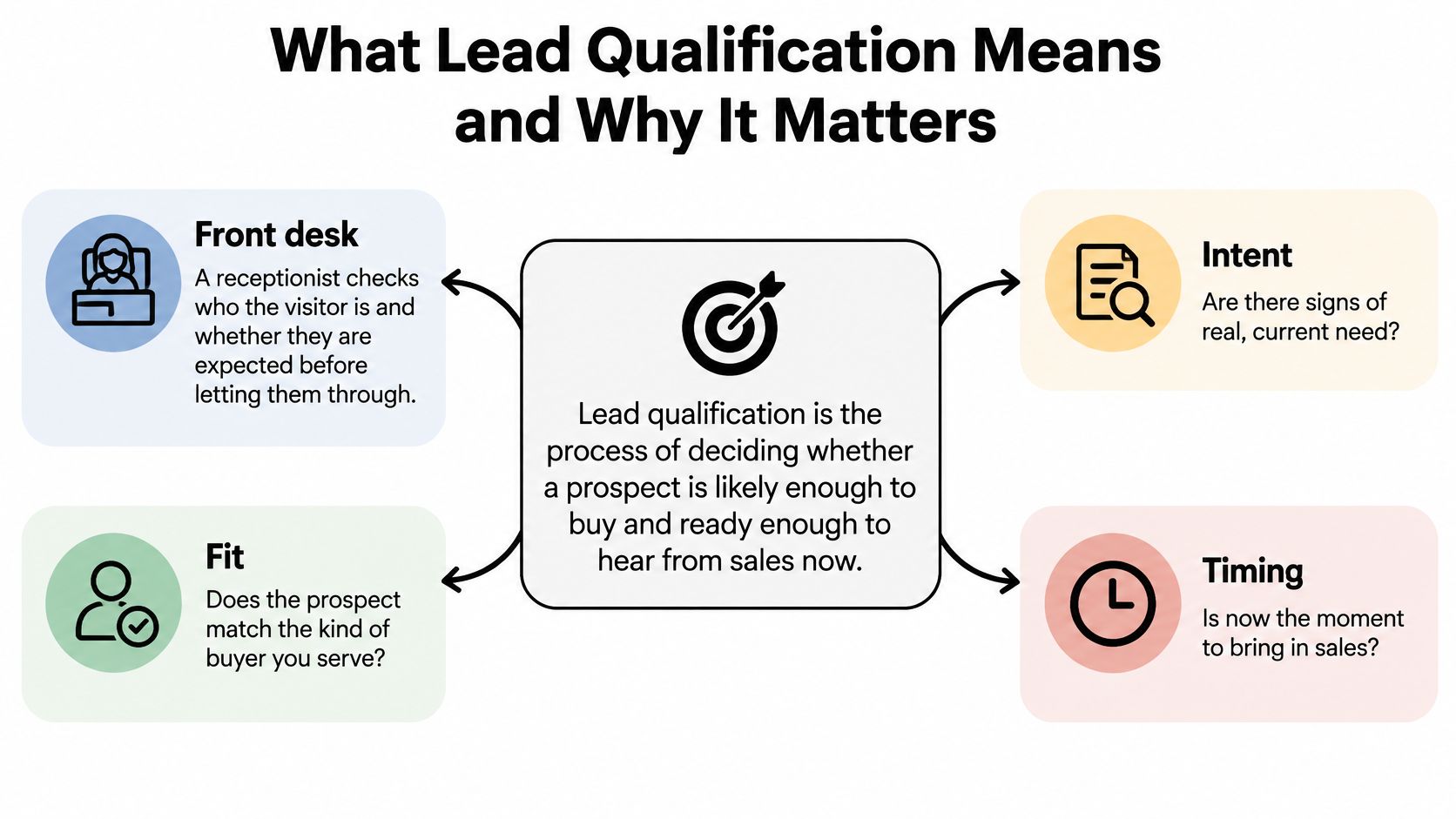
Lead qualification is the process of deciding whether a prospect is likely enough to buy, and ready enough to hear from sales now, so your sales time goes to the right leads. Roughly 31% of raw leads reach marketing-qualified status, and only about 13% of those become sales-qualified, which means most of the work is deciding who not to call yet.
So here's the question most qualification advice skips: if a visitor gives you a working email address and says they're interested, what exactly have you learned? You've learned they can type an email and that they're curious. You haven't learned whether they're in your service area, whether they can approve the spend, whether the phone number reaches a real person, or whether they want to talk to anyone at all this month.
Most small businesses run qualification as a mood. Whoever opens the inbox decides who sounds keen. That works at five inquiries a week and breaks at fifty, because the judgment changes with the reader, the hour and the workload.
Table of Contents
- What Lead Qualification Means and Why It Matters
- How Leads Move From Raw Inquiry to Sales-Ready
- BANT, CHAMP and MEDDIC Compared Side by Side
- Scoring Models and the Metrics to Track
- Manual vs Automated Qualification and Routing
- Sample Qualification Scripts and a Worked Scoring Example
- Protecting Lead Data While You Qualify
- Automate Your First Qualification Flow This Week
What Lead Qualification Means and Why It Matters
Think of a hotel front desk. Three people walk in during the same ten minutes: someone asking whether the restaurant is open to non-guests, someone with a reservation for tomorrow, and someone whose flight was cancelled and who needs a room tonight. A good clerk sorts them in seconds, because the clerk asks a couple of questions and listens for specific answers. Qualification is that sorting, written down so anyone on your team does it the same way.
Every version of it combines two variables, and confusing them is the most common beginner mistake.
Fit and intent are different questions
Fit asks whether this prospect matches the business you run: industry, company or practice size, location, role, and use case. A dental clinic in one city has a travel zone; a software vendor has a list of industries it serves. Fit is mostly static. It doesn't change because someone typed enthusiastically.
Intent asks whether the prospect is acting: a pricing question, an appointment request, three messages about the same treatment. Intent moves. It rises when someone asks for a Saturday slot and falls when they go quiet for six weeks.
High fit with low intent is a nurture lead. High intent with no fit is a polite referral elsewhere. You need both, plus a third check on timing, before a human should pick up the phone.
Why small teams feel this first
A five-person business has no dedicated sales development rep. The person answering inquiries is also doing the work being sold, so every unqualified call costs billable time twice: once on the call, once catching up afterwards. Without a filter, the loudest inquiry wins, and the quiet prospect who was ready to book on Tuesday gets a reply on Friday.
The payoff for getting this right is large. In 2025, Ebsta reported that deals with high qualification scores won 50% of the time, compared with 8% for poorly qualified deals, a finding collected in CloudTalk's sales productivity statistics roundup. Treat that as a reason to care, not a promise: those are enterprise deal scores, not clinic chat logs, and your own numbers will differ.
Is this prospect worth sales time now?
That's the whole test. Not "are they interested", not "did they fill in the form". Worth time, now.
How Leads Move From Raw Inquiry to Sales-Ready
Qualification isn't one yes or no. It's a ladder of progressively stronger signals, and each rung earns a different action from your team.
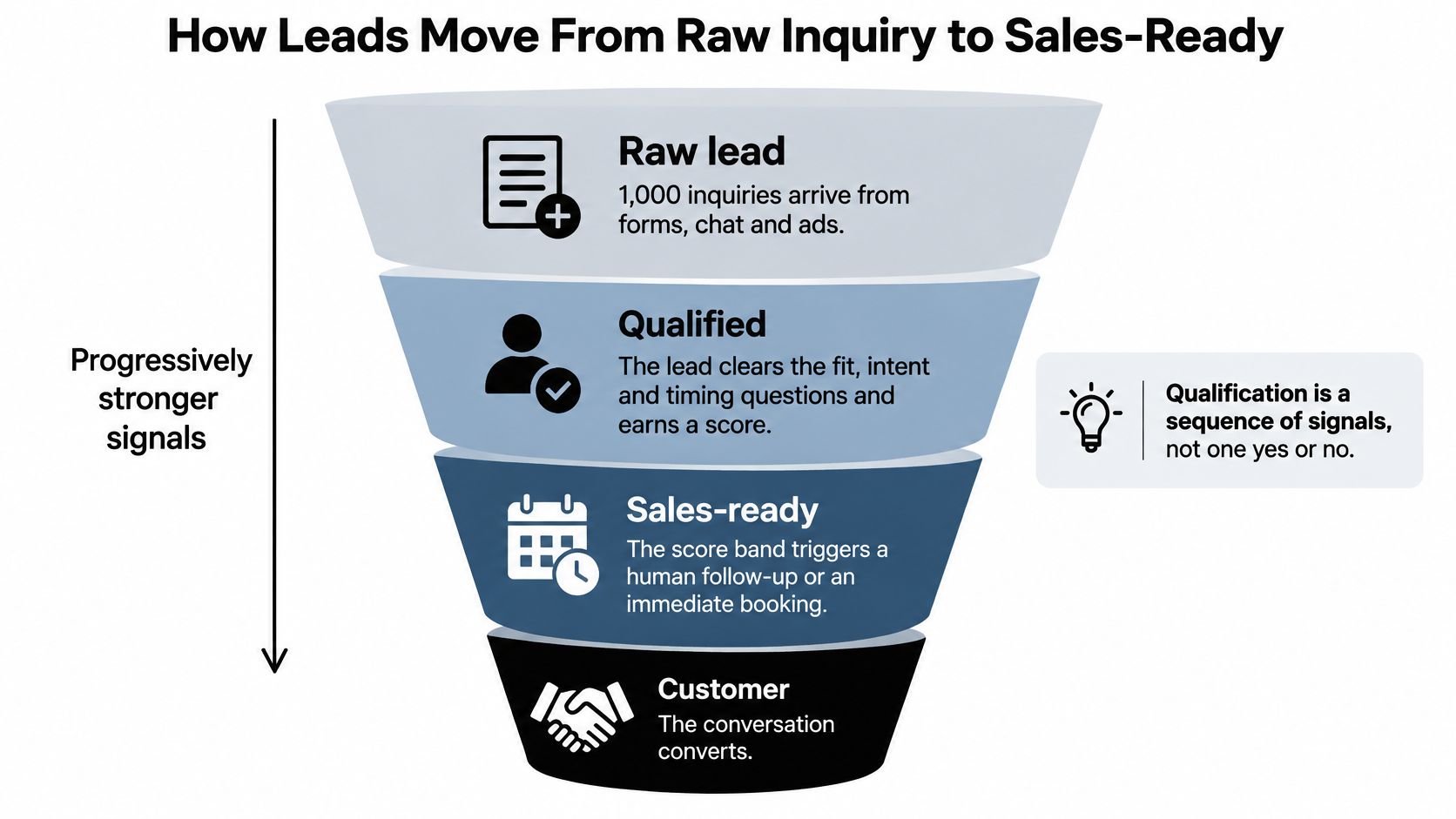
A widely cited benchmark compilation reports that roughly 31% of leads become marketing-qualified leads (MQLs), while only about 13% of MQLs advance to sales-qualified leads (SQLs), according to Shno's lead quality statistics collection. Run the arithmetic on a business generating 1,000 raw leads: about 310 clear the marketing threshold, and roughly 40 survive the second review as sales-ready. Lead volume, on its own, tells you almost nothing about how much selling you'll do.
The distinction between the two labels is worth memorising. An MQL satisfies marketing-defined criteria such as a relevant profile or engagement. An SQL has been reviewed as appropriate for direct sales follow-up. One is a pattern match; the other is a decision.
| Stage | What it means | Signal that moves it forward | Next action |
|---|---|---|---|
| Raw lead | Any inquiry or contact | Form, chat message or call | Verify contact and log the source |
| MQL | Meets marketing engagement or profile threshold | Repeat visits, content download, several questions | Nurture with relevant content |
| SQL | Reviewed as fit for direct sales follow-up | Need, budget range and timing confirmed | Assign to a rep or book a call |
| Opportunity | Active sales conversation with a defined next step | Proposal requested or demo booked | Track in the pipeline |
| Customer | Closed-won deal | Signed agreement or first payment | Onboard and measure retention |
Measure the gaps, not the totals
Pull last quarter's CRM records and calculate four rates. Write them on one page.
- Lead-to-MQL: how many inquiries clear your profile and engagement bar.
- MQL-to-SQL: how many survive a real review of need, authority and timing.
- SQL-to-opportunity: how many turn into a conversation with a defined next step.
- Opportunity-to-customer: how many close.
The weakest rate is your bottleneck, and it's rarely the one people argue about in meetings. If MQL-to-SQL is where leads die, more ad spend won't help; better intake questions will. Our guide to AI lead capture in chat covers how to collect those answers at the moment of first contact.
Those benchmark percentages shift by industry, definition, channel and how carefully anyone measures, so use them as a sanity check rather than a quota. And when a lead stalls before SQL, give it a next action instead of a deletion: a price guide, a comparison page, a follow-up next month.
Here's a walkthrough of the stages in practice:
BANT, CHAMP and MEDDIC Compared Side by Side
| Framework | Questions it covers | Best fit | Main weakness |
|---|---|---|---|
| BANT | Budget, authority, need, timeline | Short cycles and SMB services | Ignores the buying process and other stakeholders |
| CHAMP | Challenges, champion, money, prioritization | Deals that start from a clear pain | Depends on finding a strong internal champion |
| MEDDIC | Metrics, economic buyer, decision criteria, decision process, pain, champion | Complex, multi-stakeholder enterprise sales | Too heavy for simple inquiries |
Where the checklists came from
BANT is the oldest and simplest of the three. The method is commonly traced to IBM during the 1950s, when enterprise-computing sales involved expensive products, lengthy purchasing cycles and a large pool of potential buyers, as described in this glossary entry on the BANT framework. Its real contribution wasn't the four letters. It turned an informal judgment into a repeatable checklist, so two salespeople looking at the same inquiry reached roughly the same conclusion.
CHAMP reorders the conversation. It starts with the prospect's challenge and the internal person who feels it, then asks about money and priority. That order matters when your buyer is researching and doesn't want to discuss budget in message two.
MEDDIC exists because a stated problem doesn't predict a completed purchase. Deals stall when nobody has spending authority, when the value can't be quantified, or when there's no defined procurement path. Six fields are a reasonable price for that visibility on a large deal.
Match depth to complexity
The frameworks aren't rivals; they're different resolutions of the same picture. Pick by how many people can say no.
Practical rule: ask a small number of high-signal questions for SMB services (need, location, urgency, preferred appointment time) and reserve process questions for enterprise or multi-location deals.
Say a dental clinic runs chat intake. Four questions do the job: which treatment, which area you live in, whether this is pain or a routine check, and what day suits you. Adding "who is the economic buyer" would be absurd, and every extra field costs you completed conversations.
Now say a software vendor sells to a committee of six across three departments. Four questions get you a friendly contact with no authority and no timeline. That team needs the decision criteria, the procurement path and a champion who'll argue for the purchase in a room you're not in.
Scoring Models and the Metrics to Track
A lead score is arithmetic, not magic: a weighted sum of fit and intent signals, reduced by exclusion rules, mapped to an action. A practical implementation assigns weighted points to those signals, applies exclusions, and routes prospects into automated nurture, human follow-up or immediate booking, as set out in this comparison of BANT and MEDDIC. Predictive scoring goes a step further and estimates each new prospect's propensity to produce a defined outcome using historical data, commonly with logistic regression or decision trees.
Define the outcome before you assign a single point. For a clinic it might be a booked appointment that shows up. For a consultancy it might be a closed opportunity. Then score verified identity, service-area fit, urgency, requested service and booking behaviour separately, so a chatty but out-of-area inquiry never outranks a confirmed local prospect with a concrete need.
A starting sheet you can copy
These weights are an illustrative design for a single-location clinic, not industry benchmarks. Copy the structure, then set your own numbers.
| Signal | Example | Points |
|---|---|---|
| Fit: need matches a core service | Asks about cleaning or implants | +20 |
| Fit: service area match | Lives within the travel zone | +15 |
| Fit: size in target range | Household or practice size within target | +10 |
| Intent: appointment request | Asks for a Saturday slot | +25 |
| Intent: price question | Asks what a cleaning costs | +10 |
| Intent: repeated questions | Three or more questions on one service | +10 |
| Verification: phone confirmed | One-time code confirmed | +10 |
| Verification: email confirmed | Valid, confirmed address | +5 |
| Exclusion: outside service area | Location beyond the travel zone | -30, overrides the total and routes to nurture |
Map the total to three bands: 0 to 30 goes to nurture, 31 to 60 gets human follow-up, 61 and above triggers an immediate booking offer. Three bands are enough. Ten bands create arguments about the difference between a 47 and a 52.
Check the score against reality
A score is a hypothesis about who will buy. Test it monthly by comparing each band against verified-contact rate, booked-appointment rate, show rate, opportunity rate and revenue.
Two failure patterns tell you what to change. If high-score leads book and then don't show, your intent signals are rewarding curiosity, so raise the weight on verification and stated urgency. If low-score leads keep converting, a signal you ignored is doing real work, so find it in the transcripts and add it.
Before you automate anything, draft eight to ten signals with points in a spreadsheet and score twenty past inquiries by hand. You'll learn more in that hour than in a week of tool demos.
Manual vs Automated Qualification and Routing
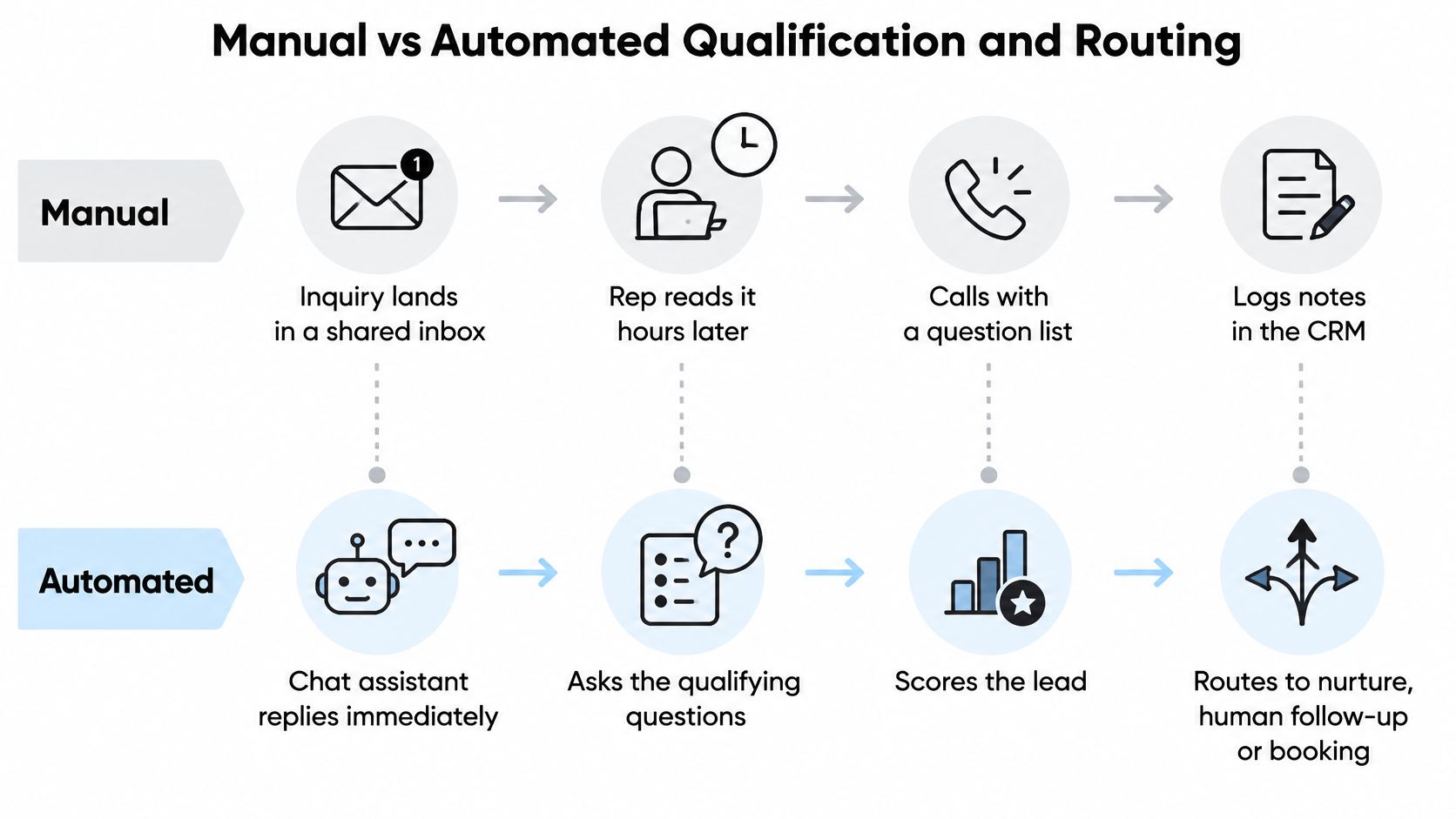
Run both workflows as a timeline and the difference becomes obvious.
Manual: an inquiry lands in a shared inbox at 9:40 pm. Someone reads it the next morning between appointments, calls with a question list, reaches voicemail, and types notes into the CRM after lunch. Automated: a chat assistant on the website or WhatsApp replies within seconds, asks the same questions, verifies the phone number, scores the answers, and either offers a slot or hands a person a summary with the score attached.
The five steps, whichever way you run them
- The inquiry arrives on any channel and gets logged with its source.
- The contact is verified, usually with a one-time code to the phone.
- Fit, need and timing get asked in a few plain questions.
- The answers produce a score.
- The score decides the route: nurture, booking, or a person.
Step five is where most small businesses lose leads, because they've only built one road. A prospect who wants a price list at midnight gets silence, or a callback they didn't ask for. Build a self-serve path (price guide, service comparison, booking link) beside the rep path, and let the prospect's own behaviour choose. Our chatbot lead routing guide walks through setting those branches up.
| Factor | Manual qualification | Automated qualification |
|---|---|---|
| Response time | Hours to days, depending on inbox load | Seconds, 24/7 |
| Consistency | Varies by rep and day | Same questions every time |
| Contact verification | Often skipped or done after handoff | Checked during the conversation |
| Handoff to sales | Email or manual CRM entry | Summary with answers and score attached |
| Staff time per lead | High for every inquiry | Low; staff see only qualified cases |
| Best fit | Complex, high-value deals | High-volume inbound inquiries and after-hours demand |
The honest trade-off
Automation is fast and consistent, and it's brittle at the edges. It reads "can you do something about my front tooth" well and reads a bundled message with three questions and a joke poorly. It also can't judge whether a nervous patient needs reassurance rather than a calendar link.
Depth has a cost too. Using every MEDDIC field on a short local-service inquiry creates unnecessary friction and may reduce completion, while a small number of high-signal questions (need, location, urgency, preferred appointment time) suits SMB services, with deeper process questions reserved for enterprise or multi-location opportunities, as this lead qualification framework guide explains. The same guide recommends calibrating qualification against outcomes and adjusting weights or thresholds when false positives and false negatives diverge.
Automation handles intake, verification and booking around the clock; people take the high-value and complicated cases, with the summary already attached.
Map your current steps with timestamps for one week. The gap you find, usually a night or a weekend, is where automation pays for itself first.
Sample Qualification Scripts and a Worked Scoring Example
Most qualification advice assumes a qualified lead wants a phone call. The timing evidence says otherwise: only about 25% of marketing-generated leads are ready to move directly to sales, and 67% of B2B buyers prefer a rep-free buying experience, according to the ConvergeHub Customer Trends Report 2025. A script that forces everyone into a conversation is fighting your own buyers.
A seven-step clinic chat script
- "Hi, I can answer questions about treatments and prices, and book you a visit. What brings you in?"
- "Which treatment are you looking for?"
- "What area are you in? We see patients within about 15 minutes of the clinic."
- "Is this pain right now, or a routine check?"
- "I'll send a one-time code to your mobile so we can confirm it's you. What's the best number?"
- "I have Saturday 9:15 or Saturday 11:00. Which suits you?"
- If they don't book: "No problem. Here's our price guide. Shall I check back tomorrow?"
Steps six and seven are the point. The script produces a next-best action, not a label. An exploratory visitor gets a useful answer and a delayed follow-up; an appointment-ready visitor gets two concrete slots.
Two leads, one set of weights
Lead A asks for a Saturday cleaning (+20), lives inside the travel zone (+15), requests a weekend slot (+25) and confirms a phone number with the code (+10). Total: 70. That clears the 61 threshold, so the assistant offers the two Saturday slots immediately and sends the team a summary with treatment, area, urgency and preferred time filled in.
Lead B asks what a cleaning costs (+10) from outside the travel zone, and gives no verified contact. The exclusion applies -30 and overrides the total, so the score lands below zero and the lead goes to automated nurture: price guide, a note about the service boundary, no call. Same question, different route, and nobody's afternoon gets consumed.
Notice what Lead B isn't: discarded. People move house, and a price enquiry today can be a booking next quarter.
Write your own five-question script for your highest-volume service, then run five past inquiries through it on paper. If two of them would have routed differently from what happened, you've found your first fix.
Protecting Lead Data While You Qualify
A valid email address doesn't make a lead qualified. The address can be perfect while the job role, company, location or purchasing authority is wrong, and every routing decision built on those fields inherits the error.
A 2025 survey of more than 200 marketing-operations and demand-generation professionals found that nearly 75% estimated at least 10% of their lead data was inaccurate, outdated or non-compliant, and more than 60% said poor data disrupted lead handoffs or reduced sales productivity, as reported in IT Business Plus coverage of the Integrate and Demand Metric survey. In the same survey, 34% of organizations reported reputational or financial harm from privacy or data-governance lapses. That's not a CRM tidiness problem. It's lost revenue and lost trust.
Collect less, verify more
- Ask only what routing needs. Treatment, area, urgency, contact. Not date of birth in message three.
- Say what they're agreeing to. One plain sentence before you request a number: what you'll send and how often.
- Verify the fields that carry weight. Phone by one-time code, decision-maker status by asking directly.
- Set retention rules. Decide how long chat transcripts and lead records live, and write it down.
- Route sensitive intake to a person. Health details in a clinic belong in a clinical system with human review, not a marketing field.
Our security and data privacy guide for business chatbots covers consent capture and retention settings in more detail. We're GDPR compliant and publish a DPA alongside our privacy and payment terms.
What a score can't tell you
An automated score is a prioritisation tool, not proof of buying intent. It misreads slang, splits bundled questions badly, and can't tell that a shared family phone belongs to three people. On a large or unusual deal, a rep's judgment outranks any checklist you've written.
Audit your last 50 lead records for three gaps: missing role, unverified contact, missing consent. Whichever gap is biggest points at one intake question. Fix that question first.
Automate Your First Qualification Flow This Week
Five steps, in order, and none of them require a developer.
- Write the five questions that separated your best leads in the script test.
- Set the score bands and name the action for each: nurture, human follow-up, immediate booking.
- Connect your highest-traffic channel first, usually website chat or WhatsApp.
- Replay ten real past inquiries and compare the routing against what happened.
- Review weights monthly, and delete any question that has never changed a routing decision.
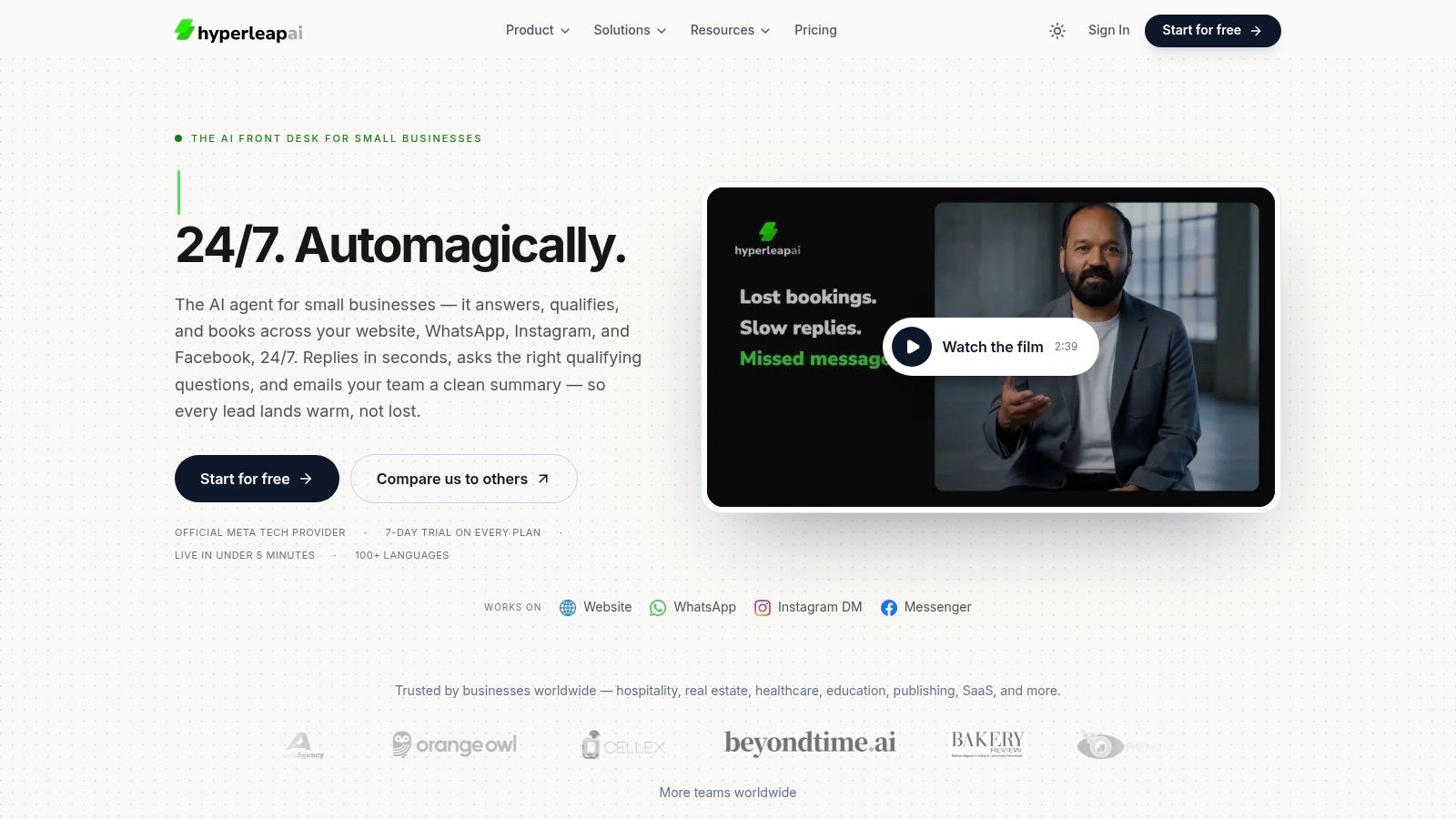
For the clinic in our example, Hyperleap AI is one option to test against those five steps. The assistant greets the visitor, asks the clinic's five questions, verifies the phone with a one-time code, scores the answers against the clinic's bands, and sends the team a lead summary with requested treatment, service-area fit, urgency and preferred slot already filled in. It answers, qualifies and books across the website, WhatsApp, Instagram and Facebook, 24/7, and passes complex or clinical cases to staff. Test it the same way you'd test a spreadsheet: ten past inquiries, then compare.
Start today with the cheapest step. Open a blank document and write the five questions your best leads answered and your worst ones didn't. Everything else (points, bands, routing, software) is built on those five lines, and you can write them before lunch.
Hyperleap AI answers every enquiry, asks your qualifying questions, verifies the contact with a one-time code, and sends you a lead that's ready to call, with the conversation context attached. If you're building your first qualification flow, pick an industry template, point it at your website, and run ten past inquiries through it this week to see how the routing compares. Visit Hyperleap AI to set up your five questions and watch the first scored lead arrive.