Guide
Lead Generation Best Practices: 9 Proven Tactics
Discover 9 lead generation best practices for SMBs: AI chat, OTP-verified capture, qualification, scheduling, and funnel KPIs that drive real bookings.

Gopi Krishna Lakkepuram · Founder & CEO
· 21 min read
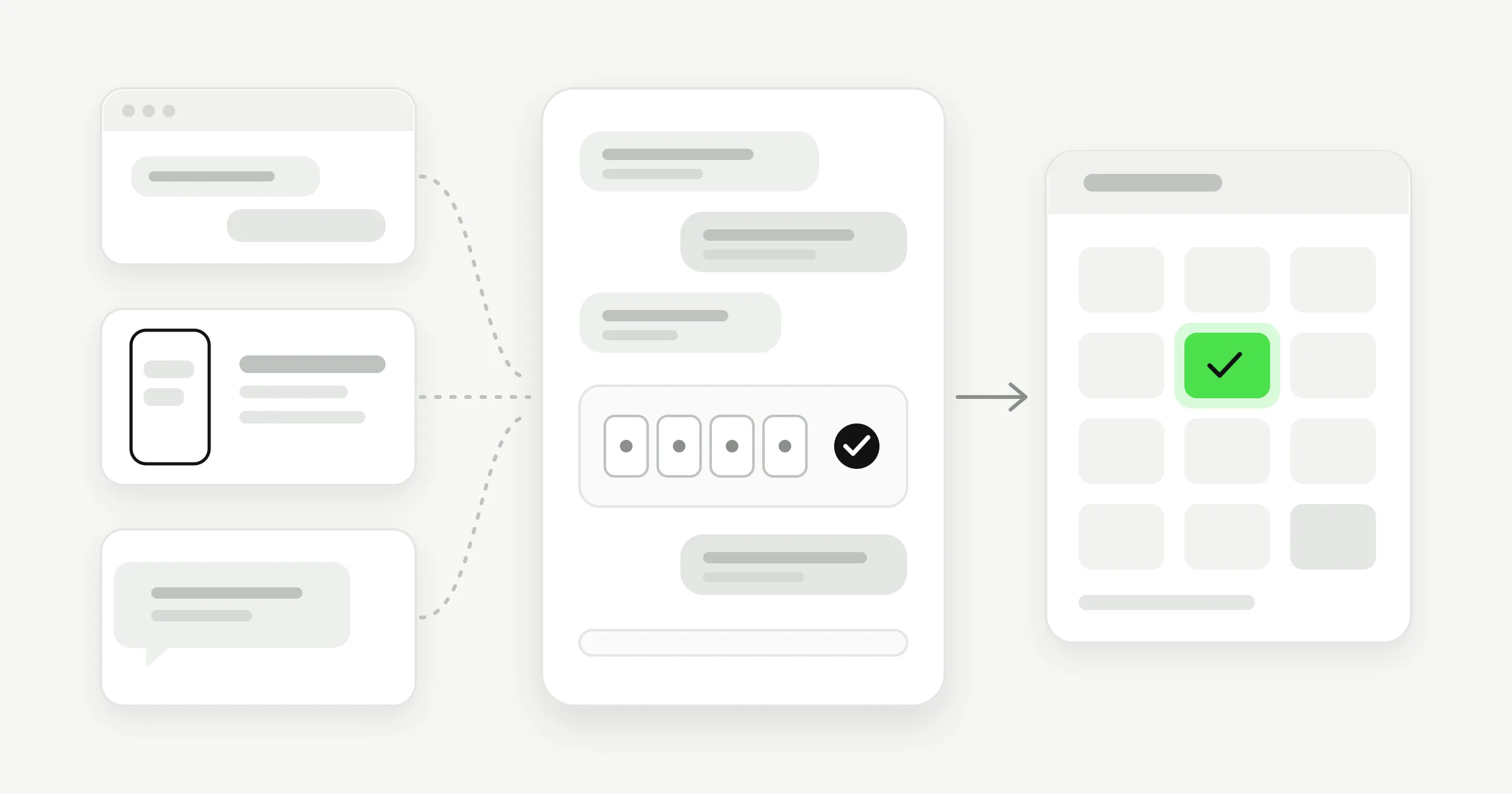
At 9:40 on a Tuesday night, someone with a cracked molar messages your clinic through the website chat box. Two hours earlier, a traveller asked your hotel on Instagram whether you have parking and a late check-in. In between, a buyer sent a pricing question to your WhatsApp business number. All three got silence, because the office was closed and nobody was watching the inbox.
By 9:15 the next morning the dental patient has booked elsewhere, the traveller has reserved a room down the road, and the buyer has cooled. None of those leads was a bad lead. Each one arrived at a moment when your business had no way to answer.
The leak nobody logs: a missed inquiry almost never shows up as a lost sale. It shows up as nothing at all, which is why it survives for years and gets blamed on the market.
The nine practices below map to specific steps in the conversation funnel: capture, verification, qualification, routing, booking and reporting. That mapping matters because most operators optimize the wrong step. They buy more traffic when their capture is closed at night, or they add qualification questions when their follow-up takes two days.
You don't need more leads. You need the ones you already paid for to get an answer while the intent is still warm. Start wherever the leak is loudest.
Table of Contents
- 1. Put an Always-On AI Chatbot on Every Channel You Already Answer
- 2. Verify Contact Details Before a Lead Reaches Your Team
- 3. Build One Knowledge Base and Share Useful Content From It
- 4. Qualify Intent Inside the Conversation, Not After It
- 5. Book the Appointment Inside the Conversation
- 6. Ask for Contact Details Only After You've Earned Them
- 7. Personalize With Context You Already Have
- 8. Notify the Right Person in Seconds and Keep One Inbox
- 9. Measure the Funnel by Step, Channel and Outcome
- How the 9 Lead Generation Practices Compare
- From Checklist to Compounding Pipeline
1. Put an Always-On AI Chatbot on Every Channel You Already Answer
Capture is the first funnel step, and it fails on hours, not on demand. The cost shows up in any serious measurement. An InsideSales analysis of more than 55 million sales activities, covering 5.7 million inbound leads across more than 400 companies, found conversion rates roughly eight times higher when a lead was contacted within five minutes than when the response came after that window. The same analysis found that only 0.1% of inbound leads were engaged within five minutes.
A chatbot closes that window without a night shift. Deploy one assistant across your website, WhatsApp, Instagram and Facebook, grounded in approved company knowledge: services, opening hours, pricing policy, parking, insurance, whatever the actual questions are. It answers the routine question, identifies the visitor who's ready to buy, collects contact details, then pushes toward a booking or a human. With Hyperleap AI, a team pastes a website URL (Studio reads the site and drafts the agent's instructions, which the team then edits), adds documents, and publishes without a developer.
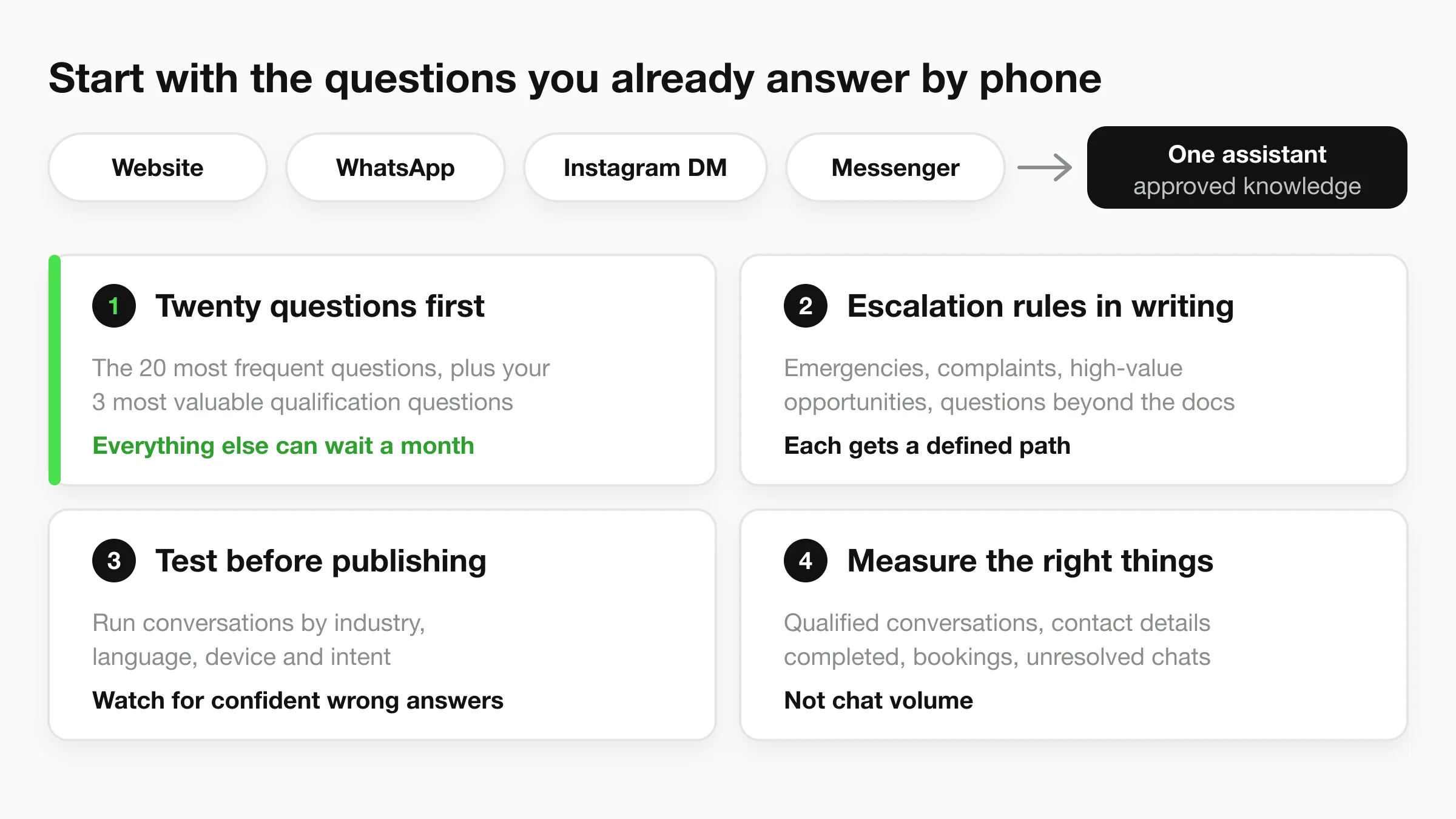
Start With the Questions You Already Answer by Phone
- Twenty questions first: load the highest-frequency questions plus your three most valuable qualification questions. Everything else can wait a month.
- Escalation rules in writing: emergencies, complaints, high-value opportunities and questions beyond the knowledge base each need a defined path, usually a phone number or a human callback.
- Location-specific answers: a multi-site business should share one knowledge base and keep each site's hours, services and promotions clearly labelled, so the bot answers from the right location and asks which one when the visitor hasn't said.
- Test before publishing: run conversations by industry, language, device and intent. The failure mode is always the same, a confident answer to a question you never expected.
- Measure the right things: qualified conversations, contact-detail completion, bookings and unresolved chats. Chat volume is vanity.
Here's the practical shape of a multi-channel deployment:
For the channel-by-channel architecture, this guide to multi-channel AI chatbot strategy covers routing and deployment order. If you're comparing assistants built for clinic intake specifically, this AI receptionist comparison walks through the trade-offs.
2. Verify Contact Details Before a Lead Reaches Your Team
A phone number that doesn't ring is worse than no lead at all. It costs a salesperson ten minutes, then a follow-up task, then a report that overstates pipeline and makes every channel look better than it is.
Verification is the second funnel step, and it's the one most SMBs skip. A one-time password check fixes it. The visitor enters a number, receives a short code, types it back, and only then does the record count as a real lead. Fake submissions, fat-fingered digits and bot spam stop at the door instead of landing in the CRM where they poison your reporting for a quarter. Hyperleap AI offers OTP verification on website chat as a paid add-on on Pro and Max, so a number is confirmed before the lead reaches your team or gets exported.
Ask after intent, never before it. A visitor who has just asked about availability, pricing or an appointment has a reason to complete a code. A visitor who lands on the page and gets asked to verify a phone number leaves.
Say a real-estate agency runs Instagram ads for viewings. Ad traffic is cheap to generate and easy to fake, so the sales team ends up calling disconnected numbers. Verifying the number before the property consultation summary goes out means the team only sees people it can reach.
- Explain the step in one sentence: "We send a short code so your viewing confirmation reaches the right number." No paragraph-long privacy lecture.
- Use plain consent language and record the wording and timestamp you showed.
- Set country and format rules before you go international, or your codes fail in half your markets.
- Watch the verification success rate alongside lead-to-appointment conversion. A falling success rate is a friction problem, not a lead-quality problem.
On messaging channels the account itself is an identity signal, but a mistyped number still slips through, so confirm it in the thread before promising a callback.
3. Build One Knowledge Base and Share Useful Content From It
Two channels, two answers, one customer who now trusts neither. That's what happens when each platform gets its own improvised FAQ and nobody owns the source.
A structured knowledge base solves it: service descriptions, FAQs, pricing policy, locations, brochures, photos, videos, documents and approved messaging, all in one place. For multi-location operators, run one central base with each location's details clearly labelled. Core brand information stays consistent; breakfast hours, pool rules, promotions and local contact details are kept per site.
Send the Asset That Moves the Conversation Forward
A hotel can send a room-category brochure, then immediately offer an availability check. A clinic can share a first-consultation guide and capture contact details while the visitor is still reading. A med spa can upload preparation instructions and pricing documents so pre-consultation answers match what the front desk says in person. Assets should match the question, stay mobile-friendly, and carry reviewed translations where the information is regulated or safety-sensitive.
- Organize by journey, location and question type, not by which department uploaded the file.
- Name an owner for every section and put a review date on it. Orphaned sections drift out of date within two quarters.
- Delete conflicting answers before adding new ones. Duplicates are the main cause of a bot contradicting itself mid-conversation.
- Write escalation guidance for medical, legal, financial and safety questions, and make the handoff visible to the visitor.
- Keep local details local. Duplicating the whole knowledge base per branch creates six places to fix one wrong price.
The maintenance workflow in these AI chatbot knowledge base best practices is worth copying wholesale if you run more than one location.
4. Qualify Intent Inside the Conversation, Not After It
A visitor asks about pricing, availability and "can someone call me today?" Ten minutes later, the lead sits in a queue with three words of context. By the time a salesperson reaches it, the visitor has booked elsewhere. Qualification is a timing problem as much as a fit problem.
A 2011 speed-to-lead study, which analyzed 1.25 million sales leads received by 42 companies (29 business-to-consumer and 13 business-to-business), found that firms trying to contact a lead within one hour were nearly seven times more likely to qualify it than firms that waited an additional hour, and more than 60 times as likely as companies that waited 24 hours or longer.
What Qualification Should Actually Capture
Ask about the signals that predict a purchase in your business, not a generic checklist. A pricing question, an availability check, a named service or a booking request each tell your team something. So do timeline, location, budget range and company size where they apply. A hotel conversation about room availability, event space and group pricing deserves a different path from a pet policy question, and the bot should recognize that without interrogating anyone.
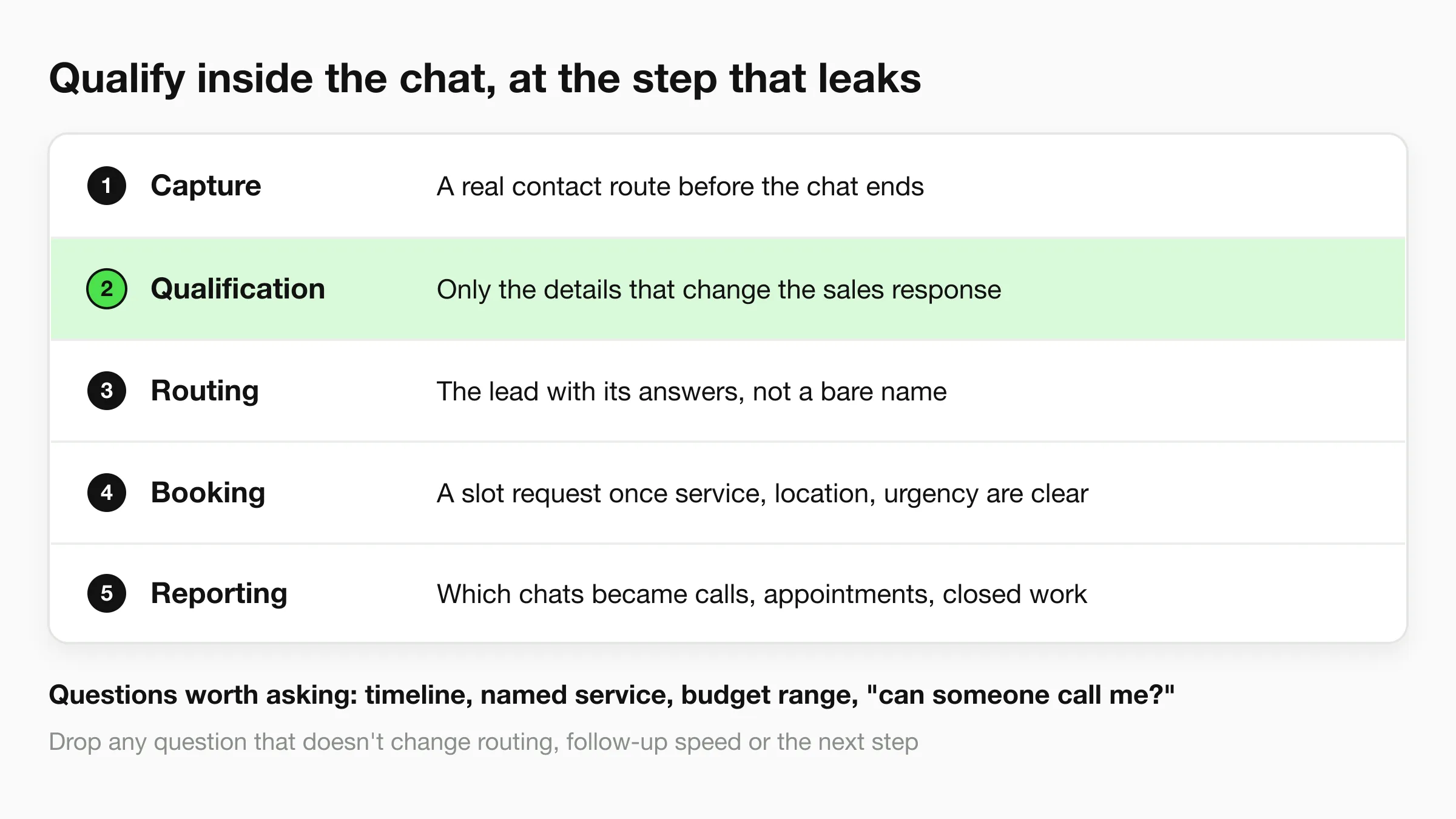
The qualifying questions should map to the funnel step where the leak happens:
- Capture: confirm the visitor has a real contact route before the chat ends. Website chat can use OTP verification (a paid add-on on Pro and Max) to help confirm a phone number is real before the lead reaches the team.
- Qualification: collect the details that change the sales response. Hyperleap AI can gather company size, current IT setup, pain points, compliance requirements and budget range, then deliver a qualified lead with context.
- Routing: send the lead with its answers, not a bare name. Hyperleap keeps conversations and contact details together for the business team and emails a clean summary in seconds.
- Booking: move high-intent conversations into a slot request once service, location and urgency are clear. The specifics belong in the booking step, but the intent signal belongs here.
- Reporting: review which chats became calls, appointments and closed work. Use that outcome data to revise your qualifying questions monthly.
The rules that keep qualification usable:
- Start with five to ten clear qualifying questions. A process nobody can explain is a process nobody will trust or maintain.
- Ask one question at a time, and only questions someone on your team will act on.
- Let the visitor's intent set the pace. A request for a quote can justify immediate routing. A casual question should not trigger a budget interrogation.
- Choose the fallback language yourself. Hyperleap can ask the visitor to call or email your team when it cannot answer, and you decide which topics it avoids.
- Check against reality. Compare the answers leads gave with booked appointments and closed deals, then adjust the questions. A qualification script that never changes is decoration.
A practical starting point is to ask about timeline, named service and budget range, and to flag a direct request to speak with someone in the lead summary. Then remove any question that does not change routing, follow-up speed or the next step in the conversation.
5. Book the Appointment Inside the Conversation
The handoff from interested to booked is where conversational funnels die. The visitor says yes, then waits for an email with a link, then gets distracted, then books with whoever made it a one-step decision.
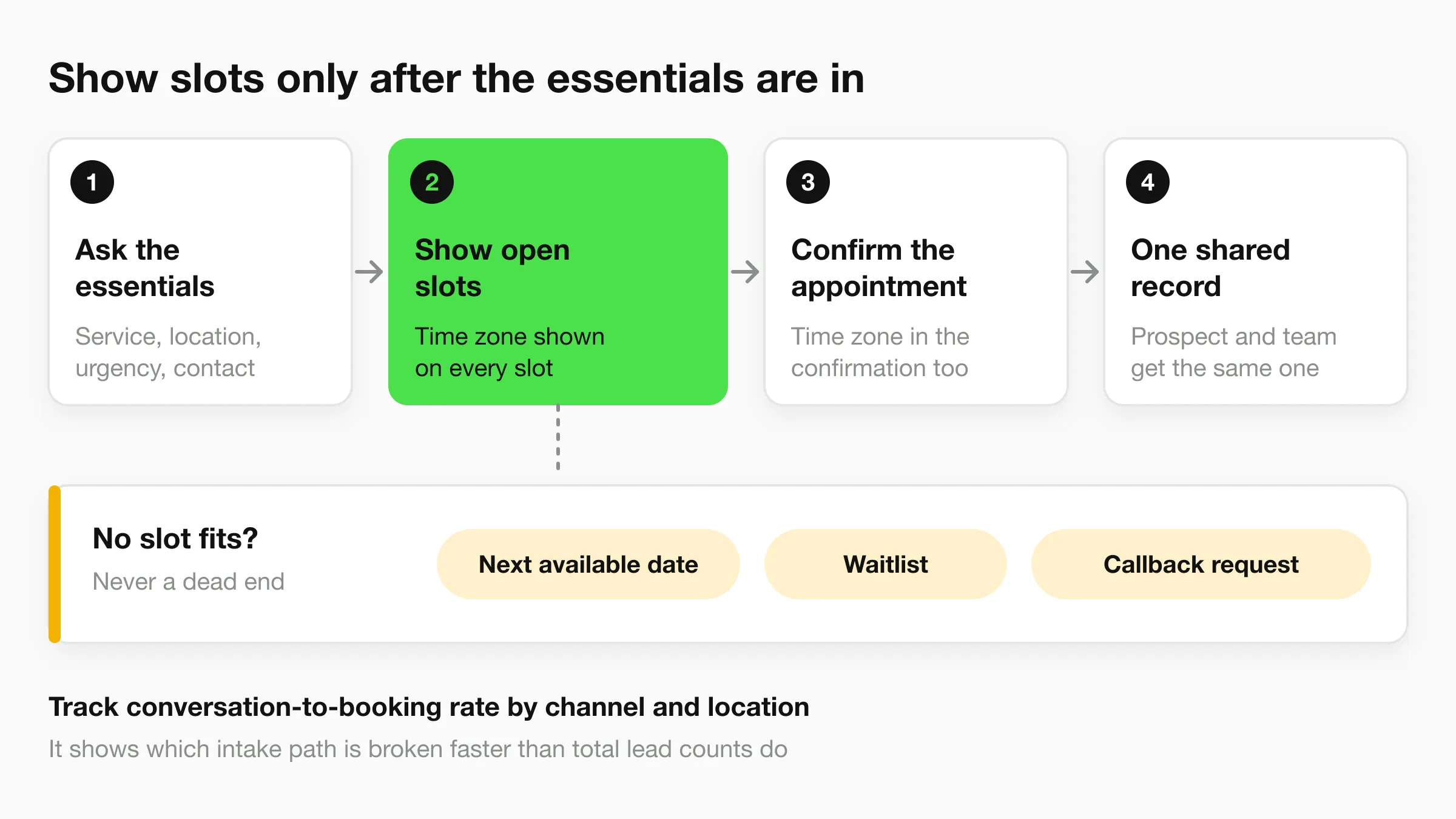
Let qualified prospects pick a slot without leaving the chat. Ask for the essentials (service, location, urgency, contact details), show the appropriate slots, confirm the appointment, and send both the prospect and the internal team the same record. Integrate with Calendly or Cal.com. On Pro and Max, Hyperleap books into Calendly or Cal.com inside the conversation at the right moment rather than at the top; on Plus, the agent shares your booking link.
Guardrails That Prevent Booking Chaos
- Only expose slots after the service, location and urgency are confirmed, or you'll book a group event into a single-room calendar.
- Show the time zone explicitly on the slot screen and in the confirmation. This is the single most common failure for hotels and agencies serving several regions.
- Make calendar updates idempotent so a reschedule edits the existing booking instead of creating a duplicate that two staff members prepare for.
- Define the no-slot fallback: the next available date, a waitlist capture, or a callback request. An empty calendar with no alternative is a dead end.
- Track conversation-to-booking rate by channel and location. It tells you which intake path is broken far faster than total lead counts do.
A clinic case makes it concrete: the bot collects the reason for the visit, routes to the correct practitioner's availability, and books directly. No phone tag, no morning callbacks, no third call to confirm.
6. Ask for Contact Details Only After You've Earned Them
A form that demands a phone number before it has given anything back is a toll booth, and visitors drive around toll booths.
Contextual capture works better because it feels like part of the conversation. A hotel asks for the preferred property and arrival date before it asks for a phone number. A clinic collects the service of interest before sharing the consultation link. An agency captures business type, website address and advertising objective before it offers a discovery call. In each case the field exists because the next step requires it, and the visitor can see that.
Consent Is Part of the Form, Not a Footnote
Much lead-generation advice still treats a form submission as universally valid permission. Recent academic research describes lead-generation sites as potential "consent farms", where users may not understand that their information will be distributed to numerous marketing partners, which exposes businesses to privacy, spam and regulatory risk, as discussed in this study on lead-generation consent practices.
The practical fix is smaller than most compliance projects: explain who will use the data, collect only what qualification or scheduling needs, separate service communications from promotional consent, record the wording and timestamp shown, and give a one-click withdrawal path. This matters most in healthcare, dental, real estate and financial services, where unnecessary fields add sensitivity as well as exposure.
Contrarian rule: a smaller list of people who knowingly asked to hear from you outperforms a bigger list of people who didn't.
- Lead with value: availability, an estimate, a checklist, a slot. Then ask.
- Limit the first capture to fields needed for the immediate next action.
- Keep phone formats tolerant for international visitors while still validating the number.
- Test field sequences, not field counts. Order changes conversion more than removal does.
7. Personalize With Context You Already Have
A visitor clicks an ad for your downtown location and the chat opens with "How can I help you today?" That's a wasted opening, and it happens on most SMB websites.
Use what the conversation already contains: requested location, service, product, campaign source, language, current page. A location-aware assistant can answer with the right parking instructions, the right opening hours and the right service menu, then hand the inquiry to the correct team. The goal is relevance, not the illusion of intimacy. Don't imply the system recognizes a returning customer unless that fact is available and permitted.
Where Personalization Actually Pays
- Multi-property hotels: confirm the property early, answer with that property's amenities and parking, then transfer the inquiry to its sales team.
- Real-estate groups: use the selected region to surface relevant listings and local market notes instead of a generic brochure.
- Clinic chains: route by treatment type and nearest location so the patient isn't asked the same two questions twice.
Keep location-specific entries for local differences only. If twenty of twenty-two answers are identical across branches, they belong in the shared base. Record location, service interest and preferred contact method with every lead so the follow-up call starts informed. Test what happens when a visitor changes location mid-conversation, because they will. And when detection is uncertain, ask the visitor to confirm rather than guessing a city and quoting the wrong price.
8. Notify the Right Person in Seconds and Keep One Inbox
A lead that lands in a shared inbox nobody owns dies politely, and the monthly report calls it a traffic problem.
Response time is the metric that exposes it. A study of speed-to-lead benchmarks covering more than 15,000 web leads and roughly 100,000 call attempts found that contacting a lead within five minutes rather than waiting 30 minutes produced about 100 times greater odds of reaching the prospect and 21 times greater odds of qualifying. Waiting 10 minutes instead of 5 cut qualification odds roughly fourfold.
The operational answer is two things working together: an instant summary after every conversation, and one inbox holding the full history across website, WhatsApp, Instagram and Facebook. Each notification should carry the contact details, a short summary, the intent signals, the requested service or product, the location and a recommended next action.
Routing Rules That Hold Up
- Route by location, service or intent instead of pouring every lead into one queue. A group-booking inquiry and a parking question don't belong to the same person.
- Assign an owner at delivery. Unassigned leads are the most expensive kind.
- Set a response service level for high-intent leads during business hours, and publish it where the team can see it.
- Include the full transcript link next to the summary so a rep can check context without asking the prospect to repeat themselves.
- Reconcile summaries against CRM records weekly. Duplicate leads from the same person across two channels are normal and should be merged, not counted twice.
An agency managing several client brands gets the clearest benefit: one exported lead report, filtered by client and channel, replaces five logins and a spreadsheet assembled by hand.
9. Measure the Funnel by Step, Channel and Outcome
Lead generation isn't a side activity. In 2024, 16% of B2B marketers surveyed by HubSpot said lead generation was their primary marketing goal, according to HubSpot's B2B marketing statistics. If it's the main goal, it deserves better than a chat-volume dashboard.
Start with realistic expectations. Recent benchmark summaries place median B2B conversion from visitor or campaign interaction to lead at about 2.9%, with a typical range of 2%–5%, and a lead-to-customer range of roughly 2%–5%, as compiled in these lead generation statistics. Those ranges argue for disciplined qualification and routing, because adding low-intent contacts raises the top line while lowering sales productivity.
Then get the attribution right. The 2025 State of Marketing Attribution report recommends treating CRM records, meaning form fills, bookings, purchases and what leads ultimately become, as the source of truth rather than trusting ad-platform dashboards alone.
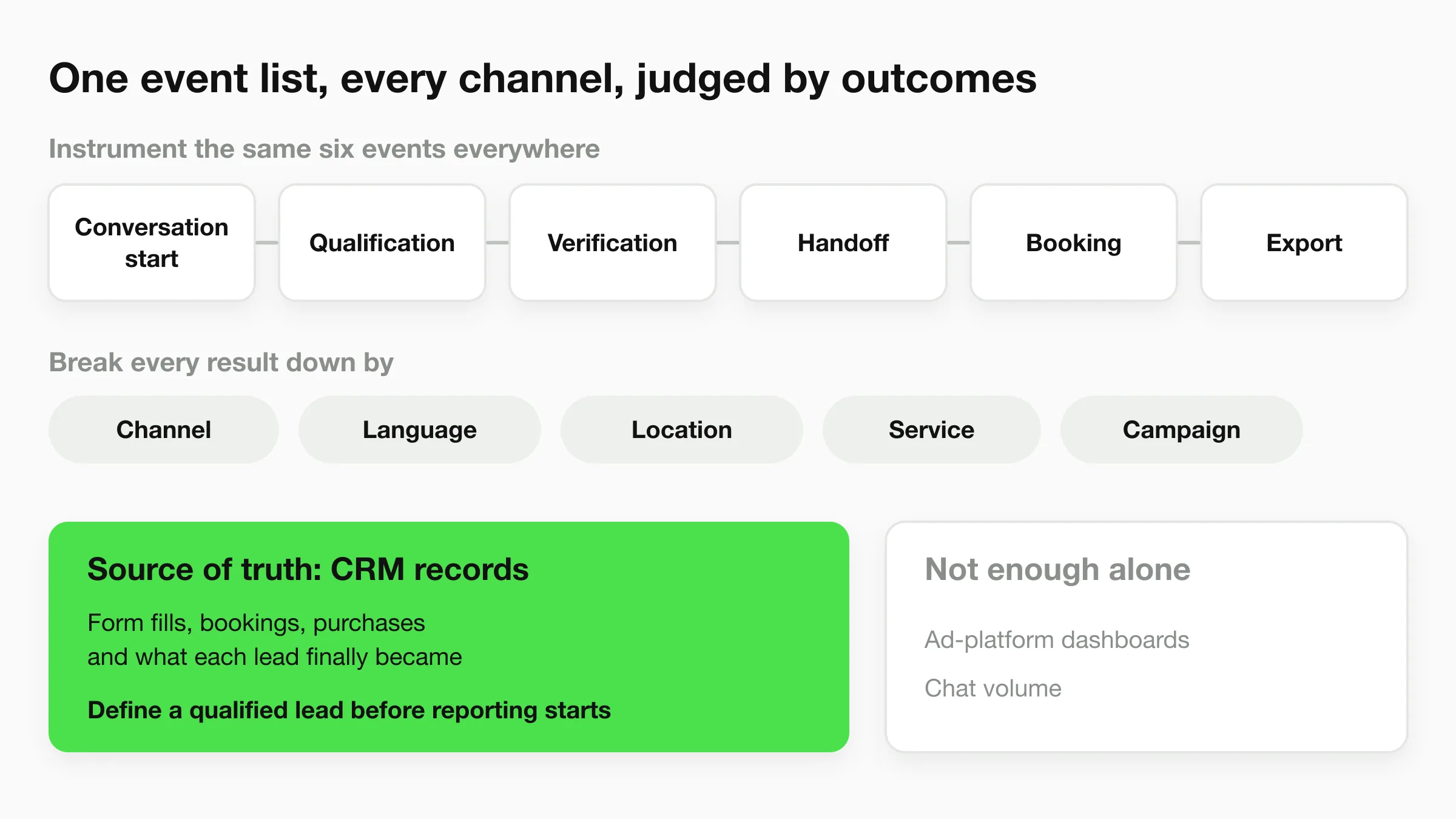
Events to Instrument
Define a qualified lead before reporting begins, then use one event taxonomy across every channel: conversation start, qualification, verification, handoff, booking, export. Break results down by channel, language, location, service and campaign. The measurement discipline in these AI chatbot KPIs is a sensible starting template.
- Review transcripts in every major segment monthly, not just the numbers.
- Watch channel quality, not channel volume. Two hundred verified contacts that book beat two thousand that don't answer.
- Change one thing at a time when you adjust forms or qualification questions, or you'll never know what worked.
How the 9 Lead Generation Practices Compare
The nine practices are not competing tactics. Each one fixes a different leak in the conversational funnel: capture, verification, qualification, routing, booking, and reporting. Read the table as a diagnostic tool. If leads stall before they reach your team, start with capture and verification. If conversations stall after the first reply, look at knowledge, qualification, and booking.
| Practice | Funnel Stage | Primary Channel | Best-Fit Vertical | Key Metric | Main Trade-Off |
|---|---|---|---|---|---|
| Deploy an Always-On AI Chatbot Across Multiple Channels | Awareness to lead capture | Website, WhatsApp, Instagram, and Facebook | Retail, healthcare, and service businesses | Qualified conversations and booking conversion | Requires a current knowledge base; complex inquiries need human escalation |
| Implement OTP-Verified Lead Capture | Lead verification | Website chat | Real estate, healthcare, and service businesses | OTP verification rate | Improves contact quality but adds conversion friction |
| Create a Unified Knowledge Base and Share Relevant Content | Consideration and lead nurturing | Website chat, WhatsApp, Instagram, and Messenger | Hospitality, healthcare, and multi-location organizations | Content engagement and content-to-booking conversion | Centralized content improves consistency but requires ongoing governance |
| Qualify Intent Inside the Conversation | Lead qualification | Website and messaging chat | Professional services, healthcare, and real estate | Qualified-lead rate and booked appointments | Helps prioritize prospects but poorly chosen questions can miss valuable leads |
| Connect Chatbot Conversations Directly to Appointment Scheduling | Conversion | Website and messaging chat with a booking workflow | Healthcare, real estate, and hospitality | Conversation-to-booking rate | Shortens the path to booking but depends on accurate calendar routing |
| Capture Contact Details with Low-Friction, Contextual Forms | Lead capture | Website chat | Healthcare, hospitality, and professional services | Qualified contact completion rate | Context improves relevance, but excessive questions can reduce completion |
| Personalize Conversations Using Visitor Context and Location | Consideration and qualification | Website chat, WhatsApp, Instagram, and Messenger | Multi-location hospitality, healthcare, and real estate | Localized lead and routing conversion | Improves relevance but increases governance needs and risks incorrect personalization |
| Automate Instant Lead Notifications and Centralized Follow-Up | Lead handoff and follow-up | One inbox across channels with email notifications | Healthcare, real estate, and agencies | Lead response time | Speeds follow-up but can create alert fatigue without thoughtful routing |
| Measure Funnel Performance with Channel- and Outcome-Based Metrics | Measurement and optimization | Cross-channel analytics and conversation data | Hospitality, healthcare, and agencies | Qualified-lead and appointment-booking rates | Enables optimization but attribution and metric definitions can be imperfect |
A few rows deserve closer reading. An always-on chatbot only helps if it answers from current business information. Hyperleap AI reads your website pages and uses your logo and colours to create an AI front desk, then answers from your website and documents across website chat, WhatsApp, Instagram, and Messenger. That setup supports capture and basic questions, while escalation rules still matter when a visitor asks something the system cannot answer.
Verification belongs in website chat. With the OTP verification add-on (Pro and Max), Hyperleap AI sends a one-time code in website chat to help confirm a visitor's phone number is real before the lead reaches your team. That improves handoff quality, but it adds a step. Use it when fake or unreachable contacts are costing sales time, not when your main problem is low traffic.
Qualification should collect context the team will use. Hyperleap AI can gather company size, current IT setup, pain points, compliance requirements, and budget range, then deliver a qualified lead with context. That is more useful than a name and phone number because the caller knows what to open with. The trade-off is length. Ask only the questions that change routing, pricing, or the next action.
Booking sits closest to revenue. Hyperleap AI handles lead capture and booking on your own website, and its AI agent answers, qualifies, and books across the website, WhatsApp, Instagram, and Facebook, 24/7 (native Calendly and Cal.com booking is on Pro and Max; on Plus the agent shares your booking link). This works well when appointment demand is steady and calendar rules are clear. It works poorly when staff availability changes often and nobody maintains the schedule.
Notification and reporting complete the loop. Hyperleap AI keeps customer conversations and contact details together, replies in seconds, asks qualifying questions, and emails the business team a clean summary. Pro and Max include after-chat follow-ups emailed to the right person and show which links and campaigns bring chats. Leads, conversations, and the CRM dashboard are available over MCP on every paid plan to the AI tools a team already uses, with read-only access except for saving lead insights to a lead profile. That makes reporting easier without giving external tools control over messaging or settings.
Use the table to assign ownership, not to collect more software. One practice with a clear owner and a measured outcome will beat a broad rollout where nobody knows whether the lead was verified, qualified, routed, booked, or lost.
From Checklist to Compounding Pipeline
Nine practices is too many to change in one month. Pick the one that removes the biggest leak in your funnel right now, assign an owner by name, and instrument it before you add another. A change nobody measures is a change nobody keeps.
If contact quality is your problem, meaning sales calls numbers that don't ring and reports that overstate pipeline, start with always-on capture and verification. Those two steps clean the input before anything else touches it, and they're the cheapest to prove. If your team is slow to respond, add in-conversation qualification and booking so the highest-intent conversations route to a person and end in a calendar slot instead of a "we'll be in touch."
Then use funnel metrics to decide where the next dollar goes. Channel quality is the only honest input to a budget conversation, and it's the argument that survives when someone asks why you're not just buying more traffic.
What compounds: every verified lead, tagged with source, response time and outcome, makes the next month's channel comparison more accurate. That's the loop. Capture, verify, qualify, route, book, measure, then tighten the step that leaks.
Two trade-offs are worth stating plainly. Automation without ownership produces faster noise: an instant chatbot that answers questions while nobody claims the lead has moved the delay downstream. And volume without consent produces a database you can't safely use. Bulk form fills exported to a CRM and mailed without a clear permission trail is a liability, not a pipeline.
A smaller volume of quickly answered, properly attributed, consented leads usually beats a larger volume optimized for cheap form fills. The operators who win this aren't generating the most inquiries. They're the ones whose inquiries reach a human or a calendar before the prospect's attention moves on.
Hyperleap AI is one option that handles these steps in a single tool: an AI front desk that answers from your own website and documents across website chat, WhatsApp, Instagram and Messenger, verifies phone numbers with one-time codes in website chat (a paid add-on on Pro and Max), emails your team a summary after each conversation, and books qualified prospects into Calendly or Cal.com on Pro and Max (on Plus it shares your booking link). Plus is $40 per month and includes 3,000 AI responses, with Pro and Max adding campaign-level visibility into which links and ads bring chats.
Every inquiry deserves an answer before the prospect's attention moves on, and that's what Hyperleap AI is built to deliver: an AI front desk that captures and qualifies leads on your website, WhatsApp, Instagram and Messenger, verifies phone numbers with one-time codes on website chat (a paid add-on on Pro and Max), then emails your team a clean summary and books ready prospects into Calendly or Cal.com (Pro and Max; Plus shares your booking link), with plans starting at $40 per month on Plus. If your funnel still leaks at 9:40 p.m., start by putting capture, verification and booking in one place. Visit Hyperleap AI to paste your website URL, review the instructions Studio drafts for your agent and go live without a developer.