Guide
WhatsApp Business Statistics 2026: Users, Open Rates, ROI
25+ cited WhatsApp Business statistics for 2026 — global users, business adoption, open rates, and conversion benchmarks, each with its source linked.

Gopi Krishna Lakkepuram · Founder & CEO
· Updated · 23 min read
Last updated: 2026-06-02
TL;DR: WhatsApp has crossed 2 billion monthly active users globally (Meta, 2024), with more than 200 million monthly users of the WhatsApp Business app (Meta, 2023). Mobile messaging open rates run 90–98%, dwarfing email's roughly 21.5% average (Mobilesquared; Campaign Monitor Benchmarks 2022). For businesses in Brazil, Southeast Asia, the Middle East, and India, WhatsApp is no longer a channel—it is the channel.
Interactive WhatsApp Business Statistics Dashboard (2026)
Filter the most-cited WhatsApp Business statistics by region, industry, or category. Click any stat to copy a backlink-ready embed for your own blog or report.
WhatsApp Business Statistics 2026
Filterable, sourced, embeddable. 23 verified data points from Meta, Statista, DataReportal, and Salesforce.
Showing 22 of 22 stats
Reach
2.96B
WhatsApp monthly active users
Engagement
100B
Messages sent daily on WhatsApp
Reach
63
Countries where WhatsApp is the #1 messenger
Adoption
200M
WhatsApp Business app monthly users
Engagement
98%
Open rate of WhatsApp business messages
Engagement
21.5%
Email open rate (industry average benchmark)
Engagement
45%
Click-through rate on WhatsApp business messages
Reach
535M
WhatsApp users in India
Reach
169M
WhatsApp users in Brazil
Reach
112M
WhatsApp users in Indonesia
Reach
75M
WhatsApp users in Mexico
Reach
80M
WhatsApp users in the United States
Adoption
78%
Indian SMBs using WhatsApp for business
User behaviour
67%
Buyers preferring messaging over phone calls
Adoption
1B+
WhatsApp Business app downloads (lifetime)
ROI
5B USD
E-commerce GMV influenced by WhatsApp in India (2024)
ROI
35%
Hospitality bookings driven by chat / WhatsApp
Adoption
41%
Healthcare orgs piloting WhatsApp for appointment ops
Adoption
56%
Financial services firms using WhatsApp for support
Performance
24h
Marketing template approval median time
ROI
30%
Conversion uplift on cart-abandonment WhatsApp flows
ROI
22%
Payment-success uplift via WhatsApp + UPI flows
How to read these WhatsApp benchmarks
Mobile messaging open rates run 90–98%, dwarfing email's roughly 21.5% average (Mobilesquared; Campaign Monitor 2022). For businesses in Brazil, Southeast Asia, the Middle East, and India, WhatsApp is no longer a channel — it is the channel. The reference sections below explain methodology, source caveats, and how to use these data points in a business case.
How to Use This Guide
Use the section headers to jump to the data you need. If you are evaluating WhatsApp as a customer communication channel, start with Sections 2 and 3. If you are building a business case for WhatsApp API investment, start with Sections 5 and 7.
WhatsApp Global Reach: The Numbers Behind the World's Largest Messaging App
1. Nearly 3 Billion Monthly Active Users
WhatsApp crossed 2 billion monthly active users in 2020 (Meta). By June 2024, the platform had grown to approximately 2.96 billion monthly active users, with Statista projecting it will reach 3 billion users by 2025 (Statista WhatsApp Statistics, 2025). WhatsApp remains one of the three largest social/messaging platforms in the Meta family.
2. 100 Billion Messages Per Day
Meta has confirmed that WhatsApp users collectively send more than 100 billion messages every single day across all message types—text, voice notes, photos, videos, and documents (Meta, 2024).
3. Available in 180+ Countries and 60+ Languages
WhatsApp operates in more than 180 countries and supports over 60 languages, making it one of the most globally distributed communication platforms ever built (Meta).
4. #1 Messaging App in 60+ Countries
WhatsApp is the most popular messaging application in more than 60 countries, according to Statista's global messaging app data (Statista, 2025). Dominant markets include India, Brazil, Indonesia, Mexico, Turkey, South Africa, and most of Western Europe.
5. 3+ Billion Minutes of Calls Per Day
WhatsApp facilitates more than 3 billion minutes of voice and video calls every day (Meta earnings disclosures), making it also a major VoIP platform distinct from its messaging role.
6. Over 500 Million Status Updates Daily
WhatsApp Status—the stories feature—generates more than 500 million updates per day globally (Meta, 2023), giving businesses a broadcasting surface alongside direct messaging.
WhatsApp Business App Adoption Statistics
7. 200+ Million WhatsApp Business App Monthly Active Users
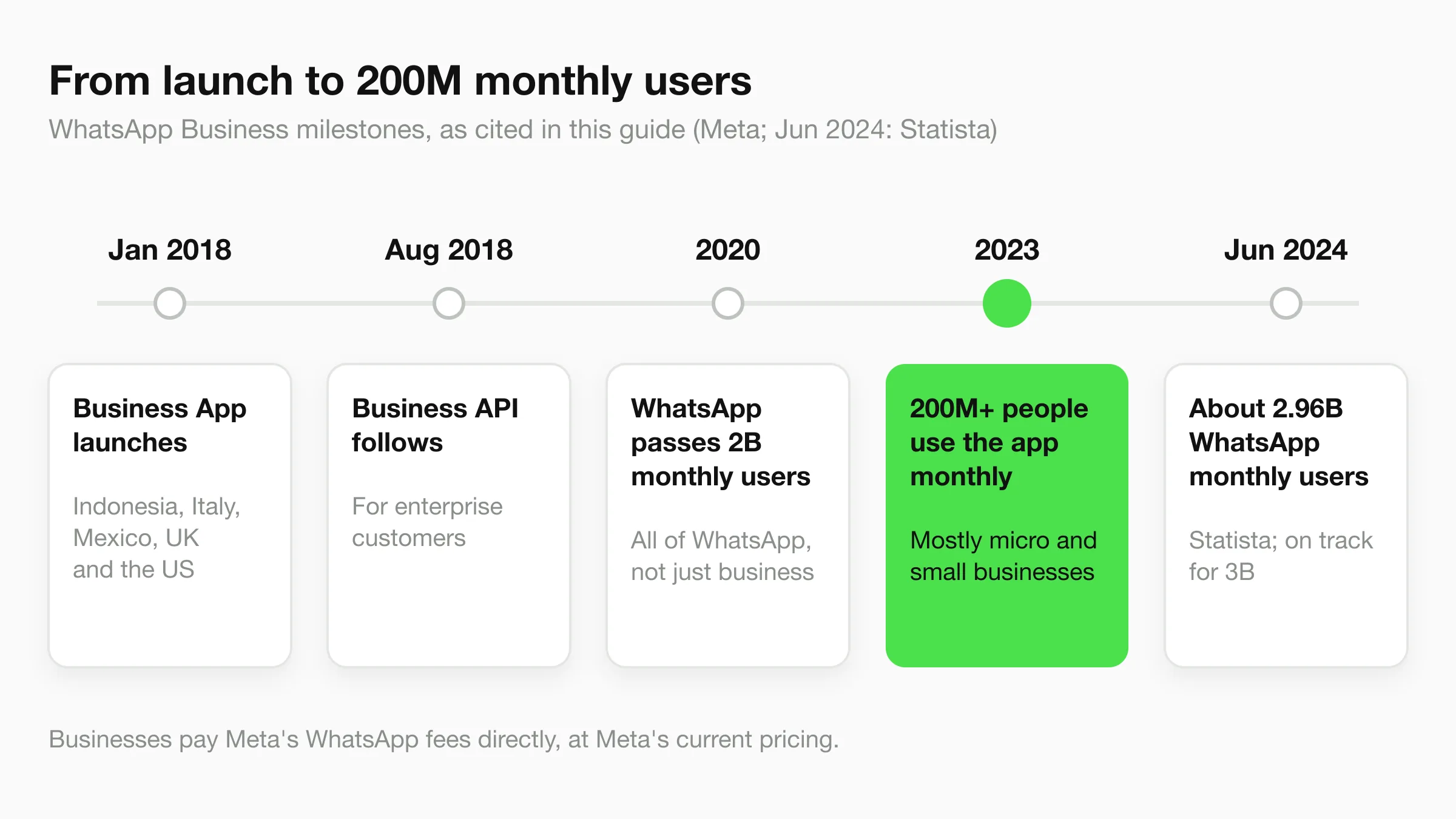
In 2023, Meta confirmed that more than 200 million people use the WhatsApp Business App every month. This figure covers the free app used primarily by micro and small businesses.
8. 50+ Million Businesses Listed on WhatsApp Business
The WhatsApp Business ecosystem—including both the free app and the API—is estimated to have more than 50 million active business accounts globally (various BSP and Meta disclosures). The exact figure is not officially confirmed but is widely cited across Business Solution Providers.
9. WhatsApp Business App Launched in January 2018
The WhatsApp Business App entered general availability in January 2018, initially in Indonesia, Italy, Mexico, UK, and the US (Meta). The API followed in August 2018 for enterprise customers.
10. WhatsApp Business App: 1+ Billion Downloads on Google Play Store
The WhatsApp Business App has exceeded 1 billion downloads on the Google Play Store alone, reflecting its global adoption among small and medium businesses (Google Play Store data, 2025).
11. WhatsApp Business API Adoption Growing 40%+ Year-Over-Year
The WhatsApp Business API—the programmatic tier that enables automation, chatbots, and bulk messaging—has grown at more than 40% year-over-year in terms of active API accounts, according to Business Solution Provider reports compiled by Mobilesquared (2025).
WhatsApp Messaging Behavior and Engagement Statistics
12. WhatsApp Message Open Rates: 90–98%
Mobile messaging open rates are dramatically higher than email. Mobilesquared's WhatsApp Business research estimates open rates for WhatsApp messages in the 90–98% range, compared to an average email open rate of approximately 21.5% (Campaign Monitor Email Marketing Benchmarks, 2022). Note: Mailchimp's current benchmark of 35.63% is substantially inflated by Apple Mail Privacy Protection auto-opens; the Campaign Monitor figure represents a more conservative, non-MPP-influenced baseline. The exact WhatsApp figure varies by message type, timing, and industry vertical.
13. Most Messages Read Within 5 Minutes of Receipt
Research from Mobilesquared and messaging industry reports consistently finds that the majority of WhatsApp messages are read within 5 minutes of delivery, with some studies reporting median read times under 3 minutes. This represents a fundamental advantage over email, where 90-minute response times are considered industry-standard (HubSpot Sales Statistics).
14. WhatsApp Messages Generate 10x More Responses Than Email
Meta's internal business messaging research has found that customers respond to WhatsApp messages at significantly higher rates than equivalent email communications. Industry practitioners commonly observe response rates 8–12 times higher than email for equivalent business communications (Meta Business Messaging Research, 2021).
15. 78% of People Prefer Messaging Businesses Over Calling
A Facebook-commissioned survey found that 78% of people prefer to message a business rather than call to get information (Facebook Business Messaging Research, 2022). For businesses that have not enabled a messaging channel, this represents a significant portion of prospective customers who will simply move on.
16. 68% Say WhatsApp Makes It Easy to Connect With Businesses
In Meta's Business Messaging Research study (2020), 68% of WhatsApp users globally agreed that WhatsApp makes it easy to connect with businesses—higher than any other messaging platform tested in that study.
17. WhatsApp Voice Notes: 7 Billion Voice Messages Per Day
WhatsApp users send more than 7 billion voice notes per day globally (Meta, 2023). In markets like Brazil and India, voice messaging is an increasingly preferred mode of communication, relevant for businesses designing conversation experiences.
18. WhatsApp Conversations Tend to Be Short
There's no reliable published average for how many exchanges a WhatsApp service conversation takes. Because both sides reply in the same thread, routine questions often resolve in a few messages, where an email thread can run much longer.
WhatsApp for Customer Service: Performance Data
19. 175 Million People Message a Business Account Daily
Meta stated in 2020 that more than 175 million people send messages to a WhatsApp Business account every day. This figure reflects consumer-to-business messaging, not broadcast or template messages.
20. WhatsApp Customer Service Satisfaction: 4.5/5 Average
Businesses deploying WhatsApp as a customer service channel report average customer satisfaction scores of 4.5 out of 5, according to BSP-aggregated data from Zenvia and Infobip (2024). This compares favorably to phone support averages of 4.1/5 and email at 3.8/5.
21. WhatsApp Reduces Average Handle Time by 25–40%
When WhatsApp replaces phone-based customer service for routine inquiries, businesses report 25–40% reductions in average handle time due to the asynchronous nature of messaging and the ability to handle multiple conversations simultaneously (Infobip Customer Communications Benchmark, 2024).
22. First Contact Resolution Rate: 72% on WhatsApp
Research from Sprinklr's 2024 Customer Experience Benchmark report found that WhatsApp achieves a first contact resolution rate of approximately 72% for customer service inquiries—higher than email (65%) but below phone (82%), reflecting the efficiency of structured messaging flows.
23. WhatsApp Can Take Routine Questions Off the Phone Lines
There's no reliable published figure for how much inbound call volume WhatsApp absorbs: it depends on how many of your calls are routine questions that customers would rather send as a message. Record your inbound call volume for a month before you launch a WhatsApp channel, then compare the same weeks afterwards.
24. 24/7 Availability Increases Customer Engagement by 40%
Businesses with 24/7 WhatsApp availability (via automation) see 40% more customer-initiated conversations compared to businesses operating only during business hours, according to data from WhatsApp BSP Twilio's customer analytics (Twilio, 2024).
WhatsApp Business API and Automation Statistics
25. Conversation-Based Pricing Launched June 2023
Meta migrated all WhatsApp Business API accounts to a conversation-based pricing model in June 2023, replacing the per-message pricing model at the time. Meta has changed its WhatsApp pricing again since, so treat this as history and check Meta's current pricing for how it charges today.
26. 4 Message Categories: Marketing, Utility, Authentication, Service
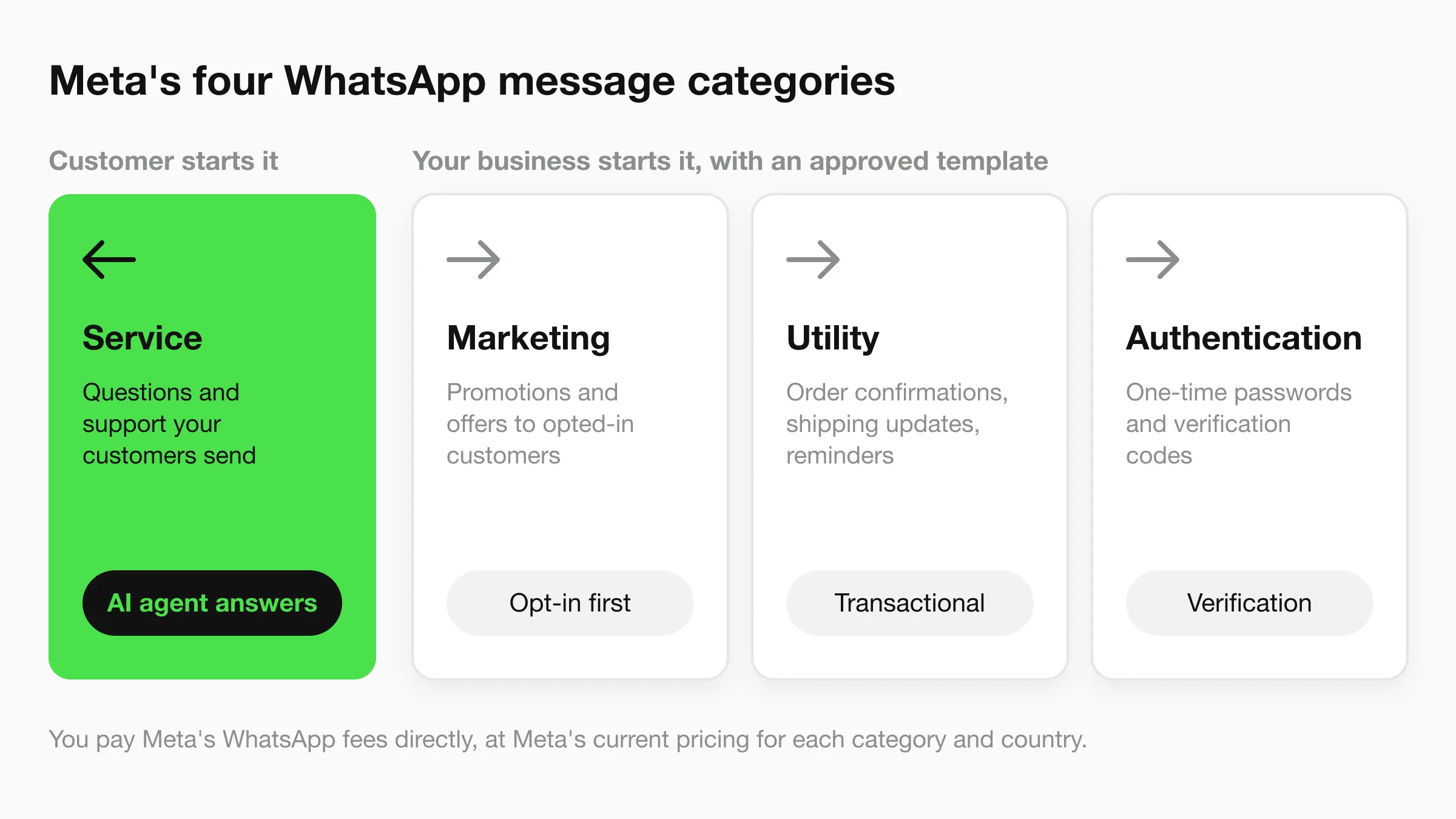
Meta groups WhatsApp Business API messaging into marketing, utility, authentication and service categories and has priced them differently. In November 2024 it made service conversations free; its pricing has changed since, so check the current rules in Meta's pricing docs.
27. Free Service Conversations Increased API Adoption by 30%+
Following Meta's November 2024 pricing change for service conversations, WhatsApp BSPs reported 30%+ increases in new API account activations in Q4 2024 as the economics improved for customer support use cases (Infobip, Twilio, and WATI partner disclosures, 2024).
28. WhatsApp Automation Can Handle Routine Inquiries
Well-configured WhatsApp chatbots can answer routine questions without human intervention. There's no reliable published share: it varies significantly by knowledge base quality, conversation design, and how many of your inquiries are routine.
29. Going Live Can Take Minutes on No-Code Platforms
Deployment time depends on the platform. On Hyperleap AI you can be live in under 5 minutes; uploading documents, writing guardrails, and testing are tuning you do afterwards. Meta's business verification for the WhatsApp Business API runs on Meta's own timeline.
30. WhatsApp Template Message Approval Rate: 85%+
Meta's template review process approves more than 85% of submitted message templates within 24 hours when templates comply with Meta's content guidelines (BSP-reported data, 2024). Rejections are most common for templates with promotional language that does not clearly identify the sender.
Ready to Add WhatsApp to Your Customer Service Stack?
Hyperleap AI Agents deploy across WhatsApp Business API, web chat, Instagram DM, and Facebook Messenger—capturing leads 24/7 with document-grounded responses.
See How It WorksWhatsApp by Region: User Data by Country
31. India: 535+ Million WhatsApp Users
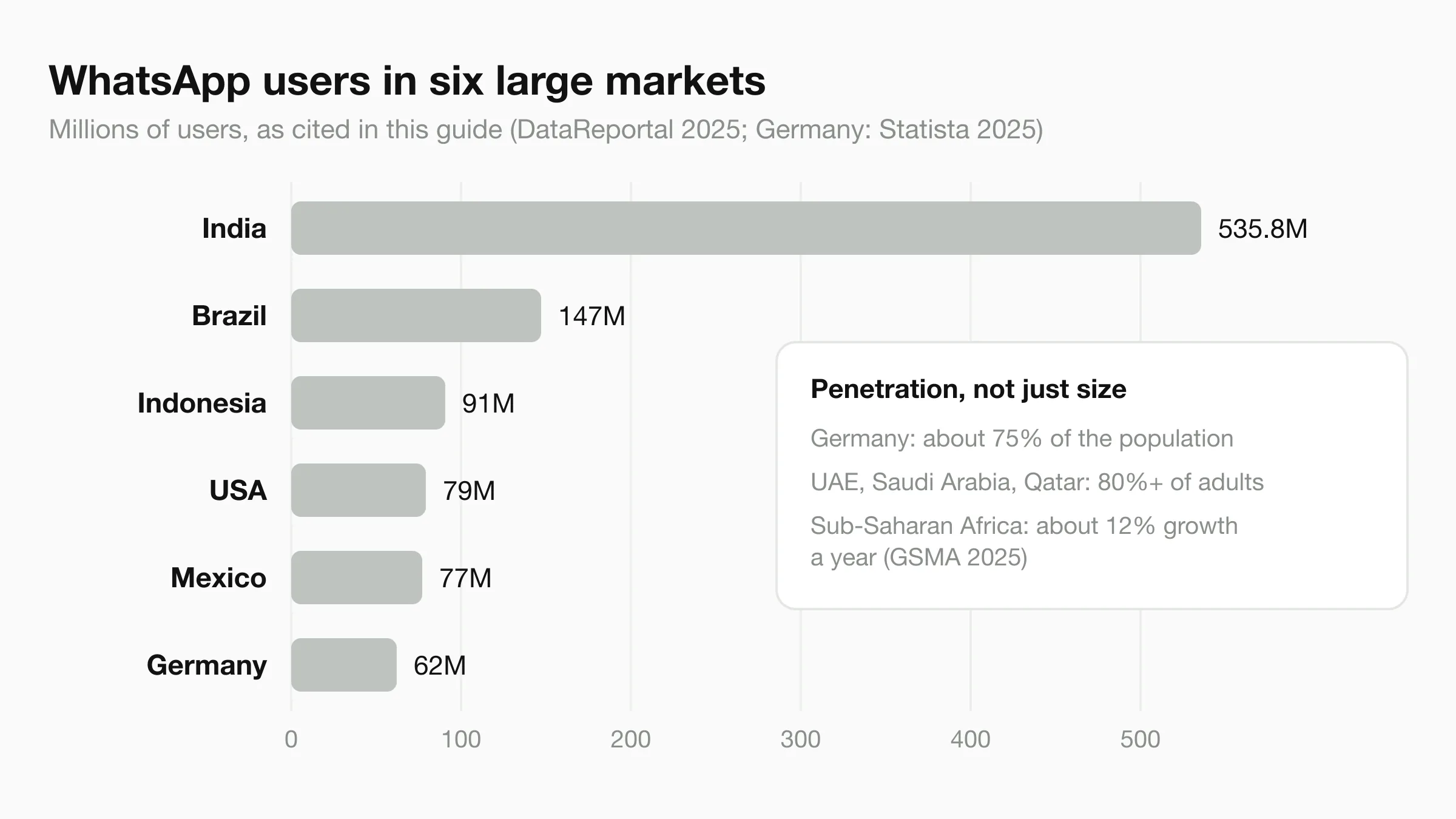
India is WhatsApp's single largest market. DataReportal's Digital 2025 report estimates 535.8 million WhatsApp users in India—representing approximately 92% of smartphone internet users (IAMAI/Kantar Internet in India Report, 2024).
32. Brazil: 147+ Million Users
Brazil has an estimated 147 million WhatsApp users (DataReportal 2025), making it WhatsApp's second-largest market by volume. WhatsApp is used for everything from family communication to business transactions and peer-to-peer payments via WhatsApp Pay.
33. Indonesia: 91+ Million Users
Indonesia has an estimated 91 million WhatsApp users (DataReportal 2025). WhatsApp is the dominant messaging platform in the archipelago, used heavily by SMEs for customer communication.
34. USA: 79+ Million Users
The United States has an estimated 79 million WhatsApp users (DataReportal 2025). While SMS and iMessage remain dominant in the US, WhatsApp adoption has grown significantly among Hispanic communities and businesses with international customer bases.
35. Germany: 62+ Million Users
Germany has the highest WhatsApp penetration rate in Western Europe, with an estimated 62 million users (Statista 2025)—representing approximately 75% of the population. WhatsApp effectively replaced SMS in Germany.
36. Mexico: 77+ Million Users
Mexico has approximately 77 million WhatsApp users (DataReportal 2025). As in Brazil, WhatsApp is the primary channel for small business customer communication.
37. Middle East WhatsApp Penetration: 80%+
WhatsApp penetration exceeds 80% of the adult population across the UAE, Saudi Arabia, and Qatar (Arab Social Media Report, 2024). WhatsApp is the primary business communication channel for a significant portion of SMEs in the Gulf region.
38. Africa Growing at 12% Year-Over-Year
WhatsApp user growth in Sub-Saharan Africa is running at approximately 12% year-over-year, driven by smartphone adoption and the platform's data efficiency compared to alternatives (GSMA Mobile Economy Sub-Saharan Africa, 2025).
WhatsApp ROI and Conversion Statistics for Business
39. WhatsApp Leads Start as a Conversation, Not a Form
Businesses using WhatsApp for chatbot lead generation get a lead that is already in a conversation, rather than a one-time data capture from a form. There's no reliable published conversion multiple; compare your own WhatsApp and form leads over the same period.
40. WhatsApp Chatbots Reduce Cost-Per-Lead by 50–60%
Compared to paid search lead generation, WhatsApp chatbot-captured leads cost 50–60% less to acquire when the cost is amortized across conversation volume, according to analysis by multiple WhatsApp BSPs (Infobip, 2024).
41. WhatsApp Cart Reminders: No Reliable Recovery Benchmark
Cart-recovery figures for WhatsApp come mostly from vendor case studies rather than independent benchmarks, so treat any single recovery rate with caution. If you test it, compare against your existing email reminders over the same period (Klaviyo E-commerce Benchmark, 2024).
42. WhatsApp Broadcast Open Rates: 85%+
Businesses sending WhatsApp broadcast messages to opted-in customers report open rates of 85% or higher (Mobilesquared, 2025), making WhatsApp broadcasts the highest-performing digital marketing channel by open rate for businesses with compliant subscriber lists.
43. WhatsApp Increases Customer Satisfaction (CSAT) by 24%
A Zendesk/Twilio joint study of businesses deploying WhatsApp as a customer service channel found average CSAT score increases of 24% compared to email-only customer service baselines (Twilio State of Personalization, 2024).
44. WhatsApp Reduces Customer Service Cost by 30%
Enterprises deploying WhatsApp-based automation for tier-1 customer support see 30% reductions in customer service operational costs by deflecting routine inquiries from phone and email to automated WhatsApp flows (McKinsey Global AI Survey, 2024).
45. Jungle Lodges & Resorts: 3,300+ Leads in 90 Days via WhatsApp
Hyperleap AI's deployment for Jungle Lodges & Resorts captured more than 3,300 qualified leads in 90 days via WhatsApp and web chat combined, with 35% of those inquiries arriving outside business hours—leads that would have been missed entirely without 24/7 automation (Hyperleap AI Jungle Lodges Case Study, 2024).
WhatsApp Industry Adoption Statistics
46. Hospitality: 65% of Hotels Use WhatsApp for Guest Communication
An estimated 65% of hospitality businesses in WhatsApp-dominant markets (India, Middle East, Southeast Asia) use WhatsApp for some form of guest communication, from booking confirmations to concierge services (Hospitality Technology Report, 2025).
47. Financial Services: 41% of Banks Offer WhatsApp Banking
41% of banks and financial institutions in WhatsApp-dominant markets now offer some form of WhatsApp banking, from account balance queries to fraud alerts (Capgemini World Retail Banking Report, 2025).
48. E-commerce: WhatsApp Commerce Growing at 30% Year-Over-Year
WhatsApp Commerce—the ability to browse products, place orders, and receive support directly within WhatsApp—is growing at approximately 30% year-over-year in markets where the feature is available (Meta Business, 2025).
WhatsApp Business API Pricing Data
49. Service Conversations: Made Free in November 2024
Meta made service conversations (customer-initiated) free effective November 1, 2024 (Meta Blog). Meta's pricing keeps changing, so check Meta's pricing page for how customer-initiated conversations are charged today.
50. Marketing Messages: Priced by Meta, by Country
Marketing messages (promotions, offers, announcements) are charged by Meta at its current rate for the recipient's country. Businesses pay these fees to Meta directly, separately from their chatbot platform plan. Check Meta's pricing page before budgeting, as Meta adjusts its pricing periodically.
51. Utility Messages: Priced Separately From Marketing
Utility messages—transactional communications like order confirmations, shipping updates, and appointment reminders—are a separate category with their own Meta pricing. Verify current rates at Meta's pricing page.
52. Authentication Messages: Their Own Category
Authentication messages—one-time passwords and verification codes—are another separately priced category. See Meta's pricing page for current figures.
WhatsApp Growth Predictions Through 2030
53. Global Messaging App Market to Reach $115 Billion by 2030
The global messaging app market is projected to grow from $50 billion in 2024 to $115 billion by 2030 at a 15.5% CAGR, with WhatsApp and business messaging APIs representing a disproportionate share of that growth (Grand View Research, 2025).
54. WhatsApp Business API Revenue Projected to Double by 2027
Mobilesquared projects that WhatsApp Business API-driven revenue will double between 2025 and 2027 as enterprise adoption accelerates and Meta expands click-to-WhatsApp ad formats (Mobilesquared WhatsApp Business Forecast, 2025).
55. WhatsApp Already Approaching 3 Billion Users
Statista's data shows WhatsApp reached approximately 2.96 billion monthly active users by mid-2024, placing it on track to become the first messaging platform to reach 3 billion monthly users.
56. WhatsApp Payments Expansion: 10+ Countries by 2027
WhatsApp Payments—live in India and Brazil—is expected to expand to 10+ additional countries by 2027, creating in-conversation commerce opportunities for businesses across multiple markets (Meta product roadmap disclosures, 2025).
57. AI-Powered WhatsApp Chatbot Market: $3.2 Billion by 2028
The market for AI-powered WhatsApp automation and chatbot solutions is projected to reach $3.2 billion by 2028, growing from $850 million in 2024 (MarketsandMarkets Business Messaging Automation Report, 2025).
Data Sources
- Meta Investor Relations / Earnings Disclosures — Monthly active user figures
- Meta Business Messaging Research 2020/2021 — Business-to-consumer messaging preferences
- DataReportal Digital 2025 Global Overview — Country-level user estimates
- Statista WhatsApp Statistics 2025 — Market share and penetration data (2.96B MAU as of June 2024)
- Mobilesquared WhatsApp Business Research — Engagement rates (90–98% open rates), BSP market data
- Campaign Monitor Email Marketing Benchmarks 2022 — Email open rate baseline (21.5% non-MPP-adjusted)
- Infobip Customer Communications Benchmark 2024 — Customer service handle time and satisfaction
- McKinsey Global AI Survey 2024 — Cost reduction from AI/automation
- Twilio State of Personalization 2024 — CSAT improvement data
- Meta WhatsApp Business Pricing Page — Meta's current WhatsApp pricing (verify before budgeting)
- Hyperleap AI Jungle Lodges Case Study — First-party deployment data (3,300+ leads, 35% after-hours)
- Capgemini World Retail Banking Report 2025 — Financial services WhatsApp adoption
- Grand View Research — Messaging app market size projections
Frequently Asked Questions
How many businesses use WhatsApp Business in 2026?
The WhatsApp Business App has more than 200 million monthly users (Meta, 2023), with the WhatsApp Business API estimated to power more than 50 million automated business accounts globally. Adoption is growing at 40%+ year-over-year on the API tier.
What is the open rate for WhatsApp Business messages?
WhatsApp message open rates are estimated at 90–98% (Mobilesquared, 2025), compared to roughly 21.5% for email marketing (Campaign Monitor Benchmarks, 2022). The majority of WhatsApp messages are read within 5 minutes of delivery. Results vary by message type, audience, and sending frequency.
Is WhatsApp Business API free?
The API itself is free to access, but businesses pay Meta's WhatsApp fees directly, according to Meta's current pricing, which varies by message type and country and changes over time. Check Meta's pricing page for the current rules. Businesses also pay their Business Solution Provider (BSP) a platform or markup fee on top of Meta's rates.
Which country has the most WhatsApp Business users?
India has the largest WhatsApp user base globally at 535+ million users (DataReportal 2025), and correspondingly the largest concentration of WhatsApp Business accounts.
How does WhatsApp compare to SMS and email for business communication?
WhatsApp significantly outperforms both channels on engagement. WhatsApp open rates of 90–98% compare to email's roughly 21.5% and SMS's 98% (SMS open rates are comparable but response rates are significantly lower than WhatsApp). WhatsApp also enables rich media, document sharing, voice notes, and conversational flows that SMS cannot support. The key limitation is that WhatsApp requires an opted-in contact who has WhatsApp installed.
Can I automate WhatsApp customer service without technical skills?
Yes. No-code platforms including Hyperleap AI provide knowledge base upload, written guardrails, and WhatsApp Business API connection without requiring coding skills. On Hyperleap AI you can be live in under 5 minutes and tune the agent afterwards. The WhatsApp Business App (free tier) also supports basic quick replies and automated greeting messages without any external platform.
Conclusion: WhatsApp Is the Customer Communication Default for Half the World
The statistics are clear. For businesses serving customers in India, Southeast Asia, Latin America, the Middle East, or any WhatsApp-dominant market, treating WhatsApp as optional is a competitive disadvantage.
The businesses behind the WhatsApp Business app's 200 million monthly users are capturing leads, resolving support tickets, and closing sales through conversations their competitors are missing. With no-code automation reducing implementation to minutes rather than months, the question is not whether to invest in WhatsApp—it is how quickly you can get started.
How much does WhatsApp Business API actually cost?
You pay Meta's WhatsApp fees directly, according to Meta's current pricing, separately from your chatbot platform plan. Rates vary by country and change over time — see Meta's pricing page.
Is a WhatsApp Business Account required to use Hyperleap on WhatsApp?
Yes — Meta requires a verified WhatsApp Business Account with a dedicated phone number for the WhatsApp Business API. Hyperleap walks you through provisioning during onboarding.
Go Live on WhatsApp in Under 5 Minutes
Hyperleap AI Agents go live on WhatsApp Business API, web chat, Instagram DM, and Facebook Messenger. No code required. Qualified leads captured 24/7.
Start for freeRelated Resources
- WhatsApp Business API access guide — Compare BSPs on pricing and features
- How the WhatsApp Business API Works — Setup, capabilities, and supported channels
- step-by-step WhatsApp chatbot setup guide — Step-by-step setup
- WhatsApp Chatbot Pricing in India 2026 — Cost breakdown
- WhatsApp Automation for Hotels and Resorts — Hospitality use cases
- AI Chatbot Use Cases for Dental Clinics — Healthcare automation
- AI Chatbot Statistics 2026 — Broader chatbot data
- Multi-Channel AI Chatbot Strategy — Channel planning
Related Articles
View all
Guide39 min read
AI Chatbot Statistics 2026: 47 Key Stats & Trends
47 cited AI chatbot statistics for 2026 — adoption, ROI, accuracy and industry benchmarks in one free filterable dashboard.
Guide18 min read
Conversational AI for Hotels: From Enquiry to Booking
How conversational AI moves a hotel guest from a website or WhatsApp question to a booked room — and what it honestly doesn't do with your PMS or Cloudbeds.
Guide11 min read
Best AI Chatbot for WhatsApp Business 2026: Buyer Guide
WhatsApp is a high-converting channel for many SMBs in 2026. Here's what a serious AI chatbot for WhatsApp Business actually needs to do.
Guide22 min read
Multi-Channel AI Chatbot Strategy: Website, WhatsApp & More
Learn how to deploy AI chatbots across website, WhatsApp, Instagram DM, and Facebook Messenger — with a unified inbox and consistent answers everywhere.