Comparison
Best AI Agents for Small Business in 2026
The best AI agents for small business in 2026, grouped by job: front desk, phone, sales, back office and assistants. Pricing and setup for each.

Gopi Krishna Lakkepuram · Founder & CEO
· 20 min read
Last verified: November 2026
Pricing below comes from each vendor's public pricing page, checked in November 2026. Vendors change plans often. Confirm current numbers on the vendor's page before you buy.
TL;DR: The best AI agent for a small business depends on the job you want it to do. For customer messages on your website, WhatsApp, Instagram and Messenger, start with an AI front desk such as Hyperleap AI (from $40/month). For phone calls, use a voice-first tool such as Goodcall or Smith.ai. For outreach research, HubSpot's Prospecting Agent is built into a CRM. For back-office chores, Zapier Agents, Lindy and n8n connect your apps. For your own day-to-day work, ChatGPT and Claude now offer task-running features. Most small businesses should deploy one customer-facing agent first, then add back-office automation later.
Which AI Agents Can a Small Business Actually Deploy in 2026?
An AI agent is software that takes an action toward a goal, not just a reply. It might answer a customer from your documents, book a visit, look up an order, research a lead, or move data between your tools. A plain chatbot answers. An agent answers and then does something.
This guide covers agents you can set up without an engineering team, grouped by the job they do. If you only want website and messaging chat, our best AI chatbot for small business guide goes deeper on that one category. This page is wider: it covers the whole agent category so you can see where each kind fits.
For the underlying concepts, read getting started with AI agents and AI agents vs chatbots.
Quick picker: which AI agent fits which job
| If you need... | Start with |
|---|---|
| Answer questions and book visits on your website, WhatsApp, Instagram DM and Messenger from one knowledge base | Hyperleap AI |
| An AI front desk that connects to your own APIs and hands hard conversations to a person | Hyperleap AI |
| Phone calls answered by an AI voice | Goodcall |
| A human-backed phone receptionist | Smith.ai |
| A chatbot inside a live-chat and helpdesk suite | Tidio (Lyro) |
| A chatbot with a large set of custom actions and an enterprise tier | Chatbase |
| Research and outreach drafts inside a CRM | HubSpot Prospecting Agent |
| Agents that work across many apps without code | Zapier Agents |
| Prompt-built assistants for email and follow-up | Lindy |
| Full control over workflows, with a self-hosted option | n8n |
| A general assistant for research and documents | ChatGPT or Claude |
If you are not sure where to start, start with the customer-facing agent. It is the one that answers people while you are busy, and it is the one where a missed message costs you a sale.
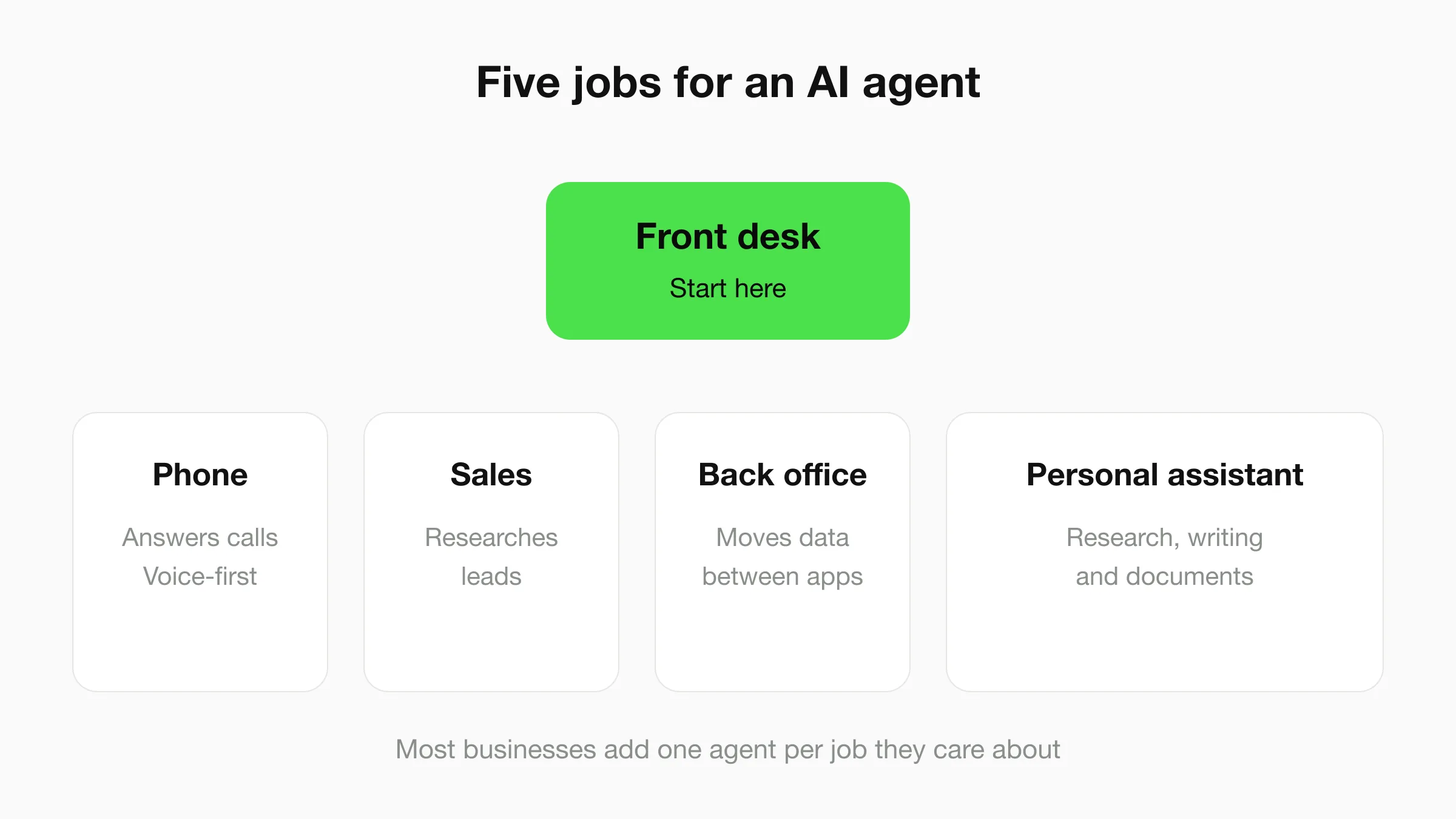
The Five Jobs You Can Hand to an AI Agent
Pick the job before you pick the tool. Small businesses usually get value in this order.
- Front desk (customer messages). Answers questions, captures contact details, books visits. Runs on your website and messaging apps.
- Phone. Answers calls, takes messages, transfers urgent ones. A separate product category from chat.
- Sales and leads. Researches prospects, drafts outreach, updates the CRM.
- Back office. Moves data between apps, files things, sends alerts, drafts documents.
- Personal assistant. Helps the owner with research, writing, spreadsheets and scheduling their own work.
One tool rarely does all five well. Most businesses end up with one agent per job they care about.
The 11 Best AI Agents for Small Business in 2026
Customer-facing front desk
1. Hyperleap AI: Best AI Front Desk for Website and Messaging Channels
Hyperleap AI is an AI front desk for small businesses. You paste your website URL, it reads the site, imports your branding and writes a starting prompt, and you add one script tag to go live. The agent answers from your own documents and pages, so its answers stay tied to what your business actually says.
What it does:
- Answers customers on your website, WhatsApp, Instagram DM and Facebook Messenger from one knowledge base, in 100+ languages.
- Collects contact details. The website chat can ask for them with a short form, and on WhatsApp, Instagram and Messenger the contact comes from the platform.
- Books appointments in the conversation with Calendly or Cal.com on Pro and Max. On Plus, the agent shares your booking link. In-chat booking with Calendly needs Calendly Standard or higher.
- Hands conversations to your team. On Pro and Max, visitors can ask for a person, your team is alerted, and any teammate can take over a live conversation and hand it back.
- Connects to your own systems. Actions (Pro and Max) let the agent call your HTTPS APIs mid-conversation, for example to look up an order status. Webhooks and an Agentic Workflow that emails your team after a conversation also sit on Pro and Max.
- Includes an MCP server on every paid plan, so you can ask Claude or ChatGPT about your leads and conversations in plain English. It is read-only, apart from saving insights it extracts to a lead's profile.
Setup effort: Low. Live in under 5 minutes on the quick-start path. Tuning (attaching documents, setting guardrails, testing) comes afterwards.
Pricing (November 2026):
- Plus: $40/month (3,000 AI responses, 1 chatbot)
- Pro: $100/month (12,000 AI responses, 2 chatbots)
- Max: $200/month (30,000 AI responses, 5 chatbots)
- 7-day free trial, card required. No free plan. Annual billing lowers the monthly rate. See the pricing page.
Best for: Clinics, salons, home-service companies, real estate teams, hotels and stores whose customers write in on the web, WhatsApp or social DMs.
Honest gaps:
- No voice or phone channel. Voice is on the roadmap, not shipped.
- No SMS, email, Slack or Telegram channel yet (all roadmap).
- No payment processing, and no Google Calendar or Outlook sync. Booking goes through Calendly or Cal.com.
- It is a customer-facing agent. It does not run your back office or do sales research.
- Zapier is in active development and not public in Zapier's directory yet. CRM connections today go through the REST API, webhooks or Actions.
Learn more on the AI front desk page, or see how a knowledge base chatbot keeps answers grounded in your documents.
2. Chatbase: Best for Teams That Want More Custom Actions Per Agent
Chatbase builds chatbots trained on your content, with an Actions feature that lets an agent call outside tools. Its pricing page lists a Basic plan at $120/month billed yearly (4,000 message credits, 1 agent, 8 AI Actions per agent, 3 workspace seats) and a Business plan at $400/month billed yearly (15,000 message credits, 12 Actions per agent, 5 seats). Enterprise is custom. The page lists a 7-day trial and no free plan.
Setup effort: Low to medium. Train on a URL or files, then configure Actions and procedures.
Best for: Businesses that want a larger action set per agent and are comfortable at a higher price point. Our Chatbase alternatives page compares it with other options in detail.
Worth knowing: Cost per month is higher than most small-business entry plans, and pricing is credit-based, so check how many credits your monthly volume needs.
3. Tidio (Lyro): Best for Live Chat Plus an AI Agent in One Suite
Tidio is a live-chat and customer-service suite. Lyro is its AI agent. The pricing page lists a Free plan at $0, Starter at about $24/month (100 billable conversations), Growth from about $49/month (250 conversations) and Plus from $300/month. Lyro AI Agent can also be bought as an add-on from about $32.50/month for 50 conversations. A Lyro conversation is one customer interaction with at least one AI reply.
Setup effort: Low. A widget and a knowledge source.
Best for: Shops and service businesses that already want live chat, a shared inbox and an AI agent from a single vendor.
Worth knowing: AI usage is metered in conversations, and the plan prices and the Lyro add-on are listed separately. Check which channels your plan covers on Tidio's page.
Phone and voice receptionists
Phone is a separate category. Voice agents are priced and built differently from chat agents. If most of your new customers call you, put a phone agent first. If they write to you, a chat agent comes first.
4. Goodcall: Best for AI Phone Answering Priced by Customer, Not by Minute
Goodcall answers calls with an AI voice. Its pricing page bills by unique customer, meaning one phone number counted once per month. Starter is $79/month (100 customers), Growth $129/month (500 customers) and Scale $299/month (2,000 customers), with overage rates per extra customer. Every plan includes a local number, or you can forward your own. You can try a demo agent before connecting a number.
Setup effort: Low to medium. Describe your business, set transfer rules, forward your number.
Best for: Restaurants, trades and clinics that lose calls when the team is busy.
5. Smith.ai: Best for Human-Backed Phone Reception
Smith.ai's pricing page lists plans starting at $300/month for 30 calls (Starter), $810/month for 90 calls (Basic) and $2,100/month for 300 calls (Pro), with per-call overage from $8.50 to $11.50. The page has AI-first, hybrid and human-first tabs, so confirm which tab matches the prices you are looking at.
Setup effort: Medium. You give call scripts and escalation rules.
Best for: Law firms and professional services where a person should handle many calls.
For a full comparison of voice and chat receptionists, see best AI receptionist software in 2026 and our AI receptionist explainer.
Sales and lead agents
6. HubSpot Prospecting Agent: Best for Outreach Research Inside a CRM
HubSpot's Agent Hub lists a Prospecting Agent that researches leads and prepares personalized outreach, alongside a Customer Agent, a Data Agent and an Agent Builder. HubSpot's pricing page shows Starter seats from $7 per seat per month for new customers, with 500 HubSpot Credits per month on Starter and extra credits at $0.01 each. Which tier includes which agent is not clear from the public page, so confirm on HubSpot's pricing page or with sales.
Setup effort: Medium. It assumes your contacts already live in HubSpot.
Best for: Teams that already run sales in HubSpot and want research done for them.
Worth knowing: It only helps if you have a CRM and a list to work from. If your leads arrive through chat, a front-desk agent such as Hyperleap captures them first. See chatbot lead generation.
Back-office and workflow agents
7. Zapier Agents: Best for Agents That Work Across Hundreds of Apps
Zapier Agents lets you describe a job in plain language and give the agent access to your apps. Zapier's pricing documentation says basic Agents access is included on every plan, including Free, with 400 activities per month on Free and 1,500 on Pro. A single agent run is capped at 10 activities on Free and 40 on paid plans. Core Zapier plans start at $19.99/month on annual billing for Pro (750 tasks) or $29.99 billed monthly. Premium Agents usage is a separate add-on.
Setup effort: Medium. Easy to start, but each agent needs clear instructions and tool access.
Best for: Owners who already use Zapier to connect apps and want an agent to handle a messy, multi-step chore such as sorting a shared inbox into a sheet.
8. Lindy: Best for Prompt-Built Assistants
Lindy lets you build AI assistants from plain-language instructions. Its pricing page lists a Free plan with $50 in credits that last 7 days, and Team plans from $29.99 per user per month (3,000 credits), with credit tiers going up from there and top-ups at $10 per 1,000 credits. Enterprise adds HIPAA with a BAA, SSO and audit logs.
Setup effort: Low to medium.
Best for: Solo operators and small teams who want an assistant for email and follow-up chores without wiring up workflows by hand.
Worth knowing: Credits are consumed as agents work, so cost follows usage. Test with the free credits on a real task before you commit.
9. n8n: Best for Full Control and a Self-Hosted Option
n8n is a workflow automation tool with AI agent nodes. Its pricing page lists Cloud Starter at €20/month billed annually (2.5K workflow executions) and Pro at €50/month billed annually (10K executions). A self-hosted version is available on GitHub.
Setup effort: Medium to high. It is more technical than Zapier or Lindy, but you get more control.
Best for: Businesses with a technical person (or an agency) who want to own the workflow and keep data on their own servers.
General assistants with agent modes
These are not purpose-built business agents. They are general assistants that increasingly run multi-step tasks for you.
10. ChatGPT: Best for an Owner's Research and Document Work
ChatGPT's pricing page lists Free, Go, Plus and Pro plans, and describes features for working on tasks and scheduling them. The public page did not show dollar amounts when we checked, so see the ChatGPT pricing page for current prices and for which plan includes which agent feature.
Setup effort: None. You open it and ask.
Best for: Owners who want help drafting, researching and summarizing. It does not answer your customers on your behalf.
11. Claude: Best for Longer Documents and Hand-Off Tasks
Claude's pricing page lists Free, Pro ($17/month billed annually or $20 billed monthly), Max ($100/month) and Ultra ($200/month) for individuals, and Team seats at $20 per seat per month billed annually ($25 monthly). Pro and above include handing off and scheduling tasks, and Claude Code. Claude can also connect to other tools through MCP.
Setup effort: None to low.
Best for: Owners who work with long documents, contracts and reports, and who want an assistant that can also read their business data.
Hyperleap tie-in: Because Hyperleap's MCP server is included on every paid plan, you can connect Claude or ChatGPT to it and ask which leads came in from WhatsApp this week. The two work together: Hyperleap talks to your customers, and the assistant helps you read the results.
Side-by-Side Comparison
| Agent | Job | Channels or surface | Starting price (Nov 2026) | Free option |
|---|---|---|---|---|
| Hyperleap AI | Front desk | Website, WhatsApp, Instagram DM, Messenger | $40/month | 7-day trial |
| Chatbase | Front desk | See vendor page | $120/month billed yearly | 7-day trial |
| Tidio (Lyro) | Front desk | Live chat suite | Free plan; Lyro add-on from about $32.50/month | Free plan, 50 free Lyro conversations |
| Goodcall | Phone | Phone | $79/month | Demo agent |
| Smith.ai | Phone | Phone | $300/month (check AI vs human tab) | See vendor page |
| HubSpot Prospecting Agent | Sales | Inside HubSpot | Starter seats from $7/seat/month | See vendor page |
| Zapier Agents | Back office | Your apps | Included in Free; Pro $19.99/month annual | Free plan |
| Lindy | Back office | Email and apps | Team from $29.99/user/month | $50 credits for 7 days |
| n8n | Back office | Workflows | €20/month billed annually | Self-hosted option |
| ChatGPT | Assistant | App | See vendor page | Free plan |
| Claude | Assistant | App | Pro $17/month billed annually | Free plan |
What each front-desk agent covers
| Capability | Hyperleap AI | Chatbase | Tidio (Lyro) |
|---|---|---|---|
| Website chat | Yes | Yes | Yes |
| WhatsApp, Instagram DM, Messenger | Yes, all three | See vendor page | See vendor page |
| Phone or voice | Roadmap | See vendor page | See vendor page |
| In-chat booking | Calendly and Cal.com (Pro and Max) | See vendor page | See vendor page |
| Human handoff | Pro and Max | See vendor page | Suite includes live chat |
| Custom API calls | Actions, up to 10 per chatbot (Pro and Max) | AI Actions, 8 or 12 per agent by plan | See vendor page |
| Entry price | $40/month | $120/month billed yearly | Free plan; add-on from about $32.50/month |
How to Choose: A Start-Here Guide by Business Type
Clinic, dental or medspa. Patients message first and call second. Start with a front-desk agent that routes urgent questions to your team and books visits. It routes; it does not give clinical advice. See dental agents.
Salon or beauty studio. Customers DM on Instagram and WhatsApp for prices and slots. A front-desk agent with booking covers most of it. See beauty agents.
Home services (plumbing, HVAC, cleaning). Emergencies come by phone, quotes come by web and message. Pair a phone agent such as Goodcall with a front-desk agent for web and messaging. See home services agents.
Real estate. Buyers ask about listings on the web and by message. A front-desk agent that captures contact details and books viewings is the first step. See real estate agents.
Online store. Most questions are about shipping, returns and order status. A front-desk agent grounded in your policy pages handles the repeat questions. Add Actions on Pro and Max to look up order status through your own API. See customer support chatbots.
Agency or consultancy. Your pain is internal: proposals, follow-ups, data between tools. Start with Zapier Agents, Lindy or n8n, and add a front-desk agent for inbound enquiries.
Owner who works alone. Start with ChatGPT or Claude for your own work, and add a front-desk agent when messages begin to pile up.
Setup Effort and Cost: What to Expect
- Customer-facing agents take minutes to start and a few days of tuning. The real work is your knowledge base: accurate prices, hours, policies.
- Phone agents need call routing and a forwarding setup, and cost scales with call or customer volume.
- Workflow agents are cheap to start and easy to over-build. Begin with one chore.
- General assistants cost little and need no setup, but they do not act on their own on your customers' behalf.
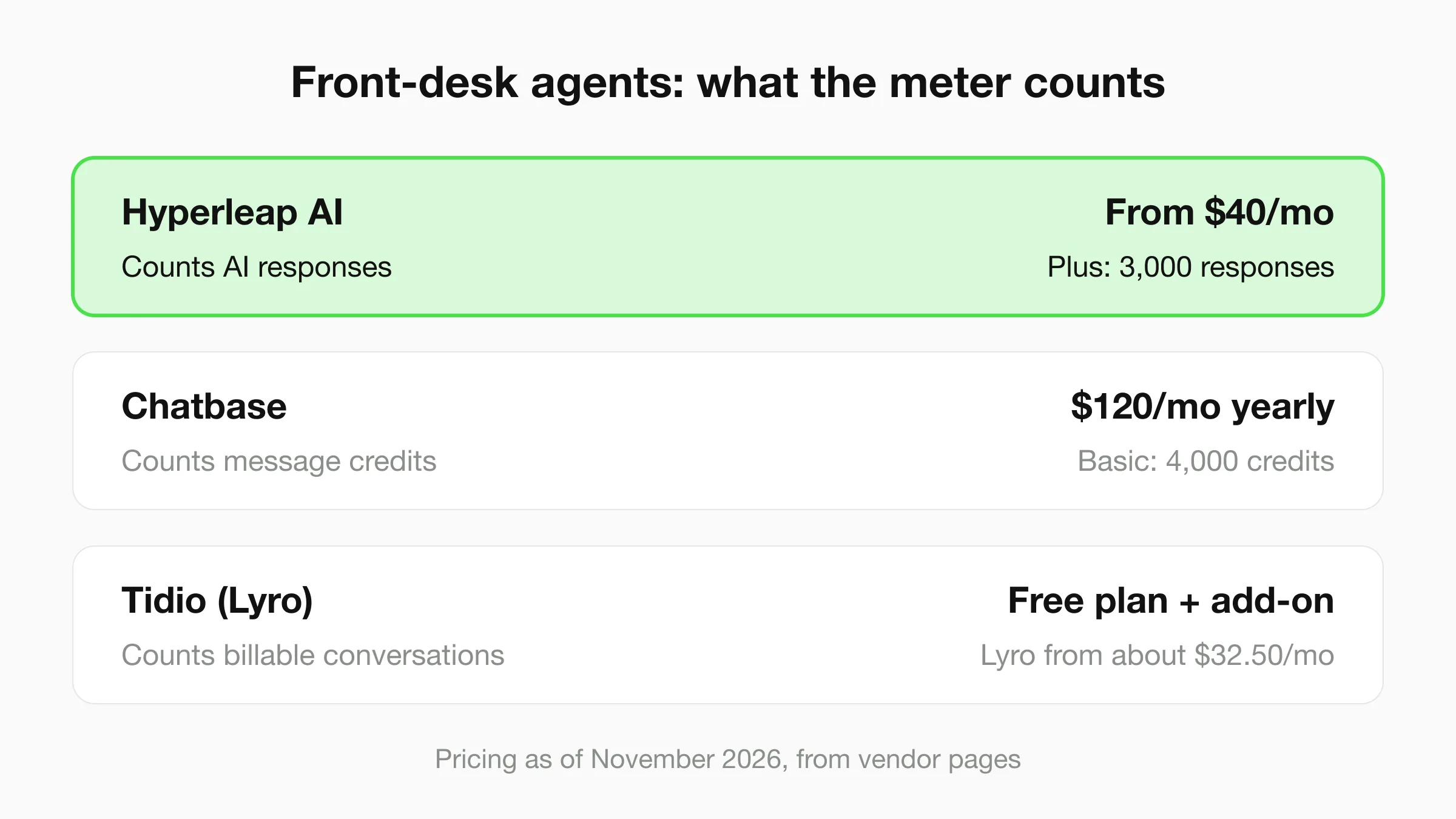
Always check what the price meter counts. Hyperleap counts AI responses. Chatbase counts message credits. Tidio counts billable conversations. Goodcall counts unique customers. Smith.ai counts calls. Zapier counts tasks and activities. Compare on your own monthly volume, not on the headline price.
Mistakes to Avoid
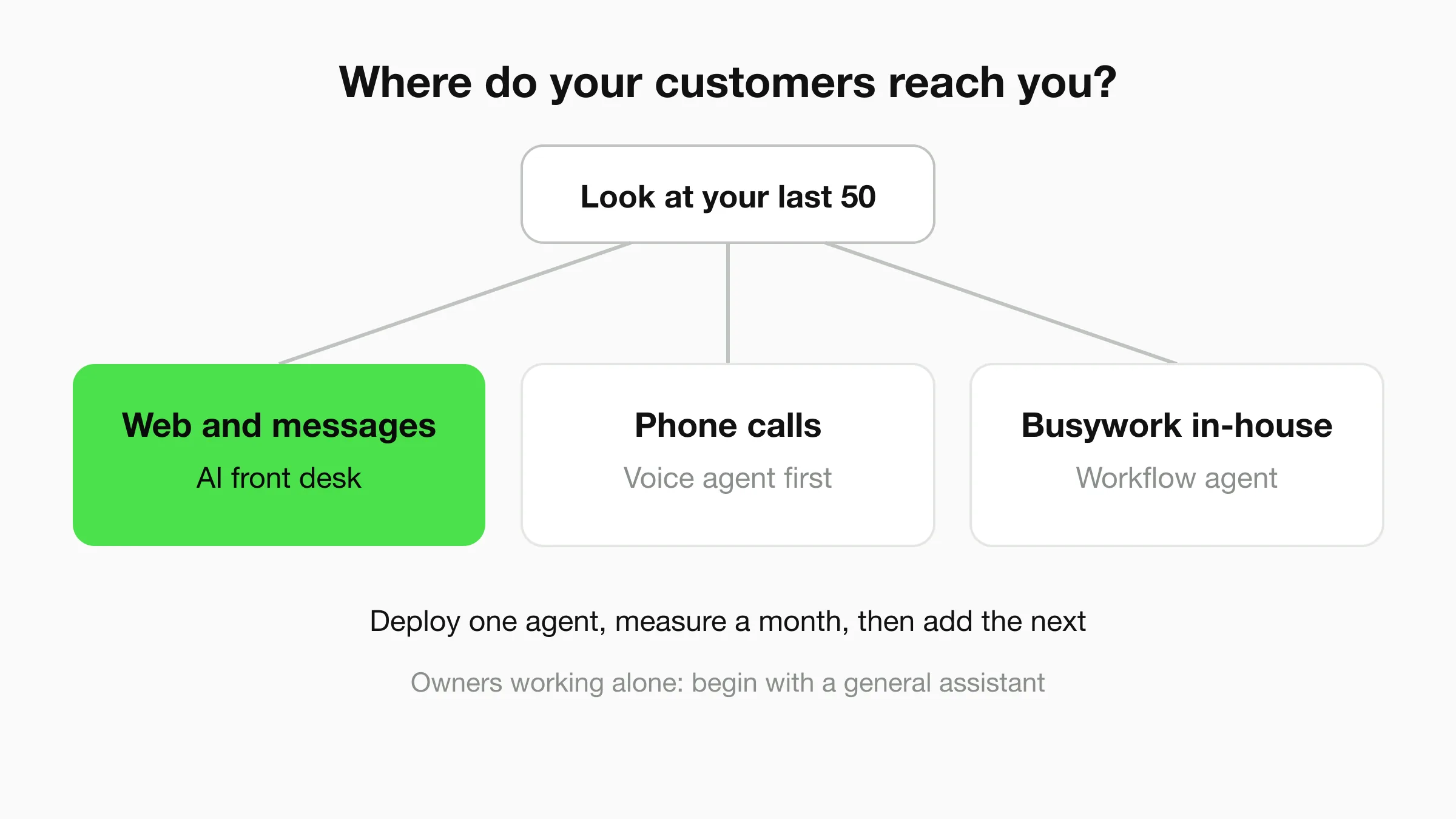
- Buying a phone agent when your customers write. Look at where your last 50 enquiries came from first.
- Skipping the knowledge base. An agent can only answer what you give it.
- No handoff plan. Decide which questions go to a person, and test that path.
- Starting with five agents. Deploy one, measure it for a month, then add another.
- Trusting vendor numbers. Ask for a trial and run your own real questions through it.
Frequently Asked Questions
What is the best AI agent for a small business?
It depends on the job. For customer messages on your website, WhatsApp, Instagram and Messenger, an AI front desk such as Hyperleap AI is a strong first choice, starting at $40/month. For calls, Goodcall or Smith.ai. For back-office chores, Zapier Agents, Lindy or n8n.
What is the difference between an AI agent and a chatbot?
A chatbot answers questions. An agent also takes actions toward a goal, such as booking a visit, calling an API or moving data between apps. Many modern chatbots have agent features, so the line is blurry. Our guide on AI agents vs chatbots explains it in more detail.
How much do AI agents for small business cost?
Prices range from free tiers and about $20 to $40 per month for entry plans, up to several hundred dollars for phone services with human staff. The meter differs by vendor (responses, credits, conversations, customers, calls or tasks), so compare on your own volume. Pricing above is as of November 2026.
Can an AI agent answer my business phone?
Yes, with a voice-first product such as Goodcall or Smith.ai. Hyperleap AI does not answer phone calls today. Voice is on its roadmap.
Do I need a developer to set up an AI agent?
Not for most of these. Hyperleap, Chatbase, Tidio, Goodcall, Lindy and Zapier Agents are built for non-developers. n8n is more technical.
Can an AI agent book appointments?
Some can. Hyperleap AI books through Calendly or Cal.com on Pro and Max, and shares your booking link on Plus. In-chat booking with Calendly needs Calendly Standard or higher. It creates new bookings only. It cannot cancel or reschedule.
Are AI agents safe to put in front of customers?
Choose one that answers from your own documents, lets a person take over, and lets you test before publishing. Hyperleap is designed to answer only from your documents, and keeps version history with draft, test and publish steps. No AI is perfect, so review conversations in the first weeks.
Where should I start if I have no budget?
Try a free plan or trial: Tidio and Zapier have free plans, Lindy gives free credits, and Hyperleap has a 7-day trial that requires a card. Pick one job and test it on real questions.
Put an AI front desk on your website in minutes
Paste your URL, review the starting prompt, add one script tag. Answers customers on your website, WhatsApp, Instagram DM and Messenger. 7-day free trial on every plan.
Start for freeConclusion
Start with the job, not the tool. If customers reach you by message, deploy a front-desk agent first. If they reach you by phone, start with a voice agent. Add back-office and sales agents once the first one is working. Keep your first deployment small, measure it against real conversations, and expand from there.
Hyperleap AI is the front-desk option on this list: one agent across Website, WhatsApp, Instagram DM and Messenger, from $40/month. See the AI agents overview to learn what that looks like for your business, or compare plans on the pricing page. For wider context, read our guides to the best no-code chatbot builders and conversational AI for customer service.
Try Hyperleap AI free for 7 days
One AI front desk for your website and messaging apps, included MCP access on every paid plan, from $40/month.
Start for freePricing and features verified November 2026 from each vendor's public pages. Confirm before purchase.
Related Articles
View all
Comparison24 min read
Best AI Receptionist Software in 2026
Compare the best AI receptionist software in 2026 — voice AI answering services vs. chat-first digital receptionists — by cost, channels, and setup.
Comparison16 min read
Best Agentforce Alternatives in 2026
Agentforce alternatives for businesses that don't run on Salesforce: how Copilot Studio, Zendesk, Fin, Ada, Chatbase and Hyperleap price and fit.
Comparison19 min read
Best Customer Communication Tools in 2026
The best customer communication tools for small businesses in 2026, grouped by job: AI front desk, shared inbox, messaging, live chat, help desk, CRM.
Comparison18 min read
Best Sierra AI Alternatives in 2026 (By Company Size)
Sierra prices by outcome and sells to enterprises. Compare 9 Sierra AI alternatives by size, pricing model and channels, from Decagon to $40/mo.