Guide
Voice of Customer Program Guide for SMBs
Build a voice of customer program SMBs can run: channel benchmarks, closed-loop metrics, sampling checks, and a 90-day multi-location rollout.

Gopi Krishna Lakkepuram · Founder & CEO
· 15 min read
Collect more feedback is popular advice for building a voice of customer program. It's also incomplete. A fuller inbox can make decisions worse if the same vocal customers dominate every channel, nobody owns the fixes, and managers mistake closed tickets for a better experience.
Start with a different question: Which customer decision will this evidence help us make? For a small business, that might mean changing booking instructions, adjusting check-in staffing, or explaining a fee before someone abandons an enquiry.
Table of Contents
- What a Voice of Customer Program Is For
- Channel Benchmarks and the Scorecard to Track
- Survey Questions and Channel Templates
- How to Hear the Customers Who Stay Silent
- Coding Feedback into Decisions You Can Audit
- How Closed Loop Feedback Becomes a Habit
- A 90 Day Program for Multi Location Brands
- Launch the First Closed Loop This Month
What a Voice of Customer Program Is For
Say a hotel group receives an angry review about check-in. The manager apologizes, adds it to a spreadsheet, and moves on. That's a response to an anecdote, not a program.
Now suppose guests at several properties describe the same delay. Someone compares arrival times, checks which locations use the same script, and asks the operations lead to test a different staffing arrangement. The team then watches whether delay complaints return. That's an operating habit.
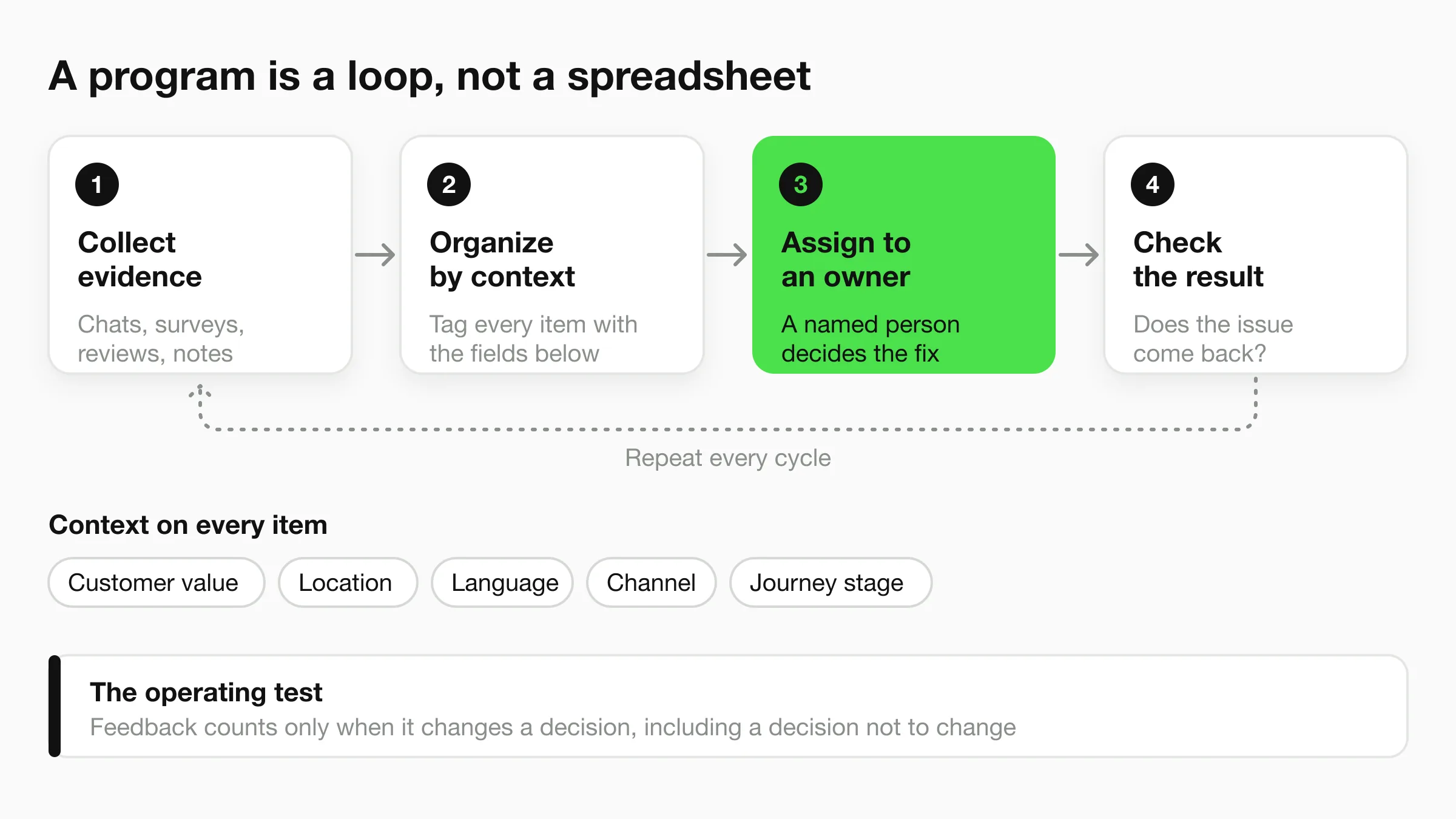
A voice of customer program is a repeating system for collecting customer evidence, organizing it by context, assigning decisions to owners, and checking the result. Context includes customer value, location, language, channel, and journey stage. Without those details, a comment about slow service might describe anything from an unanswered Instagram message to a delayed clinical appointment.
Translate comments into requirements
Customers describe experiences, not operating specifications. A guest says check-in was confusing; the operator must determine whether to change signage, confirmation messages, staffing, or the arrival process.
That translation is central to VoC's quality-engineering roots: ASQ's account of Quality Function Deployment describes how customer requirements become engineering and operational requirements. The practical lesson is to turn feedback into something a team can prioritize, implement, and measure.
For an SMB, useful outcomes include:
- Fewer repeat contacts: Customers don't have to ask again because the original answer was incomplete.
- Completed appointments: Intake or preparation confusion no longer prevents attendance.
- Recovered complaints: A customer gets a clear resolution rather than another apology.
- Clearer booking decisions: The team understands why people enquire but don't commit.
Build around the work you already do
Clinics, hotels, real-estate groups, shops, local service brands, and agencies already hear customer evidence through everyday conversations. Website chat, WhatsApp, Instagram, and Facebook aren't merely distribution channels. They're places where customers explain what they expected and what got in their way.
You don't need to turn every conversation into a survey. You need comparable channel measures, a check on missing customers, consistent issue codes, and a path from a signal to an accountable decision.
The operating test: Feedback only counts when it changes a decision, including an evidence-based decision not to change something.
Channel Benchmarks and the Scorecard to Track
2025 feedback response rates by channel and industry
SurveyMonkey's 2025 survey response-rate benchmarks offer context, not targets. A high response rate can still reflect a narrow slice of customers.
| Channel or industry | Average response rate | What a low rate usually means |
|---|---|---|
| All customer-feedback surveys | 31.81% | A blended rate hides channel bias |
| 49.17% | A useful structured ask after a known interaction | |
| Mobile in-app | 34.37% | Reaches people already using the product |
| Web link | 29.95% | Check whether the link reaches the intended segment |
| SMS | 18.54% | Respondents may not represent the whole customer base |
| Facebook-distributed | 7.61% | A digitally active slice, not all customers |
| Popup | 3.65% | A small, self-selected group, weak as a sole source |
| Technology and software | 16.89% | Category context differs from consumer businesses |
| Retail and consumer goods | 42.53% | Segment results by store despite stronger participation |
| Education | 44.70% | Don't copy this target into clinics or B2B |
Interpret the channel before the score
A popup-only clinic hears from visitors who see the popup and choose to respond. Patients who book by phone, need language assistance, or leave before reaching that page may be missing. A Facebook-only shop may miss customers who don't follow or engage with its account.
Email sent after a visit gives the business a defined invitation list, but unusable or missing email addresses leave gaps. In-app requests reach active users, not customers who have stopped using the product. Every channel has a different blind spot.
Use the benchmarks to frame questions, not predict results. Invitation timing, audience, question length, and the interaction being evaluated all affect response rates. Keep these conditions consistent when comparing locations, and check who was invited against who responded.
Track participation and action together
A useful scorecard defines its denominators and shows whether feedback led to a recorded decision.
- Response rate: Completed responses divided by eligible invitations for that channel. Document how undelivered messages are handled.
- Customer coverage: Record which eligible customers and segments were invited, then compare them with the responses received.
- Sentiment or satisfaction: Keep the wording and scale consistent, and show the response count.
- Issue severity: Distinguish inconvenience from safety, privacy, or material service failures.
- Resolution time: Measure from receipt to recorded resolution, not just the first reply.
- Loop-closure rate: Track eligible cases with an action recorded and the customer informed.
- Business outcomes: Follow repeat contacts, appointment completion, retention, or lifetime value when records support it.
Review website chat and messaging logs alongside survey results using conversation history and export tools. Keep unsolicited chat counts separate from survey response rates: a customer starting a conversation is not the same as an invited customer completing a survey.
Start with two collection channels and publish their response rates monthly. For an SMB or multi-location brand, compare results by segment, channel, and location before changing the roadmap. A blended Net Promoter Score, or NPS, cannot show whether quieter customer groups were represented or whether anyone's experience changed.
Survey Questions and Channel Templates
Ask about a specific interaction rather than the entire relationship. Someone who has just booked can explain booking friction; they can't yet evaluate the service outcome.
A reusable question bank
Use these prompts as a stable core:
- Intent: What were you trying to get done?
- Friction: What almost stopped you?
- Priority: What should we fix first?
- Return intent: Would you come back?
- Permission: May we follow up?
For email or in-app collection, make return intent the single closed rating, with the same response options everywhere. Leave the diagnostic questions open so customers aren't forced into your assumptions.
Match the request to the conversation
| Channel | Suggested wording and format |
|---|---|
| Post-visit email | Thank the customer for the booking, visit, or stay. Include the full question set through a reply option or linked form. |
| Ask what they were trying to get done and what almost stopped them, inviting a single open reply. | |
| Website chat | At booking abandonment or exit intent, ask what almost stopped them from completing the booking. |
| Facebook and Instagram | Invite a brief comment about the interaction. Move detailed complaints into a private thread. |
Keep SMS and in-thread requests short, with no more than a few prompts in the proposed template. Don't make customers finish a questionnaire before receiving help.
Attach location and journey stage to every answer. Where possible, obtain those fields from the booking or conversation context rather than asking the customer to repeat them. In healthcare settings, don't invite clinical details in public comments.
Keep the core wording fixed wherever a question appears. Different channel subsets are practical, but compare only like-for-like questions and record when you change the wording.
How to Hear the Customers Who Stay Silent
More feedback can make a decision less reliable when the additional replies come from the same narrow group. Enthusiastic fans, frustrated customers, and people comfortable posting online can dominate while quieter customers remain invisible.
Dataintelo's voice-of-customer market analysis reports survey response rates falling from 24% in 2015 to 9.8% in 2025. Treat that as market context, not a replacement benchmark for your own invitation method. The operational question remains: who didn't answer?
Use minimum viable representativeness
A small business doesn't need a complex research department to notice obvious gaps. It needs a sampling plan that stops managers confusing abundance with coverage.
- Define priority segments. Include customer value, lifecycle stage, location, language, channel, and outcome. Don't use spending alone, or you may overlook barriers affecting new customers.
- Set monitoring thresholds. Agree on the evidence required before interpreting a site's score. Base the threshold on customer volume and the decision's risk, not an arbitrary universal minimum.
- Translate the invitation. Use the languages customers speak, and check that translated prompts preserve the original meaning.
- Compare different evidence streams. Put survey themes beside chats, cancellations, no-shows, and support contacts. Keep their counts distinct because they have different collection methods.
- Label weak evidence. Mark thin or skewed samples as directional. Use them to generate questions, not authorize expensive chainwide changes.
A monitoring threshold isn't proof of statistical representativeness. It's a practical guardrail that makes gaps visible before someone acts.
Test the missing-customer explanation
Suppose downtown hotels generate frequent English-language Instagram comments, while airport properties and Spanish-speaking guests barely appear. A chainwide satisfaction average could look reassuring even though a poorly represented property has unresolved arrival problems.
The answer isn't more Instagram prompts. Add a translated post-stay invitation or another suitable channel for the missing group, then examine whether the themes differ.
If appointment no-shows never answer your surveys, you're studying the people who already managed to show up.
Don't infer that silent customers are satisfied. Compare respondents and nonrespondents using information you already hold appropriately, such as location, booking outcome, or lifecycle stage.
Maintain a monthly silence log with segment, expected share of customers, share of feedback, and the channel or outreach adjustment proposed. Assign the owner to investigate material gaps rather than treating the log as another reporting attachment.
Coding Feedback into Decisions You Can Audit
Repeated words can show where customers struggle, but they don't identify the failed process or the person who should act. A traceable taxonomy connects each code to its original evidence, making feedback easier to review and decisions easier to audit.
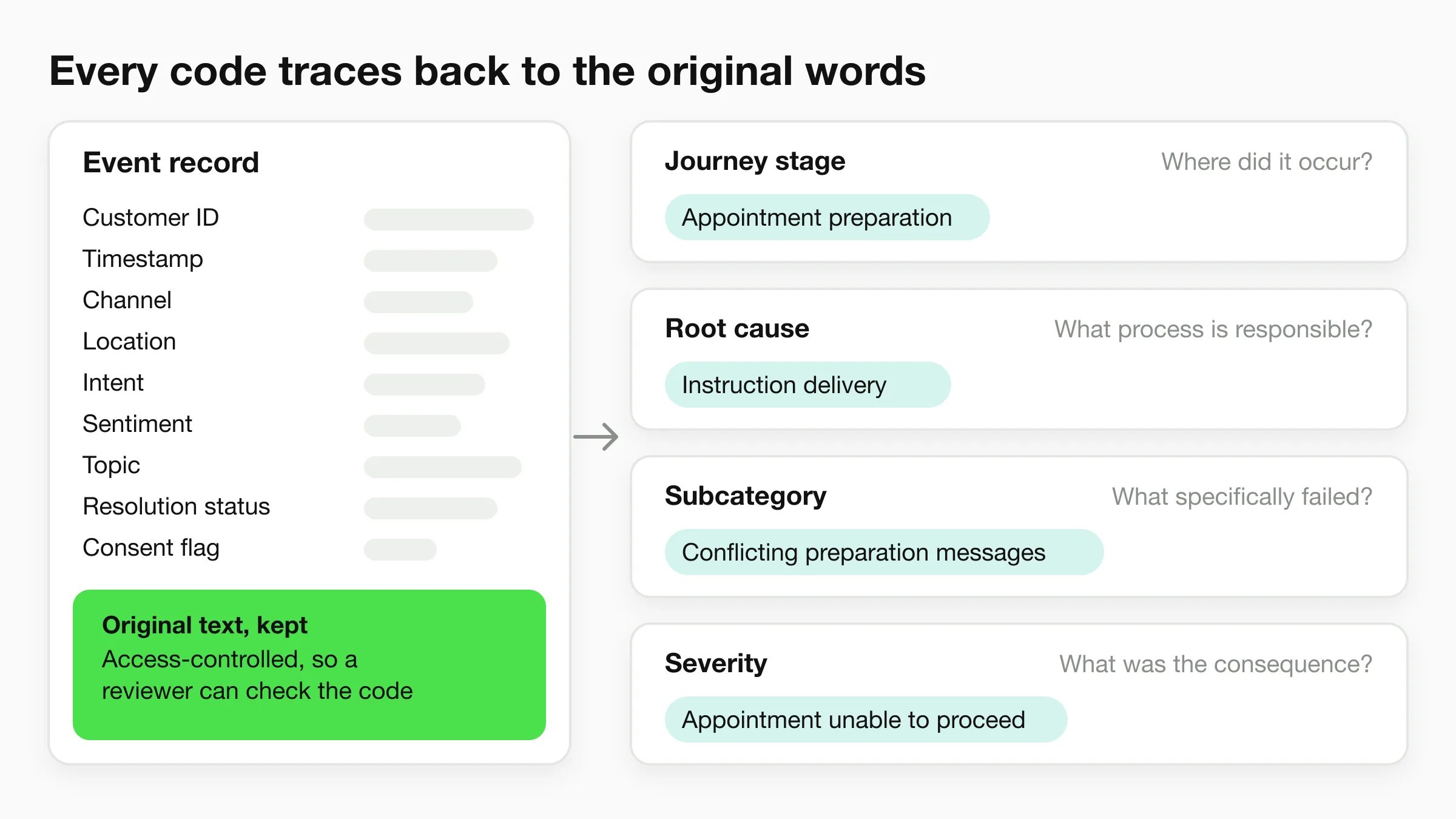
Start with an event record containing the permitted customer identifier, timestamp, channel, location, intent, sentiment, topic, resolution status, and consent flag. Retain the original text with appropriate access controls and retention rules so reviewers can check whether the code fits the evidence.
Give each code a clear job
Separate what happened in the customer journey from your explanation of why it happened:
| Coding level | Question it answers | Example |
|---|---|---|
| Journey stage | Where did the problem occur? | Appointment preparation |
| Root-cause category | What process appears responsible? | Instruction delivery |
| Subcategory | What specifically failed? | Conflicting preparation messages |
| Severity | What was the consequence or risk? | Appointment unable to proceed |
Starter topics might include arrival and booking, price clarity, staff behavior, waiting, service outcomes, and follow-up failure. These are reporting categories, not confirmed causes. When the cause is unclear, label it unconfirmed rather than letting automated classification turn a guess into a diagnosis.
For dental teams incorporating public reviews, keep the source label on each review so it is not treated as equivalent to invited patient feedback.
Validate interpretation before automating decisions
Have a human independently recode a small weekly sample. Begin by checking whether reviewers agree on category and severity. As the workflow matures, Cohen's kappa or F1 can help assess consistency.
Guidance on AI chatbot conversation analysis can help teams distinguish useful conversation signals from summaries that need verification. Recheck the codes when policies, services, or supported languages change.
Ipsos's closed-loop feedback report reports that 70% of consumers are more likely to do business again when a complaint is handled well the first time. This supports careful complaint recovery, while leaving teams to check whether the underlying issue was also addressed.
Keep one shared taxonomy, with location-specific additions where needed. Each week, rank recurring codes by frequency and severity, split the results by location, and record whether the issue appears local or shared. High comment volume alone does not make a sample fair, or prove that a change worked.
How Closed Loop Feedback Becomes a Habit
Treat feedback as a control system: observe a problem, take an accountable action, and check whether the problem returns. Sending a sympathetic reply is only part of that work.
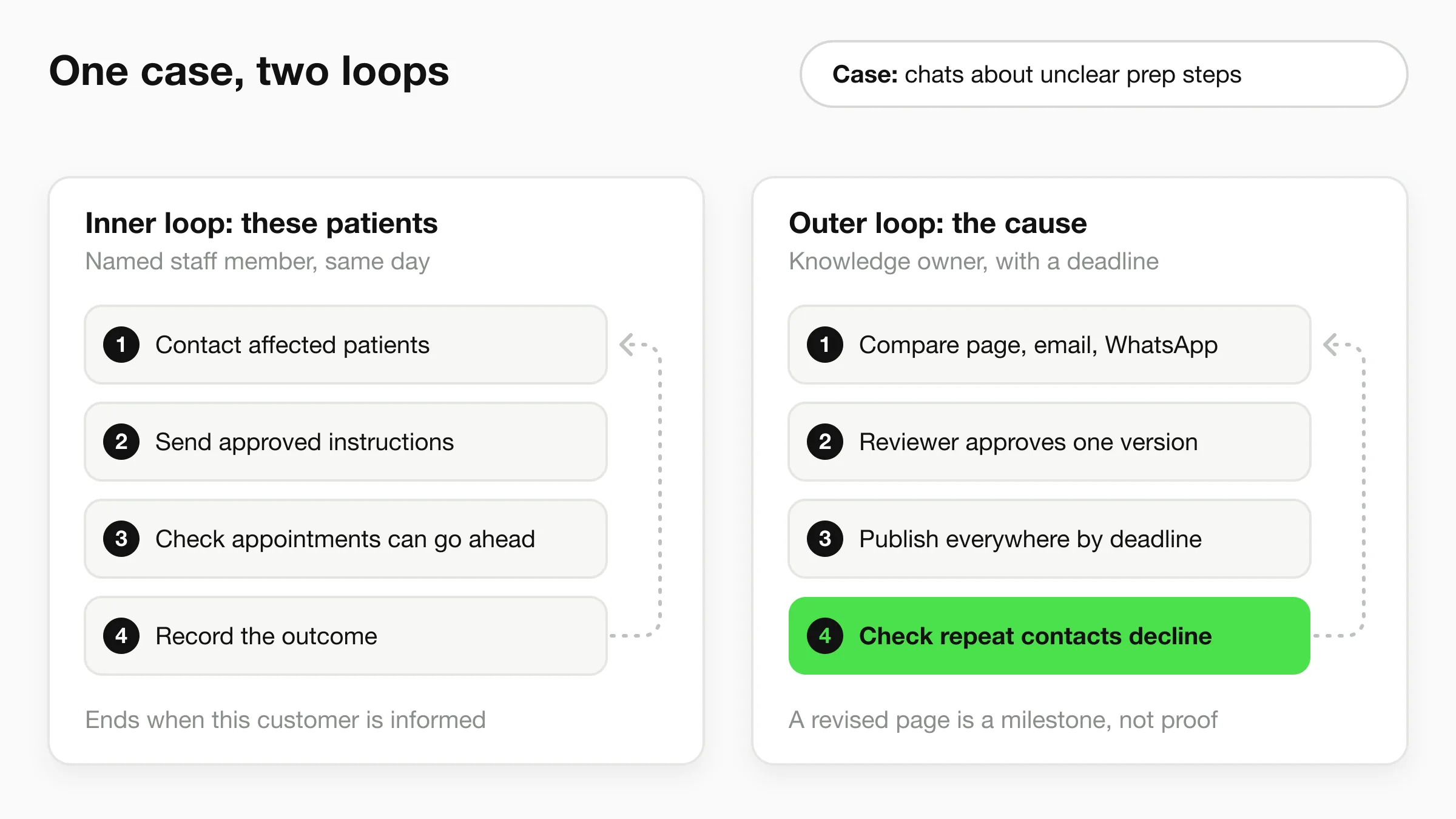
The inner loop handles an individual customer's issue. The outer loop changes the policy, script, staffing arrangement, page, or booking rule that creates a recurring pattern.
Work both loops in the same case
Suppose a dental clinic receives several chats about unclear preparation instructions. For the inner loop, a named staff member contacts the affected patients that day, supplies approved instructions, checks whether appointments can proceed, and records the outcome.
For the outer loop, the knowledge owner compares the preparation page, confirmation email, and WhatsApp reply. If they conflict, the clinic's authorized reviewer approves a consistent version and sets a deadline for publishing it across channels.
The team then checks whether preparation-related repeat contacts and disrupted appointments decline. A revised page is an implementation milestone; fewer affected appointments would be evidence of an improved outcome.
CustomerGauge's VoC benchmarks report that only 26% of companies close the loop with all customers, and that companies doing so see a threefold increase in promoters on a subsequent survey. Treat that reported relationship as a reason to measure closure carefully, not a guaranteed lift for your business.
Record proof rather than activity
Every actionable item needs:
- Accountability: A named owner and deadline.
- Context: Affected segment, location, and taxonomy code.
- Intervention: What changed, or why the request wasn't implemented.
- Outcome measure: The operational result expected to improve.
- Customer communication: The follow-up message and when it was sent.
- Recurrence check: Whether comparable cases appeared after the change.
Closing a ticket doesn't necessarily mean the customer knows what happened. Define closure so staff can distinguish resolved, explained, escalated, and awaiting confirmation.
Automate acknowledgments and routing where appropriate, but don't give an assistant authority to improvise clinical advice or sensitive remedies. A practical customer-support automation workflow should preserve a human handoff for severe, repeated, or uncertain cases.
Count surveys sent and tickets closed as activity. Look for changed customer outcomes before calling the program effective.
Hold a weekly review of severe individual cases and a separate decision on the most important recurring pattern. Keep positive and neutral feedback in view too, especially when it identifies something customers value and the business should preserve.
A 90 Day Program for Multi Location Brands
Build governance before adding collection tools. Forrester's 2025 feedback-management findings report that only 27% of teams communicate insights in a timely way, alongside continuing difficulties getting stakeholders to act.
Who owns the voice of customer program
Use this as a proposed small-team operating model. One person can hold several roles, but each duty needs an explicit owner.
| Role | Owns | Cadence | Proof |
|---|---|---|---|
| Frontline owner | Acknowledge and resolve one customer issue | Same day for severe cases | Inner-loop note and recurrence check |
| Location lead | Separate local execution misses from chainwide themes | Weekly | Site slice of priority codes |
| Operator or CX owner | Choose the outer-loop change and deadline | Biweekly | Customer-feedback change-log entry |
| Knowledge owner | Update scripts, pages, and bot answers | Within the fix deadline | Revised answer live on every channel |
Roll out in deliberate phases
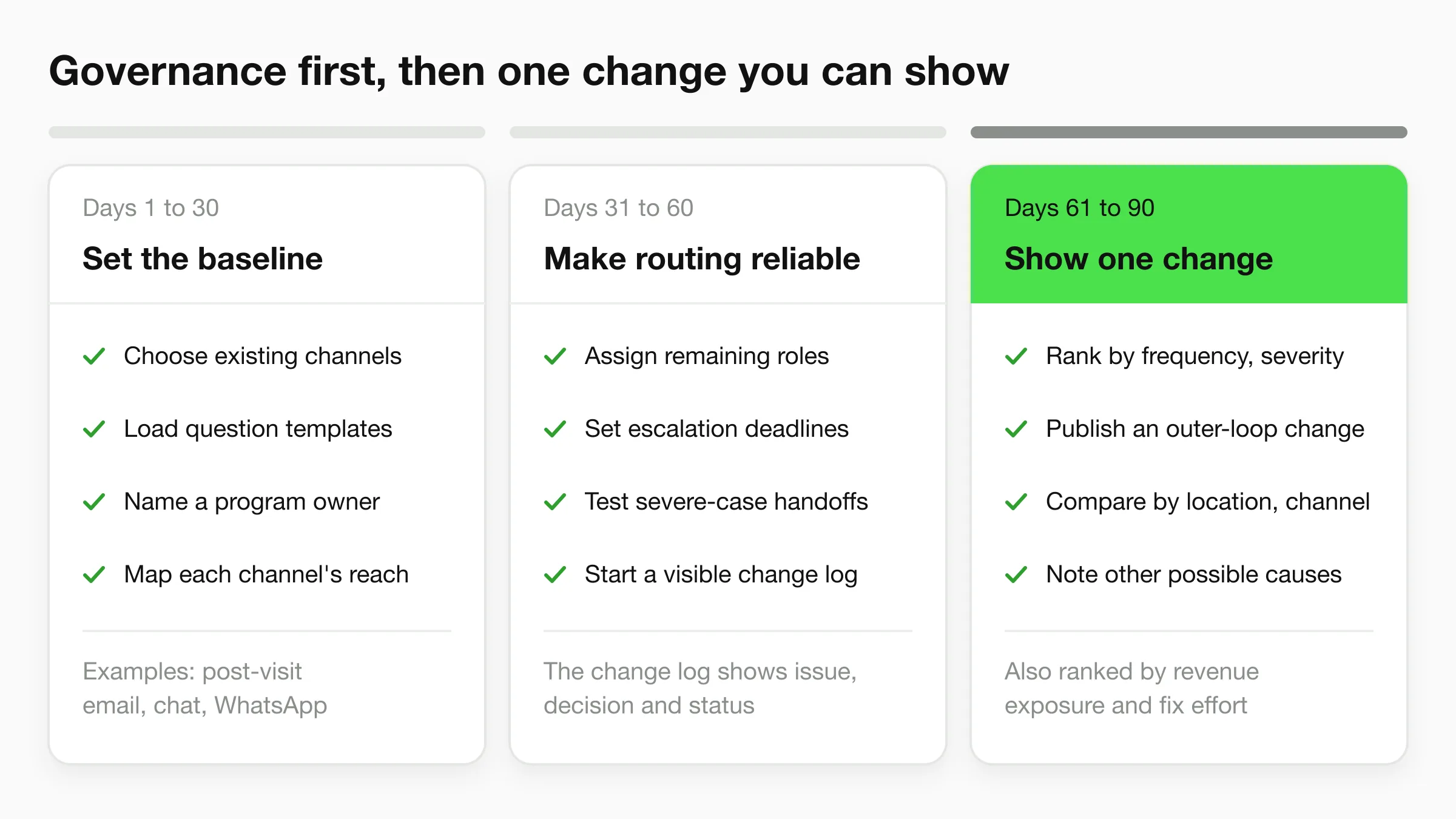
- Days 1 to 30, establish the baseline. Choose existing channels such as post-visit email, website chat, and WhatsApp. Load the question templates, name a program owner, and document which customers each channel can reach.
- Days 31 to 60, make routing dependable. Assign the remaining roles, define escalation deadlines, and test severe-case handoffs. Start a customer-visible change log showing the issue, decision, and completion status.
- Days 61 to 90, demonstrate an operational change. Rank issues by frequency, severity, revenue exposure, and fix effort. Publish an outer-loop change and compare the relevant outcome by location and channel, noting other changes that could explain the result.
For capture and routing, Hyperleap AI is one option alongside survey tools and a shared issue tracker. Teams can paste their website URL to have the assistant's instructions drafted from the site, ground it in website content or uploaded documents, collect conversations across website and Meta messaging channels, and use a unified inbox with exports.
For several locations, the Multi-variant add-on ($40/mo plus 2x credits per request, Pro and Max) answers from the right location and asks which one when a question doesn't say. OTP verification (a paid add-on on Pro and Max, website chat only), chat email summaries, and booking with Calendly or Cal.com (in the chat on Pro and Max; Plus shares your booking link) support intake, but teams must still assign ownership and verify that the configured handoff works.
Restaurant operators collecting feedback through loyalty touchpoints should keep loyalty-member comments labeled separately so repeat visitors don't become a substitute for the whole guest base.
No theme stays on the action log without an owner and a date. Tool adoption isn't the finish line; accountable use is.
Launch the First Closed Loop This Month
Start if you can name a customer journey, a pair of collection channels, and an owner with authority to act. Wait if you can't name the owner. Another survey won't solve an accountability gap.
Choose a journey tied to a current business decision, such as booking, check-in, or intake. Avoid launching across every location and touchpoint before you've tested whether staff can process what arrives.
Make the first week operational
- Choose the decision. Identify what you might change and the outcome you'll monitor.
- Code existing evidence. Bring recent chats, reviews, and cancellation notes into the hierarchy, preserving their original source.
- Mark the gaps. Identify missing locations, languages, and customer outcomes before treating themes as priorities.
- Send a focused request. Use a suitable post-interaction channel with the stable question wording. Don't default to a popup because it's easy to install.
- Test the handoff. Route a severe case to the named owner and confirm that acknowledgment, action, and follow-up are recorded.
Check for proof at month end
Your launch review should contain channel-specific response rates, a populated silence log, an individual case closed with the customer informed, and a documented process change. If one is missing, fix that part of the workflow before expanding collection.
For teams already answering website and Meta conversations, begin with the inbox export rather than buying another listening channel. Check location context, remove unnecessary personal details, and give recurring themes to someone who can change the process.
The program becomes real when a customer can see what you changed because they asked.
Hyperleap AI offers knowledge-grounded customer conversations, a unified inbox, and exports that can support your feedback capture workflow. Visit Hyperleap AI to explore collecting website and messaging conversations, then connect those signals to a named owner and a measurable change.