AI Receptionist for Med Spas: What It Actually Handles
An AI receptionist for med spas answers treatment and pricing questions, captures consultation requests on Instagram DM, and routes anything clinical to staff.
TL;DR: An AI receptionist for med spas is a chat-based front desk that runs on your website, WhatsApp, Instagram DM, and Facebook Messenger. It answers treatment and pricing-range questions from your own content, sorts new consultation requests by treatment interest, timing, and first-time-vs-returning status, sends confirmation-style prompts that help cut down no-shows, and shares your booking link. It never assesses whether a treatment is medically suitable for someone, never asks about medical history or contraindications, and never gives clinical advice — that stays with your injectors and estheticians, by design.
A prospective client finds your med spa on Instagram at 9 PM, likes three before-and-after photos, and DMs a question: "How much is a lip filler consultation?" Nobody's monitoring the account after hours. By the time your front desk sees the message the next morning, that client has already messaged two other med spas — and booked with whoever answered first.
This is the pattern that makes an AI receptionist a genuinely good fit for a med spa's front desk, more than almost any other wellness category. Med spa demand is visual, social-first, and impulsive — someone sees a result, decides in the moment, and reaches out on whatever channel they're already using. That's rarely the phone. It's Instagram DM, and increasingly a website chat widget after clicking through from an ad.
This guide covers exactly what a non-clinical AI receptionist handles for a med spa, and just as importantly, where the line sits. If you want the fuller deployment picture — pricing, setup, and the full FAQ — AI agents for med spas is the pillar page; this post walks through the individual workflows. For the broader "should this even work for a wellness business" question, do chatbots work for med spas covers the skeptic's case, and AI chatbots for med spa treatment bookings goes deeper on the booking-link mechanics specifically.
What an AI Receptionist for a Med Spa Actually Does
A med spa AI receptionist is a document-grounded chat agent that answers from content you've already written — your treatment menu, price ranges, membership terms, and policies — and it runs on the channels med spa clients actually use: your website's chat widget, WhatsApp Business, Instagram DM, and Facebook Messenger.
Here's the practical job list:
- Treatment and pricing-range questions. "How much is microneedling?" "What's included in a HydraFacial?" — answered instantly from the menu and pricing you've configured, with a clear note that final pricing depends on a consultation.
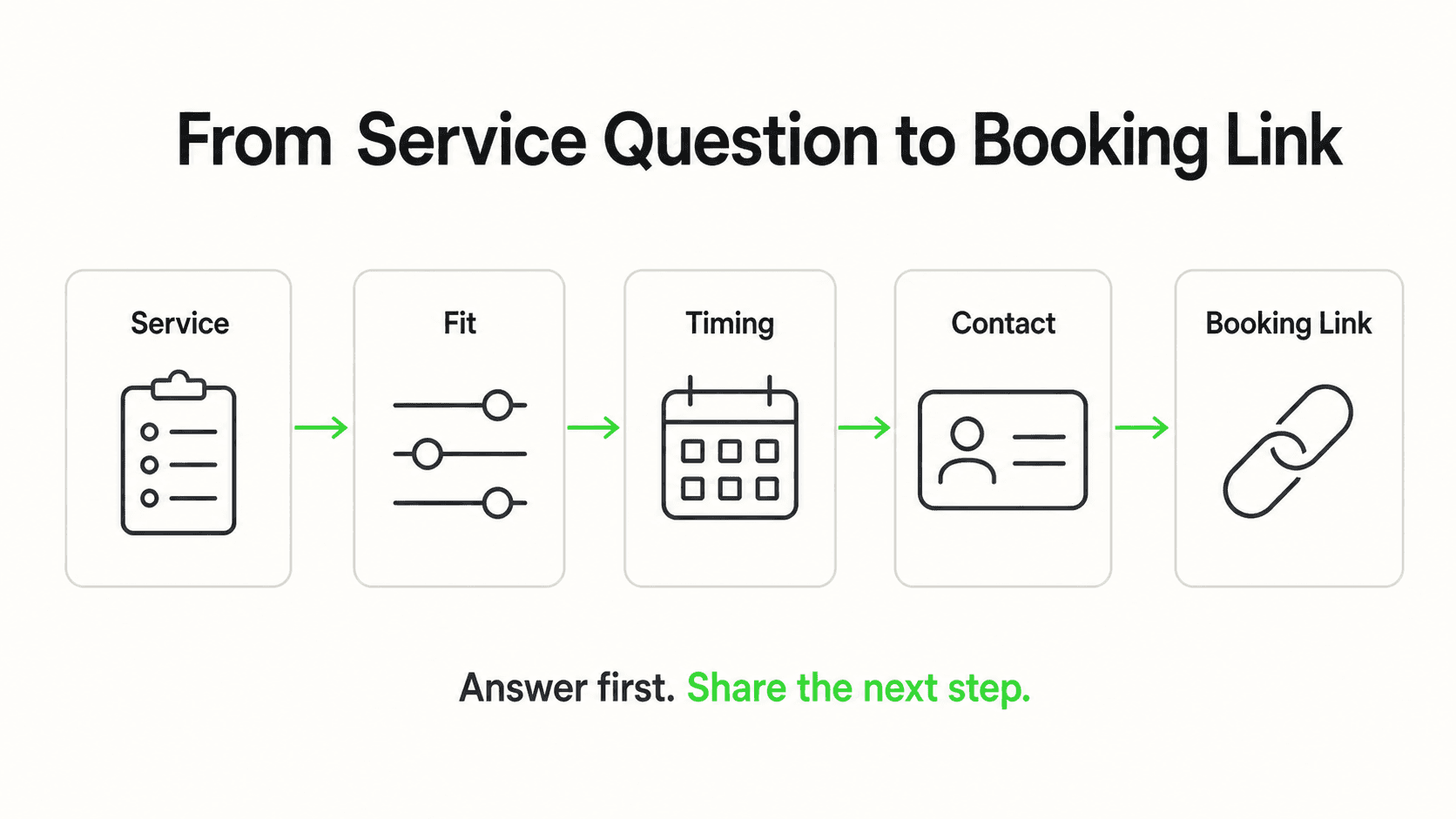
- Consultation-request intake. Instead of a bare "book now" button, the AI asks a short set of non-clinical questions: which treatment they're interested in, roughly when they'd like to come in, whether they're a new or returning client, and (where you choose to ask) a general budget range. That context goes straight to your front desk with the lead.
- Membership and package FAQs. "What's the difference between your Botox membership and paying per unit?" — answered from your published membership terms, not improvised.
- Confirmation-style prompts. Once a consultation request is captured, the AI can send a follow-up message confirming the request and reminding the client what to expect — a nudge that, qualitatively, helps reduce no-shows the way any confirmation touchpoint does, without any promise of a specific reduction number.
- Consultation booking. If you schedule through Calendly or Cal.com, the AI reads your live availability, offers real open times, and books the slot in the conversation (Calendly needs the Standard plan or higher). With your own booking page or any other tool, it shares the link and helps the visitor get to it.
- Lead capture before the conversation continues. New inquiries go through a lead form up front — name and contact details collected before the chat proceeds — so your team has a way to follow up even if the visitor drops off mid-conversation.
- Multilingual coverage. Med spas in mixed-language markets can serve prospective clients in their own language automatically across 100+ languages, without needing bilingual staff on every shift.
None of that requires the AI to know anything about a client's skin condition, allergies, or medical history. It's the same front-of-house content a well-run reception desk already hands out on a laminated menu card — just available instantly, on the channel the client is already using, at 9 PM on a Saturday.
Why Instagram DM matters more here than in most industries
Med spas get a disproportionate share of inquiries through Instagram DM compared to other service businesses, because the buying decision is often triggered by a photo. An AI receptionist that only covers your website chat widget misses the channel where a meaningful share of med spa demand actually starts.
Why Med Spa Front Desks Get Overloaded
Med spa staff are frequently doing double duty — checking in the client in the chair, answering the front desk phone, and monitoring Instagram, often with a lean team. A handful of patterns explain where the load comes from.
The same five questions, all day
"How much is Botox per unit?" "Do you have any openings this week?" "What's your cancellation policy?" These are the questions that eat receptionist time in a med spa, and they're also the easiest to fully automate because the answer never changes based on who's asking.
Instagram doesn't keep business hours
A post goes up at 7 PM, gets engagement overnight, and generates a wave of DMs before the front desk opens the next morning. Every hour that wave sits unanswered, some fraction of those prospective clients have already messaged a competing med spa. The respond-first economics that apply to home services apply just as directly here — the med spa that answers first usually books the consultation.
No-shows are expensive in a high-margin, appointment-limited business
A med spa's revenue ceiling per day is set by chair hours, not inventory. A missed consultation slot is lost revenue that can't be recovered by selling more later in the day. According to Hyperleap's positioning research, salons and med spas that rely solely on phone-based booking see a meaningful share of after-hours inquiries go unanswered until the next business day — the same pattern documented in salons and med spas losing clients to missed calls.
Front desk staff aren't clinicians, and shouldn't be answering as if they were
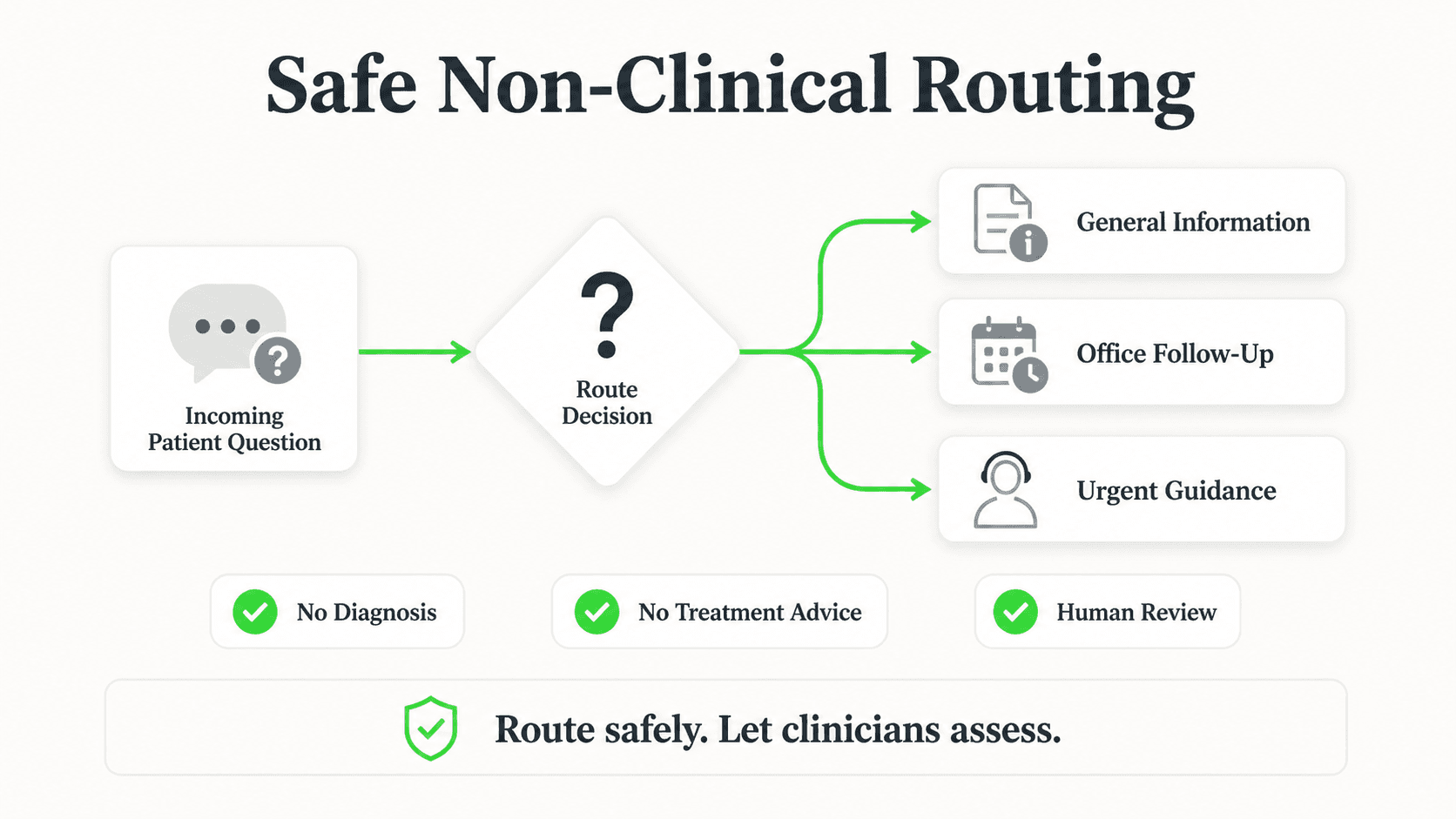
Front desk staff sometimes get asked questions that edge toward clinical territory — "is filler safe with my blood pressure medication?" — and either over-answer (a liability risk) or under-answer (a bad client experience). A configured AI receptionist removes the ambiguity: it's built to route those questions rather than improvise an answer.
See a Med Spa Front Desk Handle a Real Conversation
Watch how an AI front desk answers treatment and pricing questions, captures a consultation request, and hands off anything clinical — on your website or Instagram DM.
See How It WorksWhat This Guide Means by "Non-Clinical" — and Why It's Non-Negotiable
Hyperleap AI is not HIPAA-compliant and does not offer a Business Associate Agreement. That single fact shapes every design decision covered in this guide, and it should shape how any med spa configures an AI receptionist, regardless of vendor.
The AI routes, it does not assess. It never evaluates whether a treatment is medically appropriate for a specific person, never interprets symptoms, and never gives guidance that resembles medical advice. If a message reads as a clinical question — "is this safe for me," "will this interact with my medication," "I have a reaction, what do I do" — the AI's job is to say plainly that a provider needs to answer that and route the conversation to a human, not to attempt an answer.
Medical history and PHI stay out of the chat entirely. The AI is not configured to collect allergy information, medication lists, health conditions, or anything that constitutes protected health information. Practices should keep intake of that information in their existing paper or portal-based process — never inside the chat widget or DM thread.
Contraindications and suitability are staff-only territory. Whether a client is a good candidate for a given filler, laser setting, or peel strength is a clinical judgment made during an in-person or telehealth consultation, never by the AI.
Aftercare instructions beyond general published guidance stay with staff. The AI can share your general published aftercare document (e.g., "avoid sun exposure for 48 hours" from your printed handout), but any specific concern — swelling, unusual reaction, pain — routes immediately to a person.
This isn't a limitation bolted on as an afterthought. It's the correct design for a category where the front-of-house questions and the clinical questions look superficially similar but carry very different risk. For the deeper mechanics of how this kind of human handoff works across healthcare-adjacent categories, see AI agents for healthcare and HIPAA-compliant AI chatbots for healthcare.
7 Ways a Med Spa Uses an AI Receptionist Day to Day
1. Instagram DM Consultation Requests
What this looks like in practice: A follower DMs "how much for lip filler?" after seeing a story post. The AI responds with the price range for that treatment, asks whether they're new or returning and roughly when they'd like to come in, and shares the booking link.
Why it works: Instagram is often the highest-intent, highest-volume channel for a med spa, and it's also the channel least likely to have a staff member monitoring it around the clock.
Key features:
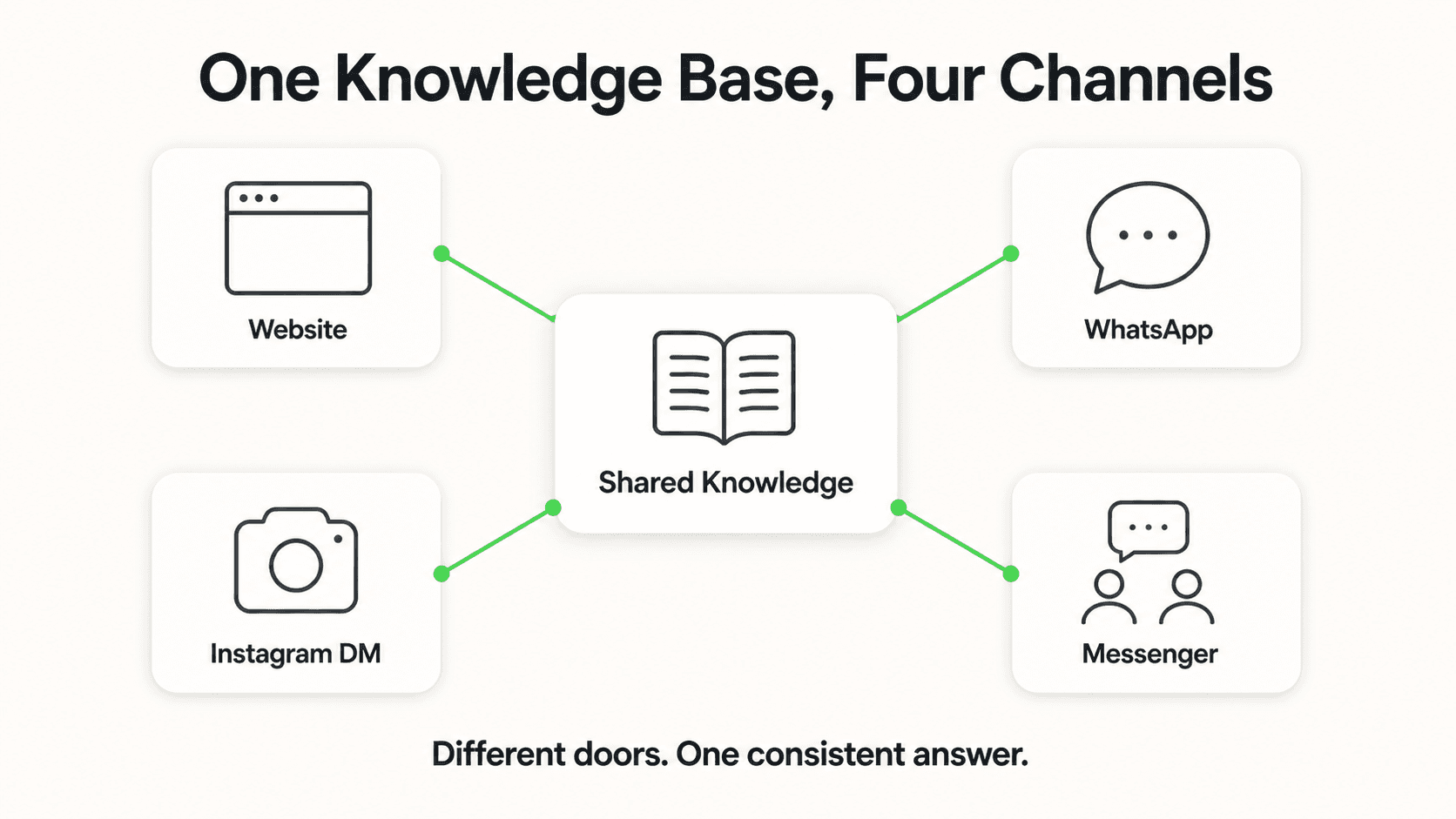
- Same knowledge base across website, Instagram DM, Messenger, and WhatsApp
- Rich card sharing of before/after galleries and service pages you've attached, each with one tappable button
- Consultation request captured and emailed to your front desk
2. Treatment Menu and Pricing-Range Answers
What this looks like in practice: "What's the difference between microneedling and microneedling with PRP?" The AI answers from your treatment descriptions, gives the price range, and notes that a consultation confirms the exact plan and cost.
Why it works: Price transparency is one of the top reasons prospective clients hesitate to reach out at all. Answering it instantly removes friction before it becomes a lost inquiry.
Key features:
- Document-grounded answers, not generic industry pricing
- Clear framing that ranges are estimates pending consultation
- No clinical suitability claims attached to pricing answers
3. Membership and Package Explanations
What this looks like in practice: "Is your Botox membership worth it if I only come in twice a year?" The AI walks through your published membership terms and lets the client decide, without pressuring toward a sale.
Why it works: Membership programs are a significant recurring-revenue driver for med spas, but the terms are often confusing enough that prospective members give up on reading the fine print themselves.
Key features:
- Answers pulled from your actual membership terms document
- Consistent explanation across every channel and every shift
- Routes billing disputes or cancellations to staff
4. New vs. Returning Client Sorting
What this looks like in practice: The AI asks early in the conversation whether the person has visited before. A returning client gets routed differently — often straight to a specific provider they've seen — while a new client gets the standard consultation-request flow.
Why it works: Returning clients often want to rebook with the same injector or esthetician; treating every inquiry identically ignores information your front desk would naturally use.
Key features:
- Simple branching based on new-vs-returning status
- Context passed to the front desk in the summary email
- No change to how clinical questions are handled either way
5. No-Show Reduction Through Confirmation Prompts
What this looks like in practice: After a consultation request is captured, the AI sends a follow-up confirming the request and, closer to the appointment window, a reminder-style message.
Why it works: Qualitatively, any additional confirmation touchpoint tends to reduce no-shows in appointment-based businesses — this is a general pattern in scheduling research, not a number Hyperleap can guarantee for any individual practice, and results vary by how a practice configures the flow.
Key features:
- Configurable confirmation and reminder messaging
- No rescheduling or cancelling in chat — those replies route to your front desk
- Client can reply to reschedule, which routes to your front desk
6. Sharing Approved Before/After Assets
What this looks like in practice: A prospective client asks to see results for a specific treatment. The AI shares an attached before/after gallery or service page as a card with a thumbnail and a single "View" button — a carousel on Instagram DM and Messenger when there are multiple assets, individual image-with-caption messages on WhatsApp.
Why it works: Visual proof is the single biggest driver of med spa booking decisions, and sharing it instantly beats "check our Instagram" as a response.
Key features:
- Asset-derived cards from photos, PDFs, or web pages you attach
- One tappable button per card (View/Open/Book)
- Works the same across website widget, Instagram DM, and Messenger
7. Escalation for Anything That Touches Medical Judgment
What this looks like in practice: "Can I get filler while breastfeeding?" The AI does not attempt an answer. It acknowledges the question, tells the client a provider will follow up, and routes the conversation to your team with full context.
Why it works: This is the boundary that makes the whole deployment safe to run without a BAA in place. It also protects the client from an answer that should come from a licensed provider, not a chatbot.
Key features:
- Keyword and pattern-based routing for clinical language
- Full conversation context passed to the human who picks it up
- No attempt at clinical reassurance or advice, ever
Real Results: What Med Spas Are Reporting
Hyperleap does not have a published med spa case study with verified metrics as of this writing, so the framing below is qualitative and, where noted, illustrative — not a guarantee of outcomes for any specific practice.
Fewer interruptions at the front desk. Practices that route routine pricing and policy questions to an AI receptionist report their staff spending less time repeating the same answers over the phone and more time with the client physically in the chair.
More after-hours inquiries actually captured. Illustrative example: a med spa that previously only captured inquiries during business hours starts seeing overnight Instagram DMs and website chats converted into consultation requests instead of going unanswered until morning.
Consistent answers across every channel. Whether a client asks on the website, WhatsApp, Instagram, or Messenger, the answer comes from the same underlying content — no risk of one staff member quoting a different price than another.
A cleaner intake trail for the front desk. Every consultation request arrives with treatment interest, timing, and new-vs-returning status already attached, instead of a bare "someone DMed asking about lips" note that a staff member has to chase down manually.
For the kind of first-party, verified numbers this guide deliberately avoids fabricating, see the Jungle Lodges case study referenced in Hyperleap's hospitality deployment — a useful reference point for the underlying after-hours pattern even though the vertical differs.
Implementation Roadmap for Med Spas
Week 1 — Import and configure the basics. Paste your website URL; Studio reads your treatment pages and pricing, detects your industry, and drafts a starting prompt. This gets you live in under 5 minutes for the quick-start path. Add your booking link and connect the channels you use — website widget first, then Instagram DM and WhatsApp.
Week 2 — Attach your real documents. Upload your treatment menu, membership terms, and general aftercare handout. Write the guardrail that routes anything resembling a clinical question straight to staff — this is the single most important configuration step for a med spa.
Week 3 — Tune the consultation-request flow. Decide exactly what non-clinical questions you want asked (treatment interest, timing, new vs. returning, budget range if you want it) and set up the summary email format your front desk will actually use.
Week 4 — Test the escalation path end to end. Send test messages that mimic real clinical questions and confirm they route correctly, every time, before opening the AI up to real client traffic across all four channels.
Common mistake to avoid
Don't let a med spa AI receptionist collect medical history, allergy information, or medication lists "just in case it's useful for staff." Keep that intake in your existing paper or portal process. The moment protected health information enters the chat, you've created a compliance problem the AI was specifically designed to avoid.
Frequently Asked Questions
Can an AI receptionist book a med spa appointment directly?
It can book consultations, yes, if you schedule through Calendly or Cal.com: the AI reads your live availability, offers real open times, and books the slot in the conversation, and the client gets the calendar invite by email (in-chat booking needs Calendly Standard or higher). With your own scheduling page or a practice-management system, it shares your booking link and captures the consultation request details for your front desk; there is no integration with those systems beyond REST API/webhook connectivity for teams that want to build their own.
Does it work on Instagram, or only on our website?
It runs on your website chat widget, WhatsApp Business API, Instagram DM, and Facebook Messenger from one shared knowledge base, so a treatment question gets the same answer regardless of which channel a prospective client uses.
Will it recommend a specific treatment for my skin concern?
No, and it's designed not to. Treatment suitability is a clinical judgment that belongs to your injectors and estheticians during an actual consultation. The AI answers general questions about what a treatment is and its price range, then routes anything that requires clinical judgment to your staff.
Is a med spa AI receptionist HIPAA-compliant?
Hyperleap AI is not HIPAA-compliant and does not offer a Business Associate Agreement. The AI is configured to stay in non-clinical, front-of-house territory and to keep protected health information out of the chat entirely — that's a design choice, not a compliance claim.
How does it actually reduce no-shows?
Through confirmation and reminder messaging after a consultation request is captured — an additional touchpoint that qualitatively helps in most appointment-based businesses. Hyperleap does not publish a specific no-show reduction percentage, since results depend on how a practice configures the flow and its existing booking process.
What happens if someone asks a medical question in the chat?
The AI acknowledges the question, tells the person a provider will follow up, and routes the full conversation to your team. It does not attempt to answer, reassure, or give guidance on anything that reads as clinical — including drug interactions, contraindications, or symptom interpretation.
How much does this cost for a med spa?
Hyperleap AI runs on three paid plans — Plus at $40/month, Pro at $100/month, and Max at $200/month — each with a 7-day free trial and a credit card required to start. There is no free plan. See pricing for the full plan breakdown, including response limits and channel counts per plan.
Getting Started
The pattern across every med spa workflow above is the same: answer the question that doesn't need a provider, capture the intent and contact details cleanly, and get out of the way the moment a question needs clinical judgment. That's a narrower job than "AI chatbot for aesthetics" sometimes implies, and it's also the version that's actually safe to run without a BAA and genuinely useful for a front desk buried in repeat questions.
If your med spa is losing Instagram DMs to whichever competitor answers first, or your front desk is fielding the same five pricing questions all day, this is the kind of deployment worth testing against your own treatment menu and booking link.
Ready to Stop Losing Consultations to Slow Replies?
Set up an AI front desk that answers treatment and pricing questions, captures consultation requests on Instagram and your website, and routes clinical questions to your team.
Start Your Free TrialIndustry Solutions
See how AI chatbots work for these industries:
Related Articles
AI Chatbot for Physical Therapy Clinics: PT Front Desk
An AI chatbot for physical therapy clinics answers insurance and scheduling questions 24/7, shares booking links, and routes clinical questions to therapists.
AI Receptionist for Pharmacies: The Non-Clinical Front Desk
An AI receptionist for pharmacies answers hours, services, and insurance questions 24/7 — and routes every medication question straight to your pharmacist.
AI Receptionist for Daycares and Preschools
An AI receptionist for daycares answers parent enquiries, shares tour links, captures waitlist leads, and routes sensitive questions to the director.
Do Chatbots Work for Med Spas? An Honest Look
Yes, with limits — chatbots handle booking, pricing, and lead capture well, but should never touch treatment suitability or medical advice.