Hotel Group Enquiry Scripts: From Question to Handoff
Use practical hotel group enquiry scripts to gather dates, room needs and event context, then hand a clear brief to your reservations team.
“We are bringing a group. What can you offer?” is a reasonable customer question, but it is not yet a brief a hotel can price. The reservations team still needs to understand the dates, approximate room requirement, flexibility and reason for the visit. Asking for everything at once turns a helpful conversation into homework. Asking too little sends another incomplete email to the team.
An AI front desk can help with the space between those extremes. It can answer approved hotel questions, collect useful group context and explain what staff need to confirm. The conversation should move the enquiry forward without suggesting that rooms have been held, rates approved or an event booked.
This guide provides original scripts, an intake record and a review checklist for that specific workflow. All group details and conversations are illustrative, not customer case studies. Adapt the wording to your property's approved policies and actual follow-up process. The objective is a better-prepared human conversation, not a claim that an AI agent can replace your reservations system or negotiate a group contract.
What Is a Group Enquiry Workflow?
A group enquiry workflow turns an initial question into a usable request for your hotel team. It identifies what the organizer is trying to arrange, collects the information needed for an initial review and makes the next step clear. The workflow ends with an enquiry handoff or an approved booking link, not an invented confirmation.
It differs from a standard room search. A group may involve different arrival dates, room types, meal arrangements, meeting space or a mixture of individual and organizer-paid stays. The organizer may not know the final headcount yet. A useful front desk preserves that uncertainty instead of converting provisional information into firm requirements.
It also differs from event planning. If the visitor primarily wants a ballroom or meeting venue, room requirements may be secondary. Ask enough to understand the request, then give the relevant team a coherent brief. Do not assume that every hotel group enquiry is a wedding or that every event needs accommodation.
For a hotel AI front desk, the supported foundation is straightforward: approved information, conversational enquiry collection and a route to your team. A published amenities page can support an answer about facilities. It does not prove that a particular space or room category is available on the requested date.
The broader hotel enquiry-to-booking guide explains the overall journey. This article focuses on the words and records used before a reservation specialist reviews a group request. That narrow scope matters: it is where helpful qualification can save the team from asking the same opening questions again, without crossing into unapproved commercial commitments.
An enquiry is not a room hold
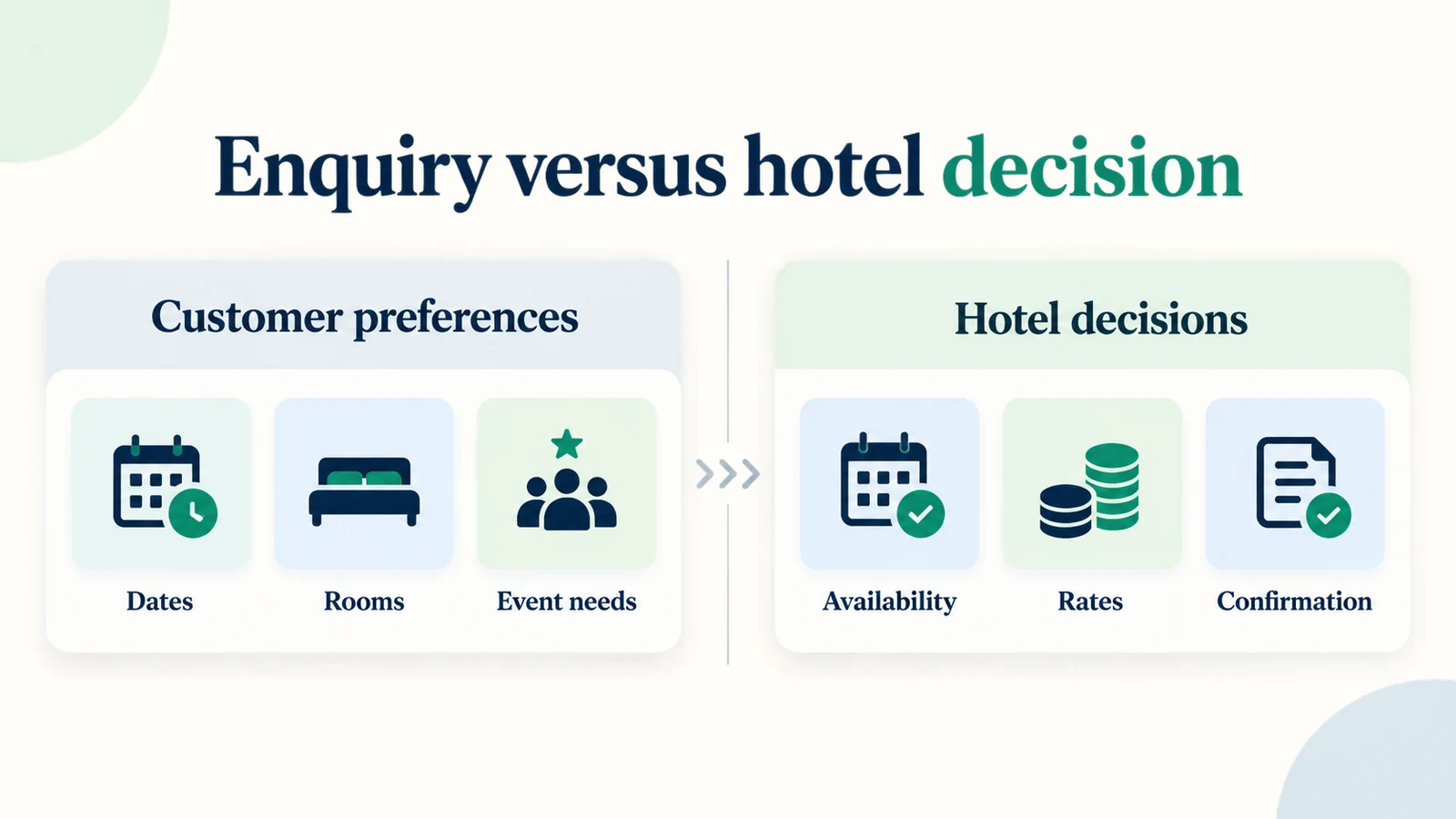
These scripts collect preferences and share approved information. They do not create a room block, check live inventory, approve a group rate, process a deposit or confirm a reservation. The hotel team and its authorized booking process handle those decisions.
Why Group Enquiries Become Difficult to Follow Up
The organizer does not have every answer yet
An initial room count is often provisional. Treating an estimate as a final commitment can cause confusion later, while refusing to proceed without a final list stops a useful conversation. Record “approximately” when the customer says approximately. Distinguish a preferred date from a fixed event date.
Different requests are mixed into one message
A visitor might ask about rooms, airport travel, dinner and a meeting room together. A reply that only covers accommodation leaves the organizer unsure whether the other questions were noticed. A concise acknowledgement of the full request helps, followed by the most useful missing detail rather than an unrelated sales paragraph.
Public rates become accidental group quotations
A public starting rate may have conditions that do not apply to a group. Repeating it without context can sound like a group offer, especially if the customer has already provided dates. If your team must quote, say so plainly. Avoid doing arithmetic with public rates to produce an apparently official group total.
The receiving team gets a transcript but no clear request
A transcript is useful evidence, but a team member still needs to know what requires a decision. “Group enquiry” is too vague. “Organizer requests approximate room options for a flexible two-night company trip, plus a meeting-space discussion” is more actionable, provided those details are actually present in the conversation.
The remedy is not a longer form. It is a conversation that distinguishes known facts, customer preferences, open questions and hotel decisions. The lead-summary guide provides the general record structure; the scripts below adapt it to group hospitality enquiries.
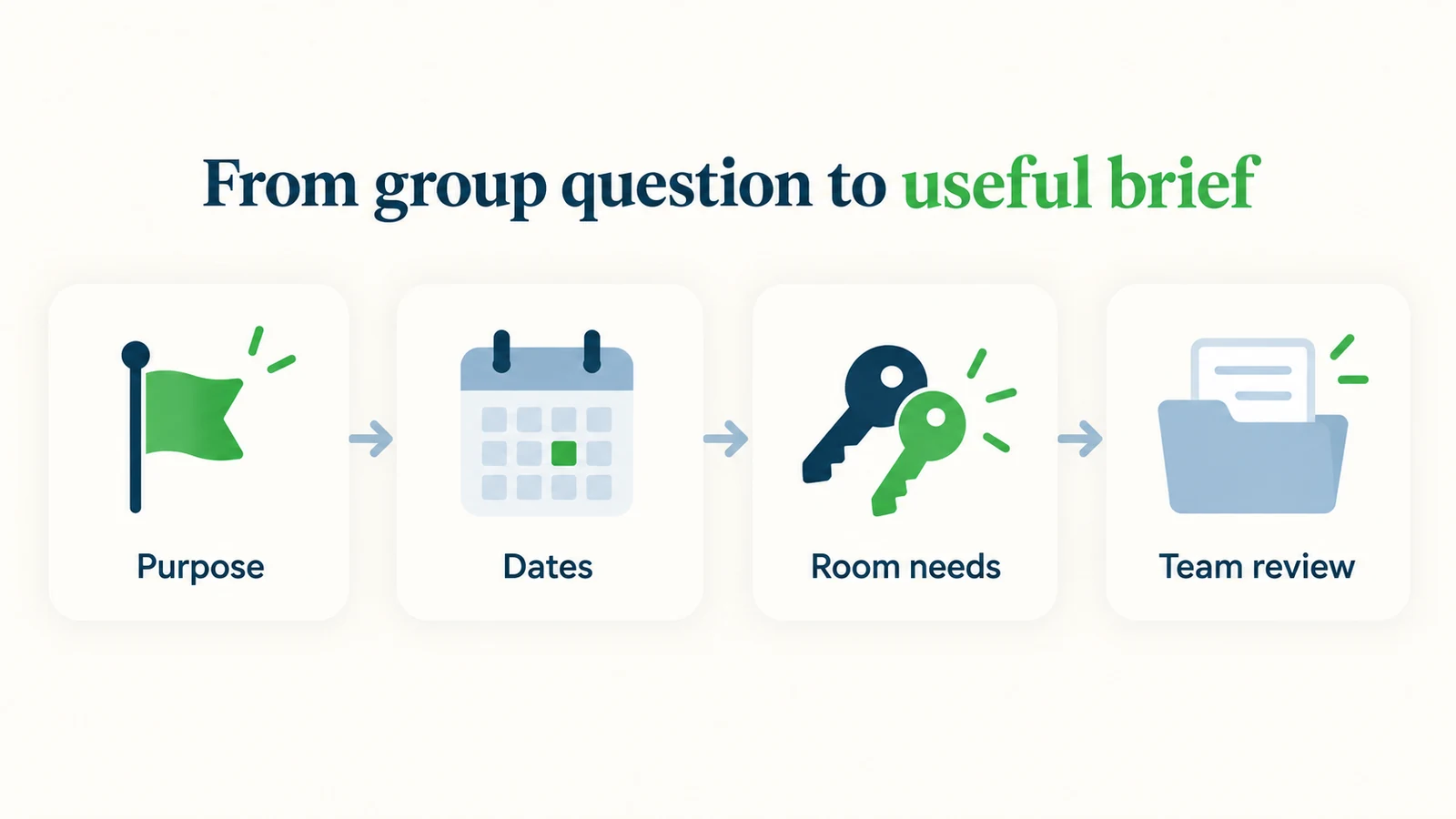
7 Scripts That Build a Better Group Brief
1. Open with the purpose of the stay
Start with a useful question and an honest description of what the front desk can do. Avoid greeting the organizer with a list of every available field. If they already explained the occasion, acknowledge it rather than asking again.
Illustrative opening:
“I can help with hotel information and collect a group enquiry for our team. Is this mainly an accommodation request, an event with rooms, or another type of group visit?”
If the customer says, “A company retreat with an afternoon meeting,” a useful response is:
“Understood: accommodation plus meeting space. What dates are you considering, and are those dates fixed or flexible?”
The purpose provides context without asking for private information. A sports trip, family gathering or company visit may create different questions, but the front desk should not infer a budget, age profile or commercial priority from the label alone.
Record the customer's description in plain language. Do not turn “a few colleagues” into a formal corporate event. If the organizer is only exploring, keep that status visible in the handoff. An exploratory enquiry can still be valuable; it simply requires a different response from a request for a final quotation.
2. Capture dates without turning them into availability
Dates are usually essential, but the way you ask affects the quality of the answer. Ask for an arrival and departure period or the intended length of stay. If the customer provides only a month, clarify whether they have a preferred week or are open to suggestions from the hotel team.
Illustrative script:
“Which arrival and departure dates are you considering? If you are flexible, I can include the alternatives in the enquiry for the team to review.”
If the organizer asks whether those dates are available:
“The reservations team will need to confirm availability for the group. I can include your preferred dates and any alternatives in the request.”
Do not say “those dates work” merely because the system has understood them. Understanding a date and validating inventory are different operations. Similarly, a calendar icon or booking link in the conversation should not imply that a room block has been reserved.
Preserve different arrival patterns when the organizer volunteers them. “Some guests arrive a day earlier” belongs in the brief as an open accommodation detail, not as an automatically split reservation. If the customer is uncertain, write “arrival pattern to confirm” rather than demanding a final rooming list during the first conversation.
3. Ask about room needs with room for uncertainty
Guest count and room count are not interchangeable. A group of guests might need single occupancy, shared rooms or a mixture. Ask which number the organizer knows and label it correctly.
Illustrative script:
“Do you have an approximate number of rooms, or only an estimated guest count at this stage? Either is helpful for the initial enquiry.”
Then, if relevant:
“Are there room preferences you would like the team to consider, such as mostly single occupancy or a mix? The team will confirm the available options.”
Avoid silently calculating a room requirement from a guest count. That calculation may depend on the organizer's preferences and the hotel's room rules. If the customer says “around a dozen rooms,” keep the approximation instead of presenting it as a contracted allocation.
The front desk does not need guest names, identity documents or a detailed rooming list to create an initial sales enquiry. Collect only what the team needs at this stage. If a later authorized process requires more information, let staff explain that process directly. This keeps the first conversation focused and reduces unnecessary exposure of personal details.
4. Separate event and meal questions from room questions
Once the main accommodation request is understood, ask about additional needs only if they are relevant. A short, targeted question is better than assuming every group requires catering, transport and meeting equipment.
Illustrative script:
“Will the team also need to review any meeting-space or meal arrangements, or is this an accommodation-only enquiry?”
If meeting space matters:
“What kind of session are you planning, and roughly how many people would attend? I can include any layout or equipment preferences for the events team.”
A public facilities description can help explain what the hotel offers in general. It cannot establish whether a room is available, whether a layout is suitable for a particular event or whether equipment is included in an unissued quotation. Use “the team can review” when a decision is still required.
Keep accommodation and event requirements as separate fields in the brief. This helps the receiving team see whether one part can proceed independently. For example, the organizer might accept flexible guest-room options but have a fixed meeting date. A summary that merges those into “flexible dates” would lose a commercially important distinction.
Give group enquiries a clear next step
Use approved hotel information to answer questions and prepare useful enquiries for your reservations team.
Start for free5. Handle price questions without manufacturing a quote
Price is a reasonable early question. The front desk should not dodge it, but it must use the information the hotel has actually approved. If there is a published group package with specific conditions, explain those conditions accurately. Otherwise, help the organizer reach the quoting team.
Illustrative script when a quote is required:
“Group pricing needs a review of the dates and room requirements. I can send those details to the team so they can discuss an appropriate quotation with you.”
If the visitor asks for a budget discussion:
“If you have an approximate budget you want the team to consider, you can include it. It is optional for this initial enquiry.”
Do not turn a budget into an approved offer. Do not multiply a public room rate by a provisional count and present the result as the group's cost. Taxes, inclusions, room categories and commercial terms may need review, and the front desk should not invent them.
Keep negotiation requests visible: a discount request, a payment-term question or a cancellation exception should be recorded as a request for the team, not answered with a friendly concession. The same principle applies to complimentary rooms and upgrades. An encouraging tone must not create a promise the hotel did not make.
6. Ask for a follow-up route after providing value
Contact capture should feel like a continuation of the enquiry, not a toll gate before basic information. Explain why the team needs a contact route and allow the organizer to choose from the methods your business actually supports.
Illustrative script:
“Would you like the reservations team to follow up on this enquiry? Please share the contact details you want them to use, and I will include the group information we discussed.”
If the person does not want follow-up yet:
“That is fine. I can still help with the hotel's published information. When you are ready, you can use the contact route shown here to discuss the group request.”
Use your real process when describing what happens next. If the team reviews enquiries during its operating hours, say that using approved language. Do not promise an immediate call, a named representative or a quotation deadline unless the business has committed to it.
For website and messaging conversations, the same principles apply even though channel constraints differ. The multi-channel strategy guide explains the broader operating setup. Keep the website and the hotel's own process as the foundation; covered messaging channels are access points, not substitutes for a reservations workflow.
7. Confirm the request, not a reservation
Close by summarizing the organizer's intent and the unresolved decisions. This is an opportunity to correct mistakes before the team spends time on the wrong brief. Keep the summary short enough to review in the conversation.
Illustrative summary:
“Your enquiry is for a company group, with approximate dates and room needs as discussed, plus a meeting-space question. Availability, rates and arrangements still need the hotel's review. Is there anything in that request you would like to correct?”
After the supported capture or handoff actually occurs, acknowledge only that action. If all you have done is provide a contact link, say that. If an enquiry record was created, a receipt acknowledgement can describe the request without implying that staff have already approved it.
An organizer may respond, “Great, so we are booked?” The correct answer should restate the boundary directly and politely: the request is awaiting the hotel's review, and a reservation is confirmed only through the hotel's authorized process. Test this follow-up rather than assuming the first disclaimer will be remembered.
For the receiving side, follow the human-handoff guide. A handoff works when a responsible person can understand the request and continue it, not merely when the conversation ends with a reassuring phrase.
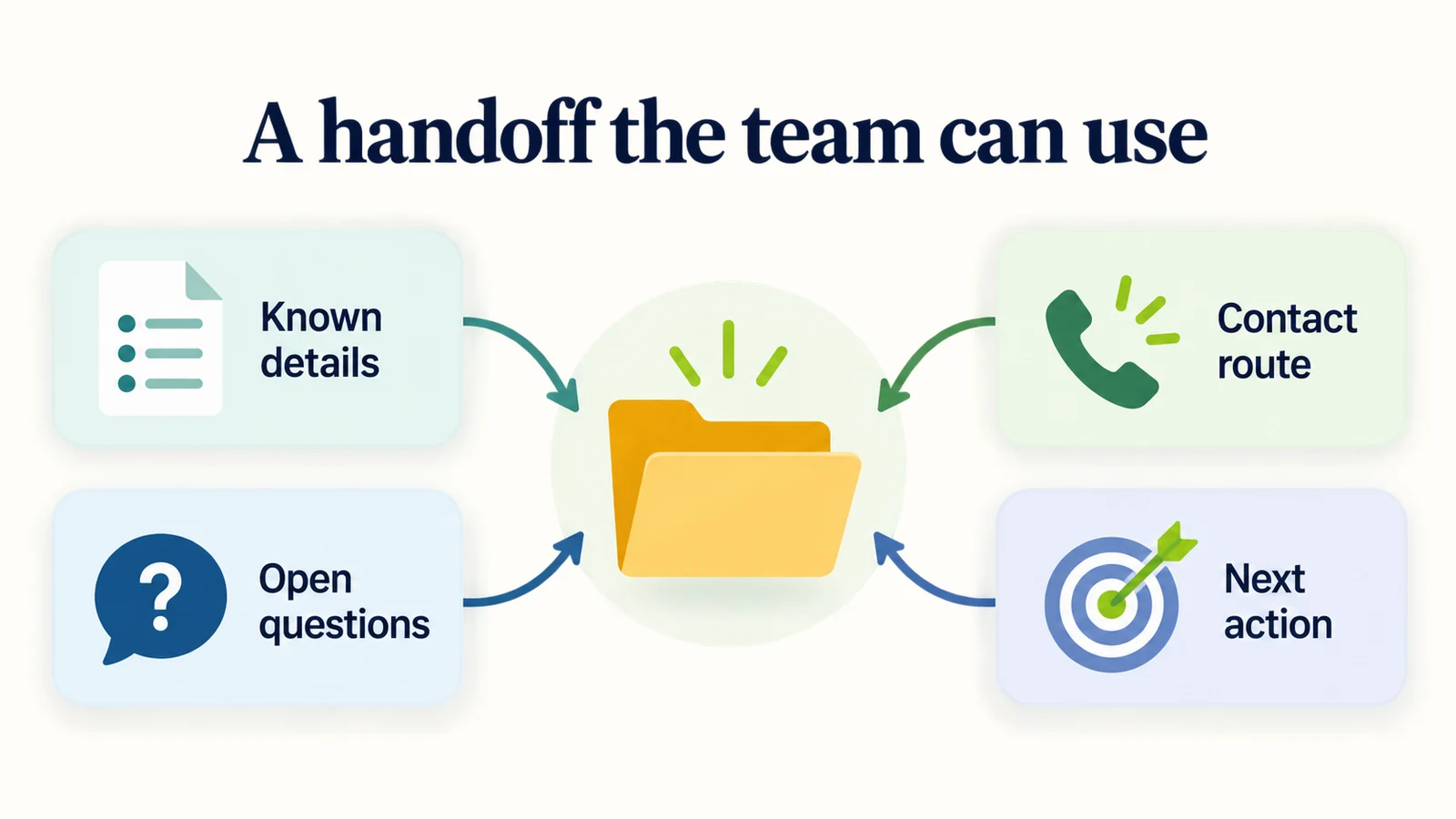
What a Handoff-Ready Group Brief Looks Like
The original template below is designed for an initial enquiry. It is not a reservation record or a contract. Use “not provided” when information is absent and “to confirm” when the customer says it is provisional. Those labels are more useful than guesses.
| Brief field | Example of useful content |
|---|---|
| Purpose | Company retreat; accommodation and a meeting-space discussion. |
| Preferred dates | Customer-stated dates; note whether alternatives are acceptable. |
| Room needs | Approximate room count, or guest count if rooms are not yet known. |
| Preferences | Customer-stated occupancy or room preferences, subject to review. |
| Additional needs | Meeting format, meals or other volunteered requirements. |
| Open decisions | Availability, pricing, inclusions and any requested exception. |
| Contact route | The details the organizer chose to provide for follow-up. |
| Context | What was already answered and the next action requested. |
The benefit is clarity, not a guaranteed commercial outcome. A member of the reservations team can see which questions require an answer and avoid treating provisional details as settled terms. The organizer can correct the summary while the conversation is still fresh.
Compare two fictional handoffs. The first says, “Guest wants a group booking. Please contact.” The second identifies the purpose, approximate stay pattern, whether rooms or guest counts were supplied, and the question about meeting space. The second does not guarantee a booking, but it gives staff a better starting point.
Review the actual received record rather than assuming every desired field will appear automatically. Hyperleap AI supports enquiry capture and email summaries; your configuration and the conversation determine the information available. If staff need a separate manual worksheet, document that step. Do not describe a custom record layout as an existing product screen unless it has been verified in the deployed setup.
How to Put These Scripts Into Practice
First, agree on the enquiry boundary with reservations and events staff. Decide which published questions can be answered and which decisions must stay with a person. Include rates, availability, payment terms, room holds and exceptions in that discussion. The front desk should not discover those boundaries by making a mistake in a live conversation.
Prepare the source material next. Use current property information, approved facility descriptions, valid contact routes and any published group terms the team wants referenced. Remove superseded brochures that might conflict with current policies. The knowledge-source guide explains why this preparation matters more than simply adding more documents.
Choose the minimum fields for an initial enquiry. Different hotels will need different detail, but every required field should have a reason. A company name may be useful for a corporate enquiry; a full guest list is usually a different stage of the process. Keep optional preferences clearly optional, and avoid asking for sensitive personal or payment information in general chat.
Configure the agent's approved answers and enquiry flow, then test realistic conversations. Try a fixed-date request, an approximate group size, an accommodation-only enquiry and an event request with no room requirement. Include a customer who asks for a discount, declines to share contact details or assumes a request has created a reservation.
Inspect the output with the actual receiving team. Can they distinguish a guest count from a room count? Are date alternatives preserved? Does the summary identify the open pricing question? Correct the source or workflow where needed and repeat the same scenarios. A visually polished chat does not compensate for a misleading enquiry record.
Finally, publish only when the operating owner is ready to receive requests. An AI reply is not evidence of staffed availability. Use your approved follow-up expectations, make contact routes visible and review early conversations for missing questions. Keep a change record when policies or team responsibilities move.
This process complements, rather than replaces, your existing hotel automation guide. The scripts here address one specific moment: preparing a useful group enquiry without claiming that the booking work has already happened.
Frequently Asked Questions
Can the AI front desk reserve a block of rooms?
Not in the workflow described here. It can collect the organizer's requirements and share approved information or links. The hotel team and its authorized reservations process must review availability, commercial terms and any room hold. Do not use confirmation language for an enquiry.
Should we ask for the final guest list immediately?
For an initial enquiry, focus on the information your team needs to assess the request. An approximate count and room preferences may be sufficient to start. A final rooming list belongs to the hotel's later process, with appropriate handling of personal information.
What if the organizer only knows a month and a rough size?
Keep those details provisional and ask whether there are preferred dates or constraints. Do not invent exact dates or a final room count. A clear exploratory brief can still support a useful conversation with the hotel team about options.
Can we show public prices in the conversation?
You can use current approved published information with its conditions, but do not present it as a group quotation unless it genuinely applies. If a group rate requires review, explain that and collect the relevant enquiry details rather than calculating an unofficial total.
What should happen when a group asks for an exception?
Record the request and route it to the person authorized to decide. Examples include unusual payment terms, cancellation changes or complimentary rooms. The front desk can explain the published policy, but a friendly conversation should not authorize a commercial exception.
How do we know whether the scripts are helping?
Review enquiry completeness, repeated clarification needs and whether staff can continue the conversation without restarting it. Track actual booking outcomes separately in your established process. Do not infer revenue impact solely from the number of conversations or captured contact details.
Make the First Conversation Easier to Continue
A good group enquiry conversation does not try to finish every piece of reservations work. It establishes the purpose, preserves the organizer's uncertainty and makes the hotel's next decision clear. The customer receives useful information, and the team receives a request it can understand.
Start with these scripts, adapt them to your property's approved facts and inspect the actual handoff. Keep availability, rates and confirmation in the authorized booking process. That boundary is what allows an AI front desk to be helpful without making promises the hotel has not reviewed.
Prepare better hotel enquiries
Build an AI front desk that answers approved questions and gives your team the context to continue the conversation.
Start for freeIndustry Solutions
See how AI chatbots work for these industries:
Related Articles
Hotel Late-Arrival Questions: An Approved Answer Pack
Prepare accurate hotel late-arrival replies with public policy sources, private-access boundaries and a clear route to your reception team.

Real Estate Lead Handoff: The Agent-Ready Checklist
Use a real estate lead handoff checklist to preserve buyer intent, property context, unanswered questions and the next action without inventing certainty.
Wedding Venue Tour Enquiries: A Question Pack
Prepare better wedding venue tours with questions on date flexibility, guest range, event shape and priorities, plus a copy-ready host handoff.

Quote or Estimate? AI Front Desk Reply Templates
Use clear quote-versus-estimate replies, scope questions and approval checks so your AI front desk does not promise a price your team has not agreed.