Seller Enquiries: A Real Estate Intake Template
Use a seller enquiry template to capture property type, broad area, timing and the next agent conversation without promising valuations or collecting documents.

A seller asks, “Can you help me sell my property?” The agent needs enough context to begin a useful conversation, but the first reply often swings between extremes: a bare request for a phone number or a long form asking for information the seller is not ready to share.
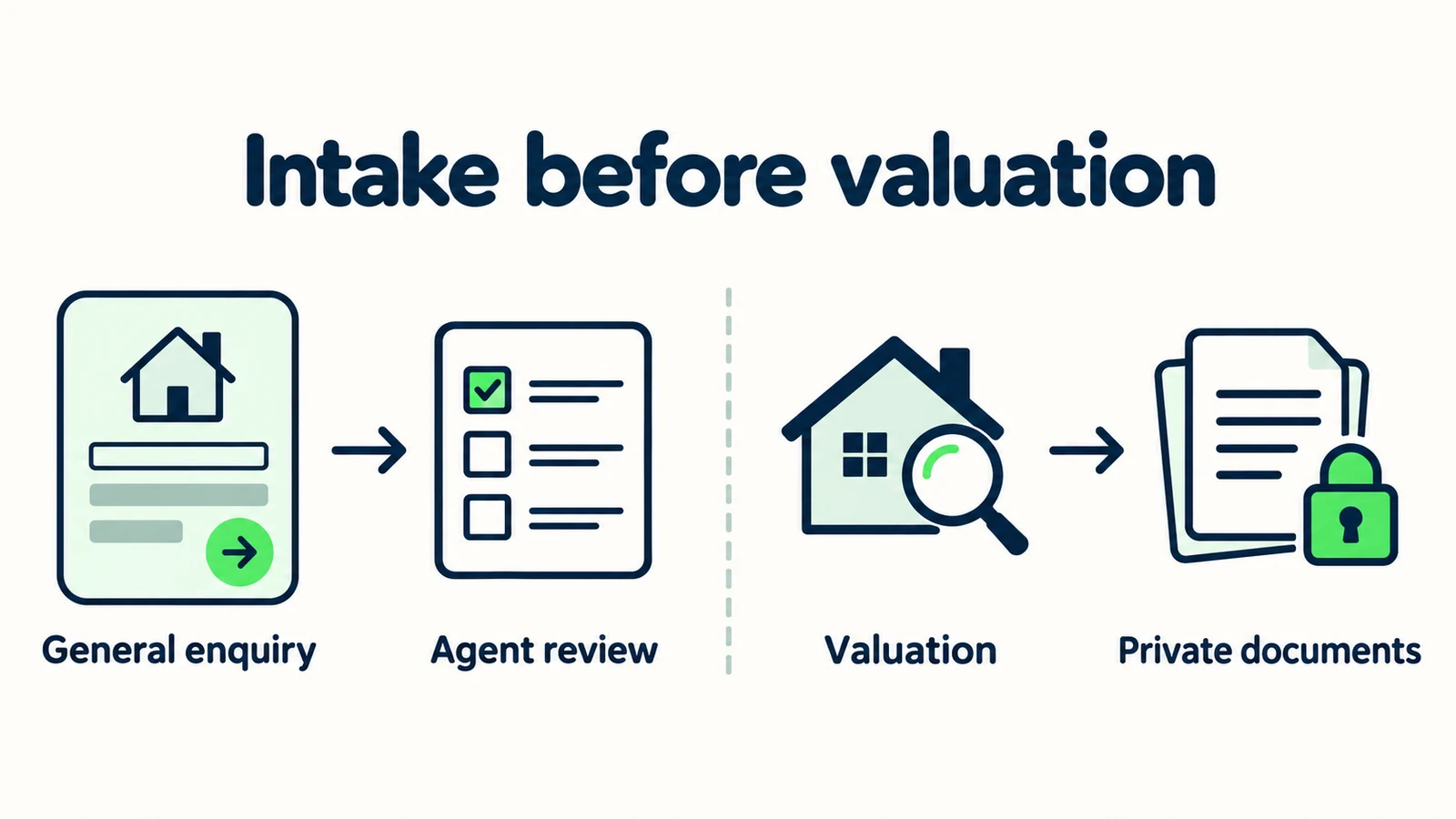
Good real estate seller enquiry questions occupy the middle ground. They establish the broad property type, area, likely timing and the question the seller wants answered. They do not estimate a sale price, verify ownership or demand private paperwork before a person has explained the process.
This guide provides a seller-specific intake template and illustrative scripts for an AI front desk. It is distinct from buyer matching or a general lead-scoring framework. The goal is a better first agent conversation: enough context to prepare, clear uncertainty where details are unknown and no suggestion that the AI has appraised, listed or accepted the property.
What a Seller Intake Should Capture—and Leave Open
A seller intake is a brief for an agent, not an assessment of the property. It records what the enquirer says and the next question that needs professional attention. Treating the brief this way prevents early assumptions from becoming facts in the follow-up.
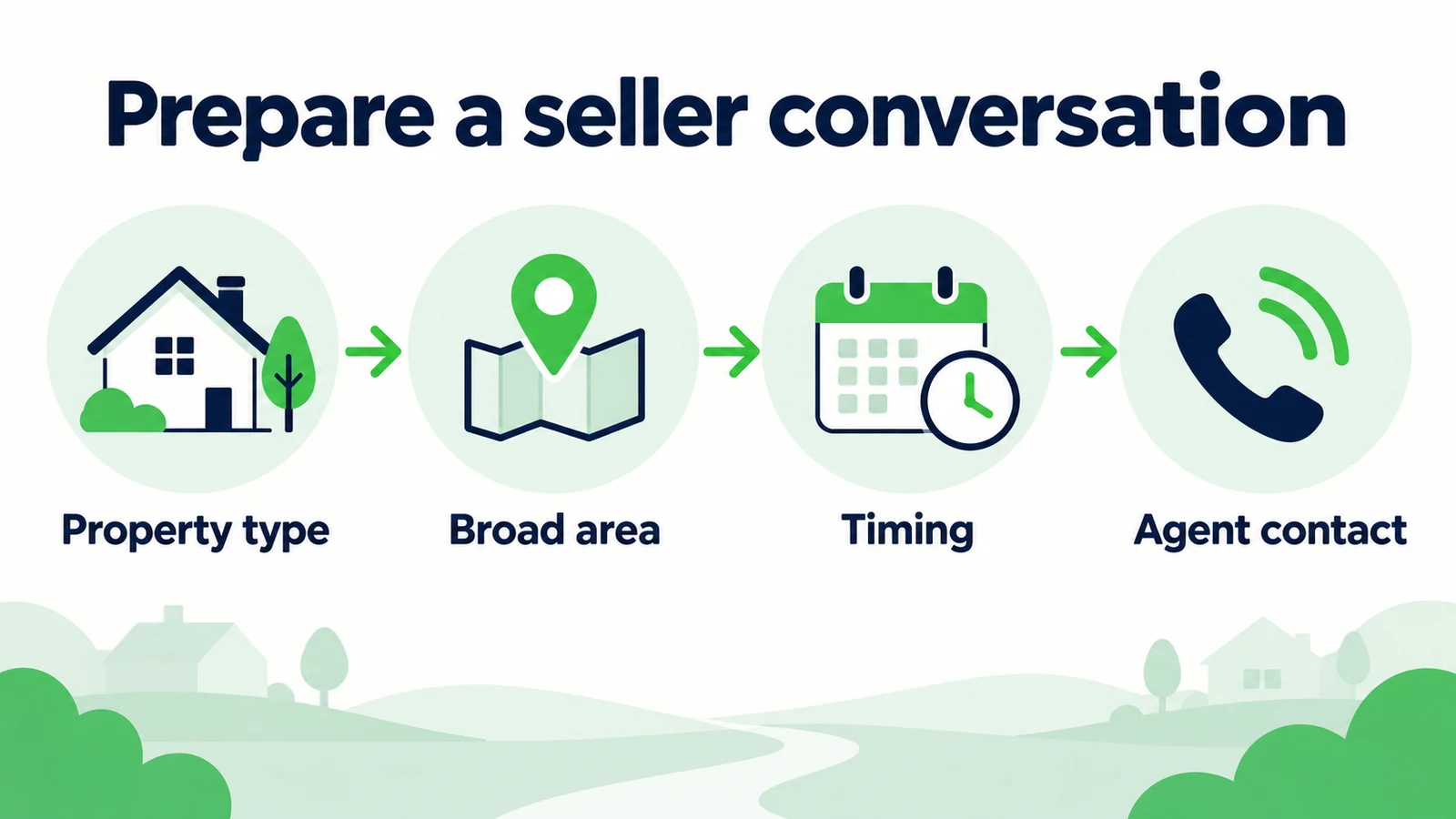
Start with property type and broad location. These help the agency determine which team should review the enquiry. Add timing as a preference or stated need, not a promised completion date. Ask what the person wants to discuss: the selling process, an agent consultation, a valuation appointment or general service information.
Your real estate AI front desk can answer from approved agency information and collect relevant enquiry context. It does not need access to live listings or a valuation model to make that first conversation useful. Do not imply that a property was looked up, its ownership checked or its likely sale price established.
| Capture now | Leave for the appropriate later process |
|---|---|
| Broad property type | Detailed professional assessment |
| General area | Private ownership documents |
| Stated timescale | Promised sale or completion date |
| Main question | Personalized legal or financial advice |
| Preferred contact route | Identity or authority verification |
| Existing agency relationship, if volunteered and relevant | Contract interpretation |
The real estate qualification guide covers the wider buyer-and-seller workflow. This template focuses on preserving seller intent before an agent has spoken with them. It should make the next conversation easier, not decide whether the property is suitable for listing.
Do not force every visitor to become a lead. Someone asking what your agency does can receive public information without providing a contact method. Ask for follow-up details when they choose that next step and explain the purpose in plain language.
An enquiry is not an ownership check
Record the person's stated relationship to the property only when it is useful. Do not treat that statement as verified authority, request ownership paperwork in general chat or advise on legal rights to sell.
Why Seller Enquiries Need Their Own Question Pack
Buyer questions do not reveal seller intent
Asking a seller for their purchase budget or preferred bedroom count starts the wrong conversation. A seller may care about process, timing, presentation or who will handle the sale. Use the question that changes the next agent interaction rather than reusing a buyer form with a different greeting.
Urgency can be interpreted too strongly
“We would like to move quickly” may mean the person wants an initial conversation soon. It does not establish a deadline, a distressed situation or permission to pressure them. Ask what timing they have in mind and record their wording without attaching a motive.
A broad location becomes a premature data request
The agency may need only a town or neighborhood to identify the right team. Asking for a full address immediately can be unnecessary. Explain why more precise information is needed when the actual process reaches that point, and use the agency's approved route for sensitive material.
Valuation language implies knowledge the front desk does not have
A seller may ask what the property is worth. The useful response is to explain the agency's approved valuation or consultation process, not generate a plausible figure. A fluent answer is not evidence of inspection, market analysis or an authorized professional opinion.
7 Seller Questions That Prepare the Agent
1. Establish whether this is a selling enquiry or a general question
Begin with the intent already expressed. If the visitor says they want to sell, acknowledge that. If they ask a general service question, answer it before moving into intake. Do not assume that browsing a seller page means the person has decided to list.
Visitor: “I might sell later, but I don't know where to start.”
Front desk: “I can explain the agency's published selling process. Are you mainly looking for an overview, or would you like an agent to discuss your situation?”
This gives the person a choice without asking them to commit to a listing. If they choose an overview, share the approved information and leave the conversation open. If they want a person, ask only the details that help prepare that contact.
Keep the status “exploring” when appropriate. Do not translate an early question into “ready to instruct.” The agent can discover readiness through a human conversation. The front desk's role is to preserve the starting point accurately.
The real estate response guide emphasizes answering the actual question. Apply that principle before introducing the rest of this template. A relevant first response is more helpful than a complete form collected in the wrong context.
2. Ask for the broad property type
Property type can help route the enquiry, but the categories should fit the agency's services. A simple question might offer house, apartment, land or another type without implying that every category is handled by the same team.
Front desk: “What type of property are you considering selling? A broad description is enough for the first conversation.”
If the person is unsure how to classify it, accept their own description. Do not force a technical category or infer legal use from a casual phrase. “Building with a shop below and living space above” is more useful than a guessed classification the agent later needs to undo.
Use approved agency information to explain the next step where the property type is outside the published scope. Do not reject a customer based on an invented rule. “The team needs to confirm whether this falls within its services” preserves the uncertainty honestly.
Record the distinction between the customer's description and an agent assessment. The intake note might say “visitor describes a mixed-use building; service fit needs review.” It should not say “approved commercial listing” before anyone has made that decision. This small wording choice prevents the brief from overstating what the conversation established.
3. Request only the location detail needed for routing
Ask for the general area first when that is enough to identify the relevant team. A city, neighborhood or broad postal area may be sufficient, depending on the agency's approved process. Do not present this as a universal rule; determine the minimum useful detail for your own coverage.
Front desk: “Which area is the property in? You do not need to share private documents here; the broad location will help the team understand the enquiry.”
If the visitor provides a full address voluntarily, do not repeat it unnecessarily in public-facing acknowledgements. Follow the business's information-handling process and avoid requesting additional identifying material merely because one detail has already been supplied.
Answer coverage questions from the approved source. A nearby office or an old listing does not prove current service coverage. If the location is ambiguous, ask which town or region the visitor means rather than choosing the most familiar one.
In the handoff, separate “area stated” from “coverage confirmed.” If the source clearly supports the area, say which public service information was shared. If not, mark the team review. A clear routing question should not become an invented claim about agency reach.
4. Ask about timescale without promising an outcome
Timing helps the agent prepare, but it should be collected in the seller's terms. Ask whether they are exploring, hoping to begin soon or working toward a particular date. Avoid implying that the agency can meet a target simply because the customer states it.
Visitor: “We would like everything finished before we move.”
Front desk: “I can note that timing is important. What date or period are you working toward? The agent can discuss the process and what needs to be considered.”
Do not advise on completion, legal arrangements or financial consequences. Those questions belong with appropriately qualified people through the agency's normal process. The front desk can preserve the question without attempting to answer it.
Avoid urgency labels that imply a motive. “Wants an agent conversation this week” is a clear request. “Desperate seller” is a subjective and inappropriate interpretation. Keep the language respectful and factual, particularly where the customer mentions a personal transition.
If the timing is uncertain, write “not decided.” This is not an incomplete record that must be repaired through repeated questioning. It tells the agent to begin with exploration rather than assuming a transaction is already underway.
5. Capture the question the seller wants answered
Ask what would make the first agent conversation useful. This often reveals more than another demographic field. The person may want to understand the service process, discuss preparing the property or arrange the agency's valuation route.
Front desk: “What would you most like the agent to explain in the first conversation?”
If the visitor asks for a valuation, explain the approved process without providing a number. Do not infer a figure from a general area, property type or a claim about a neighbor's sale. The question is valuable precisely because it identifies a decision that needs the agent.
If the visitor asks about fees, use only the agency's approved public information and its conditions. Do not calculate a personalized offer, negotiate or interpret a private agreement. Record an unanswered fee question for the agent rather than smoothing it over with a generic assurance.
The lead-qualification guide provides a useful broader principle: each question should help decide the next action. In a seller intake, “what do you want to discuss?” often does that better than asking for a long list of property details that will later be collected through a formal process.
6. Offer the right agent-contact path
Once the visitor chooses a human conversation, explain the actual route. If the agency uses an approved appointment link, share it and make clear that the linked process handles selection and confirmation. If a person reviews requests, collect a preferred contact method and any useful availability preference.
Front desk: “I can help prepare the enquiry for the team. What contact method would you like them to use, and is there a preferred time to reach you?”
A preferred time is not a promised callback. Preserve that distinction in the customer message and the internal note. Do not say an agent is assigned, available or on the way unless the operating process verifies it.
Let the visitor use an approved direct contact route instead of leaving details. Some people prefer to call or send their own message. The front desk should not block that choice by insisting on completion of every field.
The human-handoff guide covers the broader responsibilities. For this seller pack, the important output is a clear next step: the customer knows what they need to do, and the team knows what still needs a response.
7. Read back a bounded summary
End with a short summary that distinguishes stated facts, preferences and open questions. Invite a correction without asking the person to repeat the entire enquiry.
Front desk: “You are exploring the sale of an apartment in the area you mentioned, with timing still open. You would like an agent to explain the selling process and the valuation appointment route. Is there anything important I have missed?”
Do not include a claim that the property has been accepted for sale or that the agency has verified the person's authority. Do not state that a valuation is complete simply because the customer asked for one. Keep the request as a request.
If delivery to the team is verified, describe that actual action. If not, provide the approved contact route or explain the remaining step. A well-written summary is not proof that it arrived in a staff inbox.
Use the lead-summary guide to keep the receiving record concise. The seller-specific difference is the emphasis on property type, broad area, timescale and the question for the agent—not buyer preferences, live listing matches or an invented readiness score.
Prepare a more useful seller conversation
Use Hyperleap AI to answer agency FAQs and capture a clear seller enquiry before an agent follows up.
Start for freeThe Seller Handoff Template
The following is an original team worksheet. It can live in your normal working document or review process; it is not a claim of a native property-management or CRM integration.
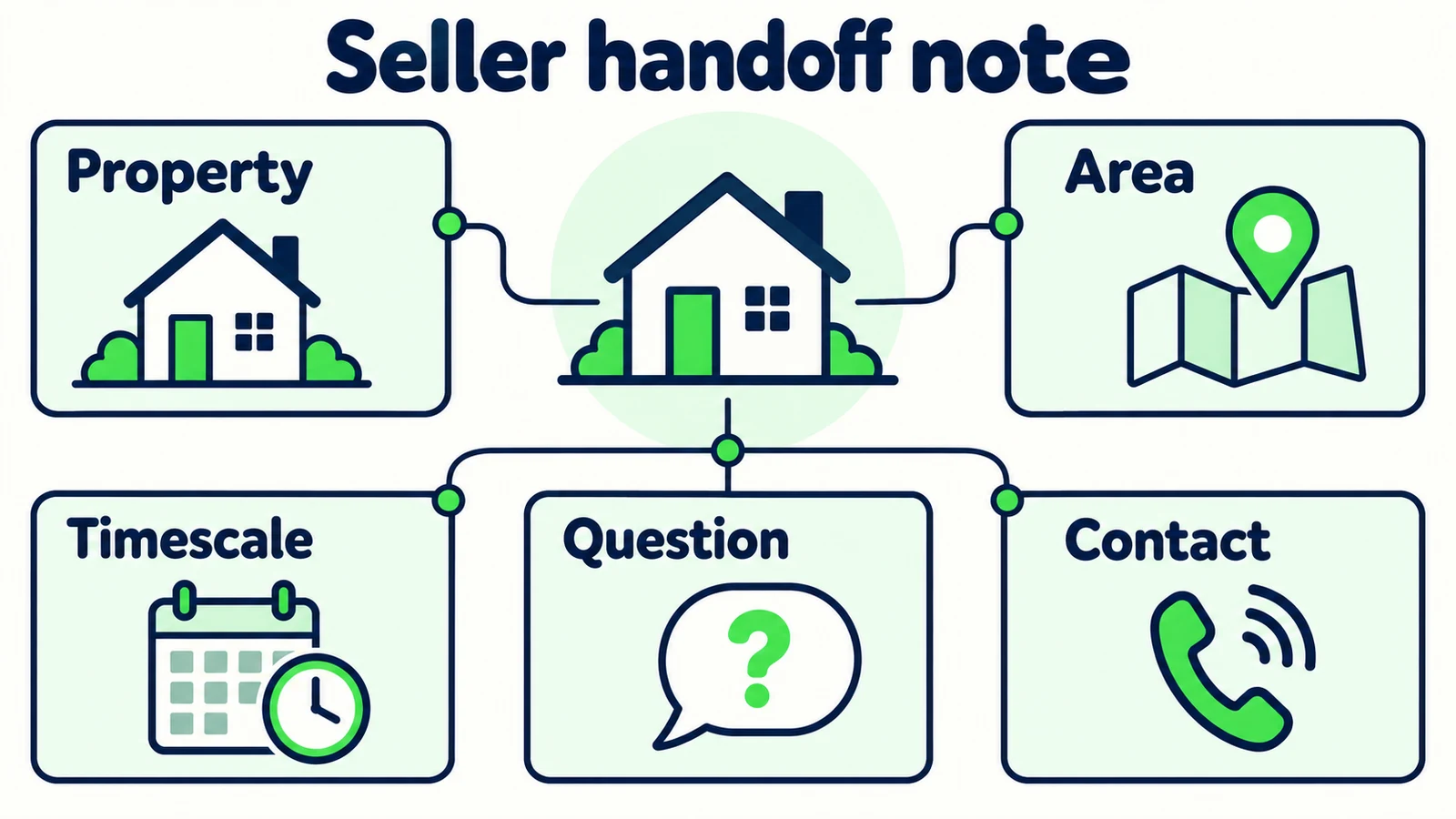
| Field | What to record |
|---|---|
| Enquiry intent | Exploring a sale, requesting information or asking for agent contact |
| Property description | Customer's broad description, without inferred classification |
| Area | Minimum location detail needed for the next step |
| Timing | Stated preference, target period or undecided |
| Main question | What the seller wants the agent to explain |
| Information shared | Which approved agency details were provided |
| Open decision | Valuation, service fit, fees or another item requiring review |
| Contact preference | Method and preferred time, if supplied |
| Status | Link shared, request prepared or verified delivery |
| Next owner action | What a person needs to do next |
Consider a fictional enquiry: the person is thinking about selling an apartment, is unsure when to begin and wants to understand the agency's approach before arranging a valuation. A weak summary says, “Hot seller lead; valuation requested.” A better summary says, “Exploring a sale; timing undecided; wants a process overview and to understand how a valuation appointment is arranged.”
The better summary does not make the opportunity smaller. It makes the customer's position more accurate. An agent can begin with the right conversation rather than assuming a commitment and creating pressure.
Review the template with the agents who receive enquiries. Ask which fields they use, what they still have to ask and whether any wording implies a decision they did not make. Measure avoidable repetition and corrections in your own workflow. Do not infer commission, sale probability or conversion gains from a fuller intake record alone.
Introduce Seller Intake Without Building a Valuation Tool
Collect the agency's approved public service information first. Clarify which property types and areas need team review, which consultation route is current and what the front desk may say about fees. Resolve outdated documents before using them as answering sources.
Write the intake instructions in plain language. Tell the front desk to answer public questions, ask relevant seller-context questions and preserve uncertainty. Include explicit limits around valuation, ownership, listing status and private documents. A useful instruction names the action to take when a limit is reached, not just a list of things to refuse.
Run fictional conversations representing different stages: a person exploring a sale, someone with a target date, a visitor outside the published area, a person asking for a price estimate and someone who does not want to leave contact details. Check that each receives an understandable next step.
Review the visible reply and internal brief together. Does the summary upgrade a tentative statement? Does it call a preferred contact time confirmed? Does it repeat a private detail unnecessarily? Fix those meaning changes before focusing on stylistic polish.
Hyperleap AI can support the front-desk conversation and provide a unified inbox across its supported channels. Your agency still owns staffing, professional review and any downstream business systems. Do not assume a native real estate CRM or listing-feed connection. If custom connectivity is required, evaluate it separately from the source-grounded intake described here.
Keep the questions current as the agency's services change. The AI front-desk overview describes the broader operating role: routine answers and useful context, with people handling decisions that need judgment. This seller template applies that role without pretending that first contact is the same as a professional assessment.
Frequently Asked Questions
What should a seller enquiry form ask first?
Start with the person's actual request. If they want an agent conversation, broad property type and area can help prepare it. If they only want public information about the agency, answer that first. Do not require a complete property record before explaining the service.
Should an AI front desk estimate what the property is worth?
Not in the workflow described here. It should explain the agency's approved valuation or consultation process and pass the question to the appropriate person. A broad location and customer description do not establish a professional valuation, and the front desk should not invent a figure.
Do we need the full address at first contact?
Collect only the detail your approved next step requires. A broad area may be enough for initial routing. If more precise information becomes necessary, explain why and use the agency's normal process. Do not request private ownership documents in a general chat to make the intake look complete.
How should the front desk handle an urgent sale request?
Record the customer's stated timescale and offer the approved agent-contact route. Do not infer the reason for urgency or promise a sale or completion date. Questions about legal or financial implications belong with appropriately qualified people, not an automated first-contact script.
Can Hyperleap AI look up listings or update a real estate CRM?
Do not assume native listing-feed or real estate CRM access. The seller template uses approved agency sources, enquiry collection and human follow-up. Any custom connection through APIs or webhooks needs its own requirements and verification; it is separate from the capabilities demonstrated by this intake process.
How can agents judge whether the template helps?
Review whether the brief captures the seller's real question, reduces repeated introductory questions and avoids overstated commitments. Ask the receiving agents which fields they actually use. A better intake record is useful evidence of preparation, but it does not by itself establish a change in sales or commission.
Prepare the Conversation Without Deciding the Sale
A seller enquiry is the beginning of a relationship, not a transaction to complete through a script. The front desk should make it easier for a person to understand the seller's situation without assuming authority, value or readiness.
Use broad property context, a stated timescale and the customer's main question. Offer a clear contact route, preserve uncertainty and summarize only what the conversation established. Leave valuation, documentation and professional decisions to the appropriate process.
When the agent receives the brief, the useful question should be “how can I help this person move forward?” rather than “which of these promises did the AI make?” That is the standard this seller intake template is designed to support.
Give agents the context for a better first reply
Build a Hyperleap AI front desk around approved agency information and a respectful seller enquiry flow.
Start for freeIndustry Solutions
See how AI chatbots work for these industries:
Related Articles

Real Estate Lead Handoff: The Agent-Ready Checklist
Use a real estate lead handoff checklist to preserve buyer intent, property context, unanswered questions and the next action without inventing certainty.

Ask for Contact Details Without Blocking the Answer
Use practical contact-request scripts that explain the purpose, respect customer choice and keep useful answers separate from lead capture.

Wedding Venue Tour Enquiries: A Question Pack
Prepare better wedding venue tours with questions on date flexibility, guest range, event shape and priorities, plus a copy-ready host handoff.

Quote or Estimate? AI Front Desk Reply Templates
Use clear quote-versus-estimate replies, scope questions and approval checks so your AI front desk does not promise a price your team has not agreed.