Real Estate Lead Handoff: The Agent-Ready Checklist
Use a real estate lead handoff checklist to preserve buyer intent, property context, unanswered questions and the next action without inventing certainty.

An agent opens a lead notification that says “Interested in a property. Please call.” The conversation may have contained a specific listing, a timing constraint and a question about arranging a viewing, but none of that survived the handoff. The agent now has to reread the transcript or ask the customer to start again.
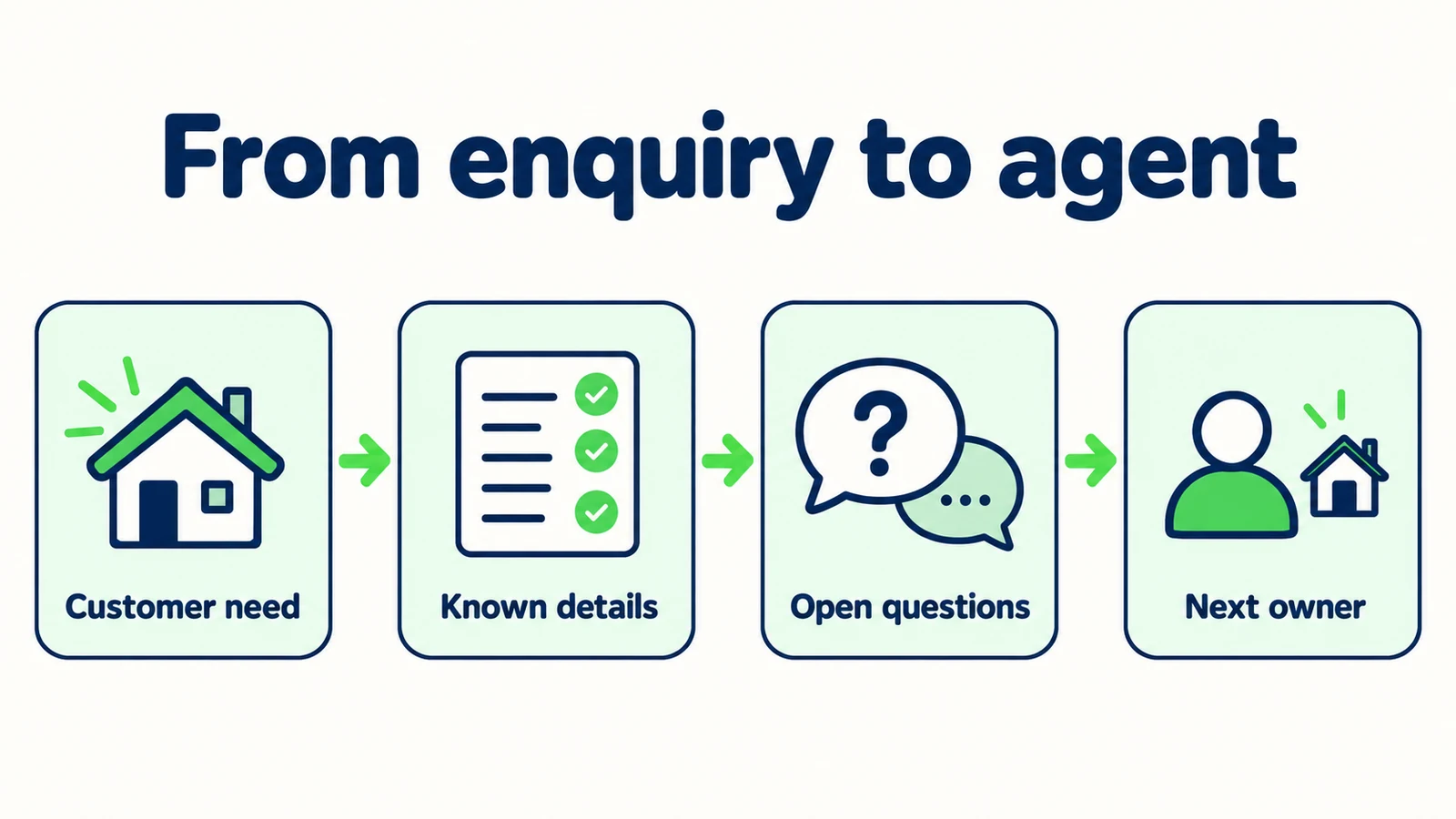
A real estate lead handoff checklist should make the next human conversation easier. It preserves what the customer actually wants, which details are known, what remains uncertain and who needs to do what next. It does not turn a few chat messages into proof of buying readiness or a confirmed appointment.
This guide provides an agent-ready record, complete-versus-incomplete examples and a review process. All sample leads are fictional. The focus is the information transferred after an enquiry, not the opening reply or a promise that AI can access live listings. Use the checklist alongside your agency's approved process, with staff responsible for listing facts, availability, commercial advice and commitments.
What Is an Agent-Ready Lead Handoff?
An agent-ready handoff is a short, evidence-based brief that lets the receiving person understand the enquiry and choose a sensible next action. It should answer: who is asking, what they are trying to do, which property or area they mean, what they have already said and what the agency still needs to confirm.
“Ready” does not mean every field is complete. A customer may be exploring, may not know their preferred move date or may decline to share a telephone number. An honest brief with explicit unknowns is more useful than a full-looking form containing guesses.
It also does not mean financially qualified. A stated budget is customer-provided context, not a verification of funds. A proposed viewing time is a preference, not an appointment. An enquiry about a property is not evidence that the property remains available. Keep those differences visible in the language of the record.
The broader real estate lead qualification guide explains the conversational role. The first-response playbook covers how to reply. This checklist begins where those guides leave off: preparing the information an agent receives after the initial exchange.
An AI front desk for real estate can answer approved questions, collect enquiry details and share approved links. Hyperleap AI does not provide native MLS access, live listing synchronization or a native real-estate CRM integration. The handoff should be useful without implying any of those capabilities.
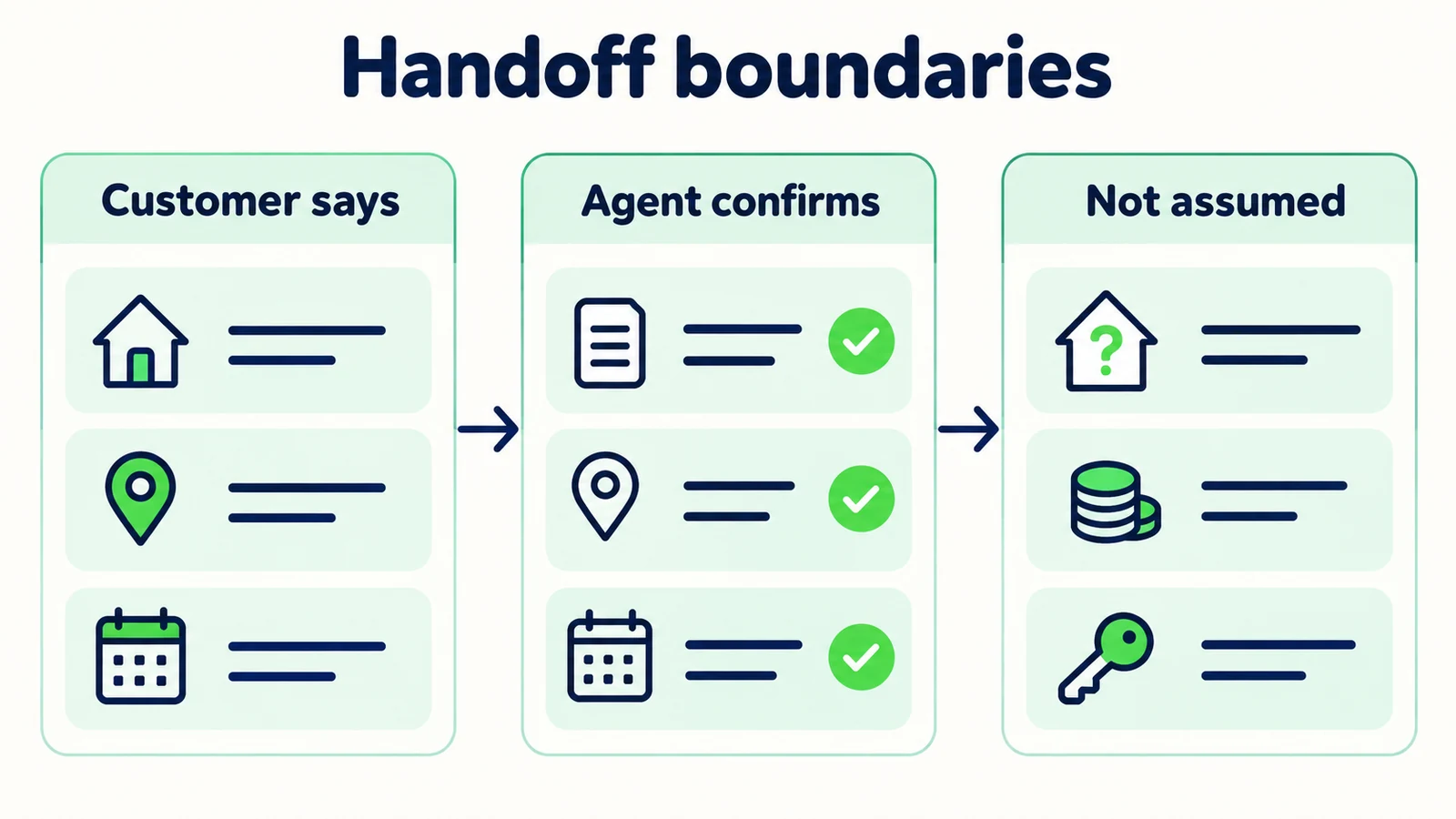
Keep three kinds of information separate
Distinguish customer statements, agency-confirmed facts and open questions. “Customer would like a Saturday viewing” is a preference. “Saturday viewing confirmed” is a different claim and requires an actual authorized confirmation.
Why Leads Lose Meaning Between Chat and Agent
The record captures fields but loses the question
Name, phone and budget can all be present while the reason for the enquiry is missing. If the customer asked about access to a particular property, the agent should not open with a generic sales pitch. Put the customer's main question before secondary qualification details.
A summary sounds more certain than the conversation
“Looking around next spring” can become “moving in spring.” “Would prefer a house” can become “house buyer.” The shorter version may be easier to scan, but it changes the evidence. Preserve words such as approximate, preferred, considering and not yet decided when they matter.
Property references are incomplete
“The apartment on your website” is not enough if several listings fit. A pasted URL, listing reference or customer-provided address can help identify the property. If none is available, mark the property as unclear and ask a focused clarification. Do not infer it from a price or a vague neighborhood description.
Everyone can see the lead, but nobody owns the next step
A shared inbox solves visibility, not responsibility by itself. Your team needs an operating rule for who reviews new enquiries and who acknowledges the handoff. Those are business practices, not automatic assignment features claimed by this article. A clear next action prevents the record from becoming merely another notification.
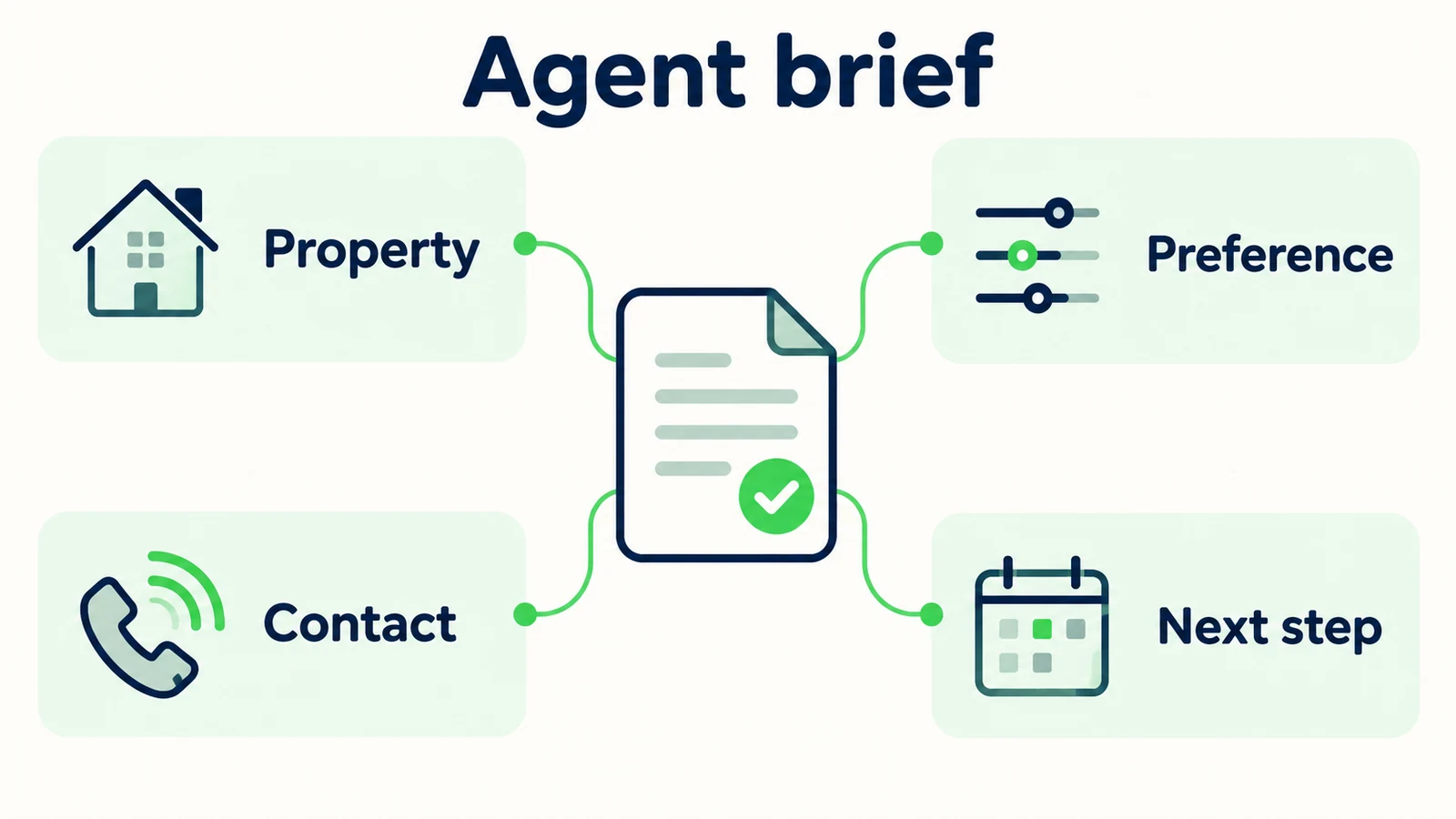
7 Fields That Make a Real Estate Handoff Useful
1. Put the customer's actual request first
Open the brief with a sentence describing what the customer wants from the agency. Use an action: asks about a property, requests a viewing discussion, wants to understand the selling process or needs clarification about a published detail. Avoid labels such as “hot lead” unless your team has a defined, evidence-based meaning for them.
Illustrative brief opening:
“Customer asks whether the agency can discuss a viewing for the property they linked and wants clarification about the published parking description.”
That sentence helps the agent begin with the relevant question. It does not assume the customer is ready to offer, has financing arranged or has accepted the property's terms.
If the conversation contains several requests, identify the main one and preserve the others as open questions. Do not discard an accessibility or practical access question because it does not fit a sales field. The customer may consider that detail central to deciding whether to proceed.
For a vague enquiry, use equally honest wording: “Customer is exploring homes in the area; no specific property identified.” The receiving agent can then choose an exploratory response instead of behaving as though a particular listing has already been selected.
2. Capture the property or search context precisely
Record the listing URL, reference or address the customer actually supplied. If the person names more than one property, keep those references distinct. Do not blend details from separate listings into a single fictional property description.
Illustrative clarification:
“Could you share the listing link or reference for the property you mean? That will help the agent review the right enquiry.”
When the person is searching more broadly, record the area and property preferences they volunteer. Separate requirements from preferences. “Needs step-free entry information” is different from “prefers a ground-floor property,” and neither should become a promise that a listing is suitable.
Keep published facts separate from live status. An attached brochure may support an answer about a described feature, but it does not prove current availability or that the description has remained unchanged. Mark any fact needing confirmation for the agent.
The source page can be helpful context, but a visitor arriving from one listing page may ask about another. Do not let page context override an explicit customer correction. The handoff should preserve the latest clarified reference and, where useful, note that an earlier reference was corrected.
3. Record timing as a preference, not a commitment
Timing helps an agent prioritize the conversation appropriately, but it should remain faithful to the customer's words. Distinguish the desired move period, the preferred time to speak and a proposed viewing time. These are separate fields with different operational meanings.
Illustrative question:
“Are you working toward a particular move period, or are you still exploring? If you would like the agent to contact you, is there a preferred time to reach you?”
A customer might be exploring a move in several months while wanting a call this week. Compressing those details into “urgent” loses the distinction. Likewise, a request for a weekend viewing does not establish whether the agency, property owner or current occupant can accommodate it.
Use full dates when the customer supplies them, and ask a clarification when relative wording would create confusion. For a remote customer, include the time zone they specify for contact preferences. Do not invent one from their telephone prefix.
If timing is unknown, write unknown or not discussed. The next agent can ask when it becomes relevant. A missing timeline should not automatically disqualify a useful enquiry or trigger repeated pressure for an answer the customer does not yet have.
4. Preserve commercial context without declaring qualification
A stated budget, intended use or readiness question can help the agent prepare. Record these as customer statements and avoid converting them into verified financial facts or suitability judgments.
Illustrative record:
“Customer states an approximate search budget and asks what costs the agency can explain. Financing status was not discussed.”
The AI front desk should not request bank statements, identity documents or detailed financial records during an ordinary pre-sales conversation. If an authorized later process requires documentation, staff should explain the approved route and purpose.
Do not infer a budget from a customer's occupation, name, location or language. Ask only the business-relevant questions needed for the enquiry and let the person decline or defer. Qualification should help the customer and agent understand fit, not turn a simple question into an intrusive interview.
Avoid financial or legal advice. A question about affordability, contracts, tax treatment or financing should be routed to an appropriately authorized person. The handoff can preserve the question without attempting an answer. The lead qualification framework is useful for question design, but real estate decisions still require the agency's own professional process.
5. Note what was answered and what remains unresolved
A lead brief should prevent the next person from repeating information unnecessarily. List the main approved facts already shared and the questions that remain open. Keep this section concise; it is a map of the conversation, not a duplicate transcript.
Illustrative split:
Answered: agency contact hours and the link to the published property brochure. Open: whether a proposed viewing time is possible and clarification of the parking arrangement.
This distinction helps the agent start with the unresolved issue. It also makes it easier to spot an answer that needs correction. If the front desk gave an uncertain or unsupported statement, flag it for review instead of presenting it as confirmed agency information.
The lead-summary guide explains the general difference between a summary and a transcript. For real estate, pay particular attention to statements about availability, price, property condition and appointment status. These can carry practical consequences when summarized carelessly.
Attach a route back to the original conversation in the system your team uses. A brief should be enough for orientation, but the agent may need exact wording before responding. Do not strip away the evidence and leave only an AI-generated interpretation of the customer's intent.
6. Include contact choice and the permitted next step
Record the contact details the person chose to provide and their preferred route for follow-up. A telephone number appearing in a messaging profile should not be treated as permission for every kind of outreach. Follow your business's approved contact practices and the customer's expressed preference.
Illustrative question:
“Would you like the agent to follow up about this enquiry? If so, which contact method would you prefer?”
If the person wants to remain in the current channel, preserve that preference. If they decline to share additional details, continue with the general information you can provide. Do not turn access to a public brochure into a requirement to disclose unrelated personal information.
State the next step accurately: contact requested, viewing discussion requested or approved booking link shared. “Link shared” is not “appointment booked.” “Details collected” is not “agent contacted.” Only describe a notification as delivered when the actual configured delivery has succeeded.
The human-handoff guidance is relevant here: an expectation is a promise from the customer's perspective. Do not introduce a callback deadline just because it sounds reassuring. Use only the commitments your agency has approved and can support.
7. Give the record an owner and a correction path
Define who reviews new enquiries, how they acknowledge responsibility and what happens if the information is incomplete. This can be a simple team practice. It does not require claiming automatic lead assignment, scoring or CRM synchronization.
An agent should be able to correct the brief after reading the transcript or speaking with the customer. Preserve the difference between an original customer statement and a later correction. If a property reference changes, update the working record without pretending the first reference was never supplied.
For possible duplicates, review the evidence manually. Similar names or messages do not prove that two records belong to the same person. Avoid merging contacts automatically based on weak clues. The receiving team should follow its established customer-record process.
Finally, record the actual outcome of the handoff separately from the quality of the initial brief. The lead may be well documented but not ready to proceed. Another enquiry may be incomplete but important. A clean record supports better follow-up; it does not guarantee a viewing, offer or transaction. Keeping those measures separate helps the team improve the process without overstating its commercial effect.
Give agents a better starting point
Collect the customer's question and useful context, then keep property decisions and follow-up with your team.
Start for freeCompare an Incomplete Brief With an Agent-Ready One
The following synthetic example shows a difference in record quality, not a customer success result.
| Field | Incomplete version | Agent-ready version |
|---|---|---|
| Main request | Interested buyer | Requests a discussion about viewing the linked property |
| Property | Apartment from website | Customer-provided listing link; current availability unconfirmed |
| Timing | Urgent | Prefers a conversation this week; move period not discussed |
| Questions | Wants details | Asks about published parking description and possible viewing times |
| Commercial context | Qualified | Budget and financing not discussed |
| Contact | Call lead | Customer requests email first; address supplied through approved form |
| Next action | Follow up | Agent to review property question and propose the appropriate next step |
The second record does not contain more certainty. It contains better distinctions. The agent can see what the customer requested and what must still be checked. That makes it easier to write a relevant opening reply.
Use a short acceptance test for each handoff. Can the receiving person identify the main question without reading the whole transcript? Can they distinguish a preference from a confirmed fact? Can they find the evidence? Is the next action clear? If the answer to any of these is no, improve the brief rather than adding a decorative lead score.
Keep incomplete records visible. A person who leaves before sharing contact details may still reveal a common question your knowledge base should answer. Do not count that record as a contactable lead, but do not discard the learning. Similarly, an agent's correction can identify a recurring summary problem worth fixing in the source or instructions.
Introduce the Checklist Without Slowing Every Enquiry
Start with the enquiries your agents already receive. Review a small, appropriate sample under your normal access rules, and identify which missing details cause staff to ask the customer to repeat themselves. Use fictional records for testing and training wherever possible.
Choose the minimum fields needed for the first human response. A property reference and an unresolved question may matter more than a long qualification form. Ask additional questions only when they advance the customer's request. The objective is a useful conversation, not maximum data collection.
Configure the front desk to answer from approved property and agency material, preserve uncertainty and use the agreed contact route. Hyperleap AI supports lead capture, conversation histories, emailed summaries and CSV/Excel exports. Native real-estate CRM connectivity and live listing access should not be assumed. If your team builds a separate connection through the REST API and webhooks, verify that workflow independently.
Test the handoff end to end with synthetic enquiries. Check not just the chat response but the record the receiving agent actually sees. Does the property reference survive? Is the customer's preferred contact route present? Does the summary accidentally call a requested viewing confirmed? Correct those issues before expanding the workflow.
Assign a reviewer for early handoffs and record recurring corrections. A shared AI front desk can help organize customer conversations, but your agency remains responsible for ownership and follow-through. Evaluate the workflow by the usefulness and accuracy of the brief, then measure commercial outcomes separately through your established process.
Frequently Asked Questions
What is the minimum information an agent needs?
The agent needs the customer's request, relevant property or search context, known contact preference and the unresolved question or next action. Not every enquiry needs a full qualification form. Explicit unknowns are better than guessed details.
Should every lead receive a readiness score?
Not necessarily. A score is only useful when its meaning and evidence are defined by your team. A concise record of intent, timing and open questions can be more actionable than an unexplained label such as hot or qualified.
Can Hyperleap check whether a listing is still available?
Do not assume live listing access. Hyperleap can answer from approved attached information, but this workflow does not include native MLS access or live listing synchronization. The agency should confirm current availability through its authorized process.
Does sharing a viewing link confirm an appointment?
No. Sharing an approved booking link gives the customer a next step. A requested time remains a preference until the authorized booking process or responsible person confirms it. The handoff should preserve that distinction.
How should uncertain or corrected details be recorded?
Label uncertain information as customer-reported, approximate, not discussed or awaiting confirmation as appropriate. When a detail changes, preserve the correction and its source in your working process. Do not silently convert an earlier guess into a verified fact.
Can lead records move into our CRM?
Hyperleap supports CSV/Excel export and offers a REST API and webhooks for separately implemented workflows. This is not a claim of a native real-estate CRM integration. Verify field mapping, delivery and handling of corrections before relying on a custom connection.
Hand Over the Enquiry, Not a Guess About the Buyer
A useful real estate lead handoff gives an agent enough context to continue the conversation naturally. It preserves the customer's question, identifies the property or search, records preferences honestly and makes the open decision clear.
The checklist is deliberately modest. It does not declare financing verified, a listing available or a viewing booked. Those decisions remain with the people and systems authorized to make them. The brief's job is to reduce repeated opening questions and prevent useful context from disappearing between channels and team members.
Start by comparing one current lead notification with the agent-ready example. Improve the missing distinction that creates the most extra work, then test the record the agent actually receives. That is a practical foundation for an AI front desk your team can use with confidence in its boundaries.
Create clearer real estate enquiries
Answer approved questions and give your agents a concise brief with known details, open questions and a useful next step.
Start for freeIndustry Solutions
See how AI chatbots work for these industries:
Related Articles

Wedding Venue Tour Enquiries: A Question Pack
Prepare better wedding venue tours with questions on date flexibility, guest range, event shape and priorities, plus a copy-ready host handoff.

Quote or Estimate? AI Front Desk Reply Templates
Use clear quote-versus-estimate replies, scope questions and approval checks so your AI front desk does not promise a price your team has not agreed.

Service-Area Answers: Scripts for Local Businesses
Give clear service-area answers with location questions, boundary scripts and a practical handoff record for local service enquiries.

Hotel Group Enquiry Scripts: From Question to Handoff
Use practical hotel group enquiry scripts to gather dates, room needs and event context, then hand a clear brief to your reservations team.