AI Receptionist for Restaurants: Chat-First Guide
An AI receptionist for restaurants answers menu and hours questions, qualifies reservation and private-dining requests, and shares your reservation link 24/7.

An AI receptionist for restaurants is a chat-based AI agent that answers hours, menu, and dietary questions from your own content, qualifies reservation and private-dining requests, and shares your reservation link — on your website, WhatsApp, Instagram DM, and Facebook Messenger. It is chat-first, not a phone system: it does not answer your phone line, and it does not write into OpenTable, Resy, or other reservation systems. It shares whatever reservation link you already use (if you take bookings through Calendly or Cal.com, it can offer live times and book the slot in the chat) and collects the guest's details so your host stand gets a clean summary instead of another call during the dinner rush.
The dinner rush doesn't leave anyone free to answer the phone, let alone reply to a DM asking whether the restaurant has a gluten-free option. Meanwhile, a guest scrolling Instagram at 6:45 PM, trying to decide where to eat tonight, sends a message and moves on to the next restaurant if nobody answers in a few minutes. That's not a staffing failure — it's math. A host stand running food, seating tables, and managing a waitlist cannot also monitor three inboxes in real time.
This guide covers what an AI receptionist actually automates for a restaurant: the honest limits around reservations (it shares your booking link — it does not hold a table), how it handles large-party and private-event inquiries, the FAQ questions that eat up host-stand time, and where a chat-based AI receptionist stops and a phone answering service still matters. For the full picture of chatbot conversation design for restaurants, see AI chatbot for restaurant reservations and orders; for a broader look at what restaurants stand to lose when responses are slow, see why restaurants lose reservations to slow response; and for the wider industry deployment, AI agents for restaurants covers everything from FAQ handling to catering inquiries. The mechanics of connecting to reservation systems specifically are covered in restaurant booking APIs and AI agents. Private-dining qualification follows the same pattern used for catering inquiries and event planning leads. Other service businesses run the same after-hours pattern — see AI chatbot for wedding venues and AI receptionist for veterinary clinics.
What Is an AI Receptionist for Restaurants?
An AI receptionist for restaurants is a messaging-based AI agent that performs the front-of-house information job — answering hours, menu, dietary, and parking questions, and fielding reservation and event inquiries — around the clock, without staffing a phone line. It runs on the channels guests already message through outside of a phone call: your website's chat widget, WhatsApp Business, Instagram DM, and Facebook Messenger.
For a restaurant specifically, that means:
- Answer instantly, any hour — including the after-close window when tomorrow's diners are deciding where to book.
- Answer from your actual menu and policies, not a generic script — hours, parking, dress code, dietary options, and what's in a dish.
- Qualify reservation and private-dining requests — party size, date, time, dietary notes — before handing them to your team.
- Share your reservation link rather than pretending to check table availability itself.
This is chat-first by design, not a limitation to apologize for: it covers the growing share of restaurant inquiries that arrive as a message rather than a phone call — the diner who DMs your Instagram after seeing a plated dish, the guest already texting on WhatsApp who expects an instant reply, the person Googling "restaurant name hours" at 11 PM and opening a chat widget instead of dialing.
Chat-first, not phone-first
Hyperleap's AI receptionist for restaurants works on your website chat widget, WhatsApp, Instagram DM, and Facebook Messenger. It does not answer phone calls — voice is on Hyperleap's roadmap, not a shipped feature. If a meaningful share of your reservation calls arrive by phone, keep whatever phone answering setup you already have; a chat-based AI receptionist works alongside it, covering the channels a phone system doesn't reach, not replacing your phone line. See AI receptionist vs. answering service for how the two fit together.
Why Restaurants Lose Guests to Slower Competitors
The dinner-rush blind spot
Your busiest service hours are exactly when nobody at the host stand has time to answer a chat message. A guest asking "do you have a table for 4 at 7?" during Friday dinner rush often gets no reply until the message is noticed hours later — by which point they've already booked somewhere else.
The after-hours research window
A large share of restaurant decision-making happens the evening before or the afternoon of a visit — someone browsing options for tomorrow night's dinner, or a group deciding where to celebrate a birthday next weekend. If your only answer to an after-hours message is silence until you reopen, you're invisible to that decision entirely.
Private events and large parties get buried
A private-dining or large-party inquiry is one of the highest-value messages a restaurant receives, and it's also one of the easiest to lose in a busy inbox — buried under routine "what are your hours" questions with no way to flag it as urgent. Without a system that captures date, headcount, dietary needs, and budget up front, these inquiries sit unanswered until someone has time to dig through messages.
Guests expect an instant answer, not a callback
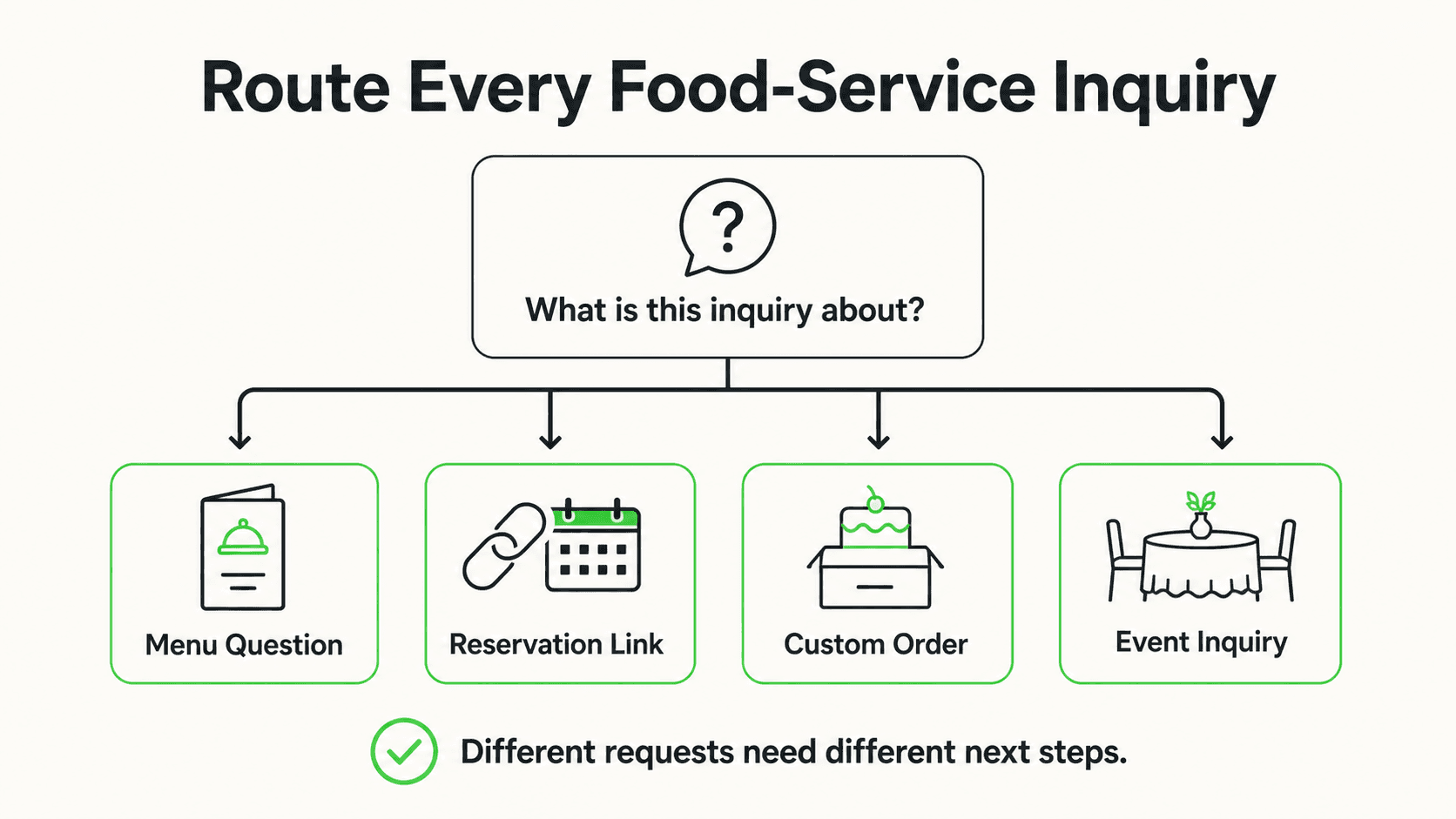
Diners comparing two restaurants for tonight's reservation don't wait for a callback — they book with whichever one answers now. A restaurant with no coverage on WhatsApp or Instagram DM effectively tells that guest to look elsewhere.
7 Ways an AI Receptionist Handles Restaurant Inquiries
1. Answering Hours, Location, and Parking Questions
What this looks like in practice: A guest messages asking whether you're open on a holiday, where to park, or whether you take walk-ins. The AI answers instantly from the hours and policy information you've provided, without a human touching the message.
Why it works: These are the highest-volume, lowest-complexity questions a host stand fields — and every one answered by the AI is one less interruption during service.
Key features:
- Hours, holiday schedule, and location answered from your content
- Parking, dress code, and walk-in policy covered
- Consistent answers regardless of who's working the shift
2. Sharing Your Reservation Link and Capturing Party Details
What this looks like in practice: A guest asks to book a table for six on Saturday. The AI shares your reservation link — OpenTable, Resy, or your own booking page — right in the chat, and captures party size, date, time, and any special occasion notes, then emails your team a summary.
Why it works: It gets the guest moving toward an actual booking immediately instead of leaving them to hunt for your reservation page, while still giving your host stand visibility into who's inquired.
Key features:
- Reservation-link sharing for OpenTable, Resy, and similar systems — the AI does not check table availability, hold a table, or confirm the booking there
- If you book tastings or private-dining calls through Calendly or Cal.com, the AI can connect to it, show live times, and book the slot in the conversation (in-chat booking needs Calendly Standard or higher)
- Party size, date, time, and occasion captured conversationally
- Confirmation still happens in your existing reservation system
3. Qualifying Large-Party and Private-Dining Requests
What this looks like in practice: A guest asks about hosting a 25-person rehearsal dinner. Instead of a generic "we'll get back to you," the AI walks through your private-dining capacity, minimum spend, and lead-time policy as you've written them, then collects date, headcount, dietary needs, and budget for your events coordinator.
Why it works: Private events are high-value bookings that deserve a real qualification conversation, not a form buried in a shared inbox. A complete brief means your coordinator's first response is a warm follow-up, not a round of clarifying questions.
Key features:
- Private-dining capacity, minimums, and lead times explained from your documents
- Structured capture of date, headcount, dietary needs, and budget
- No deposits or payments taken — that stays with your team
4. Answering Menu and Dietary Questions Accurately
What this looks like in practice: A guest with a nut allergy asks which dishes are safe. The AI answers from your menu and prep notes — which dishes are vegetarian, vegan, gluten-free, or nut-free — and is instructed not to guess on anything ambiguous.
Why it works: Allergy and dietary questions are a real liability concern; an AI that answers only from what you've documented, and escalates anything uncertain, protects both the guest and the restaurant.
Key features:
- Answers pulled only from your attached menu and prep documentation
- Ambiguous cases (cross-contamination, severe allergies) routed to your team
- Guests advised to confirm specifics with the kitchen on arrival
5. Handling Menu Updates Without Manual Rework
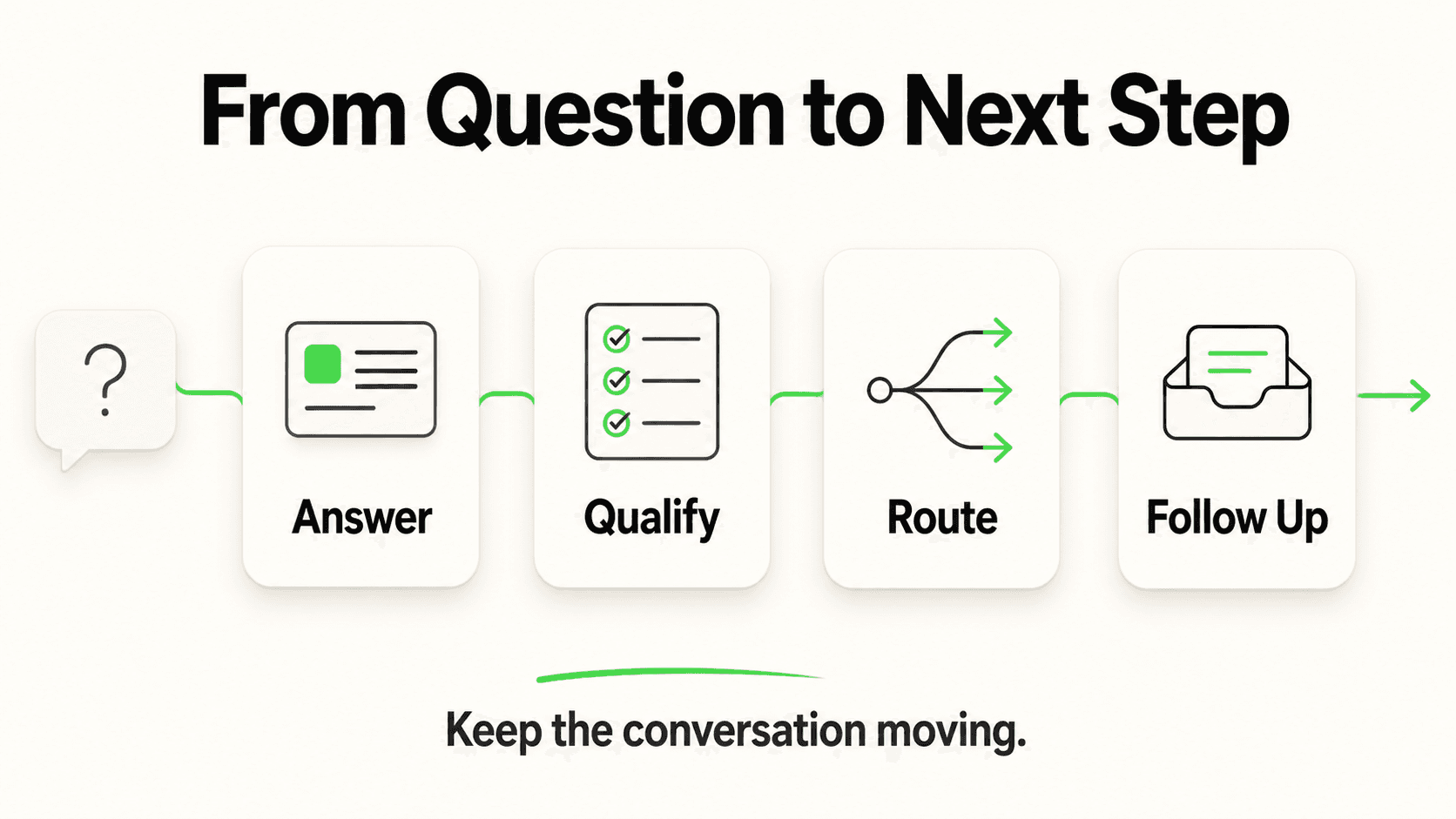
What this looks like in practice: Your menu changes weekly with new specials and sold-out items. You update one document — a PDF, a Google Doc, or your menu page — and re-attach it; the AI's answers reflect the latest version immediately.
Why it works: A stale menu chatbot is worse than no chatbot — it actively misleads guests. Keeping the source document current is the entire maintenance burden.
Key features:
- Single source-of-truth document drives all menu answers
- Daily specials and sold-out items reflected as soon as you update
- No developer or technical step required to refresh content
6. Covering WhatsApp, Instagram DM, and Messenger — Where Guests Actually Message
What this looks like in practice: A guest DMs your Instagram after seeing a plated dish in a post, asking if you take reservations for that night. The AI answers on the same channel the guest already used, with the same accuracy as your website chat.
Why it works: A meaningful share of restaurant inquiries never touch your website at all — they arrive as a social DM or a WhatsApp message. Covering only your website leaves that volume unanswered.
Key features:
- Same knowledge base answers consistently across website, WhatsApp, Instagram DM, and Messenger
- Runs on Meta's official Business APIs — Hyperleap AI is a Meta Technology Provider and Business Partner, so there's no third-party relay in the middle of your WhatsApp or Instagram traffic
- All conversations land in one Studio inbox regardless of channel
7. Supporting Multilingual Guests
What this looks like in practice: A guest messages in Spanish or Portuguese asking about the menu. The AI responds in the guest's language, drawing on the same underlying menu and policy content.
Why it works: Restaurants in diverse or tourist-heavy markets serve guests who don't all search or message in English; answering in the guest's own language removes a real barrier to booking.
Key features:
- Responds across 100+ languages based on the guest's message
- No separate content to maintain per language — answers derive from your single source documents
- Consistent policy and menu accuracy regardless of language
What a Voice Answering Service Still Covers
Some restaurant inquiries genuinely arrive by phone — a guest calling to confirm a reservation time, or an older guest who prefers to talk rather than type. An AI receptionist that runs on chat channels does not answer your phone line; if phone volume is significant for your restaurant, a phone answering service or IVR still has a role. The two aren't competitors: a chat-based AI receptionist covers the messages your phone system never sees, while your phone setup continues to handle calls. Evaluate what channel your actual inquiry volume arrives on before assuming one tool replaces the other.
That evaluation matters more than it sounds. Some restaurants — particularly those with an older or less digitally native guest base — still get the majority of reservation requests as phone calls, and for those restaurants a chat-based AI receptionist is a useful supplement, not the primary fix. Restaurants that skew younger, urban, or delivery-and-social-heavy tend to see the opposite pattern: a large share of inquiries already arrive as a DM or a website chat message, and those restaurants get the most immediate value from covering those channels well. Look at where your unanswered inquiries are actually piling up — a missed-call log versus an unread Instagram DM folder — before deciding which gap to close first.
Integration Requirements to Evaluate
Restaurants researching this category often ask whether an AI receptionist connects directly to their point-of-sale system, their reservation platform's availability calendar, or their online ordering flow. As of today, it does not — and any vendor claiming a live two-way sync into OpenTable, Resy, or a POS system is a claim worth verifying carefully before you buy, since a broken sync can double-book a table faster than no sync at all. What Hyperleap does offer is a REST API and webhooks, so a restaurant's own developer or a technical partner can build a connection into other systems if needed — but that's an integration requirement to evaluate on a case-by-case basis, not a built-in feature to assume. For most restaurants, sharing the reservation link and routing a clean summary to staff is a simpler, more reliable pattern than chasing a live sync that doesn't yet exist in this product category.
Real Results: What Restaurants Are Achieving
Response speed
- Guests get menu and hours answers in seconds, at any hour, instead of waiting for a callback
- After-hours and pre-dinner-rush messages get the same instant response as a quiet Tuesday afternoon
- Reservation and event inquiries arrive at the host stand as a structured summary, not a missed notification
Staff time
- Front-of-house staff spend less time re-answering "are you open" and "do you have parking" during service
- Private-event inquiries arrive pre-qualified with date, headcount, and budget already captured
- One inbox in Studio covers website, WhatsApp, Instagram DM, and Messenger instead of monitoring separate apps
Guest experience
- Guests with dietary restrictions get accurate, document-grounded answers instead of a guess from whoever picks up the phone
- Multilingual guests get answered in their own language without a bilingual staff member on shift
Illustrative example, not a guarantee
A restaurant that currently has no after-hours or social-DM coverage can expect a portion of nightly reservation inquiries to arrive outside service hours or on channels other than the phone — the exact share varies by market and restaurant type. The value is in not losing that guest to a faster-responding competitor down the street, not a specific percentage lift. Treat any framing like this as illustrative, not a promised outcome.
Implementation Roadmap for Restaurants
Days 1–2: Gather your core content. Menu (with allergen and dietary notes), hours, parking and dress-code policy, private-dining details, and your reservation link.
Day 3 (under 5 minutes for the quick-start path): Set up the AI. Paste your website URL into Studio; it reads your site, imports branding, detects your industry, and drafts a starting prompt automatically. Add one script tag to go live.
Days 4–7: Connect WhatsApp, Instagram DM, and Messenger. Route all three into the same Studio inbox as your website chat.
Week 2: Attach your full menu and write allergy guardrails. Upload your complete menu with prep notes, and set explicit instructions for what the AI should never guess on.
Week 3: Review private-dining and large-party handoffs. Check the email summaries your events coordinator is receiving and refine what details get captured.
Ongoing: Update your menu document weekly. Specials, sold-out items, and seasonal changes flow through automatically once you re-attach the current version.
Try it with your own menu
Paste your restaurant's website and see how the AI answers a real dietary question and shares your reservation link.
Try It FreeFrequently Asked Questions
Does an AI receptionist for restaurants take reservations?
Not in OpenTable, Resy, or other reservation systems. It shares your existing reservation link directly in the chat and collects the guest's party size, date, and time. It does not check table availability, hold a table, or confirm the booking; that final step still happens in your own reservation system. The exception is Calendly or Cal.com: connect either and the AI offers real open times and books the slot in the conversation.
Does it answer the restaurant's phone line?
No. It is chat-first — website chat widget, WhatsApp, Instagram DM, and Facebook Messenger. Voice is on Hyperleap's roadmap, not shipped today. If most of your reservation volume arrives by phone, keep your existing phone setup running alongside it; the AI receptionist covers the messaging channels a phone system doesn't reach.
How does it handle food allergy questions safely?
It answers only from the menu and prep documentation you've attached — which dishes are vegetarian, vegan, gluten-free, or nut-free — and is instructed not to guess on ambiguous cases like cross-contamination risk or severe allergies. Those are routed to your staff, and guests are told to confirm specifics with the kitchen on arrival.
Can it handle large private-dining or event inquiries?
Yes. It explains your private-dining capacity, minimum spend, and lead times from your own policy documents, then collects date, headcount, dietary needs, and budget, and emails a complete brief to your events coordinator. It does not take deposits or process payments.
What happens when our menu changes?
You update one source document — a PDF, a Google Doc, or your menu webpage — and re-attach it. The AI's answers reflect the latest version immediately, including daily specials and sold-out items, with no separate rebuild required.
Which messaging channels does it support?
Your website chat widget, WhatsApp Business, Instagram DM, and Facebook Messenger, all managed from one inbox in Studio. WhatsApp, Instagram, and Messenger run on Meta's official Business APIs — Hyperleap AI is a Meta Technology Provider and Business Partner.
How much does an AI receptionist for restaurants cost?
Hyperleap AI plans start at $40/month (Plus), with Pro at $100/month and Max at $200/month, each on a 7-day free trial that requires a credit card. See pricing for the response volume, chatbot count, and channel limits at each tier. For a fuller breakdown of what an AI receptionist costs relative to staffing options, see AI receptionist cost and how does an AI receptionist work.
The Front Desk Your Host Stand Has Been Missing
Restaurants don't lose guests because the food is wrong — they lose them because nobody answered fast enough. An AI receptionist for restaurants closes that gap on the channels a phone system was never built for: the DM after a dinner rush post, the WhatsApp message from a regular, the late-night search for tomorrow's reservation. It answers from your actual menu and policies, qualifies the requests worth a human follow-up, and shares your reservation link — so your host stand's first touch with a guest is a warm confirmation, not damage control.
If you're weighing options broadly, the best AI chatbots for restaurants in 2026 compares how different tools handle this same job. If you'd rather see it work against your own menu first, that's a five-minute setup away.
Cover every message, every hour
See how the AI front desk for restaurants answers menu and dietary questions and shares your reservation link across website, WhatsApp, and Instagram DM.
Get Started FreeIndustry Solutions
See how AI chatbots work for these industries:
Related Articles
AI Chatbot for Restaurants: Reservations, FAQs & Orders
How AI chatbots handle reservations, menu questions, and private dining inquiries 24/7 so front-of-house focuses on seated guests.
Hotel Cancellation Answers: A Source-Check Checklist
Build hotel cancellation answers around booking channels, rate terms and stay dates, with a source-check worksheet and clear staff-review boundaries.

Hotel Group Enquiry Scripts: From Question to Handoff
Use practical hotel group enquiry scripts to gather dates, room needs and event context, then hand a clear brief to your reservations team.
AI Receptionist for Landscaping Businesses
An AI receptionist for landscaping businesses answers quote and service questions 24/7, qualifies property details, and shares your booking link.