Guide
Customer Support vs Customer Service: The Difference
Customer service helps people through the whole buying relationship. Customer support fixes problems with what they bought. Here is how to run both.

Gopi Krishna Lakkepuram · Founder & CEO
· 13 min read
TL;DR
- Customer service is help across the whole relationship: before the sale, during it, and after. Customer support is the narrower job of helping people use or fix what they bought.
- Support is a part of service. Most people use the two words interchangeably, and for a 2 to 20 person business the label matters less than knowing which questions need a person with product knowledge.
- Split the work by question type, not by job title. Let an AI front desk handle repeat service questions, and route technical problems to a named person with full context.
Customer service helps a person at any point in their relationship with your business: choosing, buying, changing an order, paying, complaining. Customer support helps a person who already has your product or service and needs it to work. Support sits inside service, and the difference is mainly scope and depth.
Below you get a comparison table, four industry examples, and a way to organise both with a very small team, including where an AI front desk fits and where it should stop.
What is customer service?
Customer service is every interaction where your business helps a customer get what they came for, from first question to final invoice. It covers pre-sale questions, bookings, order status, returns, billing, and complaints.
A salon answering "Do you do balayage, and how long does it take?" is doing customer service. So is a store explaining its return window, a clinic confirming an appointment, and a hotel replying to a late-arrival request. None of these needs product expertise. They need accurate information and fast replies.
For a deeper look at what good service means in practice, see what is good customer service and customer service skills.
What is customer support?
Customer support is help with a specific product or service the customer already has, usually when something is not working or they cannot work out how to use it. It is narrower and deeper than service, and it often needs technical knowledge.
A heating company diagnosing why a thermostat will not reach temperature is doing customer support. So is a software agency debugging a client's site error, or a store troubleshooting a device that will not pair. The customer has a problem. Someone with the right knowledge has to find the cause.
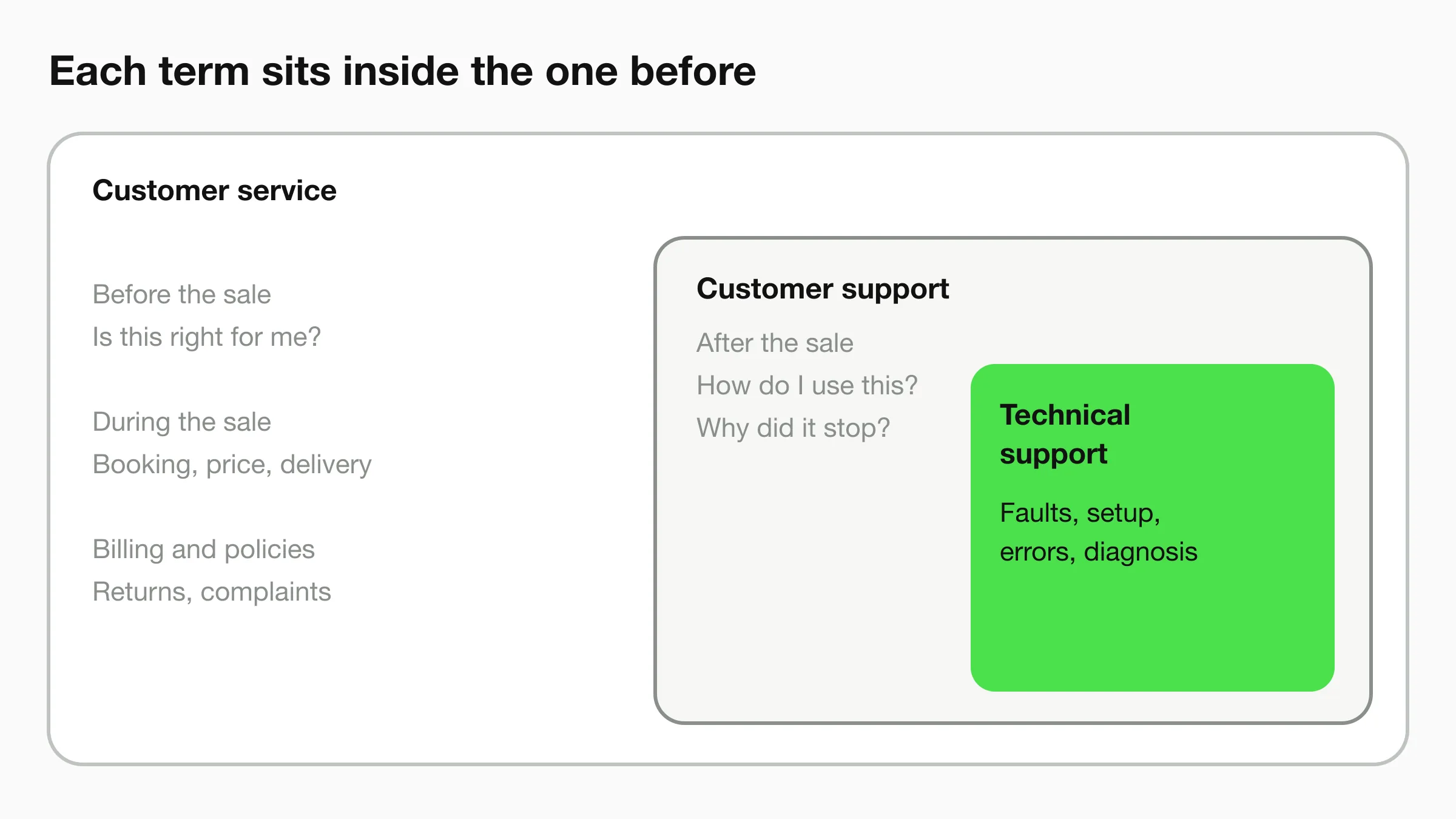
"Technical support" is the sharpest form of customer support. If you search for customer service vs technical support, the short answer is this: technical support is a type of customer support, and customer support is a type of customer service. Each term is a smaller circle inside the one before.
The difference at a glance
The two overlap, so the table below describes the typical pattern, not a law. Your business may blur some rows, and that is normal.
| Customer service | Customer support | |
|---|---|---|
| Scope | The whole relationship: before, during, and after the sale | Using, fixing, and getting value from what was bought |
| Timing | Any stage, often before purchase | Mostly after purchase |
| Typical trigger | A question, a request, a complaint | Something broke, or the customer is stuck |
| Core skills | Clear communication, empathy, policy knowledge, speed | Product knowledge, diagnosis, step-by-step explanation, patience |
| Typical metrics | First response time, satisfaction, resolution at first contact | Time to resolution, reopen rate, escalation rate, backlog |
| Typical tools | Shared inbox, messaging channels, FAQ, booking links | Ticketing, knowledge base, logs, screen sharing, remote access |
| Who owns it | Whoever fronts the business: owner, front desk, sales | Someone who knows the product: technician, specialist, developer |
| Failure looks like | Slow or inconsistent answers, a customer who feels ignored | A problem that stays unfixed, repeat contacts for the same issue |
If you want the metrics side in full, customer service metrics defines each one with a formula.
Where customer service and customer support overlap
The overlap is large, and most real conversations start in it. A customer messages "my order is wrong". That is a service question until you learn the item arrived faulty, and then it is a support problem.
Two things overlap in almost every business. Customers use the same channel for both: the same website chat, WhatsApp number, or inbox, because they do not know which team they are writing to. And tone counts in both, since a technically correct fix delivered coldly still feels like bad service.
This is why large companies often run one team with two tiers. A first line handles common service questions. A second line handles problems that need product knowledge. Your business can copy that shape with one or two people.
Why the distinction matters, and when it does not
The distinction matters when it changes who answers, what they need to know, and how you measure the result. It does not matter when someone is arguing about a job title.
It matters when:
- You are hiring. A friendly generalist and a product specialist are different people with different pay and training.
- You are measuring. A service question should close in one reply. A support problem may take a day and three exchanges. Judging both by the same clock punishes the wrong team.
- You are choosing tools. A shared inbox suits service. Ticketing and a searchable knowledge base start to matter once support problems repeat.
- You are using AI. Repeat service questions are where automation is safest. Open-ended technical diagnosis is where a person should stay involved.
It does not matter when:
- You are the only person answering. You do both anyway, and a label adds nothing.
- Your product is simple and rarely breaks. Almost everything is service, and a separate support function would be overhead.
- A customer is asking. They care whether they got an answer, not which department sent it.
A useful test for each message: does answering it need knowledge of how the product works, beyond what is on your website? If yes, it is support. If no, it is service.
Four examples from four industries
The same split shows up everywhere. Here is how it looks in four small businesses.
Dental clinic
Service: opening hours, whether the clinic takes a patient's insurance plan, how to book a cleaning, what to bring to a first visit. Support: a patient whose crown feels loose after treatment and needs to describe symptoms to a clinician. The service questions repeat all day. The second one must reach a clinician, and the AI must never assess it. See dental agents for how clinics set this up.
Home services (HVAC)
Service: service area, call-out fee structure, availability this week, how to book a visit. Support: a customer whose system stopped cooling after an install, who needs a technician's diagnosis. The first set can be answered from a price list and a schedule. The second needs a person who knows the unit. Home services agents cover the front-desk side.
E-commerce store
Service: shipping times, returns policy, sizing, order status. Support: a device that will not pair, or a product that stopped working in week three, where the owner or a technician has to walk the customer through a fix. Our guide to e-commerce customer service goes deeper on the first group.
IT services agency
Service: pricing structure, onboarding steps, contract terms, how to request work. Support: a client's site is down, or an integration threw an error. This is the clearest example of customer service vs technical support inside one business. Sales-side questions go to an AI front desk. Incident reports go straight to an engineer.
How to organise both with a team of two to twenty
A small team does not need two departments. It needs a clear rule for who handles which kind of message and a way to pass the problem along without making the customer repeat themselves.
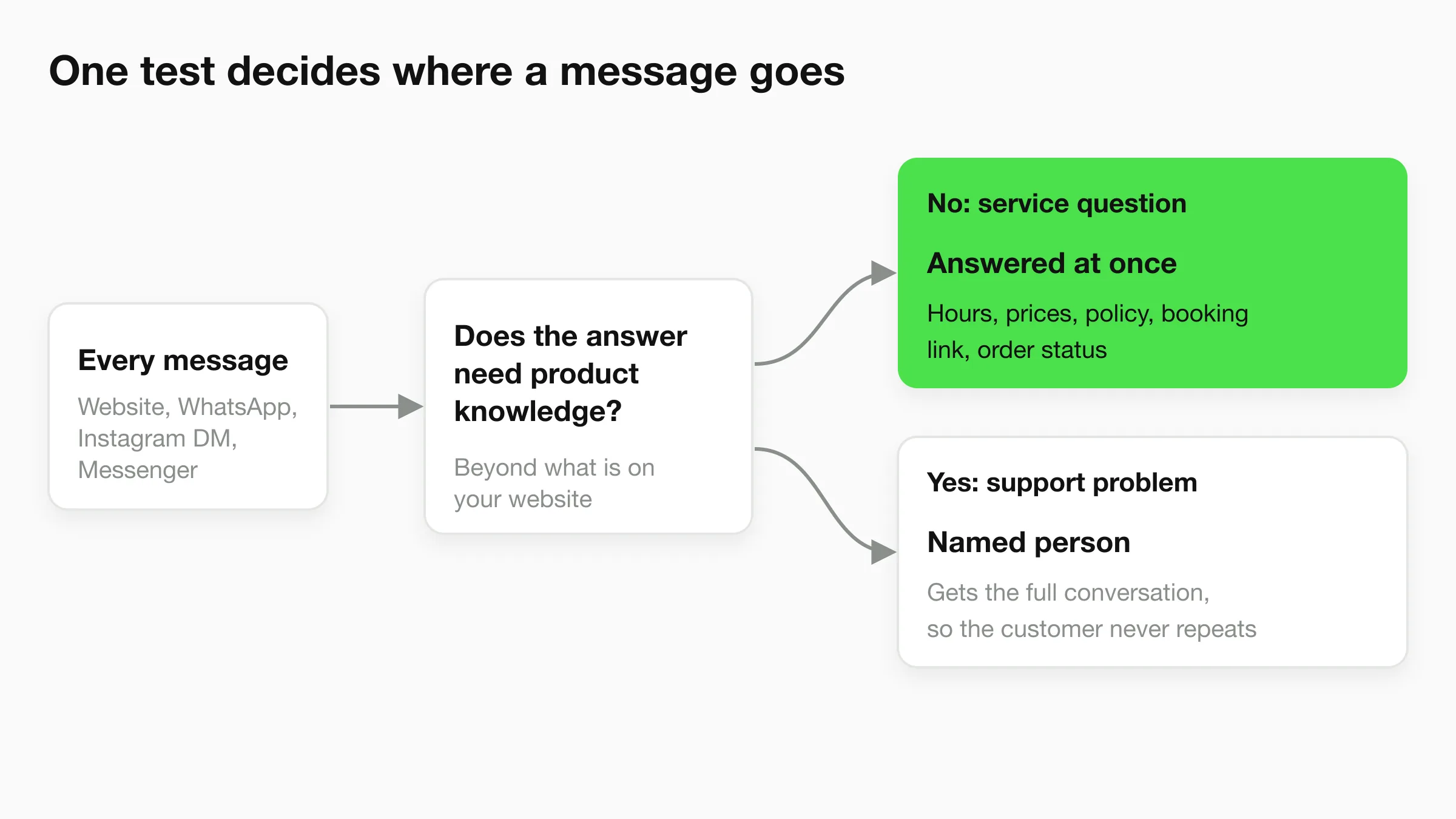
1. Put one front line in front of every channel. Website chat, WhatsApp, Instagram DMs, Facebook Messenger, and any inbox should reach the same place. One front line means one standard of reply. This can be a person, an AI front desk, or both.
2. List your repeat service questions. Pull the last 50 customer messages from your inbox. Sort them by topic. In most small businesses, a short list of topics covers most of them: hours, prices, availability, policies, order status. These are the questions to answer instantly and consistently.
3. Name an owner for technical problems. Pick a specific person, not "the team". For a team of five that might be your most experienced technician. For fifteen, it might be one support specialist. Write down who covers when they are out.
4. Define the handoff. A handoff is good when the person picking up the problem sees the whole conversation and the customer's details, and the customer does not have to start again. A handoff is bad when the customer is told "please email us" and repeats everything.
5. Review the log weekly. Read 10 conversations. Mark any answer that was wrong, slow, or sent to the wrong place, and fix the source, such as a missing FAQ or an outdated price.
6. Write down repeat technical answers. Once you have answered the same technical question three times, write the answer down once. It serves your team and your AI front desk. How to automate customer support has the step-by-step version.
Where an AI front desk fits
An AI front desk fits at the front line of customer service: the repeat questions you can answer from your own documents. Technical problems should go to a person.
Hyperleap AI works this way. You paste your website URL, and Hyperleap reads your pages and drafts an agent you can have live in under 5 minutes. The agent answers from your knowledge base on your website, WhatsApp, Instagram DM, and Facebook Messenger, in 100+ languages. It can collect a customer's contact details and the nature of their problem, and every conversation is logged so you can review it.
Here is how the split looks in practice:
| Message | Who handles it |
|---|---|
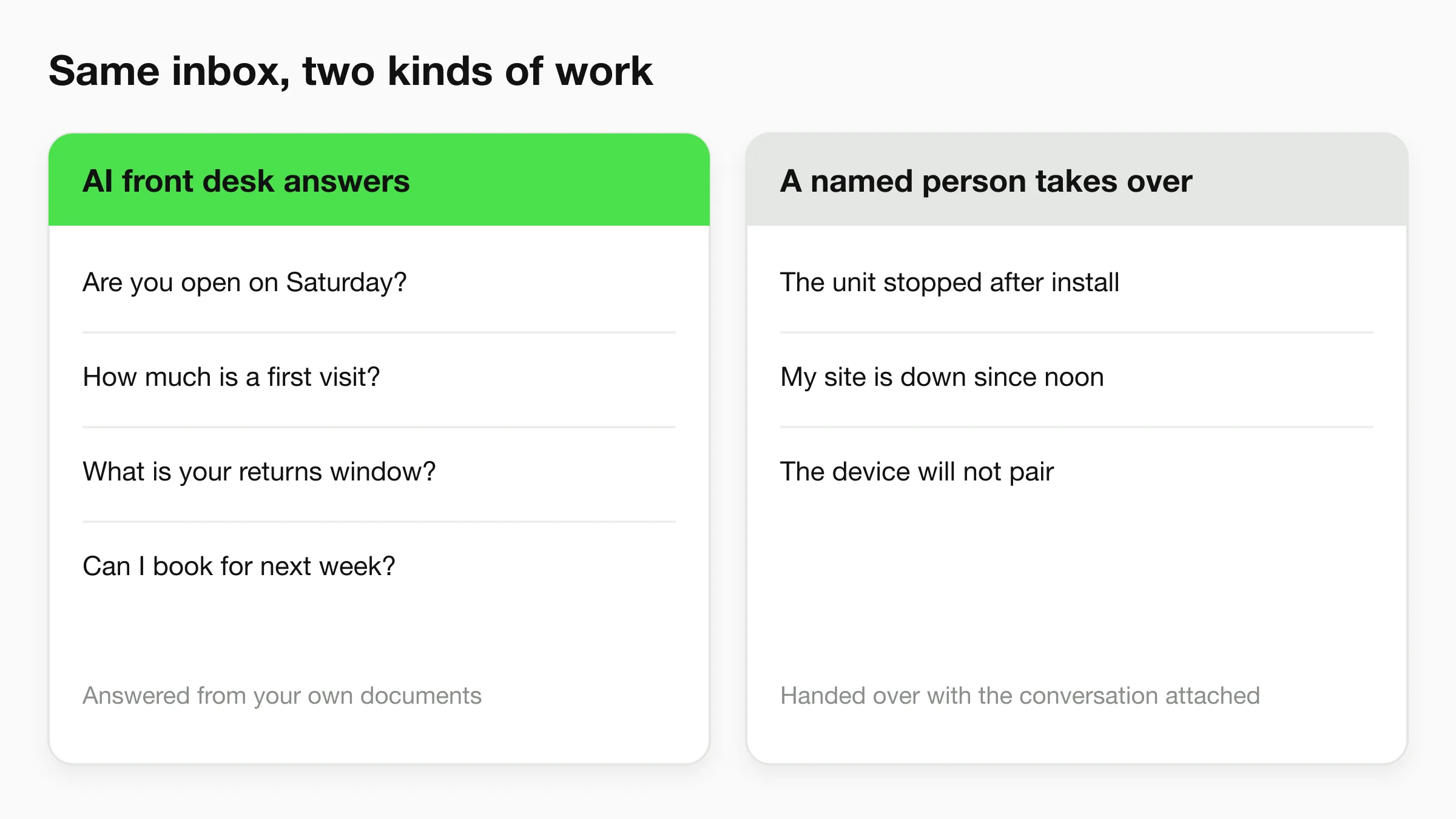
| "Are you open Saturday?" | AI front desk, instantly |
| "What is your returns policy?" | AI front desk, from your documents |
| "Can I book a visit next week?" | AI front desk shares your booking link on Plus, or books in the chat with Calendly or Cal.com on Pro and Max |
| "My unit stopped working after the install" | Routed to your technician, with the conversation attached |
| "I want to speak to someone" | Handed to a person |
On the Pro and Max plans, human handoff alerts your team in Studio and lets a teammate take over a live conversation, including on WhatsApp, Instagram, and Messenger, then hand it back to the AI. On the Plus plan, the agent can still capture the customer's details and your team follows up by hand. Actions, available on Pro and Max, let the agent look up information such as order status from your own API.
What the AI should not do
Do not ask an AI front desk to diagnose faults, assess symptoms, or give legal or financial advice. Write that boundary into the agent's instructions, and make sure every technical or sensitive message has a path to a named person. The AI's job is to get the customer to the right place quickly, not to guess.
Our guides on AI customer service best practices and conversational AI for customer service cover the setup in more detail. If your main need is the front line, the customer support chatbot page explains what the agent handles and how it hands off.
Put a front desk on your customer questions
Hyperleap AI answers service questions on your website, WhatsApp, Instagram DM, and Facebook Messenger, and keeps a log of every conversation. Plans from $40/month, 7-day free trial.
Start for freeFrequently Asked Questions
What is the main difference between customer service and customer support?
Customer service covers the whole customer relationship, including questions before purchase. Customer support is narrower: it helps customers use or fix something they already bought. Support is usually deeper and more technical, and it is a part of service.
Is customer support the same as technical support?
Not exactly. Technical support is one kind of customer support, focused on faults, setup, and how-to problems with a product. Customer support can also include non-technical help, such as warranty or account questions after purchase.
Do small businesses need separate service and support teams?
Usually no. With 2 to 20 people, you need a clear rule for who answers which type of question, not two departments. Give routine service questions to a front line and technical problems to a named person.
Which comes first for a new business, customer service or customer support?
Customer service. Pre-sale and booking questions arrive before anyone owns your product. Build a fast, consistent front line first, then add structure for technical problems as they start to repeat.
Can AI handle customer service and customer support?
AI is well suited to repeat service questions answered from your own documents. For technical problems, it works best as a first step that collects details and routes the customer to a person. The AI agent should not diagnose faults.
Which metrics should I track for each?
For service, track first response time and whether the question was resolved in one reply. For support, track time to resolution, how often issues reopen, and how many go to a specialist. Customer service metrics has formulas for all of them.
Should I use "support" or "service" on my website?
Use the word your customers search for and understand. Many businesses use "Support" for the help link and "Customer service" in policies. Either works, provided the page shows how to reach a person.
Route the easy questions, keep the hard ones human
Set up an AI front desk from your website in minutes, then decide where handoffs go. Start with a 7-day free trial.
Start for freeIndustry Solutions
See how AI chatbots work for these industries:
Related Articles
View all
Guide19 min read
Customer Service Metrics: 13 Defined, 6 to Start With
The customer service metrics that matter for a small business: definitions, formulas, what to track, what to skip, and a simple weekly scorecard.
Guide18 min read
Customer Self-Service: Options, Examples and Setup
Customer self-service explained for small businesses: seven options compared by cost and effort, how to pick what to automate, and how to measure it.
Guide19 min read
Customer Service Skills: 14 That Matter, With Examples
The 14 customer service skills a small business needs, each with a plain definition, a weak vs better reply, and a way to train it in a small team.
Guide13 min read
Customer Success vs Customer Support: The Real Difference
Customer success vs customer support: support fixes problems when asked, success prevents them. Compare goals and metrics, and see how small teams do both.