Guide
Customer Service Skills: 14 That Matter, With Examples
The 14 customer service skills a small business needs, each with a plain definition, a weak vs better reply, and a way to train it in a small team.

Gopi Krishna Lakkepuram · Founder & CEO
· 19 min read
TL;DR
- Customer service skills are the habits that let you understand what a customer needs, fix it or route it to the right person, and leave them feeling looked after.
- Small businesses need 14 of them. Most are soft skills (listening, empathy, calm, plain writing) backed by two hard ones (knowing your own answers and following through).
- Each skill below has a definition, a weak reply next to a better one, and a way to train it without a training department.
- The same skills work on resumes. Pick the five that match the job and describe what you did with each.
- An AI front desk can take the repetitive first answers so your people spend their skills on conversations that need judgement.
The lasting damage in customer service rarely comes from one big failure. It comes from small ones: a reply that ignored half the question, a quote that arrived two days late, a "no" with no alternative attached. Qualtrics' 2025 consumer survey of 20,001 people across 14 countries found that 34% of consumers reduce their spending with a company after a negative experience, and 13% cut it entirely.
The customer service skills that prevent those small failures are learnable. This guide covers the 14 that matter most in a small business, with a real exchange for each and a way to train it in a team of two to twenty. It is written for owners and team leads, not for call center managers. If you are here to write a resume, jump to the resume section.
How to use this guide
Don't try to train all 14 at once. Pick the two your last ten conversations were weakest at, work on those for a month, then pick two more. The weekly routine near the end shows how.
What are customer service skills, and which ones matter most?
Customer service skills are the abilities that help you resolve a customer's question or problem well: hearing what they actually asked, answering clearly, owning the outcome, and knowing when to bring in someone else. They fall into two groups. Soft skills cover how you treat the person. Hard skills cover whether you can actually solve the thing.
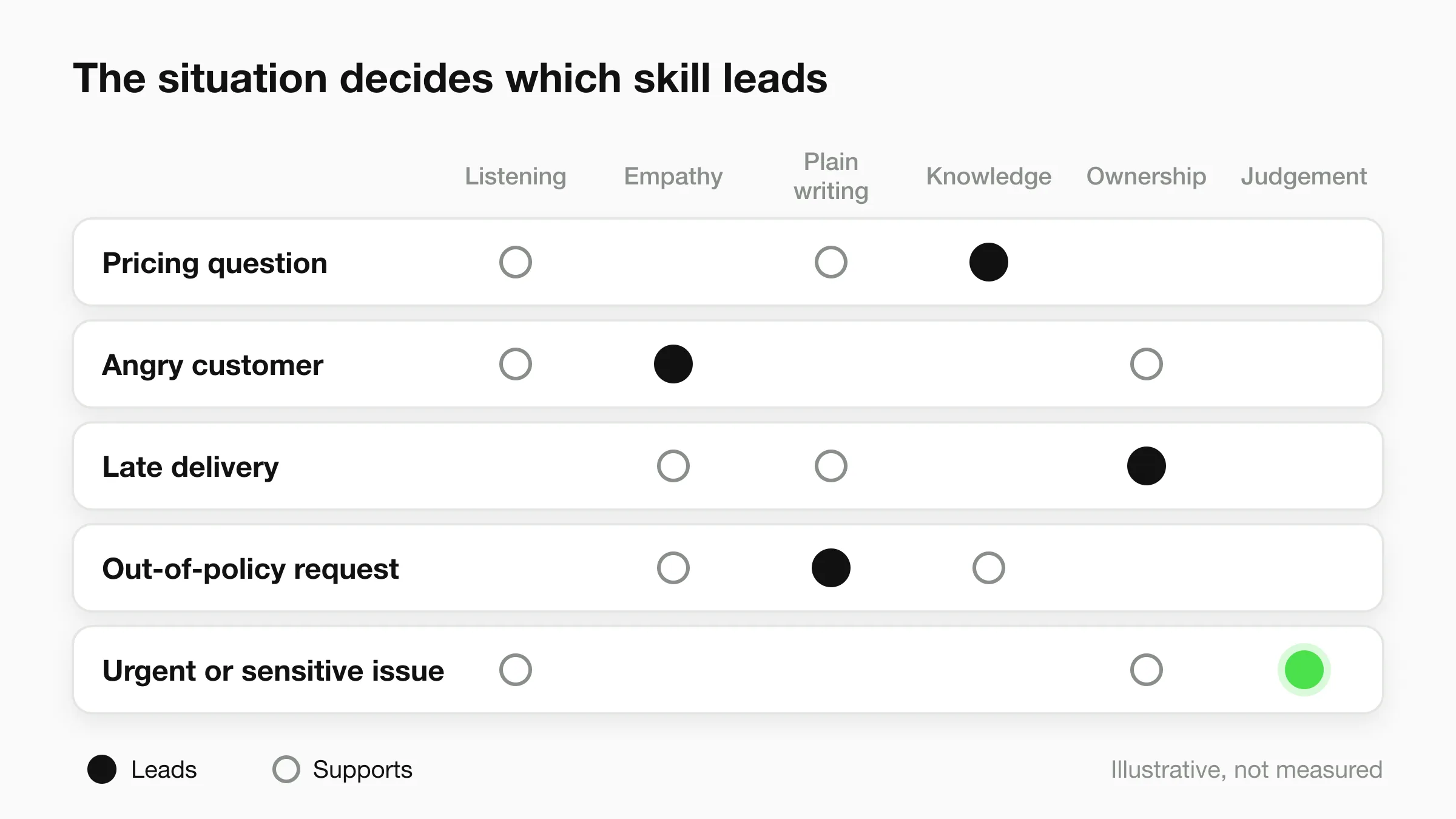
Which skill matters most depends on the situation. A pricing question leans on clear questions and product knowledge. An angry message leans on calm and empathy. An urgent safety issue leans on judgement about who should take over. The matrix below maps five common situations to the skills they lean on hardest.
The 14 customer service skills, with examples
Every example below is illustrative: invented but realistic exchanges meant to show the pattern, not records of real customers.
1. Active listening
Definition: Hearing what the customer said, including the parts that are easy to skip, and proving it before you answer.
Customer: I booked Friday at 3pm, nobody called about the quote, and now I don't know which day the crew is coming.
Weak: Your crew comes Thursday.
Better: Let me check I have this right: you booked Friday at 3pm, you haven't had the quote call, and you're unsure which day the crew arrives. I'll check both now and reply in this chat.
The weak reply answers one of three issues. The better one restates all three, so the customer knows nothing got dropped.
Train it: Adopt a "restate before you answer" rule for any message with more than one question. Each week, read three conversations and mark every question the customer asked that never got answered.
2. Asking clarifying questions
Definition: Asking the one or two questions that turn a vague request into one you can answer well.
Customer: How much for a cleaning?
Weak: It depends.
Better: Happy to price that. Is it a one-bedroom or larger, and is it a one-time clean or recurring?
"It depends" is true and useless. Two specific questions move the conversation forward and also qualify the enquiry for you.
Train it: For your five most common vague questions ("how much", "do you do X", "are you available"), write the two follow-up questions that unlock a real answer. Put them on a one-page sheet. The same list is the backbone of your lead qualification questions.
3. Empathy
Definition: Acknowledging how the situation feels for the customer, then doing something about it. Empathy without action is just politeness.
Customer: My flowers arrived wilted and the party is today.
Weak: Sorry for the inconvenience. Please see our refund policy.
Better: That's a rough thing to happen on the day of the party, and I'm sorry. I'm sending a replacement bouquet today and refunding delivery. Can you send a photo so I can sort this out with the florist?
The better version names the situation in one sentence and spends the rest on the fix. Long apologies read as stalling.
Train it: Teach a two-part formula: one sentence that names the feeling or the stakes, then the action. Practice by rewriting "Sorry for the inconvenience" into a sentence specific to the problem.
4. Staying calm under pressure
Definition: Keeping your tone steady when the customer's isn't, so the conversation can move toward a fix.
Customer: THIS IS THE THIRD TIME I HAVE ASKED. WHERE IS MY ORDER
Weak: Please calm down.
Better: You're right to be frustrated. Three requests is too many. Give me two minutes to find your order and I'll tell you exactly where it is.
"Please calm down" has never calmed anyone. Agreeing with the legitimate part of the complaint takes the heat out.
Train it: Set a pause rule: before replying to an angry message, read it once, find the one real problem inside it, and write only about that. Role-play one heated scenario for ten minutes a week so the first time isn't live.
5. Clear, plain writing
Definition: Writing replies a stressed customer can read once on a phone and understand.
Weak: Per our policy, cancellations within the 24-hour window forfeit the deposit.
Better: If you cancel less than 24 hours before, we keep the deposit. Earlier than that, you get it back.
Short sentences, everyday words, the answer in the first line. If you have to re-read your own reply to check it makes sense, it is too dense.
Train it: Read replies aloud before sending. One idea per sentence. Keep a short list of banned phrases ("per our policy", "as previously stated", "kindly") and swap them for what you'd say to someone standing at your counter. Our customer service response templates show plain versions of common replies.
6. Positive language
Definition: Saying what you can do before what you can't.
Customer: Can you do Sunday?
Weak: We can't do Sunday.
Better: We have Saturday morning or Monday after 8. Which suits you better?
Both replies say the same thing about Sunday. The second one gives the customer a next move.
Train it: Find your top three "we can't" answers. For each, write the "here's what we can do" version and keep it in your shared answers sheet.
7. Product and policy knowledge
Definition: Knowing your hours, prices, services, policies and exceptions well enough to answer without guessing. This is the main hard skill in customer service.
Customer: Are you open late today?
Weak: I think we close at 6?
Better: We're open until 6 today, and the last fitting starts at 5:30.
"I think" teaches the customer to double-check everything you say. The better reply includes the detail they'd have asked about next.
Train it: Keep one maintained answers document: hours, pricing, policies, exceptions, who handles what. Quiz new hires on ten items in their first week. Update it the same day anything changes.
8. Responsiveness and expectation-setting
Definition: Replying quickly when you can, and saying exactly when the customer will hear back when you can't.
Customer: Can you quote a bathroom repaint?
Weak: (no reply for two days)
Better: Got it. I need to see photos to quote accurately. Send two or three and I'll have a number to you by 4pm tomorrow.
An honest deadline beats a fast but empty "we'll get back to you". People forgive waiting when they know how long.
Train it: Write down a response standard per channel (for example: chat the same hour during opening times, email by end of next business day). Review the slowest five replies each week and ask what blocked them. For the cost of slow replies in lead work, see our response time conversion data.
9. Problem solving
Definition: Moving from "what happened" to a workable fix, and offering a fallback if the first fix isn't possible.
Customer: My discount code isn't working.
Weak: Codes expire. Nothing I can do.
Better: That code ended Sunday. I'll apply the same discount to this order so you don't lose out, and I'll let you know when the next one runs.
The weak reply is accurate and ends the conversation. The better one solves the customer's actual problem, which is paying the price they expected.
Train it: Use a "two options" rule: offer a fix and an alternative. Agree in advance what each person may offer without asking (a small credit, a free reschedule).
10. Ownership and follow-through
Definition: Treating the customer's issue as yours until it is resolved, and closing the loop even when the news isn't good.
Customer: Where's my part? It was due Monday.
Weak: I'll pass this to the warehouse.
Better: I'm taking this one. I'll contact the warehouse today and message you by 5pm either way.
"I'll pass this on" hands the customer a new problem: chasing it. A named owner and a time removes it.
Train it: Every open issue gets one named owner and a "next update by" time in a shared sheet or inbox. Review open items every morning. Our small-team inbox shift handoff template covers how to pass open items between people without dropping them.
11. Saying no well
Definition: Declining a request clearly, with the reason in a sentence and an alternative if there is one.
Customer: I want a full refund. It's been two months.
Weak: No, that's outside our policy.
Better: I can't refund orders past our return window, and I know that's not what you hoped to hear. I can offer store credit for the full amount. Would that work?
A "no" that comes with a reason and an offer feels like a decision. A bare "no" feels like a wall.
Train it: List the five requests you decline most often. Write the reason in one plain sentence and the best alternative for each. Decide who may make exceptions, and for what, so the answer doesn't vary by who's on shift.
12. Adapting to the channel and the person
Definition: Matching length, tone and format to where the message arrived and who sent it.
On a website chat or Instagram DM, a three-paragraph reply feels like a form letter. A short reply with one link works better. On email, more detail is expected. Someone writing in a hurry wants the answer first. Someone writing a long, careful message wants a reply that shows you read it.
Customer (chat): Do you ship to Canada?
Weak: Thank you for contacting us regarding our international shipping options. We offer a range of delivery services depending on destination and parcel weight...
Better: Yes, we ship to Canada. Delivery usually takes a week or two, and the exact cost shows at checkout. Want the shipping page link?
Train it: Make a one-page channel cheat sheet: target reply length, greeting style, and what to include for each channel you answer on.
13. Knowing when to hand off
Definition: Recognising the moments when a conversation needs a different person, and handing it over cleanly so the customer doesn't have to repeat themselves.
Customer: I'm worried about a reaction after yesterday's appointment.
Weak: (tries to answer the concern)
Better: I'm bringing in our practice manager now so you get a proper answer today. What's the best number to reach you on?
Health, safety, legal, money disputes and genuinely upset customers belong with a person who has the authority to act. The skill is spotting them early, and saying what happens next.
Train it: Write a short list of handoff triggers (the customer asks for a person, safety or health is mentioned, a complaint repeats for the third time, the answer isn't in your documents). Practice the handoff sentence until it is automatic. Our guide to chatbot-to-human handoff has the full list of triggers and what context should travel with the case.
14. Learning from every conversation
Definition: Turning repeat questions and repeat mistakes into fixes, so the same problem stops coming back.
Every conversation tells you something: a question your website doesn't answer, a policy people misread, a step that confuses them. Teams that never look back answer the same question two hundred times.
Train it: Keep a running list of questions someone had to look up. Anything asked three times goes into your answers document and, where it fits, onto your website. Once a month, ask: what were the top five reasons people wrote to us, and which could be removed by fixing something upstream?
What a good reply looks like: the anatomy
Across all 14 examples, the better replies share a shape. They acknowledge the situation in a sentence, answer or act, state the next step, give a time, and say who owns it. You don't need all five every time. A simple hours question needs only the answer. A complaint needs all five.
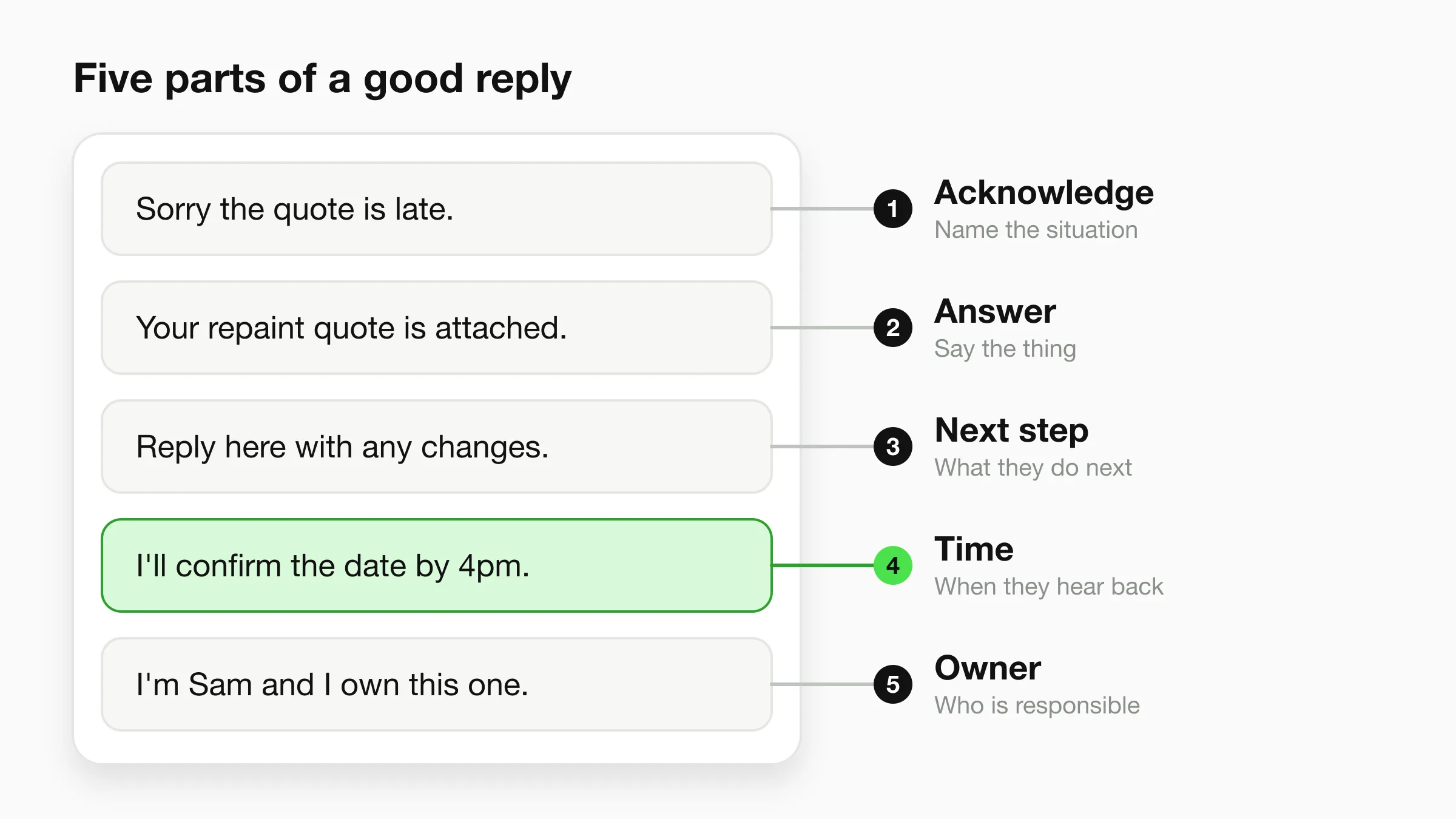
The parts most often missing are the time and the owner. "We'll look into it" has neither. "I'll message you by 5pm" has both.
Soft skills for customer service vs hard skills
Soft skills for customer service are the interpersonal ones: listening, empathy, patience, calm, positive language, and tact when saying no. Hard skills are the measurable, teachable ones: product knowledge, typing speed and writing clarity, using your inbox or booking tool, and following your policies correctly.
Small teams usually over-hire for soft skills and under-train hard ones. A warm person who gives the wrong cancellation policy still produces an unhappy customer. To hire, role-play a tense scenario and watch the response. To train hard skills, use a documented answers sheet, checklists and short quizzes.
Customer service skills for your resume
Pick five skills that match the job and show each one through something you did, because a bare list of adjectives tells a hiring manager nothing. For customer-facing roles at small businesses, the strongest resume skills are active listening, clear written communication, problem solving, product knowledge, and handling difficult conversations.
Write each as an action plus the context:
- Resolved booking and billing questions by chat and email, passing account issues to the owner the same day.
- Wrote a one-page answers sheet for hours, pricing and policies that new staff used in their first week.
- Calmed upset customers by acknowledging the issue first and offering two fix options.
- Tracked open customer issues in a shared sheet with an owner and next-update time for each.
- Rewrote policy replies into plain language so customers could act on them without a follow-up.
Only add numbers you can back up from your own records, such as tickets handled or rating scores you can show. Never invent a figure to make a bullet sound stronger. A specific, honest bullet beats a vague one with a made-up percentage.
How to train customer service skills in a small team
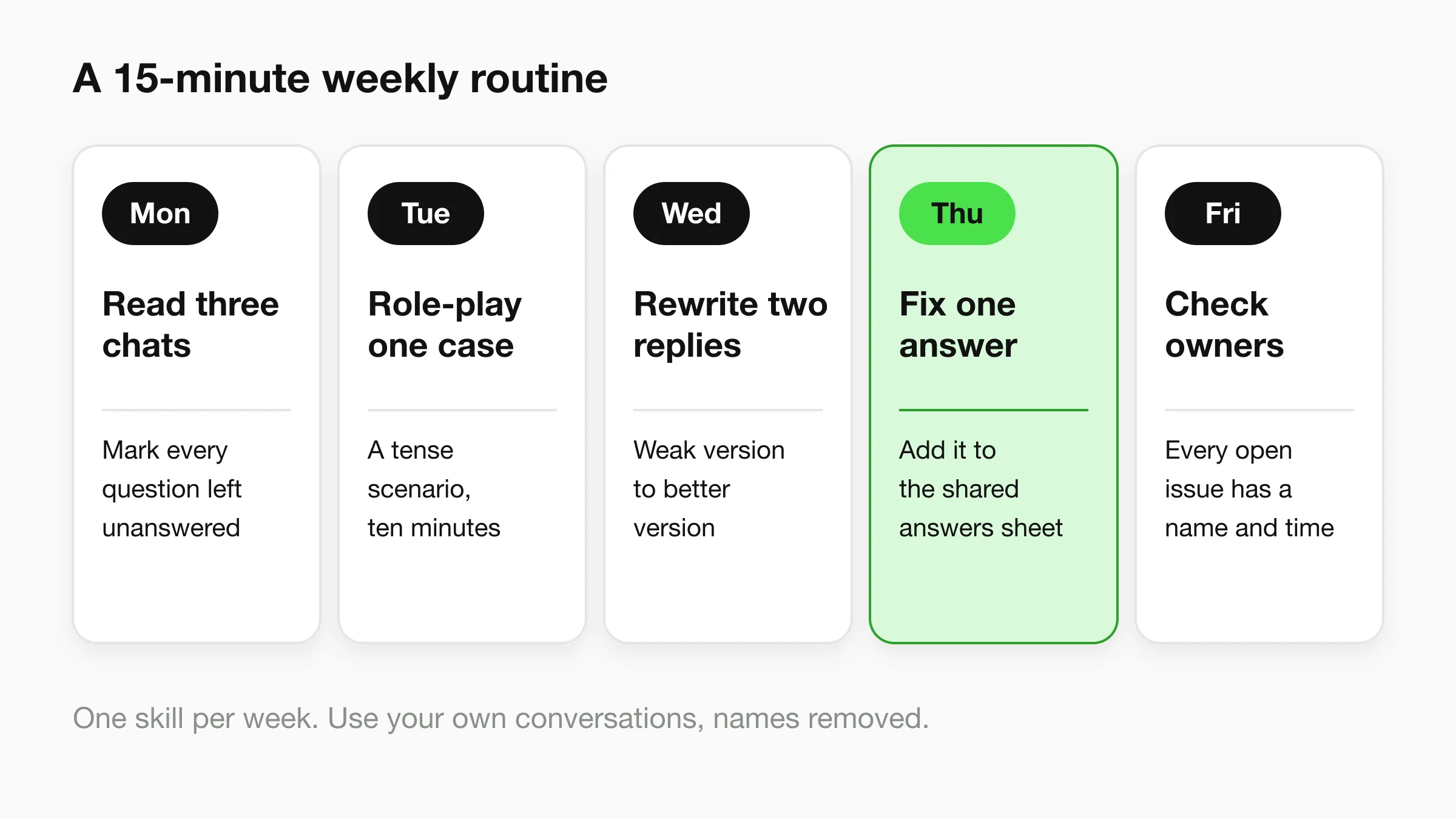
Training works when it is short, regular and based on your own conversations. A two-hour workshop once a year fades within a month. Fifteen minutes a week sticks.
The routine below is built for a team with no trainer. It uses real conversations, one skill at a time.
A few rules make it work:
- Use real conversations, with names removed. Invented scenarios feel like school.
- Review the reply, not the person. Ask what the customer needed and what would have been better.
- One skill per week. Focus beats coverage.
- Write down what you learn. A better answer goes into the answers sheet that day.
Give your team the first answers back
Hyperleap's AI front desk answers repeat questions on your website, WhatsApp, Instagram DM and Facebook Messenger from your own documents, so your people can focus on the conversations that need them. Plans from $40/month, 7-day free trial.
Start for freeWhere an AI front desk fits: first answers by AI, judgement by people
An AI front desk handles the repetitive first answers (hours, pricing ranges, policies, "do you do X") at any hour, from the documents you give it, so your team's skills go to the conversations where judgement matters. It doesn't replace the 14 skills above. It protects your team's time for the ones that need a person.
Here is what that looks like in practice (illustrative exchange on a home-services website, 11:40pm):
Customer: Do you do weekend emergency call-outs, and is there a call-out fee?
AI front desk: We do take weekend emergency calls. The call-out fee is listed on our emergency page: [link]. Can I take your name and a number so the on-call technician can reach you?
Customer: Sure. Actually, it's my elderly dad's house and I'm not sure he's been told about the water damage yet. Can I speak to someone about how to handle that?
AI front desk: Of course. I'm passing this to the team now with our conversation attached, so you won't need to repeat anything. Someone will reply as soon as they're in. Can I confirm the best number to reach you on?
The first answers were routine, so the AI handled them from the business's own documents. The second message needed tact and judgement, so it moved to a person. This is the same skill #13 from above, built into the system: visitors can ask for a person, the team is alerted in Studio, and any teammate can take over the live conversation (including on WhatsApp, Instagram DM and Messenger) and hand it back to the AI afterward.
Two honest limits. Human handoff and live takeover are on the Pro and Max plans, not Plus. And the AI answers from the documents you attach, so the answers sheet from skill #7 becomes its knowledge. The conversation log shows which sources an answer drew on, which feeds skill #14. Teams that run this well still review conversations weekly.
If you are weighing whether AI should be doing any of this, will AI replace customer service covers what it does well and what still needs a person. For the operating habits that keep an AI front desk accurate, see AI customer service best practices. For home-services teams specifically, see our home services AI agents page. If you want the overview of what the product does, start with the AI front desk or the customer support chatbot page, and see pricing for plan details.
Frequently Asked Questions
What are the most important customer service skills?
Active listening, clear communication, empathy, product knowledge, problem solving and ownership matter most in nearly every customer-facing role. The best way to rank them for your business is to read your last ten conversations and see which skill, if stronger, would have changed the outcome most.
What are examples of customer service skills?
Examples include restating a customer's issue before answering, asking one clarifying question, staying calm with an upset customer, writing in plain language, knowing your policies, telling the customer exactly when they'll hear back, and handing off cases that need a manager. Each of the 14 above has a worked example.
What are soft skills for customer service?
Soft skills for customer service are the interpersonal skills: listening, empathy, patience, calm, positive language, tact and adaptability. They sit alongside hard skills such as product knowledge, policy accuracy, and using your inbox or booking tools well.
What customer service skills should I put on my resume?
Choose the five that match the job ad and show each through something you did, such as "Resolved booking questions by chat and email and escalated account issues the same day". Add numbers only if you can back them with your own records.
How do I train a small team in customer service?
Run 15 minutes a week: review three real conversations, role-play one tense scenario, rewrite two weak replies, add any missing answer to your shared answers sheet, and check open issues have an owner. Focus on one skill per week.
Does an AI front desk replace customer service skills?
No. It answers repetitive first questions from your documents so your team has more time for conversations that need empathy and judgement. On Pro and Max, visitors can ask for a person and teammates can take over a live conversation. Your team's skills matter more for those conversations, not less.
Spend your team's skills where they count
Let an AI front desk handle the repeat first answers across your website, WhatsApp, Instagram DM and Facebook Messenger, with a path to a person on Pro and Max. 7-day free trial.
Start for freeIndustry Solutions
See how AI chatbots work for these industries:
Related Articles
View all
Guide18 min read
Customer Self-Service: Options, Examples and Setup
Customer self-service explained for small businesses: seven options compared by cost and effort, how to pick what to automate, and how to measure it.
Guide19 min read
Customer Service Metrics: 13 Defined, 6 to Start With
The customer service metrics that matter for a small business: definitions, formulas, what to track, what to skip, and a simple weekly scorecard.
Guide13 min read
Customer Success vs Customer Support: The Real Difference
Customer success vs customer support: support fixes problems when asked, success prevents them. Compare goals and metrics, and see how small teams do both.
Guide17 min read
Customer Support Channels: 11 Options Compared (2026)
Compare 11 customer support channels by speed, staffing cost and automation, then pick the 2 to 4 that fit where your customers already are.