Guide
What Is Good Customer Service? 9 Traits and a Standard
Good customer service means fast, correct, consistent help from people who own the outcome. Nine traits, how to measure each, and a one-page standard.

Gopi Krishna Lakkepuram · Founder & CEO
· 18 min read
Good customer service is help that arrives quickly, gives the right answer, and is finished by someone who takes responsibility for the result. The customer should not have to chase, repeat themselves, or guess what happens next.
That definition sounds obvious. The hard part is that "good" is usually left as a feeling, so every person on a small team delivers a different version of it. This guide turns the feeling into nine specific traits. Each one has a good-versus-bad example, a cheap way to measure it, and a place in a one-page standard you can adopt this week.
Key Takeaways
- Good service has two halves. The speed and consistency half can be written into a standard and often automated. The judgement and recovery half belongs to people.
- Nine traits cover it: fast first reply, the right answer, the same answer on every channel, an easy route to a human, follow-through, owning mistakes, proactive updates, remembering context, and a clear next step.
- Every trait can be measured with a spreadsheet. You do not need a survey platform.
- A standard fits on one page. Nine promises, nine numbers, one owner per number.
Who this is for
Owners and managers of small teams: clinics, salons, home-service companies, agencies, hotels, online stores. The examples below are illustrative scenarios, not customer case studies.
What Is Good Customer Service?
Good customer service has four parts that customers can feel without ever naming them:
- Speed. Someone acknowledges the request while the customer still cares about it.
- Accuracy. The answer is correct for this customer's situation, not a generic one.
- Ease. Reaching you, and reaching a person when needed, takes little effort.
- Ownership. One person or team stays responsible until the problem is resolved, including when the business caused it.
Excellent customer service is the same four parts, done consistently enough that customers stop expecting trouble. Consistency is the difference. Most businesses can deliver a great interaction on a good day. Good service is what happens on the Friday afternoon when two people are out sick.
Warmth helps, but a warm reply with the wrong answer is still bad service.
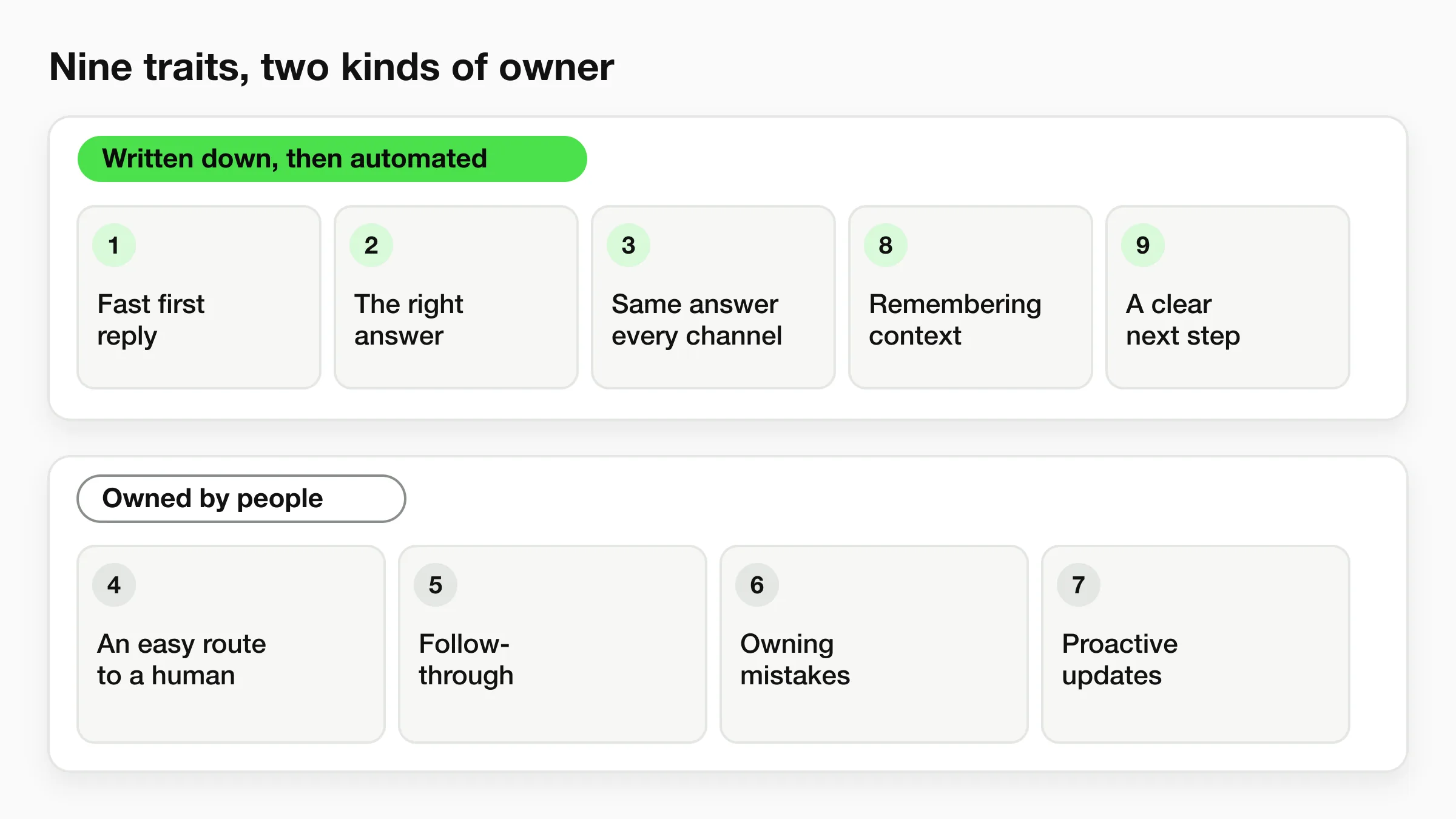
The 9 Characteristics of Good Customer Service
The traits below are ordered roughly the way a customer meets them: first contact, then the answer, then what happens after. For each one you get a good and bad example, a way to measure it, and the line it adds to your standard. For the skills behind each trait, see customer service skills.
1. A fast first reply
What it means: The customer hears back quickly enough to know they were noticed. This is acknowledgement, not necessarily resolution.
Good vs bad (illustrative): A customer messages a dental clinic at 8:40 pm asking if a chipped tooth can be seen tomorrow. Good: a reply within minutes with the first-appointment options and a note that the front desk confirms at 8 am. Bad: silence until 9:15 the next morning, by which time they have booked the practice that answered.
How to measure: Median time from the customer's first message to the first human or AI reply, tracked separately for business hours and after hours. Pull timestamps from your inbox or WhatsApp Business export into a sheet and take the median, not the average, so one forgotten message does not hide the pattern.
Standard line: "First reply within X minutes during hours, and within Y minutes after hours."
Speed matters most where customers are comparing options. For the data, see how slow response times cost businesses sales and response time versus conversion rates across ten industries. This post covers what else good service needs once the first reply is fast.
2. The right answer
What it means: The answer is accurate and specific to the question, and it comes from one agreed source of truth.
Good vs bad (illustrative): A salon is asked, "Do you do balayage on short hair, and how long does it take?" Good: "Yes on bobs and longer. Plan for about three hours, and we'd do a quick consultation first." Bad: "Please call us for pricing and services," which sends the customer away from the answer they came for.
How to measure: Review 20 conversations a month and mark each answer correct, incorrect, or incomplete. The share marked correct is your accuracy rate. Anything marked incorrect becomes a fix to your FAQ or training notes that same week.
Standard line: "Answers come from the current FAQ. Wrong answers are corrected within one week."
Wrong answers usually come from outdated information, not careless people. Keep one maintained document for prices, hours, and policies. For a model, the answer approval register shows how to track who approved each answer.
3. Consistency across channels
What it means: The customer gets the same answer on your website chat, WhatsApp, Instagram DM, Messenger, and the phone.
Good vs bad (illustrative): A home-services company quotes a call-out fee. Good: the fee is the same whether the customer asked on the website or in an Instagram DM. Bad: the owner's DM reply says $60, the website says $75, and the technician says the fee depends. The customer now distrusts all three.
How to measure: Once a quarter, send the same five questions through every channel you offer and compare the answers side by side. Mismatches go on a fix list.
Standard line: "Every channel answers from the same source. We test five questions across channels each quarter."
Customers do not think in channels. They think in "the business," and they notice when two parts of it disagree.
4. An easy route to a human
What it means: The customer can reach a person without a fight, and the person knows what has already been said.
Good vs bad (illustrative): A hotel guest asks about a late check-out for a medical reason. Good: the guest is told a colleague will pick this up, and the front desk sees the conversation so far. Bad: the guest is asked to repeat their name, booking, and reason three times.
How to measure: Count conversations where the customer asked for a person, and how many minutes passed before a person replied. Also count how often the customer had to repeat information.
Standard line: "A person replies to a handoff request within X minutes during hours, and sees the full conversation."
Hiding the human is the most common way to damage an otherwise good setup. See chatbot-to-human handoff best practices for trigger and script design.
5. Follow-through
What it means: When you say "I'll check and come back to you," you come back, on the day you said.
Good vs bad (illustrative): A property manager tells a tenant the leak will be looked at Thursday. Good: a message Thursday morning with the plumber's arrival window. Bad: nothing until the tenant writes again on Friday.
How to measure: Keep a simple log of every promise made to a customer ("call back by Tuesday") with a due date, and mark each kept or missed. Promises kept divided by promises made is the number to watch. Most small teams have never counted it, which is why it surprises them.
Standard line: "Every promise gets a due date and a name. Missed promises are reviewed weekly."
Follow-through is rarely about effort. It is about whether promises live in someone's head or in a shared list.
6. Owning mistakes
What it means: When the business gets it wrong, it says so plainly, fixes it, and does not make the customer prove it.
Good vs bad (illustrative): An online store ships the wrong size. Good: "That was our error. A replacement is on the way today, and you can keep the one you received or return it free." Bad: "Please send photos and your order number so we can investigate," in reply to a mistake the store can see in its own records.
How to measure: Track two things on every complaint: how long until a fix was offered, and whether the fix needed the customer to do extra work. Review the five slowest cases each month.
Standard line: "Staff may fix errors up to $X without approval. We apologise once, plainly, and then fix it."
The pre-approved amount matters most. If every refund needs the owner's sign-off, owning mistakes becomes impossible at 6 pm on a Saturday.
7. Proactive updates
What it means: The customer hears about delays and changes from you before they have to ask.
Good vs bad (illustrative): A photographer's editing is running two days late. Good: a short message on the due date with a new date. Bad: the client sends a polite "just checking in" on day three, then a less polite one on day five.
How to measure: Count "just checking in" and "any update?" messages. Each one is a failed proactive update. The fewer you receive, the better your updates are.
Standard line: "If a promised date will slip, the customer hears from us before the date, with the new one."
This is the cheapest trait to adopt and the one customers praise most, because it removes anxiety rather than adding a feature.
8. Remembering context
What it means: The customer does not have to start over. Previous messages, orders, and preferences are visible to whoever helps next.
Good vs bad (illustrative): A returning dog-grooming client messages, "Same as last time?" Good: the reply names the dog and the usual service. Bad: "Which dog, and what service did you have?"
How to measure: Sample 20 repeat-customer conversations a month and count the times the customer had to restate something already on file.
Standard line: "Notes from every conversation go in one place that every teammate can see."
A shared inbox and a habit of writing two-line notes beat an expensive system nobody updates.
9. A clear next step
What it means: Every conversation ends with the customer knowing what happens next and who is doing it.
Good vs bad (illustrative): A real estate enquiry about a viewing. Good: "Saturday 11 am is held for you. You'll get a confirmation by email, and Priya will message you the morning of." Bad: "Let us know if you have any other questions!"
How to measure: Read the last message of 20 conversations a month. Does it name an action, an owner, and a time? Score each yes or no.
Standard line: "Every conversation ends with a next step, an owner, and a time."
Good Customer Service Examples Side by Side
The table summarises the nine traits as a quick reference. The examples are illustrative scenarios.
| Trait | Good looks like | Bad looks like |
|---|---|---|
| Fast first reply | Reply in minutes, even after hours | Silence until the next morning |
| Right answer | Specific to the question | "Please call for details" |
| Consistent | Same fee on every channel | Three different quotes |
| Human route | Handoff with context | Customer repeats everything |
| Follow-through | Update on the day promised | Customer has to chase |
| Owning mistakes | Plain apology, fast fix | Customer must prove the error |
| Proactive updates | Delay announced before due date | "Any update?" arrives first |
| Remembering context | "Same as last time?" works | "Which service did you have?" |
| Clear next step | Action, owner, time | "Let us know if you have questions" |
How to Measure Good Customer Service Cheaply
You can measure all nine traits with a spreadsheet and about 90 minutes a month; for a wider set of numbers, see customer service metrics. The method:
- Export your conversations. Most inboxes and WhatsApp Business let you export or at least filter by date. Timestamps give you first-reply time.
- Sample 20 conversations. Pick them across channels and days. Score them against the nine traits with yes or no.
- Keep a promise log. One tab, four columns: customer, promise, due date, kept or missed.
- Ask one question after resolution. "Did we solve it? Yes or no." A binary question gets more responses than a five-point scale and tells you what you need to know.
- Review monthly with the whole team. Pick the one trait with the lowest score and fix only that one next month.
First reply and resolution are different numbers
A fast first reply that says "we'll get back to you" is acknowledgement, not service. Track first reply time and time to resolution separately so one cannot hide the other.
A One-Page Customer Service Standard for a Small Team
A standard turns the nine traits into promises a new hire can read in two minutes. Fill in your own numbers. The figures below are placeholders to show the format, not recommended targets.
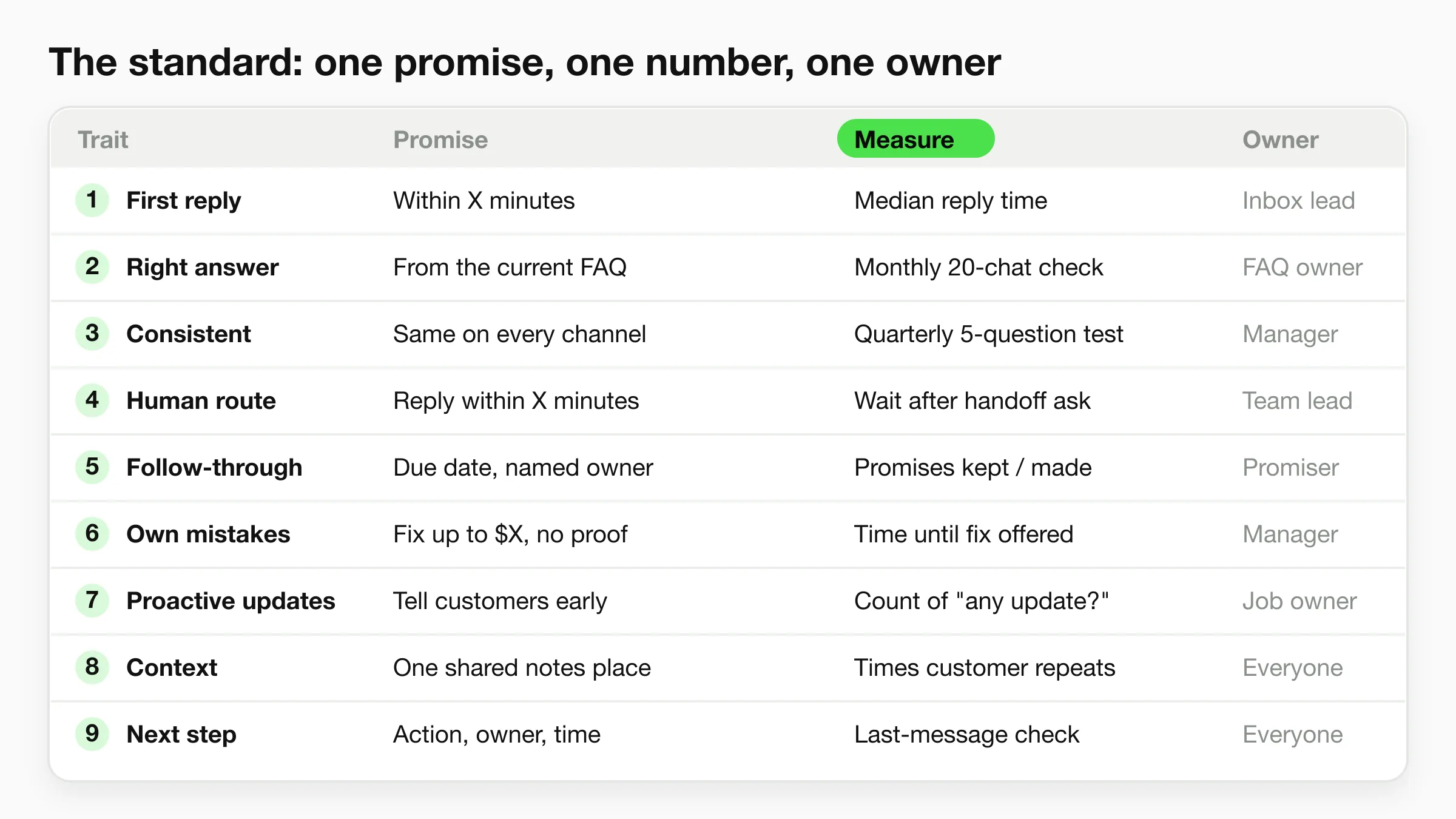
Use this template:
- First reply: within [X] minutes during hours and [Y] minutes after hours. Owner: whoever runs the inbox.
- Answers: from the current FAQ only. Wrong answers fixed within one week. Owner: the person who maintains the FAQ.
- Channels: same answers everywhere, tested quarterly. Owner: manager.
- Handoff: a person replies within [X] minutes of a request and sees the full conversation. Owner: team lead.
- Promises: each has a due date and a name. Owner: whoever made it.
- Mistakes: staff can fix errors up to [$X] without approval. Owner: manager sets the limit.
- Updates: customers hear about slips before the date. Owner: whoever owns the job.
- Context: notes go in one shared place. Owner: everyone.
- Next step: every conversation ends with action, owner, and time. Owner: everyone.
Print it, pin it, and review it monthly. When something goes wrong, check which line was missing or ignored.
Where an AI Front Desk Fits
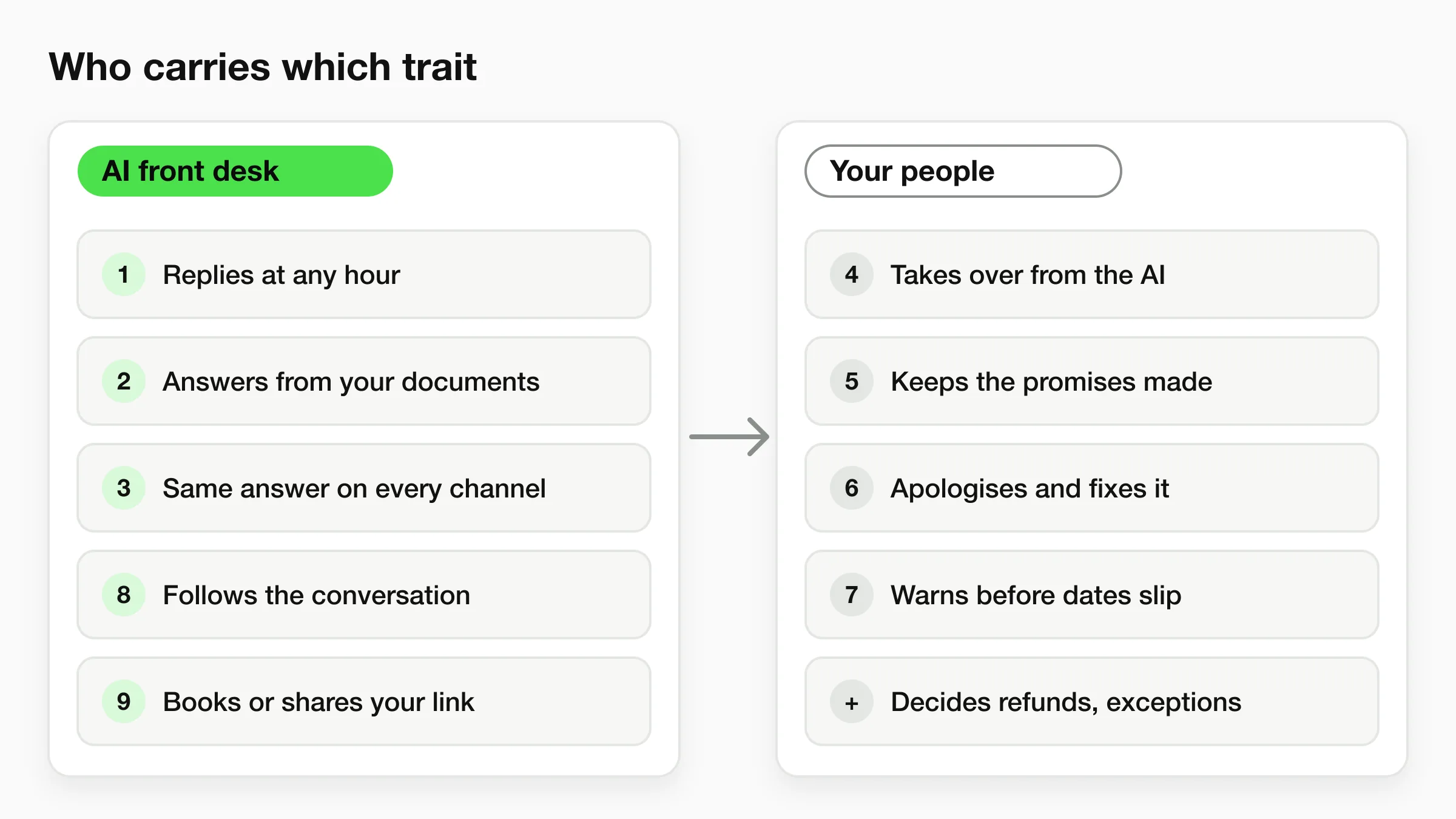
The first three traits and part of the eighth are about speed and consistency. Those are the traits a person struggles to deliver at 8:40 pm or while with another customer. An AI front desk can cover them. The judgement traits, which are owning mistakes, handoff decisions, and follow-through on promises, stay with people.
Here is how that split works with Hyperleap:
- Fast first reply. The agent replies on your website, WhatsApp, Instagram DM, and Facebook Messenger at any hour.
- The right answer. It answers from the documents and pages you upload, so the answer comes from your own information rather than a guess. Keeping those documents current is still your job, and it is the main lever on accuracy.
- Consistency across channels. One agent and one knowledge base serve all four channels, so the call-out fee is the same wherever the customer asks.
- A route to a human. On Pro and Max, visitors can ask for a person, your team is alerted, and a teammate can take over the live conversation and hand it back to the AI.
- Remembering context. Within a conversation, the agent follows what the customer already said. Your team sees the conversation in one inbox.
- A clear next step. On Pro and Max, the agent can book through Calendly or Cal.com so the conversation ends with a held time. On Plus it shares your booking link. In-chat booking needs Calendly Standard or higher.
What the AI should not own: apologising for a mistake, deciding on a refund, calling a customer back, or handling an upset customer. Set the agent to hand those off. The test of a good setup is that people spend their time on exactly the cases that need judgement.
For the operating rules behind this setup, see AI customer service best practices, which covers disclosure, escalation design, and weekly log review. For what customers now expect from messaging, including channel norms, read what SMB customers expect from messaging in 2026. If you are weighing a support bot, the customer support chatbot page shows what Hyperleap does and does not do.
Cover the speed traits without hiring night staff
Hyperleap AI answers on your website, WhatsApp, Instagram DM, and Facebook Messenger from your own documents. Plans start at $40/month with a 7-day free trial.
Start for freeIndustry Notes: What Good Looks Like in Practice
The nine traits apply everywhere, but the weight changes by business.
Dental and medical practices. Handoff and owning mistakes matter most. Patients with a pain or a worry expect a person quickly. An AI can answer hours, new-patient steps, and insurance-acceptance questions you have documented, and should route anything clinical to staff. See dental agents.
Home services. First reply speed and proactive updates dominate. A customer with a leak is messaging several companies. The one that answers and gives an arrival window wins. See home services agents.
Salons and beauty. Staff are hands-busy most of the day, so the first-reply trait is hard to meet manually. Booking in the conversation closes the loop. See beauty agents.
Common Mistakes When Trying to Improve Customer Service
- Training on tone before fixing answers. A friendly wrong answer is worse than a plain right one.
- Setting targets nobody owns. Every line in the standard needs a named person.
- Hiding the route to a human. It saves minutes and costs customers.
- Adding automation before writing the standard. Automate a clear standard, not a vague hope.
Start With One Page
Good customer service is not a mystery and not a budget item. It is nine traits, each with a promise and a number. Write the standard, measure it for a month, and fix the weakest line. Then decide where software can carry the speed and consistency load so your people can carry the judgement.
Put the standard to work
Set up an AI front desk that handles the first reply and routine questions, and hands everything else to your team. 7-day free trial; see pricing for plan details.
Start for freeFor plan details, see Hyperleap pricing. To plan what to automate first, read the customer service automation guide.
Frequently Asked Questions
What is good customer service in simple terms?
Good customer service is getting a fast, correct answer from someone who takes responsibility until the problem is solved. The customer does not chase, repeat themselves, or wonder what happens next.
What are the characteristics of good customer service?
The nine in this guide are a fast first reply, the right answer, consistency across channels, an easy route to a human, follow-through, owning mistakes, proactive updates, remembering context, and a clear next step.
What is an example of excellent customer service?
A customer messages at night about a damaged item. They get a reply within minutes, a plain apology the next morning, a replacement shipped that day, and a message when it is delivered. Nothing required them to prove the error or ask for an update.
How do you measure customer service quality?
Track first reply time, the share of correct answers from a 20-conversation monthly sample, promises kept versus made, and a one-question "did we solve it?" survey. A spreadsheet is enough for a small team.
Can an AI chatbot provide good customer service?
It can deliver the speed and consistency traits: fast first replies, answers from your own documents, and the same answer on every channel. It should hand off complaints, refunds, and sensitive cases to a person. Hyperleap's human handoff is available on Pro and Max.
What is the most important trait of good customer service?
It depends on the business, but ownership underlies the rest. Without someone responsible for the outcome, fast replies and correct answers still leave customers stuck when something goes wrong.
How long should a customer service reply take?
There is no single right number. Set a target for business hours and another for after hours based on how quickly your customers compare alternatives, then measure the median against it. The response time and conversion rates guide has industry context.
Industry Solutions
See how AI chatbots work for these industries:
Related Articles
View all
Guide16 min read
How to Improve Customer Satisfaction: 15 Tactics
Satisfaction rises when replies are fast, answers are right, effort is low, and problems get fixed fairly. 15 tactics, a CSAT survey and a 30-day plan.
Guide17 min read
Proactive Customer Service: 12 Examples for Small Business
Proactive customer service means answering before customers ask. See 12 examples with the channel and owner for each, plus how to measure it.
Guide17 min read
AI Receptionist for Restaurants: Chat-First Guide
An AI receptionist for restaurants answers menu and hours questions, qualifies reservation and private-dining requests, and shares your reservation link 24/7.
Guide20 min read
Event Planning AI Front Desk for Lead Qualification
An event planning AI front desk can collect date, venue, guest count, scope, budget, and decision timing before a planner follows up.