Guide
How to Improve Customer Satisfaction: 15 Tactics
Satisfaction rises when replies are fast, answers are right, effort is low, and problems get fixed fairly. 15 tactics, a CSAT survey and a 30-day plan.

Gopi Krishna Lakkepuram · Founder & CEO
· 16 min read
TL;DR: To improve customer satisfaction, work on six things customers feel directly: how fast you reply, whether the answer is right, how much effort they spend, whether you seem to care, whether you do what you said, and how fairly you fix mistakes. Pick one tactic per driver, measure with a single-question CSAT survey, and review the results weekly. The 15 tactics below each end with something you can do this week.
Most advice on how to improve customer satisfaction starts with surveys or loyalty programs. Customers rarely rate you on either. They rate the last time they needed something from you. Did they hear back quickly, get a correct answer, and not have to chase?
That is good news for a small business. Every driver in this guide is something a team of three can change within a month, without new software.
What actually drives customer satisfaction
Customer satisfaction is the gap between what a customer expected and what they got. Researchers have studied that gap for decades. The best-known academic instrument, SERVQUAL, scores service quality on five dimensions: reliability, responsiveness, assurance, empathy and tangibles (SERVQUAL overview). Three of those (reliability, responsiveness, empathy) show up in every practical framework.
Practical work on support adds two more. A well-known Harvard Business Review article argues that companies get more loyalty from reducing customer effort than from trying to delight. And the research on service failures says that how you handle a mistake matters as much as whether it happened.
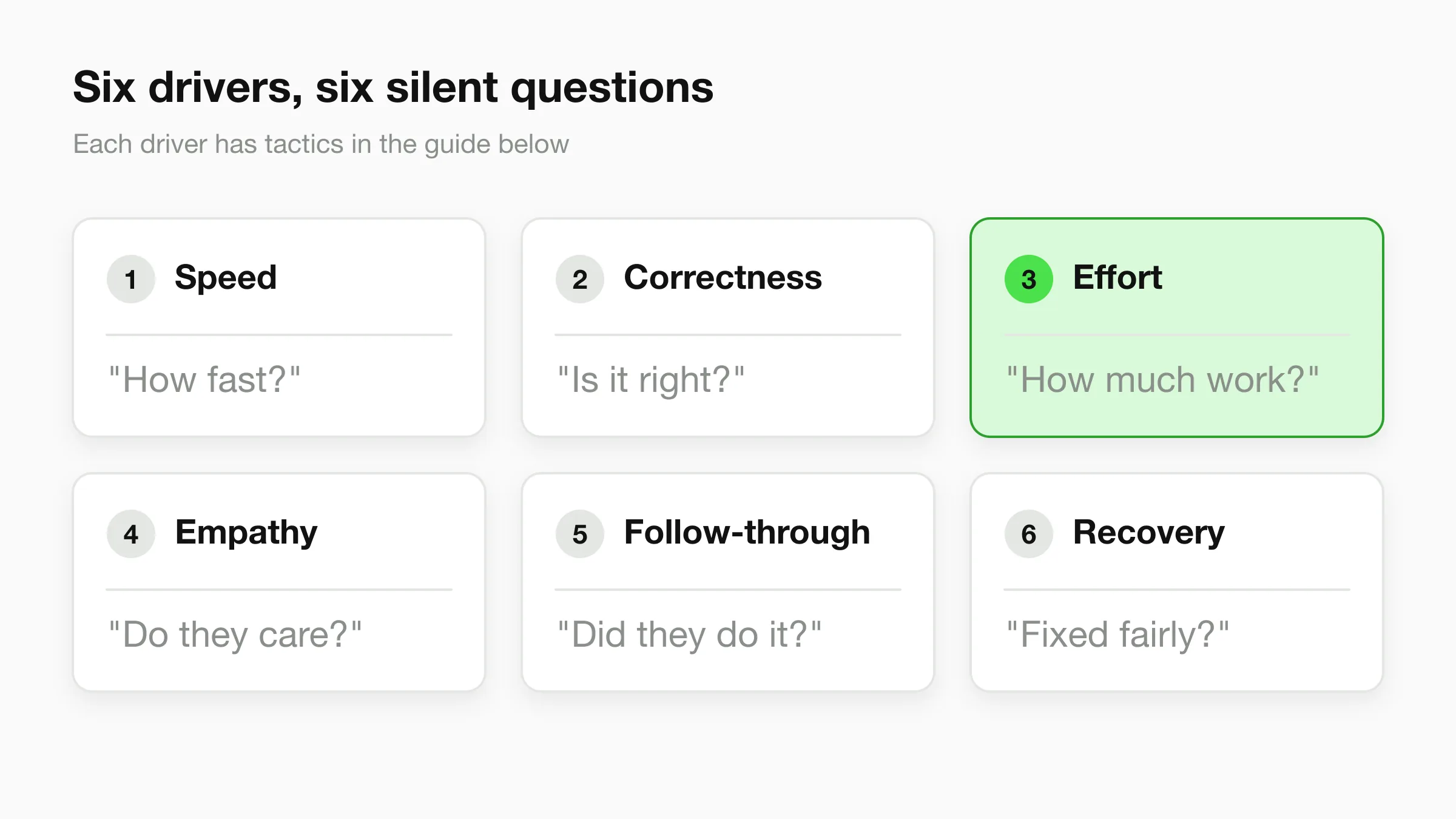
Put together, six drivers are worth managing:
- Speed: how long until a person gets a first useful reply.
- Correctness: whether the answer is right and consistent.
- Effort: how much work the customer does to get it.
- Empathy: whether they feel understood.
- Follow-through: whether you do what you said you would.
- Recovery: how fairly you fix things when you get it wrong.
The business case is simple. Harvard Business Review notes that acquiring a new customer is five to 25 times more expensive than keeping an existing one, depending on the study and industry. Satisfaction is how you keep them.
This guide is about the levers you control. For the operating side of AI in support, see AI customer service best practices. For the cost of waiting, see how slow response times cost your business.
15 ways to improve customer satisfaction, grouped by driver
Each tactic below has a "This week" action. Do the actions in order if you are starting from zero, or jump to the driver where your complaints cluster.
Speed: reply while the customer is still paying attention
1. Promise a first-reply time and publish it. A stated promise beats an unspoken one, because customers judge you against what they were told. Pick a number your team can hit on a bad day, such as "within 2 hours on business days," and put it on the contact page and in your auto-reply.
This week: write the promise in one sentence and add it to your contact page and email signature.
2. Cover the hours nobody is working. Customers write in the evening and on weekends, when your team is off. If the first reply lands the next morning, the customer has already compared you with someone who answered. Our deeper look at response time and conversion by industry shows how much this varies by sector.
This week: open your last 30 messages and count how many arrived outside staffed hours. If it is more than a handful, decide who or what answers them.
3. Acknowledge first, resolve second. Not every question can be answered in a minute. A reply that says "we have it, and you will hear from us by Thursday noon" is far better than silence. It turns an open-ended wait into a defined one.
This week: write an acknowledgment template that always includes a specific time. Never "soon."
Correctness: one right answer, every time
4. Write the top 20 questions once, with one approved answer each. Inconsistent answers cause more irritation than slow ones. If two team members give different answers on refund timing, one customer will eventually hear both. Pull the 20 most common questions from your inbox and write one answer for each.
This week: export the last month of messages, tag the repeated questions, and write the first 10 answers in a shared document.
5. Fix the source, not the single reply. When someone gives a wrong answer, correcting that message fixes one customer. Correcting the document the answer came from fixes the next fifty. Keep a short "wrong answers" list and update the source the same day.
This week: start the list. Every time a customer says "that is not what I was told," add a line with the source that needs changing.
6. Say "I don't know" fast, and route it. A guess that turns out wrong costs more satisfaction than an honest handoff. Decide in advance which topics always go to a person, such as price exceptions, refunds, safety, medical or legal questions. Tell the customer who will reply and when.
This week: list three topics that must never be guessed at, and name the person who owns each.
Effort: make it easy to get what they came for
7. Never make a customer repeat themselves. Few things frustrate customers more than explaining the problem again after a handoff. When one person passes a case to another, write a three-line note covering who the customer is, what they asked, and what has been tried.
This week: create a handoff note template with those three lines and use it for every transfer.
8. Reply where they wrote. If someone messaged your Instagram, answer on Instagram, not by asking them to email. Moving a customer to another channel adds a step they did not choose. Keep one owner per channel so nothing sits unanswered.
This week: list every place customers contact you and assign one named owner to each.
9. Remove the steps behind your top three requests. Look for the questions people ask again and again: opening hours, booking, order or job status, how to return something. Each one can usually be a direct link, a short form or a ready answer.
This week: find your three most repeated requests and add a direct link or ready answer for each, in your auto-reply or on the page customers land on.
Empathy: show you understood before you solve
10. Name the problem in the customer's words first. "That sounds frustrating, the delivery arrived damaged and you have a party on Saturday" lands better than "Sorry for the inconvenience." Specific beats scripted. It proves you read the message.
This week: write three opening lines for your most common complaints, using the customer's own details as placeholders.
11. Match the tone to the stakes. A routine question deserves a short, warm answer. A frightened or angry customer deserves a slower, human one. A fast cheerful reply to someone who is upset reads as not listening.
This week: decide what counts as an "upset" message in your business (words like "unacceptable," a second complaint, a large order at risk) and make sure those go to a person.
Follow-through: do what you said you would
12. Treat every promise as a task with a date. "I'll check with the team" is a promise. If it lives only in someone's head, it fails on the first busy day. Keep a simple list of open promises with the due date and owner.
This week: start a shared list. Review it at the start and end of each working day.
13. Check back after the fix. One line, a day or two later, such as "Did the replacement arrive and work properly?", catches problems you would otherwise hear about in a review. It also shows that the case mattered to you after it left your queue.
This week: message the last five customers whose issues you resolved, and see what you learn.
Recovery: fix mistakes fairly
Every business gets things wrong. Researchers have long noted a "service recovery paradox," where a customer rates a company more highly after a good fix than if nothing had gone wrong. The evidence for it is mixed, though. Reviews describe it as rare and not reliable, and it does not hold when failures repeat (overview of the evidence). So treat a good recovery as a way to limit the damage, not as a trick to win customers.
14. Apologise, fix, and make it right in proportion. A fair response has three parts: a plain apology, the fix, and something proportionate for the trouble caused. Decide the "make it right" allowance in advance, so staff do not need approval every time.
This week: agree an allowance per team member, such as a refund up to a set amount or a free service, and write down when to escalate beyond it.
15. Turn every complaint into one change. A complaint that only gets a reply will repeat. Review the week's complaints together and pick one thing to change in a process, a document or a message.
This week: put a 20-minute review in the calendar for Friday and bring the week's complaints.
A service recovery script you can copy
Use this structure when something has gone wrong. Adapt the words, but keep the order.
1. Acknowledge: "I'm sorry, [specific problem] should not have happened, and I can see why it was frustrating."
2. Own it: "That was our mistake" (only when it was).
3. Fix it now: "Here is what I'm doing right now: [action]. You will have it by [time]."
4. Make it right: "To make up for the trouble, I've [refund, credit, free extra]."
5. Close the loop: "I'll check in on [day] to make sure it worked."
Skip the long explanation of why it happened unless the customer asks. They want it fixed first.
One driver at a time
Do not roll out all 15 tactics at once. Pick the driver your complaints and low scores point to, apply its tactics for two weeks, then re-measure.
How to measure customer satisfaction
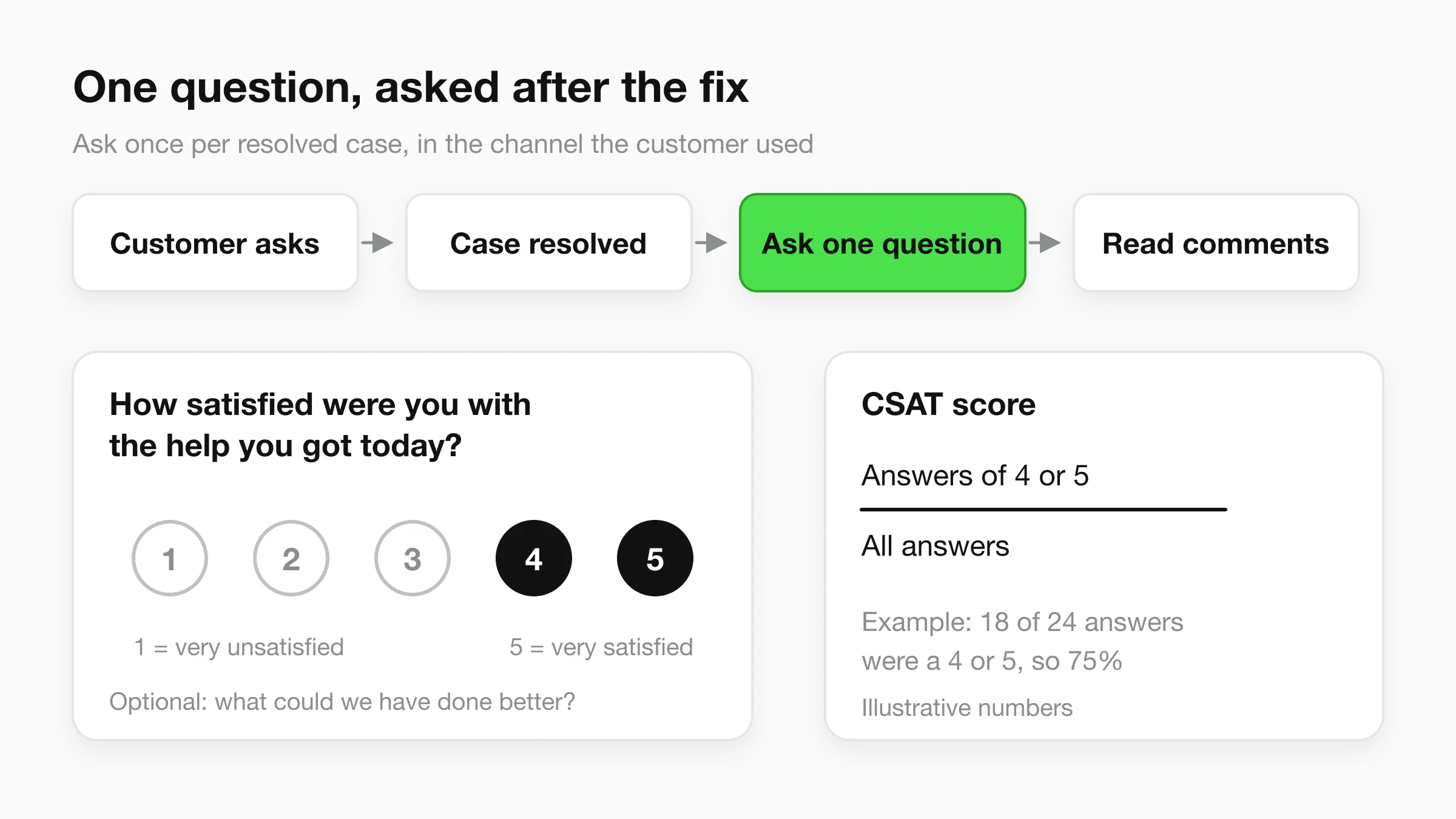
The most common measure is CSAT, the customer satisfaction score. You ask customers how satisfied they were with a specific interaction and report the share who chose a positive answer. The usual convention is a 1 to 5 scale where answers of 4 or 5 count as satisfied, so CSAT is the number of 4s and 5s divided by all responses.
Write one simple question
Keep the question about one interaction, and keep the wording plain:
- Rating question: "How satisfied were you with the help you got today?" (1 = very unsatisfied, 5 = very satisfied)
- Optional follow-up: "What is one thing we could have done better?"
Research summaries find that a single overall satisfaction question performs about as well as multi-item scales in most commercial settings, which is why one question is enough (customer satisfaction overview). Long surveys mostly reduce the number of people who finish them.
Ask at the right moment
- Ask after resolution, not after the first reply. A customer whose issue is still open will rate the wait, not the outcome.
- Ask in the channel they used. A one-line message or link in the same thread beats a separate email later.
- Ask once per case. Do not survey the same customer after every message.
- Skip cases that are still open or escalated. Follow those up personally instead.
Read the score with care
Satisfaction surveys have known weaknesses. Mood at the time of answering and social desirability bias affect results, and response rates are often low, so a score can reflect only the customers who chose to reply (same overview).
For a small business that has practical consequences:
- Do not chase small movements. With a few dozen responses, one unhappy customer shifts the score noticeably. Look at the trend over a month.
- Read every comment. At your volume, comments carry more information than the number.
- Tag each low score by driver. Was it speed, a wrong answer, effort, tone, a broken promise or a poor fix? The tag tells you which of the 15 tactics to work on.
Where an AI front desk fits in
An AI front desk helps with three of the six drivers: speed, correctness and consistency. It does not replace empathy or recovery, which need a person.
Hyperleap AI is an AI agent for small businesses that answers customer questions on your website, WhatsApp, Instagram DM and Facebook Messenger. Here is how it maps to the drivers:
- Speed: it replies in seconds on all four channels, including when nobody on your team is working. That covers tactic 2 without hiring night staff.
- Correctness: it answers from the documents and pages you give it, using your own knowledge base, rather than from general knowledge. The conversation log shows which of your sources an answer drew on, so you can find and fix the document behind a wrong answer. That is tactic 5 in practice. Answers are only as good as the documents behind them, so tactic 4 still comes first.
- Consistency: every customer gets the same approved answer, whichever channel they write on and whichever hour it is.
- Easy path to a person: on Pro and Max, visitors can ask for a human, your team is alerted in Studio, and any teammate can take over a live conversation, including on WhatsApp, Instagram and Messenger, then hand it back. On Plus, set the fallback message to tell customers how to reach your team. Handoff is a Pro and Max feature (see pricing).
Plan the person part first. Decide who takes over, which topics always go to them and how fast, using tactics 6 and 7. Our guide on AI customer service best practices covers escalation design in more detail, and the AI front desk page shows the full set of capabilities.
Two examples of where this pays off:
- A dental practice: most questions are about hours, insurance and new-patient forms, and patients ask them in the evening. Instant, consistent answers cover tactics 2 and 4, and the team handles anything clinical personally. See dental agents.
- A home-services company: customers want a quote or a time window while the crew is on a job. A prompt first reply and a clean summary for the office cover tactics 1 and 7. See home-services agents.
Customers also expect fast answers on the channels they already use. Our look at what SMB customers expect from messaging in 2026 goes through those expectations.
A 30-day plan for a small team
You do not need a project team for this. Four weeks, one owner, about an hour a day at most.
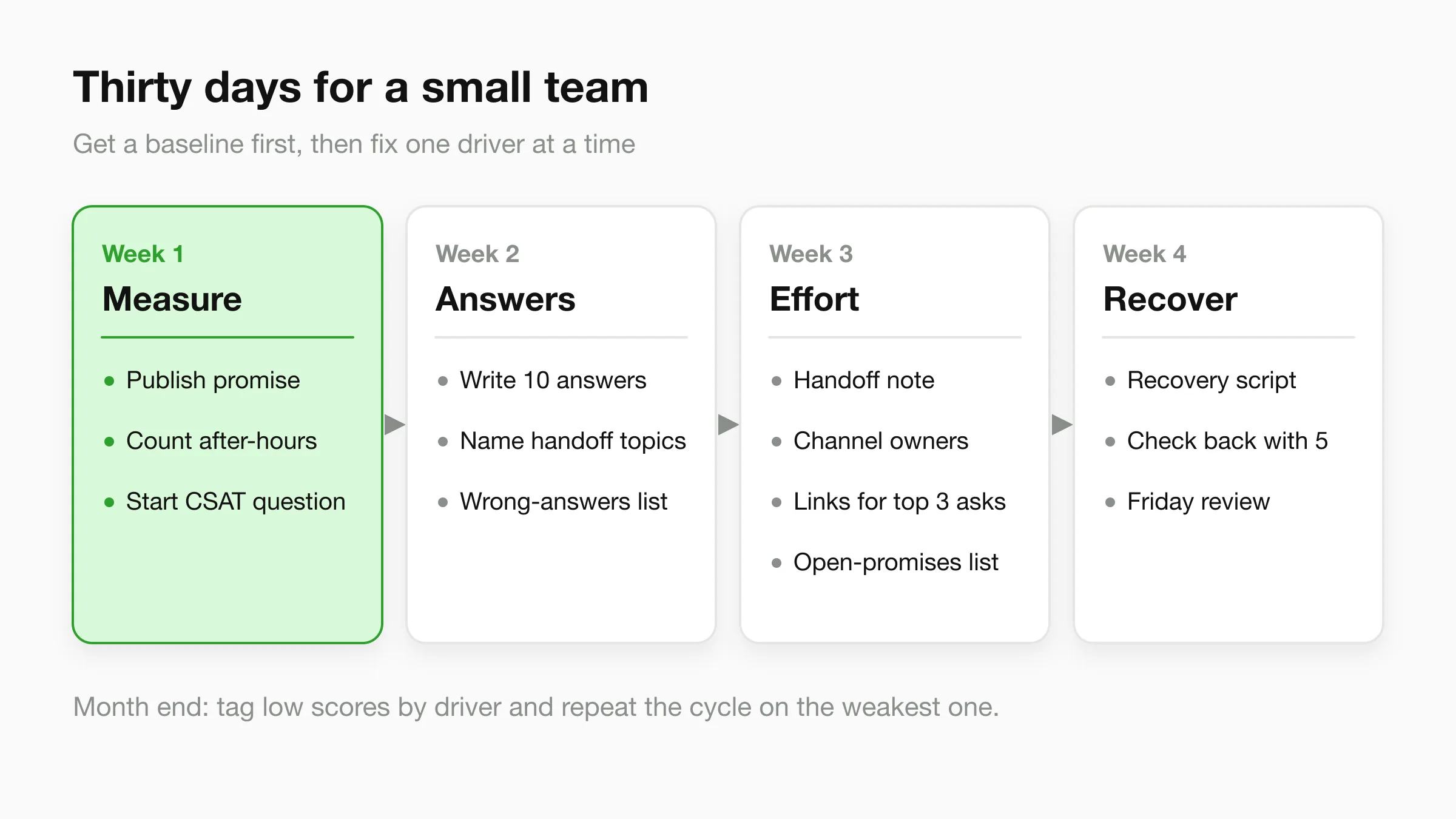
Week 1: Measure and promise. Publish your first-reply promise (tactic 1). Count after-hours messages (tactic 2). Start the one-question CSAT survey after resolved cases. Nothing else yet. You need a baseline.
Week 2: Answers and routing. Write the first 10 approved answers (tactic 4). Name the topics that always go to a person and their owners (tactic 6). Start the wrong-answers list (tactic 5).
Week 3: Effort and follow-through. Add the handoff note (tactic 7), assign channel owners (tactic 8), and add direct links for your top three requests (tactic 9). Start the open-promises list (tactic 12).
Week 4: Recovery and review. Agree the make-it-right allowance and the recovery script (tactic 14). Check back with five resolved customers (tactic 13). Run your first Friday review (tactic 15). Compare your CSAT with week 1 and read every comment.
At the end of the month, pick the weakest driver from your tagged low scores and repeat the cycle on it.
Answer customers in seconds, on every channel
Hyperleap AI answers from your own documents on your website, WhatsApp, Instagram DM and Facebook Messenger, and hands off to your team on Pro and Max.
Start for freeFrequently Asked Questions
What is the fastest way to improve customer satisfaction?
Reply faster and make your answers consistent. A published first-reply promise, coverage for the hours nobody is working, and one approved answer for each of your 20 most common questions can change how customers feel within weeks, without new tools.
How do you measure customer satisfaction?
Most businesses use CSAT: ask one question about a specific interaction on a 1 to 5 scale, and report the share of 4 and 5 answers. Ask after the case is resolved, in the channel the customer used, and add one optional comment box.
What is a good CSAT score?
It depends on your industry, channel and how you survey, so compare against your own trend first. Treat published benchmarks with caution because survey design changes scores. A steady rise over several months, with comments that agree, is a better signal than any single number.
How can a small business improve customer satisfaction on a small budget?
Most of the 15 tactics cost time, not money: written answers, a handoff note, a promise list, a weekly 20-minute review. Add software only when volume or after-hours demand makes manual replies the bottleneck.
Does AI improve customer satisfaction?
It can improve speed and consistency, because it replies in seconds at any hour and answers from the same documents every time. It does not replace a person for upset customers or judgment calls. Set up a clear route to your team, and keep the documents it answers from accurate.
How do you recover from a bad customer experience?
Apologise specifically, fix the problem, make it right in proportion, and check back. Decide your allowance in advance so staff can act quickly. Then change the process behind the complaint so it does not repeat.
How often should you ask customers for feedback?
Once per resolved case, not after every message. Reviewing results weekly and trends monthly is enough for a small team.
Put a front desk on your website today
Paste your site URL, add your documents and go live in under 5 minutes. Plans start at $40/mo with a 7-day free trial.
Start for freeIndustry Solutions
See how AI chatbots work for these industries:
Related Articles
View all
Guide18 min read
What Is Good Customer Service? 9 Traits and a Standard
Good customer service means fast, correct, consistent help from people who own the outcome. Nine traits, how to measure each, and a one-page standard.
Guide17 min read
Proactive Customer Service: 12 Examples for Small Business
Proactive customer service means answering before customers ask. See 12 examples with the channel and owner for each, plus how to measure it.
Guide17 min read
AI Receptionist for Restaurants: Chat-First Guide
An AI receptionist for restaurants answers menu and hours questions, qualifies reservation and private-dining requests, and shares your reservation link 24/7.
Guide20 min read
Event Planning AI Front Desk for Lead Qualification
An event planning AI front desk can collect date, venue, guest count, scope, budget, and decision timing before a planner follows up.