Comparison
Best AI Customer Support Software in 2026 (10 Tools)
10 AI customer support tools compared for 2026: pricing models, real costs, and fit for small teams, help desks, and enterprises.

Gopi Krishna Lakkepuram · Founder & CEO
· 17 min read
TL;DR: The right AI customer support software depends on where your support already lives. Small businesses answering customers on their website, WhatsApp, Instagram, and Messenger do well with an AI front desk such as Hyperleap AI, Tidio Lyro, or Chatbase. Teams that already run a help desk should look at the AI add-on from that vendor: Intercom Fin, Zendesk AI agents, Freshdesk Freddy, or Gorgias AI Agent. Large companies with email, voice, and compliance needs shortlist Decagon, Sierra, or Ada, all of which sell through a demo.
Last Updated: November 2026
Pricing and product names in this guide were checked on each vendor's public site in November 2026. Vendors change plans often, so confirm current numbers before you buy.
Quick picker: which tool fits which need
| If you need… | Start with |
|---|---|
| AI answers on Website, WhatsApp, Instagram DM, and Messenger from one flat plan | Hyperleap AI |
| An AI agent that goes live from your website content in minutes, with human handoff when needed | Hyperleap AI |
| A live chat tool for a small store, with an AI add-on you pay for by conversation | Tidio (Lyro) |
| A single knowledge-base bot with voice and telephony included | Chatbase |
| AI that resolves tickets inside a help desk you already pay for | Intercom Fin, Zendesk, Freshdesk, or Gorgias |
| Email, voice, and strict compliance across a large support organization | Decagon, Sierra, or Ada |
If you are not sure which bucket you fall into, start with Hyperleap: it covers the most common small business setup, and the 7-day free trial lets you test it on your real questions.
What AI customer support software does in 2026
AI customer support software answers customer questions automatically, using your own help content, and hands the conversation to a person when it should. The better tools also take actions, such as looking up an order or booking an appointment, instead of only quoting articles.
Three product shapes sit under that one label, and mixing them up is the most common buying mistake.
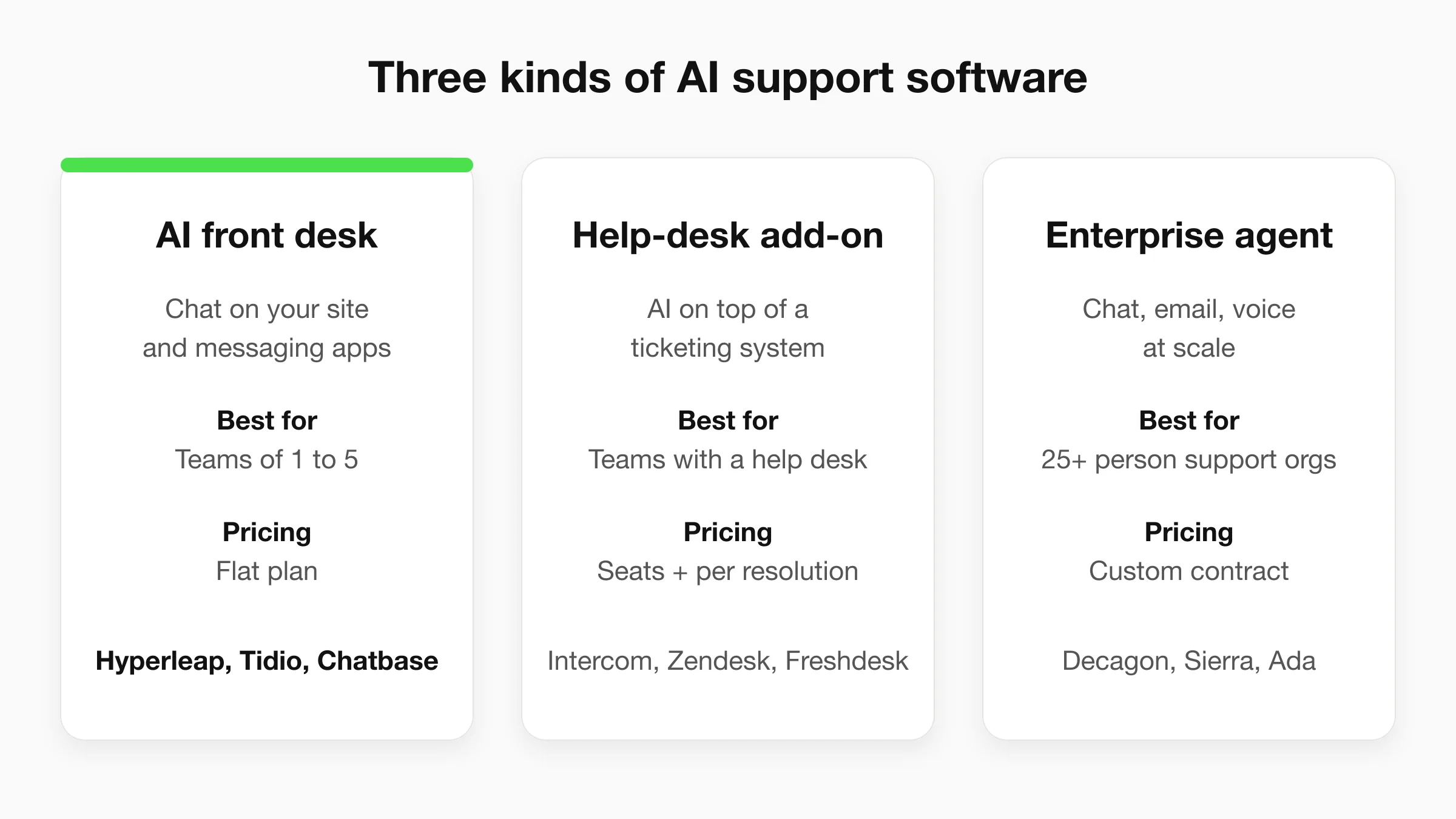
- AI front desk. A standalone AI agent that sits in front of your customers on your website and messaging apps. It does not need a ticketing system. Built for small teams.
- Help-desk AI add-on. An AI agent sold on top of a ticketing platform. It resolves what it can and passes the rest to your agents as tickets. Built for teams that already live in a help desk.
- Enterprise AI agent. A custom-deployed agent across chat, email, and voice, sold through a sales process. Built for large support organizations.
Quick comparison table
| Tool | Type | Pricing model | Public price |
|---|---|---|---|
| Hyperleap AI | AI front desk | Flat monthly plan, AI responses included | From $40/mo |
| Tidio (Lyro) | AI front desk + live chat | Plan + Lyro conversation tiers | Lyro from $32.50/mo (50 conversations) |
| Chatbase | AI front desk | Plan with message credits | From $120/mo (billed yearly) |
| Intercom Fin | Help-desk add-on | Per outcome, plus seats | $0.99 per outcome |
| Zendesk AI agents | Help-desk add-on | Per automated resolution, plus seats | $2.00 pay-as-you-go |
| Freshdesk Freddy | Help-desk add-on | Per session, plus seats | $49 per 100 extra sessions |
| Gorgias AI Agent | Help-desk add-on | Per automated interaction, plus tickets | $0.90 to $1.00 per interaction |
| Decagon | Enterprise AI agent | Not published | Custom pricing |
| Sierra | Enterprise AI agent | Outcome-based | Custom pricing |
| Ada | Enterprise AI agent | Not published | Custom pricing |
The 10 best AI customer support tools in 2026
1. Hyperleap AI: best for small businesses that want a flat price
Hyperleap AI is an AI front desk for small businesses. You paste your website URL, it reads your content and builds a starting agent, and you add the one-line embed to your site. Hyperleap also answers on WhatsApp, Instagram DM, and Facebook Messenger from the same agent, and every conversation lands in one inbox in Studio. Hyperleap AI is a Meta Technology Provider and Business Partner, so WhatsApp, Instagram, and Messenger run on Meta's official Business APIs.
Pricing (as of November 2026): Plus $40/mo, Pro $100/mo, Max $200/mo, with a 7-day free trial (card required). Plus includes 3,000 AI responses, Pro 12,000, and Max 30,000. One AI reply counts as one response. There is no per-resolution fee and no model-credit math, and GPT-6 Luna and Claude Haiku 5.5 are both included at one response per reply. Annual billing saves up to 40%.
What works well:
- Answers come from your own documents and website, which keeps replies on-topic.
- Human handoff and live takeover on Pro and Max: your team sees the alert in Studio, takes over the chat (including on WhatsApp, Instagram, and Messenger), and hands it back to the AI.
- Actions on Pro and Max let the agent call your own HTTPS APIs mid-chat, for example to look up an order status.
- Native Calendly and Cal.com booking on Pro and Max. On Plus the agent shares your booking link. In-chat booking needs Calendly Standard or higher.
- 100+ languages for customer conversations.
- An MCP server is included on every paid plan, so you can ask Claude or ChatGPT questions about your leads.
Limitations to know about:
- No email channel. Hyperleap does not read or answer email inbox tickets.
- No ticketing system. It has a unified inbox, not SLAs, queues, or ticket assignment.
- No voice channel. Voice is on the roadmap, not available today.
- No SMS yet.
- It does not process payments or cancel and reschedule bookings.
Best for: clinics, salons, home services, real estate teams, hotels, agencies, and online stores that get their questions through chat and social DMs. See the AI front desk page, the customer support chatbot page, or pricing.
2. Tidio (Lyro): best for small stores that want live chat and AI together
Tidio combines live chat, flows, and an AI agent called Lyro. It suits small ecommerce teams that want one tool for both human chat and automation.
Pricing (as of November 2026): Tidio lists a free plan with 50 billable conversations, paid plans starting around $24 a month, and Lyro as an add-on from $32.50/mo for 50 Lyro conversations. Higher Lyro tiers are priced by conversation volume in a calculator. The Plus plan starts at $300/mo plus usage, and Premium is custom.
What works well: a free entry point, an easy live chat widget, and Lyro handling common questions. Trade-offs: cost scales with conversation volume, so a busy month raises the bill. Compare the Lyro tier you need with a flat plan before committing. Our Tidio alternatives guide and Hyperleap vs Tidio go deeper.
3. Chatbase: best for a simple knowledge-base bot with voice
Chatbase trains an AI agent on your files and website and deploys it to chat, WhatsApp, Messenger, Instagram, and Slack. Its current plans also list voice and telephony.
Pricing (as of November 2026): Basic $120/mo and Business $400/mo with yearly billing (20% off), with 4,000 and 15,000 message credits per month. Enterprise is custom. Extra credits are $40 per 1,000, and removing the "Powered by Chatbase" badge is $99/mo.
What works well: quick setup, a broad channel list, and voice in the paid plans. Trade-offs: usage is metered in message credits, so you have to estimate monthly volume, and each plan covers one agent. See best Chatbase alternatives and Hyperleap vs Chatbase.
4. Intercom Fin: best AI add-on for teams already on Intercom
Fin is Intercom's AI agent. It answers from your help content and resolves conversations inside the Intercom messenger or your existing help desk.
Pricing (as of November 2026): Fin costs $0.99 per outcome. Intercom counts an outcome when a customer confirms the issue is resolved, stops asking for help after Fin responds, or Fin completes a workflow. If you use Fin with Intercom's help desk, seats cost $29 per month on Essential ($19 with annual billing), $85 on Advanced, and $132 on Expert, per seat. Fin on top of another help desk has no seat cost but carries a monthly minimum.
What works well: deep integration with a mature help desk and a clear per-outcome model. Trade-offs: you pay for outcomes plus seats, so the bill moves with both ticket volume and team size. Fin is built for teams that need a full inbox. See best Intercom alternatives and Hyperleap vs Intercom.
5. Zendesk AI agents: best for teams that need ticketing at scale
Zendesk is the long-standing ticketing platform. Its AI agents resolve conversations across channels, and Copilot assists human agents with suggested replies.
Pricing (as of November 2026): Suite plans run from $19 per agent per month (Support Team, billed yearly) to $115 (Suite Professional), and Enterprise is by quote. Automated resolutions are $2.00 pay-as-you-go, with a lower committed rate and a few included resolutions per agent each month. Copilot is a $50 per agent per month add-on on Professional and above.
What works well: routing, SLAs, reporting, and a large integration ecosystem. Trade-offs: per-agent pricing plus resolution fees, and setup that suits teams with an admin. For a lighter option see best Zendesk chat alternatives.
6. Freshdesk (Freddy AI): best value help desk with AI
Freshdesk is Freshworks' help desk. Freddy AI Agent answers customers, and Freddy Copilot supports agents.
Pricing (as of November 2026): Growth $19, Pro $55, and Enterprise $89 per agent per month, billed annually. Each plan includes 500 Freddy sessions, with extra sessions at $49 per 100. Copilot is a $29 per agent per month add-on on Pro and Enterprise.
What works well: low seat prices and a session-based AI price that is easy to estimate. Trade-offs: you manage a full help desk, which is more than a team that only answers chat questions needs. See best Freshdesk alternatives.
7. Gorgias AI Agent: best for Shopify and ecommerce support desks
Gorgias is a help desk built for online stores. Its AI Agent handles order questions and common requests, working from store data.
Pricing (as of November 2026): Helpdesk plans range from Starter at $10/mo to Pro at $300/mo (billed annually) and Advanced at $750/mo, with included ticket volumes. The AI Agent add-on is $0.90 per automated interaction on annual contracts and $1.00 on monthly contracts, and each automated interaction also counts as a ticket.
What works well: deep ecommerce tooling. Trade-offs: pricing is by ticket volume plus AI interactions, so costs climb with order volume. See best Gorgias alternatives.
8. Decagon: best for enterprise support teams with voice and email
Decagon builds AI agents for large customer service organizations and lists voice, chat, and email on one layer. Its customer list is mostly enterprise brands.
Pricing (as of November 2026): custom pricing. The public site points to a demo and publishes no price or pricing model. Trade-offs: it is built for large deployments and sales-led onboarding, so it is not a fit for a team that wants to sign up and test today.
9. Sierra: best for outcome-based enterprise agents
Sierra sells conversational agents for large consumer brands across chat, SMS, WhatsApp, email, and voice. It describes its pricing as outcome-based, so you pay when the agent delivers a result.
Pricing (as of November 2026): custom pricing. No tiers are published. Trade-offs: sales-led and designed for large brands. A small team will find the evaluation path heavier than it needs.
10. Ada: best for large teams that need coaching and compliance controls
Ada is an AI customer service platform for large enterprises. It offers messaging, voice, and email agents, plus tools to test, measure, and coach the agent. Ada lists HIPAA, SOC 2, and GDPR among its compliance credentials, which matters for regulated industries.
Pricing (as of November 2026): custom pricing. The site directs you to speak to an expert. See best Ada alternatives if the enterprise route is more than you need.
How the pricing models differ
Pricing is the hardest part of comparing these tools, because the unit changes from vendor to vendor.
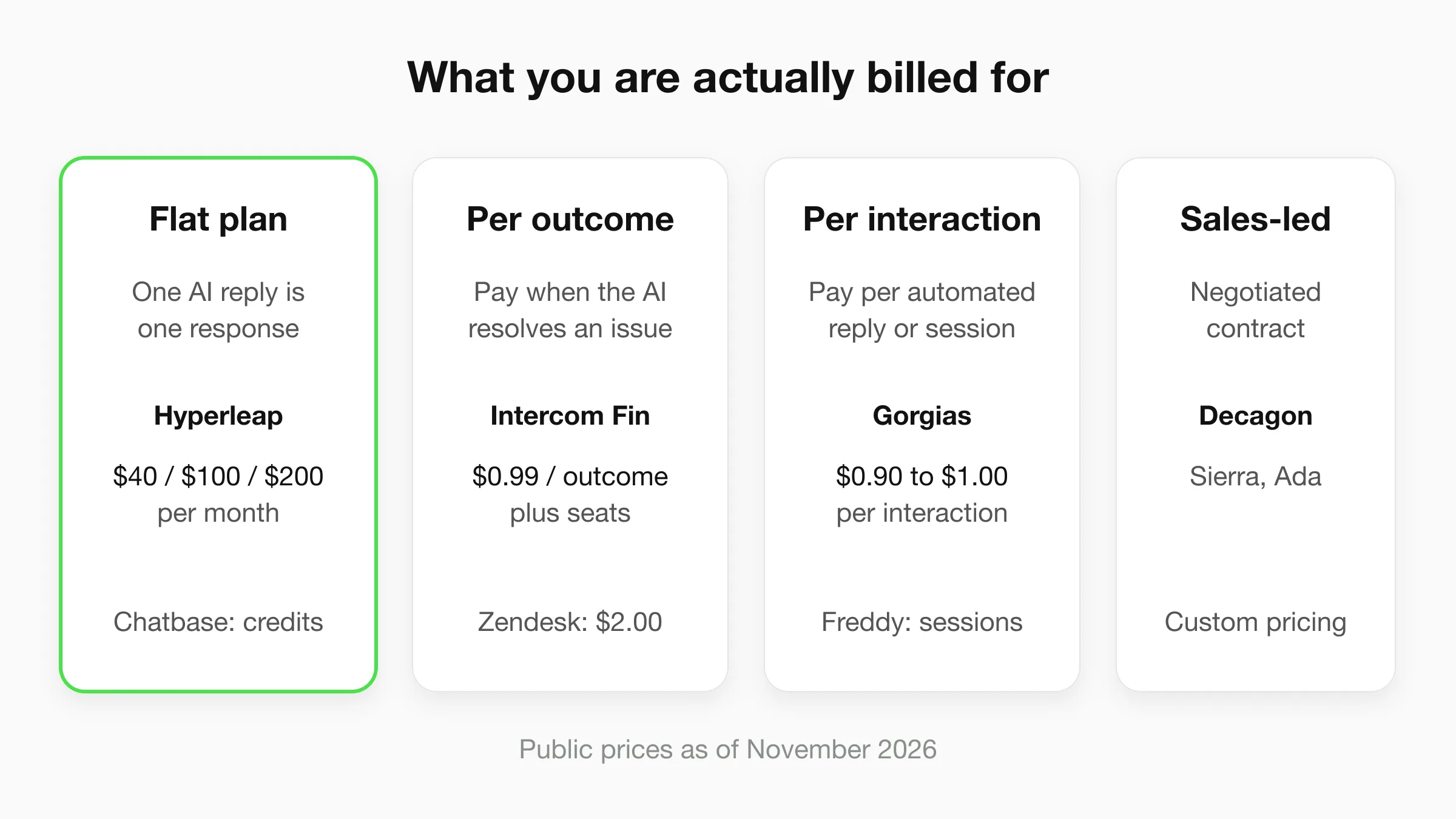
| Model | Used by | What you pay for | Watch for |
|---|---|---|---|
| Flat plan with a response allowance | Hyperleap | A monthly plan; one AI reply is one response | You move up a plan when you pass the allowance |
| Plan plus conversation tiers | Tidio Lyro | Lyro conversations per month | The tier you need as traffic grows |
| Message credits | Chatbase | Credits used per AI message | Estimating monthly volume |
| Per outcome or resolution | Intercom Fin, Zendesk | Each issue the AI counts as resolved | Plus seats; the definition of "resolved" |
| Per automated interaction | Gorgias | Each AI reply or session | Also counts toward ticket limits |
| Per session | Freshdesk Freddy | Chat sessions beyond an included block | Seat prices on top |
| Sales-led | Decagon, Sierra, Ada | A negotiated contract | Minimum commitments |
Illustrative math, not a quote
If an AI agent resolved 1,000 conversations in a month at Intercom's $0.99 per outcome, the AI portion would be $990 before seats. A flat Hyperleap Plus plan is $40 for 3,000 AI responses. A response and an outcome are different units, so this only shows how the pricing shapes diverge, not a like-for-like saving. Your real cost depends on how many conversations you handle and how many need a person.
For a wider cost comparison, see our chatbot pricing comparison. If one inbox across channels is the priority, see the omnichannel customer service platforms guide.
How to choose by team size
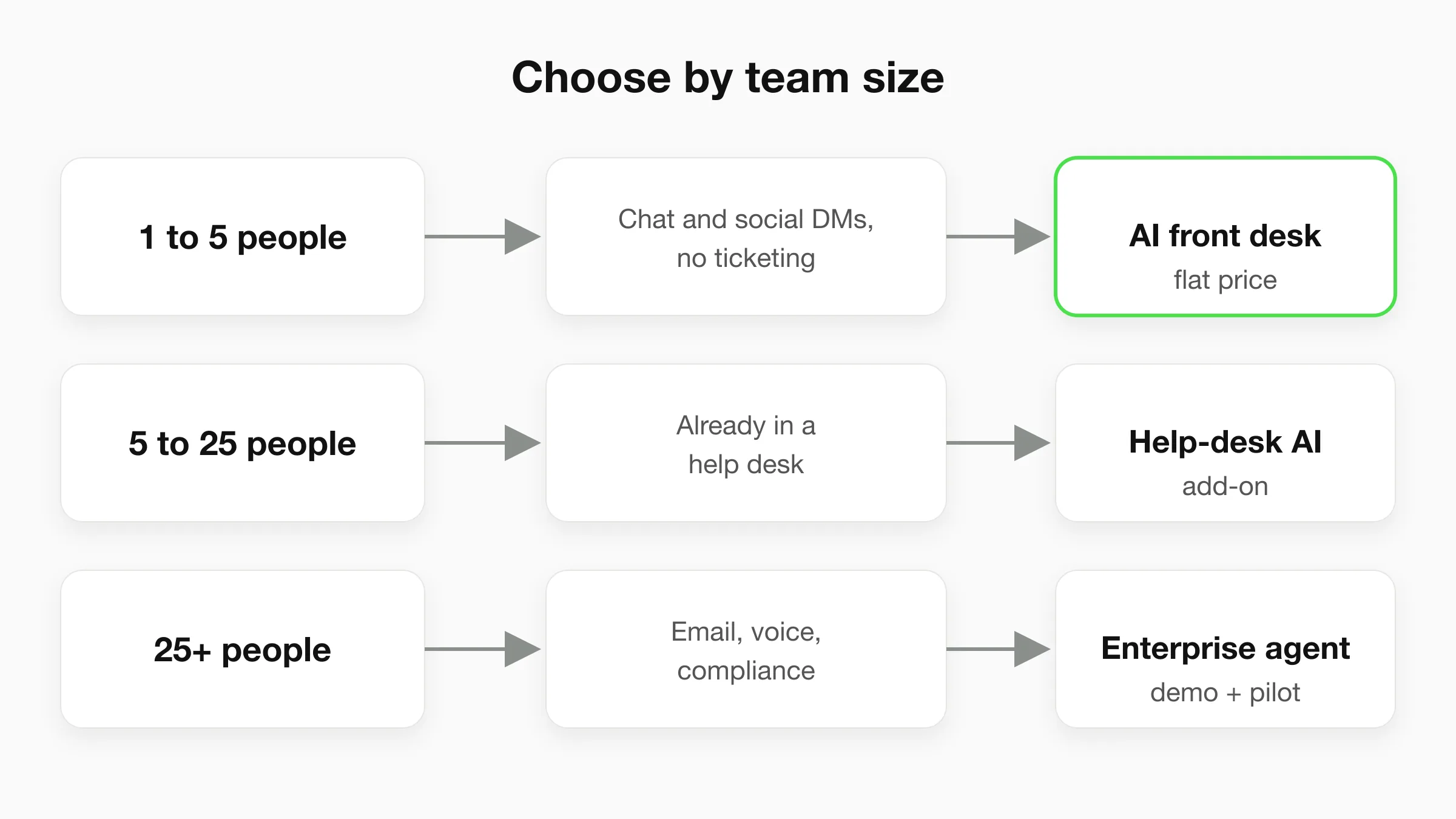
Solo owner or a team of 1 to 5. You probably have no ticketing system and do not want one. Pick an AI front desk with a flat price. Hyperleap, Tidio, and Chatbase all fit; the deciding factors are the channels you need (WhatsApp and Instagram DM are common for local businesses) and whether you want a predictable bill. A dental office, for instance, can start with the dental agents setup and answer new-patient questions after hours.
A team of 5 to 25 with a help desk. If your agents already work in Intercom, Zendesk, Freshdesk, or Gorgias, the vendor's own AI add-on is the simplest path, because tickets and handoff stay in one place. Budget for seats plus AI usage. A busy home services company that fields calls and chats may still put an AI front desk in front of the help desk to catch routine questions first.
A support organization of 25 or more. Large teams with email, voice, and compliance needs should evaluate Decagon, Sierra, or Ada, or the enterprise tiers of Zendesk and Intercom. Expect a demo, a pilot, and a negotiated contract.
What to test before you buy
- Run your 20 most common real questions. Use actual customer messages, not the vendor's demo script.
- Check handoff. Ask a question the AI should not answer and see how it reaches a person.
- Read the pricing definition. "Resolution", "outcome", "interaction", and "response" are all counted differently.
- Check the channels you need. Confirm WhatsApp, Instagram, email, or voice are supported on the plan you would buy.
- Look at how answers are sourced. The agent should answer from your documents, and you should be able to see what it used.
For a practical rollout plan, read how to automate customer support, reduce customer support costs with AI, and 24/7 customer support for a small business. For the wider picture, see conversational AI for customer service and best AI chatbots in 2026.
Try an AI front desk on your own content
Paste your website URL and see how Hyperleap answers your real customer questions. Plans from $40/mo, with a 7-day free trial.
Start for freeFrequently Asked Questions
What is AI customer support software?
AI customer support software answers customer questions automatically using your help content, and escalates to a person when needed. It ranges from small-business AI front desks to AI add-ons inside help desks and enterprise agents across chat, email, and voice.
What is the best AI customer support software for a small business?
For a small business that answers customers on its website and messaging apps, an AI front desk such as Hyperleap AI, Tidio Lyro, or Chatbase is usually the better fit than a full help desk. Hyperleap starts at $40/mo with a flat AI response allowance and covers Website, WhatsApp, Instagram DM, and Messenger.
What is an AI support agent?
An AI support agent is software that holds a support conversation, finds the answer in your content, and in some products takes an action such as looking up an order. Good ones know when to hand a conversation to a person.
How much does AI customer support software cost?
It varies by pricing model. Flat plans start around $40 per month. Per-outcome and per-resolution models run roughly $0.90 to $2.00 per resolved conversation, plus seats on help-desk plans. Enterprise tools publish no price. Prices here are as of November 2026.
Does Hyperleap replace a help desk?
No. Hyperleap is an AI front desk. It has no email channel, ticketing, or voice today. Teams that need ticket queues and SLAs keep a help desk and can still use Hyperleap for chat and social DMs.
Can AI customer support software handle WhatsApp and Instagram?
Some can. Hyperleap answers on WhatsApp, Instagram DM, and Facebook Messenger. Chatbase and Sierra also list WhatsApp. Most help-desk add-ons focus on their own messenger, email, and ticket channels, so check the channel list on the plan you would buy.
Will an AI agent replace my support team?
It handles repeat questions so people can focus on harder ones. You still need people for judgment calls, upset customers, and anything that needs access the AI does not have. Test handoff before you launch.
Conclusion
Pick the product shape first, then compare vendors inside it. Small teams that live in chat and social DMs get the most from an AI front desk with a predictable price. Teams with a help desk should start with that vendor's AI add-on. Large organizations should plan for a sales-led evaluation.
If you fit the first group, start a free trial of Hyperleap and test it on your real questions, or read our guide on conversational AI for customer service for more detail.
See Hyperleap answer your customers
Plus $40, Pro $100, Max $200 per month. Includes an MCP server on every plan and 100+ languages.
Start for freeRelated Articles
View all
Comparison21 min read
Best Help Desk Software for Small Business (2026)
Compare 10 help desk tools for small teams: prices, free plans and fit by team type, plus when an AI front desk should come first.
Comparison16 min read
Best Agentforce Alternatives in 2026
Agentforce alternatives for businesses that don't run on Salesforce: how Copilot Studio, Zendesk, Fin, Ada, Chatbase and Hyperleap price and fit.
Comparison20 min read
Best AI Agents for Small Business in 2026
The best AI agents for small business in 2026, grouped by job: front desk, phone, sales, back office and assistants. Pricing and setup for each.
Comparison19 min read
Best Customer Communication Tools in 2026
The best customer communication tools for small businesses in 2026, grouped by job: AI front desk, shared inbox, messaging, live chat, help desk, CRM.