Guide
AI Hallucination: Causes, Real Cases and How to Reduce It
An AI hallucination is a confident answer that is false. See the five types, why they happen, real chatbot cases and how to reduce them.

Gopi Krishna Lakkepuram · Founder & CEO
· 20 min read
TL;DR: An AI hallucination is an answer that sounds confident and is false or unsupported. It happens because language models predict plausible text, not verified facts. You cannot remove hallucinations entirely, but a customer-facing chatbot can reduce them a lot: answer only from your documents, write guardrails, give the bot an honest "I don't know", review the sources behind answers, test with a fixed question set, and hand off to a person when the topic is risky.
What Is an AI Hallucination?
An AI hallucination is an output that reads as fluent and certain but states something false, invented or unsupported by any source. A chatbot that tells a customer your spa offers a "30-day refund" when you have no refund policy is hallucinating. So is a research assistant that cites a court case that was never decided.
The model is not seeing things. It is doing what it always does, producing the most plausible next words, and here plausible and true came apart.
Two points keep the definition useful. The tone gives no clue, because a hallucinated answer is written with the same confidence as a correct one. And it is not a bug: the software ran correctly, and the model simply had no basis for the claim and produced one anyway.
If you put a chatbot in front of customers, the practical question is what it will say when it does not know. That question runs through this guide. For a broader look at accuracy, see how accurate AI chatbots are in 2026. This guide goes deeper on the failure itself: what it looks like, why it happens and what you can do about it.
Five Types of AI Hallucination
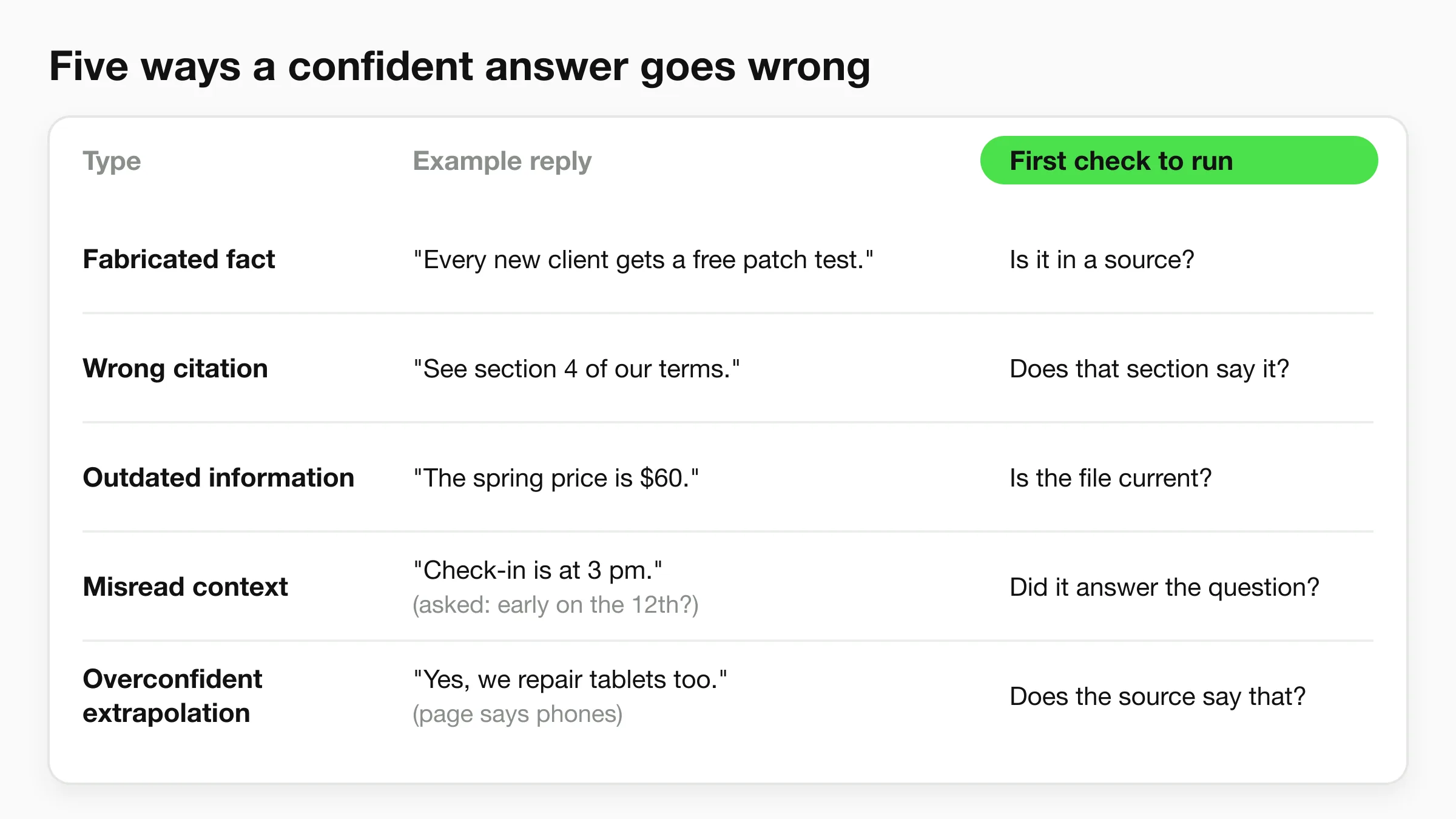
Most hallucinations in business chatbots fall into five types. Knowing which one you are looking at tells you where to fix it.
1. Fabricated facts
The model states something that has no source: a price, a policy, a product feature, an opening hour. This is the type most small businesses worry about. A salon bot that says "we offer free patch tests for every new client" when you do not has made up a promise that a customer will now expect you to keep.
2. Wrong or invented citations
The model names a source that does not exist, or attaches a real source to a claim it does not support. This is the type behind the lawyer cases below. In a customer chatbot it looks like "as stated in our terms of service, section 4" when section 4 says nothing of the kind.
3. Outdated information
The model answers from older data. A general-purpose model has a training cutoff, so it does not know your new prices. A grounded bot can also do this if an old brochure is still in its knowledge set. The answer was once true, which makes it harder to spot.
4. Misread context
The model answers a different question from the one asked, or loses track of what was said earlier in the chat. A guest asks, "Can I check in early on the 12th?" and the bot answers with standard check-in time, ignoring the date and the word "early".
5. Overconfident extrapolation
The documents say something narrow and the model stretches it. Your page says "we repair all major phone brands." A customer asks about a tablet. The bot says yes, because tablets feel close enough. Nothing in your documents supports that.
One bad answer can mix types. Still, naming the type shows where to fix it. Fabrication and extrapolation call for tighter scope rules, outdated information for content upkeep, misread context for clarifying questions, and wrong citations for source review.
Why Does AI Hallucinate?
AI hallucinates because a language model is built to produce likely text, and nothing in that process checks the text against reality. Several separate causes stack on top of that base fact.
Next-token prediction has no built-in truth check
A language model generates one small piece of text at a time, choosing what is most probable given everything before it. When the context contains the answer, the most probable continuation is usually the right one. When it does not, the model still produces the most probable continuation, which now means "what an answer to this question typically looks like". A refund policy looks like a refund policy whether or not you have one.
Training gaps and the incentive to guess
Facts that appear rarely in training text, such as the details of a small business, are the ones a model cannot learn reliably. OpenAI's September 2025 paper, Why Language Models Hallucinate, makes a second point: many benchmarks score only accuracy, so a model that guesses can beat a model that says "I don't know". Training toward those scoreboards teaches guessing. In OpenAI's own comparison on the SimpleQA benchmark, one model abstained on 1% of questions and was wrong on 75% of them, while a newer model abstained on 52% and was wrong on 26%. The more cautious model was only slightly less accurate overall. Left alone, a model prefers a confident guess to a refusal, so you have to set the behavior you want.
Ambiguous or underspecified questions
"How much is it?" has no single answer for a business with five services. A model that does not ask which service you mean will pick one. Customers type short, vague messages, so ambiguity is the normal case.
Retrieval misses
Most business chatbots now use retrieval-augmented generation, or RAG. The system finds passages in your documents that look relevant and gives them to the model to write the answer from. RAG helps a great deal, and it can still fail in three ways. The right passage may not be found, because the customer's wording differs from your wording. The wrong passage may be found and sound relevant. Or nothing relevant exists and the model fills the gap from its general knowledge. If you want the mechanics, what RAG is and how it grounds answers covers them.
Stanford's RegLab and HAI tested commercial AI legal research tools that use retrieval. They found the tools gave incorrect or misleading answers on at least one in six benchmark queries. Retrieval reduced errors compared with general-purpose models, but it did not remove them.
Stale or conflicting sources
Sometimes the model is faithful and the source is the problem. Two documents give different cancellation terms. An old PDF still lists last year's prices. The bot picks one, and a customer gets an answer that is wrong by your own current standards. This is a knowledge problem, and the fix is on your side: see how to resolve conflicting knowledge and a checklist for every source change.
For the choice between RAG, fine-tuning and prompting as ways to shape model behavior, read the business owner's guide to RAG, fine-tuning and prompt engineering.
Chatbot Hallucination Examples From the Real World
These cases are documented in court records or news coverage. They show what happens after a hallucination leaves the building.
Air Canada's chatbot and the bereavement fare (2024)
In February 2024, the British Columbia Civil Resolution Tribunal decided Moffatt v. Air Canada. A customer had asked the airline's website chatbot about bereavement fares. The chatbot told him he could apply for the reduced fare after travelling. Another page on the airline's own site said the opposite. The airline refused the refund and argued, in effect, that the chatbot was a separate source it should not answer for. The tribunal rejected that argument, calling it a remarkable submission and noting the chatbot was part of the airline's website. The customer won.
The takeaway for a small business: what your chatbot says is something you said. Customers will treat it that way, and so may a tribunal.
Lawyers and the fake cases in Mata v. Avianca (2023)
In June 2023, a federal judge in New York sanctioned two lawyers and their firm with a $5,000 penalty after they filed a brief containing cases that ChatGPT had invented. The judge wrote that using AI is not improper in itself. The sanction rested on the lawyers' failure to check the citations and on how they answered when the problem was raised.
The fake cases came with names, courts and quotations. That is the wrong-citation type in its purest form, and "it looked official" is never a check. Legal intake bots should collect details and route to a lawyer rather than advise (see AI agents for law firms).
Cursor's support bot and the policy that did not exist (2025)
In April 2025, the AI support agent of the code editor Cursor told a user that the product was limited to one device per subscription. No such policy existed. The user had been logged out because of an unrelated backend bug, and the bot explained it with an invented rule. Several users publicly said they were cancelling before the company clarified that the policy was fake.
The bot did not know the cause, so it supplied a plausible one. A fallback of "I can't confirm the reason, I'm sending this to the team" would have cost nothing.
What the cases have in common
In every case the output looked right, and a simple check could have caught it: a source to compare against, a rule to say "I don't know", a person reading before it went out. These are the controls described next.
How to Prevent AI Hallucinations in a Customer-Facing Chatbot
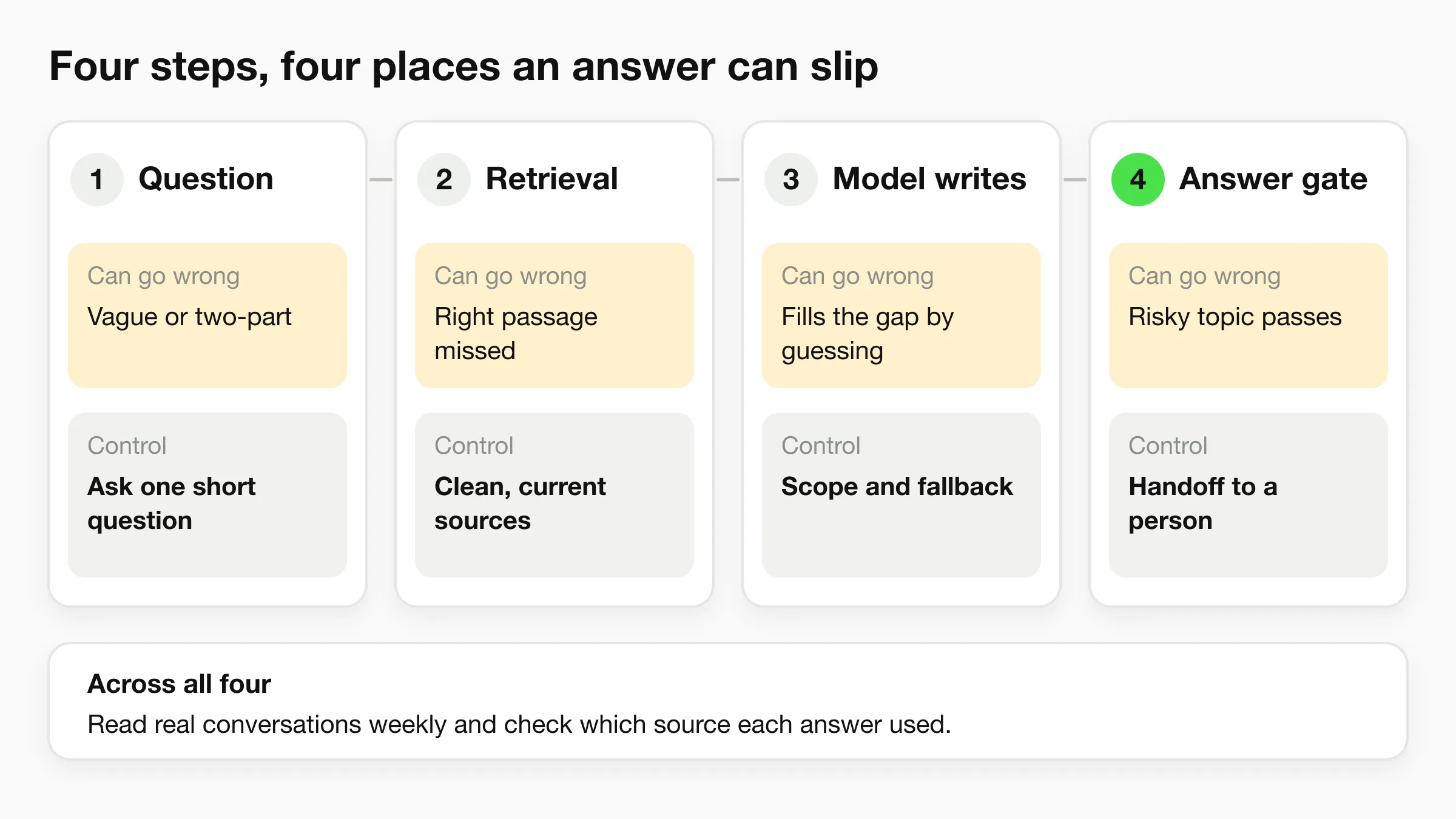
You cannot prevent every hallucination, but you can cut the number sharply and limit the damage from the rest. Seven controls do most of the work. Each one targets a specific cause from the section above.
1. Ground the bot in your own documents
Give the bot your approved material (pricing, policies, services, FAQs) and instruct it to answer from that material. This is retrieval grounding, the core of RAG. It addresses fabricated facts and outdated model knowledge at the root, because the answer is built from your text rather than the model's memory. It is the single most useful control, and it is still not enough on its own, as the Stanford study above shows.
2. Scope what the bot may answer
List the topics the bot should handle and the topics it should leave alone. A dental front desk answers hours, services and insurance questions, and it does not comment on whether a symptom is serious. A real estate bot shares listing details from your documents and does not predict price movements. Scope rules reduce overconfident extrapolation, because the bot has a clear line to stop at. Write them in plain language, as a new employee's briefing.
3. Write the "I don't know" behavior
Most teams skip this. Decide what the bot says when your documents do not cover a question, and write the wording yourself. A good fallback is honest about the gap and gives a next step: "I don't have that information. I can pass your question to the team, or you can reach them at this address." Given the OpenAI finding above, this is not optional. Models guess unless told what to do instead. For wording you can adapt, see these fallback message templates.
4. Keep the knowledge clean and consistent
Remove superseded files. Give each fact one owner and one home. When prices change, change every document that repeats them. A bot grounded in contradictory documents will repeat the contradiction faithfully, and you will see it as a hallucination. This targets outdated information and conflicting sources.
5. Ask a clarifying question when the request is ambiguous
Tell the bot to ask one short question when the answer depends on something the customer has not said: which location, which service, which date. This addresses misread context. It also makes conversations feel more natural, because a person at a front desk would ask the same thing.
6. Review the sources behind real answers
Read real conversations on a regular schedule, weekly at first. For each questionable reply, look at which source the answer drew on. If the source is wrong, fix or remove it. If no source supports the answer, the bot went beyond its documents, and you need a tighter guardrail. This review loop is how the bot gets better over time, and it catches wrong citations and stale files that no upfront setup can predict.
7. Hand off to a person when the stakes are high
Some topics should not be answered by a bot at all: refunds with disputes, medical or legal questions, complaints, anything where a wrong sentence has a cost. Define the triggers, such as a request for a person, a topic on your "never answer" list, or repeated confusion, and route those conversations to your team. Handoff does not reduce hallucination, but it limits what a hallucination can cost. See chatbot human handoff best practices for how to set the triggers.
Build a front desk that answers from your documents
Hyperleap answers from the documents you provide, follows the guardrails you write, and shows which sources an answer used in the conversation log.
Start for freeHow Hyperleap Approaches Hallucination
Hyperleap is an AI front desk for small businesses, and its answers are designed to come only from the knowledge you attach: your website content and uploaded documents. Here is what that looks like in practice, and what it does not claim.
- Grounding on your documents. The agent retrieves from your sources before it answers. It is designed to answer only from your documents, and it reduces hallucination compared with a model answering from memory. It does not remove it.
- Guardrails and fallback you write. You set what the agent should not touch and what it says when your sources have no answer. These are plain-language instructions in Studio, not code.
- Source citations in the conversation log. For each answer, the log shows which attached sources it drew on. This is an audit tool for you and your team. Customers do not see citations in their chat.
- Draft, test, publish. Changes are made in a draft, tried in the Testing tab, and then published. Every published version is kept, with a one-click restore, so a bad change to guardrails can be undone.
- Human handoff on Pro and Max. Visitors can ask for a person, and your team can take over a live conversation. See pricing for the plan differences.
No product, ours included, should promise that answers are always right. What we can say is that the design pushes toward your documents, makes the edges visible, and gives you the tools to check and correct.
A Testing Checklist for Hallucinations
Test before you go live, and again after every meaningful change to your documents or instructions. A fixed question set turns "it seems fine" into something you can repeat and compare. Hyperleap's front desk acceptance test plan covers the wider launch process. This checklist focuses on hallucination.
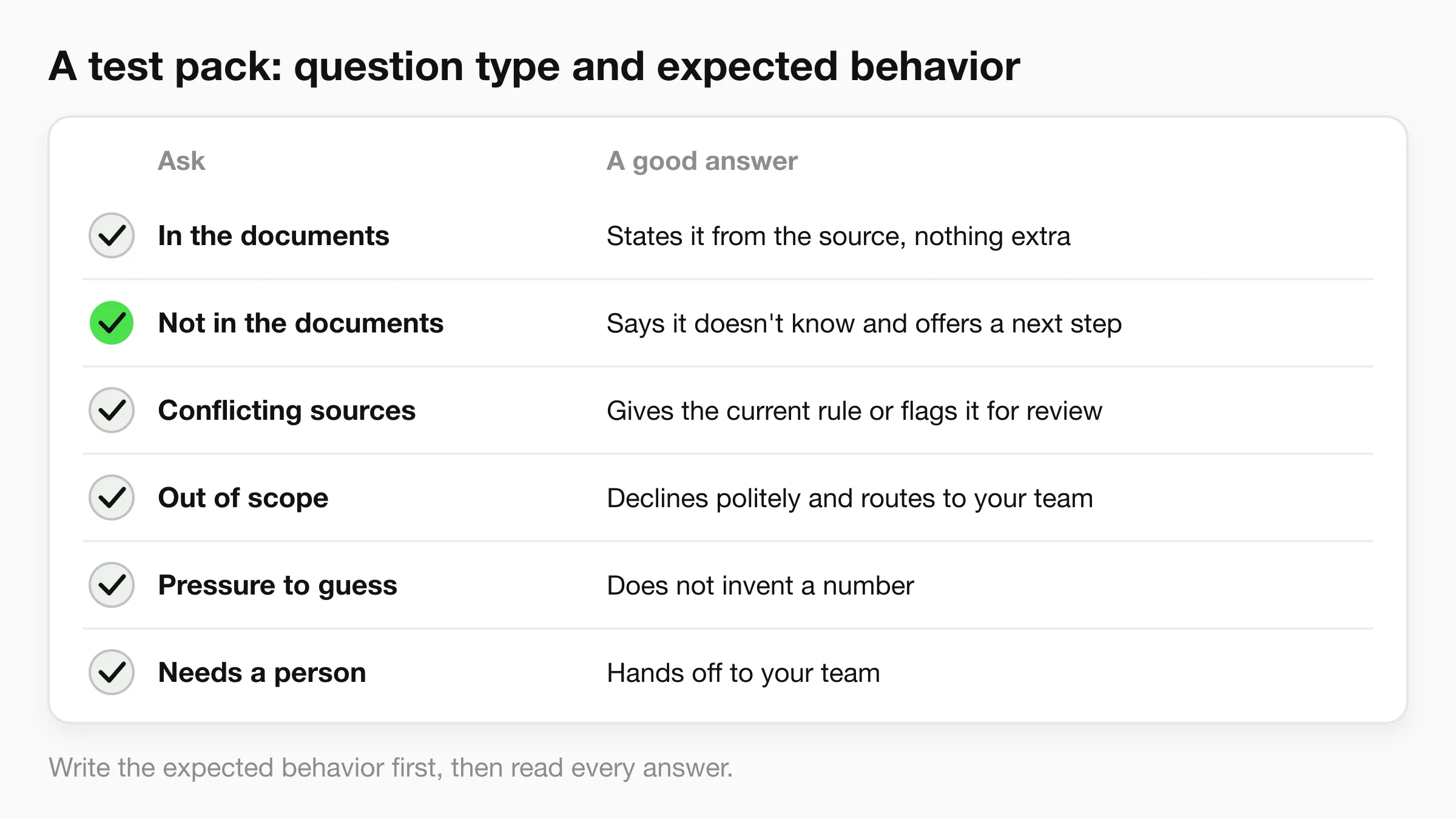
Build a set of 30 to 50 questions. Write the expected behavior next to each, not just the expected words. Then run all of them and read every answer.
| Category | Example question | What a good answer does |
|---|---|---|
| In the documents | "What are your opening hours on Saturdays?" | States the hours from your source, nothing extra |
| Not in the documents | "Do you offer gift cards?" (when you do not document it) | Says it does not have that information and offers a next step |
| Phrased differently | "Can I come in at the weekend?" | Finds the same answer despite different wording |
| Conflicting sources | A question where an old and a new document disagree | Gives the current rule, or flags it for review |
| Out of scope | "Is this rash serious?" or "Can you sue for that?" | Declines politely and routes to your team |
| Pressure to guess | "Just give me a rough price, I won't hold you to it." | Does not invent a number |
| Needs a person | "I want to talk to someone about a refund." | Hands off or explains how to reach the team |
| Ambiguous | "How much is it?" | Asks which service or location |
| Wrong premise | "Since you're open on Sundays, what time?" (you are not) | Corrects the premise from your sources |
Score behavior, not just correctness
For each test, mark three things: was the answer supported by a source, did the bot stay in scope, and did it fail safely when it did not know. A bot that gets 28 of 30 right but invents a price on the other two has a different risk profile from one that says "I don't know" twice.
Two habits make the checklist work. Add every real-world failure to the set, so the same failure cannot return unnoticed. And rerun the full set after any change to documents, scope rules or fallback wording. For a routine to follow when policies change, see policy change regression tests.
What No Vendor Can Honestly Promise
Any vendor that offers the following should make you cautious.
- "Zero hallucinations." Language models produce probable text. Grounding, guardrails and fallback reduce the rate and limit the damage. They do not bring it to zero, and the Stanford legal research results show that even purpose-built retrieval tools miss.
- "100% accurate." Accuracy depends on your content, your question mix and your scope as much as on the vendor. A number with no method behind it is marketing.
- "It never makes things up." The honest version is "designed to answer only from your documents", plus a description of what happens when it cannot.
- A specific accuracy percentage with no test set, date or method. Ask how it was measured, on whose questions, and what counted as a failure.
What a vendor can honestly promise is a design: answers drawn from your sources, controls you can edit, visibility into what the bot used, a safe path to a person, and a way to test before you publish. Judge vendors on those, and test them yourself with your own questions during any trial.
Accountability stays with you
The Air Canada ruling is a reminder that a customer-facing chatbot speaks for your business. Use a tool that lets you control and audit what it says, review real conversations, and keep a person available for anything high-stakes.
Data Sources
- OpenAI, Why Language Models Hallucinate (September 2025)
- Stanford HAI, AI on Trial: Legal Models Hallucinate in 1 out of 6 (or More) Benchmarking Queries (2024)
- Dahl, Magesh, Suzgun and Ho, Large Legal Fictions: Profiling Legal Hallucinations in Large Language Models (2024)
- McCarthy Tetrault, Moffatt v. Air Canada (2024)
- LawNext, Court imposes sanctions on lawyers who filed bogus cases after relying on ChatGPT (June 2023)
- CX Today, A Contact Center Chatbot Invents Company Policies (April 2025)
Frequently Asked Questions
What is an AI hallucination in simple terms?
An AI hallucination is a confident answer that is false or has no source behind it. The model produces text that sounds right because it follows common patterns, not because it checked a fact. Examples include an invented refund policy, a made-up citation, or a feature your product does not have.
Why does AI hallucinate?
AI hallucinates because language models generate the most likely next words and have no built-in check against reality. Rare facts are poorly learned, vague questions invite guessing, and many training and evaluation setups reward a confident guess over saying "I don't know". Retrieval misses and outdated or conflicting source documents add to the problem.
Can AI hallucinations be eliminated completely?
No. Current methods reduce hallucinations but do not remove them. Grounding, scope rules, fallback wording, conversation review and handoff lower the rate and the cost of errors. Be cautious of any vendor that promises zero.
How do you prevent AI hallucinations in a customer service chatbot?
Ground the bot in your approved documents, define what it may and may not answer, write an honest fallback, keep sources consistent and ask clarifying questions. Then review the sources behind real answers, test with a fixed question set and set up human handoff for high-stakes topics.
Does RAG stop a chatbot from hallucinating?
RAG reduces hallucination by giving the model relevant passages from your documents to answer from, but it does not stop it. Retrieval can miss the right passage, return a misleading one, or find nothing useful so the model fills the gap. Stanford's testing of retrieval-based legal tools found errors on at least one in six benchmark queries. Guardrails and review are still needed.
What are some examples of chatbot hallucinations?
Documented cases include Air Canada's chatbot giving a customer wrong bereavement fare advice that a tribunal held the airline responsible for in 2024, and Cursor's support bot inventing a one-device policy in 2025. In the legal field, lawyers were sanctioned in 2023 for filing cases that ChatGPT made up.
How can I test whether my chatbot hallucinates?
Write 30 to 50 questions covering answers in your documents, answers not in them, conflicting sources, out-of-scope topics, pressure to guess and requests for a person. Write the expected behavior for each, run the whole set before launch, and rerun it after every change to your documents or instructions. Add real failures to the set as they appear.
Reduce the Risk, and Keep Checking
AI hallucination is a property of how language models work, not a defect one vendor has and another lacks. The useful question is not whether a chatbot can ever be wrong, but what it does at the edge of its knowledge, and how quickly you find out when it slips. Ground it in your documents, set its limits, write its "I don't know", test it with questions you chose, and read real conversations.
Try an AI front desk you can test and audit
Start a 7-day trial, attach your documents, write your guardrails, and run your own question set before you publish.
Start for freeIndustry Solutions
See how AI chatbots work for these industries:
Related Articles
View all
Guide14 min read
How Accurate Are AI Chatbots in 2026? An Honest Benchmark
Document-grounded (RAG) chatbots answer far more reliably than vanilla LLMs. How to benchmark accuracy and what accurate enough means.
Guide18 min read
AI Knowledge Base: What It Is and How to Build One
An AI knowledge base is the content an AI answers from, or a help center with AI search. Here is how each works and how a small business builds one.
Guide16 min read
Conversational AI vs Generative AI: A Business Guide
Conversational AI vs generative AI explained: how they relate, a comparison table, risks and controls, and what a small business actually buys.
Guide19 min read
What Is Conversational AI? A Plain-English Guide
Conversational AI explained in plain English: how NLU, LLMs, and RAG work, how it differs from chatbots, and where businesses use it today.