Guide
Customer Engagement Strategies: 15 Ideas for Small Business
15 customer engagement strategies for small teams: what to do this week, the channel, the effort, and the one number to track for each.

Gopi Krishna Lakkepuram · Founder & CEO
· 16 min read
TL;DR
- Customer engagement strategies are the small, repeatable things you do at four moments: first contact, purchase or booking, after the sale, and when a customer goes quiet.
- A small team can run all 15 strategies below. Each one has a task for this week, a channel, an effort level, and one number to track.
- Start with first contact. A customer who gets no reply never reaches the other three stages.
- Retention is worth the effort: Bain's Frederick Reichheld found that a 5% rise in retention lifts profits by 25% to 95%, as cited in Harvard Business Review.
- An AI front desk like Hyperleap covers the first-contact stage on four channels. The after-sale and win-back strategies stay with you.
Most advice on customer engagement strategies is written for companies with a marketing team, a CRM and a loyalty app. You have a counter, a phone, a few social accounts and not enough hours. This guide is for that business. It gives you 15 strategies, grouped by the moment in the customer's journey where each one works, and each one fits into an hour or two a week.
Engagement here means something plain: the customer and your business keep talking, and the conversation is easy for both sides. It is not likes, followers or app opens. A person who asks a question and gets a clear answer is engaged. So is a person who gets a reminder, leaves a review, or comes back after six months.
Customers notice. In Salesforce's State of the Connected Customer research, 88% of customers said the experience a company provides is as important as its products or services. For a small business, experience is mostly how quickly and kindly you respond.
How this guide differs from our other posts
We already cover what customers expect from business messaging in 2026, how slow replies cost sales, and serving customers in their own language. This post is the full-cycle plan: what to do at each stage, in what order, and how to tell it is working.
What Are Customer Engagement Strategies for a Small Business?
Customer engagement strategies are planned, repeatable actions that keep customers in a useful two-way conversation with your business before, during and after a purchase. For a small business, the best ones are cheap, run on channels customers already use, and have a number you can check in five minutes.
A good strategy for a small team passes four tests:
- It happens on a schedule or a trigger. "Reply to every new message within an hour" is a strategy. "Be more responsive" is a wish.
- One person owns it. If it belongs to everyone, it happens to no one.
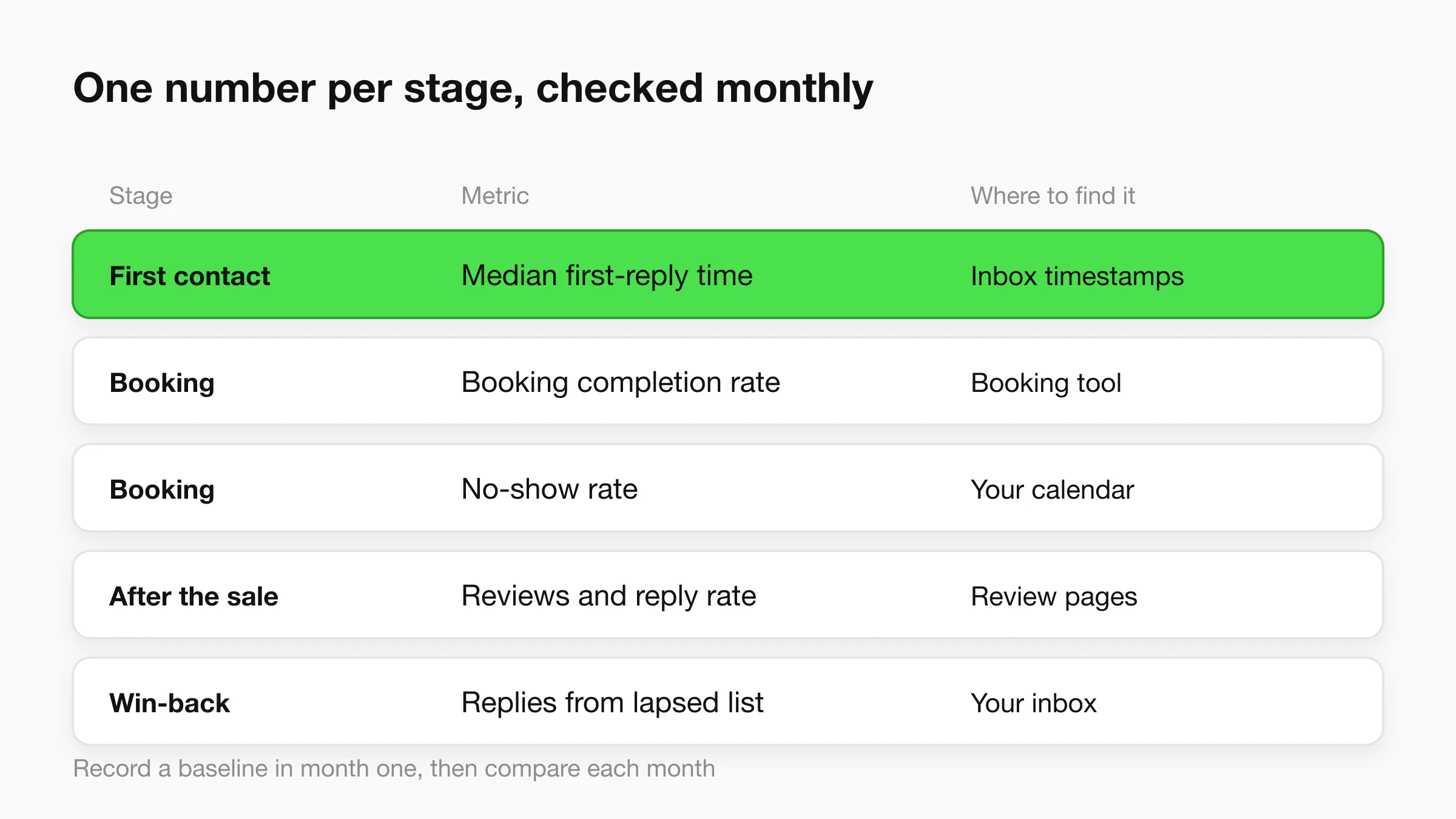
- It has one metric. A count, a time or a percentage you can pull from your inbox, calendar or review page.
- It takes under two hours a week. If it takes more, you will drop it in the first busy month.
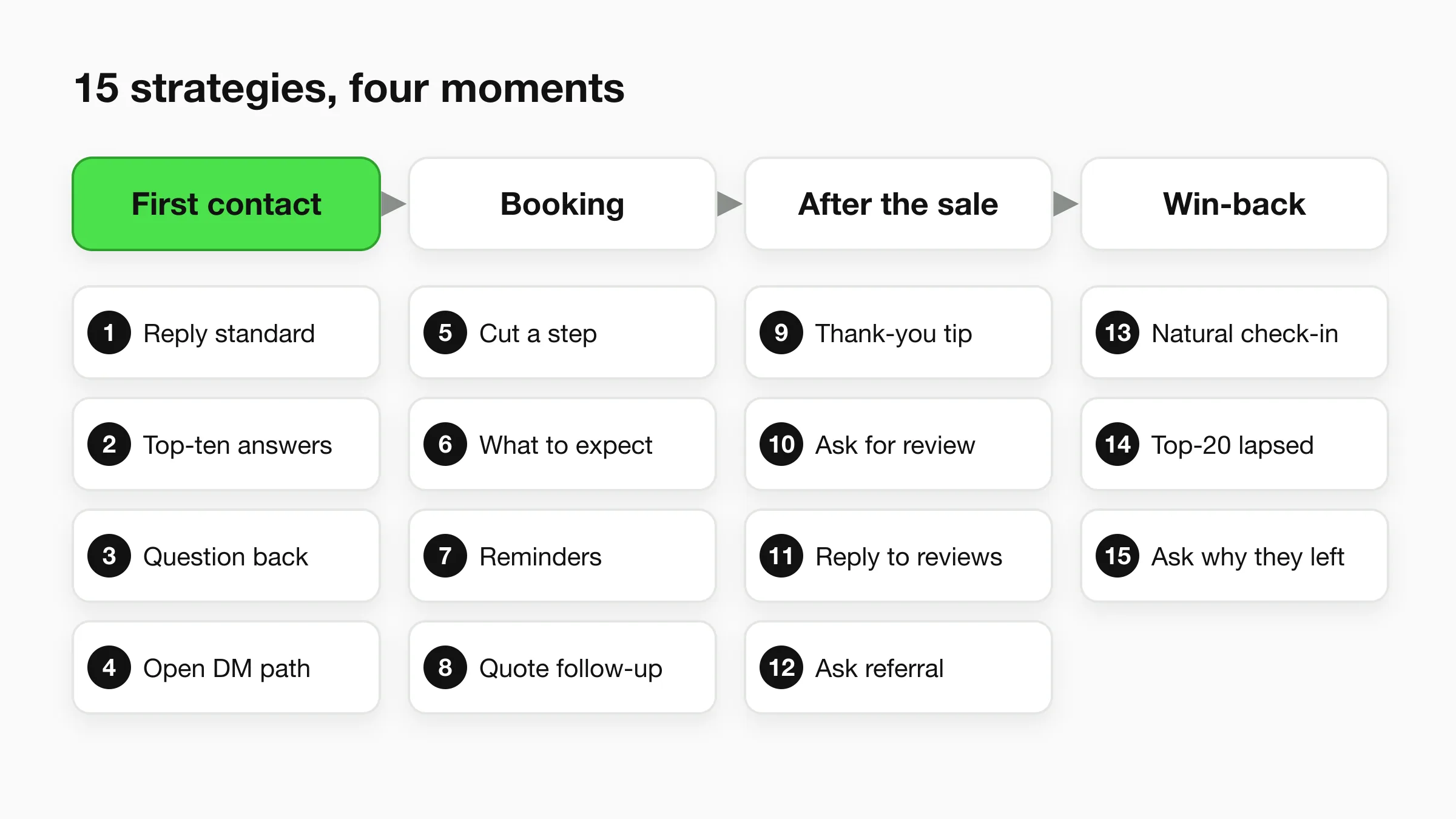
The 15 strategies below are grouped by stage. The first figure shows the whole map.
Stage 1: First Contact Engagement Strategies
First contact is the moment someone asks a question, sends a DM or fills in a form. Engagement here is about speed, clarity and making the next step obvious. Most small businesses lose more customers at this stage than at any other, because the person has not yet decided to trust you and can message three competitors in the same minute.
1. Set a reply standard and publish it
Pick a first-reply time you can keep, for example "within one hour during opening hours," and put it where people see it: your contact page, your Instagram bio, your auto-reply. A promise you keep beats a vague hope of being fast. Our guide to how slow replies cost sales covers the research behind speed; here the job is to set the standard.
This week: Decide the standard, write it in one sentence, and add it to your contact page and social bios. Channel: Website, Instagram, Facebook · Effort: Low · Measure: Median time to first reply, pulled from your inbox timestamps for the last 20 enquiries.
2. Answer the ten questions everyone asks
Open your last 50 messages and list the questions that repeat. Prices, hours, location, parking, how booking works, what to bring. Write each answer once, in two or three sentences, and keep them in a shared note. These become your FAQ page, your pinned replies and the training material for anything automated later.
This week: Write the top ten answers and publish the five most useful on your website. Channel: Website, any messaging inbox · Effort: Medium (one-off, about two hours) · Measure: Share of incoming messages that ask one of the ten. It should fall as the website answers them.
3. Ask one question back
An answer ends a conversation. An answer plus a question keeps it going. A salon that replies "We have Thursday at 4pm. Is this for a cut or a colour?" gets the information it needs to book and the customer feels attended to. Choose one qualifying question per service and add it to every first reply.
This week: Write one follow-up question for each of your top three services and use it in every reply. Channel: Any messaging channel · Effort: Low · Measure: Percentage of enquiries that reach a second customer message.
4. Make direct messages an obvious path
Many customers would rather send a DM than call. If your Instagram bio, Facebook page and website only show a phone number, you are hiding the channel they prefer. Add a "Message us" button or line to each, and check that someone reads those inboxes daily.
This week: Add a message link to your bio and your website header, and check every inbox once a day. Channel: Instagram DM, Facebook Messenger, WhatsApp, website · Effort: Low · Measure: Number of new conversations per week by channel.
Stage 2: Customer Engagement Strategies for Purchase and Booking
This stage starts when someone says yes and ends when they show up or pay. Engagement here is about removing friction and setting expectations, so the customer feels sure they made a good choice.
5. Remove one step from booking
Count the steps from "I want to book" to "I am booked." A form with eight fields, a login, a callback. Remove one. Often it is the phone-number field you never use, or the instruction to "call us to confirm."
This week: Walk through your own booking path as a customer and cut one step. Channel: Website, booking page · Effort: Low · Measure: Booking completion rate: bookings divided by people who started.
6. Send a "what to expect" confirmation
A confirmation that only repeats the date reads like a receipt. Add what to bring, where to park, how long it takes and who they will meet. A dental clinic can note that a first visit includes a short intake form; a plumber can say the arrival window and that the technician will message when ten minutes away. See how this plays out in a dental practice or a home services business.
This week: Rewrite your confirmation message with four practical details. Channel: Email or the channel the booking came from · Effort: Low · Measure: Count of "where do I go" and "what do I bring" questions after booking. It should drop.
7. Send a reminder before every appointment
Reminders work. A systematic review of 29 studies on telephone and SMS reminders for hospital appointments found they cut non-attendance by about a third on average (Hasvold and Wootton, 2011). Those were hospital clinics, so treat the size of the effect as a guide, not a promise for your business. The direction is consistent across settings.
This week: Send a reminder the day before, with a way to cancel or move the booking. Channel: Whatever the customer booked on, or your calendar tool's own reminders · Effort: Low · Measure: No-show rate: missed appointments divided by booked appointments, tracked monthly.
8. Follow up every quote within two days
Quotes go cold quietly. The customer is comparing three prices and the one that follows up with a useful line, not "just checking in," stays in mind. Add one new fact in the follow-up: a start date, a sample photo or an answer to a likely objection.
This week: List every open quote and send a follow-up to each, with one new piece of information. Channel: Email, WhatsApp, or the channel the quote went on · Effort: Medium · Measure: Quote-to-job rate over 30 days.
Stage 3: Engagement Strategies After the Sale
After the sale is where most small businesses go silent. The customer has paid, the job is done and the relationship pauses. This is also where the money is: HBR reports acquiring a new customer can cost five to 25 times more than keeping an existing one, depending on the study and industry.
9. Send a same-day thank-you with one useful tip
A thank-you with something useful in it gets read. A florist can add care instructions. A mechanic can note when to check the tyres. A tutor can send the next practice task. Keep it to three lines and sign it with a real name.
This week: Write one thank-you template per service, each with one tip, and send it on the day. Channel: WhatsApp, email, or the channel the customer uses · Effort: Low · Measure: Replies to the thank-you, counted weekly.
10. Ask for a review while the experience is fresh
BrightLocal's 2026 survey of 1,002 US consumers found that 97% read online reviews of local businesses, and 74% look for reviews written in the last three months. Recent reviews matter, so ask continuously, not once a year. Ask within a day of the visit, with a direct link, and one sentence on what a review helps with.
This week: Save your review link and send it to the last ten happy customers. Channel: WhatsApp, email, or in person with a QR code · Effort: Low · Measure: New reviews per month, and how many in the last 90 days.
11. Reply to every review, including the bad ones
Reviews are public conversations. In the same BrightLocal survey, 89% of consumers expect owners to respond, and 81% of those expect a reply within a week. Keep replies short, specific and calm. For a complaint, name the problem, say what you will do and offer a way to continue off the page.
This week: Answer every unanswered review from the last 90 days. Channel: Google, Facebook, wherever you are reviewed · Effort: Low · Measure: Review reply rate, and median days to reply.
12. Ask happy customers for one introduction
Nielsen's 2021 Trust in Advertising study, with more than 40,000 consumers, found that 88% of global respondents trust recommendations from people they know more than any other channel. A referral request is the cheapest ad you will run. Make it specific: "Do you know one neighbour who also has an old boiler?" works better than "tell your friends."
This week: Pick your ten happiest customers and send each a short, personal referral request. Channel: Direct message or in person · Effort: Low · Measure: New customers who name a referrer.
Stage 4: Win-Back Engagement Strategies
Win-back is for customers who have gone quiet. It is the least used stage and often the cheapest, because these people already know you. The aim is a friendly, low-pressure message that shows you remember them.
13. Check in at the natural interval
Every business has a rhythm: a haircut every six weeks, a service every year, a lease renewal every twelve months. Message at that interval with something helpful, such as "It has been about six weeks, want me to hold a slot?" Don't wait for them to remember you.
This week: Write down the natural return interval for each service and set a calendar reminder to message. Channel: WhatsApp, email, or the channel they last used · Effort: Medium · Measure: Repeat purchase rate within 1.5 times the natural interval.
14. Personally message your top 20 lapsed customers
Sort your customers by past spend and find the 20 best who have not been back in a year. Send each one a short, individual message. Not a blast. A line about their last visit, a real reason to return and an easy reply.
This week: Build the list of 20 and send five messages a day. Channel: Direct message or email · Effort: Medium · Measure: Replies out of 20, and returns within 30 days.
15. Ask lost customers why
When a quote is lost or a regular stops coming, ask one question: "Was it price, timing or something we got wrong?" Most people will not reply. The ones who do will tell you something you cannot learn any other way, and some will come back.
This week: Send the one-line question to everyone who declined a quote in the last 60 days. Channel: The channel the quote went on · Effort: Low · Measure: Count of replies, grouped into price, timing and service.
How Hyperleap Fits: Instant Replies at First Contact
Stage one is where an AI front desk helps most, because speed and availability are the whole game. Hyperleap AI answers customer questions on your website, WhatsApp, Instagram DM and Facebook Messenger, at any hour, from your own documents and FAQs. That covers strategies 1 to 4 without a night shift.
Three things matter for engagement:
- Instant replies on four channels. The same agent answers on each channel, so the customer who DMs at 10pm gets what the customer on your website gets. Our guide to conversational AI for customer service explains how it works and what it handles.
- Answers in 100+ languages. The customer writes in their language and gets a reply in it. For businesses with a mixed customer base, this removes a barrier that staff time cannot, as we cover in serving diverse customers in any language.
- Lead summaries. Contact details and conversation summaries land in one inbox in Studio, so your team sees who asked what before they reply. Leads can be exported as CSV or Excel.
Be clear on the limits. Hyperleap answers inbound messages. It does not send broadcasts, drip campaigns or reminders, and it has no SMS or email channel. The reminders, thank-yous, review requests and win-back messages in stages two to four are yours to send from your own tools. Plans start at $40 a month, with a 7-day free trial. See pricing.
Cover first contact tonight
Paste your website URL and have an AI front desk answering on your website and messaging channels in under 5 minutes.
Start for freeA One-Page 90-Day Customer Engagement Plan
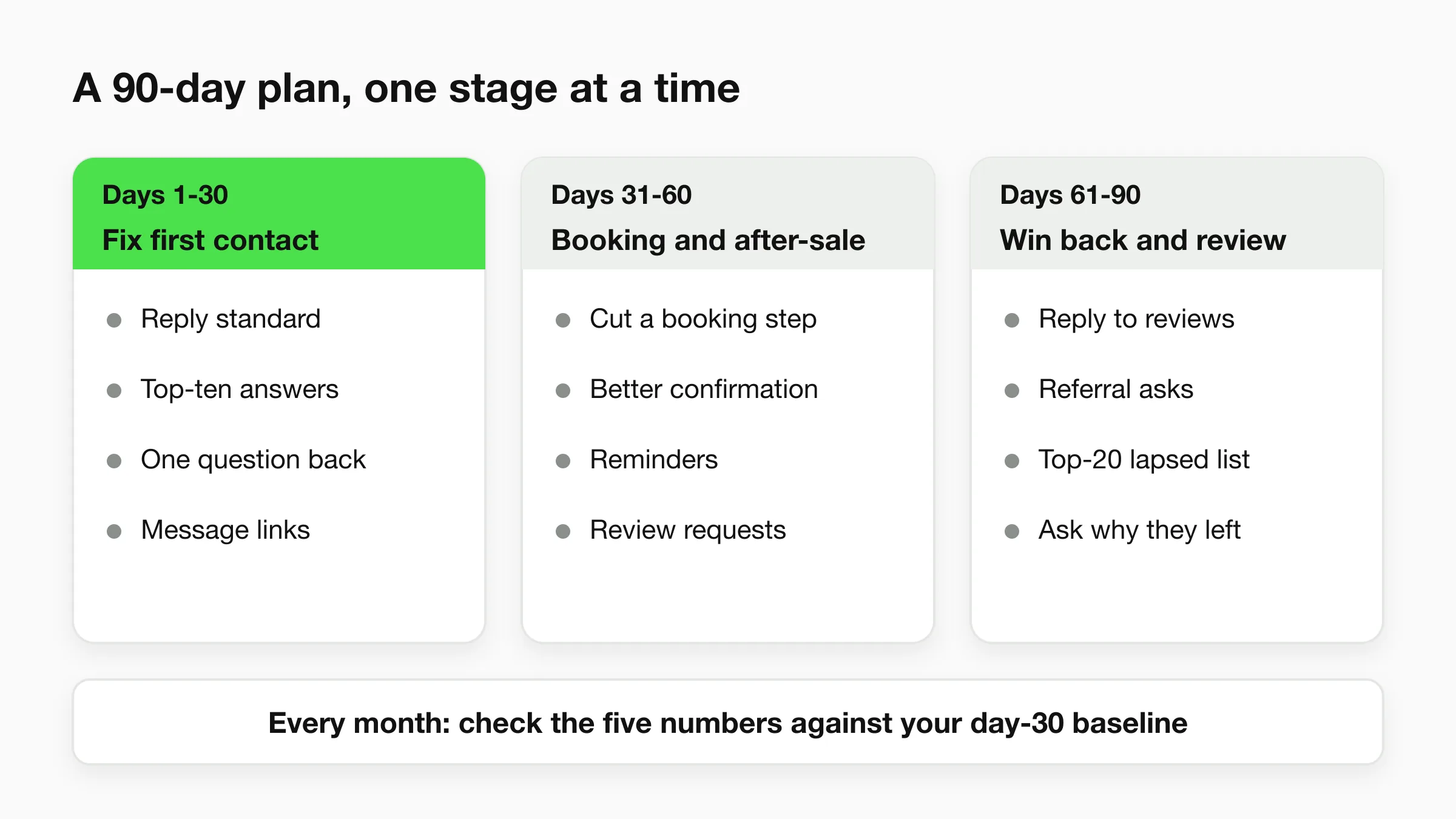
Do not start all 15 at once. Start with the stage where you lose the most people, add one stage a month, and check the numbers every month.
Days 1 to 30: fix first contact.
- Set and publish your reply standard (1).
- Write the top ten answers (2).
- Add the one qualifying question (3) and the message links (4).
- Baseline: record your median first-reply time and weekly new conversations.
Days 31 to 60: add booking and after-sale steps.
- Cut one booking step (5) and rewrite the confirmation (6).
- Start reminders (7) and quote follow-ups (8).
- Send a thank-you (9) and your first review requests (10).
- Baseline: record booking completion, no-show rate and review count.
Days 61 to 90: add win-back and review.
- Reply to all reviews (11) and send ten referral requests (12).
- Set the natural-interval check-ins (13) and message your top 20 lapsed customers (14).
- Send the lost-customer question (15).
- Review all five numbers against your day-30 baseline and keep what moved.
Give each strategy an owner and a weekly slot of 30 minutes. If a strategy has not moved its number after two months, change the message before you drop the idea.
Common Mistakes When Starting Customer Engagement
- Starting with campaigns. Newsletters and promotions come after replies, bookings and reviews work.
- Measuring activity, not outcomes. Messages sent is not a result. Median reply time and no-show rate are.
- Automating before you have answers. Write the ten answers first. Anything automated can only repeat what you wrote.
- Over-messaging. One useful message at the right time beats five. If you wonder whether it is too much, it is.
- Ignoring complaints. A calm reply to a bad review is read by every future customer who sees it.
Frequently Asked Questions
What are the best customer engagement strategies for a small business?
The best strategies are the ones you can keep up with a small team: a published reply standard, answers to common questions, booking reminders, review requests and a check-in with lapsed customers. Start with first contact, since an unanswered message never becomes a customer.
How do I improve customer engagement with a small team?
Choose two strategies, give each one owner and a 30-minute weekly slot, and track one number for each. Add the next stage each month. Use the 90-day plan above as the order of work.
What are some customer engagement ideas that cost nothing?
Replying to every review, sending a same-day thank-you with a useful tip, asking one happy customer for an introduction, and messaging your top 20 lapsed customers all cost only time. Writing the top ten answers once saves time for months.
How do I measure customer engagement?
Use one metric per stage: median first-reply time, booking completion rate, no-show rate, review count with reply rate, and the number of replies from win-back messages. Record a baseline in the first month and compare monthly.
Can a chatbot improve customer engagement?
At first contact, yes. A chatbot answers instantly at any hour, in the customer's language, and keeps the conversation going. It does not replace your thank-yous, reminders or personal win-back messages, which you send from your own tools.
Does Hyperleap send reminders or follow-up campaigns?
No. Hyperleap answers inbound messages on your website, WhatsApp, Instagram DM and Facebook Messenger. It does not send broadcasts, drip campaigns or reminders, and it has no SMS or email channel.
See your first-contact stage working
Start with the stage where small businesses lose the most customers. Set up an AI front desk and test it with your own questions.
Start for freeIndustry Solutions
See how AI chatbots work for these industries:
Related Articles
View all
Guide13 min read
Customer Success vs Customer Support: The Real Difference
Customer success vs customer support: support fixes problems when asked, success prevents them. Compare goals and metrics, and see how small teams do both.
Guide18 min read
Customer Self-Service: Options, Examples and Setup
Customer self-service explained for small businesses: seven options compared by cost and effort, how to pick what to automate, and how to measure it.
Guide19 min read
Customer Service Metrics: 13 Defined, 6 to Start With
The customer service metrics that matter for a small business: definitions, formulas, what to track, what to skip, and a simple weekly scorecard.
Guide19 min read
Customer Service Skills: 14 That Matter, With Examples
The 14 customer service skills a small business needs, each with a plain definition, a weak vs better reply, and a way to train it in a small team.