Strategy
Customer Service Trends 2026: 11 Shifts and What to Do
Eleven customer service trends for 2026 and 2027, each tied to published research, with what a small business should do this year and what to ignore.

Gopi Krishna Lakkepuram · Founder & CEO
· 17 min read
TL;DR: The customer service trends that matter in 2026 are all variations on one idea: AI now answers the routine questions, and customers judge you on what happens when it cannot. AI agents resolve more routine questions, customers ask ChatGPT before they visit your site, and one bad bot experience costs you the next try. A human route, accurate knowledge and honest measurement separate the businesses that benefit from the ones that annoy people. Below are eleven trends, the evidence for each, what a small business should do this year, and what to ignore.
The research is mostly written for enterprise contact centers. A five-person clinic or a two-van plumbing company does not need a "contextual intelligence platform". It needs to answer the same twenty questions quickly, at any hour, and to hand the unusual ones to a person without losing the thread.
This guide filters the 2025 and 2026 reports from Gartner, Salesforce, Zendesk, Intercom and Qualtrics through that lens. If you want the raw numbers, read our state of AI customer service, customer service automation statistics and AI chatbot statistics pages. This post is about what to do with them.
The 11 customer service trends at a glance
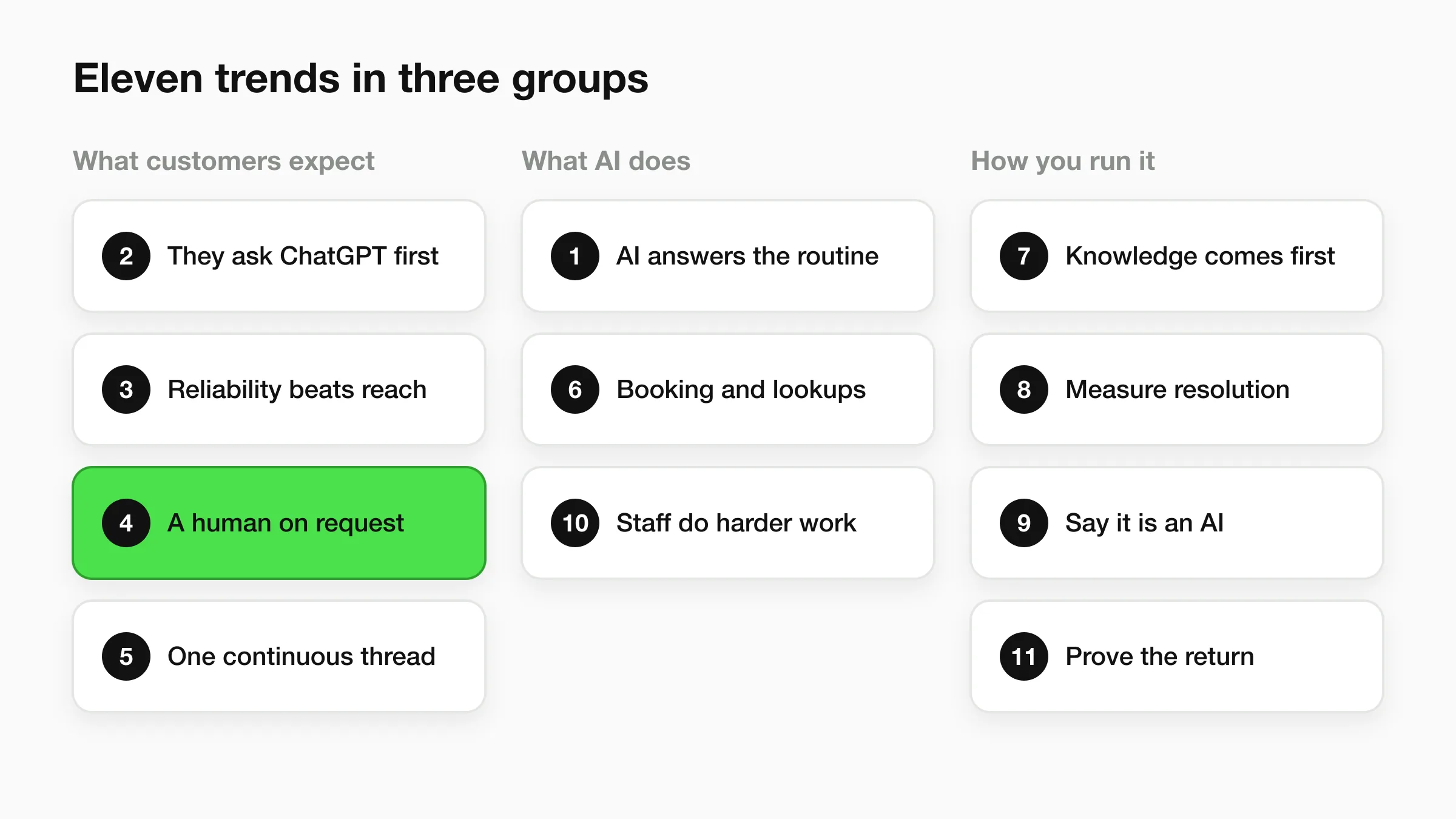
The eleven trends fall into three groups: what customers now expect, what AI now does, and how you run it. The one that matters most for a small business is the human route, so it is marked in green.
Vendor reports sell their own products. Salesforce, Zendesk and Intercom all sell AI service software, so treat their adoption figures as the direction of travel, not a guarantee of your results. Where an independent analyst (Gartner) or a consumer survey (Qualtrics) says something different, we say so.
Customer service trends 2026: what is changing and what to do
1. AI agents resolve the routine questions
AI agents now handle a large and growing share of routine service questions. In Salesforce's State of Service: AI Agents Edition, based on 3,075 service professionals surveyed in March and April 2026, 66% of service organizations use agentic AI, up from 39% a year earlier. Among cases where AI was involved, 40% of resolution interactions were completed without a human.
Salesforce's 2025 report had service teams estimating that AI handled about 30% of cases, rising to 50% by 2027. Those are team estimates, not measured outcomes. Gartner's longer-range forecast is that agentic AI will resolve 80% of common service issues without human intervention by 2029 (as reported by CX Today).
This year: list the questions you answer most often. For a dental practice that is hours, insurance accepted, new-patient forms and cleaning prices. For a salon it is services, prices and availability. Put the answers in one document and let an agent answer them from it.
Ignore: the 2029 number as a planning target. It is a forecast for large operations. Your target is "the top twenty questions are answered correctly at 2am".
2. Customers ask ChatGPT before they ask you
Customers increasingly use general AI tools to sort out service issues, and they use them far more than company chatbots. A Gartner survey of 3,566 customers in February and March 2026 found they were about three times more likely to use a third-party GenAI tool than a company's own chatbot (reported by The Next Web). Use of outside tools had nearly doubled in a year, while company chatbot use had barely moved since 2022.
Gartner's separate forecast, as reported by CX Today, is that by 2028, 70% of service journeys will begin and end with third-party conversational assistants on mobile devices.
This year: make your public facts consistent. Hours, prices, service areas and policies should say the same thing on your website, Google Business Profile and social pages, because an outside assistant will read all of them. A chat agent on your own site then answers from the same source.
Ignore: anyone selling a trick to "rank in ChatGPT". Accurate, consistent, easy-to-read pages are the whole technique.
3. Reliability beats reach
A chatbot that fails once may not get a second chance. Gartner's September 2026 survey found only 27% of customers would try a chatbot again after a negative experience. The same survey found 49% would have been willing to use a chatbot, but only 7% used one in their most recent service interaction.
Qualtrics saw the same pattern from the consumer side. In its 2026 consumer trends research (20,000+ consumers across 14 countries), about one in five people who used AI for customer service saw no benefit, almost four times the rate for AI use in general.
Gartner's advice is to start with a targeted set of issues that already resolve well and expand only once performance is reliable.
This year: launch narrow. An agent that answers fifteen topics correctly and says "I'll pass this to the team" for everything else beats an agent that tries everything.
Ignore: "answers anything" as a feature. For a small business, an agent that knows its limits is the feature.
4. A human on request is the differentiator
Customers accept AI when they can reach a person. Gartner reports that 87% of customers say it is essential for companies using GenAI to offer a way to reach a human agent. Qualtrics found 50% of consumers worry AI will stop them reaching a human. Salesforce found 77% of companies with customer-facing AI let customers ask for a human at any point.
This is the cheapest trend to act on, and the one competitors skip. A visible "talk to a person" route turns a bot you tolerate into a front desk you trust.
This year: decide in advance what goes to a person: complaints, quotes, anything urgent, anything the agent is unsure about. Tell the customer what happens next and when. Our guide to chatbot human handoff covers the wording.
On Hyperleap, human handoff and live takeover are on the Pro and Max plans; the team is alerted in Studio and can take over a live conversation, including on WhatsApp, Instagram DM and Messenger, then hand it back to the AI. On Plus, write clear "how to reach us" instructions into the agent's answers.
Ignore: containment-rate bragging. A bot that keeps people in the chat is not a success if they wanted out.
5. Messaging replaces the queue, in one continuous thread
Customers want to message you, on the channel they already use, without starting over. Zendesk's CX Trends 2026 reports that 74% of consumers find repeating themselves a significant frustration, 74% expect round-the-clock availability, and 76% would choose a company that lets them share text, images and video in one continuous thread. Salesforce found 83% of organizations with AI agents run them across five or more channels.
For a small business, "channels" means website chat, WhatsApp, Instagram DM and Facebook Messenger, whichever your customers already message you on. WhatsApp message fees are paid to Meta separately from any software plan, so check Meta's current pricing before you promise anything to customers.
This year: pick the channels where customers already write to you and answer all of them from the same knowledge. A unified inbox beats four apps checked by four people.
Ignore: adding a channel for completeness. Each one is a promise to reply.
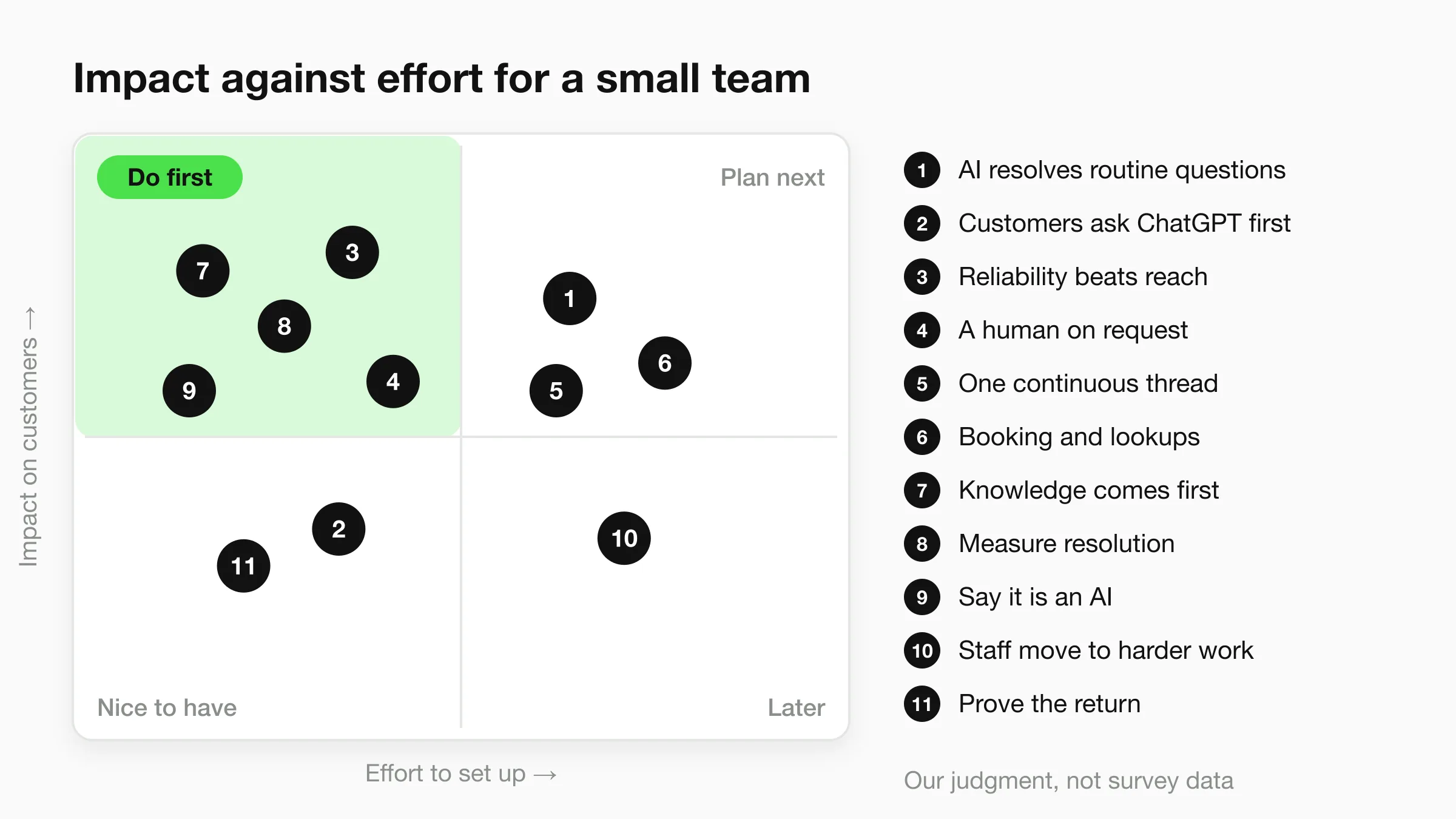
The grid above is our judgment for a team of one to ten people, not survey data. Trends 3, 4, 7, 8 and 9 take an afternoon to a week and change what customers experience. Trends 1, 5 and 6 are worth planning once those are in place.
6. Agentic actions: AI that does things, not only says things
The next step after answering is acting: booking the appointment, looking up an order, submitting a request. In the Gartner survey above, 58% of GenAI users said they had used it to act on their behalf, and 74% in B2B settings. Customers are already delegating tasks to AI tools. They will expect your agent to do the same.
This year: pick one action. For most service businesses that is booking. Hyperleap books natively through Calendly and Cal.com on the Pro and Max plans (in-chat booking needs Calendly Standard or higher; Plus shares your booking link). Pro and Max also support Actions, which let the agent call your own API to look up information such as order status. It creates new bookings only; customers cancel or reschedule from their confirmation email.
Ignore: autonomous refunds, payments and account changes until you have run read-only actions for a quarter. Start with lookups and bookings, where a mistake is cheap to fix.
7. Knowledge management is the real bottleneck
Most self-service fails because the answer is missing, outdated or unclear, not because the AI is weak. Gartner's 2024 consumer study found that only 14% of customers fully resolve their issue in self-service, and only 36% even for issues they rated very simple. In 43% of cases customers could not find relevant content, and 45% said the company did not understand what they were trying to do. This is 2024 data, but the cause has not changed.
Salesforce's 2026 survey points the same way: 59% of service leaders call data readiness a major blocker to AI adoption.
This year: treat your knowledge base as the product. Write the top twenty answers in plain sentences, with exceptions. Add pricing, service areas, policies and what you do not do. Our knowledge base best practices show how. A knowledge base chatbot is only as good as this document.
Ignore: feeding the agent every file you own. Contradictory old PDFs are how agents learn the wrong price.
8. Measure resolution, not deflection
The metric that matters is whether the customer's problem was solved, not whether a person was avoided. Salesforce found 66% of organizations with AI agents track AI resolution rates and 66% measure AI accuracy. Intercom's 2026 report shows only about 10% of teams have AI fully integrated and working at scale, and those mature teams report better metrics.
Deflection counts conversations that did not reach a human. It rewards a bot that frustrates people into giving up. Resolution asks whether they got what they came for. Read what ticket deflection is for the difference.
This year: review twenty conversations a week. Mark each as resolved, handed off well, or failed. That sample tells you more than any dashboard percentage, and it tells you which document to fix.
Ignore: a single "AI handled X%" headline number, including ours.
9. Regulation arrives: tell people it is an AI
The EU AI Act now requires clear disclosure when people interact with an AI system. Article 50(1) obliges providers to design systems so that people are informed they are interacting with an AI system, unless that is obvious to a reasonably well-informed person from the context. The information must be clear and given no later than the first interaction. The obligation applies from 2 August 2026, and the Digital Omnibus delay did not move it: only the separate marking rule in Article 50(2) got a transition, to 2 December 2026. Penalties for breaching Article 50 can reach €15 million or 3% of worldwide turnover.
The duty sits with the providers of AI systems. If you serve customers in the EU, ask your chatbot vendor how its product handles disclosure, and do not rely on it alone. Zendesk reports that 95% of consumers want to understand why AI makes certain decisions, while only 37% of organizations explain automated decisions. Qualtrics found 53% of consumers fear misuse of personal data when companies automate. This is not legal advice; check your own situation with counsel.
This year: open every conversation with a plain line such as "I'm the AI assistant for Harbor Dental. I can answer questions and book you in, or pass you to the team." Do this everywhere, not only in the EU. It costs nothing, and it meets the spirit of the rule in any market. Our AI chatbot security and privacy guide covers data handling.
Ignore: compliance badges from vendors that cannot show you what they audited.
10. Staff move to the harder work
When AI takes the routine questions, the human work gets harder and more specialized. Gartner reports that 85% of service leaders are adding tasks and responsibilities to frontline agent roles and 75% are moving agents into new positions elsewhere in the organization. In Salesforce's 2025 report, 81% of reps using AI said their role had become more specialized. McKinsey's analysis of the contact center crossroads likewise frames the question as the right mix of humans and AI, not replacement. We cover the jobs question in will AI replace customer service.
For a small business the change is simpler. The owner or office manager stops answering "are you open Saturday?" and spends the time on quotes, complaints and regulars.
This year: define who takes a handoff and how fast. A handoff nobody owns is worse than no handoff.
Ignore: headcount-cutting stories from large companies. Your constraint is owner time, not payroll.
11. Prove the return before you scale the spend
AI budgets are rising faster than anything else in service, and leaders are expected to show results. Gartner's August 2026 survey found that AI spending by customer service leaders rose 38% while overall service and support budgets rose 2%, with money moving from labor and overhead into technology. Intercom's survey shows the same split in outcomes: 62% of all respondents said their metrics improved after adopting AI, versus 87% of mature teams.
Depth matters more than breadth. Salesforce found 70% of organizations with AI agents saw measurable value within 60 days, which is a fair test to set for yourself.
This year: set one number before you start, such as after-hours messages answered, or bookings made from chat. Check it at 60 days.
Ignore: annual contracts sold on a vision. Monthly plans with a trial let you test the claim.
Put an AI front desk in front of your top 20 questions
Paste your website URL and Hyperleap drafts a starting agent from your site. Test it on the questions your customers really ask before you go live.
Start for freeWhat to do in 2027: a checklist
The customer service trends for 2027 are extensions of these eleven, so a team that has the basics in place now is ready for the next round. Eight things matter most. Start with the first and work down.
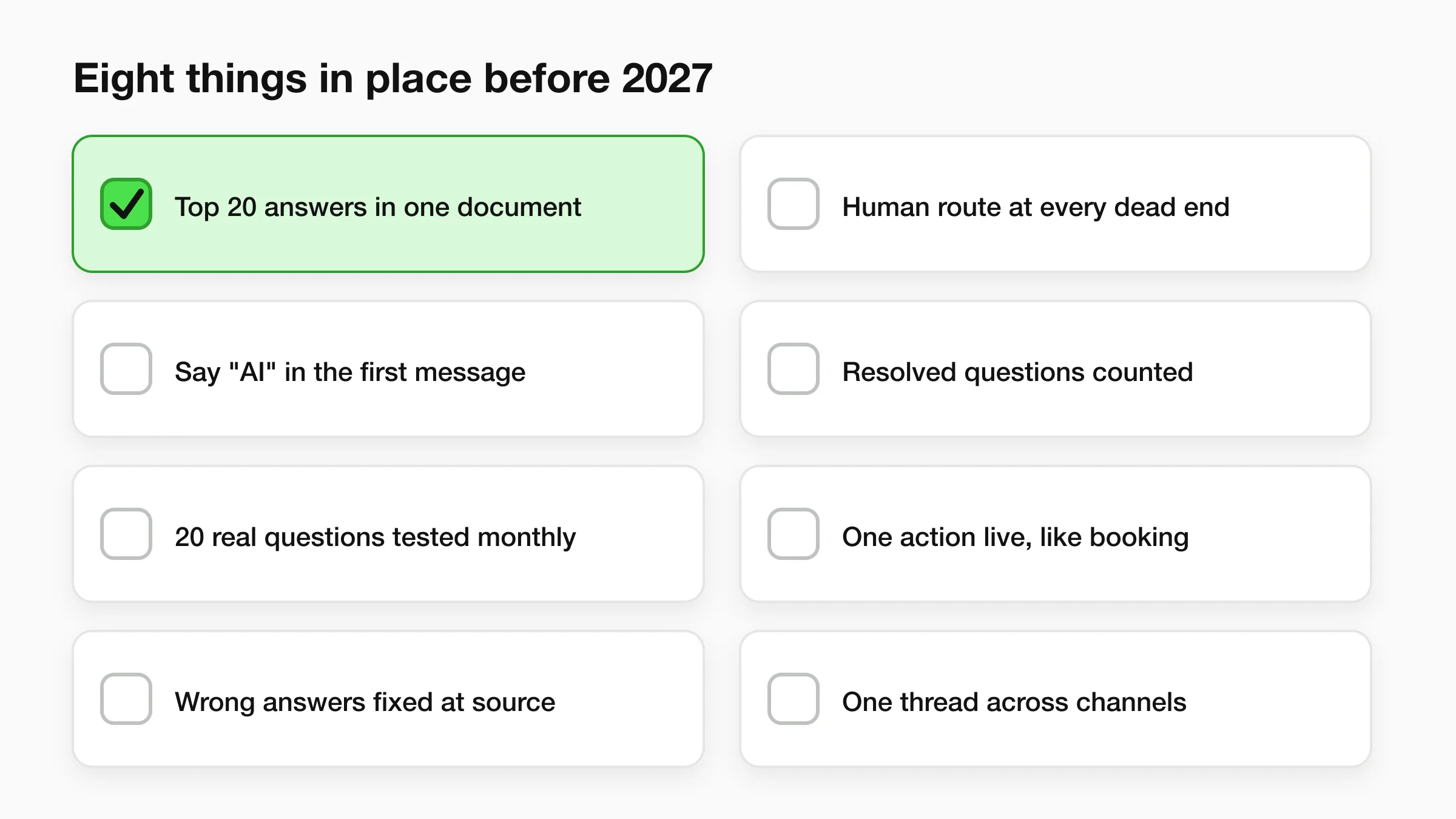
- Write your top 20 answers in one document. Plain sentences, with exceptions and what you do not do.
- Add a human route at every dead end. Say what happens next and when. Name who takes the handoff.
- Say you are an AI in the first message. Do it in every market.
- Count resolved questions. Review twenty conversations a week.
- Test with twenty real questions each month. Use real messages from your inbox, including the awkward ones.
- Put one action live. Booking or a lookup, not payments.
- Fix wrong answers at the source. Change the document, not the single reply.
- Keep one thread across channels. Website chat, WhatsApp, Instagram DM and Messenger answer from the same knowledge.
The one-hour version
If you only have an hour this week: write the twenty answers, add one line telling people how to reach a human, and read ten recent conversations. Those three steps cover trends 3, 4, 7, 8 and 9.
What the research does not tell you
Most of this evidence comes from larger organizations and from surveys. Salesforce, Zendesk and Intercom sell AI service tools, and Salesforce's case-share figures are the estimates of service teams, not audited results. Gartner's 80%-by-2029 figure is a forecast. Two Gartner findings do not sit comfortably with the adoption stories: customers are using outside AI tools far more than company chatbots, and few will give a failed chatbot a second try.
The honest reading is that AI service works when it is narrow, grounded in your own documents and backed by people. It disappoints when it is broad, vague and a wall. For a deeper look at how the pieces fit together, see our page on conversational AI for customer service and the AI front desk overview.
Frequently Asked Questions
What are the biggest customer service trends in 2026?
The biggest trends are AI agents resolving routine questions, customers using outside AI tools like ChatGPT before contacting you, and a growing demand for a human option. Gartner's 2026 research found 87% of customers say access to a human matters when a company uses GenAI, and Salesforce reports 66% of service organizations now use agentic AI.
What are the customer service trends for 2027?
Expect the 2026 trends to deepen: more AI actions such as booking and lookups, more third-party AI assistants acting for customers, and stricter disclosure rules. Gartner forecasts agentic AI will resolve 80% of common issues without human intervention by 2029. Treat that as a direction. The 2027 preparation for a small business is the checklist above.
What is the future of customer service for small businesses?
The future of customer service for a small business is AI answering routine questions on every channel at any hour, with a person for everything else. The work moves from answering the same questions to maintaining accurate knowledge, handling unusual cases and checking that the agent is resolving problems.
Will AI replace human customer service agents?
Not entirely. Gartner predicts that by 2028 no Fortune 500 company will fully replace human customer service staff with AI, and 85% of service leaders report adding tasks to human roles. AI absorbs routine questions; people take complaints, quotes and judgment calls. See our fuller answer in will AI replace customer service.
Do I have to tell customers they are talking to an AI?
In the EU, Article 50(1) of the AI Act requires that people be told they are interacting with an AI system, unless it is obvious from context, and that duty applies from 2 August 2026. Outside the EU, telling people anyway is good practice and costs nothing. This is general information, not legal advice.
Which trend should a small business act on first?
Start with knowledge and the human route. Write down your top twenty answers, and make sure every conversation has a way to reach a person. Those two changes address reliability, handoff and disclosure together, and they take days, not months.
See how an AI front desk handles your questions
Start a trial, paste your site and test the agent with your real hours, pricing and booking questions. Pro and Max add human handoff and native booking.
Start for freeSources
- Salesforce, State of Service: AI Agents Edition (2026) and State of Service 2025
- Gartner, customers three times more likely to use third-party GenAI (July 2026) and only 27% would retry a chatbot (September 2026)
- Gartner, only 14% of issues fully resolved in self-service (August 2024)
- Gartner, AI spending up 38% against 2% budget growth (August 2026)
- Zendesk, CX Trends 2026
- Intercom, 2026 Customer Service Transformation Report
- Qualtrics, 2026 Consumer Experience Trends
- EU AI Act, Article 50
Related Articles
View all
Strategy24 min read
The State of AI Customer Service for Small Businesses 2026
50+ sourced statistics on AI chatbot adoption, response times, ROI, and customer preferences — the definitive 2026 data guide for small business owners and operators.
Strategy17 min read
What Missed Calls Really Cost Your Small Business
A worked example of what missed calls cost small businesses in lost jobs, plus where inquiries actually arrive now and what to do about it.
Strategy21 min read
Customer Service Automation Statistics 2026 (Full Guide)
Customer service automation statistics for 2026. Chatbot adoption rates, AI impact on support, cost savings, and satisfaction metrics.
Strategy21 min read
AI Receptionist Cost in 2026: What You Actually Pay
AI receptionist cost ranges from $20/month for automated voice AI to $300+/month for live-agent phone answering. Full breakdown by category.