Guide
Agentic AI vs Generative AI: What Changes for SMBs
Agentic AI vs generative AI explained: a comparison table, a small-business example of each, where the line blurs, and how to judge agentic claims.

Gopi Krishna Lakkepuram · Founder & CEO
· 19 min read
TL;DR: Generative AI produces content when you ask for it: a reply, a summary, an image, a block of code. Agentic AI pursues a goal across several steps. It decides what to do next, uses tools such as a calendar or one of your APIs, remembers what happened earlier in the task, and keeps going until the goal is met or it needs a person. Most agentic systems use a generative model inside, so the two are layers of one stack, not rivals. For a small business, the practical test is simple: does the system only write words, or does it also do something with them, such as book the appointment, look up the order, or send your team a brief?
How this fits with our other guides
This article compares generative and agentic AI. For how generative AI relates to conversational AI, see conversational AI vs generative AI. For agents versus rule-based and LLM chatbots, see AI agents vs chatbots and the shorter AI agent vs chatbot page. For the deployment playbook, see generative AI for customer service.
Agentic AI vs generative AI is mostly a question about the verb. Generative AI writes. Agentic AI works. A generative tool turns a prompt into one output and stops. An agentic system takes a goal, such as "get this enquiry booked," and carries out the steps itself, checking results as it goes. The rest of this guide shows what that means in practice: a side-by-side table, the same customer message handled both ways, where the line gets blurry, the risks agentic systems add, and how to tell a real agent from a relabelled chatbot.
What Is Generative AI?
Generative AI is software that creates new content from a prompt. The content can be text, images, audio, video or code. It runs on a model trained on large amounts of data, and the model predicts what should come next based on your input.
The defining trait is the shape of the interaction: you ask, it produces, it stops. A draft email, a product description, a summary of a long document and a first pass at a logo are all generative outputs. A person then reads the result, edits it, and decides what to do with it.
That last step matters. In a pure generative workflow, a human sits between the output and the world. The model never sends the email, never changes the calendar, never touches your systems. It has no tools. If it gets a fact wrong, the error stays on your screen until you catch it.
Typical small-business uses include drafting a reply to a review, writing headline variants, and summarizing a supplier contract.
Generative AI is useful, and for most of these jobs it is all you need. The limits show up when the job is not "produce a thing" but "get a thing done."
What Is Agentic AI?
Agentic AI is software that works toward a goal across multiple steps, choosing its own actions along the way. It uses a generative model to reason and write, and adds three things the model lacks on its own: tools, memory and a loop.
Anthropic's engineering team draws a useful line in its guide on building effective agents. Workflows are "systems where LLMs and tools are orchestrated through predefined code paths." Agents are "systems where LLMs dynamically direct their own processes and tool usage." That distinction is worth keeping in your head. A fixed sequence of AI steps is automation. A system that decides its own next step is closer to an agent.
The three ingredients, in plain terms:
- Tools. The system can act outside the chat box: read a calendar, call an API, send a notification, look up a record.
- Memory. It keeps the state of the task. It knows the customer already gave a postcode, that the first time slot was declined, and that a question is still unanswered.
- A loop. It chooses an action, sees the result, and chooses again. If a slot is taken, it offers another. If the answer is not in the documents, it says so and hands the conversation to a person instead of improvising.
None of this needs the system to be "autonomous" in the science-fiction sense. In a business setting, the useful agent is a bounded one: it has a goal, a short list of things it is allowed to do, and clear points where it stops and asks a human.
Agentic AI vs Generative AI: Side-by-Side Comparison
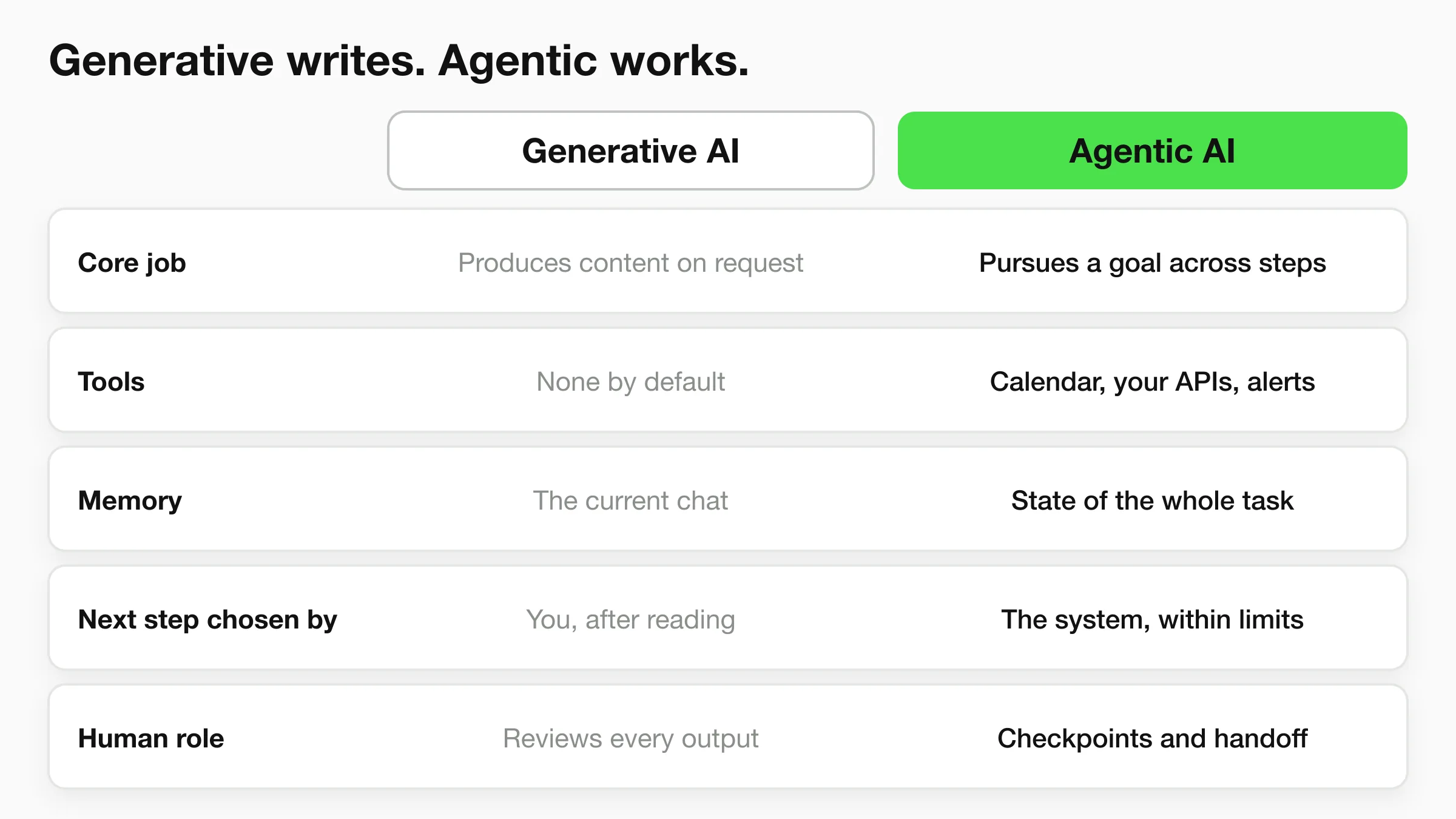
The table compares the two across the dimensions that matter when you are choosing what to buy or build.
| Dimension | Generative AI | Agentic AI |
|---|---|---|
| Core job | Produce content on request | Pursue a goal across steps |
| Unit of work | One prompt, one output | A task that may take many actions |
| Who decides the next step | You, after reading the output | The system, within limits you set |
| Tools | None by default; it only returns text, images or code | Calendar, your APIs, notifications, search, files |
| Memory | The current prompt and chat history | Task state: what is done, what is pending, what the customer said |
| Human position | Between every output and the real world | At defined checkpoints, plus handoff when the system is stuck |
| Failure mode | A wrong or off-brand draft you can read before using | A wrong action: a bad booking, a wrong lookup, a message sent to the wrong person |
| Where it shows up | Writing assistants, image tools, code completion | Customer-facing front desk agents, ticket handlers, research and ops assistants |
| What to check before buying | Output quality, brand fit, data handling | Permissions, action logs, limits, handoff, and what happens when it is wrong |
| Small-business example | Draft a reply to a customer who asked about pricing | Answer the customer, qualify the enquiry, book the visit and brief your team |
The one-line test
Ask what the system does after it writes. If the answer is "nothing, you copy it somewhere," it is generative. If the answer is "it books, looks up, updates or notifies," it has agentic behaviour.
One Customer Message, Handled Both Ways
Abstract definitions are easy to nod along to and hard to apply. So here is a single message handled by each approach.
The scenario (illustrative, not a customer case study): A small HVAC company in the US gets this message through its website chat at 9:40 p.m.: "Our AC stopped and the house is at 88 degrees. Can someone come tomorrow morning? And is the diagnostic fee credited if we go ahead with the repair?"
The generative approach
The owner, or a staff member the next morning, pastes the message into a writing assistant and asks for a polite, friendly reply. The model produces a good draft. It reads well. It might even sound like the company.
Then the human work begins. Someone has to check the fee policy, open the calendar, ask for the address and system type, send the message, and follow up when the customer replies at 6 a.m. The tool saved a few minutes of typing and none of the coordination. That is not a flaw in generative AI. It is a different job.
The agentic approach
An agent connected to the company's documents, calendar and workflow handles the same message like this:
- Answers the fee question from the company's own documents. The pricing and policy pages are the source, so the reply states the actual diagnostic fee rule rather than a plausible guess. If the documents do not cover it, the agent says it will pass the question to the team.
- Asks the qualifying questions the team always asks. What is the postcode? Is it a central system or a window unit? Is anyone in the home elderly or unwell?
- Checks live availability and offers real times. It reads the booking calendar and offers open slots tomorrow morning instead of "we will get back to you."
- Books the visit. The customer picks a time and the booking is created in the conversation, with a calendar invite sent by email.
- Hands over what needs a person. If the customer mentions a safety concern, such as a burning smell, the agent routes the conversation to your team instead of continuing alone.
- Briefs the team after the conversation. A summary lands in the right inbox: who, where, what failed, what was booked.
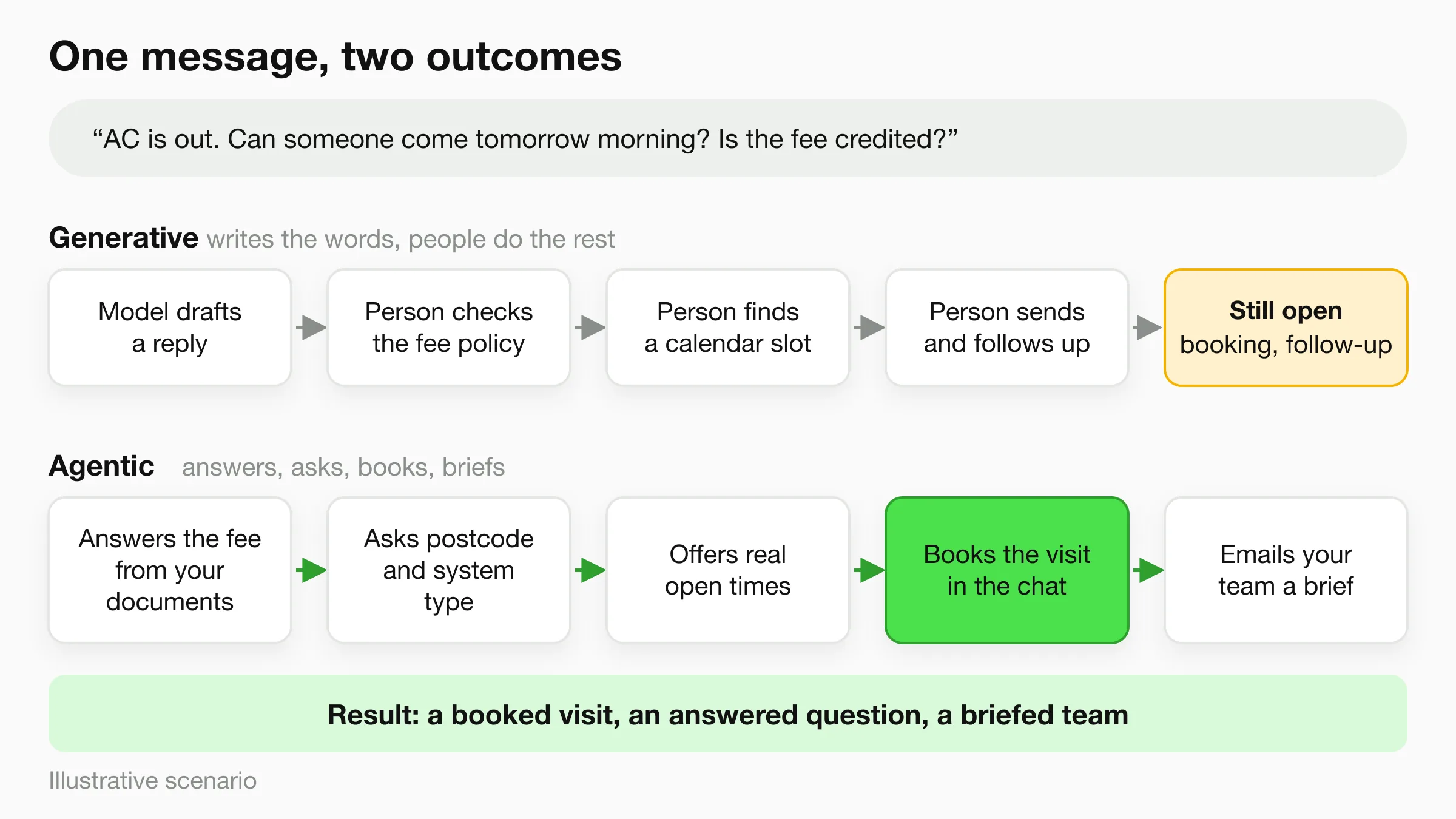
Both versions use a language model to write the words. The difference is everything around the writing: documents to answer from, tools to act with, and a defined path to a finished outcome.
The agent is only as good as its permissions
Notice what the agent did not do. It did not decide how to price the job, promise a technician arrival time you cannot keep, or diagnose the fault. Giving an agent fewer, clearer powers is how you keep it useful and safe. More on that below.
Agentic AI Examples for Small Businesses
"What is agentic AI" gets clearer when you see it in familiar jobs. These five are realistic for small teams today, and each follows the same pattern: goal, tools, checkpoint.
1. Booking agent for a clinic or salon. Goal: a booked appointment. Tools: a scheduling link or calendar. Checkpoint: questions about medical advice or pricing exceptions go to staff. See the dental agents page for a dental practice.
2. After-hours enquiry handler for a home-services company. Goal: a qualified, scheduled job. The agent collects address, problem type and urgency, offers visit times, and flags anything urgent for your team. Our HVAC walkthrough goes through it step by step, and the home services agents page shows the setup.
3. Order-status lookup for an online store. Goal: a correct answer about where an order is. Tool: a call to the store's own order API. Checkpoint: refund requests go to a person.
4. Lead qualification for a real-estate team. Goal: a lead with the details an agent needs, such as area, budget range and timeline. The agent asks in conversation and passes a summary to the team. See lead qualification chatbot.
For more worked examples across industries, see these AI agent use cases. In every case a person still owns the decisions that spend money, sign contracts or make promises. The agents that work well in small businesses handle the repetitive front of a process.
Where the Line Between Generative and Agentic Blurs
The two terms describe a spectrum more than two boxes, and vendors know it. A few cases that cause confusion:
A chatbot that answers from your documents. It is generative (a model writes each reply) and it has one tool (retrieval from your knowledge base). Is that agentic? It has a small piece of agentic behaviour, because it decides what to look up before answering. But it pursues no multi-step goal. Most people would call it a grounded generative assistant, not a full agent.
A fixed workflow with an AI step. A flow that always runs the same five steps and uses a model to write the third is a workflow, because the path is predefined. It can be very useful. It just does not pick its own path.
So "is it agentic?" is the wrong yes-or-no question. A better one is: how many steps does it carry out on its own, with which tools, and where does a person step in? That question also protects you from the main risk in this market, covered in the evaluation section below.
Risks Agentic AI Adds, and Guardrails That Contain Them
Generative AI has a familiar risk: it can write something wrong, and a person usually sees it first. Agentic AI adds a second kind of risk. A wrong answer becomes a wrong action, and actions have side effects.
The same Anthropic guide notes that agentic systems "trade latency and cost for better task performance" and carry "the potential for compounding errors." One mistaken step early in a task can carry into every later step. Here is how that plays out for a small business, and the control that answers each risk:
| Risk | What it looks like | Guardrail |
|---|---|---|
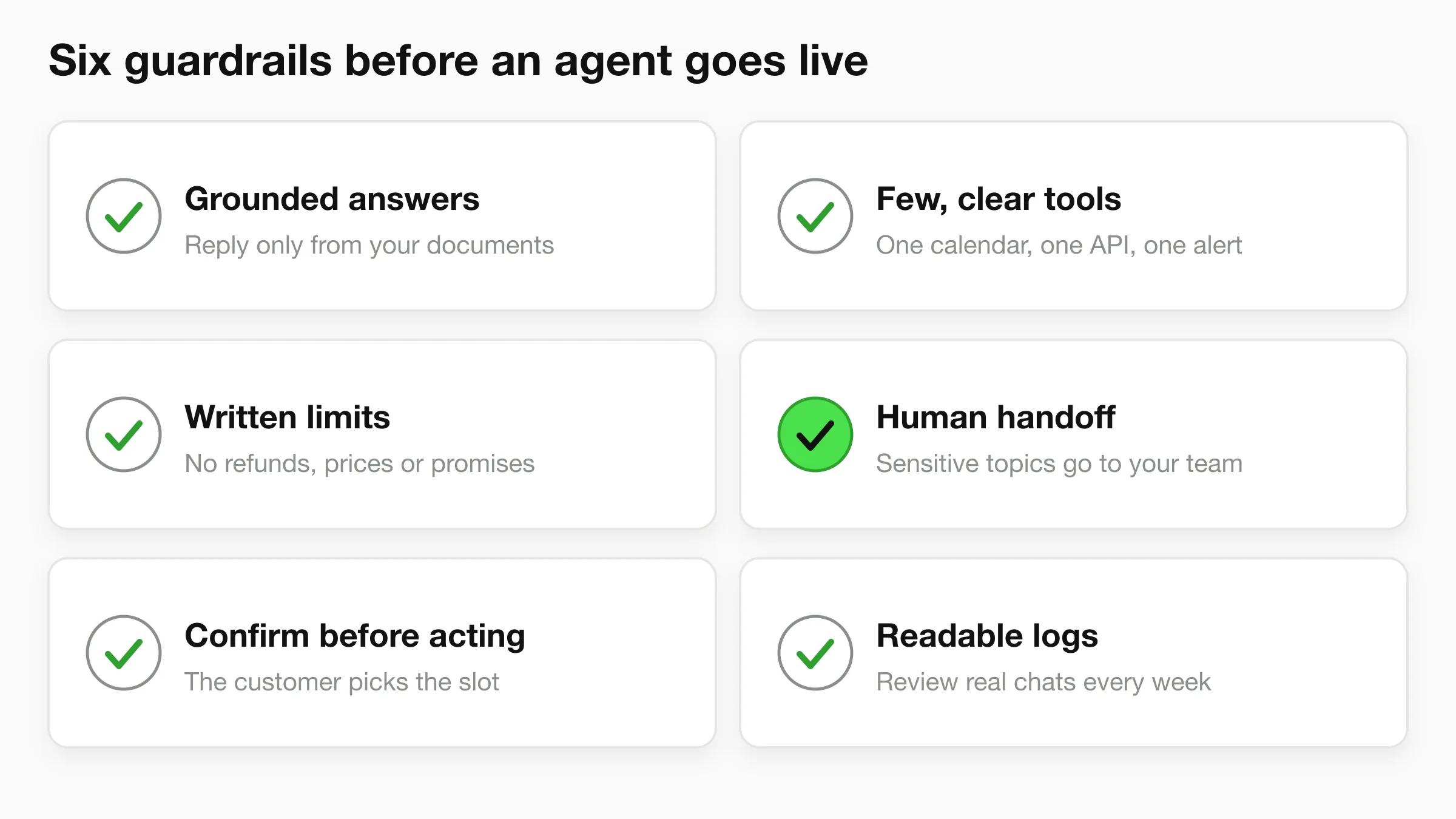
| Wrong facts | The agent states a policy or price that is not true | Answer only from your documents; say "I'm not sure" and hand off when the answer is not there |
| Wrong action | A booking in the wrong slot, a lookup against the wrong customer | Limit the tools, require confirmation before an action, and review the conversation log |
| Overreach | The agent promises a refund, a discount or an arrival time | Write the limits into its instructions; give it no tool that can grant them |
| Sensitive topics | Medical, legal or financial questions | Route to your team; never let the agent give advice |
Gartner's research on this topic is a useful reality check. In a June 2025 press release, Gartner predicted that more than 40% of agentic AI projects will be canceled by the end of 2027, citing escalating costs, unclear business value and inadequate risk controls. That is a forecast about enterprise projects, not a verdict on small-business tools. The lesson still carries over: the projects that survive have a narrow goal, clear controls and a way to show value.
Three habits cover most of the risk for a small team:
- Start narrow. One goal (book the enquiry), a handful of tools, a clear boundary.
- Keep a person in the loop for exceptions. The agent handles the routine. Your team handles refunds, complaints, safety and anything unusual. Our guide to chatbot human handoff best practices covers the triggers.
- Read the logs. Review real conversations weekly at first. You learn what customers actually ask and where the agent needs tighter instructions.
How to Evaluate "Agentic" Claims
By 2026, "agentic" is on almost every vendor homepage. Gartner calls the habit of relabelling existing chatbots, automation tools or assistants as agents "agent washing." The same press release says that only a small share of the many vendors claiming agentic capability offer it for real. You do not need to take a position on how many. You need a way to check any one vendor.
Ask these seven questions, and ask for a demonstration, not a slide:
- What goal does it pursue, and what counts as done? "Answers questions" is generative. "Books the enquiry" is a goal.
- Which tools can it use? Ask for the specific list. A calendar, your API, a notification. If the list is empty, there is no agent.
- Who sets the steps? If every conversation follows a script you drew, that is a workflow. Workflows are fine. Just price them as workflows.
- What can it not do? A good vendor answers this immediately and in detail.
- Where does a person step in? Look for human handoff, pause controls and a way to take over a live conversation.
- What does the log show? You should be able to see what it said, what it looked up and what it did.
- What does it cost when it works? Ask whether pricing is per response, per seat or per action, and what the add-ons are.
A quick demo script
Give the vendor three real messages from your inbox: one easy, one that needs a booking, and one that your documents do not cover. Watch what happens on the third. A good agent says it does not know and routes to a person. A weak one makes something up.
How Hyperleap Applies Agentic Steps in Customer Conversations
Hyperleap is an AI front desk for small businesses. The agent answers on your website, WhatsApp, Instagram DM and Facebook Messenger. It is a bounded agent, built around the conversation, and it does the following today:
- Answers from your documents. Responses draw on the knowledge you attach, so the fee policy in the HVAC example comes from your page, not from the model's general knowledge.- Asks qualifying questions. You write the questions your team asks, and the agent collects the answers and captures the contact details as part of the chat. It does not score leads.
- Books through Calendly or Cal.com. On Pro and Max, the agent reads live availability, offers real open times and creates the booking in the conversation. In-chat booking with Calendly needs a Calendly Standard plan or higher, and it creates new bookings only: customers use the links in their confirmation email to cancel or reschedule. On Plus, the agent shares your booking link instead.
- Calls your APIs through Actions. An AI chatbot that takes actions works this way. On Pro and Max, you can connect up to 10 Actions per chatbot, such as an order lookup or a ticket submission. The calls run server-side against your own HTTPS endpoints, and credentials stay encrypted.
- Hands off to a person. On Pro and Max, visitors can ask for a human, your team is alerted in Studio, and any teammate can take over a live conversation and hand it back.
- Runs the Agentic Workflow after the conversation. On Pro and Max, an AI step follows your instructions once a chat ends and emails the right people inside your business. It is email only for now.
What this does not do matters as much. The agent does not process payments, diagnose problems, or give medical or legal advice. It routes those to your team.
For the plan breakdown, see pricing. For the wider picture of how these pieces fit together as a front desk, see the AI front desk overview and the AI agents page.
See an agent handle a real enquiry
Paste your website URL, review the starting prompt Studio generates, and watch the agent answer, qualify and (on Pro and Max) book. Plans start at $40/mo with a 7-day free trial.
Start for freeWhich One Do You Need?
Most small businesses end up using both. Use generative AI when the output is the product: copy, reply drafts for review, summaries, images. Use agentic AI when the outcome is the product: an enquiry becomes a booking, a question becomes a lookup, a finished conversation becomes a briefing.
Start with the repeated job: the message your team answers over and over that ends with someone checking a document, opening a calendar or forwarding a note. That handoff is your first agentic step.
Frequently Asked Questions
What is the difference between agentic AI and generative AI?
Generative AI creates content from a prompt and stops. Agentic AI pursues a goal across several steps, using tools and memory to decide what to do next. Agentic systems usually contain a generative model, so generative AI is often a component of agentic AI rather than an alternative to it.
What is agentic AI in simple terms?
It is AI that does a task, not just writes about it. Give it a goal such as "book this customer," and it asks the questions it needs, checks your calendar, creates the booking and reports back. A generative tool alone would only write the words.
Is ChatGPT generative or agentic?
A plain chat with a language model is generative: you prompt, it responds. Once such a model is given tools (browsing, file access, connected apps) and allowed to take multiple steps toward a goal, that setup shows agentic behaviour. The label depends on how the product is configured, not on the model's name.
Are AI agents the same as agentic AI?
Closely related. "Agentic AI" describes the approach or capability: systems that act toward goals. An "AI agent" is a specific system built that way. In practice the terms are used almost interchangeably, so judge a product by what it does, not which word it uses.
Is agentic AI safe for customer-facing use?
It can be, with limits. Keep the agent's goal narrow, answer only from your own documents, restrict its tools, and provide a human handoff for anything sensitive or unusual. Review conversation logs regularly. No system is error-free, so plan for mistakes and make them easy to catch and correct.
Does a small business need agentic AI, or is generative AI enough?
Generative AI is enough if you only need drafts, summaries or images. Agentic AI pays off when your pain is follow-through: enquiries that arrive after hours, bookings that need coordinating, or answers that require looking something up. If your team spends its time copying information between tools, look at agentic steps.
Does Hyperleap use agentic AI?
Hyperleap's agent carries out several steps inside a customer conversation: it answers from your documents, asks your qualifying questions, can book through Calendly or Cal.com, can call your own APIs through Actions, and can run a follow-up workflow after the chat. Booking, Actions, handoff and the Agentic Workflow are on Pro and Max. It is a bounded agent, and your team stays in charge of decisions.
Put agentic steps on your front desk
Answer from your documents, qualify enquiries and book the visit across your website, WhatsApp, Instagram DM and Facebook Messenger. Booking, Actions and the Agentic Workflow are on Pro and Max. 7-day free trial on all plans.
Start for freeIndustry Solutions
See how AI chatbots work for these industries:
Related Articles
View all
Guide16 min read
Conversational AI vs Generative AI: A Business Guide
Conversational AI vs generative AI explained: how they relate, a comparison table, risks and controls, and what a small business actually buys.
Guide19 min read
Generative AI for Customer Service: A Practical Guide
Generative AI for customer service explained: how RAG-grounded agents work, what benefits they deliver, hallucination risks to manage, and implementation steps for SMBs.
Guide22 min read
Chatbot-to-Human Handoff: Escalation Design That Works
How to design chatbot-to-human handoff: when to escalate, what context to pass, routing options, SLAs, and a copy-ready escalation script.
Guide20 min read
Restaurant Booking APIs for AI Agents: What Connects
How OpenTable, Resy, SevenRooms, and Tock expose booking data, the two ways an AI agent can connect, and what Hyperleap ships for restaurants today.