Guide
Types of Chatbots: 6 Kinds With Examples (2026)
The types of chatbots by how they work, what they do and where they run, with one comparison table and a guide to picking one for a small business.

Gopi Krishna Lakkepuram · Founder & CEO
· 17 min read
TL;DR: There are six types of chatbots, and the difference is how each one decides what to say: menu or button bots, rule or keyword bots, retrieval or FAQ bots, generative bots, RAG-grounded bots and agentic bots. You can also sort chatbots by purpose (support, sales, booking, internal help, commerce) and by channel (website, WhatsApp, Instagram DM, Messenger, voice, in-app). For most small businesses the best fit is a RAG-grounded bot that answers from your own documents, plus a few agentic steps like booking and handing off to a person.
The word "chatbot" covers software that is almost nothing alike. A pizza shop's "tap 1 for the menu" widget and a bot that reads your policies, checks open appointment slots and books a visit are both called chatbots. This guide separates the types of chatbots so you can tell which one a vendor is selling and which one your business needs.
The six types of chatbots, by how they work
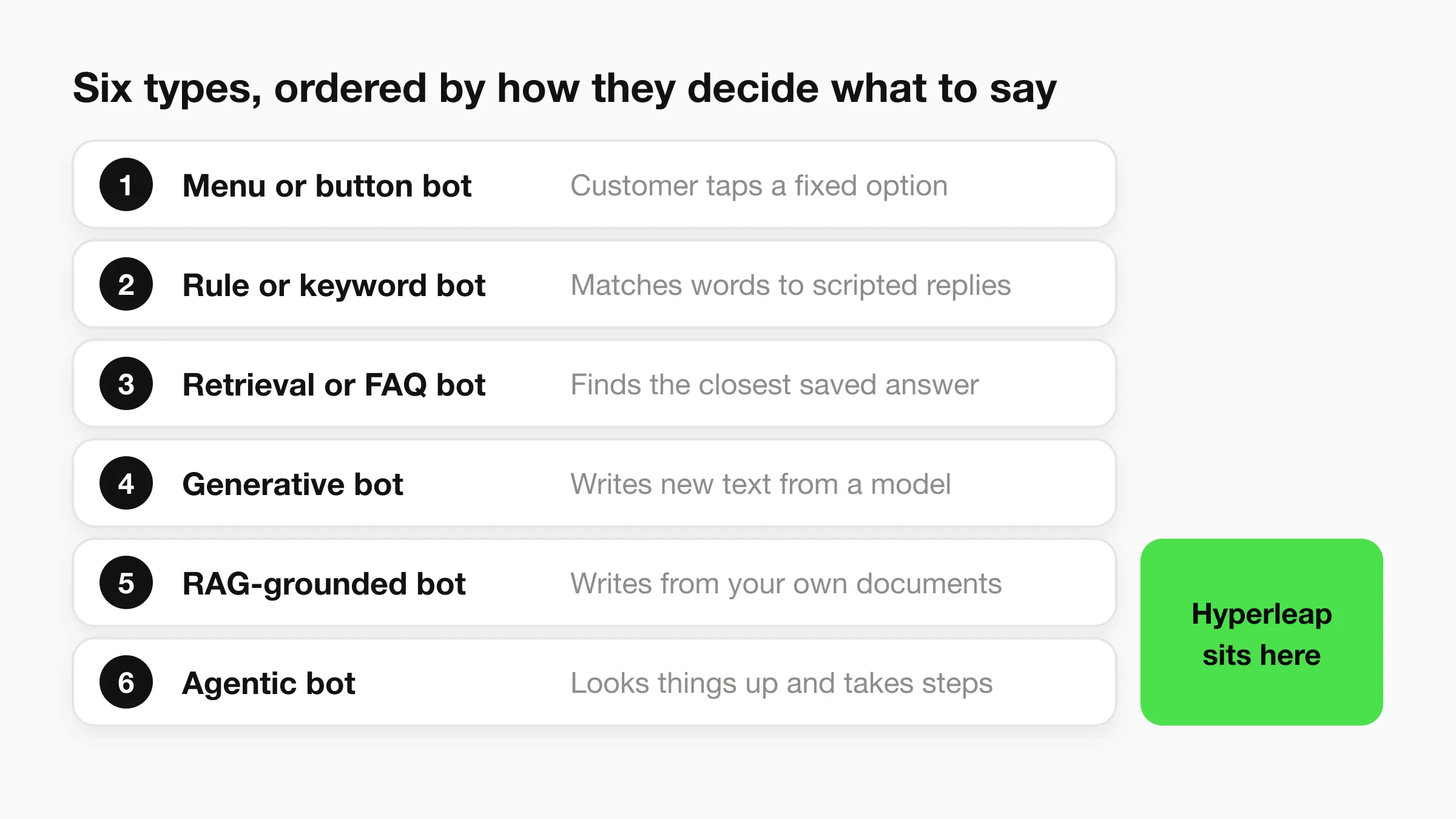
The most useful way to sort the different types of chatbots is by how the bot chooses its reply. That choice decides what it can answer, how it fails, and how much work it takes to keep running. The six types below run from the most scripted to the most flexible.
1. Menu or button chatbots
A menu chatbot shows the customer a fixed set of options and follows a decision tree. The customer taps "Opening hours", "Book a table" or "Talk to us", and the bot shows the next set of options. There is no language understanding at all, which makes it predictable and cheap to build.
The limit is the first off-menu question. If someone types "Do you have a gluten-free base for kids?" into a menu bot, it has nowhere to send them. Menu bots suit businesses with three to five repeat requests and nothing more.
2. Rule-based or keyword chatbots
A rule-based chatbot reads the customer's typed message and looks for trigger words. If the message contains "refund", it sends the refund text. If it contains "price" and "delivery", it sends the delivery price list. Joseph Weizenbaum's ELIZA, built at MIT in the mid-1960s, scanned input for ranked keywords and filled in scripted templates (Weizenbaum, 1966).
Rules handle typed text, which is a step up from menus. They fail on phrasing the author did not predict. "Can I get my money back?" has no keyword match if you only wrote a rule for "refund". Every new phrasing needs a new rule, so the rulebook grows until nobody wants to touch it.
3. Retrieval or FAQ chatbots
A retrieval chatbot stores a list of question-and-answer pairs and matches each incoming question to the closest saved question. It then returns the stored answer word for word. The matching is fuzzier than keywords, so "money back" can find your refund answer.
The strength is control: the bot only says what you wrote. The limit is the same thing seen from the other side. It can only answer questions someone already wrote an answer for, and it cannot combine two facts, such as "Is the Saturday class beginner-friendly and is there parking?"
4. Generative chatbots
A generative chatbot uses a large language model to write a new reply to each message. It handles unusual phrasing, follows a conversation, and can answer in the customer's language. This is what most people mean by "AI chatbot" today. For the longer definition, see our guide on what an AI chatbot is.
On its own, a generative model answers from its general training, not from your business. Ask it your cancellation window and it will produce a fluent, plausible answer that may not match your policy. That is why a bare generative bot is a poor fit for a business that answers to customers about prices, hours and policies.
5. RAG-grounded chatbots
A RAG-grounded chatbot looks up the relevant passages in your own documents first, then asks the model to write the reply from those passages. RAG stands for retrieval-augmented generation, a method described in a 2020 paper by Patrick Lewis and colleagues (Lewis et al., 2020). The model still writes natural sentences, but the facts come from your pages, PDFs and policies.
This fixes the main problem with a bare generative bot. When you change your price list, the answers change when the document changes. Grounding makes wrong answers less likely and easier to trace. It does not make them impossible, so you still read conversations and fix gaps in the documents. We explain the idea in more depth on our RAG chatbot page.
6. Agentic chatbots
An agentic chatbot can do things, not just say things. It decides on a next step, such as looking up an order, checking open appointment slots, creating a booking, passing the chat to a person or sending a summary to your team. These steps run through tools the bot is allowed to use.
The limit is that every tool is something to set up, test and restrict. The usual build is a RAG-grounded bot with a short list of permitted actions on top. For the wider debate, see AI agent vs chatbot.
Types of chatbots compared: one table
Here are the six types side by side, using the same criteria. The "example" column describes a small-business scenario for each, not a named product.
| Type | How it works | Strengths | Limits | Best for | Example |
|---|---|---|---|---|---|
| Menu or button | Customer taps fixed options in a decision tree | Predictable, quick to build, no wrong answers | Cannot take a typed question, dead ends off-menu | 3 to 5 repeat requests | A pizza shop widget: Menu, Hours, Order |
| Rule or keyword | Trigger words map to scripted replies | Handles typed text, cheap, fully scripted | Misses rephrased questions, rulebook grows | A short list of predictable questions | A gym bot that replies to "price" with the plans page |
| Retrieval or FAQ | Matches the question to the closest saved Q&A | Only says what you approved, handles rephrasing | Cannot answer unwritten questions or combine facts | A stable FAQ of 20 to 50 answers | A clinic FAQ bot for parking and opening hours |
| Generative | A language model writes each reply | Natural, multilingual, follows context | Answers from general training, may invent business facts | General conversation, drafting, brainstorming | A general-purpose assistant with no business documents |
| RAG-grounded | Retrieves passages from your documents, then writes from them | Answers reflect your content, updates when documents change, traceable | Only as good as your documents, still needs review | Customer questions about prices, policies, services | A dental practice bot answering from its treatment pages |
| Agentic | Decides next steps and uses connected tools | Looks up data, books, routes, notifies | Tools need setup, testing and limits | Conversations that end in an action | A salon bot that offers real open slots and books one |
Read the "Limits" column first. Each type is right for some businesses and wrong for the next.
Rule-based vs AI chatbot: where the line falls
The difference between a rule-based chatbot and an AI chatbot is who wrote the reply. In a rule-based bot, a person wrote every reply in advance and the bot only picks one. In an AI chatbot, a model composes the reply from what the customer said and, in a grounded bot, from your documents.
Types 1 to 3 are rule-based in this sense, even though type 3 uses smarter matching. Types 4 to 6 are AI chatbots. Our conversational AI vs chatbot post covers how those two labels differ, and why vendors blur them.
Rule-based bots still earn their place. They are the right choice when the allowed answers are few, when every word must be pre-approved, or when wrong answers carry legal weight. The practical test: type a question your business has never written down. A rule-based bot says "Sorry, I didn't understand". A grounded AI bot answers from your documents, or says it does not have the information and offers a person.
Types of chatbots by purpose
The same technology gets pointed at different jobs. Purpose changes what a chatbot needs to be good at, so check the job first and the technology second.
Customer support chatbots
A support chatbot answers questions from existing customers and prospects: hours, policies, delivery, how a service works. This is where RAG-grounded bots do best, because the answers already live in your documents. See customer support chatbots for how the setup works.
Sales and lead generation chatbots
A lead generation chatbot talks to visitors who are still deciding. It answers their questions, asks a few qualifying questions, and collects contact details so your team can follow up. Our chatbot lead generation page covers the flow.
Booking and scheduling chatbots
A booking chatbot gets a customer to a confirmed time. It needs live availability, which makes it an agentic type: a bot that only describes your hours is not a booking bot. Many "booking" bots only link to a calendar page, so ask which one you are buying.
Internal and HR chatbots
An internal chatbot answers employee questions about leave, expenses, IT access and policies, usually inside a company's own tools. It is a different product category from a customer-facing bot, because access control and the document set are the hard parts. Hyperleap is built for customer-facing conversations, so if the job is an HR helpdesk, evaluate tools designed for that.
Commerce chatbots
A commerce chatbot helps shoppers before and after they buy: product questions, sizing, shipping and returns policies, and "where is my order?" lookups. The lookup is an agentic step, since it needs a connection to your order system. Be precise about what a bot does at checkout. Taking a payment inside a chat is a separate build, and many stores send the shopper to their normal checkout page instead.
Types of chatbots by channel
The channel is where the conversation happens, and it decides who can reach you and what the bot can show. A good bot is not tied to one channel. The same knowledge and rules should answer on every channel you use.
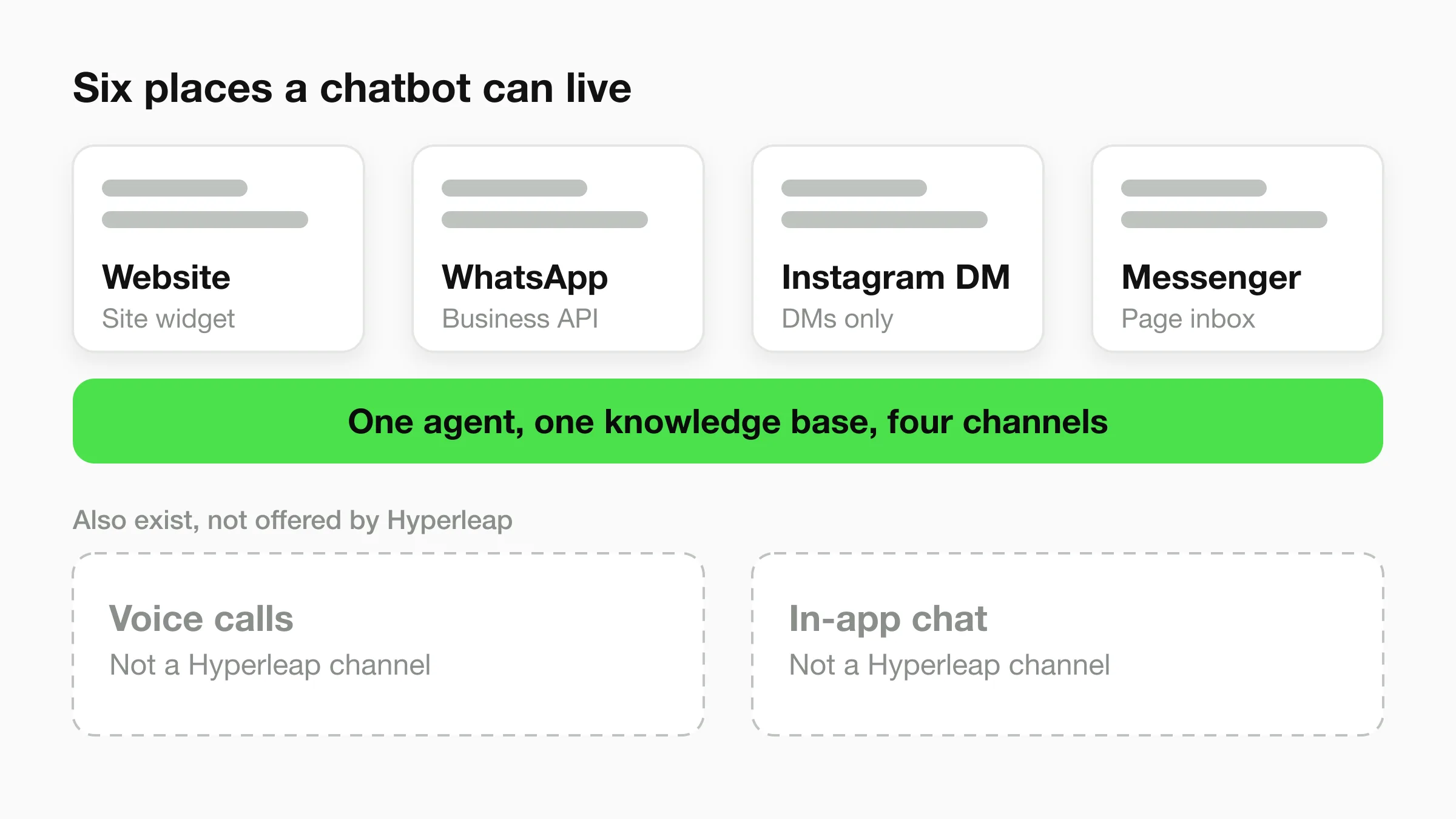
- Website chatbot. A chat widget on your own site. You control the page, the branding and the data, and it reaches visitors who are already reading about you.
- WhatsApp chatbot. Runs on Meta's WhatsApp Business API, so messages come from a business number. Customers pay Meta's WhatsApp fees directly to Meta, separately from the chatbot plan, and Meta changes its pricing, so check Meta's current pricing page before budgeting.
- Instagram DM chatbot. Answers direct messages sent to your Instagram business account. It answers DMs only, not comments on posts.
- Messenger chatbot. Answers messages sent to your Facebook Page. It reaches customers who find you through Facebook search or a Page link.
- Voice chatbot. Answers phone calls in speech. It is a different build because it needs speech recognition, speech output and tight response timing. Hyperleap does not offer voice, and it is on our roadmap, not shipped.
- In-app chatbot. Chat inside your own mobile app. Hyperleap does not offer an in-app channel.
If you are weighing the first four, our channels page shows how one agent covers them, and how the pieces differ in features. Hyperleap AI is a Meta Technology Provider and Business Partner. WhatsApp, Instagram and Messenger run on Meta's official Business APIs.
Which type of chatbot does a small business need?
For most small businesses the answer is a RAG-grounded bot with a few agentic steps, but run the decision yourself in three questions. Start at the top and stop at the first "yes".
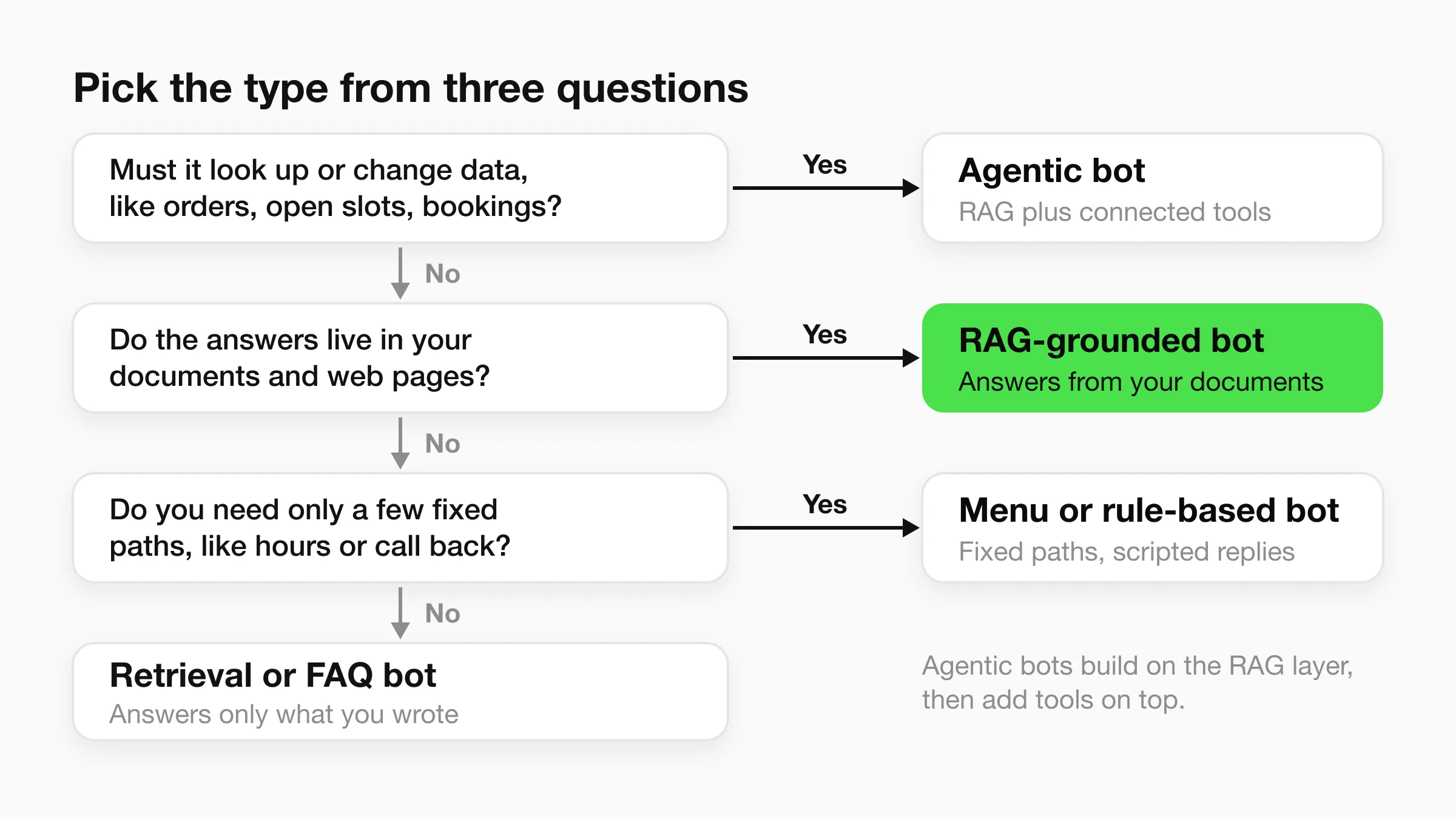
- Does the bot need to look up or change data? If customers ask "Is Thursday at 10 free?" or "Where is my order?", you need an agentic bot. Check which systems it can reach before you buy.
- Do the answers already live in your documents and web pages? If your services, prices and policies are written down, you need a RAG-grounded bot. The setup work is gathering the documents, not writing scripts.
- Do you need only a few fixed paths? If the whole job is "show hours, take a callback request, send a link", a menu or rule-based bot is enough, and it will never say anything you did not write.
If none of those fit, a retrieval FAQ bot covers a stable set of written answers.
Here are three illustrative examples of how this plays out:
- Dental practice. Patients ask about treatments, insurance questions the office can answer, and appointment times. A RAG-grounded bot answers from the treatment pages and routes anything clinical to the team. See dental agents.
- Home services company. Callers want a quote request or a slot. The bot answers service-area questions from your pages, collects the job details and passes them to the dispatcher. See home services agents.
- Online store. Shoppers ask about sizing, shipping and returns, and "where is my order?". The policy answers come from your documents, and the order lookup needs an agentic step.
Whichever type you pick, start with the ten questions your team answers most, and decide in advance what goes to a person: refunds, complaints, anything medical or legal.
See a grounded chatbot answer from your own pages
Paste your website URL and Hyperleap builds a working agent from it. Test it on your real questions before you share it with anyone.
Start for freeWhere Hyperleap fits among the types
Hyperleap AI builds the fifth and sixth types: a RAG-grounded agent with agentic steps, on four messaging channels. It is the AI front desk for small businesses, covering Website chat, WhatsApp, Instagram DM and Facebook Messenger from one agent and one knowledge base. See the AI front desk overview for the full picture.
Grounded answers. On every plan, the agent answers from the knowledge base you give it: your pages, PDFs and policies. You write the guardrails and the fallback message for questions it cannot answer. The conversation log shows which attached sources an answer drew on, so you can trace a reply back to a document. If you run several near-identical locations or courses, multi-variant lets one chatbot answer from the right one and ask which one when a question does not say.
Agentic steps. These are plan-dependent, so here is exactly what you get:
- Booking. On Pro and Max, the agent books through Calendly or Cal.com inside the chat, on all four channels. In-chat booking needs Calendly Standard or higher. It creates new bookings only. It cannot cancel or reschedule, so customers use the links in their confirmation email. On Plus, the agent shares your booking link instead.
- Actions. On Pro and Max, the agent can call your own HTTPS APIs mid-conversation, for example to look up order status or submit a request. It connects to your API. It is not a native integration with whatever system sits on the other end.
- Human handoff. On Pro and Max, visitors can ask for a person, your team is alerted in Studio, and a teammate can take over a live chat and hand it back.
- Agentic Workflow. On Pro and Max, after a conversation ends, an AI step follows your instructions and emails the right people on your team, for example a short brief on a promising enquiry.
What it does not do. Hyperleap has no voice channel and no in-app channel. It does not process payments, and it does not do SMS. Those are either roadmap or out of scope, and we would rather say so than let you find out after you subscribe.
Plans at a glance
Plus is $40/mo, Pro is $100/mo and Max is $200/mo, with a 7-day free trial on all plans and a card required to start. Every plan includes the grounded answers and all four channels. Booking in chat, Actions, human handoff and Agentic Workflow are on Pro and Max. See pricing for the full table.
Five questions to ask any vendor
Whatever you shortlist, these questions cut through labels. Where do the answers come from: your documents, your approved answers, or "our AI"? What happens when it does not know? What can it do, not just say, and on which plan? For WhatsApp, Instagram and Messenger, does the vendor use Meta's official APIs or relay through a third party? And can a teammate take over a live conversation? A vendor who answers all five plainly is worth a trial.
Data sources
- Weizenbaum, J. (1966). "ELIZA, a computer program for the study of natural language communication between man and machine." Communications of the ACM, 9(1), 36 to 45. doi.org/10.1145/365153.365168
- Lewis, P. et al. (2020). "Retrieval-Augmented Generation for Knowledge-Intensive NLP Tasks." arxiv.org/abs/2005.11401
- Hyperleap AI product documentation, plan limits and channel list, November 2026.
Frequently Asked Questions
What are the main types of chatbots?
The main types of chatbots by how they work are menu or button bots, rule or keyword bots, retrieval or FAQ bots, generative bots, RAG-grounded bots and agentic bots. The first three are rule-based, because people write the replies in advance. The last three are AI chatbots, because a language model writes the reply.
What is the difference between a rule-based and an AI chatbot?
A rule-based chatbot picks from replies a person wrote ahead of time, so it only handles what its author predicted. An AI chatbot uses a language model to compose a reply to what the customer actually said. Rule-based bots are more predictable. AI bots handle varied phrasing and follow a conversation.
What are some chatbot types examples for a small business?
A restaurant might use a menu bot with Hours, Menu and Book buttons. A gym might use a keyword bot that sends the plans page when someone types "price". A clinic or salon might use a RAG-grounded bot that answers from its service pages, and add a booking step. A store might add an order-status lookup.
Which type of chatbot is best for customer service?
For most small businesses, a RAG-grounded chatbot is the best fit for customer service, because the answers already exist in your policies and pages. It reads those documents and answers in natural language. Add a human handoff for refunds, complaints and anything sensitive, so a person takes over when judgment is needed.
Is a generative chatbot the same as a RAG chatbot?
No. A generative chatbot writes replies from a language model's general training. A RAG chatbot retrieves passages from your documents first and writes the reply from them, so the facts come from your business. RAG is a way of grounding a generative model, and it makes answers easier to trace to a source.
Can one chatbot work on WhatsApp, Instagram and a website?
Yes, if the platform supports those channels. Hyperleap runs one agent and one knowledge base across Website chat, WhatsApp, Instagram DM and Facebook Messenger. It does not offer voice calls or in-app chat. Customers pay Meta's WhatsApp fees directly to Meta, separately from the Hyperleap plan.
Do I need an agentic chatbot, or is a grounded chatbot enough?
A grounded chatbot is enough if the job is answering questions. You need agentic steps when a conversation should end in an action, such as booking a time, looking up an order or alerting your team. Many small businesses start with grounded answers and add one action later.
Pick the type that fits, then test it
Hyperleap runs a grounded AI agent on your website, WhatsApp, Instagram DM and Messenger. Plans start at $40/mo, with a 7-day free trial.
Start for freeIndustry Solutions
See how AI chatbots work for these industries:
Related Articles
View all
Guide19 min read
Ecommerce Customer Service: A Practical Guide for Stores
Ecommerce customer service for small stores: the six question types you get, how to answer each, policies to publish, and what to automate.
Guide19 min read
How to Build an AI Chatbot for Your Business
How to build an AI chatbot for your business: decide the jobs it should do, gather knowledge, choose channels, test, and go live in under 5 minutes.
Guide21 min read
How to Add an AI Chatbot to an HTML Website
Add an AI chatbot to a plain HTML site with one script tag before </body>. Step-by-step setup, testing, styling, and knowledge base tips.
Guide19 min read
How to Add an AI Chatbot to Shopify (Step by Step)
How to add an AI chatbot to Shopify with a theme.liquid embed — setup steps, Online Store 2.0 notes, and what a Shopify chatbot can and can't access.