Wedding Venue Tour Enquiries: A Question Pack
Prepare better wedding venue tours with questions on date flexibility, guest range, event shape and priorities, plus a copy-ready host handoff.
A couple asks to see your venue. The conversation seems straightforward until the tour host discovers that they need a different event space, their guest count is still moving and the date they mentioned was a preference, not a requirement. The host spends the opening of the visit reconstructing information that could have been captured gently beforehand.
Good wedding venue tour enquiry questions prepare a useful visit without turning the first conversation into a wedding-planning questionnaire. Ask about the decisions that shape the tour: date flexibility, approximate guest range, event format, practical priorities and the people who want to attend. Leave detailed planning, availability decisions and contractual commitments to the appropriate team.
This question pack is designed for an AI front desk and the human host receiving its notes. It contains illustrative dialogue and an original tour brief. It does not claim that chatting reserves a wedding date, checks a live calendar or confirms a tour. Adapt each question to your venue's approved information and actual process.
What a Tour Enquiry Brief Needs to Achieve
A tour enquiry brief should help the host understand why the visitor is coming and what they need to learn. It is not a booking contract, a complete event specification or a score declaring whether a couple is worth speaking to.
The most useful record separates confirmed customer statements from open questions. “Interested in an autumn wedding; dates flexible” is better than assigning a date because the customer mentioned a month. “Expecting roughly a medium-sized gathering; count not settled” is better than turning an early guess into the event's fixed attendance.
Your wedding venue front desk can explain published venue information, collect relevant enquiry context and get the visit booked — in the chat if you schedule tours through Calendly or Cal.com, or by sharing an approved tour-booking link for any other process. Wedding-date availability and confirmation still belong to your team. Keep those responsibilities visible so a warm conversation does not create a false expectation.
| Part of the brief | Why the host needs it |
|---|---|
| Timing and flexibility | Prepare the right date discussion |
| Approximate guest range | Choose which spaces to explain |
| Event shape | Understand ceremony, reception or combined needs |
| Visitor priorities | Focus the walk-through |
| Tour attendees | Prepare a useful conversation |
| Unresolved questions | Bring the right information or colleague |
| Contact preference | Continue through the agreed route |
The general venue-enquiry guide explains broader front-desk uses. This pack goes deeper on one handoff: from initial interest to a tour that has a purpose. A concise brief can help the host avoid asking the same introductory questions while still leaving room for the couple to change their mind.
Make uncertainty an acceptable answer
“Not decided yet” is useful information. Let visitors explore before they have a final date, guest count or budget. Record what is tentative instead of filling the gaps with assumptions.
Questions That Make a Tour Feel Like an Interrogation
Asking for every planning detail immediately
The visitor may simply want to know whether the venue suits their event. Asking for a full schedule, supplier list and detailed finances before answering a basic question is unnecessary. Begin with the customer's actual enquiry and collect the information that changes the next step.
Treating a preferred date as an available date
“We are thinking of June” is a customer preference. It is not availability evidence. Repeat it accurately in the brief, then explain how the team checks dates. Do not let a generated summary change “requested” to “confirmed.”
Assuming who makes the decision
Do not infer relationships, family roles or who pays from names or writing style. Ask who plans to join the tour because the host can prepare accordingly. Keep the language inclusive and optional. The venue needs to host a conversation, not classify a family.
Collecting sensitive information for ordinary practical needs
If someone asks about step-free access or a quiet space, collect the practical feature they want to discuss, not a diagnosis or private personal history. Answer from verified venue information and offer a staff conversation where details need checking. A broad label such as “accessible” should not replace concrete facts about the visitor's actual question.
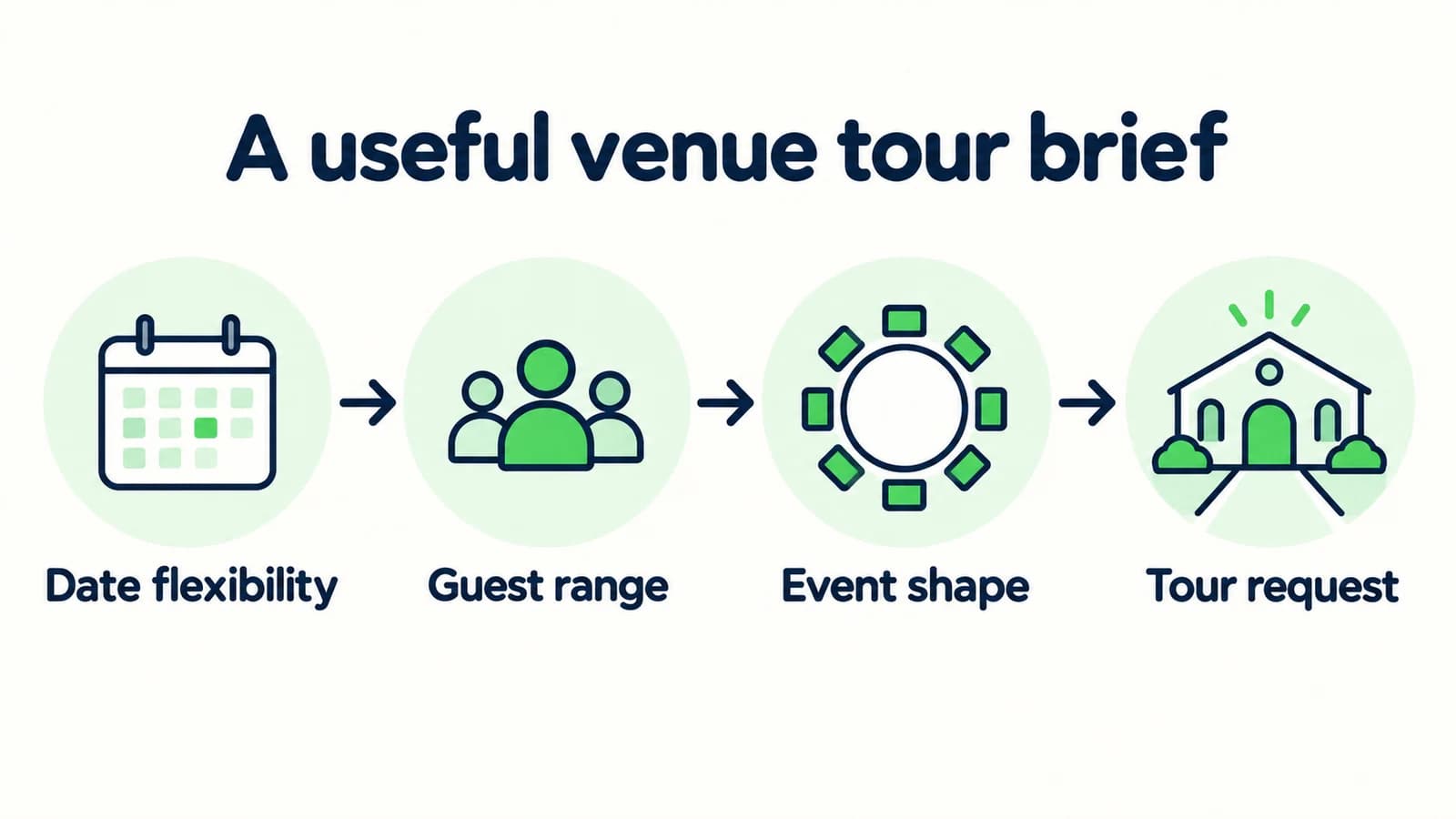
7 Question Groups for a Better-Prepared Tour
1. Ask about timing and flexibility together
Date flexibility is often more useful than a date alone. Ask whether the visitor has a fixed day, a preferred month or an open season. Preserve that distinction in the record so the host knows whether alternatives are welcome.
Visitor: “We would love to come and see the venue for a summer wedding.”
Front desk: “Of course. Do you have a particular date in mind, or are you exploring dates within the season?”
If the visitor already supplied the detail, do not ask again. Respond to the information: “I will note that you are flexible within the month.” Avoid implying the venue has accepted that month or has availability within it. The next sentence can explain the approved date-checking process.
Record the year when it is relevant and genuinely unclear. A month without a year can be ambiguous, especially near year-end. Clarify politely rather than defaulting to the next occurrence. Similarly, if the visitor says “next Saturday,” confirm the intended calendar date before passing along a tour request.
The host brief should contain both the preference and the uncertainty: “Summer preferred; exact date open; availability not checked.” This wording makes the status legible to someone who did not read the conversation.
2. Use a guest range to guide the space discussion
Ask for an approximate range, not a final seating plan. Early-stage visitors may not know the number, and a demanding question can make the conversation feel premature. Explain why the information helps: the host can focus on suitable spaces and layouts.
Front desk: “Roughly how many guests are you considering? An approximate range is fine and helps the host prepare the right spaces to show you.”
If the count is uncertain, note that. If the customer asks whether the venue can accommodate it, answer only from the approved capacity information for the relevant room and event arrangement. Do not combine capacities from different spaces or treat a maximum number as a recommendation for every layout.
Ask a follow-up only when it changes the tour. A ceremony and an evening reception may involve different attendance or space needs. The visitor does not need to complete a room-by-room specification in the first chat, but the host should know when a single count would misrepresent the event.
Use “guest range stated by visitor” in the note. Do not label it “validated capacity.” The AI front desk is collecting planning context, not approving an event layout or verifying that a particular arrangement is permitted.
3. Understand the event shape before discussing packages
A ceremony-only visit, a reception visit and a combined celebration can require different explanations. Ask which parts of the day the visitor hopes to hold at the venue. Let “still deciding” remain a valid answer.
Visitor: “We like the garden photos.”
Front desk: “Are you exploring the venue for the ceremony, the reception or both? If you are undecided, the host can explain the options during the tour.”
Do not turn a visual preference into a promise about use of a space. A garden photograph does not establish current availability, weather arrangements or what a package includes. Use the approved venue description and route questions that need staff confirmation.
Where the business has a published package guide, share it as supporting information, not a personalized quotation. Explain that the team confirms the applicable scope and terms. The visitor's choice of event shape is a starting point for that discussion, not acceptance of an offer.
For venues with accommodation, separate the event enquiry from room requirements. The hospitality front-desk overview covers the broader distinction between answering property questions and making a reservation. The tour brief can note an accommodation question without pretending that rooms have been checked or held.
4. Invite priorities without leading the visitor
Ask what the visitor most wants to see or understand. Their answer might concern an outdoor ceremony space, catering arrangements, step-free routes, a quiet preparation room or how the day flows. These details help the host tailor the visit without requiring a long preference survey.
Front desk: “Is there anything you especially want to see or discuss on the tour? I can include it in the note for the host.”
Do not suggest that a requested feature is available before checking the source. If the visitor mentions a specific requirement, answer the part you can substantiate and mark the remainder for review. “The published guide describes the ground-floor entrance; the team can confirm the route to the ceremony space” is clearer than an unsupported blanket assurance.
Keep practical needs in the visitor's own words where possible. Avoid translating them into diagnoses, categories or assumptions about ability. Do not ask why someone needs a particular feature unless that information is genuinely necessary and handled through the appropriate process.
The lead-qualification framework is useful here as a reminder that qualification means collecting relevant context, not extracting every possible field. A good tour question earns its place by helping the host prepare a better visit.
5. Ask who will attend in a neutral, optional way
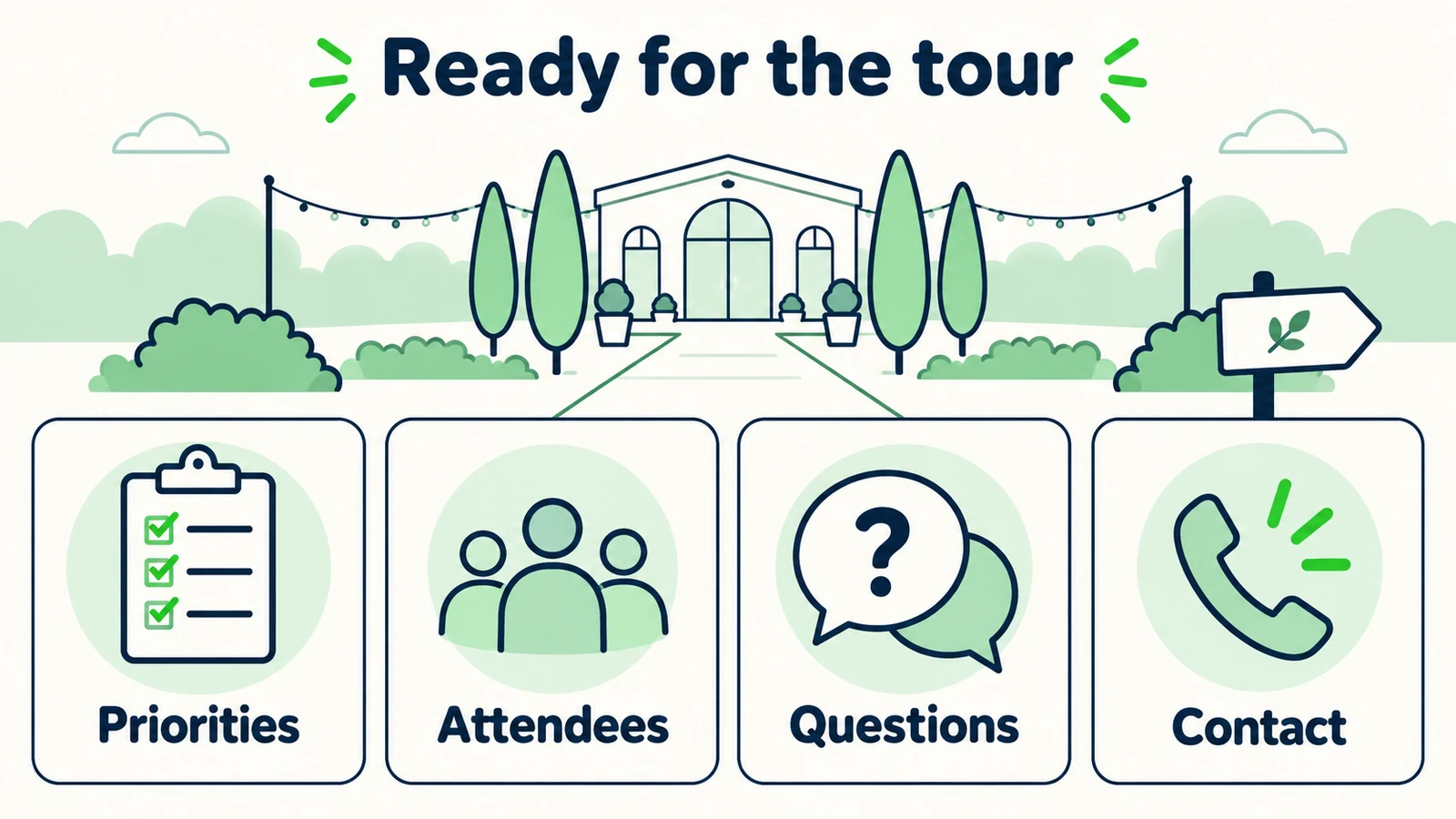
The host may need to know whether the visit involves the couple alone, relatives, a planner or another participant. Ask about attendees to prepare the tour, not to infer authority or financial responsibility.
Front desk: “Who is planning to join the tour? You can simply tell me the number of visitors or whether a planner will attend.”
Do not demand full names for every attendee in a general enquiry. If the venue needs names later for an approved access process, explain that at the appropriate point. Keep the first-contact record proportionate to the task.
If several people have different priorities, invite a short note: “Is there a question the group would like the host to prepare for?” Avoid describing one person as the decision-maker unless the customer explicitly says so and it is relevant. Wedding planning is often collaborative, and the front desk should not impose its own model of who matters.
A useful brief might say, “Two visitors expected; planner may join; they want to compare indoor and outdoor ceremony options.” It should not say, “Parents will approve the purchase,” unless that was a relevant customer statement—and even then a neutral description of the requested discussion is usually more useful.
6. Explain the tour request and booking-link boundary
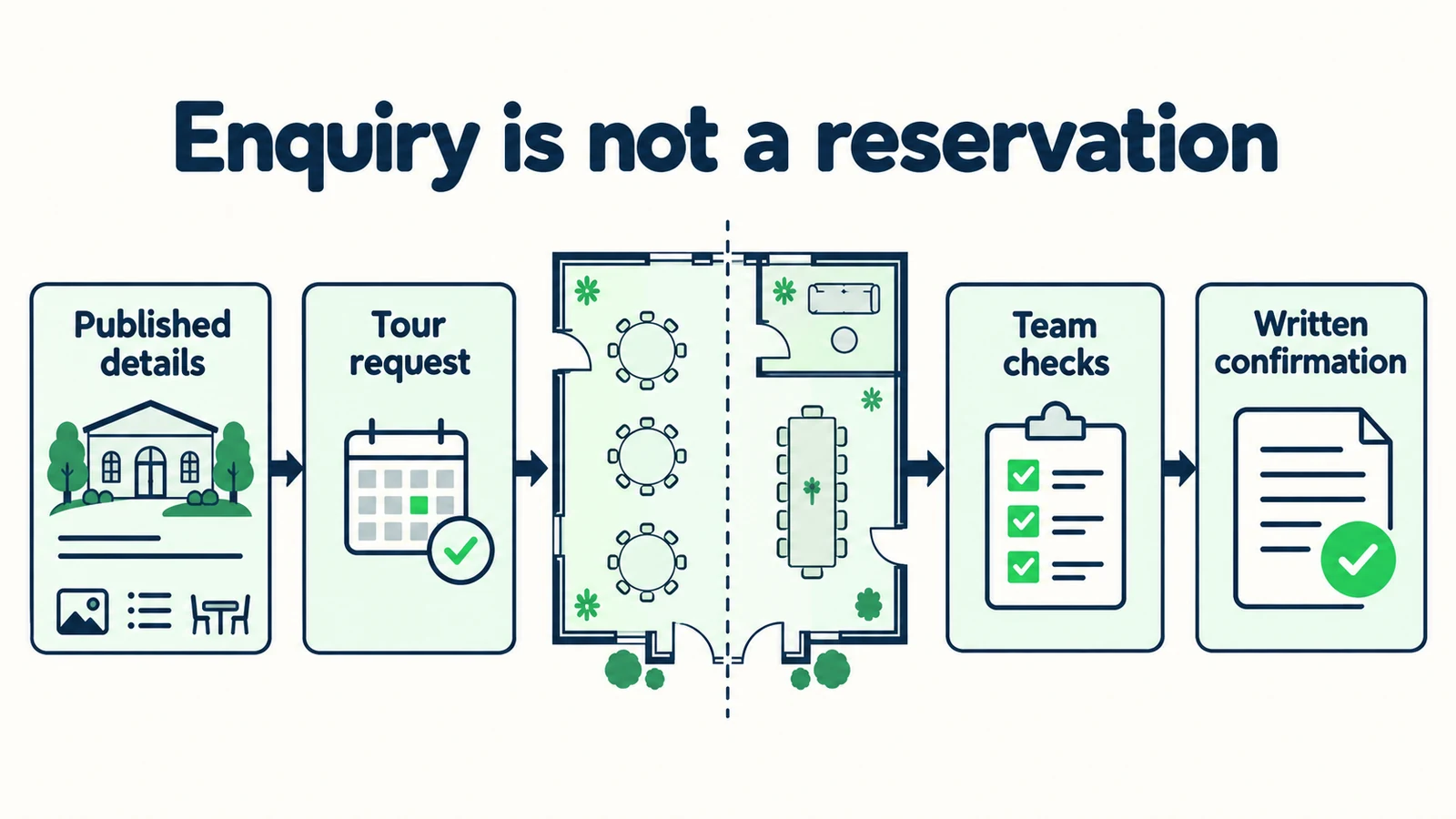
Once the relevant context is clear, give the approved next step. If the venue schedules tours through Calendly or Cal.com, the front desk can offer real open times and book the tour in the conversation; the visitor gets a calendar invite by email. If the venue uses another tour-booking page, share the link and explain that the visitor chooses and confirms through that process. If the team reviews tour requests manually, collect a preference and suitable contact method without naming it a confirmed appointment.
Front desk: “You can use the tour-booking page to choose from the options shown there. Your conversation here has not reserved a tour time or a wedding date.”
Use the final sentence only where it helps prevent a real misunderstanding; do not make every friendly reply sound defensive. The essential discipline is avoiding false confirmation. A customer saying “Friday works” still needs the actual booking process to complete.
For channels such as WhatsApp, the same meaning should remain intact. The venue messaging guide discusses channel use, but the channel itself does not change the authority of the front desk. Website, WhatsApp, Instagram DM and Messenger are ways to hold the conversation, not evidence that a calendar action occurred.
Test what happens when the link fails or the visitor cannot find a suitable option. Provide the approved contact route and carry the open question forward rather than inventing availability.
7. Confirm the brief without making new commitments
Summarize the useful details and invite a correction. Keep it short enough that the visitor can read it on a phone. Include the open questions and the status of the next step, not just the flattering parts of the enquiry.
Front desk: “I have noted a flexible autumn date, an approximate guest range still being discussed, and interest in both ceremony and reception spaces. You would especially like to see the indoor alternative. The next step is the tour-booking page; no date has been reserved in this chat.”
Only say that the team has received a note if that delivery is verified in your workflow. Otherwise describe what is being prepared or offer the appropriate route. The customer's acknowledgement of a summary does not prove staff have seen it.
An internal summary should distinguish “visitor stated,” “published information shared” and “team to confirm.” This separation prevents the host from repeating a tentative preference as an agreed arrangement. Use the lead-summary guide for the broader structure, then tailor it to your venue's tour preparation.
Do not ask the visitor to repeat everything after the summary. Ask only whether anything important is missing or incorrect. The point of the brief is to carry context forward, not to add another intake step.
Prepare your team for the next venue tour
Use Hyperleap AI to answer published venue questions and collect a clear, bounded tour enquiry.
Start for freeA Copy-Ready Tour Host Handoff
This template is a suggested team record, not a claim of automatic tour assignment or a native event-planning system. Use the fields that actually help your host and remove the rest.
| Field | Illustrative note |
|---|---|
| Visit purpose | Exploring ceremony and reception options |
| Event timing | Autumn preferred; exact date flexible |
| Guest range | Visitor has an approximate range; final count undecided |
| Spaces to discuss | Garden ceremony and indoor alternative |
| Practical priorities | Explain route between arrival and event spaces |
| Tour attendees | Couple; planner may attend |
| Open questions | Package inclusions and room requirements need staff discussion |
| Tour status | Booking link shared; completion not verified here |
| Contact preference | Visitor's chosen follow-up route, if supplied |
| Host next action | Review the open questions before the visit |
Notice what this record does not contain: a claimed available wedding date, a final quotation, a held room block or an inferred budget. It helps a person prepare without pretending that the preparation is the transaction.
Compare it with “Interested couple, please call.” The short message loses the reason for the visit and forces the host to restart. An excessively long transcript creates a different problem: the host must search for the meaningful details. The brief sits between those extremes while the original conversation remains available for context.
Measure usefulness through staff review. Could the host identify what to show? Were any important uncertainties hidden? Did the customer need to correct a supposed commitment? Record those observations in your own process before attaching conversion claims to the new question pack. Better preparation is observable; a revenue lift requires separate evidence.
Introduce the Pack Without Rebuilding Your Enquiry Process
Begin with the current venue guide and the approved tour route. Check that the source describes capacities and spaces with their conditions. Remove outdated package references and resolve conflicts before testing conversations. A prompt cannot choose the correct venue policy when the business has left it ambiguous.
Choose the questions your host actually uses. A small venue may only need date flexibility, guest range and a priority. A venue with several spaces may need event shape as well. Ask progressively rather than presenting the entire pack as a compulsory form.
Run sample conversations for different stages of planning: a visitor with a fixed date, a couple exploring a season, someone who only wants public information and a planner coordinating a group. Add a practical-access question and a visitor who asks whether the chat has reserved a date. All test details should be fictional.
Review the visible conversation, the link destination and the host note. The note should preserve uncertainty. The link should lead to the correct venue and process. The visible reply should answer ordinary questions before asking for unnecessary details. If one part fails, fix that part rather than simply adding more questions.
Hyperleap AI can provide the customer-facing conversation across supported channels and use approved venue sources. Your team still defines the host responsibilities, review times and confirmation process. The handoff guide is useful when the request needs a person before a tour can be arranged.
After launch, ask the host which questions improved the visit and which created busywork. Remove low-value fields. Add a question only when it changes preparation or prevents a recurring misunderstanding. A tour enquiry pack should feel lighter as it becomes more informed, not grow into a substitute for the event consultation.
Frequently Asked Questions
Which question should a wedding venue ask first?
Answer the visitor's actual question first, then ask the detail that changes the next step. Date flexibility is often useful, but it should not become a rigid opening when the visitor has already supplied it or is asking about a published venue feature. Keep the conversation responsive rather than forcing every enquiry through the same sequence.
Should we require an exact guest count before offering a tour?
An approximate range may be enough to prepare the visit. Record uncertainty rather than inventing precision. Your venue can set its own approved process, but the front desk should explain why a detail is needed and avoid treating an early estimate as a final event specification.
Can Hyperleap AI confirm available wedding dates?
Not wedding dates. Do not assume live venue availability from a conversation grounded in general documents: Hyperleap AI does not check or reserve event dates in your venue calendar. It can book venue tours in the chat when you schedule them through Calendly or Cal.com, but tour availability is not wedding-date availability. Use your venue's actual availability and confirmation process for event dates.
How should we ask about practical access needs?
Ask which concrete feature or route the visitor wants to understand, and answer from verified venue information. Avoid collecting diagnoses or private personal history in a general enquiry. Where details need checking, carry the practical question to the team without making a blanket assurance about suitability.
Is a tour enquiry the right time to ask about budget?
Only ask if the information genuinely helps the approved next step, and make the purpose clear. You can share published package information without demanding private financial details. Do not infer affordability or exclude a visitor based on assumptions. A person can discuss a personalized proposal through the venue's normal process.
How do we know whether the brief is useful?
Ask hosts whether they can prepare the right spaces and answers from it. Review repeated questions, missing context and any inaccurate commitments that needed correction. Those observations show whether the handoff is improving. They do not by themselves establish a change in bookings or revenue.
Make the Tour About the Venue, Not Repeating the Form
A good wedding venue tour enquiry leaves the host with a clear starting point and the visitor with a clear next step. It preserves date flexibility, approximate plans and unresolved questions rather than turning them into commitments.
Start with the details that change the visit. Ask naturally, let people remain undecided and summarize what they actually said. Keep tour requests, live availability and confirmed arrangements separate. When the team receives the brief, it should be able to prepare for a conversation rather than investigate what the AI promised.
The result you are working toward is straightforward: visitors spend the tour exploring what matters to them, while your host spends less time reconstructing the first enquiry.
Give every venue enquiry a useful next step
Build a Hyperleap AI front desk around your venue information, tour questions and approved booking path.
Start for freeIndustry Solutions
See how AI chatbots work for these industries:
Related Articles

Quote or Estimate? AI Front Desk Reply Templates
Use clear quote-versus-estimate replies, scope questions and approval checks so your AI front desk does not promise a price your team has not agreed.
Service-Area Answers: Scripts for Local Businesses
Give clear service-area answers with location questions, boundary scripts and a practical handoff record for local service enquiries.
Hotel Group Enquiry Scripts: From Question to Handoff
Use practical hotel group enquiry scripts to gather dates, room needs and event context, then hand a clear brief to your reservations team.
AI Chatbot for Wedding Venues: Handling Inquiries
See how an AI chatbot for wedding venues answers date, capacity, and pricing questions after hours, qualifies couples, and shares your tour link.