Guide
Conversational Marketing: A Small Business Guide (2026)
Conversational marketing replaces form-and-follow-up with a live dialogue. Learn the 4-step framework, channels, examples and how to start in a week.

Gopi Krishna Lakkepuram · Founder & CEO
· 18 min read
TL;DR: Conversational marketing means talking with a prospect, one to one and in real time, instead of asking them to fill in a form and wait. The visitor asks a question, gets an answer, and is guided to a next step in the same exchange. For a small business, the practical version is simple: an AI front desk answers on your website, WhatsApp, Instagram DM and Facebook Messenger at any hour, learns what the person needs, and passes the qualified lead to your team with the conversation attached.
What Is Conversational Marketing?
Conversational marketing is an approach to getting and converting customers through two-way dialogue rather than one-way messages. Instead of a banner that says "Submit your details and we'll call you back," the first thing a visitor meets is a conversation: "What are you looking for?" The business learns from the answers, and the visitor gets help while their interest is still high.
The term is generally credited to Drift, a B2B software company that built its marketing around live chat. The idea outgrew that origin. Three things separate it from ordinary marketing:
- It is two-way. The prospect speaks, the business listens and responds to what was said.
- It happens at the moment of interest. The conversation starts on the page, ad or profile that sparked the question, not days later by email.
- It ends in a next step. A booking, a quote request, a visit or a handoff to a person. A friendly chat that goes nowhere is just a cost.
This guide is about the strategy and the funnel. If you want the technology underneath (language models, retrieval, how an AI keeps its answers tied to your documents), read What Is Conversational AI?. If you want a setup walkthrough for a small team, see Conversational AI for Small Business. This post covers the decision before both of those: why you would market this way and how to design the conversation around your funnel.
Conversational Marketing vs. Forms and Follow-Up
The traditional funnel makes the prospect do the work and then makes them wait. A visitor reads a page, fills in a form, and receives a reply hours or days later, if at all. Conversational marketing collapses those steps into one exchange.
The gap matters because of timing. A Harvard Business Review study of lead response (Oldroyd, McElheran and Elkington, 2011) found that firms contacting a lead within five minutes were 21 times more likely to qualify it than firms that waited 30 minutes. That study looked at web-generated sales leads, so treat it as direction rather than a promise for your category. The direction is clear: interest cools fast.
| Forms and follow-up | Conversational marketing | |
|---|---|---|
| First contact | Visitor fills in fields, then waits | Visitor asks a question and gets an answer now |
| Who does the work | The visitor (fields, patience) | The business (listens, answers, asks) |
| Typical response time | Hours, or the next business day | Seconds |
| After hours | Form is stored, reply comes later | Conversation happens at the moment of interest |
| What you learn | Whatever fits in the form fields | The actual question, in the visitor's own words |
| Drop-off risk | High at the form and during the wait | Lower, because help starts immediately |
| Follow-up | Team reads a list of contacts | Team receives a lead with the conversation attached |
Forms do not disappear: a conversation can end by offering one. For the full comparison of forms, live chat and AI chat, read AI Chatbot vs Live Chat vs Contact Form.
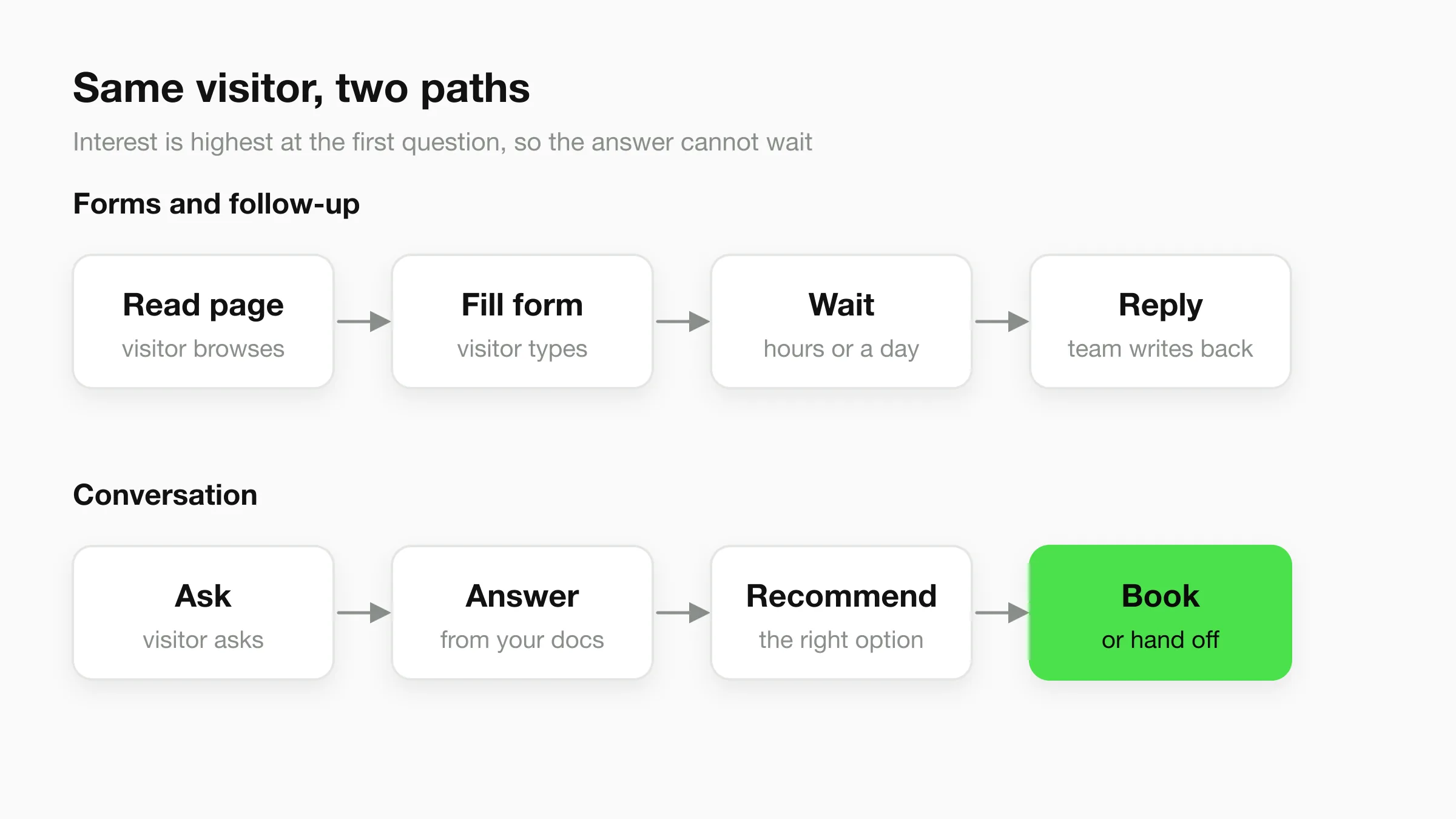
The Four-Step Framework: Engage, Understand, Recommend, Convert
Every good conversational funnel, whether run by a person or an AI, moves through the same four steps. Design each one deliberately and the conversation has a purpose. Skip one and it turns into either an interrogation or a chat about nothing.
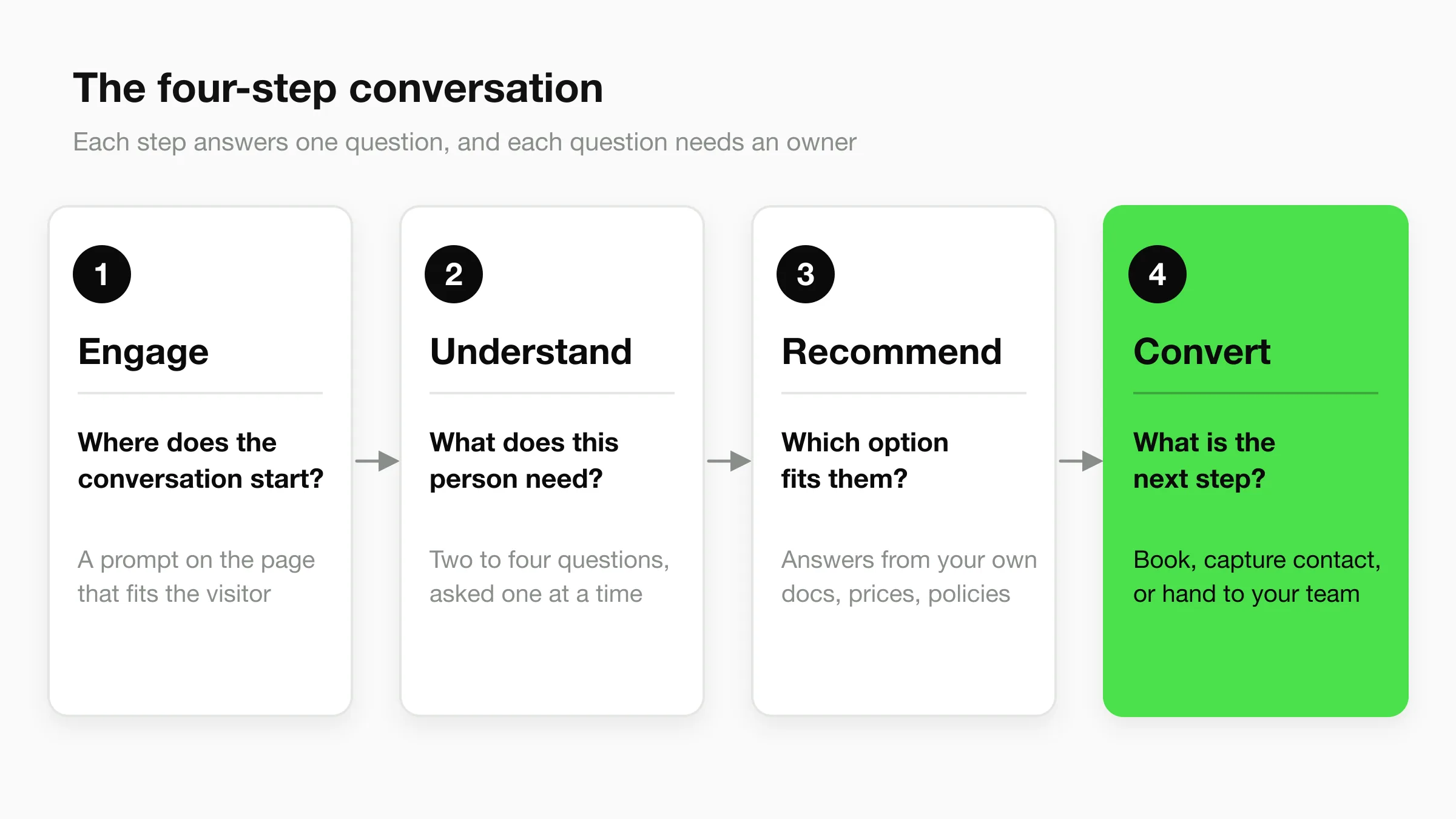
Step 1: Engage
Engagement means opening the conversation where the interest already exists, with a prompt that is specific to the page. A generic "Hi, how can I help?" on every page gets ignored. A prompt that matches the context works better.
- On a pricing page: "Want help choosing the right package?"
- On a service page for emergency repairs: "Is something leaking right now? Tell me what's happening."
- In an Instagram DM reply to a story: no prompt needed, because the person already started the conversation.
On WhatsApp, Instagram DM and Messenger, the visitor often opens the conversation. Your job is to make that easy: a click-to-chat link, a message button on an ad, a clear handle in the bio.
Step 2: Understand
Understanding means finding out what the person actually wants with as few questions as possible. Aim for two to four questions, asked one at a time, each one earning its place. A real-estate agency needs budget range and timeline. A salon needs the service and a preferred day. A home-services company needs the problem and the postcode.
The test for each question is simple: would your team use the answer? If not, drop the question. The detailed method for building this question list, including field design and handoff triggers, is in Lead Qualification Chatbot: Questions, Fields, and Handoff Rules. The point here is the role it plays in the funnel: understanding is what makes the next step relevant instead of generic.
Step 3: Recommend
Recommending means giving the visitor the specific thing that fits their situation: the right service, the right package, the right location, the right link. This is where a conversation beats a form most clearly. A form cannot tell a visitor "for a two-bedroom flat, the half-day clean is usually the right size, here is what it includes." A conversation can.
The recommendation has to come from your own material. An AI front desk answers from the documents you gave it (prices, service descriptions, policies, opening hours), so the recommendation matches what you actually offer. When the answer is not in the documents, it should say so and offer to bring in a person instead of guessing.
Step 4: Convert
Converting means turning the recommendation into a committed next step, inside the conversation where possible:
- Book it. Offer real open times and confirm the booking. With Hyperleap, native in-chat booking with Calendly or Cal.com is available on Pro and Max (in-chat booking needs Calendly Standard or higher). On Plus, the agent shares your booking link.
- Capture the contact. On the website, the chat can collect a name, email or phone with a short form. On WhatsApp, Instagram DM and Messenger, the platform already supplies the contact.
- Hand off to a person. For a complex quote, a high-value enquiry or an upset customer, route to your team with the full conversation. Human handoff and live takeover are on Pro and Max.
This is also where small businesses lose the thread: the conversation was good and nobody on the team saw it. Make sure every conversation's output lands where a person will look: a notification, a lead record, a CSV or Excel export.
Channels: Where Conversational Marketing Happens
A conversational strategy is not "put a chat bubble on the homepage." It is a decision about which channels your customers already use to reach you. For a small business, four channels cover most of it.
| Channel | Where the conversation starts | Best fit |
|---|---|---|
| Website chat | A visitor on a service, pricing or product page | Research-stage visitors, local services, e-commerce stores |
| Click-to-chat link, ad button, QR code, saved contact | Appointment-driven and relationship businesses | |
| Instagram DM | A reply to a story, a message from a profile, an ad | Salons, studios, boutiques, food and creator-led brands |
| Facebook Messenger | The business Page, ads, local discovery | Local services, community-driven and event businesses |
Hyperleap runs one AI agent across all four, so the knowledge base and tone are consistent wherever the customer shows up, and every conversation lands in one unified inbox in Studio. For a closer look at how the channels differ, see Channels. WhatsApp, Instagram and Messenger run on Meta's official Business APIs, and WhatsApp fees are paid directly to Meta, separately from your Hyperleap plan.
Start with the one channel where customers already write to you. If most enquiries arrive on WhatsApp, begin there. If traffic comes from search and ads, begin with the website.
Conversational Marketing Examples
The examples below are illustrative scenarios, not customer results. They show how the four steps look for different small businesses.
A dental practice (illustrative)
A visitor lands on the teeth-whitening page at 9:40 pm. The prompt asks whether they want to know what whitening involves and what it costs. The agent answers from the practice's own price sheet, asks whether they have had a check-up in the last year, and offers the two earliest consultation slots. The visitor books one. The front desk finds the booking and the conversation in the morning. For more on this vertical, see AI agents for dental practices.
A real-estate agency (illustrative)
A prospect messages the agency's Instagram account about a listing seen in a post. The agent confirms the listing details from the property sheet, asks about budget range and move-in timeline, and recommends two similar listings with photos and links. When the prospect asks to see one in person, the agent hands the conversation to the agent on duty with a summary. See AI agents for real estate.
A home-services company (illustrative)
Someone with a blocked drain finds the site on a Sunday evening. The agent asks what is happening, whether water is spilling now, and the postcode. It recommends the emergency call-out or a next-day appointment based on the answer, and it notifies the on-call team when the situation is urgent. See AI agents for home services.
A hospitality group (real deployment)
Jungle Lodges & Resorts, a multi-property hospitality group, deployed Hyperleap AI and picked up 3,300+ leads in 90 days, with 35% of inquiries arriving after hours when the team was not available to answer. Those are conversations that would otherwise have waited until morning or gone to another property. The Jungle Lodges case study has the details, and how hotels lose revenue to after-hours silence walks through the mechanics.
A Conversational Marketing Strategy in Five Decisions
A strategy is the set of choices that stop the conversation from drifting. These five decisions are the ones that matter for a small business.
1. Pick the high-intent entry points. List where visitors are closest to buying: pricing, booking, contact, service and location pages, plus your DM inbox. Put conversations there first. A prompt on every page dilutes the effort and annoys readers who are only browsing.
2. Define one outcome per conversation type. Pricing page: book a consultation. Product page: answer the question and send the link. Instagram DM: move to a booking. Each conversation type gets one primary next step, so the agent knows what it is steering toward.
3. Write down what the agent may and may not say. Decide which topics it answers from your documents, which it never answers (legal or medical advice, exact quotes that need an inspection), and when it hands off. Rules written in advance are easier to defend than judgment calls made by a model at 2 am.
4. Decide the handoff. Who receives a qualified lead, how fast should they reply, and where does the conversation history go? A great conversation followed by a slow human reply wastes the first half of the funnel.
5. Choose the tone once. Warm, direct, a little informal, whatever fits your brand, so the voice is the same on every channel.
Strategy test
Pick any page and answer four questions. What is the visitor trying to find out? What would a helpful person at your front desk say first? What is the one next step? Who on your team sees the result? A blank answer means the page is not ready.
How to Measure Conversational Marketing
Measure the funnel, not the chat. Chat volume is easy to count and tells you little. These metrics tell you whether the conversations are producing business.
| Metric | What it tells you | How to get it |
|---|---|---|
| Conversations started | How many visitors engage with a prompt | Studio inbox and conversation logs |
| Conversation to lead rate | Share of conversations that produce a contact or booking | Leads captured divided by conversations started |
| Time to first response | Whether you actually respond at the speed that matters | Near-instant with an AI agent; track your team's handoff reply time separately |
| After-hours share | How much demand your old process was missing | Timestamps on conversations outside your opening hours |
| Handoff rate | How often the AI needs a person | Handoff events in the inbox |
| Source and campaign | Which ads, pages or links drive useful conversations | Link tracking on Pro and Max |
| Lead to customer | Whether conversational leads actually close | Your CRM or a simple spreadsheet export |
Two practical notes. First, set a baseline before you start: count last month's enquiries, how many got a reply within an hour, and how many became customers. Second, read a sample of conversations every week. The questions visitors ask are direct market research. A cluster of questions about a service you do not list is a product idea. A cluster of "do you do X?" with no clear answer on your site is a content gap.
Hyperleap's Studio shows the conversation log, including which attached sources an answer drew on, so you can check what the agent said and fix the source when an answer is off. Leads export as CSV or Excel for your own reporting, and webhooks (Pro and Max) can send leads and bookings to your own systems.
How to Start in One Week
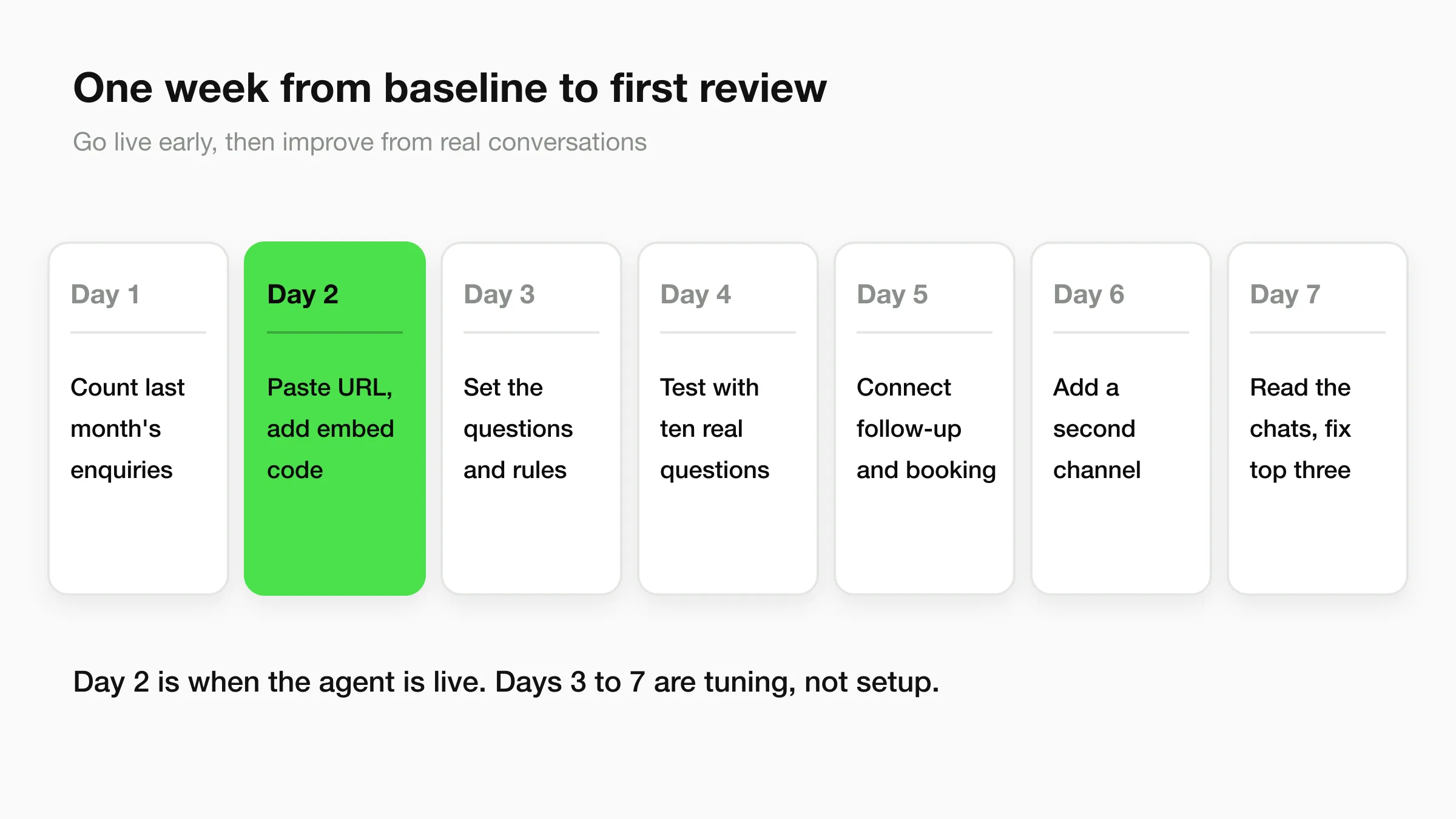
Hyperleap is live in under 5 minutes on the quick-start path: paste your website URL, Studio builds a starting agent, and the last step is one script tag. The week below is tuning, not setup.
Day 1: Baseline and pick the page. Count last month's enquiries and your average reply time. Choose the one page or channel with the highest intent.
Day 2: Go live. Paste your URL into Studio, review the generated agent, and add the embed code to your site. Add your pricing sheet, service list, policies and opening hours as sources.
Day 3: Set the conversation. Write the two to four questions the agent should ask, the one next step, and the tone. Add the handoff rule for anything it should not decide alone.
Day 4: Test like a customer. Ask the ten questions your front desk hears most. Ask three it should not answer. Check each reply against your sources and fix gaps by editing the source, not by patching the answer.
Day 5: Connect the follow-up. Decide who is notified, and set up booking if you are on Pro or Max. Make sure a person sees every lead within your reply target.
Day 6: Add a second entry point. Turn on WhatsApp, Instagram DM or Messenger if your customers use them. The same agent and knowledge base apply.
Day 7: Read and adjust. Read a full set of conversations. Fix the three most common failures. Compare against your baseline in a month, not a day.
Where Conversational Marketing Falls Short
It is the wrong tool for some jobs, and saying so protects your results.
- Long, complex sales. A six-figure project needs a human relationship. The conversation captures the basics, then hands off.
- Sensitive topics. The AI does not give medical or legal advice. It routes those questions to your team.
- Thin source material. An agent answers only from what you give it. Write down prices and policies first.
- No one to follow up. A captured lead nobody calls is worse than a form, because the visitor expected a human to continue.
- Over-prompting. Pop-ups on every page reduce trust. Fewer, more relevant prompts work better.
How Hyperleap Runs the Conversation for You
Hyperleap AI is the AI front desk for small businesses. It runs the four-step conversation on your website, WhatsApp, Instagram DM and Facebook Messenger, around the clock, in 100+ languages, answering from your own documents and passing qualified leads to your team.
What that means for each step:
- Engage: one agent answers on all four channels. Your knowledge base and tone stay consistent.
- Understand: you set the questions. The agent asks them naturally and records the answers with the lead.
- Recommend: answers come from your documents, and on Pro and Max the agent can share photos, documents and videos from your assets as cards.
- Convert: native booking with Calendly and Cal.com on Pro and Max, human handoff and live takeover on Pro and Max, CSV export of leads.
Plans start at $40 a month (Plus), with Pro at $100 and Max at $200, all with a 7-day free trial. The plan details are on the pricing page. For the lead-generation view of this strategy, see chatbot lead generation, and for the front-desk view, see AI front desk.
Put a conversation where your forms are
Paste your website URL and Hyperleap builds a starting agent in under 5 minutes. Tune it for a week, then let it answer while your team sleeps.
Start for freeFrequently Asked Questions
What is conversational marketing?
Conversational marketing is a way of attracting and converting customers through real-time, one-to-one dialogue instead of forms and delayed follow-up. The business answers the visitor's question straight away, learns what they need, recommends the right option, and guides them to a next step such as a booking or a call from your team.
What is the difference between conversational marketing and a chatbot?
A chatbot is a tool. Conversational marketing is the strategy the tool serves. The strategy covers where conversations start, what questions are asked, what the recommendation is, and who follows up. A chatbot with no strategy answers questions and produces nothing. For tactics specific to chat, see AI chatbot vs live chat vs contact form.
What are examples of conversational marketing?
Common examples include an AI agent answering pricing questions on a website at night, a WhatsApp conversation that ends in a booked appointment, an Instagram DM thread that recommends a product and shares a link, and a Messenger chat that routes a quote request to a salesperson. Each example above shows the pattern for a different small business.
How is conversational marketing measured?
Measure the funnel: conversations started, conversation-to-lead rate, time to first response, after-hours share, handoff rate, source and campaign, and lead-to-customer rate. Set a baseline before you start so you can compare. Chat volume alone is not a result.
Does conversational marketing replace email and forms?
No. It replaces the first, slowest step: the form and the wait. Email still matters for confirmations and relationship follow-up, and a short form still suits visitors who prefer it. Hyperleap's channels are Website, WhatsApp, Instagram DM and Facebook Messenger. An email channel is on the roadmap.
How much does conversational marketing cost for a small business?
Hyperleap starts at $40 a month on Plus, $100 on Pro and $200 on Max, with a 7-day free trial. Your own time to write sources, set questions and review conversations is the larger cost. Customers pay Meta's WhatsApp fees directly, separately from the plan.
Do I need a technical team to start?
No. Paste your website URL into Studio, review the starting agent, and add one script tag to your site, which takes under 5 minutes on the quick-start path. The tuning work is writing down your prices, policies and rules, which a non-technical owner or office manager can do.
Data Sources
- Oldroyd, J. B., McElheran, K., and Elkington, D., The Short Life of Online Sales Leads, Harvard Business Review (March 2011)
- Hyperleap AI, Jungle Lodges case study (first-party deployment data: 3,300+ leads in 90 days, 35% of inquiries after hours)
See how your own funnel would run as a conversation
Start with one page or one channel. Hyperleap handles the first conversation and hands the qualified lead to your team.
Start for freeIndustry Solutions
See how AI chatbots work for these industries:
Related Articles
View all
Guide18 min read
Chatbot Marketing: A 6-Step Playbook for Small Business
Chatbot marketing for small businesses: turn ad, Instagram and landing-page traffic into qualified, booked conversations in six steps.
Guide17 min read
Multilingual Hotel Chat: A Guest-Question Test Kit
Test English and Spanish hotel enquiries against the same approved facts, with arrival, policy, access and staff-handoff cases your team can review.
Guide14 min read
Chatbot Persona: A Worksheet for Tone, Name and Voice
Design a chatbot persona in one worksheet: role, name, tone dials, word lists, 'I don't know' lines, handoff and language rules, with four example cards.
Guide17 min read
Proactive Customer Service: 12 Examples for Small Business
Proactive customer service means answering before customers ask. See 12 examples with the channel and owner for each, plus how to measure it.